
theIAShub
30 Jul, 2025
Article List
- National Horticulture Mission (NHM): Objectives, Features, and Progress in India
- India-Japan Relations: Key Projects, Bullet Train Updates & Strategic Cooperation
- Tsunami Disaster: Causes, Impact, Warning Systems & Safety Measures
- Barbados Threadsnake: World's Smallest Snake Rediscovered After 20 Years
- Pralay Missile: India’s Advanced Tactical Quasi-Ballistic Missile
- International Court of Justice (ICJ) – Role, Functions & Latest Advisory on Climate Change
- PM Ekta Malls – Boosting ODOP, GI Products & Local Handicrafts Across India
- Mera Gaon Mera Dharohar (MGMD) – Cultural Mapping of Indian Villages
- Sundarbans Tiger Reserve – Expansion, Location, Flora & Fauna
- Puga Valley Hot Springs Study – New Insights into Origin of Life on Earth
1. National Horticulture Mission (NHM): Objectives, Features, and Progress in India
Context
- Recently, the Government informed Parliament about the progress made in the Horticulture Sector and provided Data for the same.
About the News
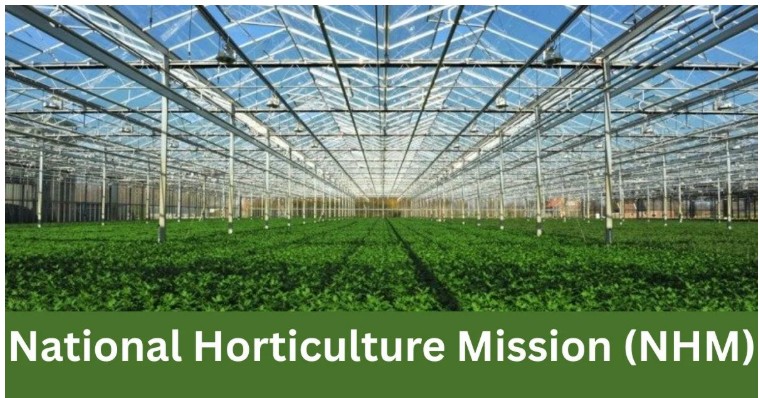
- National Horticulture Mission, a sub-scheme of Mission for Integrated Development of Horticulture (MIDH) is being implemented by the Ministry of Agriculture & Farmers Welfare since 2014 for the holistic development of horticulture in the country.
- Since the inception of MIDH scheme i.e. from 2014-15 to July, 2025 (as on date), an additional area of 15.66 Lakhs hectare has been covered under horticulture crops.
- All horticulture crops irrespective of their varieties are covered under MIDH scheme.
Other Components
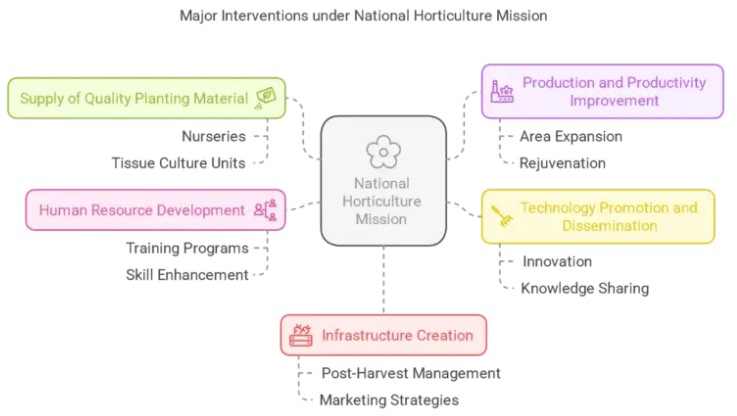
- During the last five years, a total of 55748 Post Harvest Management infrastructures including Cold storage/C.A. storage, Pack houses, Ripening chamber, Reefer vehicles, Primary / Mobile/ Minimal processing unit, preservation unit and Food processing etc. have been setup.
- A total of 11140 marketing infrastructures including Static/mobile vending cart/platform, retail outlets, Rural and primary markets/ Apni Mandi/Direct markets, wholesale and terminal markets etc. have been setup under MIDH scheme.
About National Horticulture Mission
- National Horticulture Mission(NHM) which launched in 2005-06 as the National Horticulture Board, is centrally sponsored scheme to promote complete growth and development in the horticulture sector at India.
- It has primarily focused on increasing production and productivity of various horticultural crops like fruit, vegetables, spices, flowers, medicinal plants, and plantation crops.
- The mission emphasizes adoption of modern technology, improvement of post-harvest management, and establishment of marketing systems that minimize wastage and ensure fair prices to farmers.
- It also provides capacity-building programs, development of nurseries, and establishing infrastructures for cold storage, packaging, and processing. By promoting cluster-based development with improved planting materials, the mission aims to improve domestic consumption and exports.
Features of National Horticulture Mission
The National Horticulture Mission is a central undertaking that pays a significant dollar on the comprehensive development of horticulture in India. Below are some salient features of the mission:
- Promotion of horticultural crops: It is the intensification promotion of fruits, vegetables, flowers, spices, medicinal plants, and aromatic plants with a view to diversifying agriculture for income generation among farmers.
- Areas and Productivity Extension: It involves adopting high-yielding varieties, improved planting material, and modern cultivation techniques so as to expand the area under horticulture and enhance productivity.
- Post-Harvest Management and Value Addition: It supports infrastructure establishment like cold storage, pack houses, and processing units to minimize post-harvest losses and improve the value chain of horticultural produce.
- Capacity Building and Human Resource Development: Training and skill development programs include induction for farmers, entrepreneurs, and field workers to adopt best practices and modern technologies.
- Technology Promotion: It also provides the performance of micro-irrigation, protection cultivation, integrated pest management, and organic farming, which is a great contribution toward the sustainability and efficiency of the horticultural practice.
- Market Support Development: Facilities to create marketing infrastructures are given for wholesale markets, rural markets, and e-marketing platforms for better price realization for farmers.
- Cluster-Based Development: Under this, all programs are area-specific crops encouraging an efficient use of resources and thinking to develop a targeted approach.
- Financial Assistance: The mission will give financial assistance and subsidies to the farmers and entrepreneurs for different components of horticulture development.
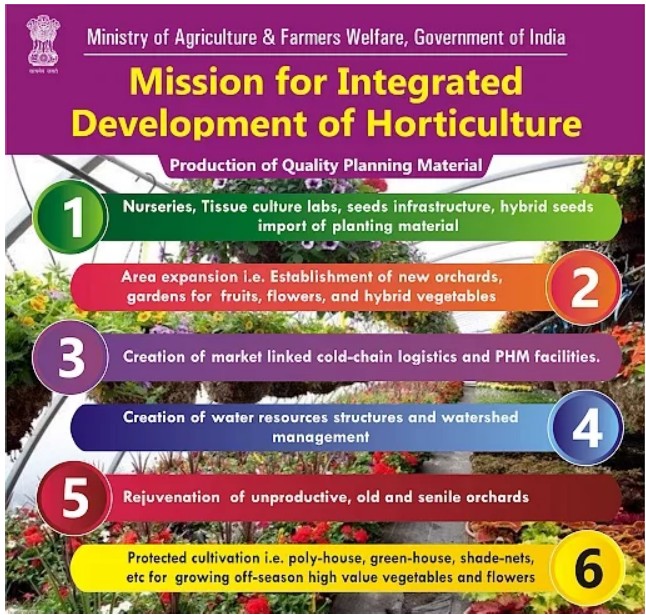
Objectives of the Mission
- Promote Horticulture: The mission aims to promote the holistic growth of the horticulture sector, including bamboo and coconut, through regionally differentiated strategies, including research, technology promotion, extension, post-harvest management, processing, and marketing.
- Encourage Farmer Associations: To bring about economies of scale and encourage farmers to join farmer groups such as Farmer Producer Organizations (FPOs).
- Enhance Income: Increase the output of horticulture, increase farmers’ incomes, and improve nutritional security.
- Boost Farm Output: Increase output through the use of high-quality seed, planting material, and water-saving microirrigation techniques.
- Skill Development: Encourage young people in rural areas to develop their skills and find work in horticulture and post-harvest management, particularly in the cold chain industry.
Status of Horticulture In India
- Contribution GDP: The horticulture sector constituting 18% of the area, contributes about 33% of the gross value to the agricultural GDP significantly boosting the Indian economy.
- The sector is being considered as a driver of economic growth and is gradually turning into an organized industry linked to seed trading, value addition, and exports.
- Employment: Horticulture provides rural employment, diversifies farm activities, and enhances farmers’ income.
- High Production: India is currently producing about 320.48 million tones of horticulture produce which has surpassed the food grain production, that too from a much less area (25.66 million Ha. for horticulture against 127.6 M. ha. for food grains)
- High productivity: Horticulture crops have high productivity compared to food grains of Kharif and Rabi Crops (12.49 tones/ha against 2.23 tones/ha.)
- Improved India’s Position: India became the world leader in producing various fruits like mango, banana, guava, papaya etc, vegetables, spices, coconut, and cashew nuts.
Way Forward
- With advanced technological interventions, strengthening cold chain infrastructure, and popularizing value-added products as pivots, the National Horticulture Mission shall extend into new fields. Development of market linkages, promotion of exports, and development of climate-resilient farming will ensure sustainable development. Training and financial backing to farmers will augment their productivity and income further, thus increasing the competitiveness of Indian horticulture on the world stage.
2. India-Japan Relations: Key Projects, Bullet Train Updates & Strategic Cooperation
Context
- Ahead of Prime Minister Narendra Modi's visit to Japan next month, Foreign Secretary Vikram Misri met with visiting Japanese Vice-Minister Takehiro Funakoshi in Delhi on Monday to discuss strengthening ties, upcoming projects and smoothing out supply chain issues.
- Both sides are understood to have discussed the latest developments in the Shinkansen Bullet train project to connect Ahmedabad (Sabarmati) and Mumbai, including Japan's decision, reported by the Japan Times earlier this year, to gift India two of its latest E-10 Shinkansen trains, which will be simultaneously introduced in Japan and India.

India And Japan Relations
- Historical-Exchange between Japan and India is said to have begun in the 6th century when Buddhism was introduced to Japan. Indian culture, filtered through Buddhism, has had a great impact on Japanese culture, and this is the source of the Japanese people's sense of closeness to India.
- Prominent Indians linked to Japan include Swami Vivekananda, Rabindranath Tagore, JRD Tata, Netaji Subhash Chandra Bose, Rash Behari Bose, and Justice Radha Binod Pal.
- Symbolic gestures such as Prime Minister Nehru’s elephant donation to Tokyo’s Ueno Zoo in 1949 reflect enduring friendship.
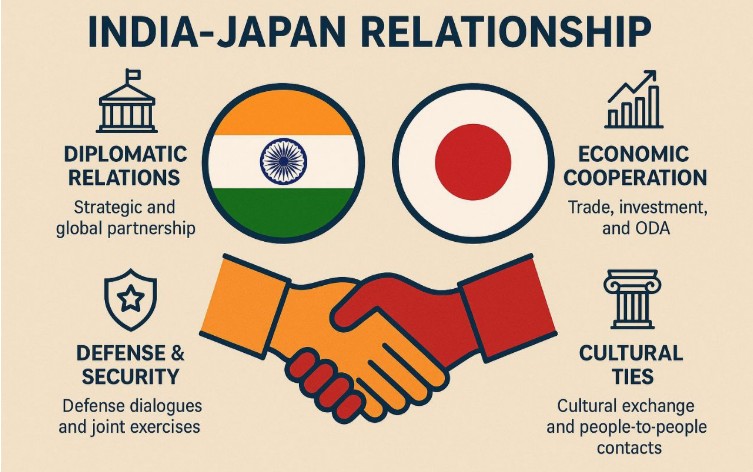
- Investment & ODA: Japan remains a major source of foreign direct investment (FDI) and Official Development Assistance (ODA) for India, funding critical infrastructure projects (e.g., metros, roads, bridges, smart cities).
Defence Cooperation
- India-Japan Defense and Security partnership forms an integral pillar of bilateral ties.
- India-Japan defense exchanges have gained strength in recent years due to growing convergence on strategic matters and its significance is growing from the common outlook on issues of peace, security and stability of the Indo-Pacific Region.
- A Joint Declaration on Security Cooperation (JDSC) between India and Japan was signed in 2008.
- JIMEX is a bilateral maritime exercise between the Indian Navy and the Japan Maritime Self-Defense Force (JMSDF).
Maritime Security
- Strong convergence on ensuring freedom of navigation and adherence to international law in the Indo-Pacific, particularly in response to challenges in the South and East China Seas.
- Information sharing and maritime domain awareness cooperation are deepening.
Economic and Commercial Cooperation
- India-Japan Comprehensive Economic Partnership (CEPA) Agreement came into effect from 1 August 2011.
- The Agreement covers not only trade in goods but also services, movement of natural persons, investments, intellectual property rights, custom procedures and other trade related issues.
- Japanʼs bilateral trade with India totaled US$ 22.85 billion during FY 2023-24.
- Exports from Japan to India during this period were US$ 17.69 billion and imports were US$ 5.15 billion.
- Today, India ranks 18th in Japanʼs total trade with 1.4% share while Japan ranks 17th in Indiaʼs total trade with 2.1% share.
- Collaboration is accelerating in renewable energy (solar, wind), green hydrogen, ammonia, and carbon capture. Japan's expertise and finance are vital for India's energy transition goals.
- Cooperation in 5G, telecom security, Al, and cybersecurity is expanding, with joint working groups driving collaboration.
Challenges in Relations
- Pace of major infrastructure projects (like the bullet train), differences in approach to the Russia-Ukraine war (though managed pragmatically), navigating complex regional geopolitics, and enhancing trade volumes relative to potential.
Way Forward
- Immense scope for collaboration in emerging technologies (Al, quantum, robotics), defense cо-development/manufacturing, healthcare, aging society solutions, climate tech, and deepening economic integration within the Indo-Pacific framework.
- Recent developments clearly indicate that the IndiaJapan partnership is on an upward trajectory, characterized by increasing strategic trust, robust economic engagement, and expanding security cooperation.
- Both nations recognize each other as indispensable partners in ensuring a stable, secure, and prosperous Indo-Pacific region.
- While challenges exist, the shared vision, growing convergences, and sustained high-level engagement provide a strong foundation for the relationship to reach even greater heights in the coming years, making it a cornerstone of the evolving regional order.
3. Tsunami Disaster: Causes, Impact, Warning Systems & Safety Measures
Context
- An 8.8 magnitude earthquake struck Russia triggering a tsunami that impacted Russia, Japan, and issued warnings as Kamchatka Peninsula as far as Hawaii and New Zealand.
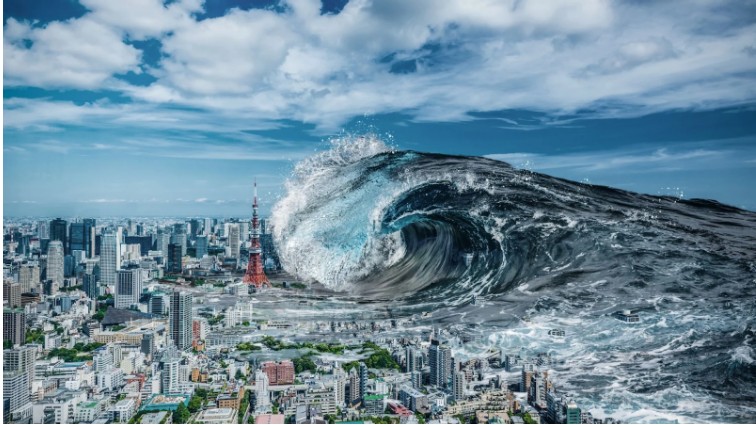
About Tsunami: What is it?
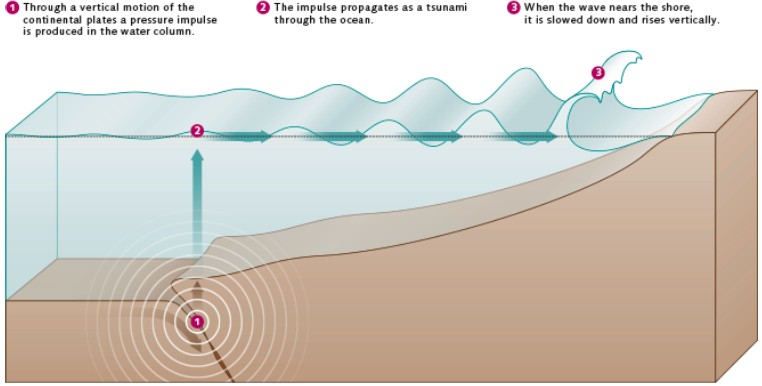
- Tsunamis consist of huge ocean waves formed because of disturbances underwater, such as earthquakes, volcanic eruptions, or landslides.
- Travelling at high speeds across vast distances, these waves grow in height as they approach shorelines, unleashing huge destruction, inundation, and loss of human life. They are natural, forceful, and unpredictable occurrences.
Other Facets
- A tsunami signifies a natural calamity where a sequence of large ocean waves are generated, ordinarily having been occasioned by some submarine disturbance such as an earthquake, volcanic eruption, or landslide.
- These disturbances displace a huge quantity of water, disallowing waves to travel at speeds of more than 800 kilometers per hour in the open ocean.
- In the deep ocean, the tsunami waves usually go unnoticed due to their very low wave heights; they get HUGE somewhere along the coastline and hit to cause devastation.
Characteristics of a Tsunami
- Cause and Origin:
- An underwater earthquake, volcanism, landslide, or meteorite impact in the ocean can move huge volumes of water and cause tsunamis.
- High Speed:
- The speed of tsunami waves in the deep sea is more than 800 kilometers per hour (500 miles per hour), almost like one of the fastest jet planes.
- Long Wavelength:
- One special characteristic of tsunami waves is that they have very long wavelengths. They can vary from about 100 kilometers to 500 kilometers, whereas normal ocean waves measure very few meters of wavelength.
- Low Wave Height in Deep Water:
- In the open ocean, tsunamis generally remain unnoticed with wave heights less than one meter.
- Wave Amplification Near Shore:
- When the tsunami waves enter these territories of shallow waters near coasts, their velocity is decreased, yet their wave height increases, sometimes even more than 30 meters (100 feet).
- Multiple Waves:
- Most of the time, a tsunami will consist of a series of waves with the first wave not always being the largest or the most destructive.
- Variable Timing:
- Time lag between successive waves may be from just a few minutes to many hours-a factor that adds to the unpredictability.
- Global Reach:
- Across entire ocean basins, tsunamis travel and affect coasts that are away from the original disturbance.
- Immense Destructive Power:
- The combined energy of tsunami waves can cause widespread devastation, flooding, and erosion upon landfall.
- Warning Signs:
- Receding ocean water, unusual sounds, and ground shaking near coastlines are natural warning signs of an impending
Causes of Tsunami
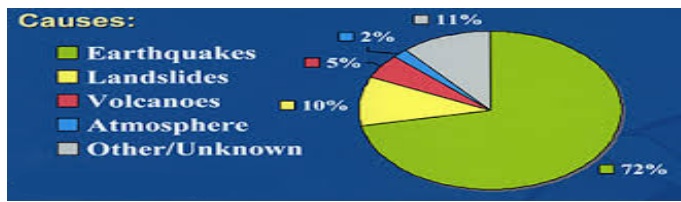
- Underwater Earthquakes:
- The most common cause for tsunami is underwater earthquake occuring at tectonic plate boundaries. With the plates shifting suddenly, huge amounts of water are displaced and tsunami waves begin.
- Volcanic Eruptions:
- Explosive volcanoes, especially those arising underwater or near shorelines, can cause the displacement of water and consequently tsunamis. Examples include eruptions that cause the collapse of volcanic islands.
- Landslides:
- Huge landslides under the sea or along the coast, often triggered by earthquakes, can displace large quantities of water and cause tsunamis.
Impact of TSUNAMI
- Human Casualties:
- Tsunamis cause extreme calamities; thousands die in the affected areas due to a sudden and colossal rise of the sea.
- Destruction of Infrastructure:
- Coastal regions witness considerable tearing to homes and buildings and to roads and bridges, so much so that it may take many years to rebuild the damaged infrastructure.
- Economic Issues:
- Property damage and loss of life, along with disruption in business and tourism, pose enormous economic problems to the affected communities and nations.
- Environmental Damage:
- Tsunamis bring about severe erosion, contamination of fresh water supplies, destruction of coral reefs, and the loss of coastal ecosystems, including mangroves and wetlands.Floods:
- Seawater inundation causes severe flooding throughout the vicinity, contaminating drinking water and agricultural land, making them unsuitable for cultivation.
- Health Issues:
- Usually, tsunamis lead to health-related issues such as waterborne diseases, injuries, and psychological trauma to the victims.
- Tsunamis bring about severe erosion, contamination of fresh water supplies, destruction of coral reefs, and the loss of coastal ecosystems, including mangroves and wetlands.Floods:
TSUNAMI Warning system around the World
- Pacific Tsunami Warning System
- Region Covered: Pacific Ocean, including North and South America, Asia, and Oceania.
- Managed By: Intergovernmental Oceanographic Commission (IOC) of UNESCO.
- Features: A network of seismic stations and DART (Deep-ocean Assessment and Reporting of Tsunamis) buoys to monitor underwater disturbances.
Indian Ocean Tsunami Warning and Mitigation System
- Region Covered: Indian Ocean countries such as India, Indonesia, Sri Lanka, and Thailand.
- Established After: The 2004 Indian Ocean tsunami.
- Features: Regional centers in India, Indonesia, and Australia providing alerts.
Japan Meteorological Agency
- Region Covered: Japan and nearby coastal areas.
- Features: Highly advanced system that issues warnings within minutes of detecting seismic activity.
Way Forward
- Global partnership in advanced early warning systems, public education, and preparedness are necessary to enhance tsunamis’ resilience. Making the coastal infrastructure resilient to tsunamis, restoring natural barriers like mangroves, and putting in place evacuation plans are ways to reduce hazards associated with tsunamis.
- With further research and awareness creation featuring international collaboration, communities can be better prepared for timely response and post-tsunami recovery.
4. Barbados Threadsnake: World's Smallest Snake Rediscovered After 20 Years
Context
- Recently, scientists rediscovered the Barbados threadsnake, the world's smallest snake, after it had remained unseen for nearly two decades.

About Barbados Threadsnake
- Discovered by herpetologist S. Blair Hedges in 2008; first living specimen found in 2006.
- Scientific name: Tetracheilostoma carlae (also termed as Leptotyphlops carlae).
- Belongs to: Family: Leptotyphlopidae and Genus: Tracheostoma.
Physical Characteristics
- Length: Up to 10 cm (approx. 4 inches).
- Weight: Around 0.6 grams - comparable to a spaghetti noodle.
- Non-venomous and harmless to humans.
- Coloration: Brown body with two pale yellow stripes on either side.
- Blind and burrowing by nature.
- Oviparous: Lays a single egg; hatchlings are about half the adult's size.
- Uses pheromones to communicate through soil, air, and water.
Habitat
- Endemic to the Caribbean island of Barbados.
- Conservation: Critically Endangered: Listed on the IUCN Red List.
5. Pralay Missile: India’s Advanced Tactical Quasi-Ballistic Missile
Context
- Recently, in a major boost to India's tactical missile capabilities, the Defence Research and Development Organisation (DRDO) successfully conducted two consecutive test flights of the Pralay missile from Dr. A.P.J. Abdul Kalam Island off the Odisha coast.
About Pralay Missile
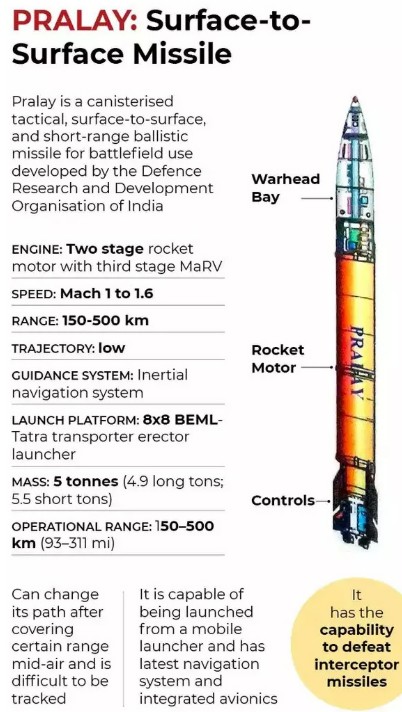
- An indigenously developed quasi-ballistic, surface-to-surface missile.
- Designed for tactical precision strikes using advanced guidance and navigation systems.
- Developed by: Research Centre Imarat (RCI), DRDO, in collaboration with Bharat Dynamics Limited (BDL), Bharat Electronics Limited (BEL) and Multiple Indian industries and MSMEs.
Technical Specifications
- Type: Solid-fuel, quasi-ballistic missile.
- Range: Estimated between 150-500+ km. Payload: Capable of carrying conventional warheads & payload capacity: 500-1,000 kg.
- Launch Platform: Can be launched from mobile road-based launchers.
Navigation
- It features advanced inertial and satellite-based guidance, with a Circular Error Probable (CEP) of less than 10 meters.
Speed
- Achieves terminal velocities up to Mach 6.1.
Flight Capability
- Follows a quasi-ballistic trajectory and can change direction mid-flight after covering a certain distance.
Target Engagement
- Designed to destroy: Radar installations, Enemy logistics hubs, Airbases and command centers and other high-value static targets.
6. International Court of Justice (ICJ) – Role, Functions & Latest Advisory on Climate Change
Context
- Recently, the International Court of Justice (ICJ) delivered a much-anticipated advisory opinion outlining nations' duties to reduce greenhouse gas emissions and the legal implications of failing to act.
Key Highlights
- Reaffirmed the significance of the UNFCCC, Kyoto Protocol, and Paris Agreement as a unified climate regime.
- Rejected the idea of sidelining older treaties in favor of only the Paris Agreement.
- Recognized Annex I and II obligations, reinforcing additional responsibilities of developed countries.
- Endorsed the CBDR-RC principle (Common But Differentiated Responsibilities and Respective Capabilities) as the core guiding principle across treaties and international environmental law.
- Interpreted 1.5°C as the de facto global temperature goal, overriding the original "well below 2°C" target of the Paris Agreement.

About ICJ
- The ICJ is the main judicial organ of the United Nations and is also known as the World Court.
Establishment
- Created in June 1945 under the UN Charter and became operational in April 1946.
Headquarters
- The Hague, Netherlands(only UN principal organ not headquartered in New York, USA)
Official Language
- French and English.
Composition
- Judges: 15 judges from different countries. Elected to 9-year terms by the UN General Assembly and Security Council.
- Judges act independently and do not represent their countries.
Ad Hoc Judges
- If a party to a case has no judge of its nationality on the bench, it may appoint a judge ad hoc for that specific case.
Registry
- The Court is supported by the Registry, its independent and permanent administrative secretariat (distinct from the UN Secretariat).
Legal Basis for Judgments
- International conventions and treaties, International customs, General principles of law recognized by civilized nations, Judicial decisions and scholarly writings.
7. PM Ekta Malls – Boosting ODOP, GI Products & Local Handicrafts Across India
Context
- Recently, in a major boost to indigenous crafts and district-specific products, the Government of India approved the construction of PM Ekta Malls in 27 States under the Scheme for Special Assistance to States for Capital Investment 2023-24 (SASCI).

About PM Ekta Malls
- To provide a national platform for showcasing products under One District One Product (ODOP), Geographical Indications (GI), and traditional handicrafts.
Objective
- Enhance market linkages and increase visibility for local artisans and craftsmen.
- Offer a unified retail and cultural experience, with dedicated space for each State and Union Territory to display their unique products.
- A total of 5,000 crore was allocated for FY 2023-24 under Part VI of the Scheme for Special
- Assistance to States for Capital Investment (SASCI). The scheme is administered by the Department of Expenditure, Ministry of Finance.
- Follows a first-come, first-served funding model.
- States are required to provide land either free of cost or at their own expense.
About SASCI
- Launched by Ministry of Tourism, to develop iconic tourist centres across India with end-to-end infrastructure, branding, and marketing at a global scale
Salient Features
- Provides funding support to State Government proposals.
- Leverages quality expertise for design, development, and maintenance.
- Projects are shortlisted based on State Government proposals.
- Projects must be developed and completed within a maximum period of two years.
8. Mera Gaon Mera Dharohar (MGMD) – Cultural Mapping of Indian Villages
Context
- Recently, as part of the Azadi Ka Amrit Mahotsav initiative, the Mera Gaon Mera Dharohar (MGMD) programme has achieved notable progress in the digital documentation of India's rural cultural heritage.

About MGMD
- Launched on 27th July 2023 as part of Azadi Ka Amrit Mahotsav, the initiative is a pan-India programme by the Ministry of Culture, implemented under the National Mission on Cultural Mapping (NMCM).
- The programme is being executed by the Indira Gandhi National Centre for the Arts (IGNCA).
Objective
- To culturally map all 6.5 lakh villages across India on a single, comprehensive virtual platform, promoting appreciation for India's rich rural heritage.
Core Idea
- To foster economic development, social harmony, and artistic growth in rural areas by preserving and promoting intangible cultural heritage.
Cultural Mapping Categories
- Villages are documented under seven broad categories:
- Arts and Crafts Village Ecologically Oriented Village Scholastic Village (linked to textual/scriptural traditions)
- Epic Village (connected to Ramayana, Mahabharata, Puranas, or oral epics)
- Historical Village (associated with local or national history)
- Architectural Heritage Village Other Noteworthy Types (e.g., fishing, horticulture, shepherding villages)
Current Progress
- As of July 2025, over 4.7 lakh villages have been uploaded on the MGMD, showcasing a diverse range of traditions, art forms, architectural styles,& local histories.
9. Sundarbans Tiger Reserve – Expansion, Location, Flora & Fauna
Context
- Recently, on the occasion of International Tiger Day, Union Environment Minister announced the expansion of the Sundarbans Tiger Reserve by 1,100 sq km. With this addition, the Sundarbans will become India's second-largest tiger reserve, further strengthening efforts toward tiger conservation and habitat protection.
About International Tiger Day
- Celebrated annually on 29th July to raise global awareness about tiger conservation.
Purpose
- To highlight the urgent need to protect tigers and their natural habitats.
- To promote international collaboration in tiger conservation efforts.
Theme for 2025
- "Securing the future of Tigers with Indigenous Peoples and Local Communities at the heart."
About Sundarbans Tiger Reserve
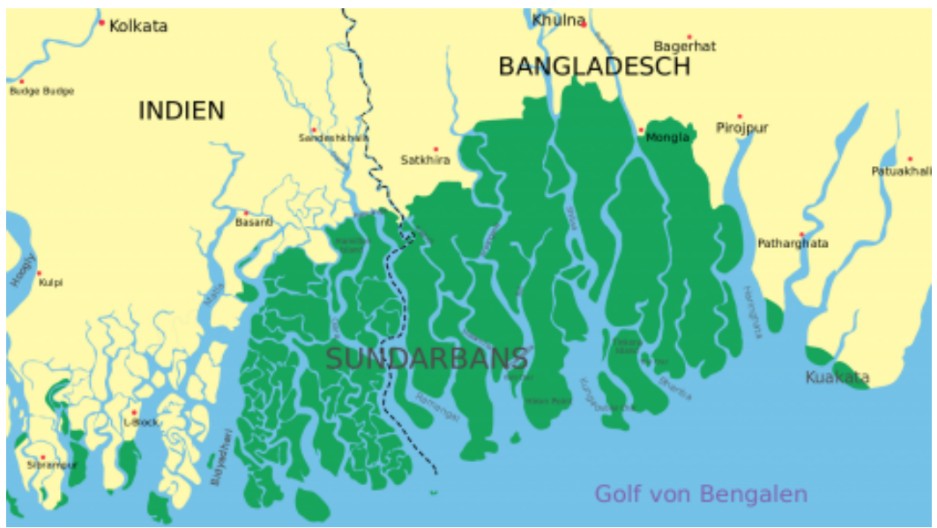
- Situated in the coastal districts of South and North 24- Parganas in West Bengal.
- Located at the southernmost end of the lower Gangetic delta, bordering the Bay of Bengal.
- Part of the Sundarbans, the world's largest delta, formed by the Ganga and Brahmaputra rivers.
- Only mangrove forest outside Bangladesh that hosts a significant population of Royal Bengal Tigers. It comprises around 105 islands of varying shapes and sizes.
Flora
- True mangroves and their associates, Halophytic herbs and shrubs and Nonmangrove species, including epiphytes and parasitic plants
Fauna
- Royal Bengal Tiger, Fishing Cat, Estuarine Crocodile, Gangetic Dolphin, Irrawaddy Dolphin, King Cobra, Water Monitor Lizard, numerous bird and reptile species.
10. Puga Valley Hot Springs Study – New Insights into Origin of Life on Earth
Context
- Recently, a team of Indian scientists found significant evidence at the Puga Valley hot springs in Ladakh that could challenge current theories on the origin of life on Earth. The discovery also holds promising implications for guiding future searches for life on Mars.
Key Findings
- The study suggests that Puga's extreme environment could function as natural prebiotic reactor, preserving early biomolecules and offering real-world insight into the origin of life.
- While global theories have focused on silica-based origins of life, this study highlights the previously underexplored role of calcium carbonates (calcite). found to concentrate and Travertine (CaCO, deposits) was to preserve organic molecules, making it a potential natural template for prebiotic chemistry.
- Analysis of travertine samples revealed: Amino acid derivatives, Formamide, Sulphur compounds & Fatty acids
- These biomolecules were encapsulated within calcite, suggesting a mechanism for stabilizing and preserving prebiotic organisms.
About Hot Spring
- A natural water outlet that emerges from the Earth's surface, heated by geothermal activity beneath the ground.
Key Features
- Water temperature is significantly higher than the surrounding air groundwater. Often found in geologically active regions, such as volcanic or tectonic zones.

2026-27 UPSC Mains English QEP Power Pages
View DetailsSubmit Your Details to Learn More



