International Court of Justice (ICJ) – Role, Functions & Latest Advisory on Climate Change

Learn about the International Court of Justice (ICJ) – its establishment, composition, functions, jurisdiction, and recent advisory opinion on nations’ climate change obligations under global treaties.

upsc-daily-current-affairs
Table of Contents
THEIASHUB
Get an Instant Call Back from Our Expert Mentors Now!
+91

Context

  • Recently, the International Court of Justice (ICJ) delivered a much-anticipated advisory opinion outlining nations' duties to reduce greenhouse gas emissions and the legal implications of failing to act.

Key Highlights

  • Reaffirmed the significance of the UNFCCC, Kyoto Protocol, and Paris Agreement as a unified climate regime.  
  • Rejected the idea of sidelining older treaties in favor of only the Paris Agreement.
  • Recognized Annex I and II obligations, reinforcing additional responsibilities of developed countries.
  • Endorsed the CBDR-RC principle (Common But Differentiated Responsibilities and Respective Capabilities) as the core guiding principle across treaties and international environmental law. 
  • Interpreted 1.5°C as the de facto global temperature goal, overriding the original "well below 2°C" target of the Paris Agreement. 
About ICJ

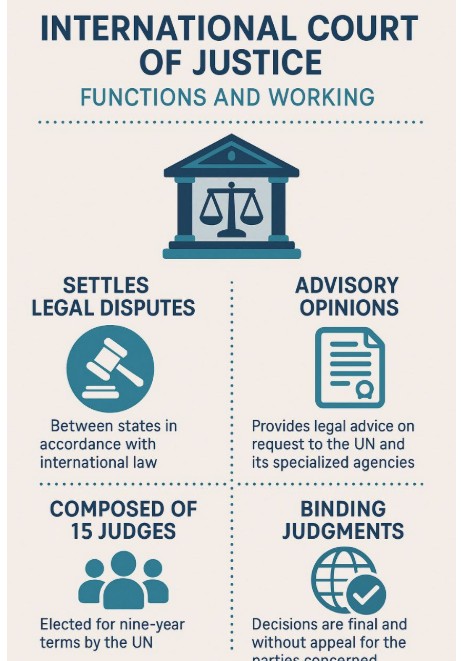
  • The ICJ is the main judicial organ of the United Nations and is also known as the World Court.

Establishment

  •  Created in June 1945 under the UN Charter and became operational in April 1946. 

Headquarters

  • The Hague, Netherlands(only UN principal organ not headquartered in New York, USA) 

Official Language

  • French and English. 

Composition

  • Judges: 15 judges from different countries. Elected to 9-year terms by the UN General Assembly and Security Council. 
  • Judges act independently and do not represent their countries.

Ad Hoc Judges

  • If a party to a case has no judge of its nationality on the bench, it may appoint a judge ad hoc for that specific case.

Registry

  • The Court is supported by the Registry, its independent and permanent administrative secretariat (distinct from the UN Secretariat).

Legal Basis for Judgments

  • International conventions and treaties, International customs, General principles of law recognized by civilized nations, Judicial decisions and scholarly writings.


UPSC QEP 2026 Batch 5 - English
Buy now View Details
Submit Your Details to Learn More
I agree to give my consent to receive updates through SMS/Email & WhatsApp*.

NEEV GS + CSAT Foundation 2026/27
Buy now View Details


Join theIAShub’s Mains Answer Writing Program

Refine your answer writing skills and elevate your UPSC preparation with personalized support and expert feedback.

Fill out the form to get started with the program or any other enquiries !

I agree to give my consent to receive updates through SMS/Email & WhatsApp*.

Best IAS Coaching In Delhi, UPSC Online & Offline Classes by IAShub

Are you dreaming of becoming an IAS officer? Then, IAShub can be your best guide. It is one of the Best IAS Coaching in Delhi. Many students who want to clear the UPSC exam join IAShub for learning. The institute gives both online and offline classes. Their teachers are experienced and helpful. They easily explain every topic. Students also get notes, tests, and tips to do well in the exam.

UPSC Online Classes by IAShub

IAShub is in Delhi and is trusted by many UPSC students. It offers coaching for every part of the UPSC exam – Prelims, Mains, and Interview. The classes are simple and easy to understand. The teachers are experts and guide students in the right way. IAShub is also known for its helpful notes, test series, and answer-writing practice. IAShub is the best coaching in Delhi and also gives UPSC Online Classes. This helps students from any place in India to learn. The online classes are live and also recorded. So, students can watch them anytime. These classes cover the full UPSC syllabus.

Key Offerings Provided by IAShub

Here are some important services provided by IAShub:

  • UPSC Prelims: IAShub teaches for Prelims with a focus on basics. It also gives daily current affairs and monthly magazines.
  • Classroom Courses: IAShub has classroom learning for students in Delhi. The environment is good and peaceful for study.
  • Live Classes: Students who live far can join live UPSC online classes. These classes are just like real classes.
  • QEP for Mains: The Quality Enrichment Program (QEP) is special for Mains preparation. It helps students write better and faster.
  • Answer Writing: Regular answer writing practice is given. Teachers also check answers and give tips to improve.
  • Free Resource: IAShub gives free notes by toppers and helpful Main Booster material.
  • Test Series: Test series are available for every subject. These help students know their weak points and improve.
  • Interview Guidance Session: IAShub also gives interview practice sessions with experts. These help students feel confident.

UPSC Exam Overview

The UPSC Civil Services Exam has three parts:

  • Prelims: It has two papers: General Studies and CSAT.
  • Mains: It has nine papers, including essays and optional subjects.
  • Interview: It tests the personality and confidence of the student.

This exam is tough, but with the right guidance, it becomes easy to manage. Students must study smart and stay regular.

How IAShub Helps in the UPSC Journey

IAShub supports students from the beginning to the end. It gives the right books, tests, and notes. The classes are easy to follow, and the teachers are always ready to help. Students get personal doubt sessions too. The test series and answer checking help students learn where they need to do better. Also, free study materials save time and money.
IAShub also guides students during the final stage – the interview. Experts take mock interviews and give useful tips. This full support makes IAShub one of the best IAS coaching in Delhi.

Best IAS Coaching In Delhi FAQs

Yes, IAShub offers live and recorded online classes. Students can attend from any part of India.

Classes are available in both English and Hindi, so students can choose the language they are comfortable with.

The classroom centre is located in Delhi. Students can visit and join offline batches there.

IAShub gives interview guidance sessions to help students prepare for the final round of UPSC.