Updated on 2025-06-10 18:48:47 | By Ankita Sen, Manager-Editorial

Get an Instant Call Back from Our Expert Mentors Now!
 Trending Searches
- UPSC CSE Overview
- UPSC CSE Admit Card
- UPSC CSE Analysis
- UPSC CSE Cut off
- UPSC CSE Pattern
- UPSC CSE Syllabus
- UPSC CSE Application Form
- UPSC CSE Selection Process
- UPSC CSE Result
- UPSC CSE Answer Keys
- UPSC CSE Vacancies
- UPSC CSE News
- UPSC CSE Preparation
- UPSC CSE Centre
- UPSC CSE Dates
- UPSC CSE Marksheet
- UPSC CSE Books
- UPSC CSE Salary
- UPSC CSE FAQs
- UPSC CSE Toppers
- UPSC CSE Age Limit
- UPSC CSE Calendar
- UPSC CSE Age Calculator
- UPSC CSE Prelims Marks Calculator
UPSC Exam 2025 Overview
|
UPSC 2025 Exam Dates |
|
|
Events |
Date |
|
Notification Release |
22nd January 2025 |
|
Application Process Start |
22nd January 2025 |
|
Correction Window |
February 22 to February 28, 2025 |
|
Last Date to Fill Form |
21st February 2025 |
|
IAS Exam Date |
25th May 2025 |
|
Prelims Admit Card |
13 May 2025 |
|
Mains DAF-I |
To be Announced |
|
UPSC Mains 2025 |
22nd August 2025 |
|
UPSC Mains Admit Card 2025 |
To be announced |
|
Duration of Mains Exam |
5 Days |
|
UPSC Mains Result 2025 |
To be announced |
|
Interview Date |
To be announced |
|
UPSC Exam 2025 Final Result |
To be announced |
What is the UPSC Exam?
The UPSC Exam, officially known as the Civil Services Examination (CSE), is a prestigious and highly competitive exam conducted by the Union Public Service Commission (UPSC). It is held annually to recruit candidates for various top administrative positions in the Government of India, including the Indian Administrative Service (IAS), Indian Police Service (IPS), Indian Foreign Service (IFS), and other central services.
The exam tests candidates on a wide range of subjects and skills, including general knowledge, aptitude, essay writing, and optional subjects. It consists of three stages: Preliminary Examination, Main Examination, and Personality Test (Interview). The UPSC Exam is considered one of the toughest exams in India due to its vast syllabus and high competition. Successful candidates are appointed as officers in various civil services and play key roles in policy-making and administration.
UPSC Exam Full Form
The full form of UPSC is the Union Public Service Commission. It is the organization that conducts many important exams for government jobs in India. The most famous exam conducted by UPSC is the UPSC exam.
Is UPSC and UPSC CSE the Same?
UPSC and UPSC CSE are not the same, but they are closely related.
UPSC stands for Union Public Service Commission, which is a constitutional body responsible for conducting various recruitment exams for central government services in India.
UPSC CSE stands for Civil Services Examination, which is one of the exams conducted by UPSC. It is the most popular and competitive exam under UPSC, used to recruit officers for services like IAS, IPS, IFS, and others.
So, while UPSC is the body, CSE is one of the exams it conducts. Other exams by UPSC include the Indian Forest Service Exam (IFoS), Engineering Services Exam (ESE), CDS, NDA, and more.
Who Conducts the UPSC Exam?
The Union Public Service Commission (UPSC) conducts the UPSC Exam. It is a constitutional body established under Article 315 of the Indian Constitution and is responsible for recruiting candidates to the All India Services and Central Civil Services.
- UPSC conducts exams like Civil Services Examination (CSE), Engineering Services Examination (ESE), Combined Medical Services (CMS), NDA, CDS, and more.
- For certain posts, UPSC selects candidates directly through interviews without a written examination.
- UPSC advises the government in cases where officers are promoted or absorbed from one service to another or taken on deputation.
- UPSC helps in creating and revising the recruitment rules for various posts and services under the Government of India.
- UPSC gives advice to the government on disciplinary matters and cases involving civil servants across different services.
 Commonly asked Questions
What are the Post Under the UPSC Exam
The UPSC Civil Services Examination (CSE) selects candidates for several prestigious positions under the Government of India. These positions are generally divided into three main categories:
The UPSC Civil Services Examination (CSE) selects candidates for several prestigious positions under the Government of India. These positions are generally divided into three main categories:
|
Category |
Service Name |
|
All India Services (AIS) |
Indian Administrative Service (IAS) Indian Police Service (IPS) Indian Forest Service (IFoS)* |
|
Group A Services |
Indian Foreign Service (IFS) Indian Revenue Service (IRS – IT & Customs) Indian Audit and Accounts Service (IAAS) Indian Civil Accounts Service (ICAS) Indian Postal Service (IPoS) Indian Information Service (IIS) Indian Defence Accounts Service (IDAS) Indian Railway Accounts Service (IRAS) Indian Trade Service (ITS) Indian Corporate Law Service (ICLS) Indian Ordnance Factories Service (IOFS) |
|
Group B Services |
DANICS (Delhi, Andaman and Nicobar Islands Civil Service) DANIPS (Delhi, Andaman and Nicobar Islands Police Service) Pondicherry Civil Service Pondicherry Police Service Armed Forces Headquarters Civil Service |
Types of Services in UPSC Exam
The UPSC Civil Services Examination recruits candidates for various prestigious services in the Indian government. These services are broadly categorised into three main types:
|
Category |
Description |
Examples of Services |
|
All India Services |
Officers serve both the Central and State Governments. |
Indian Administrative Service (IAS) Indian Police Service (IPS) Indian Forest Service (IFoS) |
|
Central Civil Services Group ‘A’ |
Officers serve only under the Central Government, in various specialized departments. |
Indian Foreign Service (IFS) Indian Revenue Service (IRS) Indian Audit and Accounts Service (IAAS) Indian Civil Accounts Service (ICAS) Indian Corporate Law Service (ICLS) Indian Defence Accounts Service (IDAS) -Indian Defence Estates Service (IDES) Indian Information Service (IIS) Indian Postal Service (IPoS) Indian Railway Management Service (IRMS) Indian Trade Service (ITS) Indian Railway Protection Force Service (RPF) and others |
|
Central Civil Services Group ‘B’ |
Officers serve under the Central Government but at a lower administrative level than Group ‘A’. |
Armed Forces Headquarters Civil Service (AFHQCS) Delhi, Andaman & Nicobar Islands Civil Service (DANICS) Delhi, Andaman & Nicobar Islands Police Service (DANIPS) Pondicherry Civil Service (PONDICS) Pondicherry Police Service (PONDIPS) |
How Many Stages in the UPSC Exam
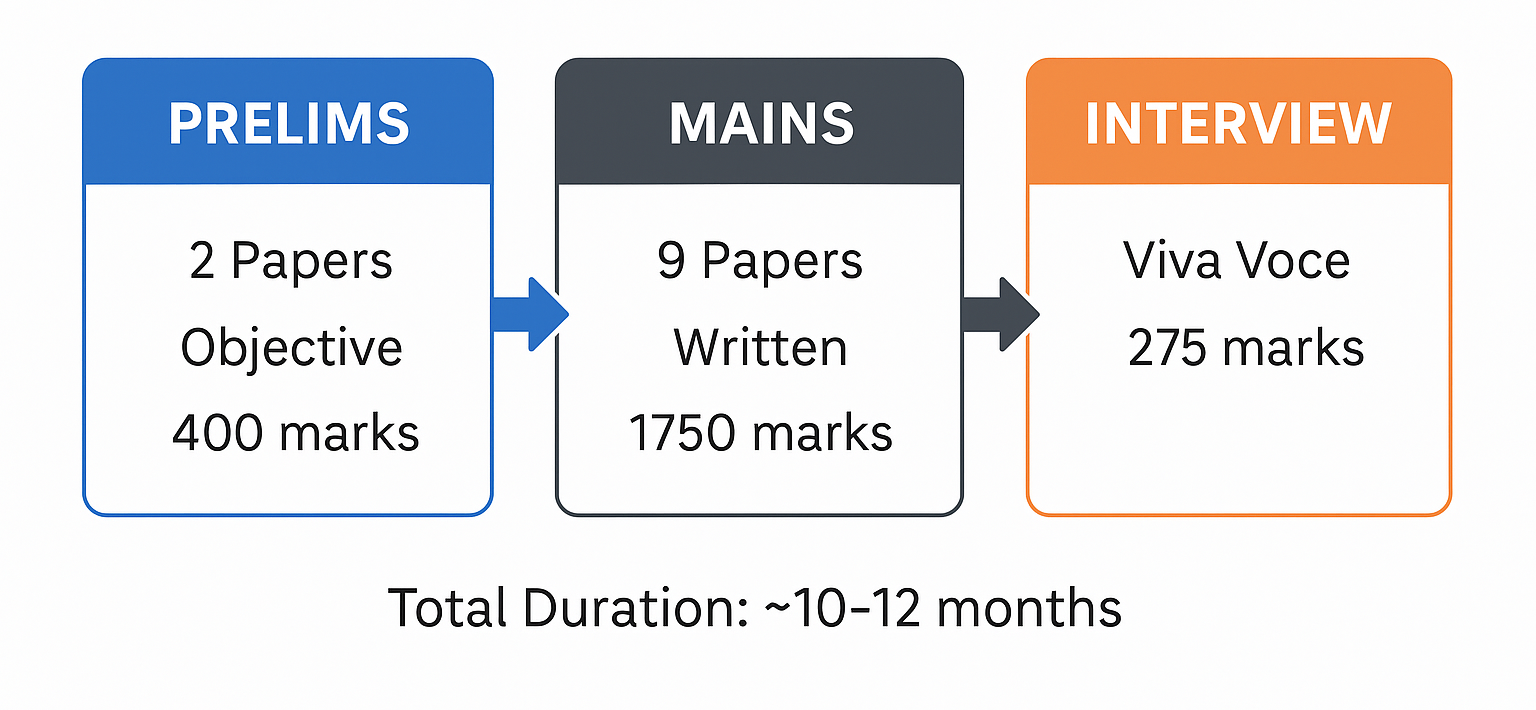
The UPSC Civil Services Examination has three main stages:
- Preliminary Examination (Prelims) – This is an objective-type screening test with two papers: General Studies Paper I and CSAT (Paper II). It is qualifying in nature and used to shortlist candidates for the Mains exam.
- Main Examination (Mains) – This is a descriptive written exam consisting of 9 papers, including 4 General Studies papers, 2 optional subject papers, 2 language papers, and 1 essay paper. Marks scored here are counted for the final merit list.
- Personality Test (Interview) – This is the final stage of the exam, where selected candidates from the Mains exam face a panel to assess their personality, communication skills, and suitability for a career in civil services.
UPSC Post and Salary
The UPSC Exam offers prestigious posts like IAS, IPS, and IFS, each with attractive salaries, perks, and immense responsibilities. The starting salary for most Group A officers is around ₹56,100, with the highest reaching up to ₹2,50,000/month. Along with financial benefits, officers receive housing, vehicles, and other allowances.
|
UPSC Salary Post Wise |
|||
|
Post Level |
Post |
Monthly Salary |
Experience |
|
District Level |
Sub-Divisional Magistrate |
₹56,100 |
0-4 years |
|
District Level |
Additional District Magistrate |
₹67,700 |
4-9 years |
|
District Level |
District Magistrate |
₹78,800 |
9-12 years |
|
State Level |
Director |
₹1,18,500 |
12-16 years |
|
State Level |
Joint Secretary |
₹1,44,200 |
16-25 years |
|
State Level |
Principal Secretary |
₹1,82,200 |
25-30 years |
|
State Level |
Chief Secretary |
₹2,25,000 |
34-36 years |
|
Central Government |
Cabinet Secretary of India |
₹2,50,000 |
37+ years |
Commonly asked Questions
UPSC Exam Eligibility Criteria
To appear for the UPSC exam, a candidate must fulfill the following eligibility conditions:
- For IAS, IPS, and IFS, the candidate must be a citizen of India—this is a non-negotiable requirement.
- For other civil services (like IRS, IRTS, etc.), candidates can be:
- Citizens of Nepal or Bhutan
- Tibetan refugees who settled in India before January 1, 1962
- Persons of Indian Origin (PIOs) who migrated from countries like Pakistan, Burma, Sri Lanka, and East African nations (Kenya, Uganda, Tanzania, Zambia, Malawi, Ethiopia, Zaire, and Vietnam) with the intent of permanent settlement in India
- All candidates from the above categories must provide an eligibility certificate issued by the Government of India.
To appear for the UPSC exam, a candidate must fulfill the following eligibility conditions:
- For IAS, IPS, and IFS, the candidate must be a citizen of India—this is a non-negotiable requirement.
- For other civil services (like IRS, IRTS, etc.), candidates can be:
- Citizens of Nepal or Bhutan
- Tibetan refugees who settled in India before January 1, 1962
- Persons of Indian Origin (PIOs) who migrated from countries like Pakistan, Burma, Sri Lanka, and East African nations (Kenya, Uganda, Tanzania, Zambia, Malawi, Ethiopia, Zaire, and Vietnam) with the intent of permanent settlement in India
- All candidates from the above categories must provide an eligibility certificate issued by the Government of India.
- The eligibility certificate is not required at the time of applying, but it must be submitted at the time of appointment to the service.
- Non-citizens of India who do not fall into the approved categories are not eligible to apply for the UPSC UPSC exam.
- Especially for the Indian Foreign Service (IFS), candidates must either be Indian citizens or Persons of Indian Origin—others are not eligible for this particular service.
UPSC Exam Educational Qualification
In addition to fulfilling the age criteria, candidates must satisfy specific educational requirements to be eligible for the UPSC UPSC exam. This section explains the detailed academic qualifications necessary for appearing in the exam.
- Candidates must have a bachelor’s degree from a recognized university in any discipline to be eligible for the UPSC UPSC exam.
- Students in their final year of graduation can appear for the Preliminary exam, but they must submit proof of passing the degree before the Main exam.
- Professional and technical degrees such as MBBS, engineering, law, agriculture, and other government-recognized vocational courses are also accepted.
- Medical students who have completed their final year of MBBS but are yet to finish their internship can apply; they must submit a completion certificate during the Main exam application.
- The degree or professional qualification must be recognized by the Government of India to ensure eligibility.
- Failure to submit the required proof of graduation or professional qualification on time will result in disqualification from further stages of the exam.
UPSC Age Limit
The age of the candidate is calculated as of 1st August of the exam year. The minimum and maximum age limit varies according to the candidate’s category.
|
Category |
Maximum Age Limit |
|
General Category |
32 years |
|
OBC Candidates |
35 years |
|
SC/ST Candidates |
37 years |
|
PwBD Candidates |
Between 35 to 42 years |
UPSC Exam Age Relaxation
While the general upper age limit for the UPSC UPSC exam is 32 years for candidates belonging to the unreserved (General) category, candidates from certain categories are eligible for age relaxation as per government norms. The extent of this relaxation depends on the category and specific circumstances of the candidate.
|
UPSC Exam Age Relaxation |
||
|
Category |
Maximum Age Relaxation |
Conditions |
|
Scheduled Castes (SC) / Scheduled Tribes (ST) |
5 years |
Candidates must belong to a recognized SC or ST community as per government records. |
|
Other Backward Classes (OBC) |
3 years |
Applicable only to OBC candidates who fall under the Non-Creamy Layer and are eligible for reservation benefits. |
|
Persons with Benchmark Disabilities (PwBD) |
10 years |
Applicable to candidates with disabilities such as: Blindness or low vision Deaf and hard of hearing Locomotor disability (including cerebral palsy, leprosy cured, dwarfism, acid attack victims, muscular dystrophy) Autism, intellectual disability, etc. |
|
Defence Services Personnel (disabled during hostilities with a foreign country or in disturbed areas) |
3 years |
Must have been disabled during active service in such operations and subsequently released from duty. |
|
Ex-Servicemen including Commissioned Officers, ECOs, SSCOs |
5 years |
Must have completed at least 5 years of military service as of August 1, 2023, and released due to: Completion of assignment Physical disability attributable to military service Invalidment |
|
ECOs / SSCOs (with extended service beyond 5 years) |
5 years |
Must have completed 5 years of initial service and received an extension. Also, must produce a certificate from the Ministry of Defence stating eligibility for civil employment with a 3-month notice period upon selection. |
UPSC Exam Attempt Limit Category Wise
UPSC limits the number of times a candidate can appear for the UPSC exam. These limits are independent of the stages (Prelims, Mains, or Interview). Even appearing in one paper of Prelims counts as an attempt.
|
Category |
Number of Attempts |
|
General/EWS |
6 attempts until the age of 32 |
|
OBC |
9 attempts until the age of 35 |
|
SC/ST |
Unlimited attempts until the age of 37 |
|
PwBD |
9 attempts until the age of 42 |
Commonly asked Questions
UPSC Exam Marks Distribution
The UPSC (Union Public Service Commission) follows a structured and transparent marking scheme for the UPSC exam. The exam is conducted in three stages:
- Preliminary Examination (Prelims) – Objective Type
- Main Examination (Mains) – Descriptive Type
- Personality Test (Interview)
The UPSC (Union Public Service Commission) follows a structured and transparent marking scheme for the UPSC exam. The exam is conducted in three stages:
- Preliminary Examination (Prelims) – Objective Type
- Main Examination (Mains) – Descriptive Type
- Personality Test (Interview)
Each stage of the exam has its marking pattern, designed to test a candidate’s general awareness, in-depth knowledge, writing skills, analytical thinking, and personality traits. Knowing the marking scheme in detail helps candidates prepare effectively and avoid common mistakes, such as negative marking errors or underestimating qualifying papers.
UPSC Prelims Marks Distribution 2025
Understanding the UPSC prelims marks distribution is essential for effective preparation. Here’s a quick summary:
|
Paper |
General Studies Paper-I (GS) |
Civil Services Aptitude Test (CSAT) Paper-II |
|
Type of Paper |
Objective (Multiple Choice Questions) |
Objective (Multiple Choice Questions) |
|
Total Marks |
200 |
200 |
|
Number of Questions |
100 |
80 |
|
Duration |
2 hours |
2 hours |
|
Negative Marking |
0.66 marks for each wrong answer |
0.83 marks for each wrong answer |
UPSC Mains Marks Distribution
The Mains is a descriptive written exam consisting of 9 papers, out of which 7 papers are counted for merit and 2 are qualifying in nature.
|
UPSC Exam Pattern 2025 Mains |
|||
|
Paper |
Name of Paper |
Time Duration |
Maximum Marks |
|
Qualifying Papers |
|||
|
Paper A |
Indian Language |
3 Hours |
300 |
|
Paper B |
English |
3 Hours |
300 |
|
Merit Papers |
|||
|
Paper I |
Essay |
3 Hours |
250 |
|
Paper II |
General Studies-I |
3 Hours |
250 |
|
Paper III |
General Studies -II |
3 Hours |
250 |
|
Paper IV |
General Studies -III |
3 Hours |
250 |
|
Paper V |
General Studies -IV |
3 Hours |
250 |
|
Paper VI |
Optional Paper 1 |
3 Hours |
250 |
|
Paper VII |
Optional Paper 2 |
3 Hours |
250 |
|
Total |
1750 Marks |
||
UPSC Marking Scheme
The UPSC (UPSC exam) marking scheme is structured across three stages: Prelims, Mains, and Interview. Here is a detailed breakdown of the marking scheme for each stage.
|
UPSC Marking Schemes |
||||||
|
Stage |
Paper/Test Name |
Number of Questions |
Marks per Question |
Total Marks |
Negative Marking |
Remarks/Qualifying Criteria |
|
Prelims |
General Studies Paper-I |
100 |
2 |
200 |
Yes (1/3rd) |
Merit ranking, GS-I counts |
|
General Studies Paper-II (CSAT) |
80 |
2.5 |
200 |
Yes (1/3rd) |
Qualifying (33% required) |
|
|
Mains |
Paper A: Indian Language (Qualifying) |
– |
– |
300 |
No |
Qualifying (25% required) |
|
Paper B: English (Qualifying) |
– |
– |
300 |
No |
Qualifying (25% required) |
|
|
Paper I: Essay |
– |
– |
250 |
No |
Merit ranking |
|
|
Paper II: General Studies I |
– |
– |
250 |
No |
Merit ranking |
|
|
Paper III: General Studies II |
– |
– |
250 |
No |
Merit ranking |
|
|
Paper IV: General Studies III |
– |
– |
250 |
No |
Merit ranking |
|
|
Paper V: General Studies IV |
– |
– |
250 |
No |
Merit ranking |
|
|
Paper VI: Optional Subject I |
– |
– |
250 |
No |
Merit ranking |
|
|
Paper VII: Optional Subject II |
– |
– |
250 |
No |
Merit ranking |
|
|
Interview |
Personality Test |
– |
– |
275 |
No |
Merit ranking |
UPSC Exam Pattern
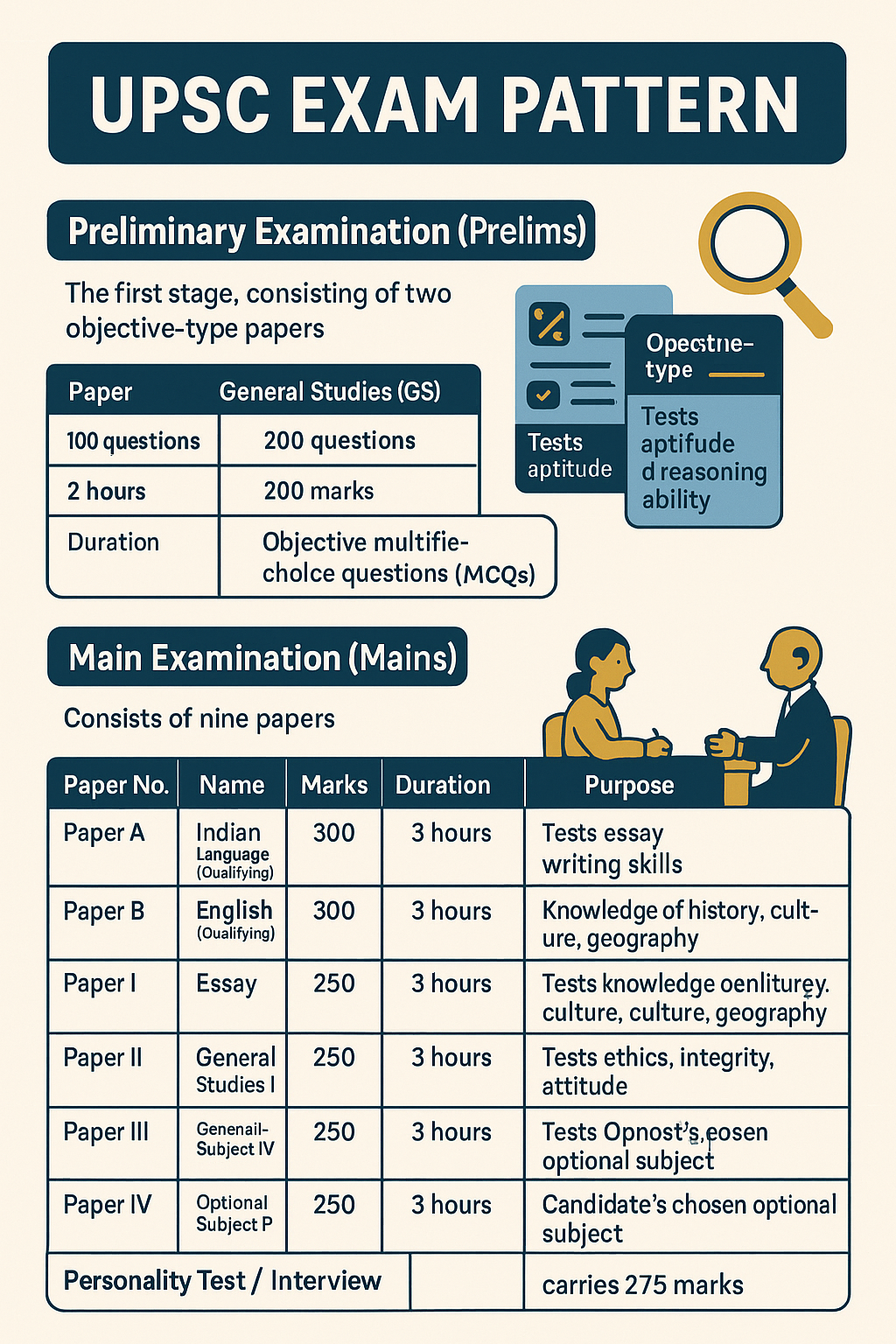
The Union Public Service Commission (UPSC) UPSC exam is conducted in three stages — Preliminary Examination, Main Examination, and Personality Test (Interview). Each stage tests different skills and knowledge areas, progressively narrowing down candidates for the coveted civil services posts like IAS, IPS, IFS, and others.
Preliminary Examination (Prelims)
The UPSC Prelims is the first stage of the exam and acts as a screening test to shortlist candidates for the mains exam. It consists of two objective-type papers:
Paper I: General Studies (GS)
- Number of Questions: 100 questions
- Marks: 200 marks
- Duration: 2 hours
- Nature: Objective multiple-choice questions (MCQs)
Paper II: Civil Services Aptitude Test (CSAT)
- Number of Questions: 80 questions
- Marks: 200 marks
- Duration: 2 hours
- Nature: Objective multiple-choice questions
- Purpose: Tests aptitude and reasoning ability
Main Examination (Mains)
The Mains exam is the second stage and consists of nine papers, all descriptive, to assess candidates’ depth of knowledge, analytical ability, and presentation skills. Marks obtained in the Mains count towards the final ranking.
|
Paper No. |
Paper Name |
Marks |
Duration |
Nature |
Purpose |
|
Paper A |
Indian Language (Qualifying) |
300 |
3 hours |
Descriptive |
Qualifying; language proficiency |
|
Paper B |
English (Qualifying) |
300 |
3 hours |
Descriptive |
Qualifying; language proficiency |
|
Paper I |
Essay |
250 |
3 hours |
Descriptive |
Tests essay writing skills |
|
Paper II |
General Studies I (History, Culture, Geography) |
250 |
3 hours |
Descriptive |
Tests knowledge of history, culture, geography |
|
Paper III |
General Studies II (Polity, Governance, International Relations) |
250 |
3 hours |
Descriptive |
Tests polity, governance, social justice, IR |
|
Paper IV |
General Studies III (Economics, Environment, Technology, Security) |
250 |
3 hours |
Descriptive |
Tests economics, environment, tech, security |
|
Paper V |
General Studies IV (Ethics, Integrity, Aptitude) |
250 |
3 hours |
Descriptive |
Tests ethics, integrity, attitude |
|
Paper VI |
Optional Subject Paper 1 |
250 |
3 hours |
Descriptive |
Candidate’s chosen optional subject |
|
Paper VII |
Optional Subject Paper 2 |
250 |
3 hours |
Descriptive |
Candidate’s chosen optional subject |
Personality Test / Interview
The final stage is the UPSC Interview or Personality Test, which carries 275 marks.
Key Aspects of the Interview:
- Conducted by a panel of UPSC members.
- Focuses on the candidate’s personality, communication skills, intellectual traits, and suitability for a career in civil services.
- Questions are generally based on the candidate’s Detailed Application Form (DAF), which includes personal background, education, hobbies, work experience, and optional subjects.
- Candidates may be asked about current affairs, governance issues, and social or economic topics.
- The interview tests qualities like clarity of thought, integrity, leadership, and problem-solving ability.
- Marks obtained here are added to the Mains marks for the final ranking.
Commonly asked Questions
UPSC Exam Syllabus 2025
The UPSC IAS (UPSC exam) syllabus is divided into three main stages: Prelims, Mains, and Interview. Here is a detailed overview of each stage’s syllabus:
The UPSC IAS (UPSC exam) syllabus is divided into three main stages: Prelims, Mains, and Interview. Here is a detailed overview of each stage’s syllabus:
UPSC Prelims Syllabus
The UPSC Preliminary Examination is the first stage of the UPSC exam and is intended to assess a candidate’s knowledge, comprehension, and analytical skills. Aspirants can download the official UPSC UPSC exam syllabus from the official UPSC website. Below is a detailed overview of the syllabus for both General Studies Paper I and General Studies Paper II (CSAT):
General Studies Paper I (GS Paper I)
This paper evaluates the candidate’s awareness of current and static subjects reevant to national and international importance. Key areas include:
|
Subject |
Topics Covered |
|
Current Events of National and International Importance |
Developments in politics, economy, environment, science & technology Major government schemes and initiatives |
|
History of India and Indian National Movement |
Ancient India: Art, culture, and architecture Medieval India: Socio-economic and cultural aspects Modern India: Freedom movement and key personalities |
|
Indian and World Geography |
Physical geography: Landforms, rivers, climate Human geography: Population, urbanization, migration Economic geography: Resources and industries |
|
Indian Polity and Governance |
Constitution of India: Features, amendments, schedules Governance mechanisms, political structure Public policy, rights issues, Panchayati Raj institutions |
|
Economic and Social Development |
Sustainable development, poverty, inclusion Economic initiatives: Make in India, Start-Up India, Digital India |
|
Environmental Ecology, Biodiversity, and Climate Change |
Basics of ecology and ecosystems Biodiversity conservation and international environmental agreements |
|
General Science |
Fundamental concepts in Physics, Chemistry, and Biology Scientific developments and their applications in daily life |
UPSC Prelims Syllabus of General Studies Paper II (CSAT)
The General Studies Paper II (CSAT) is designed to assess the aptitude of candidates in areas such as comprehension, logical reasoning, analytical ability, decision-making, and basic numeracy. It is of Class X level and plays a qualifying role in the Preliminary Examination.
|
UPSC Prelims Syllabus of General Studies Paper II (CSAT) |
|
|
Comprehension |
Reading and understanding passages. Critical analysis and interpretation. |
|
Interpersonal Skills and Communication |
Logical reasoning and decision-making. |
|
Logical Reasoning and Analytical Ability |
Puzzles, patterns, and analytical reasoning questions. |
|
Numerical Ability and Data Interpretation |
Class X-level mathematics, including percentages, ratios, and graph interpretation. |
|
Decision-Making and Problem-Solving |
Situational judgment and ethical dilemmas. |
UPSC Mains Syllabus
The UPSC Mains Examination 2025 aims to evaluate a candidate’s intellectual depth, critical reasoning, and ethical insight. Excelling in this stage demands a well-planned and disciplined preparation strategy that emphasizes clear understanding of concepts, regular practice of answer writing, and staying updated with current affairs. Following the detailed UPSC Mains syllabus closely greatly enhances the chances of success in this competitive exam.
UPSC Mains Syllabus- Essay Paper I
Candidates might need to write essays on various topics. These essays should stay focused on the subject, organize ideas logically, and be clear and concise. Marks will be given for effective and accurate expression.
UPSC Mains Syllabus General Studies I (Paper II) Indian Heritage and Culture, History, and Geography of the World and Society
- Indian Culture - Salient aspects of Art Forms, Literature, and Architecture from ancient to modern times.
- Modern Indian History: Developments from the mid-18th century to the present, including significant events, personalities, and issues.
- The Freedom Struggle: Various stages and important contributions from different regions.
- Post-independence consolidation and reorganization within the country.
- World History - Events from the 18th century, including: The Industrial Revolution, World Wars, Redrawing of national boundaries, Colonization and decolonization, Political philosophies like communism, capitalism, socialism, and their forms and societal effects.
- Indian Society: Salient features of Indian society and its diversity.
- Role of women and women's organizations, Population and associated issues, Poverty and developmental challenges, Urbanization: Problems and remedies, Effects of globalization on Indian society.
- Social empowerment, communalism, regionalism, and secularism.
- World Geography - Salient features of the world's physical geography.
- Distribution of key natural resources globally (including South Asia and the Indian sub-continent).
- Factors influencing the location of primary, secondary, and tertiary sector industries in various regions (including India).
- Important geophysical phenomena such as earthquakes, tsunamis, volcanic activity, and cyclones.
- Geographical features and their location, including changes in critical features like water bodies, ice caps, flora, and fauna, along with their impacts.
UPSC Mains Syllabus General Studies II (Paper III) Governance, Constitution, Polity, Social Justice, and International Relations
- Indian Constitution - Historical underpinnings, evolution, features, amendments, significant provisions, and basic structure.
- Union and State Functions - Functions and responsibilities, issues and challenges pertaining to the federal structure, devolution of powers and finances up to local levels, and associated challenges.
- Separation of Powers between various organs, dispute redressal mechanisms, and institutions.
- Comparison of the Indian constitutional scheme with that of other countries.
- Parliament and State Legislatures - Structure, functioning, conduct of business, powers and privileges, and issues arising out of these.
- Structure, organization, and functioning; Ministries and Departments of the Government; role of pressure groups and formal/informal associations in the polity.
- Features of Representation of People's Act
- Constitutional Posts - Appointment, powers, functions, and responsibilities of various Constitutional Bodies.
- Statutory, Regulatory, and Quasi-Judicial Bodies
- Government Policies and Interventions for development in various sectors and issues arising out of their design and implementation.
- Development Processes and the Development Industry - Role of NGOs, SHGs, various groups and associations, donors, charities, institutional and other stakeholders.
- Welfare Schemes for vulnerable sections by the Centre and States, performance of these schemes; mechanisms, laws, institutions, and bodies constituted for their protection and betterment.
- Social Sector/Services Development and Management
- Relating to Health, Education, Human Resources.
- Issues relating to development and management.
- Governance - Transparency and accountability, e-governance applications, models, successes, limitations, and potential; citizens' charters, transparency & accountability, and institutional and other measures.
- Role of Civil Services in a Democracy
UPSC Mains Syllabus General Studies III (Paper IV) Technology, Economic Development, Biodiversity, Environment, Security, and Disaster Management
- Indian Economy - Issues relating to planning, mobilization of resources, growth, development, and employment.
- Inclusive Growth and Issues arising from it.
- Government Budgeting
- Major crops, cropping patterns, different types of irrigation and irrigation systems; storage, transport, and marketing of agricultural produce and issues and related constraints; e-technology in the aid of farmers.
- Issues related to direct and indirect farm subsidies and minimum support prices; Public Distribution System—objectives, functioning, limitations, revamping; issues of buffer stocks and food security; Technology missions; economics of animal-rearing.
- Food Processing and Related Industries - Scope and significance, location, upstream and downstream requirements, supply chain management.
- Land Reforms in India
- Liberalization Effects - On the economy, changes in industrial policy, and their effects on industrial growth.
- Infrastructure - Energy, Ports, Roads, Airports, Railways, etc.
- Investment Models
- Science and Technology - Developments and their applications and effects in everyday life; achievements of Indians in science & technology; indigenization of technology and developing new technology.
- IT, Space, Computers, Robotics, Nanotechnology, Biotechnology - Awareness in these fields and issues relating to intellectual property rights.
- Conservation - Environmental pollution and degradation, environmental impact assessment.
- Disaster and Disaster Management
- Linkages Between Development and Spread of Extremism
- Internal Security Challenges - Role of external state and non-state actors.
- Challenges to internal security through communication networks, role of media and social networking sites in internal security challenges, basics of cyber security; money-laundering and its prevention.
- Security Challenges in Border Areas
- Security Forces and Agencies their mandate.
UPSC Mains Syllabus General Studies IV (Paper V) Ethics, Integrity, and Aptitude
This paper is designed to assess candidates’ attitudes and approaches toward issues related to integrity, honesty in public life, and their problem-solving skills when addressing various societal challenges and conflicts. The questions may include case studies to evaluate these qualities. The key areas covered are:
- Ethics and Human Interface: The core principles, factors, and outcomes of ethics in human behavior; different dimensions of ethics; and ethics in both personal and public relationships.
- Human Values: Insights from the lives and teachings of notable leaders, reformers, and administrators; and the role of family, society, and education in fostering values.
- Attitude: Understanding its content, structure, and function; how attitude influences thought and behavior; moral and political attitudes; and the impact of social influence and persuasion.
- Aptitude and Foundational Values for Civil Service: Qualities such as integrity, impartiality, objectivity, dedication to public service, empathy, tolerance, and compassion towards marginalized groups.
- Emotional Intelligence: Concepts and their practical applications in administration and governance.
- Contributions of Moral Thinkers and Philosophers: Important ideas from both Indian and global thinkers.
UPSC Compulsory English Paper
The English language paper in the UPSC Civil Services Mains Examination is a qualifying paper. Although the marks scored in this paper do not affect the final ranking, candidates must achieve the minimum qualifying marks to move forward in the selection process. This paper evaluates a candidate’s proficiency in English through various language tasks. The syllabus is divided as follows:
- Essay Writing (100 Marks): Candidates need to write a clear and well-organized essay on a given topic, assessing their ability to express ideas logically and command the language effectively.
- Comprehension (75 Marks): This section tests reading and interpretation skills, requiring candidates to answer questions on the main ideas and supporting details of a passage.
- Precis Writing (75 Marks): Candidates must create a concise summary of a passage, focusing on capturing the essential message while maintaining clarity and accuracy.
- Grammar and Vocabulary (50 Marks): This part evaluates knowledge of English grammar and vocabulary, including correct usage, sentence construction, synonyms, antonyms, and context-based application.
UPSC Compulsory Indian Language Paper 2025
The UPSC UPSC exam permits candidates to write their papers in any one of the 22 Indian languages listed in the Eighth Schedule of the Constitution. While this paper is often overlooked by many aspirants, it is a compulsory part of the exam, and not qualifying in it can lead to disqualification. Hence, thorough preparation is crucial. Candidates must choose one language from the Eighth Schedule, which includes the following:
|
Language |
Script |
|
Assamese |
Assamese |
|
Bengali |
Bengali |
|
Gujarati |
Gujarati |
|
Hindi |
Devanagari |
|
Kannada |
Kannada |
|
Kashmiri |
Persian |
|
Konkani |
Devanagari |
|
Malayalam |
Malayalam |
|
Manipuri |
Bengali |
|
Marathi |
Devanagari |
|
Nepali |
Devanagari |
|
Odia |
Odia |
|
Punjabi |
Gurumukhi |
|
Sanskrit |
Devanagari |
|
Sindhi |
Devanagari or Arabic |
|
Tamil |
Tamil |
|
Telugu |
Telugu |
|
Urdu |
Persian |
|
Bodo |
Devanagari |
|
Dogri |
Devanagari |
|
Maithili |
Devanagari |
|
Santhali |
Devanagari or Olchiki |
UPSC Mains Optional Paper List
Candidates are required to select one optional subject from a list of 48 choices. This subject comprises two papers—Paper I and Paper II—each carrying 250 marks, making a total contribution of 500 marks to the final score.
|
Optional Subjects |
|
|
Agriculture |
Animal Husbandry and Veterinary Science |
|
Anthropology |
Botany |
|
Chemistry |
Civil Engineering |
|
Commerce & Accountancy |
Economics |
|
Electrical Engineering |
Geography |
|
Geology |
History |
|
Law |
Management |
|
Mathematics |
Mechanical Engineering |
|
Medical Science |
Philosophy |
|
Physics |
Political Science and International Relations |
|
Psychology |
Public Administration |
|
Sociology |
Statistics |
|
Zoology |
|
The Literature paper in the UPSC Mains provides candidates with a wide range of language options. This enables aspirants to select a language they are confident in or have studied academically, increasing their chances of scoring well with the right preparation strategy.
|
Literature Subjects |
|
|
Assamese |
Bengali |
|
Bodo |
Dogri |
|
Gujarati |
Hindi |
|
Kannada |
Kashmiri |
|
Maithili |
Malayalam |
|
Manipuri |
Marathi |
|
Nepali |
Oriya |
|
Punjabi |
Sanskrit |
|
Santhali |
Sindhi |
|
Tamil |
Telugu |
|
Urdu |
English |
UPSC Exam Interview Syllabus
The IAS Interview, officially known as the Personality Test, is the final stage of the UPSC UPSC exam. It carries 275 marks and plays a crucial role in determining the candidate’s final rank. Unlike the written exams, there is no fixed syllabus for the interview. Instead, it aims to assess the overall personality, suitability, and administrative potential of the candidate.
|
Component |
Details |
|
Personality |
Confidence, presence of mind, attitude, body language, and overall behavior during the interview. |
|
General Awareness |
Understanding of current affairs, national and international issues, government policies, and socio-political developments. |
|
Communication Skills |
Clarity of thought, fluency, articulation, listening ability, and how effectively the candidate expresses ideas. |
|
Critical Thinking and Decision-Making |
Ability to analyze situations, apply logic, and make fair and ethical decisions in administrative contexts. |
|
Leadership and Administrative Qualities |
Traits like initiative, integrity, problem-solving ability, and approach to public service responsibilities. |
|
Academic Background & Optional Subject |
Questions based on graduation subjects and the optional subject chosen for the Mains exam. |
|
DAF-Based Questions |
Questions related to personal background, home state/district, educational institutions, work experience, hobbies, achievements, and interests. |
|
Hobbies and Extra-Curricular Activities |
Discussion on activities and interests mentioned in the DAF, testing sincerity and depth of involvement. |
Commonly asked Questions
UPSC Exam Preparation Strategies
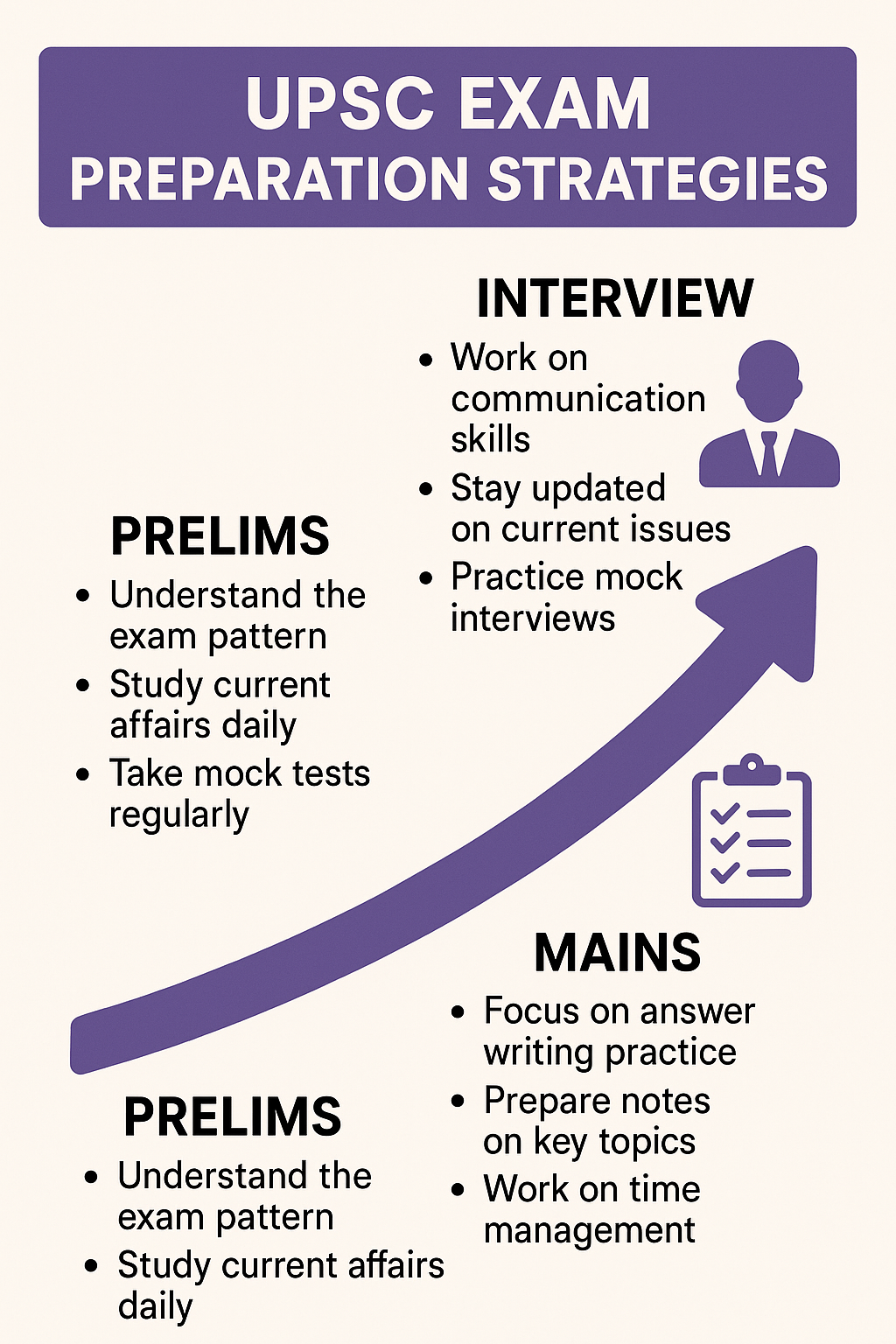
The UPSC UPSC exam is not just a test of knowledge but a test of patience, discipline, and smart planning. With lakhs of aspirants competing for limited seats, a stage-specific, well-structured strategy is essential. Let us explore in detail how aspirants can prepare effectively for each stage – Prelims, Mains, and Interview – of the UPSC exam.
UPSC Prelims Preparation Strategy
- UPSC Prelims consists of two papers: General Studies Paper-I (objective) and CSAT Paper-II (qualifying), designed to shortlist candidates for the mains exam.
- Begin with NCERT textbooks (classes 6 to 12) to build a strong foundation across subjects like History, Geography, Polity, Economics, and Science.
- After NCERTs, move on to standard reference books such as Indian Polity by M. Laxmikanth, History of Modern India by Bipan Chandra, and Geography of India by Majid Husain for in-depth understanding.
- Daily read newspapers like The Hindu or Indian Express to stay updated with current affairs, which are essential for the prelims.
- Supplement your current affairs preparation with monthly magazines such as Yojana and Kurukshetra and follow authentic sources like the Press Information Bureau (PIB).
- Regularly practice mock tests and previous years’ papers to improve speed, accuracy, and time management.
- Analyze mock test results carefully to identify and work on weak areas, which will boost your overall performance.
- The CSAT paper is qualifying; focus on practicing comprehension, reasoning, and basic quantitative aptitude to clear it comfortably.
- Avoid last-minute cramming and instead maintain a consistent study routine to retain information effectively.
UPSC Mains Exam Preparation Strategy
- UPSC Mains is a descriptive exam consisting of nine papers, including essay writing, General Studies, and optional subject papers, requiring comprehensive preparation.
- Understand the detailed mains syllabus thoroughly and prepare a structured timetable dividing subjects and topics for efficient coverage.
- Practice answer writing daily, focusing on clarity, structured presentation, and concise explanations with relevant examples.
- Develop skills to write balanced essays on socio-political and economic topics, ensuring logical flow and supporting arguments with data or examples.
- Choose your optional subject wisely based on interest and background, and devote sufficient time to master the entire syllabus of the optional.
- Incorporate editorials from newspapers like The Hindu and Indian Express into your preparation to enhance analytical and writing skills.
- Regularly revise NCERT and standard books along with notes prepared during prelims, as many topics overlap.
- Utilize online platforms such as IAS Hub to access comprehensive notes, video lectures, and mock test series, saving time and providing expert guidance.
- Time management during the mains exam is crucial; practice writing full-length answers within the word limit and time frame.
UPSC Interview Preparation Strategy
- The UPSC Interview or Personality Test assesses your communication skills, personality traits, and suitability for a career in civil services.
- Prepare your Detailed Application Form (DAF) meticulously, as interview questions often arise from your personal background, education, hobbies, and optional subject.
- Stay updated on current affairs and practice articulating your opinions in a balanced and thoughtful manner.
- Work on your communication skills, including body language, tone, and confidence, by participating in mock interviews with peers or mentors.
- Be honest and consistent in your answers, especially for questions on ethics, integrity, and personal experiences; real-life examples enhance credibility.
- Maintain patience and composure throughout the interview, listen carefully to questions, and respond respectfully and thoughtfully.
- Avoid extreme opinions or controversial statements; instead, demonstrate open-mindedness and the ability to consider multiple perspectives.
- Read about current government policies, social issues, and international affairs to answer questions confidently and knowledgeably.
- Take care of your physical and mental health to remain calm and focused during the interview day.
Commonly asked Questions
UPSC Exam Study Material
Preparing for the UPSC UPSC exam requires a strategic selection of study materials that comprehensively cover the vast syllabus for both Prelims and Mains. Here’s an overview of the key resources and types of study material widely recommended by toppers and experts:
Preparing for the UPSC UPSC exam requires a strategic selection of study materials that comprehensively cover the vast syllabus for both Prelims and Mains. Here’s an overview of the key resources and types of study material widely recommended by toppers and experts:
UPSC NCERT Books
NCERT textbooks (Class VI–XII) for History, Geography, Polity, Economy, Science, and Environment form the foundation for conceptual clarity.
Comprehensive Study Notes and Booklets
In addition to standard books, many aspirants benefit from concise and well-structured study notes and booklets. These are especially helpful during revision and last-minute preparation.
One of the trusted platforms that provides comprehensive UPSC study notes, answer writing booklets, and strategy PDFs is TheIAShub. Their content is tailored to the evolving pattern of the UPSC exam and covers both static and current affairs-based topics.
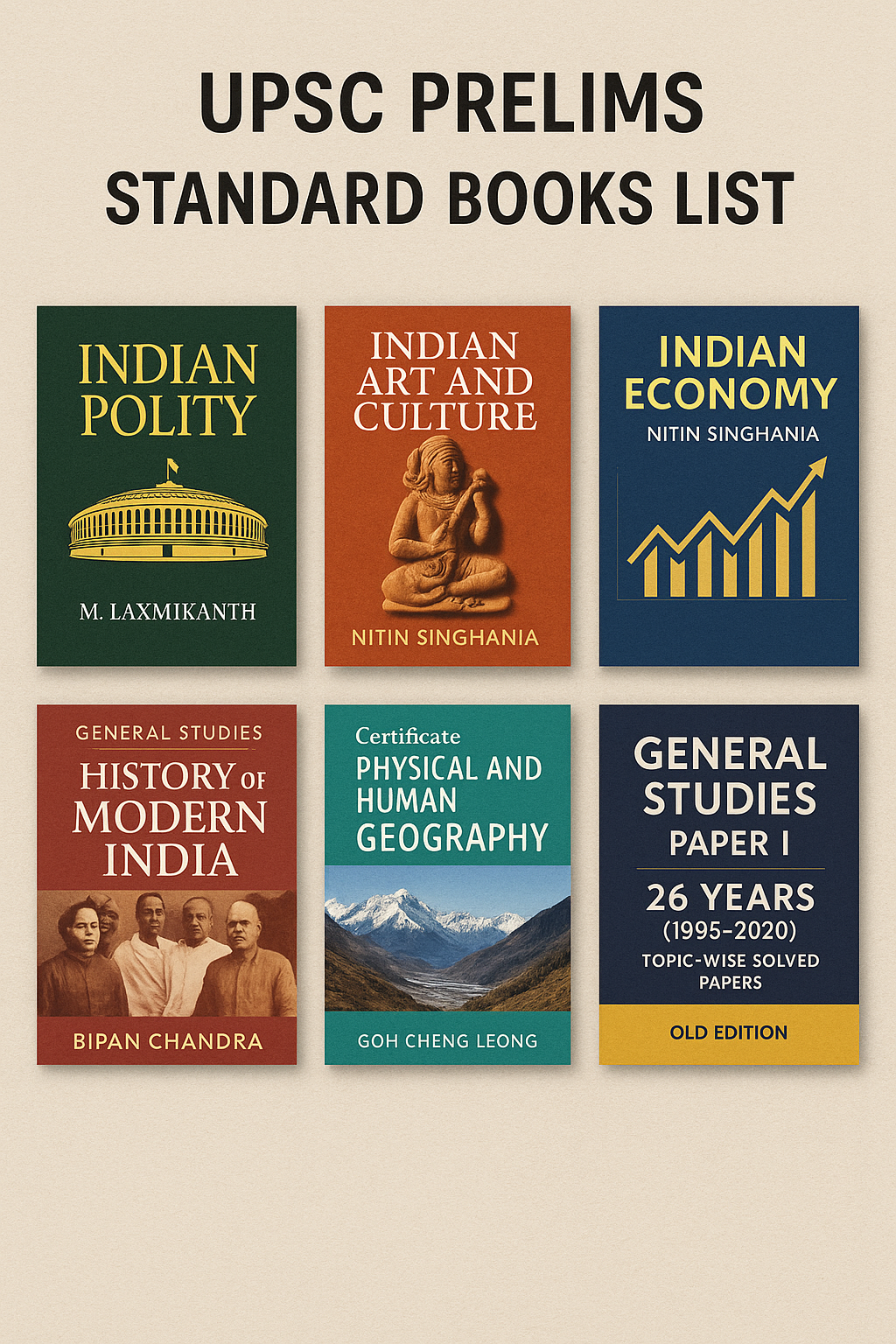
UPSC Prelims Standard Books
Preparing for the UPSC Civil Services Preliminary Exam requires a strong foundation in diverse subjects such as History, Geography, Polity, Economy, Environment, and Current Affairs. Choosing the right books is crucial for effective preparation, as they provide conceptual clarity and help cover the vast syllabus systematically.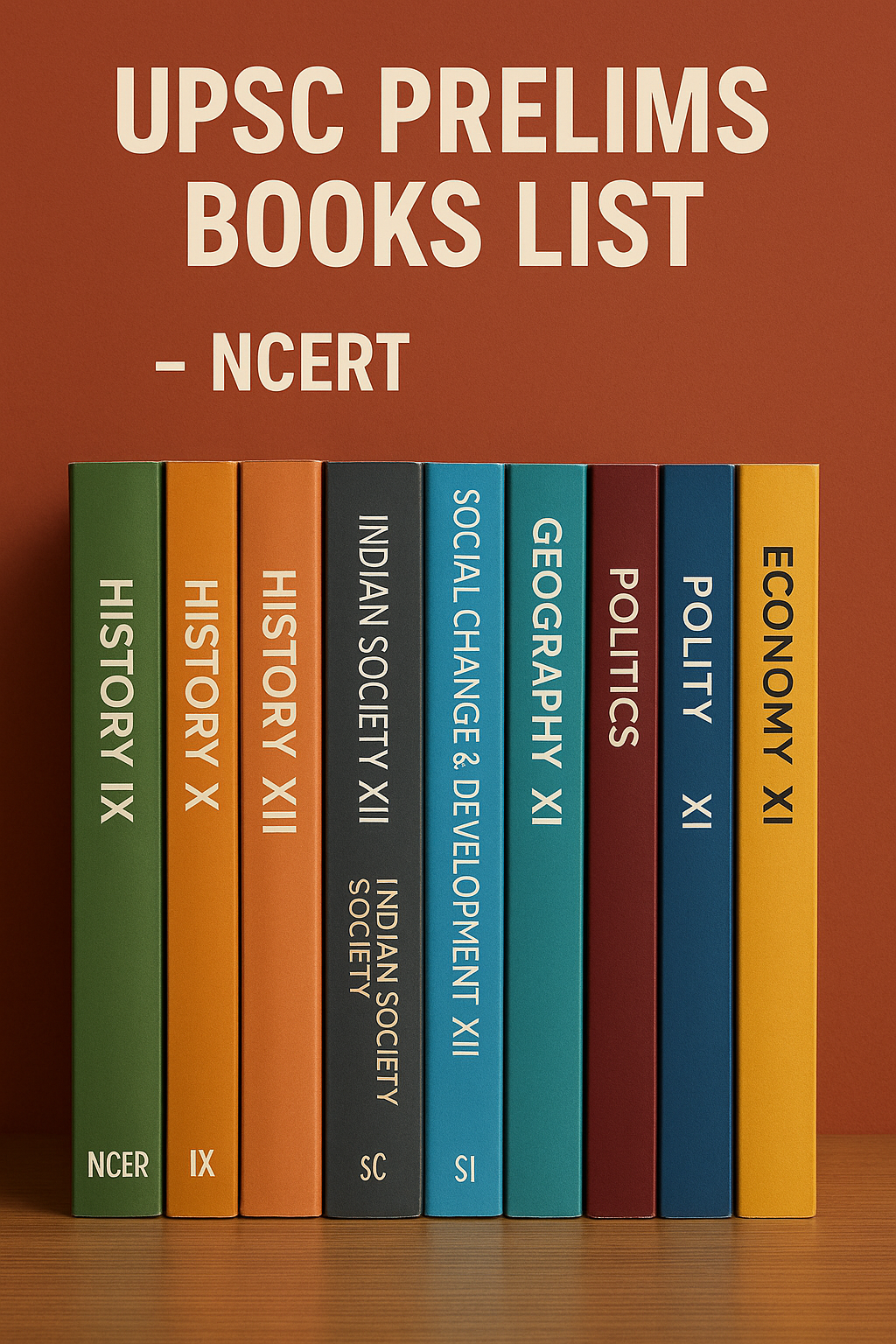
UPSC Prelims GS 1 Paper Books
The General Studies Paper 1 in UPSC Prelims covers a wide range of subjects including History, Geography, Polity, Economy, Environment, and Science. Selecting the right books helps aspirants build strong conceptual knowledge and prepare thoroughly for this diverse syllabus. Below is a list of essential books recommended for UPSC Prelims GS Paper 1 preparation.
|
Subject |
Books/Resources |
|
Polity |
Indian Polity by Laxmikanth |
|
Economy |
Indian Economy by Ramesh Singh, Mrunal.org articles, Macroeconomics – NCERT Class XII, Indian Economic Development – NCERT Class XI, Economic Survey (Selective reading from Prelims perspective), The Hindu, Internet (Arthapedia, Google, YouTube) |
|
Ancient History of India |
Old NCERT by RS Sharma |
|
Medieval History of India |
Old NCERT by Satish Chandra (Selective Reading) |
|
Modern History |
A Brief History of Modern India – Spectrum Publications, India’s Struggle for Independence – Bipan Chandra (Selective Reading), NCERT by Bipan Chandra (For the period 1700s to 1857) |
|
Indian Art and Culture |
An Introduction to Indian Art – Class XI NCERT, Chapters related to culture in Ancient and Medieval India NCERTs, Centre for Cultural Resource and Training (CCRT) material, Heritage Crafts: Living Craft Traditions of India – NCERT |
|
Environment and Biodiversity |
Shankar IAS book |
|
General Science |
General Science books – IX and X standard, The Hindu (For latest scientific terms, discoveries, and inventions), Google and YouTube |
|
Geography |
Fundamentals of Physical Geography XI NCERT, India: Physical Environment XI NCERT, Fundamentals of Human Geography XII NCERT, India: People and Economy XII NCERT, Certificate Physical and Human Geography: GC Leong, PMFIAS (Excellent resource for understanding complex topics), Google and YouTube |
|
Govt Schemes |
Govt schemes compilation by theIASHub |
|
General Trivia |
Any coaching material, Google (For global groupings, reports, institutions, rankings, etc.) |
|
Current Affairs |
The Hindu, Indian Express, PIB |
UPSC Prelims CSAT Books
The CSAT paper in UPSC Prelims tests candidates’ aptitude skills, including reasoning, comprehension, and basic numeracy. Choosing the right books is essential to strengthen these skills and clear the qualifying exam with ease. This list includes the most recommended books for effective preparation of the CSAT paper.
|
CSAT Book for UPSC |
Author |
Brief Description |
|
Analytic Reasoning |
M K Pandey |
Analytical Reasoning stands out as a top-recommended CSAT book for UPSC CSAT Paper, aiding aspirants in enhancing their analytical reasoning capabilities. The book is split into two distinct sections: Logic-based Reasoning and Rule-based Reasoning. |
|
Cracking the CSAT Paper |
Arihant Experts |
This book includes previous year question papers with solutions along with a set of 20 CSAT practice question papers. |
|
A Modern Approach to Verbal and Non-Verbal Reasoning |
RS Aggarwal |
The book helps the aspirants enhance their reasoning abilities. Consists of a wide range of reasoning-based questions along with their solutions and explanations. |
|
The Mantra of CSAT Paper II |
Gautam Puri |
This book helps you develop a strong foundation for the UPSC CSAT Paper. |
|
General Studies Paper II for UPSC Preliminary Examination |
Tata McGraw-Hill |
This book aims to deliver high-quality questions encompassing the complete UPSC CSAT syllabus. It includes all the previous year’s question papers and 15 CSAT practice papers designed according to the present patterns. |
|
CSAT Manual |
Pearson |
This book covers the CSAT practice questions for comprehension, logical reasoning, and mathematics. All the questions come with solved answers and explanations. |
UPSC Exam Mains Books
The UPSC Mains exam demands a deeper understanding of various subjects, including Essay, General Studies, and Optional Papers. Choosing the right books is crucial for developing analytical skills, enhancing answer-writing ability, and covering the vast syllabus comprehensively. Below is a list of recommended books to help aspirants prepare effectively for the UPSC Mains examination.
|
Subject |
UPSC Books |
|
History, Indian Heritage & Culture [GS Paper 1] |
|
|
Geography [GS Paper 1] |
|
|
Polity & International Relations [GS Paper 2] |
|
|
Economy [GS Paper 3] |
|
|
Ethics [GS Paper 4] |
|
|
Solved Papers |
|
UPSC Books For Optional Subjects
|
Agriculture |
|
|
Anthropology |
|
|
Botany |
|
|
Chemistry |
|
|
Economics |
|
|
History |
|
|
Management |
|
|
Mathematics |
|
|
Electrical Engineering |
|
|
Urdu |
|
|
Psychology |
|
UPSC Mains Books by TheIAShub
Preparing for the UPSC Mains Examination requires not just hard work, but also the right set of resources that offer clarity, depth, and exam-oriented content. TheIAShub has curated a range of high-quality books designed specifically to meet the demands of the UPSC Civil Services Mains exam. These books cover Essay, General Studies (GS I-IV), and Ethics with a structured approach, integrated current affairs, and model answers to enhance writing skills. Trusted by toppers and mentors alike, TheIAShub books aim to simplify complex topics, promote conceptual understanding, and support aspirants in building a strong foundation for mains success.
UPSC Exam Test Series
A well-structured UPSC test series is essential for effective UPSC preparation. It helps aspirants assess their knowledge, improve answer writing, manage time, and align their preparation with the actual exam pattern. Whether for Prelims or Mains, a good test series offers regular practice, detailed solutions, performance analysis, and insights into important topics. Joining a trusted UPSC test series can significantly boost confidence and readiness for the final exam.
Joining a test series for both Prelims and Mains is a vital step in UPSC preparation. It offers multiple benefits:
- Self-Assessment: Helps aspirants gauge their preparation level and readiness for the actual exam.
- Time Management: Improves speed and accuracy under timed conditions.
- Strategy Refinement: Enables candidates to adjust their study plan based on performance analytics and feedback.
- Confidence Building: Regular practice boosts confidence and reduces exam anxiety.
UPSC Mains Answer Writing
Answer writing is a crucial part of UPSC Mains preparation, and TheIAShub provides dedicated support through both free and paid initiatives. Their free daily answer writing platform helps aspirants build consistency, improve structuring, and get exposure to a variety of GS questions. For those seeking more in-depth guidance, TheIAShub offers a paid Mains Answer Writing Program with expert evaluation, detailed feedback, model answers, and mentorship. Whether beginner or advanced, aspirants can benefit from their structured approach to enhance writing skills and boost Mains performance.
UPSC Exam Mock Interview
The UPSC Mock Interview is a simulated version of the final Personality Test (Interview) stage of the UPSC exam. It is designed to prepare candidates by replicating the actual interview environment conducted by the UPSC panel of experts.
Benefits of Taking Mock Interviews
- Familiarity with the interview process reduces surprises and stress on the actual day.
- Helps avoid common mistakes such as overconfidence or excessive nervousness.
- Enables balanced and unbiased answers by practicing diverse question types.
- Strengthens interpersonal and social skills essential for the Personality Test.
- Provides a platform for self-assessment and continuous improvement.
TheIAShub offers a well-structured Mock Interview Program to help aspirants prepare for the final stage of the UPSC UPSC exam – the Personality Test. This program includes mock interviews with experienced panel members, personalized feedback, and guidance on body language, clarity of expression, and current affairs-based questions.
Commonly asked Questions
Previous Year Question Papers (PYQs)
Previous Year Question Papers (PYQs) for both UPSC Prelims and Mains are crucial resources for aspirants. Solving Prelims PYQs helps candidates understand the exam pattern, types of questions, and manage their time effectively. This practice enables focused and efficient preparation for the objective stage of the exam.
Previous Year Question Papers (PYQs) for both UPSC Prelims and Mains are crucial resources for aspirants. Solving Prelims PYQs helps candidates understand the exam pattern, types of questions, and manage their time effectively. This practice enables focused and efficient preparation for the objective stage of the exam.
On the other hand, Mains PYQs assist candidates in practicing detailed answer writing and identifying important topics from the syllabus. Working through Mains PYQs improves conceptual clarity and helps develop answers that meet the exam’s expectations.
Regular practice of PYQs from both stages significantly enhances performance and boosts confidence for the exam.
Last Ten Years UPSC Prelims Previous Year Papers PDF
Last 5 Years UPSC Mains Previous Year Papers PDF
|
UPSC Topper Last 5 Years
The UPSC UPSC exam is one of the toughest and most prestigious exams in India. Each year, thousands of candidates appear for it, but only a few emerge as toppers by securing the highest ranks. Knowing about the toppers of the last five years can inspire aspirants and provide valuable insights into their preparation strategies, educational backgrounds, and key qualities that led to their success.
|
Year |
Name |
State |
Optional Subject |
Service |
|
2024 |
Shakti dubey |
Uttar Pradesh |
Political Science and IR |
IAS |
|
2023 |
Aditya Srivastava |
Uttar Pradesh |
Electrical Engineering |
IAS |
|
2022 |
Ishita Kishore |
Delhi |
Political Science and IR |
IAS |
|
2021 |
Shruti Sharma |
Uttar Pradesh |
History |
IAS |
|
2020 |
Shubham Kumar |
Bihar |
Anthropology |
IAS |
|
2019 |
Pradeep Singh |
Haryana |
Public Administration |
IAS |
|
2018 |
Kanishak Kataria |
Rajasthan |
Mathematics |
IAS |
|
2017 |
Anudeep Durishetty |
Telangana |
Anthropology |
IAS |
|
2016 |
Nandini K.R. |
Karnataka |
Kannada Literature |
IAS |
|
2015 |
Tina Dabi |
Delhi |
Political Science and IR |
IAS |
|
2014 |
Ira Singhal |
Delhi |
Geography |
IAS |
|
2013 |
Gaurav Agrawal |
Rajasthan |
Economics |
IAS |
UPSC Cut Off Last 5 Years
The UPSC UPSC exam cut-off marks vary each year based on factors like exam difficulty, number of vacancies, and candidate performance. Understanding the cut-off trends for both Prelims and Mains over the last five years can help aspirants set realistic targets and strategise their preparation accordingly.
UPSC Prelims Cut Off Last 5 Years
The Prelims cut-off is the minimum qualifying marks required to clear the Preliminary exam and move on to the Mains stage. It is released separately for General, OBC, SC, ST, and other categories.
|
Category |
2023 |
2022 |
2021 |
2020 |
2019 |
|
General |
75.41 |
88.22 |
87.54 |
92.51 |
98 |
|
OBC |
74.75 |
87.54 |
89.12 |
89.12 |
95.34 |
|
ST |
47.82 |
69.35 |
70.71 |
68.71 |
77.34 |
|
SC |
59.25 |
74.08 |
75.41 |
74.84 |
82 |
|
PWD 1 |
40.4 |
49.84 |
68.02 |
70.06 |
53.34 |
|
PWD 2 |
47.13 |
58.59 |
67.33 |
63.94 |
44.66 |
|
PWD 3 |
40.4 |
40.4 |
43.09 |
40.82 |
61.34 |
|
PWD 5 |
33.68 |
41.76 |
45.8 |
42.86 |
61.34 |
|
EWS |
68.02 |
82.83 |
80.14 |
77.55 |
90 |
UPSC Mains Cut Off Marks For The Last 5 Years
The Mains cut-off is the total score from all written papers (excluding the qualifying language papers) that candidates must achieve to be shortlisted for the Interview/Personality Test.
|
Category |
2023 |
2022 |
2021 |
2020 |
2019 |
|
General |
741 |
748 |
745 |
736 |
751 |
|
OBC |
712 |
714 |
707 |
698 |
718 |
|
SC |
694 |
699 |
700 |
680 |
706 |
|
ST |
692 |
706 |
700 |
682 |
699 |
|
PWD 1 |
673 |
677 |
688 |
648 |
663 |
|
PWD 2 |
718 |
706 |
712 |
699 |
698 |
|
PWD 3 |
396 |
351 |
388 |
425 |
374 |
|
PWD 5 |
445 |
419 |
560 |
300 |
561 |
|
EWS |
706 |
715 |
713 |
687 |
696 |
UPSC Final Cut Off Marks For The Last 5 Years
The final cut-off marks include the total scores of Mains + Interview and indicate the minimum marks required to get selected for the service.
|
Category |
2023 |
2022 |
2021 |
2020 |
2019 |
|
General |
953 |
960 |
953 |
944 |
961 |
|
OBC |
919 |
923 |
910 |
907 |
925 |
|
SC |
890 |
893 |
886 |
875 |
898 |
|
ST |
891 |
900 |
883 |
876 |
893 |
|
PWD 1 |
894 |
879 |
892 |
867 |
861 |
|
PWD 2 |
930 |
913 |
932 |
910 |
890 |
|
PWD 3 |
756 |
632 |
689 |
675 |
653 |
|
PWD 5 |
589 |
590 |
701 |
465 |
708 |
|
EWS |
923 |
926 |
916 |
894 |
909 |
Registration
Exam Date
Results
Cutoff
Counselling
- On 25 April 2024, the UPSC Annual Calendar 2025 was officially released.
- The UPSC Revised Calendar 2025 was released later on 22 August 2024.
- The UPSC Notification 2025 was released on 22 January 2025.
- The UPSC Vacancy 2025 included 1129 total posts, out of which 979 were for UPSC CSE and 150 for UPSC IFoS.
- The UPSC application process for 2025 began on 22 January 2025.
- The last date to fill the UPSC application form was initially 11 February 2025.
- The UPSC last date to fill the form was extended to 21 February 2025.
- The UPSC Correction Window 2025 was open from 22 February to 28 February 2025
- The UPSC Prelims Admit Card 2025 was released on 13 May 2025.
- The UPSC Prelims Exam 2025 was conducted on 25 May 2025.
- The UPSC DAF-I (Detailed Application Form) 2025 is yet to be announced.
- The UPSC Mains Exam 2025 is scheduled to begin on 22 August 2025.
- The UPSC CSE Result 2024 was declared on 22 April 2025.
- On 25 April 2025, UPSC released the UPSC marksheets 2024 of all qualified candidates from UPSC CSE 2024.
- Shakti Dubey was declared the UPSC Topper 2024 with AIR 1 in the UPSC Civil Services Examination 2024.
- The UPSC Exam Calendar 2026 was also released, stating that the UPSC Prelims 2026 will be held on 24 May 2026.
- The UPSC Mains Exam 2026 is scheduled to begin from 21 August 2026.

UPSC Preparation Courses

2026 UPPCS Integrated English QEP B3
View Details
2026 UPPCS Integrated Hindi QEP B3
View Details
2026-27 UPSC Mains English QEP Power Pages
View Details
2026-27 UPSC Mains English QEP Power Pages
View DetailsSubmit Your Details to Learn More



0 Comment