
- UNSC Reforms: Long Time Change Needed
- India-EU FTA Talks
- Coal Gasification
- India becomes Global Leader in Fast Payments
- AdFalciVax
- INS Sandhayak: Strengthening Maritime Cooperation
- IT 2.0 APT (Advanced Postal Technology) Application
- Grandala: A Rare Bird Sighted
- GenTIGS
- Bitra Island
- BioEmu (Biomolecular Emulator): An AI learning Tool
- SIMBEX
1. UNSC Reforms: Long Time Change Needed
Context
- India has called for urgent and time-bound UN Security Council reforms while reiterating its strong commitment to the implementation and review of the “Pact for the Future” agreement to strengthen global cooperation.
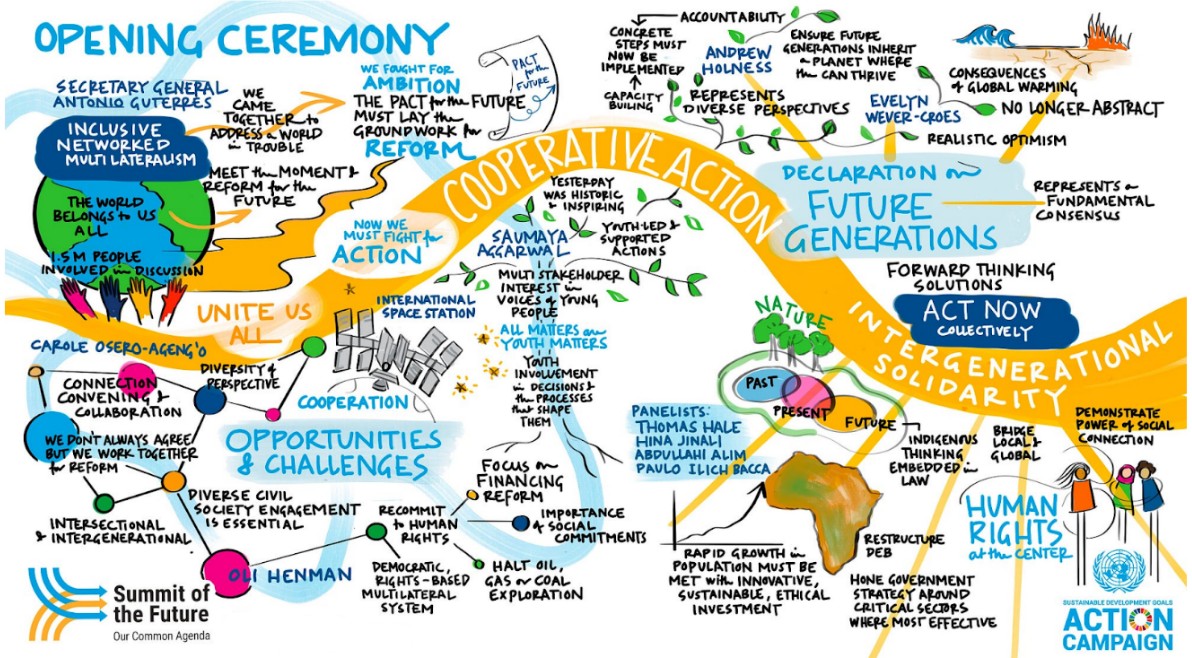
About Pact for the future: What is it?
- It was adopted at the UN “Summit of the Future”, September 2024.
- A non-binding yet significant political declaration among UN Member States.
- Its aim is to strengthen multilateralism, improve global cooperation, and tackle present and emerging global challenges.
About United Nations Security Council
- The UN Security Council is one of the six principal organs of the United Nations, entrusted with the primary responsibility of maintaining international peace and security.
- The Council comprises 15 members in total:
- 5 permanent members (P5): China, France, Russia, the United Kingdom, and the United States.
- These nations possess veto power, enabling any one of them to block the adoption of substantive resolutions.
- 10 non-permanent members, elected by the UN General Assembly for two-year terms, based on regional representation.
- Notably, over 50 UN member states have never served as members of the Security Council.
Need for Reform in UNSC
- The UNSC has failed to take timely and unified actions on pressing global crises like the COVID-19 pandemic, Climate-induced security threats, etc
- To make the UNSC more Inclusive and Representative.
- The current structure does not reflect the democratic values of a
- multipolar world.
- Expanding the Council is essential to building a fairer and more equitable
- international governance system.
- There is inadequate representation from Asia, Africa, Latin America, and the Caribbean, regions home to the majority of the global population.
- The Council's inability to act decisively in situations involving P5 interests (e.g., the Ukraine war, the Israel-Gaza conflict) has eroded global trust.
- The veto-wielding power of the P5 often paralyses the Council.
- The decision-making process is still rooted in the post-WWII power structure, which no longer reflects today’s world dynamics.
India Demand for Permanent membership of UNSC
- India is a founding member of the UN and has served on the UNSC eight times as a non-permanent member.
- India consistently supports the interests of developing nations, particularly in Asia, Africa, and Latin America. India champions a balanced and equitable world order.
- With its strategic location in the Indian Ocean, India plays a key role in maritime security and acts as a net security provider in the IndoPacific.
- India is the 4th largest economy in the world and most populous country in the World.
- India has been an active member of the UN and has participated actively in UN peacekeeping operations around the globe.
- India is also the Largest Democracy in the world and permanent membership will strengthen the Voice Of Democracy at global Level.
Challenges in Reforming the UNSC
- A two-thirds majority in the UN General Assembly (129 of 193 members), and Ratification by two-thirds of UNSC members, including all P-5 nations which makes the amendment process very cumbersome and difficult.
- The P-5 countries (the US, UK, France, Russia, China) are reluctant to dilute their privileged position.
- Lack of Consensus Among Member States.
- Size of expansion in both permanent and non-permanent categories.
- Regional representation (e.g., who should represent Asia, Africa, Latin America)
- Whether new permanent members should have veto powers.
India’s Efforts for UNSC Reform
- India has actively participated in the Inter-Governmental Negotiations (IGN)—the official UN platform for discussions on UNSC reform.
- India has consistently demanded expansion in both permanent and non-permanent categories, and enhanced representation for developing countries, especially from Asia, Africa, and Latin America.
- India is a founding member of the G4 grouping, along with Japan, Brazil, and Germany.
- These four nations support each other’s candidatures for permanent membership and advocate for comprehensive reforms in the Council.
- India is also part of the L.69 Group. This group seeks to enhance the voice and representation of developing nations in global decisionmaking, especially within the UNSC.
Way Forward
- Ensure greater representation from Africa, Asia-Pacific, Latin America, and the Caribbean to enhance the Council’s legitimacy and inclusivity.
- Transition the Intergovernmental Negotiations (IGN) process into formal text-based negotiations to move beyond general statements and develop actionable proposals.
- Support G4’s proposal for a new category of longer-term nonpermanent seats as a transitional arrangement.
- Reform representation based on financial, military, and peacekeeping contributions.
- Countries like Germany, Japan, and India, being major contributors, should have a larger say in global decision-making.
2. India-EU FTA Talks
Context
- India and the European Union (EU) have made notable headway in the 12th round of Free Trade Agreement (FTA) negotiations, with the digital trade chapter finalised in principle and substantial progress achieved on services and investment chapters.
Key Highlights
- Digital Trade Chapter – A milestone development: It covers cross-border data flows, crucial for e-commerce and digital services.
- Significance: A key enabler for India’s IT and digital economy to scale up and integrate with the global services ecosystem.
- Pending disclosure: Textual positions of both parties are yet to be made public.
India-EU FTA Overview
- Negotiation Resumption: Talks resumed in June 2022 after an 8-year hiatus (stalled in 2013 due to market access disagreements).
- Objective: To finalize a comprehensive trade agreement covering goods, services, investments, and geographical indications.
- Negotiation Structure: The agreement will be concluded in two phases, following India’s phased approach used in previous FTAs (e.g., with Australia).
- This is partly due to the volatile global trade environment, including US tariff actions.
India-EU Services and Investment Integration
- EU’s objective: To eliminate “discriminatory and disproportionate obstacles” for EU service providers.
- India’s advantage: Rapidly expanding IT and financial services sectors could benefit from increased EU investment.
Cross-Border Data Flow – Strategic and Contested
- Global context: Cross-border data flows are critical in the age of Artificial Intelligence (AI), the Fourth Industrial Revolution’s cornerstone.
- India’s position: Resistant to diluting data localisation norms, emphasizing policy space, privacy, and cyber sovereignty.
- India’s policy stance: India has traditionally resisted altering its stance on data localisation under any plurilateral agreements at the World Trade Organization (WTO) to preserve policy space.
- The Reserve Bank of India’s (RBI) 2018 norms: Made it mandatory for payment system providers such as Mastercard and Visa to store payment data of Indian residents within the country.
- UN Conference on Trade and Development’s (UNCTAD) 2018 report: Stressed data’s strategic value and endorsed localisation for development and regulatory oversight.
India-EU Relations
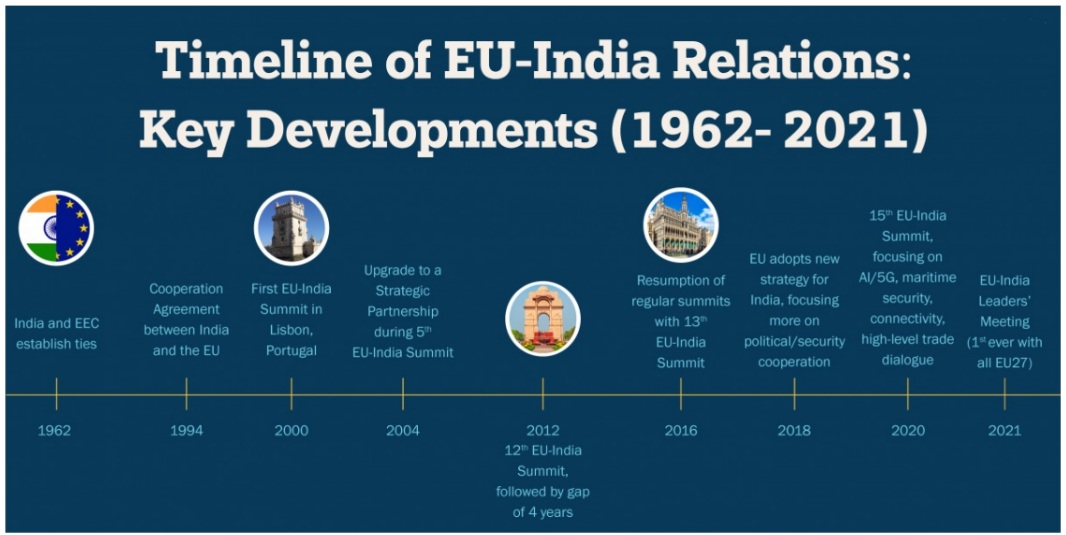
- Political cooperation: India-EU relations date to the early 1960s, and a cooperation agreement signed in 1994 took the bilateral relationship beyond trade and economic cooperation.
- The first India-EU Summit, in 2000, marked a watershed in the evolution of the relationship.
- At the 5th India-EU Summit at The Hague in 2004, the relationship was upgraded to a ‘Strategic Partnership’.
- Economic cooperation : India’s bilateral trade in goods with the EU was USD 137.41 billion in 2023-24, making it the largest trading partner of India for goods.
- EU is India’s largest trading partner for goods, 17% of India’s exports go to the EU and 9% of EU exports come to India.
- Other areas of cooperation:
- The India-EU Water Partnership (IEWP), established in 2016, aims to enhance technological, scientific, and policy frameworks in water management.
- In 2020, there was an agreement for research and development cooperation in the peaceful uses of nuclear energy between the European Atomic Energy Community and the Government of India.
- India and the EU established the Trade and Technology Council (TTC) in 2023. The TTC is a forum for the two parties to collaborate on trade, technology, and security. The TTC’s goals.
Way Forward
- The recent progress in India-EU FTA negotiations represents a turning point, particularly in digital trade and investment.
- By balancing economic integration with regulatory sovereignty, India seeks to unlock growth opportunities while preserving national interests — a delicate equilibrium that aligns with its broader trade and digital strategy in the evolving global order.
3. Coal Gasification
Context
- Recently Union Minister of Coal and Mines Shri G. Kishan Reddy in a written reply in Rajya Sabha gave information about Coal Gasification and steps taken by the government to promote the same.
About Coal Gasification
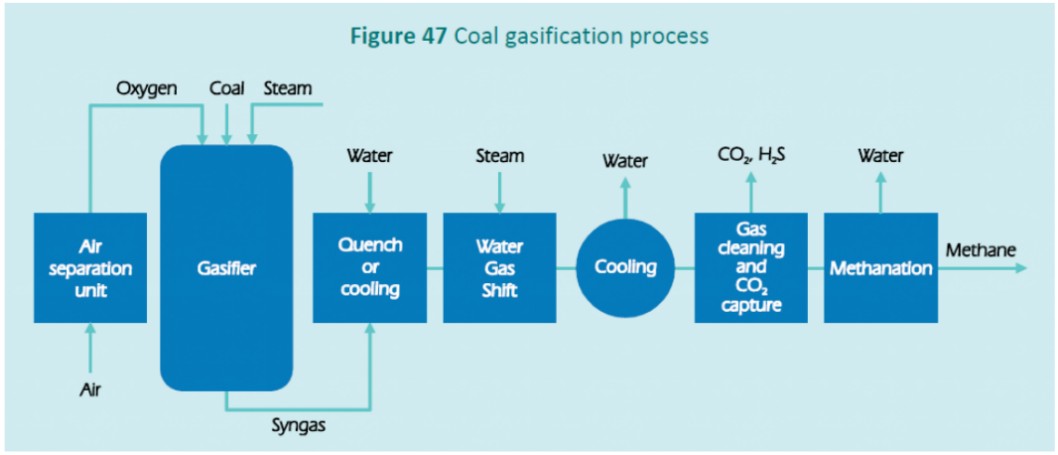
- It is a process in which coal is partially oxidised with air, oxygen, steam or carbon dioxide to form a fuel gas.
- This gas is then used instead of piped natural gas , methane and others for deriving energy.
- India has a reserve of 307 Billion tonnes of thermal coal and about 80% of coal produced is used in thermal power plants.
- With environmental concerns and the development of renewable energy, diversification of coal for its sustainable use is inevitable.
Benefits of Coal Gasification
- It is considered as a cleaner option compared to the burning of coal and it facilitates utilization of the chemical properties of coal.
- It produces SynGas that is usable in producing Synthetic Natural Gas (SNG), energy fuel (methanol & ethanol), ammonia for fertilizers and petro-chemicals.
- These products will help move towards self-sufficiency under Atmanirbhar Bharat Abhiyaan.
- Steel companies typically use coking coal in their manufacturing process.
- Most of the coking coal is imported and is expensive. To cut costs, plants can use syngas, which comes from coal gasification plants in the place of coking coal.
Steps by Government
- The Government has approved investment by Coal India Limited (CIL) in joint ventures of Coal India Limited - Bharat Heavy Electricals Limited (CIL-BHEL) and Coal India Limited - Gas Authority of India Limited (CIL-GAIL) for undertaking coal gasification projects. Both JV companies have now been established.
- Setting up of National Coal Gasification Mission
- In order to create awareness among all stakeholders and to prepare an implementable road map with specific responsibilities, the Ministry of Coal has decided to set up the National Coal Gasification Mission. The Mission is created with an aim to take up following objectives which are required for the vision of achieving 100 MT coal gasification by 2030.
- In 2022, a new sub-sector, "Production of Syngas leading to coal gasification," was created under the Non-Regulated Sector (NRS) linkage auctions policy to support coal gasification initiative.
- A 50% rebate in the revenue share for coal used in gasification has been introduced in commercial coal block auctions, provided that at least 10% of the total coal production is used for gasification purposes.
- NITI Aayog is presently exploring a roadmap and suitable technology options for surface coal gasification in the Indian context. In this perspective, a Technical Committee on Surface Coal Gasification has been constituted by (S&T), NITI AAYOG.
|
Coal gasification usage in other countries
|
Concerns
- According to a recent assessment, coal gasification actually produces more carbon dioxide than a conventional coal-powered thermal power plant.
- The coal gasifiers using steel plants have higher greenhouse gas emissions than many of their counterparts.
- Their emissions range from 2.8-3.1 tonnes of CO2 per tonne of steel manufacture while the sector average emissions is only 2.5.
- Coal gasification plants are costlier than conventional power plants. Since, coal is the main feed for gasification, it, in no way helps in India’s decarbonisation goals.
- International Studies :
- A recent study by Princeton University in the United States found that using synthetic natural gas for residential cooking and heating, for electricity generation, or for industrial heat generation, results in 10, 40 and 70 per cent more CO2 emissions than directly burning coal that provides the same amount of energy in each sector.
- According to a study by Duke University in the US, the syngas process converts a relatively high-quality energy source (coal) to a lower quality state (gas) and consumes a lot of energy in doing so.
- Thus, the efficiency of conversion is also low.
Way Forward
- Coal gasification projects will need a dedicated infrastructure to be able to get them on the ground.
- Availability of basic facilities such as land, water and feedstock, which is coal, is extremely important for these projects to get kick-started.
- The National Coal Gasification Mission’s objective to gasify 100 MT of coal will definitely require collaboration amongst the Government at various levels – Central, State and Local.
- The Government would need to take some major and path breaking policy decisions to create a technologically and economically feasible environment to push coal gasification in India.
- There have been numerous research efforts going on in different universities, laboratories, and PSU’s sporadically on the coal gasification process.
- There is an urgent need to consolidate all of them and bring them under one umbrella to avoid reinventing the wheel and have better collaboration.
4. India becomes Global Leader in Fast Payments
Context
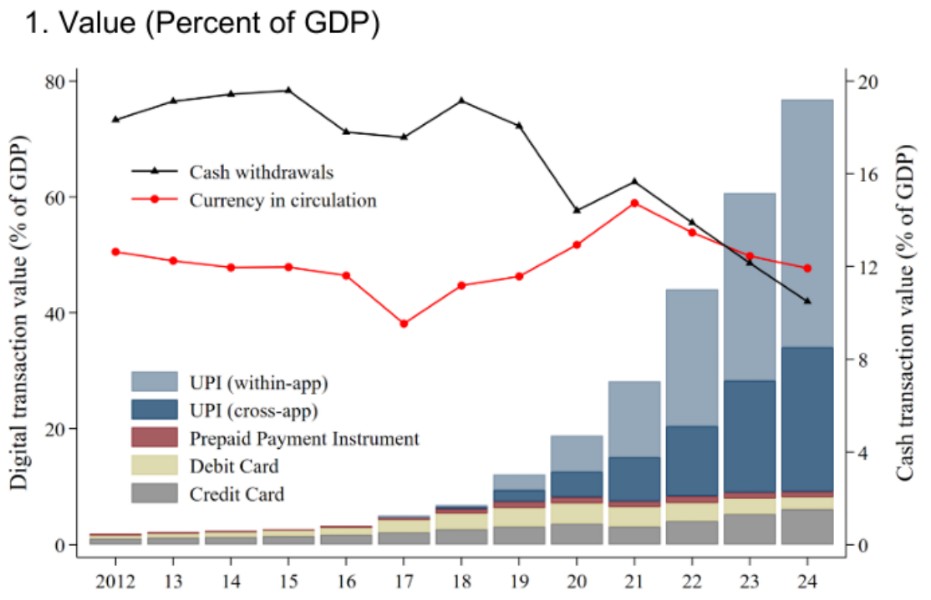
- India has become the global leader in real-time payments as UPI processed 18.39 billion transactions in June 2025, according to an IMF-supported report.
About Report
- Jointly developed by the International Monetary Fund (IMF) and FIS Global, this Fast Payments Report 2025 analyses global public digital infrastructure.
- Faster Payment Adoption Score (FPAS) to benchmark digital payment adoption is a new metric used by the report.
Achievements of India
- India leads 30 countries, surpassing Brazil, Singapore, UK, and USA.
- Processes over 640 million transactions daily, serving 491 million individuals and 65 million merchants via 675 banks, showing India’s UPI scale.
- Delivers payments within 5 seconds, with near-zero cost per transaction.
- UPI is now operational in 7 countries, including France, UAE, and Singapore.
About Unified Payments Interface (UPI) and its Features
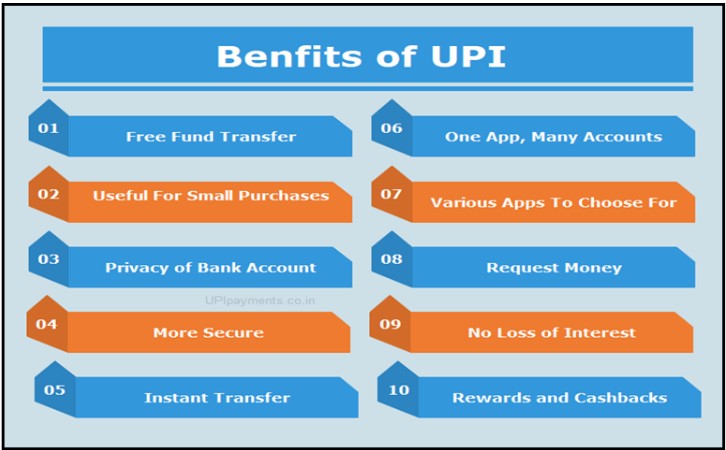
- UPI powers multiple bank accounts into a single mobile application (of any participating bank), merging several banking features e.g., transfer of funds, etc.
- It was developed by NPCI in 2016 and built over Immediate Payment Service (IMPS) infrastructure.
- It is the most successful real-time payment system globally, providing simplicity, safety, and security in person-to-person (P2P) and person-to-merchant (P2M) transactions in India.
|
About National Payments Corporation of India (NPCI)
|
Features of India UPI System
- Unified interface across banks and apps like PhonePe, GPay, Paytm which provides Interportability.
- Aadhaar-linked, USSD-enabled, multilingual access—enabling rural digital payments enabling Inclusiveness.
- Real-time fraud detection, tokenisation, and regulatory compliance complying security protocols.
Limitation of UPI
- Regulation: Expanding UPI to accommodate a global user base will require adhering to data protection, financial laws and regulations of different countries posing regulatory and compliance challenges.
- Also, significant scalability in terms of software, network and partner banks is required.
- Dominance of Foreign-owned UPI Apps: Parliamentary panel’s report, ‘Digital Payment and Online Security Measures for Data Protection’ recently highlights that foreign entities like PhonePe and Google Pay dominate the Indian fintech sector.
- Security and Fraud: Cybercriminals may exploit vulnerabilities in the system or use social engineering techniques to gain access to sensitive information leading to financial losses.
|
Initiatives to promote UPI UPI for secondary market: Introduced by NPCI to enhance the ease of equity trading in the country. UPI Chalega Campaign: Launched by NPCI to promote UPI as an easy, safe, and instant mode of payment. It also educates users about various features such as UPI LITE that enables swift low value transactions. MoU between Google India Digital Services and NPCI International Payments: To broaden use of UPI payments, enabling travellers to make transactions abroad and ease remittances process between countries. India’s UPI in overseas markets: Various countries like Oman, UAE, France, Nepal, Bhutan etc. are using UPI system for payment. UPI 123PAY: It is an instant payment system for feature phone users who can use UPI payment service in a safe and secure manner. |
Way Ahead
- Regulation: A collaborative approach among nations, partnership among financial institutions, service providers etc. is required to develop a uniform compliance and regulatory framework among the partner nations.
- Infrastructure: Banks and Payment service providers need to expand their infrastructure in terms of software, network etc. to process higher transactions per second and accommodate a global user base.
- Fraud Protection: A collaborative effort between UPI service providers, banks, and users is required to identify and respond to UPI frauds.
5. AdFalciVax
Context
- Recently, the Indian Council of Medical Research (ICMR) invited domestic vaccine manufacturers to collaborate on the commercial rollout of its newly developed malaria vaccine, AdFalciVax.
About AdFalciVax
- A next-generation vaccine developed using recombinant DNA technology to elicit a strong immune response.
- Dual Protein Targets: It expresses two key proteins of the malaria parasite, aiming for enhanced protection compared to current vaccines that target only parasite fragments.
- Full-Length CSP Gene: The vaccine includes the complete gene for the circumsporozoite protein (CSP), a major surface protein of Plasmodium falciparum, the deadliest malaria parasite. This is expected to generate a more robust and long-lasting immune response.
- Transmission Blocking Component: AdFalciVax also includes a second component aimed at disrupting the parasite's lifecycle within the mosquito, thereby reducing community-level transmission.
- The vaccine has been developed by the ICMR-Regional Medical Research Centre (RMRC), Bhubaneswar.
Current WHO-approved Vaccines
- Existing vaccines like RTS,S/AS01 (Mosquirix) and R21/Matrix-M mainly target Plasmodium falciparum, the most lethal malaria parasite.
India's Dual Burden
- India faces a significant malaria burden not only from P. falciparum but also from Plasmodium vivax, which is known for causing recurring infections.
- Upcoming versions of AdFalciVax may aim to broaden protection to include other malaria-causing parasites such as P. vivax, P. malariae, P. ovale, and the zoonotic P. knowlesi.
6. INS Sandhayak: Strengthening Maritime Cooperation
Context
- Recently, in a major step towards strengthening maritime cooperation in Southeast Asia, the Indian Navy's 1st indigenously built Survey Vessel Large (SVL), INS Sandhayak, made its maiden port call at Port Klang, Malaysia.
About INS Sandhayak
- The first indigenously designed and built vessel of the Sandhayak-class, constructed by Garden Reach Shipbuilders & Engineers (GRSE), Kolkata.
Multi-Role Capabilities
- Equipped for full-scale coastal and deep-water hydrographic surveys, oceanographic data collection, search and rescue (SAR) missions, and humanitarian assistance with onboard helicopter and hospital facilities.
- Primary Mission: To conduct hydrographic surveys for ports, harbour approaches, navigational channels, and routes extending up to the Exclusive Economic Zone (EEZ) and extended continental shelf. •
- Secondary Role: Functions as a hospital ship or offers limited defence support during emergencies or wartime scenarios.
- Advanced Technologies Onboard: Features cutting-edge hydrographic tools such as a Data Acquisition and Processing System, Autonomous Underwater Vehicle, Remotely Operated Vehicle, DGPS long-range positioning systems, and digital side-scan sonar.
- Performance: Powered by two diesel engines, the ship can achieve speeds exceeding 18 knots.
7. IT 2.0 APT (Advanced Postal Technology) Application
Context
- Recently, the Department of Posts launched its next-generation IT 2.0 APT application, aimed at modernising and transforming India's postal ecosystem.
About IT 2.0 AРT Application
- Aims to improve user experience with a more intuitive interface, faster service delivery, and a secure, efficient backend for postal operations.
- Comprehensive Digital Integration: Will support real-time, transparent, and standardised services such as parcel booking, tracking, savings accounts, mail delivery, and grievance redressal.
- Deployment Plan: Includes a scheduled downtime across 36 post offices in Delhi to enable data migration, system validation, and final rollout.
- Focus on Efficiency and Accessibility: Seeks to transform India Post into a technology-driven logistics and financial services provider while ensuring universal access, especially in rural and semi-urban areas.
- Commitment to Digital Governance: Reinforces India Post's role in creating a digitally empowered postal network that supports seamless citizen-centric services.
8. Grandala: A Rare Bird Sighted
Context
- Recently, a rare electric-blue bird, the Grandala, was spotted in the Sainj Valley of Himachal Pradesh. This striking species is known for its vibrant plumage and limited sightings in the region.
About Grandala
- A unique bird species in the thrush family (Turdidae), and the only species in the genus Grandala.
- Diet & Lifestyle: It is an arboreal insectivore, primarily feeding on insects in trees.
- Geographic Range: Found across the northeastern Indian subcontinent and nearby regions, including Bhutan, India, Nepal, Myanmar, and parts of China like Tibet.
- Preferred Habitat: Inhabits alpine and subalpine zones, typically at elevations of 3,000 5,000 meters.
Features and Size
- Body length ranges from 20.5 to 23 cm; weight between 38 to 52 grams.
- Male Plumage: Striking blue-gray body with black wings and tail.
- Female Plumage: Brownish body with white stripes, gray-blue rump, and white-tipped wing feathers.
- Flocking Behavior: Known for forming large flocks, sometimes up to 200 birds especially during the non-breeding season.
- IUCN Red List: Classified as Least Concern
9. GenTIGS
Context
- Recently, the Tata Institute for Genetics and Society (TIGS), Bengaluru, developed GenTIGS, a gene database aimed at facilitating the early identification and diagnosis of rare genetic disorders.
About GenTIGS
- An integrated gene database that catalogs genes and pathogenic variants linked to rare genetic disorders (RGDs).
- It is designed to simplify access and analysis of data related to RGDs and their associated genetic mutations, such as: Nonsynonymous mutations, Microsatellites and Gene duplications.
Key Information Provided
- Globally and Indian-prevalent rare genetic disorders
- Causative genes and specific mutations
- Descriptions of the disorders
- Gene Ontology (GO) terms
- Clinical interpretations and Cross-references to external genomic databases.
Features
- Offers flexible search options and a user-friendly browser.
- Includes hyperlinks to various external datasets for in-depth exploration.
- Supports both experimental and computational research on rare disorders.
Built using data from
- Published scientific research
- Existing genomic databases
- The latest Human Genome sequence data
- Variants in GenTIGS are mapped to understanding of disease associations IndiGenomes metadata for accurate annotation and understanding of disease associations.
10. Bitra Island
Context
- Recently, in a move with significant implications for the Lakshadweep archipelago, the administration has been considering the acquisition of Bitra Island for defence and strategic purposes.
About Bitra Island
- Lies in the northern part of the Lakshadweep archipelago and is the smallest inhabited island in the Union Territory.
- A shrine dedicated to Malik Mulla, an Arab saint believed to be buried on the island, serves as a pilgrimage site.
- Historically, the island was known as a breeding ground for numerous seabirds.
- Climate: Closely resembles that of Kerala. The hottest months are from March to May, with temperatures ranging between 25°C and 35°C. 7.
- Humidity remains high, typically ranging from 70% to 76% throughout the year.
- Strategic Significance: If acquired for defence, Bitra would become the third island Lakshadweep to host a military base.
- Currently, the archipelago has two naval bases: INS Dweeprakshak in Kavaratti (UT capital) in INS Jatayu in Minicoy
11. BioEmu (Biomolecular Emulator): An AI learning Tool
Context
- Recently, BioEmu, a new Al-powered deep learning tool, was developed by Microsoft, Rice University (USA), and Freie Universität (Germany).
About BioEmu
- An advanced generative deep learning system designed to predict the diverse shapes a protein can adopt under biological conditions.
Working
- BioEmu models the equilibrium distribution of protein structures, given an amino acid sequence.
- It is capable of predicting the entire range of conformations that a protein may naturally explore.
- Compared to traditional molecular dynamics (MD) simulations, BioEmu is significantly faster, cheaper, and scalable.
Applications and Performance: It effectively captures
- Large conformational shifts in enzymes
- Local unfolding events that regulate protein activity
- Fleeting cryptic pockets, which are potential drug binding sites (e.g., in the cancer-linked Ras protein)
Accuracy
- Predicts 83% of large structural shifts
- Predicts 70-81% of small changes, including the open and closed forms of adenylate kinase
- It can also analyze proteins with no fixed 3D structure and assess how mutations impact stability.
Efficiency
- Capable of producing thousands of protein conformations in minutes to hours on a single GPU, enabling high-resolution protein flexibility modeling at scale.
12. SIMBEX
Context
- Recently, the Indian Navy announced its participation in the 32nd edition of SIMBEX (Singapore-India Maritime Bilateral Exercise), previously known as Exercise Lion King.
About SIMBEX
- Conducted every year between the Indian Navy and the Republic Singapore Navy (RSN)
Background
- Initiated in 1994, it has grown into one of the most comprehensive bilateral maritime engagements of the Indian Navy.
Significance
- Supports India's Act East Policy and Vision SAGAR (Security and Growth for All in the Region).
- Enhances maritime cooperation, interoperability, and regional stability.
Other Bilateral Defence Engagements with Singapore
- Exercise AGNI WARRIOR - Army-level joint training.
- Joint Military Training (JMT) - Air Force exercise between the Indian Air Force and the Republic of Singapore Air Force.

2026-27 UPSC Mains English QEP Power Pages
View DetailsSubmit Your Details to Learn More



