Coal Gasification

India is promoting coal gasification as a cleaner alternative to coal burning, aiming to gasify 100 MT of coal by 2030 under the National Coal Gasification Mission. While offering energy and industrial benefits, the process faces challenges including high emissions, costs, and infrastructure needs.

upsc-daily-current-affairs
THEIASHUB
Get an Instant Call Back from Our Expert Mentors Now!
+91

Context

  • Recently Union Minister of Coal and Mines Shri G. Kishan Reddy in a written reply in Rajya Sabha gave information about Coal Gasification and steps taken by the government to promote the same.

About Coal Gasification

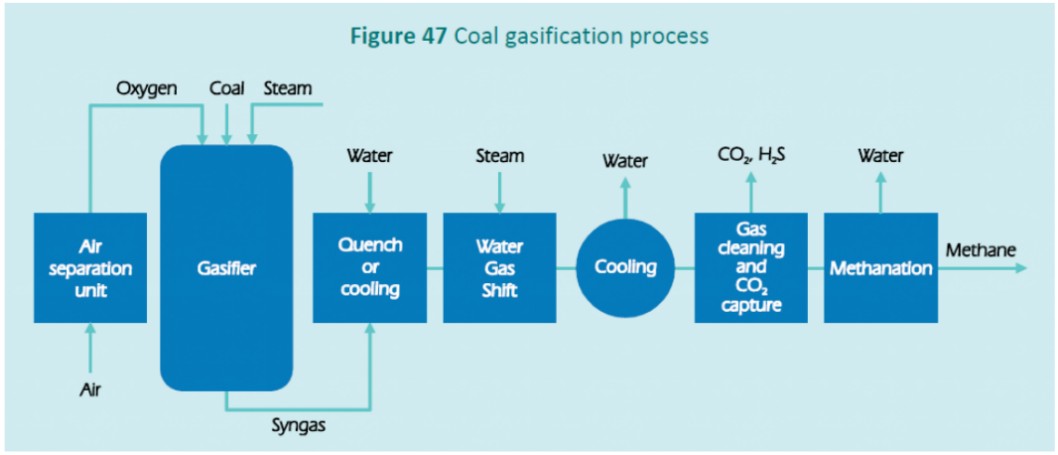
  • It is a process in which coal is partially oxidised with air, oxygen, steam or carbon dioxide to form a fuel gas. 
    • This gas is then used instead of piped natural gas , methane and others for deriving energy.
  • India has a reserve of 307 Billion tonnes of thermal coal and about 80% of coal produced is used in thermal power plants. 
    • With environmental concerns and the development of renewable energy, diversification of coal for its sustainable use is inevitable.
Benefits of Coal Gasification

  • It is considered as a cleaner option compared to the burning of coal and it facilitates utilization of the chemical properties of coal.
  • It produces SynGas that is usable in producing Synthetic Natural Gas (SNG), energy fuel (methanol & ethanol), ammonia for fertilizers and petro-chemicals. 
    • These products will help move towards self-sufficiency under Atmanirbhar Bharat Abhiyaan. 
  • Steel companies typically use coking coal in their manufacturing process.
    • Most of the coking coal is imported and is expensive. To cut costs, plants can use syngas, which comes from coal gasification plants in the place of coking coal.

Steps by Government

  • The Government has approved investment by Coal India Limited (CIL) in joint ventures of Coal India Limited - Bharat Heavy Electricals Limited (CIL-BHEL) and Coal India Limited - Gas Authority of India Limited (CIL-GAIL) for undertaking coal gasification projects. Both JV companies have now been established.
  • Setting up of National Coal Gasification Mission
    • In order to create awareness among all stakeholders and to prepare an implementable road map with specific responsibilities, the Ministry of Coal has decided to set up the National Coal Gasification Mission. The Mission is created with an aim to take up following objectives which are required for the vision of achieving 100 MT coal gasification by 2030.
    • In 2022, a new sub-sector, "Production of Syngas leading to coal gasification," was created under the Non-Regulated Sector (NRS) linkage auctions policy to support coal gasification initiative.
    • A 50% rebate in the revenue share for coal used in gasification has been introduced in commercial coal block auctions, provided that at least 10% of the total coal production is used for gasification purposes.
    • NITI Aayog is presently exploring a roadmap and suitable technology options for surface coal gasification in the Indian context. In this perspective, a Technical Committee on Surface Coal Gasification has been constituted by (S&T), NITI AAYOG.

Coal gasification usage in other countries

  • Coal gasification is prominent in China. 
    • Five per cent of China’s total coal consumption is from its gasifier.
    • China has the biggest number of coal gasification projects in the world due to the support of the Chinese Government through its 9th-12th Five-Year Plans.
  • Other Asian countries such as Japan are focusing on more efficient power generation cycles; for instance, coupling gasification with fuel cells.
  • The US has some coal gasification plants running. 
  • The Queensland Government in Australia announced the decision to prohibit all underground coal gasification activities and the in situ gasification of oil shale in April 2016.
    • The Queensland Parliament passed legislation on August 24, 2017, which places a moratorium on all activities relating to underground coal gasification.

Concerns

  • According to a recent assessment, coal gasification actually produces more carbon dioxide than a conventional coal-powered thermal power plant.
  • The coal gasifiers using steel plants have higher greenhouse gas emissions than many of their counterparts. 
    • Their emissions range from 2.8-3.1 tonnes of CO2 per tonne of steel manufacture while the sector average emissions is only 2.5.
  • Coal gasification plants are costlier than conventional power plants. Since, coal is the main feed for gasification, it, in no way helps in India’s decarbonisation goals.
  • International Studies :
    • A recent study by Princeton University in the United States found that using synthetic natural gas for residential cooking and heating, for electricity generation, or for industrial heat generation, results in 10, 40 and 70 per cent more CO2 emissions than directly burning coal that provides the same amount of energy in each sector.
    • According to a study by Duke University in the US, the syngas process converts a relatively high-quality energy source (coal) to a lower quality state (gas) and consumes a lot of energy in doing so.
    • Thus, the efficiency of conversion is also low. 

Way Forward

  • Coal gasification projects will need a dedicated infrastructure to be able to get them on the ground. 
    • Availability of basic facilities such as land, water and feedstock, which is coal, is extremely important for these projects to get kick-started.
  • The National Coal Gasification Mission’s objective to gasify 100 MT of coal will definitely require collaboration amongst the Government at various levels – Central, State and Local.
  • The Government would need to take some major and path breaking policy decisions to create a technologically and economically feasible environment to push coal gasification in India.
  • There have been numerous research efforts going on in different universities, laboratories, and PSU’s sporadically on the coal gasification process. 
    • There is an urgent need to consolidate all of them and bring them under one umbrella to avoid reinventing the wheel and have better collaboration.


UPSC QEP 2026 Batch 5 - English
Buy now View Details
Submit Your Details to Learn More
I agree to give my consent to receive updates through SMS/Email & WhatsApp*.

NEEV GS + CSAT Foundation 2026/27
Buy now View Details


Join theIAShub’s Mains Answer Writing Program

Refine your answer writing skills and elevate your UPSC preparation with personalized support and expert feedback.

Fill out the form to get started with the program or any other enquiries !

I agree to give my consent to receive updates through SMS/Email & WhatsApp*.

Best IAS Coaching In Delhi, UPSC Online & Offline Classes by IAShub

Are you dreaming of becoming an IAS officer? Then, IAShub can be your best guide. It is one of the Best IAS Coaching in Delhi. Many students who want to clear the UPSC exam join IAShub for learning. The institute gives both online and offline classes. Their teachers are experienced and helpful. They easily explain every topic. Students also get notes, tests, and tips to do well in the exam.

UPSC Online Classes by IAShub

IAShub is in Delhi and is trusted by many UPSC students. It offers coaching for every part of the UPSC exam – Prelims, Mains, and Interview. The classes are simple and easy to understand. The teachers are experts and guide students in the right way. IAShub is also known for its helpful notes, test series, and answer-writing practice. IAShub is the best coaching in Delhi and also gives UPSC Online Classes. This helps students from any place in India to learn. The online classes are live and also recorded. So, students can watch them anytime. These classes cover the full UPSC syllabus.

Key Offerings Provided by IAShub

Here are some important services provided by IAShub:

  • UPSC Prelims: IAShub teaches for Prelims with a focus on basics. It also gives daily current affairs and monthly magazines.
  • Classroom Courses: IAShub has classroom learning for students in Delhi. The environment is good and peaceful for study.
  • Live Classes: Students who live far can join live UPSC online classes. These classes are just like real classes.
  • QEP for Mains: The Quality Enrichment Program (QEP) is special for Mains preparation. It helps students write better and faster.
  • Answer Writing: Regular answer writing practice is given. Teachers also check answers and give tips to improve.
  • Free Resource: IAShub gives free notes by toppers and helpful Main Booster material.
  • Test Series: Test series are available for every subject. These help students know their weak points and improve.
  • Interview Guidance Session: IAShub also gives interview practice sessions with experts. These help students feel confident.

UPSC Exam Overview

The UPSC Civil Services Exam has three parts:

  • Prelims: It has two papers: General Studies and CSAT.
  • Mains: It has nine papers, including essays and optional subjects.
  • Interview: It tests the personality and confidence of the student.

This exam is tough, but with the right guidance, it becomes easy to manage. Students must study smart and stay regular.

How IAShub Helps in the UPSC Journey

IAShub supports students from the beginning to the end. It gives the right books, tests, and notes. The classes are easy to follow, and the teachers are always ready to help. Students get personal doubt sessions too. The test series and answer checking help students learn where they need to do better. Also, free study materials save time and money.
IAShub also guides students during the final stage – the interview. Experts take mock interviews and give useful tips. This full support makes IAShub one of the best IAS coaching in Delhi.

Best IAS Coaching In Delhi FAQs

Yes, IAShub offers live and recorded online classes. Students can attend from any part of India.

Classes are available in both English and Hindi, so students can choose the language they are comfortable with.

The classroom centre is located in Delhi. Students can visit and join offline batches there.

IAShub gives interview guidance sessions to help students prepare for the final round of UPSC.