
theIAShub
18 Jul, 2025
Article List
- BIMSTEC Ports Conclave
- Criminalization of Politics in India: Causes, Consequences, and the Way Forward
- India and Russian Trade Oil: Showing Double Standards of Western World
- Swach Survekshan 2024-25
- Zimislecel
- 2025 Global Wetland Outlook (GWO)
- IRAS 18162-2048: An Astronomical Breakthrough
- Central Himalayan Region
- Pheromone: Promising Discovery to Prevent Locusts
1. BIMSTEC Ports Conclave
Context
- The Union Minister of Ports, Shipping & Waterways (MoPSW) inaugurated the second edition of BIMSTEC Ports Conclave.
About Ports Conclave
- The two-day BIMSTEC Ports Conclave was held under the auspices of the Visakhapatnam Port Authority.
- Theme: Blue Economy, Innovation and Sustainable Partnerships.
- Representatives of ministries from port authorities of BIMSTEC member nations of Bangladesh, Bhutan, India, Myanmar, Nepal, Sri Lanka, and Thailand participated in it.
- Aim: To operationalise the recently signed BIMSTEC Agreement on Maritime Transport Cooperation (AMTC), facilitate dialogue on port-led development, and foster deeper integration in maritime trade, logistics, cruise tourism, and skill development.
- BIMSTEC Sustainable Maritime Transport Centre is going to be established under the Indian Ocean Centre of Excellence for Sustainable Maritime Transport (IOCE-SMarT) at Mumbai.
- The Panels explored plans for port-linked industrial zones, digital integration, and sustainable cruise routes, alongside proposals for a BIMSTEC Ports Coordination Centre and a regional Port Community System.
About BIMSTEC
- It is a regional organization established in 1997 with signing of the Bangkok Declaration.]
- It was originally formed with 4 Members (Bangladesh, India, Sri Lanka & Thailand) with the acronym 'BIST-EC'.
- Secretariat: Dhaka, Bangladesh
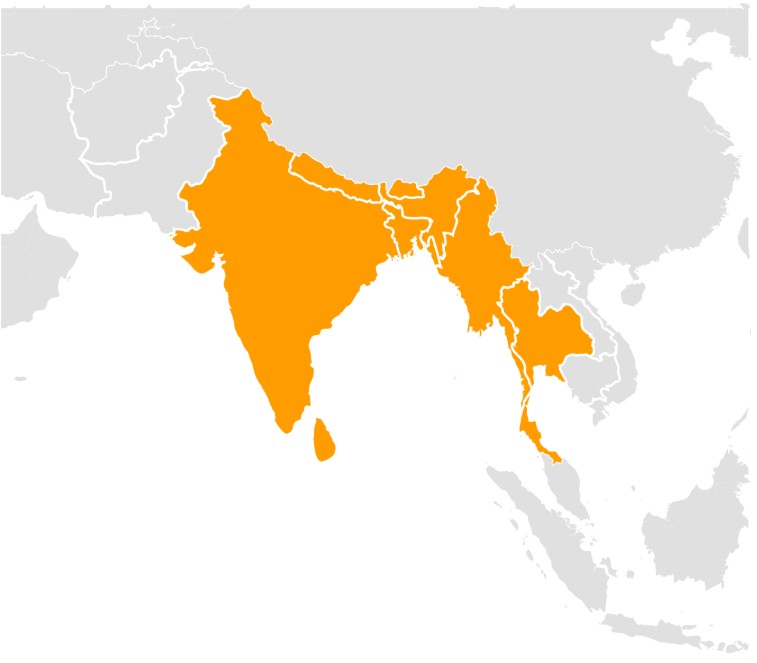
- Member States (7): Bangladesh, Bhutan, India, Myanmar, Nepal, Sri Lanka, and Thailand.
- BIMSTEC Charter: Foundational document that outlines the goals, principles, and structure of the BIMSTEC. It was finalized in the 5th Summit (2022) in Sri Lanka.
- Charter confers legal personality on the grouping and paves the way for external partnerships and admission of observers and new members.
Objective
- To create an enabling environment for rapid economic development and social progress and maintain peace and stability in the Bay of Bengal region.
- 7 Priority Areas/Pillars (each led by 1 Member country): Trade & Investment (Bangladesh); Environment & Climate Change (Bhutan); People-to-People Contacts (Nepal); Agriculture & Food Security (Myanmar); Science &Technology and Innovation (Sri Lanka) and Connectivity (Thailand).
- India is the Lead Country for Security pillar under which there are 3 sub-sectors – Counter-Terrorism and Transnational Crime, Disaster Management and Energy Security.
Significance for Ports Conclave for India
- Advancing Maritime Connectivity and Trade Efficiency: The conclave emphasized the operationalization of the BIMSTEC Coastal Shipping and Maritime Transport Agreements, which is vital for India’s ambitions to become a regional maritime logistics hub.
- Strengthening India’s ‘Act East’ and ‘Neighbourhood First’ Policies: By engaging BIMSTEC countries the conclave reinforces India’s ‘Act East’ policy, which seeks deeper ties with Southeast Asia.
- Operationalizing the Kaladan Multi-Modal Transit Transport Project: The conclave showcased India’s flagship Kaladan project, which connects Kolkata Port → Sittwe Port (Myanmar) → Inland waterway to Paletwa → Road to Mizoram.
- This corridor is a model for multi-modal regional connectivity and vital in improving access to its northeastern states.
- Promoting the Blue Economy and Sustainable Development: The conclave promoted sustainable maritime practices, this aligns with India’s Blue Economy Policy Framework, which seeks to balance economic growth with ocean ecosystem protection.
Way Forward
- While the BIMSTEC Ports Conclave has opened up vast opportunities for India to become the maritime centre of the Bay of Bengal, several challenges — infrastructural, institutional, geopolitical, and logistical — must be addressed.
- A coordinated push involving capacity building, diplomatic engagement, infrastructure financing, and security cooperation is necessary to translate vision into outcomes.
2. Criminalization of Politics in India: Causes, Consequences, and the Way Forward
Context
- The criminalization of politics in India represents a grave threat to democratic governance, the rule of law, and public trust in institutions.
- Despite constitutional safeguards and democratic structures, a significant number of elected representatives in India have criminal charges pending against them, including those related to serious offences like murder, rape, and corruption.
Data on the Issue
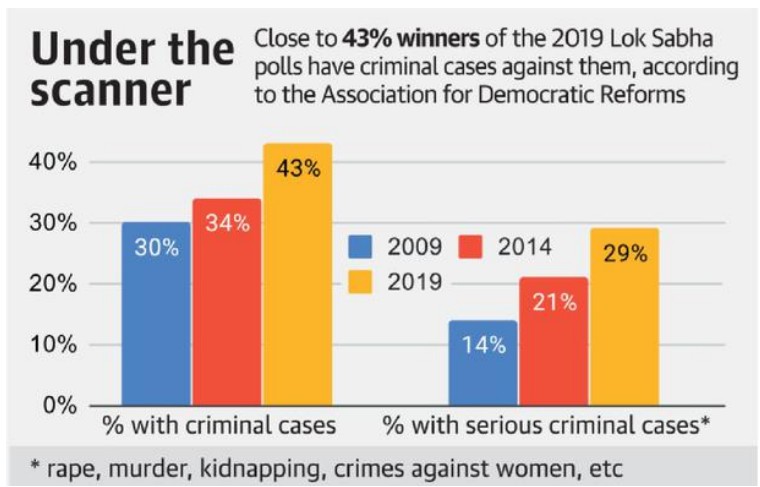
- According to data from the Association for Democratic Reforms (ADR), 46 per cent of MPs elected in the 2024 Lok Sabha elections (251 out of 543) have pending criminal cases against them.
- These charges include heinous crimes such as murder, attempted murder, rape, and kidnapping.
Causes
- Nexus Between Crime and Politics: This relationship transforms politics into a tool for protecting personal interests and evading justice.
- For Example is Mohammad Shahabuddin, a former Member of Parliament from Siwan, Bihar. Despite facing over 40 criminal cases, including murder and kidnapping, he was repeatedly elected due to his influence and ability to control the local administration.
- Electoral System Flaws: India's First-Past-The-Post (FPTP) system allows a candidate to win without a majority, making it possible for individuals with criminal records to manipulate caste or communal divisions for narrow vote banks.
- Role of Money and Muscle Power: Criminal candidates typically possess substantial unaccounted wealth and control over local enforcement, enabling them to fund expensive election campaigns and exert physical dominance. Anant Singh, a legislator from Bihar, known as "Chhote Sarkar," has been elected multiple times despite facing serious criminal allegations, including illegal arms possession and extortion.
- Voter Behavior and Caste Politics: Caste-based politics significantly influences voter behavior, especially in North Indian states. Voters often prioritize caste identity over candidate integrity, believing that a representative from their community-regardless of criminal backgroundwill safeguard their interests.
- Legal and Institutional Delays: The Indian judicial process is notoriously slow, with criminal trials against politicians often dragging on for years. Under current laws, only convicted individuals are barred from contesting elections, allowing those with pending cases to continue participating in the political process. The Representation of the People Act, 1951, disqualifies candidates only post-conviction.
Consequences of Criminalization
- Undermining Democratic Institutions: The entry of individuals with criminal backgrounds into legislatures dilutes the quality and integrity of democratic institutions.
- Corruption and Policy Paralysis: Criminal politicians often engage in corrupt practices, using their position to extract personal benefits For instance, local development funds like the MPLADS have frequently been misused by legislators for self-promotion or to reward supporters.
- Threat to Rule of Law: The most alarming consequence of criminalization is the erosion of the rule of law. Politicians with criminal influence often interfere in investigation.
Impact on Democracy and Governance in India
- Impact on Governance: Governance suffers immensely when the political class is tainted by criminal records. Leaders with vested interests often prioritize personal or group interests over broader policy objectives.
- A significant outcome is policy paralysis-an environment where crucial decisions are delayed or avoided due to political compromises or fear of exposure. Bihar and Uttar Pradesh in the 199os and early 20oos, recorded slower development, poorer law and order, and ineffective service delivery (ADR, 2020).
Legal and Judicial Responses
- Representation of the People Act, 1951: The Representation of the People Act (RPA), 1951 is the primary legislation governing electoral conduct in India. Section 8 of the Act specifies disqualification of candidates upon conviction for certain offences, including corruption, rape, and murder.
- Supreme Court Judgments: In Lily Thomas v. Union of India (2013), the Supreme Court ruled that convicted lawmakers would be immediately disqualified from holding office, striking down the provision that allowed them to continuе for three months post-conviction pending appeal. This landmark verdict removed legal protection previously exploited by convicted politicians to remain in power.
- Election Commission Guidelines: Introduction of mandatory affidavits through a 2003 Supreme Court ruling, requiring all candidates to disclose their criminal, financial, and educational background at the time of nomination.
Way Forward
- Disqualification on Framing of Charges: The Representation of the People Act should be amended to disqualify candidates at the stage of charge-framing for serious and non-bailable offences.
- Fast-track Courts: Dedicated fast-track courts must be established to adjudicate criminal cases against politicians.
- Independent Election Commission: The Election Commission's powers should be enhanced to enforce the Model Code of Conduct, scrutinize nominations, and penalize violations.
3. India and Russian Trade Oil: Showing Double Standards of Western World
Context
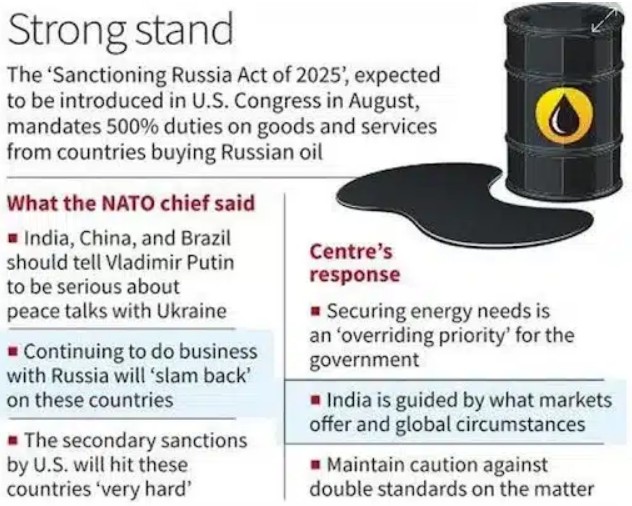
- India warns against global bias as US considers secondary sanctions over Russian oil trade; emphasizes energy security priority.
About the News
- India firmly dismissed concerns over possible U.S. sanctions on its Russian oil trade.
- Petroleum Minister Hardeep Singh Puri emphasized India’s diversified oil imports—from 27 to 40 countries—and said India would handle any challenges.
- On the same day, MEA warned against “double standards,” stressing India’s priority is securing affordable energy for its people based on market availability and global conditions.
- These remarks came after NATO chief Mark Rutte suggested countries buying Russian oil could face U.S. secondary sanctions aimed at pressuring Russia over the Ukraine war.
Strategic Autonomy Under pressure: Multi Alignment Challenge
- India's foreign policy philosophy has evolved from Cold War-era non-alignment to contemporary strategic autonomy, reflecting the realities of a multipolar world.
- This approach, often termed multi-alignment, allows India to engage with multiple global powers without being constrained by exclusive alliances.
- On one hand, it's deepening partnerships with blocs like the Quad (India, US, Japan, Australia) and the Indo-Pacific Economic Framework.
- On the other hand, it's careful to maintain ties with Russia and participate in forums like BRICS and the Shanghai Cooperation Organisation.
Should India Be Concerned About New US Sanctions
- India’s trade with Russia has grown sharply, reaching a record $68.7 billion in FY 2024–25—almost six times the pre-pandemic figure.
- India’s key imports from Russia include crude oil, petroleum products, fertilizers, and coal, with oil purchases rising significantly after Western sanctions on Moscow in 2022.
- While this raises concern over potential US sanctions, India maintains it has diversified its oil sources and can shift suppliers if necessary.
- Another factor is China—Russia’s largest trade partner—making it uncertain if the US would risk escalating tensions with Beijing again.
India’s Trade Diversification Strategies
- India is exploring export diversification, shifting market focus from the US to regions like the European Union, ASEAN, and Africa.
- This strategy reduces over-dependence on any single market while building resilience against future trade disruptions.
- The government has also accelerated domestic manufacturing initiatives through Production Linked Incentive (PLI) schemes in electronics, textiles, and pharmaceuticals.
- These programs aim to reduce import dependence while enhancing export competitiveness, creating a more resilient economic structure.
Way Ahead
- India's navigation of the Russia trade challenge reflects broader themes in contemporary international relations. India's approach to managing potential tariffs involves building economic resilience across multiple dimensions. This involves finding new suppliers, making more goods within the country, and setting up backup plans in key sectors. The government's focus on self-reliance (Atmanirbhar Bharat) takes on new significance in this context.
4. Swach Survekshan 2024-25
Context
- Ahmedabad emerged as the cleanest big city in the Swachh Survekshan 2024–25. The awards were conferred by President Droupadi Murmu during a national felicitation event.
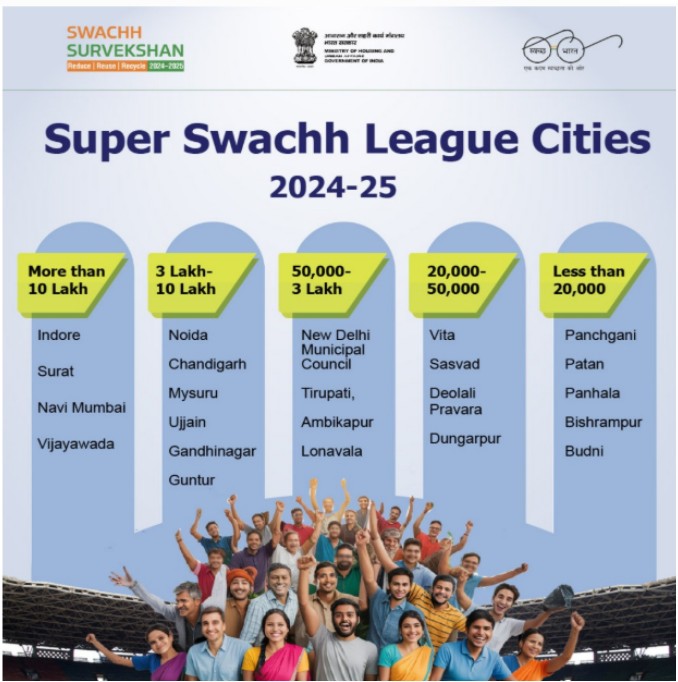
- This is the first time Ahmedabad has secured the top spot, as the consistent chart-topper Indore transitions into a newly created ‘Swachh Bharat Super League 1.0’, recognising its sustained excellence in urban sanitation.
About Swachta Survekshan
- Launched in 2016 under the Swachh Bharat Mission-Urban (SBM-U), Swachh Survekshan is the world’s largest urban sanitation survey
- It is conducted by the Ministry of Housing and Urban Affairs.
- Objective: Promote competitive spirit among cities for cleanliness and Sanitation.
- It evaluates cities on multiple parameters, including:
- Citizen feedback
- Waste segregation and processing
- Open defecation-free (ODF) status
- Cleanliness in public areas
- Municipal innovation and digital monitoring.
- The 2024-25 edition of the survey covered over 4,500 Urban Local Bodies (ULBs), with over 12 crore citizen responses, making it one of the most participatory surveys of its kind globally.
Rankings and Winners
Cleanest Big Cities with population of 10lakh plus.
- 1st - Ahmedabad, 2nd- Bhopal. 3rd - Lucknow
- 3 to 10 Lakh Category - 1st - Mira-Bhayandar, 2nd - Bilaspur, 3rd - Jamshedpur
- Best Ganga Town - Varanasi for the 4th time followed by Prayagraj
- Best Cantonment Board - Secunderabad Cantonment.
- Safaimitra Surakshit Shehar (Sanitation worker Safety) - Visakhapatnam, Jabalpur, Gorakhpur.
- 3-10 lakh population: Noida, Chandigarh, Mysuru, Ujjain, Gandhinagar.
- Super Swatch League Inductees, 23 cities - Indore, Surat, Navi Mumbai, Vijayawada, Chandigarh, Mysore, etc.
- Best Performing State: Maharashtra, followed by Madhya Pradesh and Chattisgarh on second and third place respectively.
About Swachh Super League
- The Super Swachh League is a new category introduced in Swachh Survekshan 2024–25 to honour cities showing sustained excellence in urban sanitation and cleanliness over multiple years.
- Objective: To create a premier league of consistently high-performing cities across population brackets, promoting competitive excellence and peer benchmarking.
- Eligibility Criteria
- Cities must have a minimum Garbage free City (GFC) star rating, ideally 3-star or above.
- Must consistently rank high in Swachh Survekshan across key parameters like door-to-door waste collection, source segregation,ODF ++ Status, and citizen engagement.
Innovations in Survey
- The Swachh Survekshan 2024-25 introduced some key innovations.
- AI-Based Tools for validation of cleanliness parameters
- Swachhta League for Youth engagement
- Special Emphasis on legacy waste management and city beautification
- Star Rating for Garbage Free Cities (GFC) updated alongside Survekshan rankings.
Effects on Urban Governance
- Swachh Survekshan has emerged not only as a cleanliness ranking tool but also as a key driver for competitive federalism, inspiring states and cities to enhance urban governance.
- It has also catalysed job creation in the waste management sector and promoted entrepreneurship in circular economy ventures.
5. Zimislecel
Context
- Recently, a landmark clinical advancement demonstrated that a therapy using labgrown islet cells, called zimislecel, has the potential to restore insulin production in individuals with severe Type 1 diabetes.
About Zimislecel
- A novel therapy that involves infusing lab-grown islet cells, derived from pluripotent stem cells, into the liver via the hepatic portal vein.
- These islet cells replace the insulin-producing beta cells destroyed by the immune system in Type 1 diabetes.
- Once implanted, the cells begin producing insulin naturally from within the body.
- Clinical Trial Overview: Phase 1/2 trial included 12 patients with severe, long-standing Type 1 diabetes. Participants had poor glucose control and a history of life-threatening hypoglycaemic episodes.
Key Findings
- Insulin production restored: All 12 patients began producing C-peptide, a marker of insulin secretion-within 90 days.
- Improved blood sugar control HbA1c levels dropped below 7% in all participants within four months.
- Reduced insulin dependence: 10 out of 12 participants were able to completely stop insulin injections.
- Better glucose range stability: Time in target blood glucose range increased from 50% to over 93%.
About Type 1 Diabetes
- Caused by the immune system attacking the pancreas's insulin-producing islet cells, stopping natural insulin production.
- Patients must rely on external insulin injections and continuous glucose monitoring to manage their condition. Nearly 75% of individuals with Type 1 diabetes are unable to consistently achieve target glucose levels.
- Poor glucose control increases the risk of long-term complications, including nerve damage, kidney disease, and cardiovascular issues.
6. 2025 Global Wetland Outlook (GWO)
Context
- Recently, the 2025 Global Wetland Outlook (GWO), released by the Ramsar Convention Secretariat, has raised serious concerns over the alarming rate of wetland degradation in Africa, as among the most severely deteriorated in the world.
Key Highlights
- Field surveys show actual wetland conditions are often worse than national estimates suggest.
- Across all six Ramsar regions, more countries reported wetland decline than improvement most critically in least developed and lower-middle-income countries.
- Comparative Global Trends: North America & Oceania: Invasive species are the main threat.
- Europe: Prolonged drought is the primary concern.
About Ramsar Convention
- An international treaty for the conservation and sustainable use of wetlands, also known as the Convention on Wetlands.
- Origin: Signed in Ramsar, Iran, on 2nd February 1971.
- World Wetlands Day: Celebrated every year on 2nd February to mark the signing of the convention.
- Membership: Has 172 Contracting Parties as of 2025.
About Wetlands
- Areas of marsh, peatland, or water (static or flowing; fresh, brackish, or saline). Includes marine water up to 6 metres deep at low tide.
- Act as ecotones-transitional zones between land and water ecosystems.
- Examples of Wetlands: Mangroves, Lake littorals (shoreline areas between highest and lowest water levels), Floodplains (adjacent low-lying river areas that flood periodically), Marshes and swamps.
7. IRAS 18162-2048: An Astronomical Breakthrough
Context
- Recently, in a significant astronomical breakthrough, scientists from the Indian Institute of Space Science and Technology (IIST), Thiruvananthapuram, have detected circularly polarised radio emissions near the massive young protostar IRAS 18162-2048.
This marks the first direct evidence of strong magnetic fields in the immediate environment of such a protostar.
About IRAS 18162-2048
- A massive protostar located about 4,500 light years away in the Milky Way. It is one of the most studied massive protostars due to its unique energetic features.
- The protostar is known for powering HH80-81, one of the largest and brightest bipolar jets in the galaxy-ejecting high-speed matter in opposite directions.
- These Herbig-Haro (HH) jets are crucial markers of early star formation.
- New Discovery: While previous studies had mapped magnetic fields along the jet, the latest detection marks the first direct evidence of magnetic activity near the core of the protostar.
- This strongly suggests that magnetic fields play a key role in launching and regulating such massive outflows.
- Scientific Impact: The discovery provides new insights into high-mass star formation, a less understood process compared to low-mass star formation. It supports the theory that magnetic fields are essential in shaping early stellar evolution.
About Protostar
- An early stage in the process of star formation, preceding the main sequence phase.
- It forms from the collapse of a giant molecular cloud in the interstellar medium, composed mainly of gas and dust.
- Becomes a main sequence star once hydrogen fusion begins in its core.
- Typically obscured by surrounding dust, making them difficult to detect in visible light.
8. Central Himalayan Region
Context
- Recently, for the first time, Indian scientists have obtained continuous, high-resolution ground-based measurements of major greenhouse gases in the Central Himalayan region.
- This breakthrough reveals how both natural processes and human activities are shaping emissions in this ecologically fragile and climate-sensitive zone.
Key Highlights
- Conducted by ARIES (Aryabhatta Research Institute of Observational Sciences), Nainital, under the Department of Science and Technology (DST)
- Based on five years of continuous ground measurements (2014-2018) in the Central Himalayan region.
- Diurnal and Seasonal Patterns: Carbon dioxide (CO2) dips during the daytime, due to photosynthesis, but rises in spring due to biomass burning and minimal vegetation.
- Methane (CH4) peaks in autumn, likely due to agricultural practices such as rice cultivation.
- Carbon monoxide (CO) shows highest levels in late spring, driven by regional pollution transported from the plains.
Comparative Trends with Mauna Loa (Hawaii)
- CO2: Rising at 2.66 ppm/year in the Himalayas (higher than global average).
- CH4: Increasing at 9.53 ppb/year, again exceeding background levels.
- CO: Declining at 3.15 ppb/year, possibly due to improved combustion or changing emission sources
About Central Himalayas
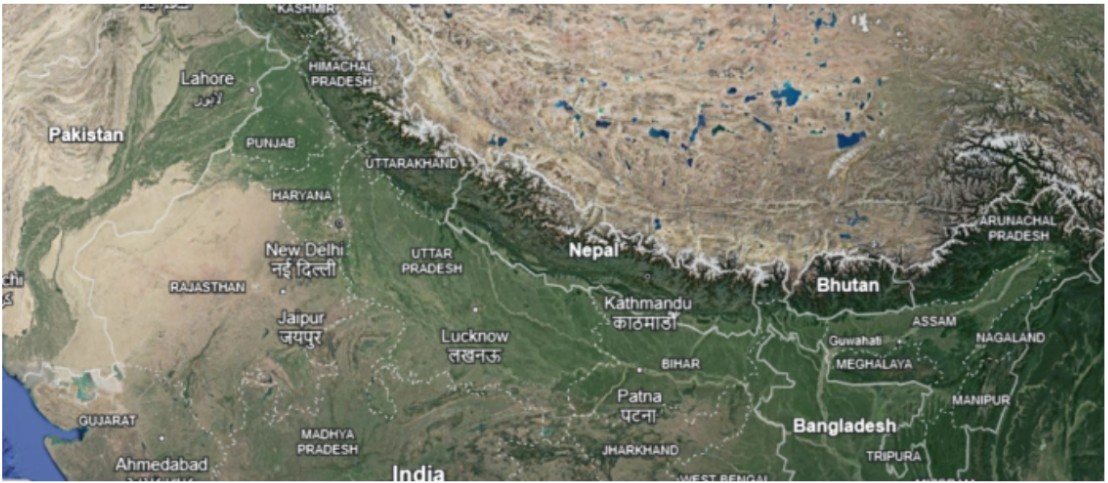
- Also known as the Himadri, Inner Himalayas, or Greater Himalayas.
- Made up of Archaean rocks such as granite, gneiss, and ancient schist.
- Changing Orientation Across Regions: Southeast across northern Pakistan, northern India, and Nepal.
- Eastward through Sikkim and Bhutan.
- Northeast across northern Arunachal Pradesh.
- Prominent peaks, including Nanga Parbat, Mount Everest, Kanchenjunga, and Namcha Barwa.
- The range features steep slopes on its northern side and gentler slopes on the southern side.
9. Pheromone: Promising Discovery to Prevent Locusts
Context
- Recently, scientists have successfully demonstrated that manipulating pheromones in locusts can prevent them from forming destructive swarms or engaging in group behaviors that lead to mass feeding frenzies.
- This breakthrough offers a promising strategy for controlling locust outbreaks by disrupting their communication signals.
About Pheromones
- Chemical substances secreted outside the body by an individual and detected by another of the same species.
- They are present in all bodily secretions, especially in axillary sweat, and are sensed by the olfactory system
- Pheromones are classified as ecto-hormones because they act outside the body.
- Types of Pheromones: Releaser Pheromones: Trigger an immediate and specific response.
- Signaler Pheromones - Convey information about the individual (e.g., help a mother recognize her baby).
- Modulator Pheromones - Influence mood and emotional states.
- Primer Pheromones - Affect hormonal activity, such as during pregnancy or menstrual cycles.
Role of Pheromones in Animals and Other Organisms:
- In animals, pheromones help raise alarms, mark food trails, warn intruders, and bond with offspring.
- Detected via the vomeronasal organ.
- Fungi, slime molds, and algae use them to attract mating types during reproduction.

2026-27 UPSC Mains English QEP Power Pages
View DetailsSubmit Your Details to Learn More



