
theIAShub
18 Jul, 2025
Table of Contents

Get an Instant Call Back from Our Expert Mentors!
Context
- The criminalization of politics in India represents a grave threat to democratic governance, the rule of law, and public trust in institutions.
- Despite constitutional safeguards and democratic structures, a significant number of elected representatives in India have criminal charges pending against them, including those related to serious offences like murder, rape, and corruption.
Data on the Issue
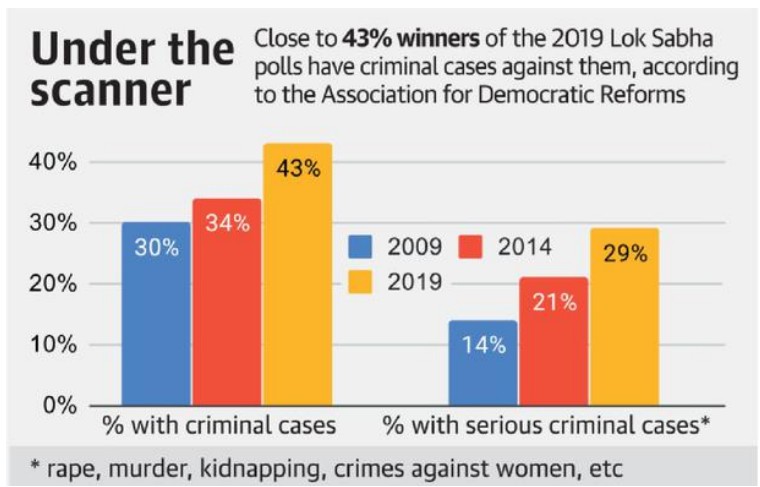
- According to data from the Association for Democratic Reforms (ADR), 46 per cent of MPs elected in the 2024 Lok Sabha elections (251 out of 543) have pending criminal cases against them.
- These charges include heinous crimes such as murder, attempted murder, rape, and kidnapping.
Causes
- Nexus Between Crime and Politics: This relationship transforms politics into a tool for protecting personal interests and evading justice.
- For Example is Mohammad Shahabuddin, a former Member of Parliament from Siwan, Bihar. Despite facing over 40 criminal cases, including murder and kidnapping, he was repeatedly elected due to his influence and ability to control the local administration.
- Electoral System Flaws: India's First-Past-The-Post (FPTP) system allows a candidate to win without a majority, making it possible for individuals with criminal records to manipulate caste or communal divisions for narrow vote banks.
- Role of Money and Muscle Power: Criminal candidates typically possess substantial unaccounted wealth and control over local enforcement, enabling them to fund expensive election campaigns and exert physical dominance. Anant Singh, a legislator from Bihar, known as "Chhote Sarkar," has been elected multiple times despite facing serious criminal allegations, including illegal arms possession and extortion.
- Voter Behavior and Caste Politics: Caste-based politics significantly influences voter behavior, especially in North Indian states. Voters often prioritize caste identity over candidate integrity, believing that a representative from their community-regardless of criminal backgroundwill safeguard their interests.
- Legal and Institutional Delays: The Indian judicial process is notoriously slow, with criminal trials against politicians often dragging on for years. Under current laws, only convicted individuals are barred from contesting elections, allowing those with pending cases to continue participating in the political process. The Representation of the People Act, 1951, disqualifies candidates only post-conviction.
Consequences of Criminalization
- Undermining Democratic Institutions: The entry of individuals with criminal backgrounds into legislatures dilutes the quality and integrity of democratic institutions.
- Corruption and Policy Paralysis: Criminal politicians often engage in corrupt practices, using their position to extract personal benefits For instance, local development funds like the MPLADS have frequently been misused by legislators for self-promotion or to reward supporters.
- Threat to Rule of Law: The most alarming consequence of criminalization is the erosion of the rule of law. Politicians with criminal influence often interfere in investigation.
Impact on Democracy and Governance in India
- Impact on Governance: Governance suffers immensely when the political class is tainted by criminal records. Leaders with vested interests often prioritize personal or group interests over broader policy objectives.
- A significant outcome is policy paralysis-an environment where crucial decisions are delayed or avoided due to political compromises or fear of exposure. Bihar and Uttar Pradesh in the 199os and early 20oos, recorded slower development, poorer law and order, and ineffective service delivery (ADR, 2020).
Legal and Judicial Responses
- Representation of the People Act, 1951: The Representation of the People Act (RPA), 1951 is the primary legislation governing electoral conduct in India. Section 8 of the Act specifies disqualification of candidates upon conviction for certain offences, including corruption, rape, and murder.
- Supreme Court Judgments: In Lily Thomas v. Union of India (2013), the Supreme Court ruled that convicted lawmakers would be immediately disqualified from holding office, striking down the provision that allowed them to continuе for three months post-conviction pending appeal. This landmark verdict removed legal protection previously exploited by convicted politicians to remain in power.
- Election Commission Guidelines: Introduction of mandatory affidavits through a 2003 Supreme Court ruling, requiring all candidates to disclose their criminal, financial, and educational background at the time of nomination.
Way Forward
- Disqualification on Framing of Charges: The Representation of the People Act should be amended to disqualify candidates at the stage of charge-framing for serious and non-bailable offences.
- Fast-track Courts: Dedicated fast-track courts must be established to adjudicate criminal cases against politicians.
- Independent Election Commission: The Election Commission's powers should be enhanced to enforce the Model Code of Conduct, scrutinize nominations, and penalize violations.

2026-27 UPSC Mains English QEP Power Pages
View DetailsSubmit Your Details to Learn More



