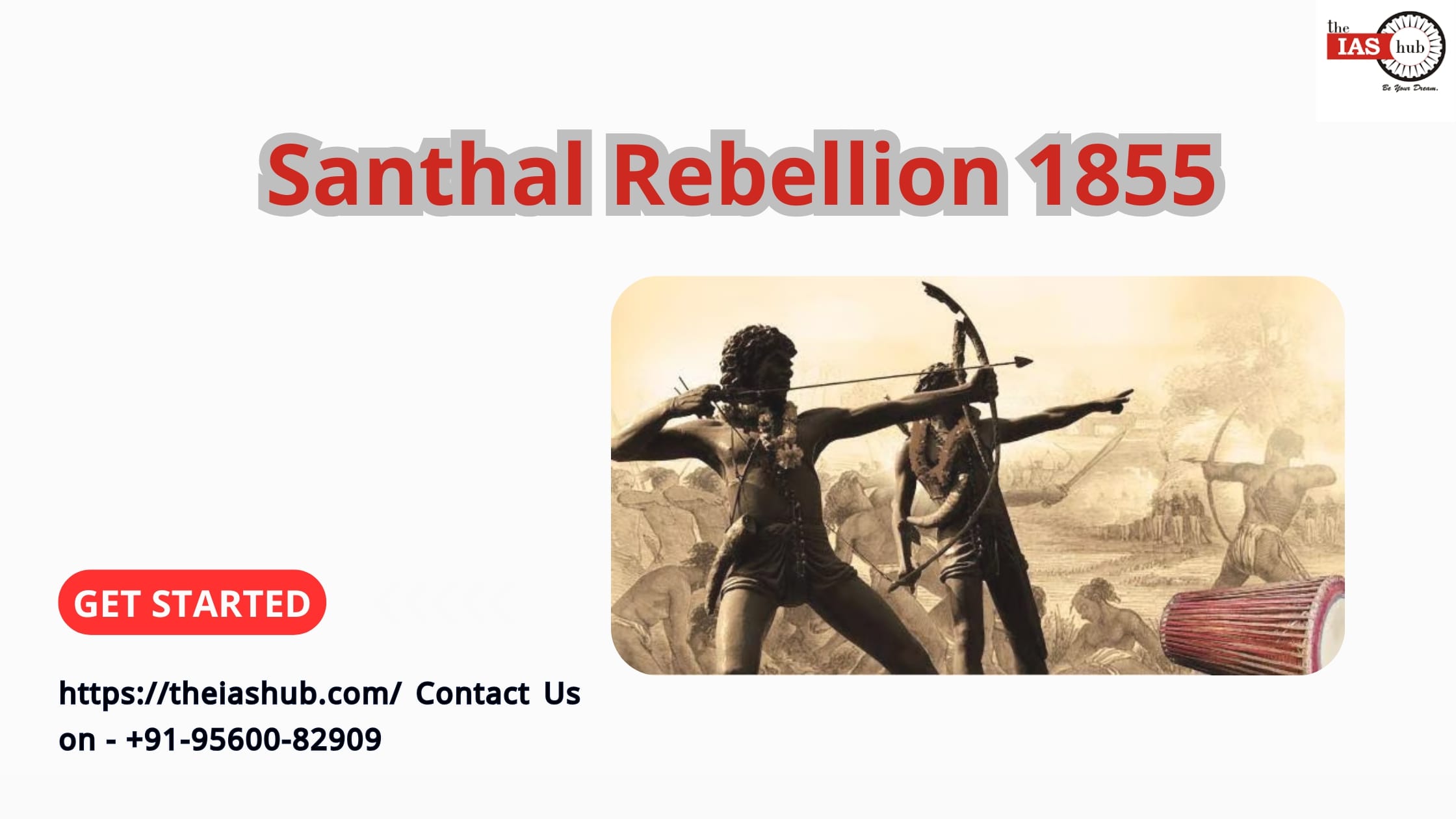
Santhal Rebellion 1855: Leader, Year, Cause, Outcome, Significance, Legacy

Santhal Rebellions 1855, learn about the Santhal rebellion cause, key leaders, significance, and outcomes. Ideal for Santhal rebellion UPSC preparation, Discover when and where the Santhal rebellion took place, who led it, and how it shaped tribal resistance against British colonial rule in India.

Santhal Rebellion
THEIASHUB

Santhal Revolt (1855–1856), also known as Santhal Hool, was a revolt by the Santhal tribal people against the British East India Company’s oppressive zamindari system in the Bengal Presidency. The rebellion took place on 30 June 1855 and was led by four Murmu Brothers – Sidhu, Kanhu, Chand, and Bhairav. It took place in the Santhal Parganas, a region now part of present-day Jharkhand. It was a result of exploitation and subjugation endured by the Santhals under British authorities and moneylenders (Mahajan), landholders (zamindars), and dishonest officials..

Also read Revolt of 1857

Who Were Santhals?

Santhals were one of the largest tribal communities in India, predominantly residing in the states of Jharkhand, Bihar, West Bengal, and Odisha. known for their rich cultural heritage, distinct language (Santhali), and deep connection to the land they inhabited. Traditionally, the Santhals had been agriculturists, depending on the land for their livelihood. The Santhal community had a strong social structure, with their society being organised into various clans known as ‘parhas.’

Also read –Santhal community

What Was Santhal Rebellion?

Santhal Rebellion 1855-1856 was an “organised war against colonialism” led by the Santhals, standing against the highest forms of oppression – culturally, economically and otherwise – they were subjected to by the British and their collaborator, zamindars and corrupt moneylenders(Mahajan). Santhal Rebellion was Led by two brothers, Sidhu and Kanhu. It saw the participation of as many as 32 castes and communities rallying behind them. The seeds of the Santhal rebellion, however, were sown in 1832 when the East India Company created the Damin-i-Koh region (skirt of hill – Where they were enjoying revenue-free collective land holding) in the forested belt of the Rajmahal hills. The area was allocated to the Santhals displaced from Birbhum, Murshidabad, Bhagalpur, Barabhum, Manbhum, Palamau, and Chhotanagpur, all areas of the Bengal Presidency.

Also read Revolts Before 1857

Santhal Rebellion Causes 

Santhal Rebellion was driven by a confluence of economic, social, and cultural grievances, as given below:

  • Santhal Rebellion’s major cause was the Permanent Settlement tax system which was introduced by the British government in some of the regions such as Bihar, Orissa and Bengal.
  • Under the Permanent Settlement tax in 1793, the British government started putting a particular section of land up for auction if the peasants were unable to pay the rent. This instigated the Santhal Rebellion.·   
  • The original landlords during the time of the Santhal Revolt could own the land as long as they paid a particular amount to the government.
  • Gradually, the tax amount also increased to a great extent, which left the Santhals with no choice but to revolt against the British government. The revolt came to be known as the Santhal Revolt.
  • Another cause of the Santhal Rebellion was the ‘barter system’ in which the tribal people were facing issues in returning the payment in the form of cash, resulting in frequent loss of land due to their inability to meet financial demands.
  • Santhals faced cultural marginalisation as British policies and upper-caste dominance undermined their cultural beliefs and traditional practices.
  • The rebellion embodied a millenarian movement, with leaders Sidhu and Kanhu Murmu claiming divine inspiration from Thakur Bonga to establish a utopian Santhal Raj free from oppression.

Santhal Rebellion Key Events

Santhal Rebellion was a revolt by the Santhal tribal people against the British East India Company’s oppressive zamindari system in the Bengal Presidency. It was an uprising against the exploitative diku system, which has several critical phases and is given below:

Beginning

  • Santhal Rebellion began on June 30, 1855, when brothers Sidhu, Kanhu, Chand, and Bhairav Murmu, alongside their sisters Phulo and Jhano Murmu, mobilised around 10,000–60,000 Santhals at Bhognadih to launch the rebellion.
  • Santhal fighters used traditional weapons like bows, arrows, axes, and spears. They did not have modern guns like the British. However, their determination, courage, and unity gave them strength.
  • Santhals: Burned government offices, destroyed records of debt and land ownership, attacked corrupt moneylenders and British police stations, established their own form of governance, collected taxes and settled disputes without British help

Guerrilla Warfare Technique

  • Santhal tribe used traditional weapons such as bows, arrows, and spears, and utilised guerrilla tactics, capitalising on their intimate knowledge of the local terrain.
  • Sannthal targeted symbols of colonialism and the zamindari system, including police stations, zamindar estates, railway lines, and indigo factories.
  • Santhal Rebellion secured control over significant areas, including parts of the Rajmahal Hills, Bhagalpur, and Birbhum districts, disrupting colonial communication networks, such as postal and railway systems.*

 British Response

  • At first, the British officials were shocked and unprepared. But soon, they brought in a large number of trained British and Indian troops under Major General G.W.A. Lloyd. The Santhals were surrounded and attacked from many directions.
  • Due to their lack of advanced weapons, many Santhal fighters were killed. Their villages were burned, and thousands of Santhal men, women, and children lost their lives. Even Sidhu and Kanhu Murmu were captured and executed.
  • By the middle of 1856, the rebellion was completely crushed, and British suppression was brutal, resulting in an estimated 15,000 Santhal deaths, including leaders Sidhu and Kanhu, and the destruction of villages. But the spirit of the Santhal people could never be broken.

Outcomes of the Santhal Rebellion 

Santhal Rebellion, though brutally suppressed by the British forces, However, it had major Outcomes that are given below:

 British Policy Changes

  • After seeing the tribal anger, the British created a separate administrative region called Santhal Parganas to provide some protection to the tribal land and culture.
  • Laws like the Santhal Parganas Tenancy Act were later passed to control exploitation. Land  Protections Through Laws: The Santhal Parganas Tenancy Act of 1876 was enacted to protect Santhal land rights, prohibiting land transfers to non-Santhals and curbing 

Tribal Identity and Pride

  • The Santhal Rebellion gave tribal people a sense of identity, dignity, and history.
  • It reminded India that even poor and marginalised communities could rise and fight for justice. Revolt strengthened  cultural and political consciousness, inspiring subsequent tribal movements

 Memorials and Celebrations

  • June 30 is celebrated every year as Santhal Hul Diwas
  • Statues of Sidhu and Kanhu Murmu have been built in many towns
  • Schools, colleges, and roads are named in their memory
  • Their story is taught in Indian history books as a symbol of tribal resistance

Also read – Integration of Tribal Post Independence

Santhal Rebellion Leaders 

Santhal Rebellion, also known as the Santhal Hul, was led by Brothers Kanhu and Sidho Murmu who mobilised the Santhal community against British colonial rule and the exploitative diku system. However other leaders played the important role given below; 

  • Brothers Kanhu and Sidho Murmu hailed from the Santhal clan, Murmu. They led the rebellion against the British tax regime and the zamindars’ exploitation on June 30, 1855. The brothers spread the word about their plan through uniquely folded sal leaves, a communication system called Dharwak, and mobilised 10,000 people, and declared a rebellion. Claiming divine inspiration from Thakur Bonga, he sought to establish a Santhal Raj free from oppression.

Santhal Rebellion

  • Their brothers, Chand and Bairab, played significant roles in mobilising Santhal forces and coordinating resistance efforts. Utilising traditional weapons and local terrain knowledge, they focused on reclaiming Santhal lands and challenging British authority.
  • Sisters Phulo and Jhano Murmu joined forces. With Phulo and Jhano joining the rebellion, more women took up arms against the British. They help in combat and mobilisation, rallying Santhal women and exemplifying the community’s collective resistance. Their efforts, despite risks such as potential harassment by British soldiers.

Santhal Rebellion

  • Santhal leader Harma Desmanjhi, whose arrest at Panchkatia sparked the rebellion, Harma’s detention galvanised the community.

Santhal Rebellion Significance 

Santhal Rebellion represents a landmark episode in India’s struggle against British colonial domination, particularly within the sphere of indigenous movements. Its significance is given below:

  • The major significance of the Santhal Rebellion was that it threw light on the complicated Zamindari system introduced by the East India Company.
  • It was because of the revolt that the harsh reality of the Zamindari system was brought to light. Later, the British government’s Santhal Pargana Tenancy Act was passed.
  • The Santhal Rebellion was also significant as it exposed the cruelty of the lenders who exploited the ignorant Santhal tribals and demanded extremely high interest rates on the loans they provided to them.
  • Rebellion established a powerful Santhal identity, rights, and self-determination. Through this uprising, the Santhals articulated their grievances, striving to protect their ancestral lands, cultural heritage, and communal dignity.
  • The Santhal Rebellion served as a beacon for later tribal and agrarian uprisings across India. It exemplified the tenacity and bravery of Indigenous communities in confronting systemic oppression and exploitation.
  • The rebellion prompted significant reforms in the British colonial administration of tribal regions. In its aftermath, the British established the Santhal Parganas district in 1856, designed to grant limited self-governance and improved administrative oversight for the Santhal community.

Are you preparing for UPSC 2026? Join IAShub’s UPSC coaching batches to boost your preparation. Enroll now!

Santhal Rebellions FAQs

The rebellion was led by brothers Sidhu, Kanhu, Chand, and Bhairav Murmu, alongside their sisters Phulo and Jhano Murmu. Other figures included Harma Desmanjhi, whose arrest sparked the uprising, and Ram Manjhi, who sustained resistance efforts.

Land Alienation: The Main causes of the Santhal rebellion are the Permanent Settlement of 1793 and encroachments on the    Damin-i-Koh region displaced Santhals.Economic Exploitation: Usurious moneylenders and bonded labour practices like kamioti and hardware trapped Santhals in debt. Forced Labour and Corruptio Begari (forced labour) and corrupt officials ignored Santhal's grievances. Cultural Oppression: British policies and upper-caste dominance marginalised Santhal animist beliefs, prompting a millenarian vision of a Santhal Raj.

The rebellion commenced on June 30, 1855, at Bhognadih in the Santhal Parganas, sparked by the arrest of Santhal leader Harma Desmanjhi at Panchkatia. It spread across regions like the Rajmahal Hills, Bhagalpur, and Birbhum.

The Santhals employed guerrilla warfare, using traditional weapons (bows, arrows, spears) and leveraging their knowledge of local terrain to attack police stations, zamindar properties, railway lines, and indigo factories.


UPSC QEP 2026 Batch 5 - English
Buy now View Details

Submit Your Details to Learn More


NEEV GS + CSAT Foundation 2026/27
Buy now View Details


Join theIAShub’s Mains Answer Writing Program

Refine your answer writing skills and elevate your UPSC preparation with personalized support and expert feedback.

Fill out the form to get started with the program or any other enquiries !

Let's Connect with Counselor

Best IAS Coaching In Delhi, UPSC Online & Offline Classes by IAShub

Are you dreaming of becoming an IAS officer? Then, IAShub can be your best guide. It is one of the Best IAS Coaching in Delhi. Many students who want to clear the UPSC exam join IAShub for learning. The institute gives both online and offline classes. Their teachers are experienced and helpful. They easily explain every topic. Students also get notes, tests, and tips to do well in the exam.

UPSC Online Classes by IAShub

IAShub is in Delhi and is trusted by many UPSC students. It offers coaching for every part of the UPSC exam – Prelims, Mains, and Interview. The classes are simple and easy to understand. The teachers are experts and guide students in the right way. IAShub is also known for its helpful notes, test series, and answer-writing practice. IAShub is the best coaching in Delhi and also gives UPSC Online Classes. This helps students from any place in India to learn. The online classes are live and also recorded. So, students can watch them anytime. These classes cover the full UPSC syllabus.

Key Offerings Provided by IAShub

Here are some important services provided by IAShub:

  • UPSC Prelims: IAShub teaches for Prelims with a focus on basics. It also gives daily current affairs and monthly magazines.
  • Classroom Courses: IAShub has classroom learning for students in Delhi. The environment is good and peaceful for study.
  • Live Classes: Students who live far can join live UPSC online classes. These classes are just like real classes.
  • QEP for Mains: The Quality Enrichment Program (QEP) is special for Mains preparation. It helps students write better and faster.
  • Answer Writing: Regular answer writing practice is given. Teachers also check answers and give tips to improve.
  • Free Resource: IAShub gives free notes by toppers and helpful Main Booster material.
  • Test Series: Test series are available for every subject. These help students know their weak points and improve.
  • Interview Guidance Session: IAShub also gives interview practice sessions with experts. These help students feel confident.

UPSC Exam Overview

The UPSC Civil Services Exam has three parts:

  • Prelims: It has two papers: General Studies and CSAT.
  • Mains: It has nine papers, including essays and optional subjects.
  • Interview: It tests the personality and confidence of the student.

This exam is tough, but with the right guidance, it becomes easy to manage. Students must study smart and stay regular.

How IAShub Helps in the UPSC Journey

IAShub supports students from the beginning to the end. It gives the right books, tests, and notes. The classes are easy to follow, and the teachers are always ready to help. Students get personal doubt sessions too. The test series and answer checking help students learn where they need to do better. Also, free study materials save time and money.
IAShub also guides students during the final stage – the interview. Experts take mock interviews and give useful tips. This full support makes IAShub one of the best IAS coaching in Delhi.

Best IAS Coaching In Delhi FAQs

Yes, IAShub offers live and recorded online classes. Students can attend from any part of India.

Classes are available in both English and Hindi, so students can choose the language they are comfortable with.

The classroom centre is located in Delhi. Students can visit and join offline batches there.

IAShub gives interview guidance sessions to help students prepare for the final round of UPSC.
Footer Image