The Revolt of 1857: Causes, Key Leaders, and Impact on India’s Struggle for Independence

Discover the causes, key leaders, and impact of the Revolt of 1857, a crucial chapter in India’s fight for independence. Learn about the political, economic, and socio-religious factors that led to the uprising, along with the courage of leaders like Rani Laxmibai, Nana Saheb, and General Bakht Khan.

THEIASHUB
Get an Instant Call Back from Our Expert Mentors Now!
+91

The Revolt of 1857, also known as the First War of Indian Independence, was a widespread uprising against the British East India Company's rule in India. It was a watershed moment in Indian history. It emerged as a spontaneous uprising against various grievances and injustices inflicted by the British East India Company.


Interesting Facts:

  • According to Jawaharlal Nehru, he maintained that the Revolt of 1857 was essentially "a feudal uprising, though there were some nationalistic elements in it."
  • V.D. Savarkar considered the Revolt of 1857 as the First War of Independence.
  • R.C. Majumdar expressed his perspective on the Revolt of 1857 by stating, "The Revolt of 1857 is neither First, nor National, nor a War of Independence."

Major Causes Behind the Revolt of 1857

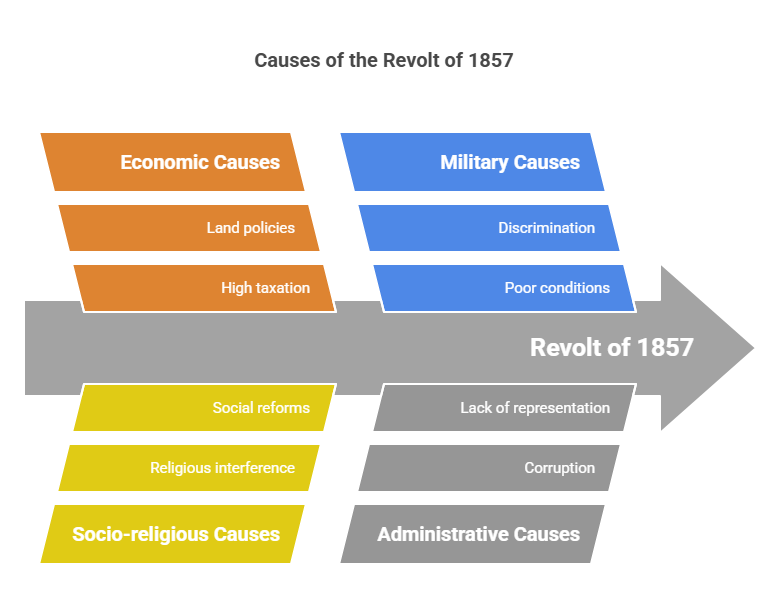
The Revolt of 1857 was driven by political annexations, economic exploitation, socio-religious discontent, military grievances, and administrative misrule by the British.

Political Causes Behind the Revolt of 1857

  • Annexation of Princely States through various instruments such as the doctrine of lapse, and subsidiary alliance among others.
  • Discontent among Sepoys due to various acts of Britishers, such as General Service Enlistment act, use of greased cartridges in Enfield rifles.
  • Loss of Power and Prestige of the Mughal Emperor as well as Zamindar due to British policies such as doctrine of lapse and heavy taxes on land respectively.
  • The policy of indirect rule through Indian princes created a sense of insecurity and fear of losing power among them.
  • The decline of the Mughal Empire and the symbolic leadership of Bahadur Shah II created a rallying point for anti-British sentiments.

Interesting Facts:

Doctrine of Lapse:
  • Introduced by: Lord Dalhousie, Governor-General from 1848 to 1856. 
  • The doctrine stated that if an Indian ruler died without a male heir, his kingdom would be annexed by the East India Company. 
  • Kingdoms annexed under this: Satara (1848), Sambalpur (1850), Udaipur (1852), Nagpur (1853), and Jhansi (1854). 

Economic Causes

  • The economic policies of the British, including heavy taxation, land revenue policies like the Permanent Settlement, and the exploitation of resources, led to economic hardships.
  • The introduction of free trade policies favored British goods over Indian products, leading to the decline of Indian industries and unemployment.
  • The introduction of cash crops like indigo and opium led to the displacement of food crops, causing famines and further impoverishing the peasantry.
  • The loss of royal patronage displaced those pursuing religious and cultural pursuits, resulting in a loss of livelihood. 
  • Zamindars were discontented due to high land taxes and stringent collection methods.

Socio-religious Causes

  • The British interference in social customs and practices, such as the abolition of sati and the promotion of Western education, was seen as cultural imperialism.
  • Religious insensitivity, such as the use of animal fat in cartridges, offended the religious sentiments of both Hindus and Muslims, leading to widespread outrage.
  • The spread of Christian missionaries and conversions fueled fears of cultural and religious extinction among traditional Indian communities.

Military Causes

  • The discontent among Indian sepoys due to low pay, racial discrimination, and the use of Indian soldiers for overseas campaigns.
  • The introduction of the Enfield rifle and the use of greased cartridges, which were rumored to be coated with animal fat, sparked a religious controversy and further alienated the sepoys.

Administrative Causes

  • The inefficiency and corruption in the British administration, led to misgovernance and resentment among the Indian population.
  • The dismantling of the administrative structure of the Mughal Empire and the imposition of British laws and regulations without consideration for local customs and traditions.

Intellectual and Cultural Causes

  • The impact of Western education and ideas of nationalism and democracy, which inspired educated Indians to seek political and social reforms.
  • The role of Indian intellectuals and reformers, such as Raja Ram Mohan Roy and Ishwar Chandra Vidyasagar, in promoting social reforms and challenging British policies.

Major Centers of Revolt of 1857 and Key Leaders

The Revolt of 1857, or India's First War of Independence, saw bitter opposition in most major centers of revolt of 1857 in North India. Indian leaders like General Bakht Khan at Delhi, Nana Saheb at Kanpur, and Rani Laxmibai at Jhansi led the resistance against British domination. But the British, led by officers such as John Nicholson, Sir Colin Campbell, and Sir Hugh Rose, made harsh counterattacks to quell the rebellion. The Delhi, Kanpur, Lucknow, and Jhansi battles are still key milestones in India's fight for independence.
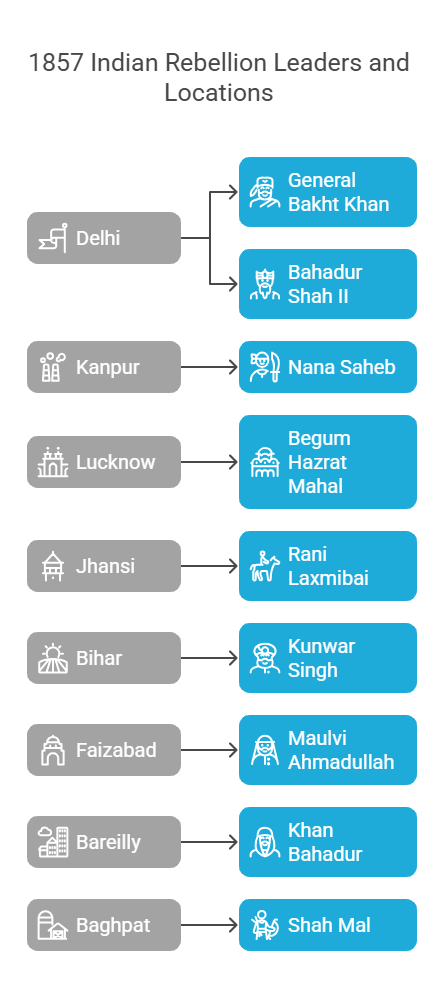
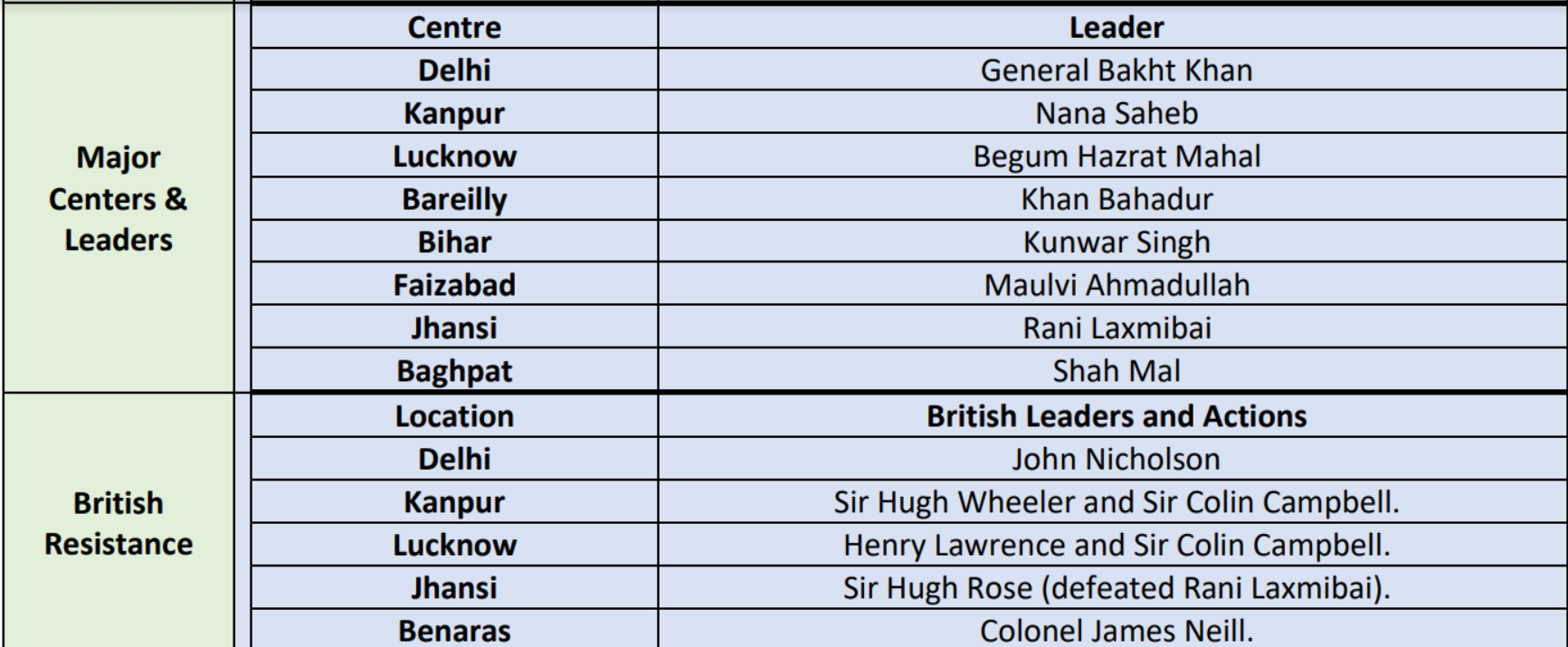

  • Delhi – General Bakht Khan commanded the rebellion in Delhi, mobilizing troops under the nominal command of Bahadur Shah II.
  • Kanpur – Nana Saheb became the leader, fiercely opposing British rule but ultimately defeated by British troops.
  • Lucknow – Begum Hazrat Mahal was a key figure in opposing British rule and mobilizing Awadh's troops.
  • Jhansi – Rani Laxmibai, who was the epitome of courage, fought valiantly with British forces but was finally defeated by Sir Hugh Rose.
  • Bihar – Kunwar Singh, though an old man, organized a strong resistance against the British in Bihar.
  • Faizabad – Maulvi Ahmadullah, a military strategist, played a crucial role in organizing the troops against the British.
  • Bareilly – Khan Bahadur led the Bareilly revolt, demonstrating fierce resistance.
  • Baghpat – Shah Mal, a local chieftain, commanded peasant units in the area.


UPSC QEP 2026 Batch 5 - English
Buy now View Details
Submit Your Details to Learn More
I agree to give my consent to receive updates through SMS/Email & WhatsApp*.

NEEV GS + CSAT Foundation 2026/27
Buy now View Details


Join theIAShub’s Mains Answer Writing Program

Refine your answer writing skills and elevate your UPSC preparation with personalized support and expert feedback.

Fill out the form to get started with the program or any other enquiries !

I agree to give my consent to receive updates through SMS/Email & WhatsApp*.

Best IAS Coaching In Delhi, UPSC Online & Offline Classes by IAShub

Are you dreaming of becoming an IAS officer? Then, IAShub can be your best guide. It is one of the Best IAS Coaching in Delhi. Many students who want to clear the UPSC exam join IAShub for learning. The institute gives both online and offline classes. Their teachers are experienced and helpful. They easily explain every topic. Students also get notes, tests, and tips to do well in the exam.

UPSC Online Classes by IAShub

IAShub is in Delhi and is trusted by many UPSC students. It offers coaching for every part of the UPSC exam – Prelims, Mains, and Interview. The classes are simple and easy to understand. The teachers are experts and guide students in the right way. IAShub is also known for its helpful notes, test series, and answer-writing practice. IAShub is the best coaching in Delhi and also gives UPSC Online Classes. This helps students from any place in India to learn. The online classes are live and also recorded. So, students can watch them anytime. These classes cover the full UPSC syllabus.

Key Offerings Provided by IAShub

Here are some important services provided by IAShub:

  • UPSC Prelims: IAShub teaches for Prelims with a focus on basics. It also gives daily current affairs and monthly magazines.
  • Classroom Courses: IAShub has classroom learning for students in Delhi. The environment is good and peaceful for study.
  • Live Classes: Students who live far can join live UPSC online classes. These classes are just like real classes.
  • QEP for Mains: The Quality Enrichment Program (QEP) is special for Mains preparation. It helps students write better and faster.
  • Answer Writing: Regular answer writing practice is given. Teachers also check answers and give tips to improve.
  • Free Resource: IAShub gives free notes by toppers and helpful Main Booster material.
  • Test Series: Test series are available for every subject. These help students know their weak points and improve.
  • Interview Guidance Session: IAShub also gives interview practice sessions with experts. These help students feel confident.

UPSC Exam Overview

The UPSC Civil Services Exam has three parts:

  • Prelims: It has two papers: General Studies and CSAT.
  • Mains: It has nine papers, including essays and optional subjects.
  • Interview: It tests the personality and confidence of the student.

This exam is tough, but with the right guidance, it becomes easy to manage. Students must study smart and stay regular.

How IAShub Helps in the UPSC Journey

IAShub supports students from the beginning to the end. It gives the right books, tests, and notes. The classes are easy to follow, and the teachers are always ready to help. Students get personal doubt sessions too. The test series and answer checking help students learn where they need to do better. Also, free study materials save time and money.
IAShub also guides students during the final stage – the interview. Experts take mock interviews and give useful tips. This full support makes IAShub one of the best IAS coaching in Delhi.

Best IAS Coaching In Delhi FAQs

Yes, IAShub offers live and recorded online classes. Students can attend from any part of India.

Classes are available in both English and Hindi, so students can choose the language they are comfortable with.

The classroom centre is located in Delhi. Students can visit and join offline batches there.

IAShub gives interview guidance sessions to help students prepare for the final round of UPSC.