


Explore the Integration of Tribals in post-independence India through key policies, constitutional provisions, and development programs. Learn about challenges faced and progress made in uplifting tribal communities while preserving their cultural identity.
 theIASHub | 28 Jun, 2025 | 5106

The Integration of Tribals in post-independence India has been a vital objective for the Indian government. After centuries of marginalization, particularly during British rule, tribal communities remained economically, socially, and politically backward. The Indian state, recognizing this imbalance, adopted several measures to uplift tribal populations while respecting their culture and autonomy. However, the journey of the Integration of Tribals has not been easy, and it continues to evolve through constitutional provisions, welfare schemes, and inclusive governance.
Before India’s independence, tribal communities lived mostly in isolation and had a self-sustained relationship with forests. However, under British colonial policies, their traditional rights were stripped away. The Integration of Tribals was never a priority under colonial rule. Instead, tribals were subjected to:
The socio-economic exploitation led to several tribal uprisings like the Santhal Uprising and the Munda Rebellion led by Birsa Munda.
Even after independence, various factors made the Integration of Tribals a difficult task:
Due to these challenges, several strategic approaches were debated for ensuring the Integration of Tribals without harming their unique identities.
Sociologist G.S. Ghurye advocated an Assimilation Approach. This model aimed to integrate tribals completely into mainstream society. Key features:
However, this method risked cultural erosion and undermined the community’s identity during the process of Integration of Tribals.
In contrast, Verrier Elwin promoted the Isolation Approach, often called the National Park Approach:
Although it preserved culture, this approach restricted access to development, education, and political rights—making the Integration of Tribals incomplete and impractical.
The most widely accepted method was the Integration Approach, which balances tribal identity with national development:
This method represents a holistic path for the Integration of Tribals into the broader Indian framework.
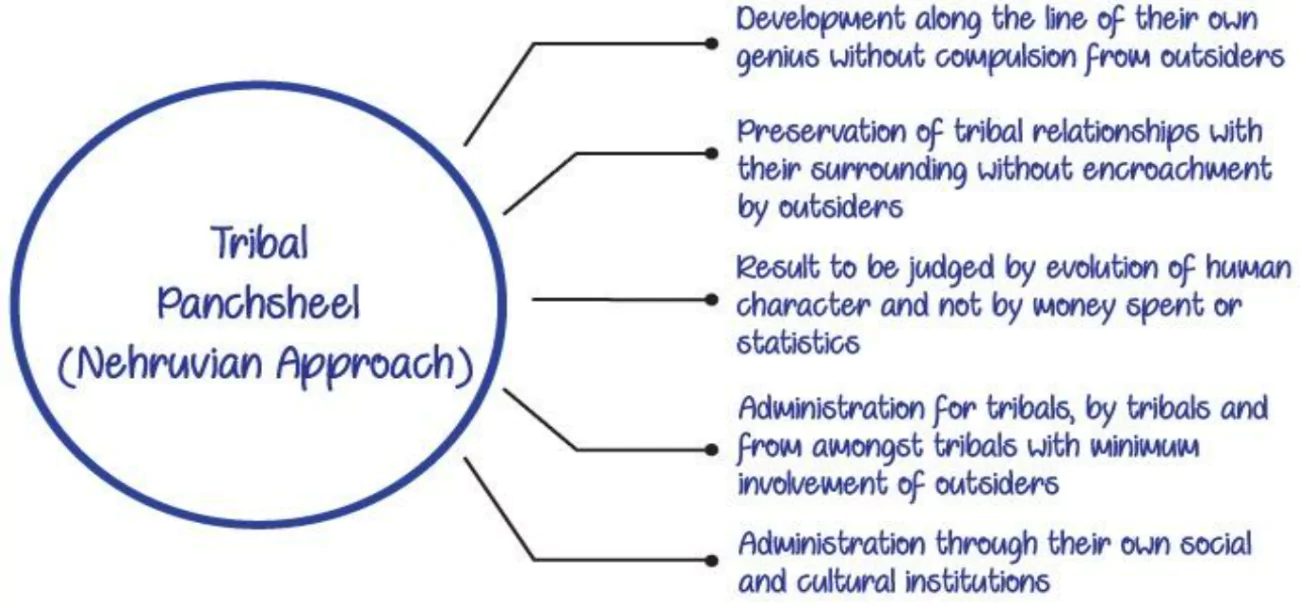
Prime Minister Jawaharlal Nehru laid down the Tribal Panchsheel, which became the moral and administrative foundation for the Integration of Tribals in India. The key principles were:
The Indian Constitution includes several special provisions to aid in the Integration of Tribals:
These legal tools are vital instruments in the Integration of Tribals into India’s democratic framework.
The Forest Rights Act recognized traditional forest dwellers’ rights to land and forest resources. It empowered tribal people to manage their own resources and strengthened their role in ecological protection—an essential step for the Integration of Tribals.
These education-focused initiatives are foundational to the Integration of Tribals through empowerment.
These programs ensure the Integration of Tribals with economic dignity and community participation.
The National Scheduled Tribes Finance and Development Corporation (NSTFDC) was launched in 2001 under the Ministry of Tribal Affairs. It helps achieve the Integration of Tribals by:
By financially empowering tribal communities, NSTFDC plays a critical role in their holistic development and Integration of Tribals.
The Integration of Tribals is not merely a political or economic goal—it's a constitutional and moral responsibility. While multiple approaches have been tried, the integration model based on respect, representation, and empowerment has shown the most success. From constitutional protections to targeted programs, India continues to ensure that its tribal communities are not left behind. A truly inclusive nation is one where the Integration of Tribals is not just policy—but practice.


Refine your answer writing skills and elevate your UPSC preparation with personalized support and expert feedback.
Fill out the form to get started with the program or any other enquiries !

Are you dreaming of becoming an IAS officer? Then, IAShub can be your best guide. It is one of the Best IAS Coaching in Delhi. Many students who want to clear the UPSC exam join IAShub for learning. The institute gives both online and offline classes. Their teachers are experienced and helpful. They easily explain every topic. Students also get notes, tests, and tips to do well in the exam.
IAShub is in Delhi and is trusted by many UPSC students. It offers coaching for every part of the UPSC exam – Prelims, Mains, and Interview. The classes are simple and easy to understand. The teachers are experts and guide students in the right way. IAShub is also known for its helpful notes, test series, and answer-writing practice. IAShub is the best coaching in Delhi and also gives UPSC Online Classes. This helps students from any place in India to learn. The online classes are live and also recorded. So, students can watch them anytime. These classes cover the full UPSC syllabus.
Here are some important services provided by IAShub:
The UPSC Civil Services Exam has three parts:
This exam is tough, but with the right guidance, it becomes easy to manage. Students must study smart and stay regular.
IAShub supports students from the beginning to the end. It gives the right books, tests, and notes. The classes are easy to follow, and the teachers are always ready to help. Students get personal doubt sessions too. The test series and answer checking help students learn where they need to do better. Also, free study materials save time and money.
IAShub also guides students during the final stage – the interview. Experts take mock interviews and give useful tips. This full support makes IAShub one of the best IAS coaching in Delhi.
Join 39,000+ UPSC Aspirants! 🚀
Get Free UPSC/State PSC Study Materials, Daily Current Affairs Question & Exam Updates.
Join Telegram Channel
