Explore key highlights of the Union Budget 2025-26, including tax reforms, infrastructure focus, fiscal health, and measures to boost growth, investment, and welfare
 theIAShub | 06 Jan, 2025 | 4624 | 0 |
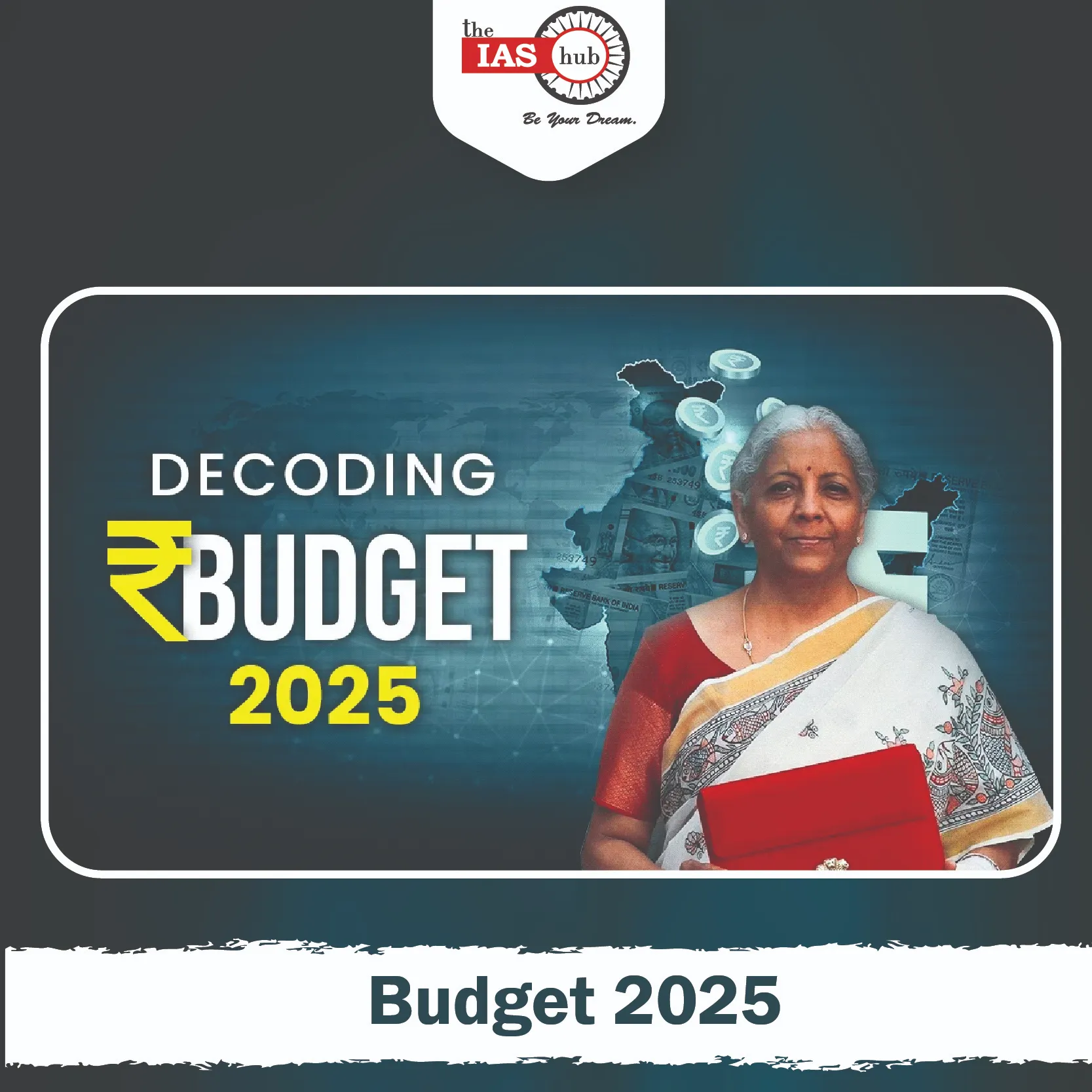

Union Budget 2025-26 has been presented by Finance Minister Nirmala Sitharaman, and will play a key role in shaping India’s economy for the year ahead. As the new year begins, this budget is expected to focus on important reforms and priorities for the country.
Union Budget 2025-26 has announced significant tax reforms, infrastructure development, and measures to boost economic growth. The budget is also expected to allocate more funds for education and healthcare and announce measures to boost the stock market and encourage investment.
In this article, we will look at the expected date, key highlights, and what to expect from the upcoming Union Budget 2025-26. This Budget 2025 is expected to be a crucial one, given the current economic scenario.
A budget is an annual financial document that details estimated income and expenses for a specific period, typically one year. It serves as a framework for managing resources and achieving objectives like resource mobilization and fiscal stability.
In India, the national budget is drafted by the Budget Division of the Department of Economic Affairs (DEA) under the Ministry of Finance. It is then presented to Parliament for review and approval, guiding the country’s financial planning and supporting its economic and social policies.
In the constitution of India the Budget is not directly mentioned; it is referred to as Annual Financial Statement. Here are constitutional provisions which make the Budget necessary.
| Articles | Provisions |
| Article 112 | The President shall, every financial year, cause to lay an annual financial statement before both Houses of Parliament, a statement of the estimated receipts and expenditure of the Government of India for that year. |
| Article 113 | No demand for a grant shall be made except on the recommendation of the President. |
|
Article 114 |
No amount can be withdrawn from the Consolidated Fund of India(CFI) without authorization from the Parliament. |
|
Article 266 |
All revenues received by the government shall be credited to the “Consolidated Fund of India”.
All other public money, such as provident fund, Postal insurance, etc, shall be credited to the Public Account of India. |
| Article 267 | Parliament may by law establish a Contingency Fund of India to meet unexpected or unforeseen expenditures. |
The constitution mandates the President to lay down the Annual Financial Statement (Union Budget) in the parliament. The Finance Minister on behalf of the President lays it down in Parliament on 1st February, 11 A.M IST.
Here is the speech of Finance Minister Nirmala Sitaraman which provides an overview of the budget.
Here is the actual Union Budget 2025 Document.
Union Budget divides itself into two parts:
These accounts are further divided into 4 more parts by inclusion of expenditure and income sections in the above two parts.
Following are the few terms that will help you understand the complexities of Union Budget:

Tax & Personal Finance
Farmers & Rural Support
Jobs & Welfare
Infrastructure & Energy
Economy & Fiscal Health
Who Gains & Who Loses?
The standard deduction has been increased to ₹75,000, further reducing the taxable income for salaried individuals.
| Annual Income range | Tax Rate |
| 0-4 Lakhs | 0% |
| 4-8 Lakhs | 5% |
| 8-12 Lakhs | 10% |
| 12-16 Lakhs | 15% |
| 16-20 Lakhs | 20% |
| 20-24 Lakhs | 25% |
| Above 24 Lakhs | 30% |
Thus, a salaried individual has to pay nil tax on incomes upto ₹12.75 lakh.
Securities Transaction Tax
The Securities Transaction Tax (STT) is a tax levied on the purchase and sale of securities, including stocks, bonds, and mutual funds. The government may announce a reduction in the STT rate to boost the stock market and encourage investment.
Key expectations include tax reforms, infrastructure development, support for agriculture, better funding for education and healthcare, and measures to boost investments.
The Securities Transaction Tax (STT) rate varies based on the type of trade, such as 0.1% for delivery-based equity trades.
Industries expect GST reductions, increased funding for infrastructure, and support for sectors like real estate, IT, automobiles, and manufacturing.
Total Expenditure: The government is estimated to spend Rs 48,20,512 crore in 2024-25. This is an increase of 8.5% over the actuals of 2023-24.

Refine your answer writing skills and elevate your UPSC preparation with personalized support and expert feedback.
Fill out the form to get started with the program or any other enquiries !
Are you dreaming of becoming an IAS officer? Then, IAShub can be your best guide. It is one of the Best IAS Coaching in Delhi. Many students who want to clear the UPSC exam join IAShub for learning. The institute gives both online and offline classes. Their teachers are experienced and helpful. They easily explain every topic. Students also get notes, tests, and tips to do well in the exam.
IAShub is in Delhi and is trusted by many UPSC students. It offers coaching for every part of the UPSC exam – Prelims, Mains, and Interview. The classes are simple and easy to understand. The teachers are experts and guide students in the right way. IAShub is also known for its helpful notes, test series, and answer-writing practice. IAShub is the best coaching in Delhi and also gives UPSC Online Classes. This helps students from any place in India to learn. The online classes are live and also recorded. So, students can watch them anytime. These classes cover the full UPSC syllabus.
Here are some important services provided by IAShub:
The UPSC Civil Services Exam has three parts:
This exam is tough, but with the right guidance, it becomes easy to manage. Students must study smart and stay regular.
IAShub supports students from the beginning to the end. It gives the right books, tests, and notes. The classes are easy to follow, and the teachers are always ready to help. Students get personal doubt sessions too. The test series and answer checking help students learn where they need to do better. Also, free study materials save time and money.
IAShub also guides students during the final stage – the interview. Experts take mock interviews and give useful tips. This full support makes IAShub one of the best IAS coaching in Delhi.