
















Explore Meghalaya’s history, languages, polity, rivers, national parks, and dams. Learn about its statehood journey, tribal cultures, living root bridges, and iconic sites like Shillong and Cherrapunji.
 theIAShub | 06 May, 2025 | 6131 | 0 |

Meghalaya is a state in northeastern India, known for its beautiful landscapes, rich culture, and many types of plants and animals. The name “Meghalaya” means “abode of clouds,” which describes its misty hills and valleys.
Meghalaya is famous for its living root bridges, made by local Khasi and Jaintia people. Shillong, the capital, is called the “Scotland of the East” because of its lovely scenery. Meghalaya gets a lot of rain, which helps create lush forests, waterfalls like Nohkalikai, and wildlife areas. The state’s festivals and traditions add to its unique beauty.
Meghalaya’s path to becoming a state is a remarkable story. It became an autonomous region on April 2, 1970, and gained full statehood on January 21, 1972. This marked the beginning of a new era in the geopolitical history of North Eastern India.
The emergence of Meghalaya was the result of peaceful democratic negotiations and mutual understanding, which stood in stark contrast to the violence and unrest that often troubled the region’s history. It was the triumph of peaceful negotiation over conflict, leading to the creation of a unique and prosperous state in India.
Also Read: Indian States and Their Capitals
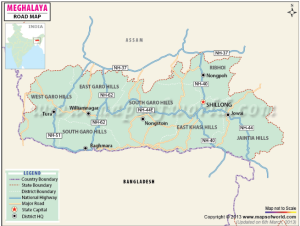
Meghalaya shares borders with Assam to the north and east, and Bangladesh to the south and west. The state stretches about 300 kilometers in length and around 100 kilometers in breadth. Shillong, the capital city, is located at an altitude of 1496 meters above sea level and is known for its pleasant climate.
Also Read: World Autism Awareness Day
Meghalaya has several rivers, most of which are rain-fed and flow southward into Bangladesh. Major rivers include:
While Meghalaya does not have high-altitude Himalayan passes, it has several natural corridors and low mountain passes through the hills:
Meghalaya has invested in dams for hydroelectricity, irrigation, and water supply. Key dams include:
Meghalaya hosts ecologically rich national parks that protect rare species and diverse flora and fauna:
Note: Meghalaya does not currently have a designated Tiger Reserve, but Nokrek is an important habitat for several endangered species.
[metaslider id=”5575″]
The state has numerous sanctuaries that support biodiversity conservation:
Meghalaya follows the parliamentary system of governance, in line with the Constitution of India. The state has a unicameral legislature, with the Meghalaya Legislative Assembly consisting of 60 Members of the Legislative Assembly (MLAs). These members are elected directly by the people through state elections held every five years.
The Governor of Meghalaya is the constitutional head of the state, appointed by the President of India, while the Chief Minister is the head of the government, holding executive powers. The state’s legislative framework is supported by the High Court of Meghalaya, which ensures judicial oversight and legal redress.
In terms of political history, the formation of Meghalaya was a landmark in India’s federal framework. Its peaceful creation on January 21, 1972, through democratic negotiations, highlighted the strength of Indian democracy. Over the years, various regional parties such as the National People’s Party (NPP), United Democratic Party (UDP), and Indian National Congress (INC) have played prominent roles in the political scenario of the state.
Meghalaya is rich in cultural diversity, which is reflected in the distinct customs, traditions, and festivals of its indigenous communities. The state is home to three major tribes: the Khasi, the Jaintia, and the Garo. Each tribe has its own language, cultural practices, and social structures. The state’s official languages are Khasi, Pnar, and Garo, with English being the medium of education and administration.
The people of Meghalaya are known for their warm hospitality and strong sense of community. Traditional festivals such as the Wangala festival of the Garos, and Shad Suk Mynsiem of the Khasis, showcase the rich cultural fabric of the state. Music and dance are central to the lives of the people, and the vibrant traditional songs and dances reflect the region’s deep connection with nature.
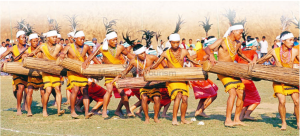
Image: Wangala Festival
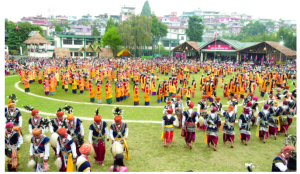
Image: Shad Suk Mynsiem
Agriculture plays a significant role in the economy of Meghalaya, with the majority of the population being dependent on farming for their livelihood. The state’s Department of Agriculture, which was created in 1882, continues to focus on increasing crop production, improving productivity, and ensuring food security. The state has a favorable climate for horticulture, and various crops such as oranges, pineapples, and areca nuts are grown in abundance.
The Department of Agriculture’s efforts to increase the income of farmers, promote modern agricultural techniques, and encourage commercial farming have been vital in improving the economic condition of rural communities. The state’s focus on water resources, minor irrigation, and sustainable agricultural practices further supports rural development.
Also Read: UJALA Scheme
Meghalaya has become an increasingly popular tourist destination, thanks to its natural beauty, rich cultural heritage, and unique landscapes. The state is home to picturesque valleys, breathtaking waterfalls, and crystal-clear rivers, making it a haven for nature lovers. The picturesque hill stations, including Shillong, Mawsynram, and Cherrapunji, attract tourists from across the world.
Tourism in the state is managed by the Directorate of Tourism, which aims to promote Meghalaya as a prominent tourist destination. The state government has focused on developing infrastructure to accommodate tourists, including providing better facilities, transportation, and accommodations. Various promotional activities, such as festivals, exhibitions, and participation in travel fairs, have been organized to boost the tourism sector.
The state’s commitment to environmental sustainability is reflected in the work of the Forests and Environment Department. Established to protect and manage the state’s forests, the department works to ensure that Meghalaya’s rich biodiversity and natural resources are conserved for future generations. The state is home to diverse flora and fauna, with several national parks and wildlife sanctuaries protecting these ecosystems.
Efforts are being made to ensure environmental stability, with a focus on maintaining ecological balance. The department also promotes the sustainable harvesting of forest resources and conservation of medicinal plants. The state’s focus on environmental sustainability is crucial for maintaining the natural beauty and biodiversity that make it a unique destination.
Also Read: Deendayal Antyodaya Yojana
[metaslider id=”5575″]
Given Meghalaya’s strategic location bordering Bangladesh, the state has also prioritized the development of its border areas. The Border Areas Development Department, established in 1973, is responsible for implementing development projects in these regions, including infrastructure development, education, healthcare, and provision of basic amenities. The Border Areas Development Programme (BADP) aims to bridge the gaps in development in these remote and inaccessible areas, with a focus on the welfare of border communities.

Are you preparing for UPSC 2025? Join IAShub’s UPSC coaching batches to boost your preparation. Enroll now!

Shillong is the capital of Meghalaya, often referred to as the "Scotland of the East" due to its picturesque hills, valleys, and pleasant weather.
Meghalaya is home to three major tribes: the Khasi, Garo, and Jaintia, each with distinct languages, cultural practices, and social structures.
The official languages of Meghalaya are Khasi, Pnar, and Garo. English is widely used for administration and education.
Meghalaya was granted autonomous status on April 2, 1970, and became a full-fledged state on January 21, 1972, after peaceful negotiations.


Refine your answer writing skills and elevate your UPSC preparation with personalized support and expert feedback.
Fill out the form to get started with the program or any other enquiries !



Are you dreaming of becoming an IAS officer? Then, IAShub can be your best guide. It is one of the Best IAS Coaching in Delhi. Many students who want to clear the UPSC exam join IAShub for learning. The institute gives both online and offline classes. Their teachers are experienced and helpful. They easily explain every topic. Students also get notes, tests, and tips to do well in the exam.
IAShub is in Delhi and is trusted by many UPSC students. It offers coaching for every part of the UPSC exam – Prelims, Mains, and Interview. The classes are simple and easy to understand. The teachers are experts and guide students in the right way. IAShub is also known for its helpful notes, test series, and answer-writing practice. IAShub is the best coaching in Delhi and also gives UPSC Online Classes. This helps students from any place in India to learn. The online classes are live and also recorded. So, students can watch them anytime. These classes cover the full UPSC syllabus.
Here are some important services provided by IAShub:
The UPSC Civil Services Exam has three parts:
This exam is tough, but with the right guidance, it becomes easy to manage. Students must study smart and stay regular.
IAShub supports students from the beginning to the end. It gives the right books, tests, and notes. The classes are easy to follow, and the teachers are always ready to help. Students get personal doubt sessions too. The test series and answer checking help students learn where they need to do better. Also, free study materials save time and money.
IAShub also guides students during the final stage – the interview. Experts take mock interviews and give useful tips. This full support makes IAShub one of the best IAS coaching in Delhi.

Join 50,000+ UPSC Aspirants! 🚀
Get Free UPSC/IAS Study Materials, Daily Current Affairs, Editorial Summaries & Exam Updates.
Join Telegram Channel