The National Food Security Mission aims to increase food grain production and ensure food security in India. Learn National Food Security Mission objectives, beneficiaries, and implementation details here.
 theIAShub | 04 Apr, 2025 | 2943 | 0 |

The National Food Security Mission (NFSM) is a crucial government initiative aimed at enhancing food grain production in India. It is an important topic for UPSC aspirants, as it aligns with the themes of agriculture, food security, and rural development. Understanding NFSM can help candidates grasp India’s approach to ensuring food availability, sustainability, and economic upliftment of farmers.
The National Food Security Mission (NFSM) is a Centrally Sponsored Scheme launched in 2007 based on recommendations from the National Development Council (NDC). The mission focuses on boosting the production of rice, wheat, and pulses through area expansion, productivity enhancement, and improved farming techniques. Over time, it has also included coarse cereals and commercial crops under its scope.
Also Read: UPSC Prelims Cut off Analysis
The NFSM was designed to achieve the following objectives:
| Objective | Description |
| Increase food grain production | Achieve self-sufficiency in food grain production to ensure food security. |
| Enhance farm-level productivity | Promote modern agricultural techniques, seed quality improvement, and mechanization. |
| Restore soil fertility | Improve soil health and sustainable farming practices. |
| Raise farmers’ income | Increase earnings of farmers by improving productivity and profitability. |
| Employment generation | Create jobs in agriculture and allied sectors. |
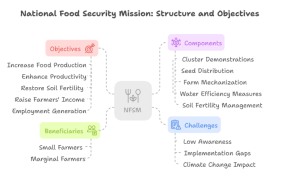
The NFSM scheme is implemented across 638 districts in 29 states. The key components include:
Also Read: UPSC Prelims Syllabus
The primary beneficiaries of the NFSM are farmers, particularly small and marginal farmers. They receive support in the form of:
The NFSM includes various components targeting specific food crops and farming practices:
[metaslider id=”5575″]
The NFSM follows a structured approach to implementation, which includes:
The National Food Security Act (NFSA), 2013, complements the NFSM by ensuring access to subsidized food grains for up to 75% of rural and 50% of urban populations under the Targeted Public Distribution System (TPDS). Key provisions include:
Also Read: UPSC Prelims Pattern
Despite its success, the NFSM faces several challenges, including:
The National Food Security Mission plays a vital role in ensuring food security, boosting agricultural production, and supporting farmers. Alongside the National Food Security Act, it strengthens India’s efforts to achieve self-sufficiency and nutritional security for its citizens.
Are you preparing for UPSC 2025? Join IAShub’s UPSC coaching batches to boost your preparation. Enroll now!

The Ministry of Agriculture and Farmers' Welfare implements the NFSM in coordination with state governments and agricultural institutions.
The NFSM provides subsidized seeds, modern equipment, training, and financial aid to small and marginal farmers to boost productivity.
The mission covers rice, wheat, pulses, coarse cereals (millets, maize, barley), and commercial crops like cotton, jute, and sugarcane.
Success is measured through increased food grain production, improved soil fertility, higher farmer incomes, and employment generation in the agricultural sector.
The National Food Security Mission (NFSM) was launched during the Eleventh Five-Year Plan in 2007-08.
The initial target of the NFSM was to increase food grain production by an additional 20 million metric tonnes (MT).


Refine your answer writing skills and elevate your UPSC preparation with personalized support and expert feedback.
Fill out the form to get started with the program or any other enquiries !






Are you dreaming of becoming an IAS officer? Then, IAShub can be your best guide. It is one of the Best IAS Coaching in Delhi. Many students who want to clear the UPSC exam join IAShub for learning. The institute gives both online and offline classes. Their teachers are experienced and helpful. They easily explain every topic. Students also get notes, tests, and tips to do well in the exam.
IAShub is in Delhi and is trusted by many UPSC students. It offers coaching for every part of the UPSC exam – Prelims, Mains, and Interview. The classes are simple and easy to understand. The teachers are experts and guide students in the right way. IAShub is also known for its helpful notes, test series, and answer-writing practice. IAShub is the best coaching in Delhi and also gives UPSC Online Classes. This helps students from any place in India to learn. The online classes are live and also recorded. So, students can watch them anytime. These classes cover the full UPSC syllabus.
Here are some important services provided by IAShub:
The UPSC Civil Services Exam has three parts:
This exam is tough, but with the right guidance, it becomes easy to manage. Students must study smart and stay regular.
IAShub supports students from the beginning to the end. It gives the right books, tests, and notes. The classes are easy to follow, and the teachers are always ready to help. Students get personal doubt sessions too. The test series and answer checking help students learn where they need to do better. Also, free study materials save time and money.
IAShub also guides students during the final stage – the interview. Experts take mock interviews and give useful tips. This full support makes IAShub one of the best IAS coaching in Delhi.