How to Reduce Regionalism in India: Policies, Challenges, and the Way Ahead

Explore key government initiatives, constitutional provisions, and policy reforms adopted to reduce regionalism in India and promote national integration.

THEIASHUB
Get an Instant Call Back from Our Expert Mentors Now!
+91

India’s vast diversity is its strength, but it also poses unique challenges. Among them, regionalism—a sense of identity and loyalty to one’s region over the nation—has often threatened the unity and integrity of the country. Addressing this requires a multi-faceted approach that balances regional aspirations with national goals. In this article, we examine how to reduce regionalism through constitutional, legislative, economic, and policy-driven measures.
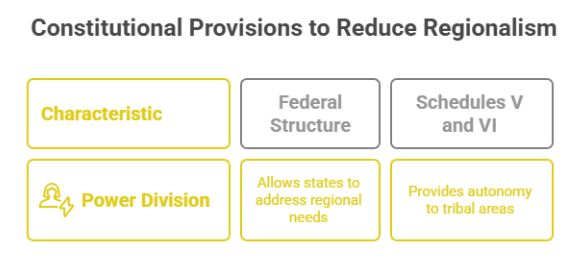
Constitutional Provisions to Reduce Regionalism

Federal Structure and Power Division

India’s federal structure has been carefully designed to reduce regionalism by empowering both the Centre and the States.

  • Division of powers between the Union and States (Seventh Schedule) allows states to address regional needs.
  • Schedules V and VI provide autonomy to tribal areas to preserve their distinct identities while remaining within the constitutional framework.

Decentralization and Local Governance

Decentralization through Panchayati Raj Institutions (PRIs) and urban local bodies ensures that regional issues are addressed locally.

  • 73rd and 74th Constitutional Amendments empowered local governance to respond to grassroots challenges.
  • This promotes effective governance and helps reduce regionalism by integrating local populations into the democratic process.

Legislative and Institutional Measures to Reduce Regionalism

Creation of New States

The reorganization of states has often been used as a tool to reduce regionalism.

  • Telangana, Jharkhand, Chhattisgarh, and Uttarakhand were created to meet regional demands.
  • Granting statehood has helped to channel regional identity into positive governance structures.

Autonomy and Special Provisions

Special autonomy provisions help in recognizing and managing regional differences.

  • Autonomy under the Sixth Schedule in the North-East provides legislative and administrative powers to autonomous councils.
  • These provisions ensure regional voices are heard without fragmenting the nation.

Role of Zonal and Regional Councils

  • Zonal Councils and Inter-State Councils promote dialogue among states to solve common problems.
  • They function as important platforms to reduce regionalism by fostering inter-state cooperation.

Economic Programs and Development Schemes

Inclusive Economic Policies

Economic disparity is one of the biggest causes of regionalism. Addressing these inequalities is crucial to reduce regionalism.

  • Aspirational Districts Programme targets underdeveloped districts in health, education, and infrastructure.
  • Special grants to backward states ensure equitable development.

Special Economic Zones (SEZs)

  • SEZs are set up to attract investment and create jobs in lagging regions.
  • These zones help reduce regionalism by promoting economic opportunities in neglected areas.

Incentives for Investment in Backward Areas

  • Government schemes like tax holidays, income tax concessions, and industrial subsidies aim to reduce regional imbalances.
  • They encourage industries to invest in underdeveloped regions, thereby helping to reduce regionalism.

Policy and Administrative Reforms

Role of NITI Aayog and Finance Commissions

  • NITI Aayog, a policy think tank, designs region-specific development plans.
  • Finance Commissions recommend fiscal devolution, enabling states to address their regional needs better.

These bodies ensure that financial and development decisions are not centralized, thus helping reduce regionalism.

Fiscal Federalism through GST and Grants

  • The Goods and Services Tax (GST) is an example of cooperative federalism.
  • It promotes a unified market, reducing economic inequalities and helping to reduce regionalism.

Social, Cultural, and Educational Initiatives

Linguistic Reorganization of States

  • Reorganization of states based on language has reduced linguistic tensions and promoted harmony.
  • It was a major step to reduce regionalism during the early years of the republic.

Three Language Formula

  • Encourages learning of Hindi, English, and the regional language.
  • Helps in building linguistic bridges among different regions and works to reduce regionalism by promoting national understanding.

Cultural Exchange Programs

  • Initiatives like ‘Ek Bharat Shreshtha Bharat’ promote state-to-state cultural exchanges.
  • These build national identity and actively reduce regionalism by celebrating unity in diversity.

Government Initiatives to Reduce Regionalism

Ministry of Development of North Eastern Region (DoNER)

  • Created in 2001, it coordinates efforts for development in the North-East.
  • It is the only ministry with a territorial jurisdiction, helping to reduce regionalism in one of the most diverse regions of India.

Special Category Status (SCS)

  • Given to states with geographical and socio-economic disadvantages.
  • Provides additional funding and incentives to uplift backward states and reduce regionalism.

National Integration Programs

  • Campaigns like Doordarshan’s Regional Channels, regional film festivals, and media representation help counter stereotypes.
  • These play a vital role in spreading awareness and help reduce regionalism.

Policy Innovation and Best Practices by States

Model Schemes

  • Tamil Nadu’s Skill Development Programs under MGNREGA and Rajasthan’s Bhamashah Scheme are innovative regional models.
  • Encouraging policy experimentation at state levels can effectively reduce regionalism by providing scalable solutions.

Infrastructure Development Initiatives

  • National Infrastructure Pipeline (NIP) and Smart Cities Mission prioritize infrastructure in underdeveloped areas.
  • Improved connectivity and living standards are crucial to reduce regionalism.

The Way Forward: Long-Term Strategies to Reduce Regionalism

Strengthening Cooperative Federalism

  • Empower states financially and administratively.
  • Recommendations of the 15th Finance Commission on increased fiscal space must be implemented to reduce regionalism.

Promote Inter-State Cooperation

  • Resolve disputes like water sharing through negotiation and coordination.
  • The Mahanadi River dispute resolution between Odisha and Chhattisgarh sets a great example.

Address Secessionist Movements through Dialogue

  • Political negotiations like the Bodoland Territorial Region Accord in Assam are vital for long-term peace.
  • Engaging with grievances through development helps reduce regionalism effectively.

Empowering Local Governance

  • Strengthen Panchayati Raj Institutions and urban local bodies to give regions control over their development.
  • More local participation helps in understanding and addressing region-specific problems.

Conclusion: A United India Through Balanced Regional Growth

To successfully reduce regionalism, India must walk a fine line between respecting regional identities and reinforcing national unity. Constitutional mechanisms, inclusive economic policies, infrastructure development, and effective decentralization are all part of the broader strategy. By fostering cooperation and addressing grievances through sustained development, India can ensure that regional pride becomes a contributor to, not a competitor of, national integration.


UPSC QEP 2026 Batch 5 - English
2026 UPPCS Integrated Hindi QEP B3
View Details
Submit Your Details to Learn More
I agree to give my consent to receive updates through SMS/Email & WhatsApp*.
UPSC QEP 2026 Batch 5 - English
2026 UPPCS Integrated English QEP B3
View Details

Join theIAShub’s Mains Answer Writing Program

Refine your answer writing skills and elevate your UPSC preparation with personalized support and expert feedback.

Fill out the form to get started with the program or any other enquiries !
I agree to give my consent to receive updates through SMS/Email & WhatsApp*.

Best IAS Coaching In Delhi, UPSC Online & Offline Classes by IAShub

Are you dreaming of becoming an IAS officer? Then, IAShub can be your best guide. It is one of the Best IAS Coaching in Delhi. Many students who want to clear the UPSC exam join IAShub for learning. The institute gives both online and offline classes. Their teachers are experienced and helpful. They easily explain every topic. Students also get notes, tests, and tips to do well in the exam.

UPSC Online Classes by IAShub

IAShub is in Delhi and is trusted by many UPSC students. It offers coaching for every part of the UPSC exam – Prelims, Mains, and Interview. The classes are simple and easy to understand. The teachers are experts and guide students in the right way. IAShub is also known for its helpful notes, test series, and answer-writing practice. IAShub is the best coaching in Delhi and also gives UPSC Online Classes. This helps students from any place in India to learn. The online classes are live and also recorded. So, students can watch them anytime. These classes cover the full UPSC syllabus.

Key Offerings Provided by IAShub

Here are some important services provided by IAShub:

  • UPSC Prelims: IAShub teaches for Prelims with a focus on basics. It also gives daily current affairs and monthly magazines.
  • Classroom Courses: IAShub has classroom learning for students in Delhi. The environment is good and peaceful for study.
  • Live Classes: Students who live far can join live UPSC online classes. These classes are just like real classes.
  • QEP for Mains: The Quality Enrichment Program (QEP) is special for Mains preparation. It helps students write better and faster.
  • Answer Writing: Regular answer writing practice is given. Teachers also check answers and give tips to improve.
  • Free Resource: IAShub gives free notes by toppers and helpful Main Booster material.
  • Test Series: Test series are available for every subject. These help students know their weak points and improve.
  • Interview Guidance Session: IAShub also gives interview practice sessions with experts. These help students feel confident.

UPSC Exam Overview

The UPSC Civil Services Exam has three parts:

  • Prelims: It has two papers: General Studies and CSAT.
  • Mains: It has nine papers, including essays and optional subjects.
  • Interview: It tests the personality and confidence of the student.

This exam is tough, but with the right guidance, it becomes easy to manage. Students must study smart and stay regular.

How IAShub Helps in the UPSC Journey

IAShub supports students from the beginning to the end. It gives the right books, tests, and notes. The classes are easy to follow, and the teachers are always ready to help. Students get personal doubt sessions too. The test series and answer checking help students learn where they need to do better. Also, free study materials save time and money.
IAShub also guides students during the final stage – the interview. Experts take mock interviews and give useful tips. This full support makes IAShub one of the best IAS coaching in Delhi.

Best IAS Coaching In Delhi FAQs

Yes, IAShub offers live and recorded online classes. Students can attend from any part of India.

Classes are available in both English and Hindi, so students can choose the language they are comfortable with.

The classroom centre is located in Delhi. Students can visit and join offline batches there.

IAShub gives interview guidance sessions to help students prepare for the final round of UPSC.
