Impact of British Rule in India: Economic, Social, and Cultural Consequences

Impact of British Rule on India led to economic exploitation, decline of industries, land revenue burdens, and social changes. Learn how colonial policies shaped India.

THEIASHUB
Get an Instant Call Back from Our Expert Mentors Now!
+91

The impact of British rule in India was significant and extensive, extending to several sectors of the economy, society, and culture. British policy caused the transformation of India's ancient economy, introduction of fresh land revenue structures, and plunder of resources in favor of the colonial government. The effects of British rule were short-term as well as long-term, leaving a lasting impression on India's political and economic system for centuries to come. Following are some of the major areas where British policies played an important role:
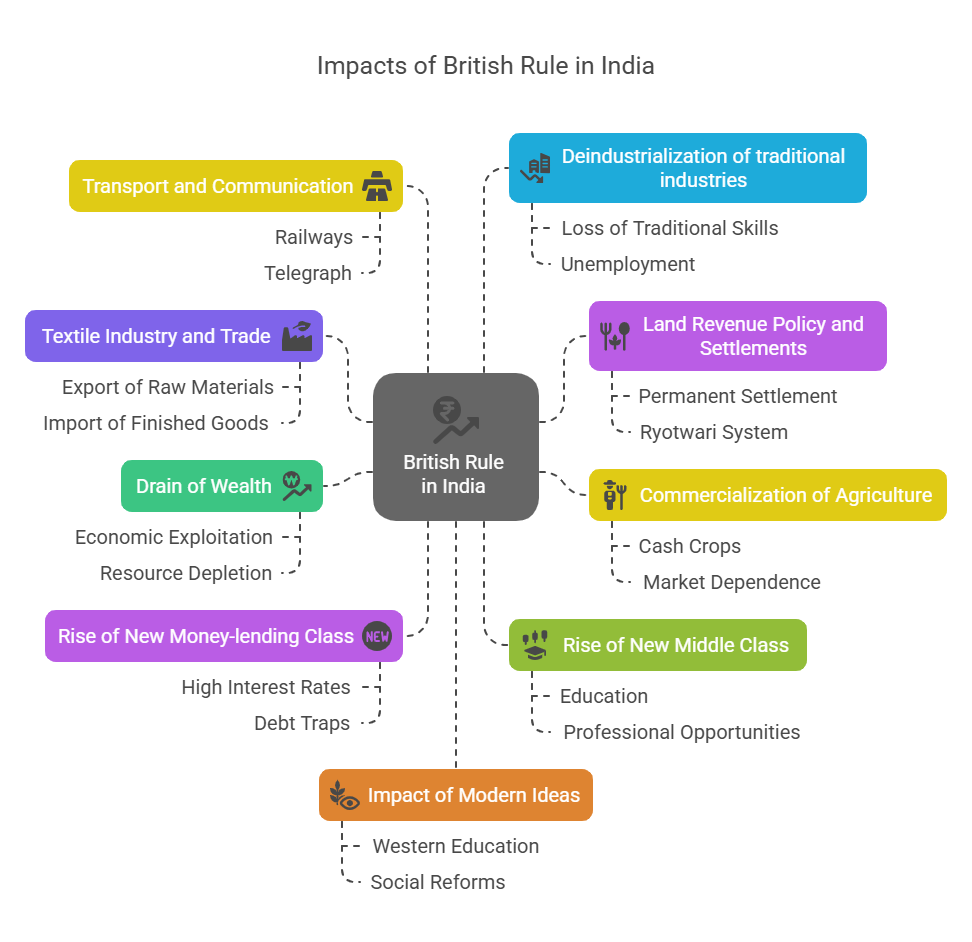

  • Textile Industry and Trade: The massive import of machine-made clothes from England to India led to the decline of local textile production.
  • British goods were sold at lower prices, severely threatening Indian handicrafts and local markets.
  • India transitioned from being a leading exporter of fine textiles to an importer of British manufactured clothes, while exporting raw cotton.
  • The collapse of the Indian handloom industry resulted in widespread unemployment and increased pressure on rural economies.
  • Land Revenue Policy and Settlements: Under British Rule in India, the British increased land revenue to finance their administration and wars, often without considering the economic conditions of the cultivators.
  • Various land revenue systems were introduced, including the Permanent Settlement in Bengal, the Mahalwari system in North-Western provinces, and the Ryotwari system in Madras and Bombay, causing hardship to many cultivators.
  • These experiments often led to over-taxation and contributed to rural indebtedness and landlessness.
  • Commercialization of Agriculture: During British Rule in India, the British introduced the cultivation of commercial crops such as cotton, jute, indigo, and tea, primarily to serve British industrial needs.
  • British control over lucrative markets like opium and indigo limited profits for Indian producers, who faced exploitation.
  • Tea plantations, managed by the British, brought severe hardships for workers, including poor working conditions and low wages.
  • The commercialization of agriculture led to the increased transfer of land ownership to moneylenders and landlords, exacerbating rural exploitation and poverty.
  • Drain of Wealth: Significant portions of India's wealth were drained to Britain through taxes, trade profits, and salaries, benefiting the British Empire and impoverishing India. This economic drain was highlighted by Dadabhai Naoroji's "Drain Theory."
  • Rise of New Money-lending Class: The exploitation by moneylenders increased as peasants borrowed to pay high taxes, leading to widespread transfer of land ownership from cultivators to moneylenders.
  • Rise of New Middle Class: British commercial interests created economic opportunities for a new elite class, including traders, administrators, and professionals.

  • A new landed aristocracy and urban middle class emerged, often collaborating with the British.
  • The spread of British power and the establishment of modern education systems created job opportunities in administration and services.
  • Transport and Communication: The British built an extensive railway network, initially to facilitate trade and troop movements.
  • Railways primarily benefited British capitalists and facilitated the export of raw materials and import of British goods.
  • Over time, railways contributed to national awakening, unifying different regions and aiding the freedom struggle by improving communication.
  • Deindustrialization of traditional industries: Traditional industries, such as textile and handicrafts, suffered due to competition from British goods, leading to deindustrialization.
  • The British introduced a few modern industries, such as jute mills in Bengal and cotton mills in Bombay, which were controlled by British capitalists and served their interests. 
  • and introduction of a few modern industries controlled by them.
  • Impact of Modern Ideas: Under British Rule in India, India adopted ideas of liberty, equality, human rights, science, and technology from the West, leading to social and cultural changes.
  • Modernization accelerated through improved transport, communication, and education systems, laying the groundwork for future developments.

UPSC PREVIOUS YEAR QUESTIONS (PYQs)

  1. Question (2022, 10 Marks)
    Why did the armies of the British East India Company – mostly composed of Indian soldiers – win consistently against the more numerous and better equipped armies of the then Indian rulers? Give reasons.

  2. Question (2017, 10 Marks)
    Clarify how mid-eighteenth-century India was beset with the spectre of a fragmented polity.

  3. Question (2014, 12.5 Marks)
    The third battle of Panipat was fought in 1761. Why were so many empire-shaking battles fought at Panipat?

  4. Question (2014, 12.5 Marks)
    Examine critically the various facets of economic policies of the British in India from the mid-eighteenth century till Independence.


UPSC QEP 2026 Batch 5 - English
Buy now View Details
Submit Your Details to Learn More
I agree to give my consent to receive updates through SMS/Email & WhatsApp*.

NEEV GS + CSAT Foundation 2026/27
Buy now View Details


Join theIAShub’s Mains Answer Writing Program

Refine your answer writing skills and elevate your UPSC preparation with personalized support and expert feedback.

Fill out the form to get started with the program or any other enquiries !

I agree to give my consent to receive updates through SMS/Email & WhatsApp*.

Best IAS Coaching In Delhi, UPSC Online & Offline Classes by IAShub

Are you dreaming of becoming an IAS officer? Then, IAShub can be your best guide. It is one of the Best IAS Coaching in Delhi. Many students who want to clear the UPSC exam join IAShub for learning. The institute gives both online and offline classes. Their teachers are experienced and helpful. They easily explain every topic. Students also get notes, tests, and tips to do well in the exam.

UPSC Online Classes by IAShub

IAShub is in Delhi and is trusted by many UPSC students. It offers coaching for every part of the UPSC exam – Prelims, Mains, and Interview. The classes are simple and easy to understand. The teachers are experts and guide students in the right way. IAShub is also known for its helpful notes, test series, and answer-writing practice. IAShub is the best coaching in Delhi and also gives UPSC Online Classes. This helps students from any place in India to learn. The online classes are live and also recorded. So, students can watch them anytime. These classes cover the full UPSC syllabus.

Key Offerings Provided by IAShub

Here are some important services provided by IAShub:

  • UPSC Prelims: IAShub teaches for Prelims with a focus on basics. It also gives daily current affairs and monthly magazines.
  • Classroom Courses: IAShub has classroom learning for students in Delhi. The environment is good and peaceful for study.
  • Live Classes: Students who live far can join live UPSC online classes. These classes are just like real classes.
  • QEP for Mains: The Quality Enrichment Program (QEP) is special for Mains preparation. It helps students write better and faster.
  • Answer Writing: Regular answer writing practice is given. Teachers also check answers and give tips to improve.
  • Free Resource: IAShub gives free notes by toppers and helpful Main Booster material.
  • Test Series: Test series are available for every subject. These help students know their weak points and improve.
  • Interview Guidance Session: IAShub also gives interview practice sessions with experts. These help students feel confident.

UPSC Exam Overview

The UPSC Civil Services Exam has three parts:

  • Prelims: It has two papers: General Studies and CSAT.
  • Mains: It has nine papers, including essays and optional subjects.
  • Interview: It tests the personality and confidence of the student.

This exam is tough, but with the right guidance, it becomes easy to manage. Students must study smart and stay regular.

How IAShub Helps in the UPSC Journey

IAShub supports students from the beginning to the end. It gives the right books, tests, and notes. The classes are easy to follow, and the teachers are always ready to help. Students get personal doubt sessions too. The test series and answer checking help students learn where they need to do better. Also, free study materials save time and money.
IAShub also guides students during the final stage – the interview. Experts take mock interviews and give useful tips. This full support makes IAShub one of the best IAS coaching in Delhi.

Best IAS Coaching In Delhi FAQs

Yes, IAShub offers live and recorded online classes. Students can attend from any part of India.

Classes are available in both English and Hindi, so students can choose the language they are comfortable with.

The classroom centre is located in Delhi. Students can visit and join offline batches there.

IAShub gives interview guidance sessions to help students prepare for the final round of UPSC.