
theIAShub
01 Aug, 2025
Article List
- USA Imposes 25% Tariff on Indian Exports | Impact on Trade, MSMEs & Bilateral Ties
- India at 10th BRICS Culture Ministers Meeting | Promotes Cultural Diplomacy & Indigenous Knowledge
- Linguistic Reorganization of Indian States | A Model of Unity in Diversity
- Restoring Mangroves in India | Coastal Protection, Biodiversity & Climate Resilience
1. USA Imposes 25% Tariff on Indian Exports | Impact on Trade, MSMEs & Bilateral Ties
Context
- Recently, the US President Donald Trump has announced a 25% tariff on all imports from India, effective August 1, 2025, along with an unspecified penalty for India’s continued purchases of Russian oil and military equipment.
Why US has imposed Tariffs on India
- Trade Deficit : The U.S. goods trade deficit with India was $45.7 billion in 2024, representing a 5.4% increase from 2023. This growing imbalance has been a concern for the Trump administration, which views such deficits as evidence of unfair trading relationships.
- Trade Barriers : The US accuses India of maintaining high tariffs and other non-tariff barriers, particularly citing India’s agricultural subsidies and sanitary and phytosanitary (SPS) measures related to food safety.
- BRICS MEMBERSHIP : The bloc is viewed by the USA as anti-dollar and a challenge to American economic hegemony. India's participation in BRICS initiatives, including discussions on alternative payment systems and trade mechanisms, has raised concerns in Washington about the long-term implications for dollar dominance in global trade.
- India’s Energy and Defense Ties with Russia: India’s status as Russia’s largest energy buyer (accounts for 35–40% of India’s total oil imports), and its long-standing defense ties with Moscow.
- The penalty component of the tariff is reportedly linked to these purchases, though its exact nature remains unspecified.
India Trade Landscape with USA
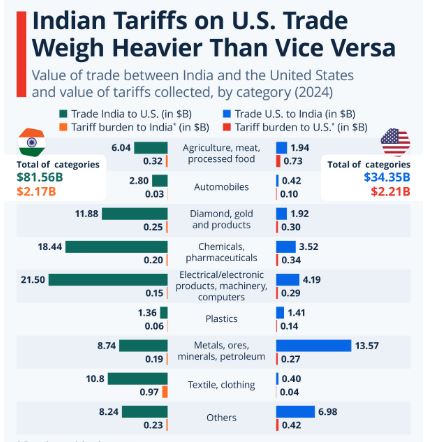
- The United States stands as India's largest trading partner, with bilateral trade reaching $131.84 billion in 2024-25.
- Both countries seek to more than double bilateral trade to $500 billion by 2030 and negotiate a multi-sector BTA (Bilateral Trade Agreement).
- India's exports to the US totaled $87 billion, spanning sectors from electronics and pharmaceuticals to textiles and gems.
- However, this relationship has been characterized by a US goods trade deficit of $45.7 billion in 2024.
Implication of Tariffs on India
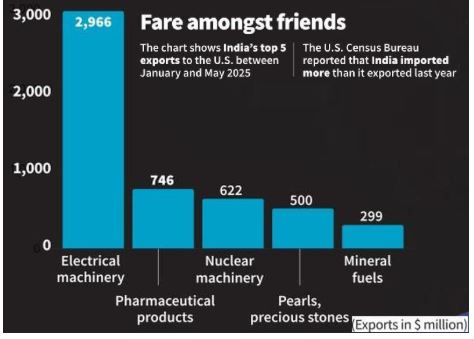
- Economic Impact on Indian Exports: The tariff affects $129 billion in annual bilateral trade, with India’s exports to the U.S. valued at $86.5 billion in FY25.
- Most Vulnerable Sectors:
- Pharmaceuticals: India is a major supplier of generic drugs to the U.S.
- Auto Parts & Engineering Goods: $2.2 billion worth of auto components exported in 2024 now face full tariffs.
- Textiles, Gems & Jewellery, Electronics, and Seafood: These export-heavy sectors may lose price competitiveness.
- Pressure on MSMEs and Labour-Intensive Industries: The tariff could disproportionately affect small manufacturers and exporters, especially in labour-intensive sectors like garments, leather, and handicrafts.
- Industry bodies like FICCI warn of immediate disruption to India’s export-intensive sectors.
- Geopolitical Undercurrents: The penalty component is linked to India’s energy and defense ties with Russia, making this tariff not just economic but geopolitical.
- India’s strategic autonomy in foreign policy — especially its stance on Russia — may face renewed scrutiny.
- Market Volatility and Investor Sentiment: Indian stock indices like Sensex and Nifty dropped sharply following the announcement.
- Analysts expect short-term volatility, especially in sectors dependent on U.S. demand.
Government Response
- The Government of India has taken note of the US President's statement concerning bilateral trade and is studying its implications. The MINISTRY OF COMMERCE AND INDUSTRY issued a measured response emphasizing continuity in diplomatic engagement.
- Over the past months, India and the United States have been engaged in negotiations aimed at concluding a fair, balanced, and mutually beneficial bilateral trade agreement. The government has reiterated its commitment to achieving this objective despite the tariff announcement.
- The government emphasized its priorities, stating that it attaches utmost importance to protecting and promoting the welfare of farmers, entrepreneurs, and Micro, Small and Medium Enterprises (MSMEs).
- This stance reflects India's consistent approach to trade negotiations, where domestic economic interests take precedence.
Strategic Options and Way Ahead for India
- Market Diversification: Reduce dependence on U.S. markets by expanding exports to Europe, Southeast Asia, and Africa.
- Strengthen ties with countries that have already negotiated favorable tariff deals with the U.S., like Japan and the EU.
- Domestic Resilience: Boost Make in India initiatives to absorb external shocks.
- Provide support packages for affected sectors like pharmaceuticals, textiles, auto parts, and seafood.
2. India at 10th BRICS Culture Ministers Meeting | Promotes Cultural Diplomacy & Indigenous Knowledge
Context
- In the recently held BRICS Culture Minister meeting, India Emphasised on promoting mutual understanding, cultural exchange, and other collaborative initiatives in the culture sector.
About the Meeting and India’s Stand
- India assured that it is committed to cultural diplomacy, heritage conservation, and people-to-people exchanges amongst the BRICS nations through cooperation/exchange.
- In the fields of Arts, Museum & Galleries, Cultural Heritage, Archives, Literature, puppetry, various arts forms and dance forms, theater etc.
- The Hon'ble Minister of Culture held bilateral meetings with his counterparts from Brazil, South Africa, and the United Arab Emirates (UAE) on the sidelines of the BRICS Culture Ministers Meeting.
Indigenous Knowledge
- India emphasised on supporting integration of culture into the climate adaptation framework by integrating indigenous knowledge and traditional practices into contemporary climate strategies
- As That would unlock sustainable, low-impact solutions that have been refined over generations—from indigenous water management systems and climate-responsive vernacular architecture to environmentally friendly artisanal crafts.
Environmental Integration
- India also laid emphasis on Mission LiFE-Lifestyle for Environment recognizes that Indian culture and living traditions are inherently sustainable.
- The importance of conserving our precious natural resources and living in harmony with nature are emphasized in our ancient scriptures.
- LiFE seeks to channel the efforts of individuals and communities into a global mass movement of positive behavioural change.
About BRICS
- BRICS is an acronym that refers to a group of five major emerging national economies: Brazil, Russia, India, China, and South Africa.
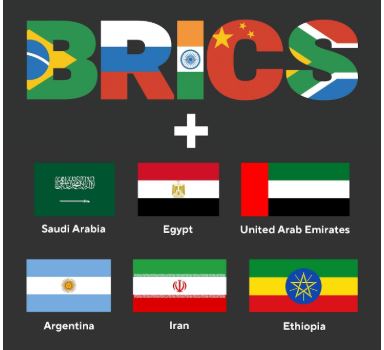
- 1. Egypt, Ethiopia, Iran, Indonesia, Saudi Arabia, and the United Arab Emirates have joined BRICS as new full members.
- – The term was originally coined by economist Jim O’Neill in 2001.
- – Origin: As a formal grouping, BRIC started after the meeting of the Leaders of Russia, India and China in St. Petersburg on the margins of the G8 Outreach Summit in 2006.
- 1. The grouping was formalized during the 1st meeting of BRIC Foreign Ministers on the margins of UNGA in New York in 2006.
- 2. Initially, the grouping was termed BRIC as South Africa was inducted in 2010 and from there on it has been referred to as BRICS.
- – Summits: The governments of the BRICS states have met annually at formal summits since 2009.
- – BRICS countries have come together to deliberate on important issues under the three pillars of:
- political and security, economic and financial and
- cultural and people-to-people exchanges.
- New Development Bank: Formerly referred to as the BRICS Development Bank, is a multilateral development bank established by the BRICS states.
- 1. The Bank shall support public or private projects through loans, guarantees, equity participation and other financial instruments.
Relevance of BRICS
- Platform for Strategic Autonomy: BRICS offers India a non-Western multilateral platform to engage with global powers without aligning exclusively with any bloc.
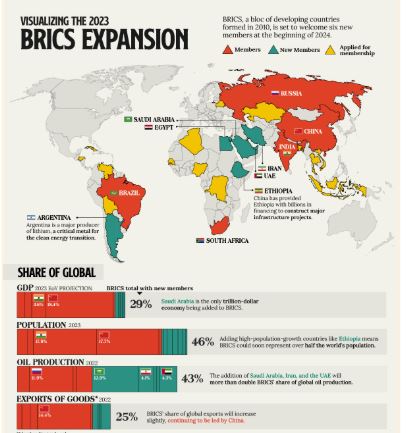
- Strengthening the Group: With the additions of new countries, it will represent almost half the world’s population, and will include three of the world’s biggest oil producers, Saudi Arabia, the UAE and Iran.
- Focus on Middle East: With the inclusion of Saudi Arabia, Iran, the UAE, and Egypt, there is a Middle East focus, bearing geo-economic, geostrategic, and geopolitical implications.
- Voice for Global Governance: The grouping now represents a larger share of the world’s population and economy.
- This means the group is potentially a powerful voice for reforming global governance structures and can also act as an influential player within these arrangements.
- Additionally, India positions itself as a leading voice of the Global South within BRICS.
- Push for Multilateral Reform: A larger BRICS enhances the push for UNSC reform, where India seeks a permanent seat.
- Counterbalance to China’s Dominance: A broader membership may dilute China’s dominance within BRICS.
- India can build coalitions with new members to promote balanced agendas and prevent unilateralism.
Challenges to BRICS
- Internal Geopolitical Tensions: India–China border disputes strain bilateral trust.
- Asymmetry in Power and Influence: China’s economic dominance creates imbalance in decision-making.
- Lack of Cohesive Vision: BRICS lacks a unified ideology or strategic coherence beyond broad themes like multilateralism and development.
- Members pursue divergent national interests, limiting collective action.
- Institutional Limitations: BRICS has no permanent secretariat, making coordination ad hoc and dependent on rotating presidencies.
- Limited enforcement mechanisms reduce implementation of summit declarations and commitments.
- Economic Disparities: Members are at different stages of economic development and face unique challenges, it creates difficulty in setting common economic goals or trade policies.
- Impact of External Alliances: India’s engagement with the West and Indo-Pacific frameworks.
- Russia’s increasing dependence on China post-Ukraine conflict.
- These shifts complicate internal unity and raise questions about long-term alignment.
- Expansion-related Challenges: The inclusion of new members adds diversity but also increases coordination complexity and risks diluting the original focus.
Way Ahead
- While BRICS holds significant potential as a voice of the Global South and a platform for multipolarity, it faces serious structural, political, and institutional challenges.
- Overcoming these would require a shared strategic vision, institutional strengthening, and internal diplomacy — especially among key players like India, China, and Russia.
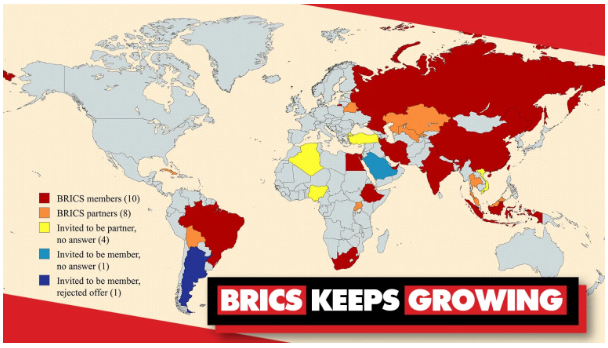
- As the BRICS operates based on consensus-driven decision-making, attaining consensus among 11 countries characterized by diverse economies, geographical locations, and interests proves to be substantially more challenging than doing so among the original five members.
- To ensure the continued effectiveness and consistency of the institution, in the long run, BRICS might opt to focus on easier-to-achieve objectives.
3. Linguistic Reorganization of Indian States | A Model of Unity in Diversity
Context
- Tamil Nadu Governor R N Ravi recently sparked controversy by claiming that the linguistic reorganisation of Indian states turned large sections of people into “second-class citizens.
Indian States before Linguistic Reorganization
- At the time of Independence in 1947, India inherited a complex administrative setup shaped by British colonial rule.
- The British governed India through two parallel systems — direct control in provinces and indirect control over 565 princely states.
- The boundaries drawn were dictated largely by administrative convenience rather than cultural or linguistic coherence.
Historical Context
- Abode of languages: India is a land of many languages, each with its distinct script, grammar, vocabulary and literary tradition.
- For example: As per the 1961 census, there are 1,652 major languages in India.
- British policy: British colonial rule skillfully crafted multilingual administrative territories in India. In pursuit of this policy, H S Risley, the then home secretary, submitted a note to the Crown in December 1903, suggesting the division of Bengal, and then Lord Curzon did divide Bengal, a linguistically homogenous unit.
- Linguistic unity: But this colonial administrative action helped the Bengali speaking people to learn to think in terms of linguistic unity.
- First bifurcation before independence: Though colonial administration was forced to undo the bifurcation of Bengal on religious basis, but at the same time it carved out Assam and Bihar as separate provinces in 1911 on a linguistic basis.
- Congress opinion before independence: In 1917, the Congress Party had committed itself to the creation of linguistic provinces in a free India.
- Congress linguistic reorganisation: After Congress’s Nagpur Session in 1920, the principle was extended and formalized with the creation of provincial Congress Committee by linguistic zones. The linguistic reorganization of the Congress was encouraged and supported by Mahatma Gandhi.
- Demand of separate states: During that time some Marathi speaking Congress members raised the pitches for separate Maharashtra State. Following this demand, other language speaking people too demand a separate state for them.
Linguistic Reorganisation of States in 1956
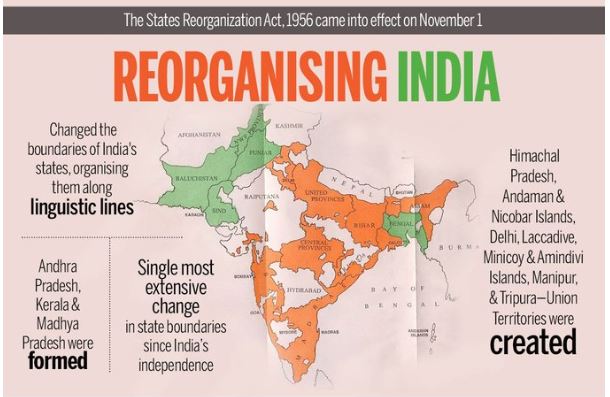
- In its report submitted on September 30, 1955, the SRC acknowledged that the growing importance of regional languages and political awareness made linguistic reorganisation inevitable.
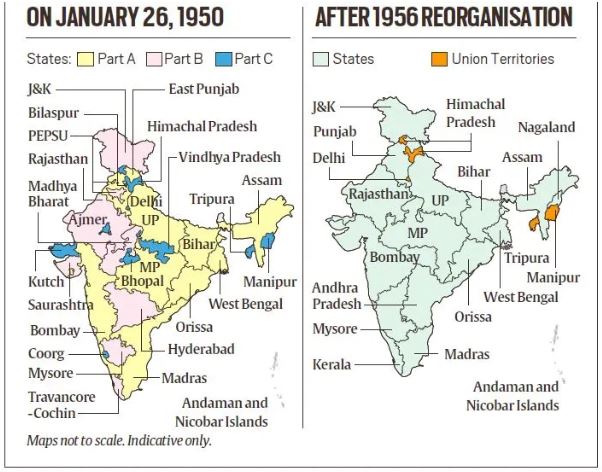
- Following the SRC’s recommendations, the States Reorganisation Act of 1956 was enacted.
- It redrew India’s political map, reducing the existing divisions and reorganising the country into 14 states and six Union Territories, primarily along linguistic lines — marking a turning point in India’s federal structure.
Trigger for Reorganisation of States
- The turning point came when Potti Sriramulu, a Telugu-speaking Gandhian and former railway engineer, died in December 1952, after a 58-day hunger strike demanding a separate state for Telugu speakers.
- His death triggered widespread protests, forcing PM Nehru to announce the creation of Andhra on December 17, 1952.
- The state was officially formed on October 1, 1953.
Committees and Commissions Related State Reorganisation
- Dhar Commission 1948: Appointed by the Constituent Assembly. It suggested reorganisation based on historical, geographical and administrative convenience rather than linguistic as sole criteria because India faced partition and lost Bengal, Burma etc. in past on linguistic/communal agendas.
- JVP Committee 1949: It dismissed the idea of reorganisation but kept the door open for future re-examination on public demand. They understood that the ad-hoc reorganisation of Princely States with adjoining provinces were not stable and sensible idea.
- Fazl Ali Commission 1953: Officially known as State reorganisation Commission. It accepted language as the basis of reorganisation of States. But it rejected the theory of ‘One-Language-One State’. Its view was that the unity of India should be regarded as the Primary consideration in any redrawing of the country’s political units.
ARC Views on Reorganisation based on Language
- The Second Administrative Reforms Commission (ARC) in its 2008 report hailed the successful resolution of linguistic conflicts as a major post-independence achievement.
- It observed that linguistic states helped ensure administrative unity and effectiveness.
- Notably, the few major secessionist movements in India — in Nagaland, Punjab, and Kashmir — were based on issues of ethnicity, religion, or territory, not language.
- This demonstrates how linguistic federalism contributed to national cohesion instead of undermining it.
Views of National Leaders on State Reorganisation
BR Ambedkar
- Supported the formation of linguistic provinces and submitted a memorandum to the Dar Commission advocating the creation of the Marathi-majority Maharashtra state with Bombay as its capital.
- Suggested that the official language of every province should be the same as the official language of the Central Government to address national unity concerns.
- Supported the idea of “One state. One language,” but opposed the idea of “One language. One state.”
Jawaharlal Nehru
- Recognized the dangers of linguistic chauvinism and communalism early on.
- Despite Congress’ earlier endorsement of the idea of linguistic provinces, Nehru and Patel resisted the idea to prevent division but eventually had to accept linguistic reorganization.
Conclusion
- While there has been progress in some states, the position of linguistic minorities in most states has been unsatisfactory. The document highlights that while India succeeded in accommodating linguistic diversities (strengthening the national policy framework), other nations (such as the USSR, which failed to integrate Yugoslavia due to linguistic and ethnic diversities) were not as successful.
4. Restoring Mangroves in India | Coastal Protection, Biodiversity & Climate Resilience
Context
- India has launched major mangrove restoration drives across Tamil Nadu, Gujarat, and Mumbai to fight climate risks. These efforts enhance coastal security, biodiversity, and climate resilience amid rising ecological threats.
About Restoring Mangroves to Secure India’s Coast
About Mangroves
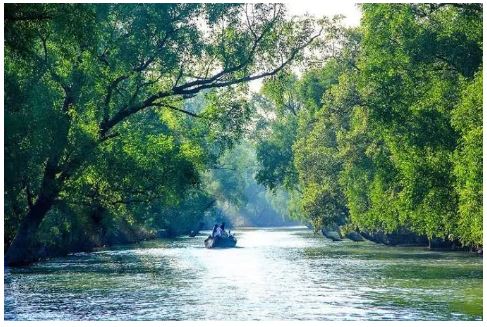
- Mangrove is a type of tree species that grow in intertidal salty environments near the mouths of the delta of rivers along the coasts because they can tolerate frequent flooding and are able to obtain fresh water from rivers and also the nutrients required from salt water.
Features of Mangrove
- They are salt-tolerant plant species with roots dangling down into the water.
- Since they grow in very high salinity waters, they are adapted to the condition and are salt tolerant.
- They can secrete salt from their leaves to balance the salt intake.
- They have developed roots bearing pneumatophore (or aerial roots).
- These forests are also become quite resistant to high temperatures.
- They exhibit a viviparous mode of reproduction.
Mangrove Distribution In India
- In India, they are found all along the Indian coastline in sheltered estuaries, tidal creeks, backwaters, and salt marshes.
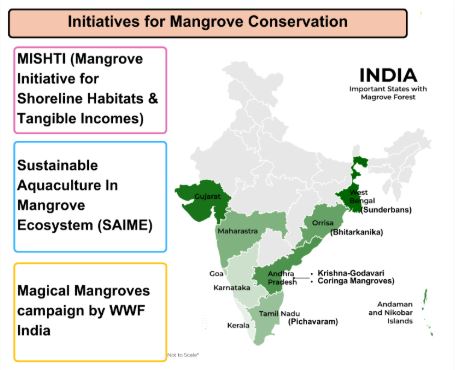
- Some of the largest mangrove forests in the world are found in the alluvial deltas of Ganga, Godavari, Krishna, Cauvery and in the islands of Andaman and Nicobar.
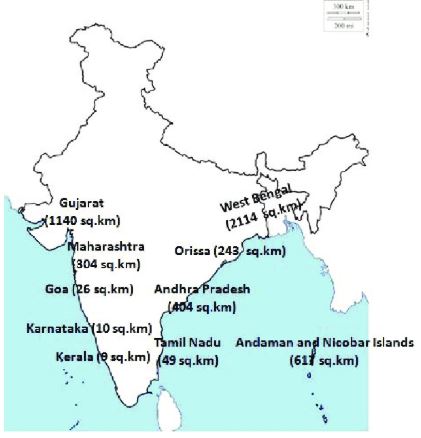
|
STATE/UNION TERRITORIES |
MANGROVE AREAS |
|
West Bengal |
Sunderbans |
|
Orissa |
Bhitarkanika, Mahanadi, Subernarekha, Devi, Chilka, Dhamra, Mangrove Genetic Resources Centre |
|
Andhra Pradesh |
Coringa, East Godavari, Krishna |
|
Tamil Nadu |
Pichavaram, Muthupet, Ramnad, Pulicat, Kazhuveli |
|
Andaman and Nicobar |
North Andamans, Nicobar |
|
Kerala |
Vembanad, Kannur (Northern Kerala) |
|
Karnataka |
Coondapur, Dakshin Kannada/Honnavar, Karwar, Manglore Forest Division |
|
Goa |
Goa |
|
Maharashtra |
Achra-Ratnagiri, Devgarh-Vijay Durg, Veldur, Kundalika-Revdanda, Mumbra-Diva, Vikroli, Shreevardhan, Vaitarna, Vasai-Manori, Malvan |
|
Gujarat |
Gulf of Kutchh, Gulf of Khambat |
Significance of Mangroves
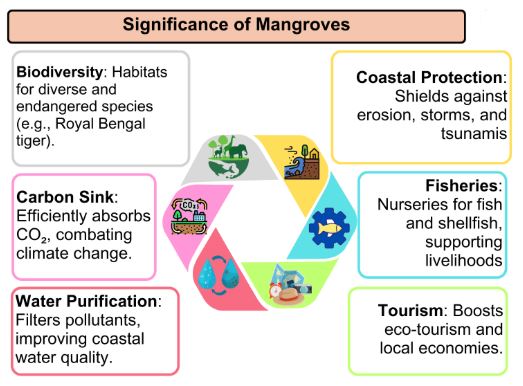
- They are a very productive ecosystem and highly rich in biodiversity
- They provide shelter for a wide variety of marine species and serve as important nursery areas for young marine animals.
- They are home to a wide variety of fish, reptiles such as sea turtles, land turtles, alligators, crocodiles, caimans, snakes, and lizards and invertebrates such as shrimp, crabs, oysters, tunicates, sponges, snails, and insects.
- Their dense root systems trap and hold sediments flowing down rivers and off the land.
- It stabilises the coastline and prevents erosion from waves and storms.
Threats to Mangroves
- City expansion leads to mangrove clearance for roads, ports, and real estate, destroying natural buffers.
- Rivers and drains dump waste into mangrove zones, reducing regeneration and harming aquatic life
- Shrimp farms in coastal areas have replaced native mangrove habitats, especially in Tamil Nadu and Andhra Pradesh.
- Sea-level rise and erratic rainfall alter tidal patterns and increase salinity, damaging delicate mangrove systems.
Efforts at Conservation of Mangroves
- Mangrove cover doubled from 4,500 to 9,000 ha (2021–24) via canal reworking and native seed planting under Green Tamil Nadu Mission
- Over 19,000 ha of mangroves planted in 2 years, exceeding national targets under MISHTI Initiative in Gujrat.
- Thane Creek Project: ₹10.3 crore project to plant 3.75 lakh mangrove saplings and intercept 150 tonnes of plastic over 3 years in Mumbai.
Conclusion
- Mangroves are nature’s frontline defense for coastal India, blending ecology with economy. Their restoration secures biodiversity, climate resilience, and community livelihoods. India must scale scientific, community-led models to protect these green sentinels.

2026-27 UPSC Mains English QEP Power Pages
View DetailsSubmit Your Details to Learn More



