
theIAShub
01 Aug, 2025
Table of Contents

Get an Instant Call Back from Our Expert Mentors!
Context
- In the recently held BRICS Culture Minister meeting, India Emphasised on promoting mutual understanding, cultural exchange, and other collaborative initiatives in the culture sector.
About the Meeting and India’s Stand
- India assured that it is committed to cultural diplomacy, heritage conservation, and people-to-people exchanges amongst the BRICS nations through cooperation/exchange.
- In the fields of Arts, Museum & Galleries, Cultural Heritage, Archives, Literature, puppetry, various arts forms and dance forms, theater etc.
- The Hon'ble Minister of Culture held bilateral meetings with his counterparts from Brazil, South Africa, and the United Arab Emirates (UAE) on the sidelines of the BRICS Culture Ministers Meeting.
Indigenous Knowledge
- India emphasised on supporting integration of culture into the climate adaptation framework by integrating indigenous knowledge and traditional practices into contemporary climate strategies
- As That would unlock sustainable, low-impact solutions that have been refined over generations—from indigenous water management systems and climate-responsive vernacular architecture to environmentally friendly artisanal crafts.
Environmental Integration
- India also laid emphasis on Mission LiFE-Lifestyle for Environment recognizes that Indian culture and living traditions are inherently sustainable.
- The importance of conserving our precious natural resources and living in harmony with nature are emphasized in our ancient scriptures.
- LiFE seeks to channel the efforts of individuals and communities into a global mass movement of positive behavioural change.
About BRICS
- BRICS is an acronym that refers to a group of five major emerging national economies: Brazil, Russia, India, China, and South Africa.
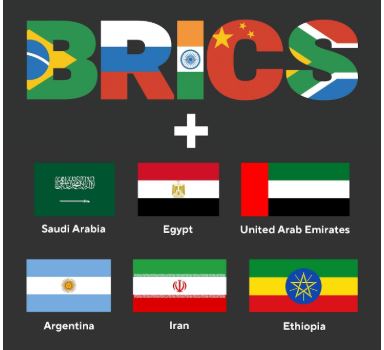
- 1. Egypt, Ethiopia, Iran, Indonesia, Saudi Arabia, and the United Arab Emirates have joined BRICS as new full members.
- – The term was originally coined by economist Jim O’Neill in 2001.
- – Origin: As a formal grouping, BRIC started after the meeting of the Leaders of Russia, India and China in St. Petersburg on the margins of the G8 Outreach Summit in 2006.
- 1. The grouping was formalized during the 1st meeting of BRIC Foreign Ministers on the margins of UNGA in New York in 2006.
- 2. Initially, the grouping was termed BRIC as South Africa was inducted in 2010 and from there on it has been referred to as BRICS.
- – Summits: The governments of the BRICS states have met annually at formal summits since 2009.
- – BRICS countries have come together to deliberate on important issues under the three pillars of:
- political and security, economic and financial and
- cultural and people-to-people exchanges.
- New Development Bank: Formerly referred to as the BRICS Development Bank, is a multilateral development bank established by the BRICS states.
- 1. The Bank shall support public or private projects through loans, guarantees, equity participation and other financial instruments.
Relevance of BRICS
- Platform for Strategic Autonomy: BRICS offers India a non-Western multilateral platform to engage with global powers without aligning exclusively with any bloc.
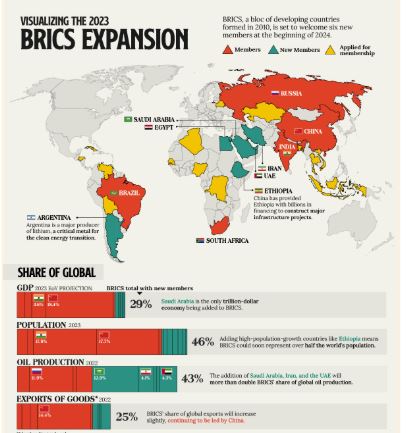
- Strengthening the Group: With the additions of new countries, it will represent almost half the world’s population, and will include three of the world’s biggest oil producers, Saudi Arabia, the UAE and Iran.
- Focus on Middle East: With the inclusion of Saudi Arabia, Iran, the UAE, and Egypt, there is a Middle East focus, bearing geo-economic, geostrategic, and geopolitical implications.
- Voice for Global Governance: The grouping now represents a larger share of the world’s population and economy.
- This means the group is potentially a powerful voice for reforming global governance structures and can also act as an influential player within these arrangements.
- Additionally, India positions itself as a leading voice of the Global South within BRICS.
- Push for Multilateral Reform: A larger BRICS enhances the push for UNSC reform, where India seeks a permanent seat.
- Counterbalance to China’s Dominance: A broader membership may dilute China’s dominance within BRICS.
- India can build coalitions with new members to promote balanced agendas and prevent unilateralism.
Challenges to BRICS
- Internal Geopolitical Tensions: India–China border disputes strain bilateral trust.
- Asymmetry in Power and Influence: China’s economic dominance creates imbalance in decision-making.
- Lack of Cohesive Vision: BRICS lacks a unified ideology or strategic coherence beyond broad themes like multilateralism and development.
- Members pursue divergent national interests, limiting collective action.
- Institutional Limitations: BRICS has no permanent secretariat, making coordination ad hoc and dependent on rotating presidencies.
- Limited enforcement mechanisms reduce implementation of summit declarations and commitments.
- Economic Disparities: Members are at different stages of economic development and face unique challenges, it creates difficulty in setting common economic goals or trade policies.
- Impact of External Alliances: India’s engagement with the West and Indo-Pacific frameworks.
- Russia’s increasing dependence on China post-Ukraine conflict.
- These shifts complicate internal unity and raise questions about long-term alignment.
- Expansion-related Challenges: The inclusion of new members adds diversity but also increases coordination complexity and risks diluting the original focus.
Way Ahead
- While BRICS holds significant potential as a voice of the Global South and a platform for multipolarity, it faces serious structural, political, and institutional challenges.
- Overcoming these would require a shared strategic vision, institutional strengthening, and internal diplomacy — especially among key players like India, China, and Russia.
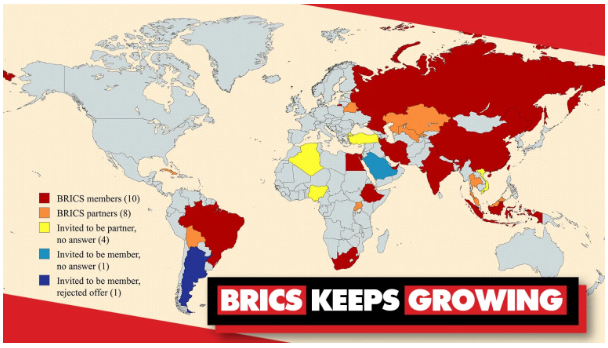
- As the BRICS operates based on consensus-driven decision-making, attaining consensus among 11 countries characterized by diverse economies, geographical locations, and interests proves to be substantially more challenging than doing so among the original five members.
- To ensure the continued effectiveness and consistency of the institution, in the long run, BRICS might opt to focus on easier-to-achieve objectives.

2026-27 UPSC Mains English QEP Power Pages
View DetailsSubmit Your Details to Learn More



