
theIAShub
01 Aug, 2025
Table of Contents
- Context
- Indian States before Linguistic Reorganization
- Historical Context
- Linguistic Reorganisation of States in 1956
- Trigger for Reorganisation of States
- Committees and Commissions Related State Reorganisation
- ARC Views on Reorganisation based on Language
- Views of National Leaders on State Reorganisation
- Conclusion

Get an Instant Call Back from Our Expert Mentors!
Context
- Tamil Nadu Governor R N Ravi recently sparked controversy by claiming that the linguistic reorganisation of Indian states turned large sections of people into “second-class citizens.
Indian States before Linguistic Reorganization
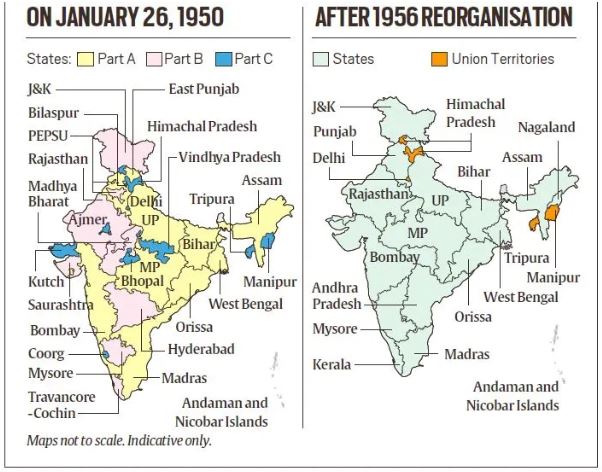
- At the time of Independence in 1947, India inherited a complex administrative setup shaped by British colonial rule.
- The British governed India through two parallel systems — direct control in provinces and indirect control over 565 princely states.
- The boundaries drawn were dictated largely by administrative convenience rather than cultural or linguistic coherence.
Historical Context
- Abode of languages: India is a land of many languages, each with its distinct script, grammar, vocabulary and literary tradition.
- For example: As per the 1961 census, there are 1,652 major languages in India.
- British policy: British colonial rule skillfully crafted multilingual administrative territories in India. In pursuit of this policy, H S Risley, the then home secretary, submitted a note to the Crown in December 1903, suggesting the division of Bengal, and then Lord Curzon did divide Bengal, a linguistically homogenous unit.
- Linguistic unity: But this colonial administrative action helped the Bengali speaking people to learn to think in terms of linguistic unity.
- First bifurcation before independence: Though colonial administration was forced to undo the bifurcation of Bengal on religious basis, but at the same time it carved out Assam and Bihar as separate provinces in 1911 on a linguistic basis.
- Congress opinion before independence: In 1917, the Congress Party had committed itself to the creation of linguistic provinces in a free India.
- Congress linguistic reorganisation: After Congress’s Nagpur Session in 1920, the principle was extended and formalized with the creation of provincial Congress Committee by linguistic zones. The linguistic reorganization of the Congress was encouraged and supported by Mahatma Gandhi.
- Demand of separate states: During that time some Marathi speaking Congress members raised the pitches for separate Maharashtra State. Following this demand, other language speaking people too demand a separate state for them.
Linguistic Reorganisation of States in 1956
- In its report submitted on September 30, 1955, the SRC acknowledged that the growing importance of regional languages and political awareness made linguistic reorganisation inevitable.
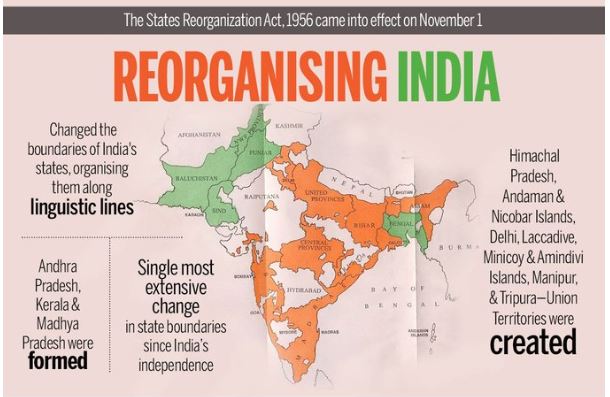
- Following the SRC’s recommendations, the States Reorganisation Act of 1956 was enacted.
- It redrew India’s political map, reducing the existing divisions and reorganising the country into 14 states and six Union Territories, primarily along linguistic lines — marking a turning point in India’s federal structure.
Trigger for Reorganisation of States
- The turning point came when Potti Sriramulu, a Telugu-speaking Gandhian and former railway engineer, died in December 1952, after a 58-day hunger strike demanding a separate state for Telugu speakers.
- His death triggered widespread protests, forcing PM Nehru to announce the creation of Andhra on December 17, 1952.
- The state was officially formed on October 1, 1953.
Committees and Commissions Related State Reorganisation
- Dhar Commission 1948: Appointed by the Constituent Assembly. It suggested reorganisation based on historical, geographical and administrative convenience rather than linguistic as sole criteria because India faced partition and lost Bengal, Burma etc. in past on linguistic/communal agendas.
- JVP Committee 1949: It dismissed the idea of reorganisation but kept the door open for future re-examination on public demand. They understood that the ad-hoc reorganisation of Princely States with adjoining provinces were not stable and sensible idea.
- Fazl Ali Commission 1953: Officially known as State reorganisation Commission. It accepted language as the basis of reorganisation of States. But it rejected the theory of ‘One-Language-One State’. Its view was that the unity of India should be regarded as the Primary consideration in any redrawing of the country’s political units.
ARC Views on Reorganisation based on Language
- The Second Administrative Reforms Commission (ARC) in its 2008 report hailed the successful resolution of linguistic conflicts as a major post-independence achievement.
- It observed that linguistic states helped ensure administrative unity and effectiveness.
- Notably, the few major secessionist movements in India — in Nagaland, Punjab, and Kashmir — were based on issues of ethnicity, religion, or territory, not language.
- This demonstrates how linguistic federalism contributed to national cohesion instead of undermining it.
Views of National Leaders on State Reorganisation
BR Ambedkar
- Supported the formation of linguistic provinces and submitted a memorandum to the Dar Commission advocating the creation of the Marathi-majority Maharashtra state with Bombay as its capital.
- Suggested that the official language of every province should be the same as the official language of the Central Government to address national unity concerns.
- Supported the idea of “One state. One language,” but opposed the idea of “One language. One state.”
Jawaharlal Nehru
- Recognized the dangers of linguistic chauvinism and communalism early on.
- Despite Congress’ earlier endorsement of the idea of linguistic provinces, Nehru and Patel resisted the idea to prevent division but eventually had to accept linguistic reorganization.
Conclusion
- While there has been progress in some states, the position of linguistic minorities in most states has been unsatisfactory. The document highlights that while India succeeded in accommodating linguistic diversities (strengthening the national policy framework), other nations (such as the USSR, which failed to integrate Yugoslavia due to linguistic and ethnic diversities) were not as successful.

2026-27 UPSC Mains English QEP Power Pages
View DetailsSubmit Your Details to Learn More



