
theIAShub
19 Jul, 2025
Article List
- Green Hydrogen from Bio Waste: Towards A Sustainable Future
- Mitochondrial Replacement Theory
- India-Maldives Relations: Resetting Ties
- Digital Arrest
- Allographa Effusosoredica
- Cnemaspis Brahmaputra
- Coronal Mass Ejections (CMEs)
- Chronic Venous Insufficiency (CVI)
- Urban Aerosol Clean Islands
- Trade Connect' ePlatform
- Hydrogen Peroxide (H₂O2)
- Crushed 2025
1. Green Hydrogen from Bio Waste: Towards A Sustainable Future
Context
- Union Minister Shri Pralhad Joshi lauds the innovation of producing green hydrogen from bio-waste at the Indian Institute of Science, Bengaluru.
About the News
- The Institute showed an innovative invention and experiment that produces environmentally friendly pure green hydrogen from agricultural waste.
- He especially praised the 'highly advanced green water generator production system' developed by Professor Dasappa and his team from bio-waste.
- This system can produce up to 5 kilograms of green hydrogen per hour using India's own agricultural residues with over 99% purity.
- This development can also help in turning Agricultural Waste into Energy for the sustainable future of the Farming Sector in India.
About Hydrogen Energy
- Hydrogen is a clean fuel. It is an energy carrier that can be used for a broad range of applications.
- Also it could serve as a possible substitute to liquid and fossil fuels.Its physical properties like – at standard temperature and pressure, hydrogen is a nontoxic, nonmetallic, odorless, tasteless, colorless, and highly combustible diatomic gas with the molecular formula H2.
- Hydrogen energy is expected to reduce carbon emissions that are set to jump by 1.5 billion tons in 2021. It has the highest energy content by weight and lowest energy content by volume.
- Hydrogen has been colour-coded based on the source of production, and the emphasis is on the use of Green Hydrogen as it helps in reducing the emissions of greenhouse gases and increases the share of renewables in total energy consumption.
Hydrogen Energy In India
- Currently, the bulk of the global energy consumption comes from hydrocarbons as Hydrogen is still at an early stage of entering the energy sector in India.
- In 2003, National Hydrogen Energy Board was formed and in 2006 the Ministry of New and Renewable Energy laid out the National Hydrogen Energy Road Map identifying transport and power generation as two major green energy initiatives.
- By 2050 India intends to produce three-fourths of its hydrogen from renewable resources.
About Green Hydrogen
- Hydrogen is a key industrial fuel that has a variety of applications including the production of ammonia (a key fertilizer), steel, refineries and electricity.
- It refers to hydrogen produced through electrolysis, which splits water molecules (H2O) into hydrogen (H2) and oxygen (O2) using electricity generated from renewable sources like solar, wind, hydro etc.
- Another method of producing GH2 is from biomass, which involves the gasification of biomass to produce hydrogen.
Current Production
- Green hydrogen currently accounts for less than 1% of global hydrogen production due to it being expensive to produce.
- A kilogram of black hydrogen costs USD 0.9-1.5 to produce while grey hydrogen costs USD 1.7-2.3 and blue hydrogen can cost anywhere from USD 1.3-3.6. However, green hydrogen costs USD 3.5-5.5 per kg, according to a 2020 analysis by the Council for Energy, Environment and Water.
About National Green Hydrogen Mission (NGHM)
- Launched in 2023, with an outlay of ₹ 19,744 crore.
- Duration: Phase I (2022-23 to 2025-26) and Phase II (2026-27 to 2029-30).
- Objective: To make India a Global Hub for production, usage and export of Green Hydrogen and its derivatives.
Key Components
- Facilitating demand creation through exports and domestic utilization.
- Strategic Interventions for Green Hydrogen Transition (SIGHT) programme, which includes incentives for manufacturing of electrolysers and production of green hydrogen.
- Pilot Projects for steel, mobility, shipping, decentralized energy applications, hydrogen production from biomass, hydrogen storage, etc.
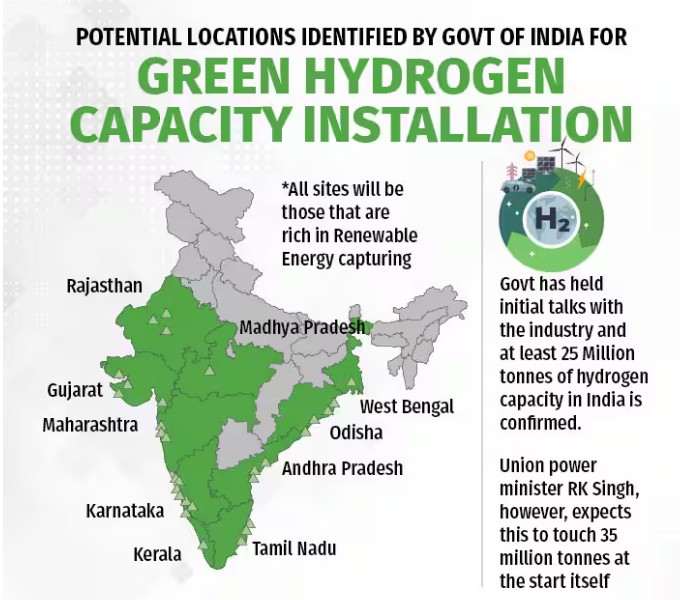
- Development of Green Hydrogen Hubs (for e.g., 3ports namely Deendayal (Kandla, Gujarat), Paradip (Odisha) and V.O. Chidambaranar (Tuticorin, Tamil Nadu) have been identified.
- Establishing a robust framework of regulations and standards.
- Research & Development programme.
Challenges in Green Hydrogen Adoption
- Economically viability: The NITI Aayog report states that the current cost of producing green hydrogen via electrolysis, ranging from $4.10 to $7 per kg, is still too high to compete with grey or brown hydrogen.
- Difficulty in Hydrogen Storage: As hydrogen as a gas typically requires high-pressure tanks (350–700 bar) tank pressure and as a liquid requires cryogenic temperatures because the boiling point of hydrogen at one atmosphere pressure is −252.8°C.
- Lack of Skill: In the domain of hydrogen production, the workforce demand is expected to reach ~2.83 lakhs, encompassing roles in design and planning, installation, commissioning, and green hydrogen production units.
Way forward
- Reduce cost: India aims to reduce green hydrogen production costs to $1 per kg by 2030 through low-cost renewable energy, local electrolyser manufacturing, and technological advancements.
- Incentives: For new applications, where the viability of using green hydrogen is still at early stage, necessary incentives should be designed.
- Construct an inter-ministerial governance structure: An interdisciplinary Project Management Unit (PMU) with globally trained experts must be created which can dedicate fulltime resources to effectively implement the mission.
2. Mitochondrial Replacement Theory
Context
- Eight healthy babies were born in Britain with the help of an experimental technique called Mitochondrial Replacement Therapy (MRT).
About
- The mothers were all at high risk for passing on life-threatening diseases to their babies due to mutations in their mitochondria.
- The four boys and four girls were born to seven women and have no signs of the mitochondrial diseases they were at risk of inheriting.
- The UK became the first country to approve the use of mitochondrial donation in 2015.
- The procedure is not yet permitted in India.
About Mitochondria
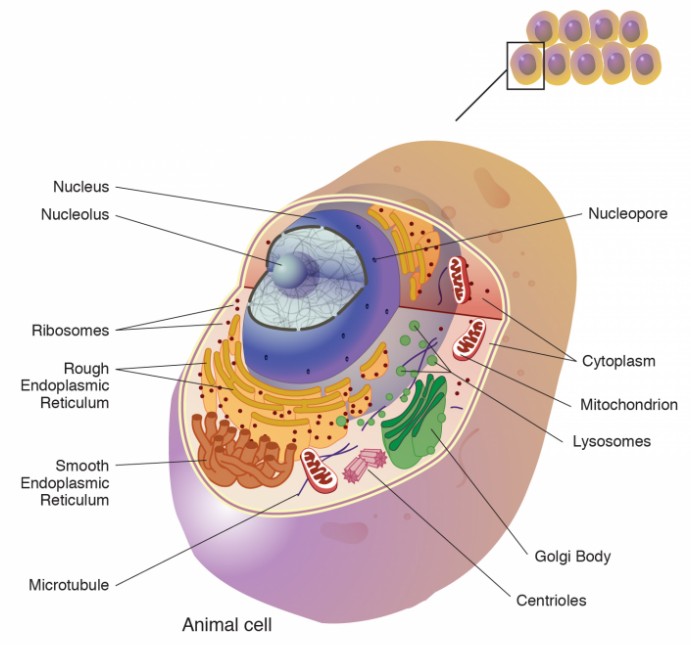
- Mitochondria are membrane-bound cell organelles that generate most of the chemical energy needed to power the cell’s biochemical reactions.
- Mitochondria are often referred to as the powerhouse of the cell.
- Chemical energy produced by the mitochondria is stored in a small molecule called adenosine triphosphate (ATP). ATP is the chemical energy “currency” of the cell that powers the cell’s metabolic activities.
About Mitochondrial Genes
- The fluid surrounding the nucleus contains hundreds to thousands of mitochondria that carry their own set of 37 genes.
- People inherit all their mitochondria from their biological mother, mutations can affect all the children a woman has.
- Mutations in these genes can impair or completely disable mitochondria with catastrophic effects.
- The first symptoms of mitochondrial disease tend to appear in early childhood as energy-hungry organs such as the brain, heart and muscles start to fail.
About Mitochondrial Donation Treatment
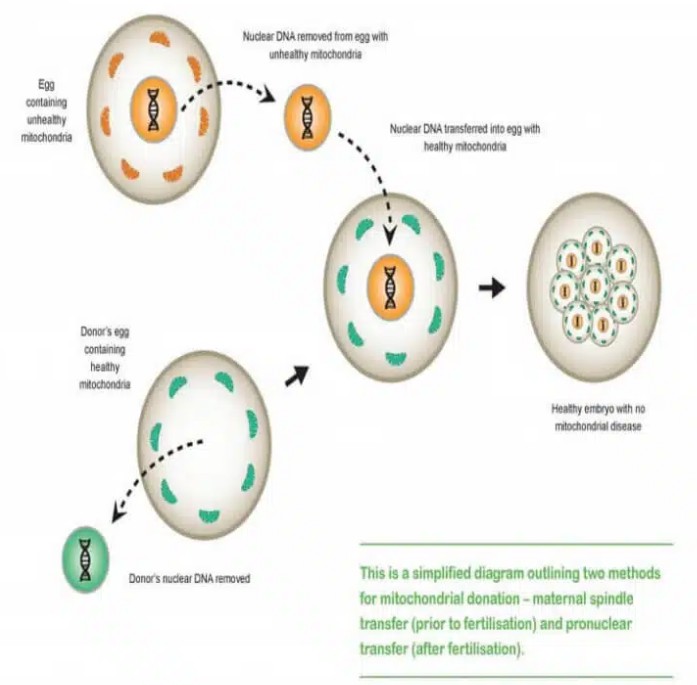
- A three-parent baby is produced from the genetic material of one man and two women through mitochondrial replacement therapy (MRT) and three-person in vitro fertilization (IVF).
- Aim: To prevent children from inheriting mutated mitochondria.
- Procedure: It involves fertilising the mother’s egg with the father’s sperm and then transferring the genetic material from the nucleus into a fertilised healthy donor egg that has had its own nucleus removed.
- This creates a fertilised egg with a full set of chromosomes from the parents, but healthy mitochondria from the donor.
- The egg is then implanted into the womb to establish a pregnancy.
Conclusion
- Even though research in mitochondrial donation treatment is still in its infancy, mitochondrial donation is a blessing for the vast majority of people who suffer from mitochondrial disorders for whom there is no known solution.
3. India-Maldives Relations: Resetting Ties
Context
- On July 25-26, Prime Minister Narendra Modi will visit the Maldives, where he will serve as the Chief Guest at the country’s 60th National Day celebrations, according to the report.
About the News
- This visit is particularly significant as it marks the first under President Mohamed Muizzu's administration, following recent tensions in India-Maldives relations sparked by the "India Out" campaign.
- In October 2024, Maldivian President Mohamed Muizzu visited India and emphasised that the relationship between Malé and New Delhi is “built on respect and shared interests” and that Delhi has been, and is, one of the archipelago's largest trade and development partners.
Evolution of India- Maldives Relations
- The relationship between India and the Maldives has evolved over the years, influenced by geopolitical, economic, and strategic considerations.
- Early Diplomatic Ties (1965-1978): The Maldives gained independence from the British in 1965, and established diplomatic relations with India.
- India was one of the first countries to recognize the Maldives as an independent nation.
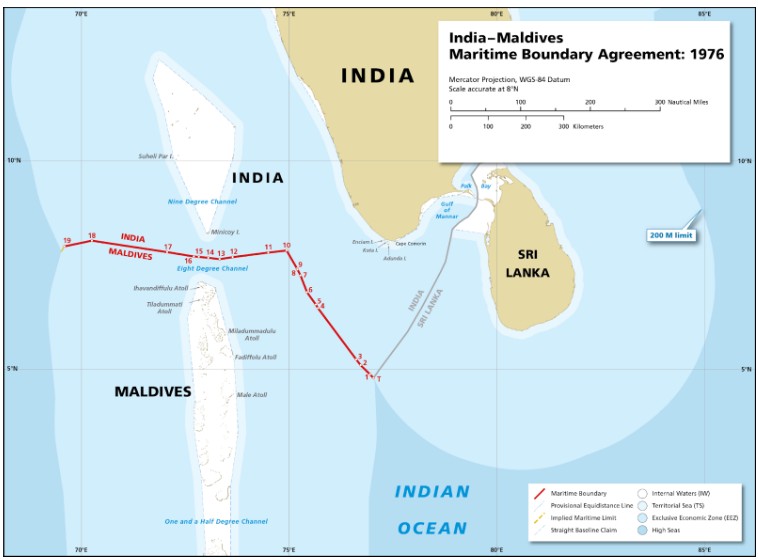
- Strategic Partnership (1978-1988): The signing of the Maritime Boundary Agreement in 1979 helped define the maritime boundaries between the two countries.
- Political Turbulence (1988-2008): The relationship faced challenges in 1988 when a coup attempt in the Maldives led to the intervention of Indian forces in Operation Cactus.
- India’s military intervention was aimed at thwarting the coup and preserving the Maldives’ political stability.
- This event temporarily strained diplomatic relations but was later resolved.Normalization and Economic Cooperation (2008-2013): In 2008, the Maldives experienced a peaceful political transition, and Mohamed Nasheed became the President.
- The relationship between India and the Maldives improved, focusing on economic cooperation, trade, and people-to-people ties.
- India provided developmental assistance to the Maldives, particularly in infrastructure projects and capacity building.
- Period of Strain (2013-2018): The relationship faced challenges during the presidency of Abdulla Yameen, with concerns over issues such as democratic backsliding, human rights, and a perceived tilt towards China.
- The Maldives’ growing engagement with China, including infrastructure projects under the Belt and Road Initiative, raised strategic concerns for India.
- Renewed Engagement (2018 Onward): The election of Ibrahim Mohamed Solih as the President of the Maldives in 2018 marked a shift in bilateral relations. There was a renewed emphasis on strengthening ties with India.
- The two countries reaffirmed their commitment to democratic values, and India extended financial assistance for various developmental projects.
Significance of Maldives for India
- Geopolitical: Maldives is one of the cornerstones of India's NFP (Neighbourhood First policy) and SAGAR (Security and Growth for All in the Region) due to its location.
- Strategic:
- Maldives is geographically positioned like a 'toll gate' between western Indian Ocean chokepoints (Gulf of Aden and Strait of Hormuz), and eastern Indian Ocean chokepoint of Strait of Malacca.
- Situated along key shipping lanes in the Indian Ocean, Maldives is central to India's interests in safeguarding freedom of navigation, regional security and stability.
- Geo-economics: Maldives is located along the major commercial Sea lines of communication (SLOC).
- 50% of India's external trade and 80% of India's energy imports transit through these SLOCs in the vicinity of Maldives. Also, India emerged as Maldives' largest trade partner in 2023 touching almost $1 billion.Security: A strong relationship with Maldives will enable India to counter China's ambitious 'String of Pearls' in the IOR.
- Counter terrorism and piracy: For India, Maldives is the first line of defence against terrorism, piracy on the high seas, drug trafficking etc., in the Indian Ocean.
- Diaspora and Tourism: Indian expatriates makes up a large part of the workforce in the Maldives, especially in sectors like healthcare and education. Also, it is a popular tourist destination for Indians, which benefits both economies.
Challenges in the bilateral relationship
- China's strategic footprints: China's rising footprints in the Maldives through the 'Belt and Road Initiative' (BRI), 'String of Pearls' construct, investment in Maldivian infrastructures has raised concerns for India.
- E.g., construction of the Sinamale Bridge, pact for military assistance to Maldives, etc.
- Radicalisation: Increase in radical Islamist fundamentalists in Maldives, including Pakistan backed jihadi terror groups, Islamic State (IS) etc.India's concern: These terrorist organisations may use Maldives as a launch pad for attacks on India and Indian assets.
- Anti-India sentiments: Growing anti-India sentiments under the current Maldivian regime, demanding withdrawal of Indian military troops and helicopters, halting Indian infrastructural developments, India-out campaign, etc.
- Lack of transparency and misunderstanding: Raising of objections by local Maldivian media in the agreements signed between the previous regime and India.
- E.g. Indian grant-in-aid UTF (Uthuru Thila Falhu - Island) Harbour project was speculated by Maldivian media that it would be turned into an Indian naval base instead of Maldivian coastguard harbour and dockyard.
Way Ahead
- The evolution of India-Maldives relations reflects a combination of geopolitical dynamics, changes in leadership, and shared regional interests.
- India is steadfast in its commitments towards Maldives and has always walked the extra mile towards building relations.
- Any impulsive steps to undo the carefully nurtured all encompassing partnership is likely to harm Maldives more than it would India.
- By acknowledging and addressing these challenges, India and the Maldives can navigate the complexities of their relationship and build a stronger, more resilient, and mutually beneficial partnership for the future.
4. Digital Arrest
Context
- A west Bengal Court recently sentenced Nine People to Life Imprisonment for involvement in a Digital Arrest scam.
- This is among the first such case of Conviction in Country related to Digital Arrest.
About Digital Arrest
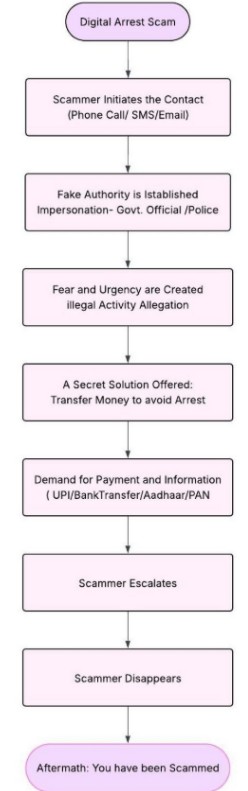
- Digital Arrest is a new and innovative tactic employed by cybercriminals to defraud gullible victims and extort money.
Modus Operandi
- The modus operandi in this cybercrime method is that fraudsters pose as law enforcement officials such as police, Enforcement Directorate, CBI, among others, and manipulate them into believing that they have committed some serious crime.
- In certain cases, the victims are “digitally arrested”, and forced to stay visible over Skype or other video conferencing platforms to the criminals until their demands are met.
- The cyber fraudsters deceive the victim into believing that he or she has been put under ‘digital arrest’ and will be prosecuted if they do not pay the scamsters a huge amount of money.
- The cyber criminals often force the naive victims to self-arrest or self-quarantine themselves, by tricking them into believing that they have been put under ‘digital arrest’ and cannot leave their house unless they pay up.
Impact on Victims
- This has left the victims of Digital Arrest break financially, emotionally as they experience a feeling of captivity.
- Some of the victims have been financially wiped out and others have lost all their cash as they have lost their life savings.
- Under the psychological pressure, the victims are convinced they are engaged in lawful criminal actions and must adhere to the criminals’ instructions not to be arrested.
Prevention and Awareness
- Verify the Caller: In any case you must try to identify the caller and then call the local police department or any other governmental institution.
- Do Not Share Personal Information: In regard to detail section and privacy, never provide any details related to personal or even financial character through the phone or targeted video number with an unidentified person.
- Report Suspicious Calls: In case a person feels that it is a fake call they should promptly report it to the local police or cybercrime department.
- Stay Informed: Be familiar with the current scams and fraud practices that can be used by potential threats.
Steps by Government
- The Ministry of Home Affairs has set up the ‘Indian Cyber Crime Coordination Centre’ (I4C) as an attached office to deal with all types of cybercrimes in the country, in a coordinated and comprehensive manner.
- The Central Government has launched a comprehensive awareness programme on digital arrest scams which, inter-alia, include; newspaper advertisement, announcement in Delhi Metros, use of social media influencers to create special posts, campaign through Prasar Bharti and electronic media, special programme on Aakashvani and participated in Raahgiri Function.
- I4C proactively identified and blocked more than 1700 Skype IDs and 59,000 Whatsapp accounts used for Digital Arrest.
- The Central Government has published a Press Release on Alert against incidents of ‘Blackmail’ and ‘Digital Arrest’ by Cyber Criminals Impersonating State/UT Police, NCB, CBI, RBI and other Law Enforcement Agencies.
- The Central Government and Telecom Service Providers (TSPs) have devised a system to identify and block incoming international spoofed calls displaying Indian mobile numbers that appear to be originating within India.
5. Allographa Effusosoredica
Context
- Recently, in a remarkable discovery that deepens our understanding of biodiversity and ancient symbiotic systems, scientists have identified a new species of lichen, Allographa effusosoredica from the ecologically rich Western Ghats.
About Allographa Effusosoredica
- A crustose lichen marked by its effuse soredia and presence of norstictic acid, a rarely occurring secondary metabolite.
- Both morphological and molecular analyses (fungal component and algal symbiont) confirmed its novelty.
- It is phylogenetically close to Allographa xanthospora but shows strong morphological resemblance to Graphis glaucescens, suggesting evolutionary convergence.
- This is the first Indian species of Allographa validated through molecular sequencing, showcasing the power of integrative taxonomy
About Lichens
- Are composite organisms formed by a partnership between fungi and photosynthetic organisms (green algae or cyanobacteria).
- This symbiosis allows them to thrive in extreme environments and contribute to soil formation, nutrient cycling, and air quality monitoring.
- The newly discovered species harbours a rare algal photobiont from the genus Trentepohlia, rarely seen in tropical lichens.
Conservation and Climate Relevance
- Lichens are sensitive bioindicators of environmental change, reacting to air pollution and climate shifts.
- The discovery underscores the biodiversity significance of the Western Ghats, a region under threat from deforestation, urbanisation, and climate stress.
- It calls for enhanced molecular and ecological research into unexplored microbial and fungal life-many of which may unlock insights into climate adaptation, ecosystem resilience, or biomedical applications.
6. Cnemaspis Brahmaputra
Context
- Recently, in a remarkable zoological discovery, researchers identified a new species of gecko-Cnemaspis brahmaputra-from the riverbanks of Assam, India.
- The species was discovered near the Dirgheswari Temple, located on
- the northern bank of the Brahmaputra River.
About Cnemaspis Brahmaputra
- Belongs to the Cnemaspis podihuna clade, a group of small, diurnal geckos previously thought to be mostly restricted to Sri Lanka.
- Its presence in Assam points to an ancient biogeographic link between Sri Lanka and Northeast India, highlighting historical faunal exchange across the subcontinent.
Distinctive Evolutionary Traits:
- The species is genetically and morphologically distinct from its Sri Lankan relatives, indicating significant evolutionary divergence.
- Strengthens the understanding of regional endemism and evolutionary history in the Brahmaputra valley.
Unique Features
- Larger body size compared to related species.
- Fewer mid-body scale rows but more ventral scale
- No tubercles on the lower flanks. rows across the belly.
- Presence of three enlarged rows of thigh scales, aligned parallel to the enlarged femoral scale row.
Ecological Significance
- This is only the second known species of the genus Cnemaspis from Northeast India.
- The first species, Cnemaspis assamensis, was described in 2000.
- Both species are part of the podihuna clade and are restricted to the Brahmaputra River valley.
- Interestingly, the two species occur on opposite banks of the river and show significant genetic differences, emphasizing localized speciation.
7. Coronal Mass Ejections (CMEs)
Context
- Recently, scientists at the Indian Institute of Astrophysics traced the rare auroras over Ladakh in May 2024 to a unique sequence of six interacting Coronal Mass Ejections (CMEs).
- Together, these CMEs caused one of the most intense geomagnetic storms in the past two decades.
About CMEs
- They are massive ejections of magnetized plasma from the Sun's outer atmosphere, the corona
- They are caused by magnetic reconnection-the realignment of tangled magnetic field lines on the Sun.
- When magnetic field lines snap and reconnect, they release energy that can propel CMES into space.
- CMEs often originate near sunspot groups and may occur alongside solar flares, although not always.
- Their speeds range from below 250 km/s to over 3000 km/s; the fastest Earth-directed CMEs can reach Earth in 15-18 hours.
- CMEs expand as they travel, with large ones filling up to a quarter of the Sun-Earth distancе.
- They are most frequent during the solar maximum, the peak of the Sun's 11-year activity cycle.
Impact on Earth
- Interfere with communication and GPS systems.
- Damage power grids and critical infrastructure.
- They also produce auroras when charged particles interact with Earth's magnetic field.
8. Chronic Venous Insufficiency (CVI)
Context
- Recently, the White House officially confirmed that President Donald Trump has been diagnosed with Chronic Venous Insufficiency (CVI) following symptoms of swelling in his lower legs and bruising on his hand.
About CVI
- A vascular condition where veins in the legs fail to return blood efficiently to the heart.
- It occurs due to damaged or weakened vein valves, leading to venous reflux-a backward flow of blood. This causes blood pooling in the lower legs and feet.
Common Symptoms
- Swelling, especially around the ankles and feet
- Aching, heaviness, or tingling in the legs
- Varicose veins enlarged and twisted veins
- Leg cramps, skin changes, and in severe cases, leg ulcers.
Is CVI Serious?
- In early stages, CVI is generally mild and manageable. If left untreated, it may lead to complications like: Deep Vein Thrombosis (DVT) - blood clots in deeper veins
- Pulmonary Embolism - clots that travel to the lungs
- Long-term progression can significantly affect mobility and quality of life.
Treatment
- Lifestyle changes such as regular exercise, leg elevation, and weight management, followed by compression therapy using tight stockings or bandages, medications to improve blood flow, and, in advanced cases, surgical intervention.
9. Urban Aerosol Clean Islands
Context
- Recently, a 17-year satellite-based study (2003-2020) of 141 Indian cities found that several cities in the north and northwest Indo-Gangetic Plain have lower aerosol levels than nearby rural areas. Researchers from IIT Bhubaneswar have dubbed these cities.
"Urban Aerosol Clean Islands"
Key Highlights
- 57% of cities (mainly in south & southeast India) had higher aerosol levels than nearby rural areas, termed Urban Aerosol Pollution Islands.
- 43% of cities (mainly in north & northwest Indo-Gangetic Plain) had lower aerosol levels than surrounding areas, termed Urban Aerosol Clean Islands.
About Urban Aerosol Clean Islands
- Cities acted as barriers that resisted or redirected incoming aerosols.
- Clean island effect was most visible during pre-monsoon due to dust transport; disappears during monsoon and less prominent in winter.
- Wind Stilling Effect: Caused by urban structures slowing surface winds, creating atmospheric stagnation zones.
- These act as invisible barriers, blocking long-range dust and pollution, especially from the Thar Desert and biomass burning.
Global Context
- Similar clean island effects have been noted in Shanghai, Atlanta, and European cities, though attributed to suburban emissions.
10. Trade Connect' ePlatform
Context
- Recently, the Directorate General of Foreign Trade (DGFT) showcased its flagship 'Trade Connect' ePlatform to promote the digital empowerment of Indian exporters, particularly MSMEs.
About Trade Connect ePlatform
- A one-stop digital trade facilitation hub for Indian exporters.
Key features
- Updated info on tariffs, trade events, certifications, and e-commerce opportunities.
- Secure, paperless issuance of preferential and non-preferential Certificates of Origin.
- A robust network of Indian Missions abroad, Export Promotion Councils, and Commodity Boards to assist exporters
- Multilingual interactive training modules to help MSMEs understand export procedures.
11. Hydrogen Peroxide (H₂O2)
Context
- Recently, researchers at the S. N. Bose Centre for Basic Sciences (SNBCBS) achieved a major scientific breakthrough by developing a novel photocatalyst capable of converting sunlight and water directly into hydrogen peroxide (H2O2). The new material, named Mo-DHTA COF-a dimolybdenum-based covalent organic framework.
About H₂02
- A non-toxic and environmentally safe chemical. Breaks down into only water and oxygen, making it ideal for sustainable and green chemical processes.
- Used in disinfection, water treatment, medical sterilization, & as an oxidizer in fuel cells.
About Mo-DHTA COF
- A novel metal-organic photocatalyst developed by embedding dimolybdenum paddlewheel units into a covalent organic framework (COF).
- It has been engineered for efficient and eco-friendly hydrogen peroxide production using sunlight and water.
- High surface area and porosity enable better exposure for photocatalytic reactions.
- Narrow band gap allows strong absorption of visible light.
- Stable structure supports repeated reuse without performance loss.
12. Crushed 2025
Context
- Recently, a new report titled Crushed 2025 by the Safe in India (SII) Foundation has raised alarming concerns about worker safety in India's rapidly growing automotive sector.
Key Findings
- 35% year-on-year increase in worker injuries in 2024, with 1,200+ injuries reported, up from 900+ in 2023.
- 78% of cases occurred in auto-component factories, mostly on illegally operated power presses.
- 70% of factories skip daily machine checks, inspecting only during breakdowns or audits.
- Women workers remain at higher risk, with frequent denial of basic entitlements like ESIC coverage.
- Most vulnerable segments of the workforce -migrant workers, contractual labourers, and individuals with limited education suffer a disproportionate burden of workplace injuries.

2026-27 UPSC Mains English QEP Power Pages
View DetailsSubmit Your Details to Learn More



