
theIAShub
19 Jul, 2025

Table of Contents

Get an Instant Call Back from Our Expert Mentors!
Context
- Union Minister Shri Pralhad Joshi lauds the innovation of producing green hydrogen from bio-waste at the Indian Institute of Science, Bengaluru.
About the News
- The Institute showed an innovative invention and experiment that produces environmentally friendly pure green hydrogen from agricultural waste.
- He especially praised the 'highly advanced green water generator production system' developed by Professor Dasappa and his team from bio-waste.
- This system can produce up to 5 kilograms of green hydrogen per hour using India's own agricultural residues with over 99% purity.
- This development can also help in turning Agricultural Waste into Energy for the sustainable future of the Farming Sector in India.
About Hydrogen Energy
- Hydrogen is a clean fuel. It is an energy carrier that can be used for a broad range of applications.
- Also it could serve as a possible substitute to liquid and fossil fuels.Its physical properties like – at standard temperature and pressure, hydrogen is a nontoxic, nonmetallic, odorless, tasteless, colorless, and highly combustible diatomic gas with the molecular formula H2.
- Hydrogen energy is expected to reduce carbon emissions that are set to jump by 1.5 billion tons in 2021. It has the highest energy content by weight and lowest energy content by volume.
- Hydrogen has been colour-coded based on the source of production, and the emphasis is on the use of Green Hydrogen as it helps in reducing the emissions of greenhouse gases and increases the share of renewables in total energy consumption.
Hydrogen Energy In India
- Currently, the bulk of the global energy consumption comes from hydrocarbons as Hydrogen is still at an early stage of entering the energy sector in India.
- In 2003, National Hydrogen Energy Board was formed and in 2006 the Ministry of New and Renewable Energy laid out the National Hydrogen Energy Road Map identifying transport and power generation as two major green energy initiatives.
- By 2050 India intends to produce three-fourths of its hydrogen from renewable resources.
About Green Hydrogen
- Hydrogen is a key industrial fuel that has a variety of applications including the production of ammonia (a key fertilizer), steel, refineries and electricity.
- It refers to hydrogen produced through electrolysis, which splits water molecules (H2O) into hydrogen (H2) and oxygen (O2) using electricity generated from renewable sources like solar, wind, hydro etc.
- Another method of producing GH2 is from biomass, which involves the gasification of biomass to produce hydrogen.
Current Production
- Green hydrogen currently accounts for less than 1% of global hydrogen production due to it being expensive to produce.
- A kilogram of black hydrogen costs USD 0.9-1.5 to produce while grey hydrogen costs USD 1.7-2.3 and blue hydrogen can cost anywhere from USD 1.3-3.6. However, green hydrogen costs USD 3.5-5.5 per kg, according to a 2020 analysis by the Council for Energy, Environment and Water.
About National Green Hydrogen Mission (NGHM)
- Launched in 2023, with an outlay of ₹ 19,744 crore.
- Duration: Phase I (2022-23 to 2025-26) and Phase II (2026-27 to 2029-30).
- Objective: To make India a Global Hub for production, usage and export of Green Hydrogen and its derivatives.
Key Components
- Facilitating demand creation through exports and domestic utilization.
- Strategic Interventions for Green Hydrogen Transition (SIGHT) programme, which includes incentives for manufacturing of electrolysers and production of green hydrogen.
- Pilot Projects for steel, mobility, shipping, decentralized energy applications, hydrogen production from biomass, hydrogen storage, etc.
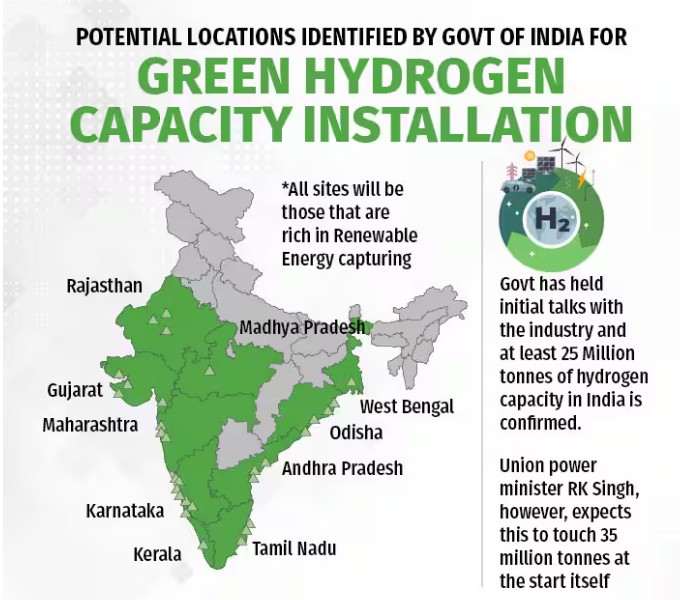
- Development of Green Hydrogen Hubs (for e.g., 3ports namely Deendayal (Kandla, Gujarat), Paradip (Odisha) and V.O. Chidambaranar (Tuticorin, Tamil Nadu) have been identified.
- Establishing a robust framework of regulations and standards.
- Research & Development programme.
Challenges in Green Hydrogen Adoption
- Economically viability: The NITI Aayog report states that the current cost of producing green hydrogen via electrolysis, ranging from $4.10 to $7 per kg, is still too high to compete with grey or brown hydrogen.
- Difficulty in Hydrogen Storage: As hydrogen as a gas typically requires high-pressure tanks (350–700 bar) tank pressure and as a liquid requires cryogenic temperatures because the boiling point of hydrogen at one atmosphere pressure is −252.8°C.
- Lack of Skill: In the domain of hydrogen production, the workforce demand is expected to reach ~2.83 lakhs, encompassing roles in design and planning, installation, commissioning, and green hydrogen production units.
Way forward
- Reduce cost: India aims to reduce green hydrogen production costs to $1 per kg by 2030 through low-cost renewable energy, local electrolyser manufacturing, and technological advancements.
- Incentives: For new applications, where the viability of using green hydrogen is still at early stage, necessary incentives should be designed.
- Construct an inter-ministerial governance structure: An interdisciplinary Project Management Unit (PMU) with globally trained experts must be created which can dedicate fulltime resources to effectively implement the mission.

2026-27 UPSC Mains English QEP Power Pages
View DetailsSubmit Your Details to Learn More



