
theIAShub
15 Jul, 2025
Article List
- India’s Renewable Rise: Setting New Paradigms
- Coal Plants and FGD System: Centre exempts 78% of Coal Plants from installing FGD System
- Ordinary Resident: Who is Qualified
- Carbon Fibre Foot Prosthesis
- Grassland Bird Survey Report
- Trade Watch Quarterly
- Operation Shiva
- Quantum Noise
- Sugar and Fat Boards
1. India’s Renewable Rise: Setting New Paradigms
Context
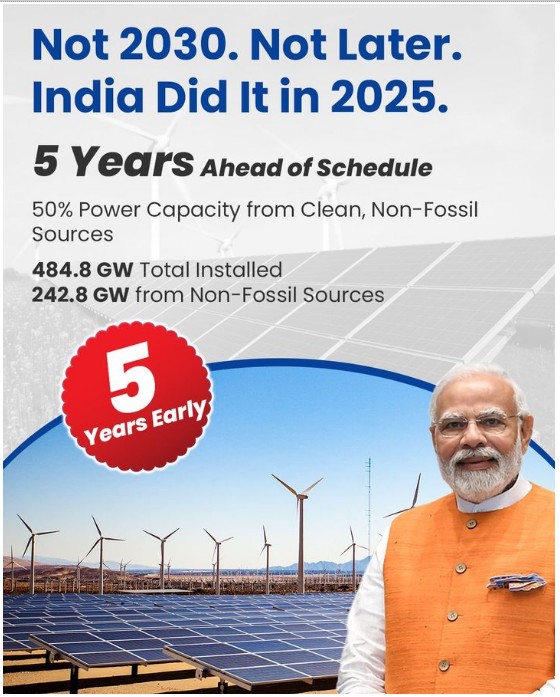
- India has achieved a landmark in its energy transition journey by reaching 50% of its installed electricity capacity from non-fossil fuel sources—five years ahead of the target set under its Nationally Determined Contributions (NDCs) to the Paris Agreement.
About the news
- Policy-Driven Progress Fuelling Clean Energy Growth: Flagship programmes such as PM-KUSUM, PM Surya Ghar: Muft Bijli Yojana, solar park development, and the National Wind-Solar Hybrid Policy have laid a strong foundation for this transformation.
- The bioenergy sector, which was once on the margins, has now become an important contributor to both rural livelihoods and clean energy generation.
- Expanding Renewable Base with Co-Benefits: Solar parks across the country have facilitated utility-scale renewable energy installations at record-low tariffs.
- Wind energy, particularly in states such as Gujarat and Tamil Nadu, continues to play a vital role in meeting the country’s evening peak power demand.
- These initiatives have not only decarbonised the power sector but have also delivered widespread co-benefits—enhanced energy access, employment generation, reduced air pollution, better public health outcomes, and stronger rural incomes.
- Towards a Modern, Inclusive Energy Future: Expanding the deployment of Battery Energy Storage Systems (BESS) and pumped hydro storage will be critical to ensure grid reliability and round-the-clock power availability.
- Promoting circularity in the lifecycle of solar panels, wind turbine blades, and batteries will support sustainable and responsible material use.
- Accelerated investments in green hydrogen as a future-ready industrial fuel will also play a vital role in deepening decarbonisation across sectors.Technology as the Force Multiplier.
About Renewable Energy: What is it?
- It is energy derived from natural sources that are replenished at a higher rate than they are consumed. Renewable energy sources are plentiful and all around us.
- For Example: Solar Energy, Wind Energy, Geothermal Energy, Hydro Power, Ocean Energy, Bio Energy.
Current Status
- India ranks fourth globally in renewable energy capacity.
- 4th in Wind Power (46.65 GW) capacity and 5th in solar photovoltaic power (85.47 GW).
- First time crossed 200 GW capacity from non-fossil fuel sources.
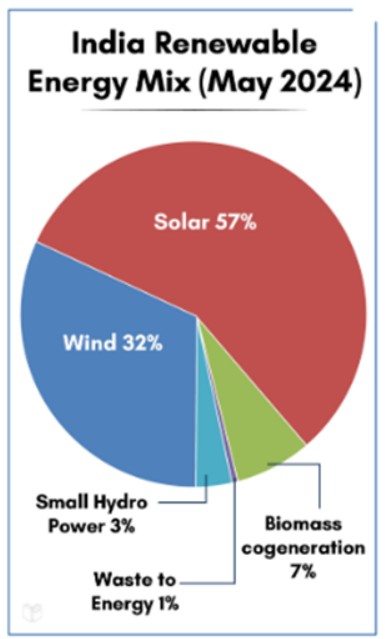
- It includes Solar power: 85.47 GW, Large hydro power: 46.93 GW, Wind power: 46.66 GW, Biopower: 10.95 GW, Small hydropower: 5.00 GW, Waste to Energy: 0.60 GW.
- RE targets in India
- India aims reaching a non-fossil fuel energy capacity of 500 GW by 2030.
- Fulfilling at least half of its energy requirements via RE by 2030.
Challenges faced by the Sector
- High cost: The material and natural resource (primarily land) costs to generate one unit of electricity are substantially higher for RE compared to the generation of one unit of electricity from fossil fuels.
- The highly diffused nature of RE requires elaborate installations such as solar panels and wind turbines.
- Land acquisition: For e.g., Identification of land with RE potential, its conversion (if needed), clearance from land ceiling Act, decision on land lease rent, clearance from revenue department, and other such clearances take time.
- Poor DISCOMS performance: Since most DISCOMS are bound by Power Purchase Agreement (PPA) for thermal power, their capacity to procure solar based power is reduced, thus affecting the overall Renewable purchase obligations (RPO) targets.
- Storage Concern: Due to Intermittency (Renewable sources are not constant, they fluctuate based on weather conditions) and grid balancing challenge (sudden surges or drops in renewable energy generation can strain the grid).
- Environmental: For e.g., birds and bats can have collisions with wind turbines, especially during migration seasons. Also, large amount of water is needed for hydrogen production.
Initiatives taken by Government
- FDI: Up to 100% FDI is allowed under the automatic route for renewable energy generation.
- PM Surya Ghar: Muft Bijli Yojana: Aimed to install rooftop solar plants in one crore households with a total financial outlay of ₹75,021 crore and to be implemented until FY27.
- Green Energy Corridor (GEC) projects: Initiated to facilitate renewable power evacuation and reshaping of the grid for future requirements.
- Solar Parks Scheme: To provide solar power developers with a plug and play model, by facilitating necessary infrastructure along with all statutory clearances.
- National Green Hydrogen Mission, 2023: The mission targets to achieve about 5 million metric tonnes (MMT) of annual Green Hydrogen production capacity by 2030.
Way Ahead
- Increase Energy Storage Capacity: Energy storage system (e.g. pump‐storage hydroelectricity, battery storage etc.) can be used for storing energy available from RE sources to be used at other times of the day.
- This can bring down the variability of generation in RE sources, improving grid stability, enabling energy/peak shifting etc.
- Centre-State Coordination: The central government needs to work with the state governments to identify exclusive land (for e.g., RE zones). Similarly, States need to ensure the 'must run' status for renewable power feeding into grid is being implemented in true spirit.
- A 'must run' status means that the concerned power plant has to supply electricity to the grid under all condition.
- Financing Innovations: Streamlining the contracting process (e.g., standardization of contracts), and making available relevant information, expanding the use of green bonds etc.
- Upgrade grid technology: System operators at all levels (i.e. state, regional and national) should have visibility of the grid status in neighbouring balancing areas and also the ability to easily coordinate with them.
2. Coal Plants and FGD System: Centre exempts 78% of Coal Plants from installing FGD System
Context
- The Ministry of Environment, Forest and Climate Change (MoEFCC) has exempted nearly 78% of India’s thermal power plants (TPPs) from installing Flue Gas Desulphurisation (FGD) systems.
About Fuel Gas Desulphurisation
- FGD systems are technologies used in coal-based thermal power plants to remove SO₂ from exhaust flue gases before they are released into the atmosphere.
- Mechanism: The most common FGD method involves using a wet scrubber that reacts with a limestone slurry to convert SO₂ into gypsum.
- Purpose: Helps reduce acid rain, secondary particulate matter, and improves ambient air quality.
Sulphur Dioxide: A significant Air Pollutant
- Sulphur dioxide (SO₂) is a major air pollutant primarily released from coal-fired power plants and other fossil fuel combustion.
- It poses serious health and environmental risks. As a respiratory irritant, SO₂ can trigger asthma, bronchitis, and other lung diseases.
- It is also a precursor to PM2.5, fine particulate matter linked to heart attacks, strokes, and premature death.
Categorisation of Thermal Power Plants
- Category A: Comprises ~11% of India’s 600 TPP units and has to mandatorily install FGD systems by December 30, 2027.
- These are located within 10 km radius of the National Capital Region or are cities with a population of at least a million (2011 Census).
- Category B: Comprises another 11% of TPP units and are located near Critically Polluted Areas (CPAs) or Non-Attainment Cities (NACs).
- Installation of FGD is subject to approval by the Expert Appraisal Committee (EAC).
- Deadline: December 30, 2028, if required.
- Category C: It comprises the remaining 78% of TPP units. They are fully exempted from installing FGD systems and are mostly located in regions outside pollution hotspots.
Rationale Behind Policy Shift
- According to the Ministry, India’s ambient SO₂ levels have been declining, with 2023 measurements across 492 cities showing compliance in all but two.
- Indian coal naturally has low sulphur content, leading to relatively lower SO₂ emissions.
- Studies have found no major difference in SO₂ concentrations between cities with and without FGD-fitted plants.
Concerns
- Health Impacts: SO₂ is a precursor to PM2.5, which can penetrate lungs and bloodstream. Chronic exposure is linked to asthma, heart disease, and premature death.
- According to the Lancet Commission on Pollution and Health 2022, pollution-related deaths in India exceeded 2.3 million annually.
- Violation of Polluter Pays Principle: Exempting TPPs from installing FGDs violates the environmental principle that polluters should bear the cost of pollution mitigation.
- Undermines Pollution Targets: India’s Clean Air Programme and COP26 commitments are weakened by this decision.
- Air Pollution Dispersion: Coal plants emit pollutants that travel up to 200 km from the source.
- Tall chimneys do not eliminate pollution but disperse it into wider areas, impacting rural populations and neighboring states.
Way Ahead
- Health-Cost Internalisation: Use models like the Health Impact Assessment (HIA) to account for medical costs, productivity loss, and mortality.
- Accelerate Renewable Energy Transition: Shift focus towards cleaner sources like solar, wind, and biomass to reduce dependency on coal.
- Pollution Control Mandates for All Categories: Pollution is not limited by administrative categories; hence, uniform emission norms should be enforced.
- Build FGD Installation Capacity: Encourage Make in India initiatives to build indigenous capacity for FGD manufacturing and deployment.
- Public Disclosure and Monitoring: Real-time emissions data of SO₂, PM2.5, and other pollutants should be made publicly available for accountability.
3. Ordinary Resident: Who is Qualified
Context
- Recently, the Election Commission’s Special Intensive Revision (SIR) in Bihar has sparked discussions on electoral inclusion, particularly for migrant populations, focusing on the balance between electoral roll integrity and inclusive democratic participation.
About Ordinary Resident: Who is it?
- According to Section 19 of the RP Act, only a person who is an ‘ordinarily resident’ in a constituency can be enrolled in its electoral roll.
- Section 20 provides the meaning of the term ‘ordinarily resident’.
- It specifies that mere ownership or possession of a house does not make one ordinarily resident.
- However a person temporarily absent from their place of residence will still be considered ordinarily resident there.
- Specific categories of individuals (e.g., armed forces, government officials posted outside India, constitutional office holders) are deemed to be ordinarily resident in their home constituency despite being physically away.
- Section 20A (added in 2010) allows Non-Resident Indians (NRIs) to register and vote from the address mentioned in their passport, even if they live abroad for extended periods.
- The Election Commission of India (ECI) is responsible for preparing electoral rolls under the Representation of the People Act, 1950 (RP Act).
Rules Governing Electoral Rolls
- The Registration of Electors Rules, 1960 (RER), framed by the Central Government in consultation with the ECI, govern the:
- Preparation of electoral rolls.
- Inclusion and exclusion of names.
- Process of verification and changes in voter lists.
Challenges for Migrant Workers
- India has a large migrant workforce, especially from poorer regions like Bihar, Uttar Pradesh, Odisha, Jharkhand, and Chhattisgarh.
- The Periodic Labour Force Survey (2020-21) estimates that around 11% of Indians migrate for employment, which amounts to over 15 crore people. Key Issues are;
- Temporary Nature of Migration: Most labourers migrate for short-term work and live in makeshift homes or worksite camps without permanent addresses.
- Voter Identity and Registration Gaps: Many migrants fail to register as voters in their place of work due to lack of documentation and mobility.
- Reluctance to Shift Voter Registration: Migrants have stronger social and economic ties with their home villages or towns. They choose to vote where their families live and their properties exist.
- Disenfranchisement Risk: Removal from rolls in the original constituency, combined with no registration at the new workplace, may leave many completely disenfranchised.
Way Ahead
- Amendments in RP Act and RER: Introduce special provisions for migrant workers, akin to those for service voters and NRIs.
- Allow dual documentation to maintain residence proof in the original place even while temporarily living elsewhere.
- Use of Technology: Use Aadhaar-linked electoral rolls to ensure;
- One person, one vote (preventing multiple registrations),
- Seamless transfer of voting rights across locations.
- Alternative Voting Mechanisms: Explore options like Postal ballots for migrants, Mobile polling stations at major work clusters, and Remote voting technologies piloted by the ECI.
4. Carbon Fibre Foot Prosthesis
Context
- DRDO and AIIMS Bibinagar unveils first make in india cost effective advanced Carbon Fibre Foot Prosthesis.
About and features of CFFP
- CFFP is biomechanically tested to loads up to 125 kgs with sufficient factor of safety.
- It has three variants to cater to patients of different weights.
- This foot is designed with the goal of offering a high-quality and affordable solution accessible to a larger population in need, while delivering performance at par with available international models.
Benefits of the Invention
- It is expected to reduce the cost significantly to as low as less than Rs 20,000 in production in comparison to the current imported similar products that cost around Rs two lakh.
- This innovation is expected to significantly improve accessibility to high-quality prosthetics for low income group amputees in India.
- It will reduce dependency on imported technologies, and support broader social & economic inclusion for people with disabilities.
5. Grassland Bird Survey Report
Context
- Recently, Kaziranga National Park and Tiger Reserve released its first-ever Scientific Survey Report on Grassland Birds, revealing a remarkable diversity of avian species.
Key Highlights
- The survey spanned areas under the Eastern Assam, Biswanath, and Nagaon Wildlife Divisions.
- The survey documented 43 species of grassland-dependent birds, including:
- 1 Critically Endangered species
- 2 Endangered species
- 6 Vulnerable species
- These findings underscore Kaziranga's floodplain grasslands as one of the richest avian habitats in India.
- Star Discovery: A breeding colony of the Endangered Finn's Weaver (Ploceus megarhynchus), locally known as Tukura Charai, was rediscovered in the Kohora Range-a significant indicator of healthy grassland ecosystems.
- Focus on Threatened and Endemic Species: 10 key species that are either threatened or endemic to the Brahmaputra floodplains.
About Kaziranga National Park
- Located in the northeastern state of Assam (India), within the Brahmaputra Valley floodplain.
- Ecological Significance: It is the largest undisturbed and representative area of Brahmaputra Valley floodplains, playing a crucial role in ecosystem conservation.
- Designated as a UNESCO World Heritage Site in 1985.
- Flora includes dense elephant grass and swamplands enriched with aquatic plants like water lilies, hyacinths, and lotus.
- Fauna comprises several endangered species, including the one-horned rhinoceros (world's largest population), Royal Bengal tiger, eastern swamp deer, elephant, wild buffalo, hoolock gibbon, capped langur, and Gangetic dolphin, making it a vital wildlife habitat.
6. Trade Watch Quarterly
Context
- Recently, NITI Aayog released the third edition of its flagship publication, Trade Watch Quarterly, for the third quarter of FY 2024-25 (October-December, 2024)
Key Highlights
- Despite geopolitical headwinds, India's trade performance in Q3 FY25 showed cautious resilience:
- Merchandise exports grew by 3%, reaching $108 billion.
- Imports increased by 6.5% to $187 billion, widening the trade deficit.
- A robust services surplus of $52 billion, driven by 17% growth in services exports, helped offset the merchandise gap.
Export Composition Trends:
- India emerged as the 5th largest exporter of Digitally Delivered Services (DDS), clocking $269 billion in 2024.
- Aircraft, spacecraft, and related parts entered the top export list with over 200% YoY growth.
- High-tech exports especially in electrical machinery and arms/ammunition, have grown at a CAGR of 10.6% since 2014.
About NITI Ayog
- Established on January 1, 2015, NITI Aayog (National Institution for Transforming India) replaced the Planning Commission as the premier policy think tank of the Government of India.
- It aims to drive economic development, promote cooperative federalism, and enable state participation in national policymaking.
Composition
- Chairperson: PM of India →Vice Chairperson: Appointed by the PM
- CEO: Appointed by PM; holds Secretary rank.
- Full-Time Members: Subject matter experts in key fields
- Ex-Officio Members: Up to four Union Ministers
- Governing Council: Includes CMs of States, LGs of UTs, and PM (as Chair)
- Special Invitees: UT administrators and domain experts
- Regional Councils: Formed for addressing specific regional challenges
7. Operation Shiva
Context
- Recently, the Indian Army launched Operation Shiva to ensure the safe and uninterrupted conduct of the Amarnath Yatra in Jammu & Kashmir.
About Yatra
- The annual pilgrimage leads to the Amarnath Cave, located at an altitude of around 3,888 meters, where a naturally formed ice Shivling symbolizes Lord Shiva.
Key Features
- Conducted in coordination with the civil administration and Central Armed Police Forces (CAPFs).
- Focuses on securing both Northern and Southern Yatra routes amidst rising threats from Pakistan-backed terror proxies, particularly after Operation Sindoor.
- Over 8,500 troops have been mobilized, backed by advanced technology and logistics.
- Dynamic counter-terrorism grid is in place with prophylactic security & corridor protection.
- More than 50 Counter-Unmanned Aerial Systems (C-UAS) and Electronic Warfare (EW) units have been deployed to neutralize drone threats.
- Unmanned Aerial Vehicles (UAVs) conduct regular surveillance with live monitoring of the Yatra routes and the holy cave.
- Engineer task forces are engaged in track widening, bridge construction, and disaster mitigation.
- Over 150 doctors and paramedics deployed.
8. Quantum Noise
Context
- Recently, scientists at the Raman Research Institute (RRI), Bengaluru, in collaboration with national and international researchers, conducted a groundbreaking study challenging the conventional belief that quantum noise always disrupts entangled states.
About Quantum Noise
- Refers to unwanted disturbances in quantum systems that can disrupt their functioning, particularly in quantum computing and communication.
- Impact vs. Classical Noise: Unlike classical noise, which adds random errors to a signal, quantum noise has deeper, more complex effects, often altering the fundamental quantum properties of the system.
Key Findings
- Findings reveal that, under certain conditions, quantum noise can actually preserve and even generate entanglement within individual particles.
- Single-particle (intra-particle) entanglement is stronger: Entanglement within a single particle is more resistant to noise than entanglement between two particles.
- A specific type of noise called amplitude damping can not only damage but also create or bring back entanglement in single-particle systems.
- In contrast, entanglement between two separate particles only fades with noise and doesn't recover or form on its own.
- Scientists developed a formula to track and predict how entanglement behaves when noise is present. Entanglement within one particle decays more slowly compared to between two particles, across different types of noise.
- The behavior of entanglement under noise can be shown using simple geometric shapes, making it easier to understand. This form of entanglement can help build stronger and more reliable quantum computers and communication systems.
- Quantum Entanglement, termed by Einstein as "spooky action at a distance," describes a mysterious linkage between particles, where a change in one instantly affects the other, regardless of the distance. However, this fragile connection is notoriously vulnerable to environmental noise, leading to a breakdown of coherence-a process called decoherence.
9. Sugar and Fat Boards
Context
- Recently, in a landmark move to combat lifestyle diseases and promote healthy eating habits, the Ministry of Health and Family Welfare directed all Central and State government offices to display 'Sugar and Fat Boards' in canteens and food stalls within their premises.
Key Highlights:
- The initiative is supported by the Indian Council of Medical Research National Institute of Nutrition (ICMR-NIN), which has also provided a model template for the boards.
- Recommended Limits: Sugar: Max 25 grams per day (= 5 teaspoons)
- ✓ Visible Fats (oil, ghee, butter): Max 30 grams per day ( 6 teaspoons)
- Origin of the Concept: First introduced in schools under CBSE and ICSE, the initiative is now being scaled up to government offices nationwide.
- Experts warn that reused cooking oil produces trans fats, increasing the risk cardiovascular diseases.

2026-27 UPSC Mains English QEP Power Pages
View DetailsSubmit Your Details to Learn More



