
theIAShub
15 Jul, 2025
Table of Contents

Get an Instant Call Back from Our Expert Mentors!
Context
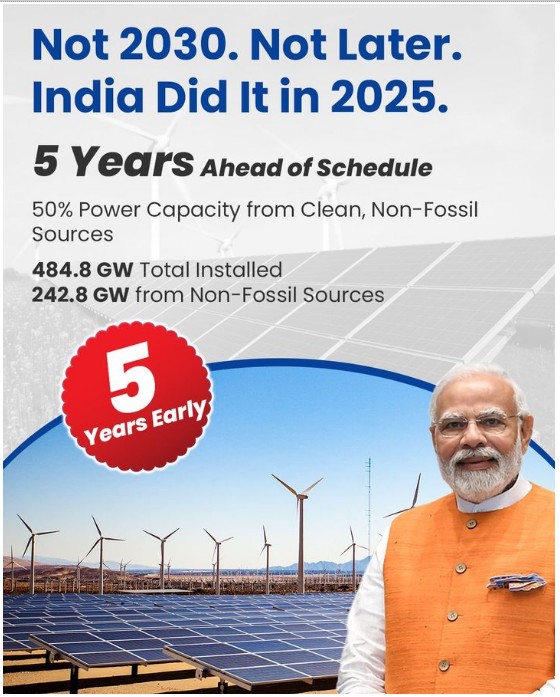
- India has achieved a landmark in its energy transition journey by reaching 50% of its installed electricity capacity from non-fossil fuel sources—five years ahead of the target set under its Nationally Determined Contributions (NDCs) to the Paris Agreement.
About the news
- Policy-Driven Progress Fuelling Clean Energy Growth: Flagship programmes such as PM-KUSUM, PM Surya Ghar: Muft Bijli Yojana, solar park development, and the National Wind-Solar Hybrid Policy have laid a strong foundation for this transformation.
- The bioenergy sector, which was once on the margins, has now become an important contributor to both rural livelihoods and clean energy generation.
- Expanding Renewable Base with Co-Benefits: Solar parks across the country have facilitated utility-scale renewable energy installations at record-low tariffs.
- Wind energy, particularly in states such as Gujarat and Tamil Nadu, continues to play a vital role in meeting the country’s evening peak power demand.
- These initiatives have not only decarbonised the power sector but have also delivered widespread co-benefits—enhanced energy access, employment generation, reduced air pollution, better public health outcomes, and stronger rural incomes.
- Towards a Modern, Inclusive Energy Future: Expanding the deployment of Battery Energy Storage Systems (BESS) and pumped hydro storage will be critical to ensure grid reliability and round-the-clock power availability.
- Promoting circularity in the lifecycle of solar panels, wind turbine blades, and batteries will support sustainable and responsible material use.
- Accelerated investments in green hydrogen as a future-ready industrial fuel will also play a vital role in deepening decarbonisation across sectors.Technology as the Force Multiplier.
About Renewable Energy: What is it?
- It is energy derived from natural sources that are replenished at a higher rate than they are consumed. Renewable energy sources are plentiful and all around us.
- For Example: Solar Energy, Wind Energy, Geothermal Energy, Hydro Power, Ocean Energy, Bio Energy.
Current Status
- India ranks fourth globally in renewable energy capacity.
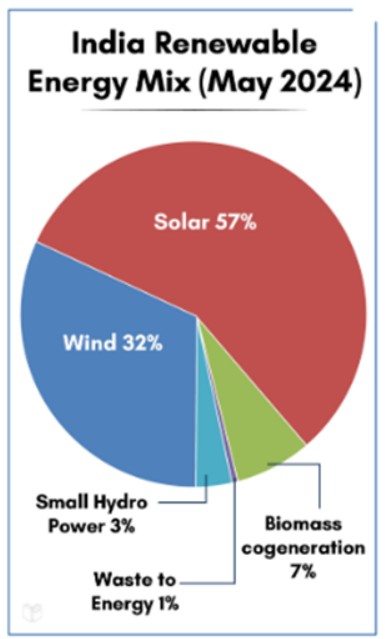
- 4th in Wind Power (46.65 GW) capacity and 5th in solar photovoltaic power (85.47 GW).
- First time crossed 200 GW capacity from non-fossil fuel sources.
- It includes Solar power: 85.47 GW, Large hydro power: 46.93 GW, Wind power: 46.66 GW, Biopower: 10.95 GW, Small hydropower: 5.00 GW, Waste to Energy: 0.60 GW.
- RE targets in India
- India aims reaching a non-fossil fuel energy capacity of 500 GW by 2030.
- Fulfilling at least half of its energy requirements via RE by 2030.
Challenges faced by the Sector
- High cost: The material and natural resource (primarily land) costs to generate one unit of electricity are substantially higher for RE compared to the generation of one unit of electricity from fossil fuels.
- The highly diffused nature of RE requires elaborate installations such as solar panels and wind turbines.
- Land acquisition: For e.g., Identification of land with RE potential, its conversion (if needed), clearance from land ceiling Act, decision on land lease rent, clearance from revenue department, and other such clearances take time.
- Poor DISCOMS performance: Since most DISCOMS are bound by Power Purchase Agreement (PPA) for thermal power, their capacity to procure solar based power is reduced, thus affecting the overall Renewable purchase obligations (RPO) targets.
- Storage Concern: Due to Intermittency (Renewable sources are not constant, they fluctuate based on weather conditions) and grid balancing challenge (sudden surges or drops in renewable energy generation can strain the grid).
- Environmental: For e.g., birds and bats can have collisions with wind turbines, especially during migration seasons. Also, large amount of water is needed for hydrogen production.
Initiatives taken by Government
- FDI: Up to 100% FDI is allowed under the automatic route for renewable energy generation.
- PM Surya Ghar: Muft Bijli Yojana: Aimed to install rooftop solar plants in one crore households with a total financial outlay of ₹75,021 crore and to be implemented until FY27.
- Green Energy Corridor (GEC) projects: Initiated to facilitate renewable power evacuation and reshaping of the grid for future requirements.
- Solar Parks Scheme: To provide solar power developers with a plug and play model, by facilitating necessary infrastructure along with all statutory clearances.
- National Green Hydrogen Mission, 2023: The mission targets to achieve about 5 million metric tonnes (MMT) of annual Green Hydrogen production capacity by 2030.
Way Ahead
- Increase Energy Storage Capacity: Energy storage system (e.g. pump‐storage hydroelectricity, battery storage etc.) can be used for storing energy available from RE sources to be used at other times of the day.
- This can bring down the variability of generation in RE sources, improving grid stability, enabling energy/peak shifting etc.
- Centre-State Coordination: The central government needs to work with the state governments to identify exclusive land (for e.g., RE zones). Similarly, States need to ensure the 'must run' status for renewable power feeding into grid is being implemented in true spirit.
- A 'must run' status means that the concerned power plant has to supply electricity to the grid under all condition.
- Financing Innovations: Streamlining the contracting process (e.g., standardization of contracts), and making available relevant information, expanding the use of green bonds etc.
- Upgrade grid technology: System operators at all levels (i.e. state, regional and national) should have visibility of the grid status in neighbouring balancing areas and also the ability to easily coordinate with them.

2026-27 UPSC Mains English QEP Power Pages
View DetailsSubmit Your Details to Learn More



