Explore the Updated Union Territories of India List 2025 with Capitals. Learn About Their Constitutional Status, Governance, Types, Area, Population, and Key Facts. Useful for UPSC and Competitive Exams. Check the Complete UTs List and Details Here.
 theIAShub | 11 Jun, 2025 | 29363 | 0 |
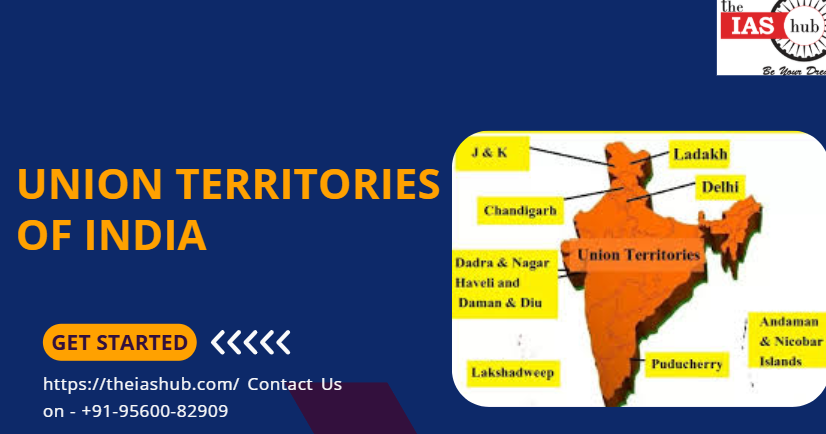

Union territories (UTs) are administrative regions governed directly by the Central Government of India. Unlike states, which have their own elected governments and legislatures, most Union territories are centrally administered by an Administrator or Lieutenant Governor appointed by the President. A few Union territories, like Delhi and Puducherry, have elected legislatures with limited powers.
As of 2025, India has 8 Union territories, including the National Capital Territory of Delhi, Jammu & Kashmir, Ladakh, and others. This article covers their details, history, constitutional status, reasons for their creation, and other important facts relevant for competitive exams and general knowledge.
Union territories of India are special administrative regions directly managed by the Central Government. The governance model is different from that of states. While states have their own governments, most UTs are administered by an Administrator or Lieutenant Governor, appointed by the President.
In some cases, Union territories can have legislatures with limited law-making authority. Currently, only Delhi, Puducherry, and Jammu & Kashmir have this provision.
Union territories typically have smaller geographical areas, lower populations, strategic locations, or unique historical backgrounds that make central administration more practical than statehood.

Also Reads: Indian States and Their Capitals 2025
As of 2025, India has 8 Union Territories. The current list reflects significant changes in recent years, including the reorganization of Jammu & Kashmir in 2019 and the merger of Dadra & Nagar Haveli and Daman & Diu in 2020.
The current Union Territories of India are:
Here’s the updated list of Union territories in India and their respective capitals as of 2025:
| Union Territory | Capital(s) |
| Andaman & Nicobar Islands | Port Blair |
| Chandigarh | Chandigarh |
| Dadra & Nagar Haveli and Daman & Diu | Daman |
| Lakshadweep | Kavaratti |
| Delhi (National Capital Territory) | New Delhi |
| Puducherry | Puducherry |
| Jammu & Kashmir | Srinagar (Summer), Jammu (Winter) |
| Ladakh | Leh (Summer), Kargil (Winter) |
Different types of UTs in India:
| Category | Details |
| First UT of India | Andaman and Nicobar Islands (designated as a UT after Independence, officially recognized under the States Reorganisation Act, 1956 along with Delhi and Lakshadweep). |
| Largest UT by Area | Ladakh (59,146 sq. km) |
| Smallest UT by Area | Lakshadweep (32 sq. km) |
| UTs with Legislature | 1. Delhi (National Capital Territory of Delhi) 2. Puducherry 3. Jammu & Kashmir |
| UTs without Legislature | 1. Andaman & Nicobar Islands 2. Chandigarh 3. Dadra & Nagar Haveli and Daman & Diu 4. Lakshadweep 5. Ladakh |

As per the latest available data from the 2011 Census:

Image: Maps of India

Image: Maps of India
The population distribution of other UTs is as follows:
| Union Territory | Population (2011 Census) |
| Delhi (NCT) | 16,787,941 |
| Jammu & Kashmir | 12,267,013 |
| Puducherry | 1,247,953 |
| Chandigarh | 1,055,450 |
| Andaman & Nicobar Islands | 380,581 |
| Ladakh | 274,289 |
| Lakshadweep | 64,473 |
Union territories are governed under Articles 239 to 241 of the Constitution of India. The key provisions are:
Parliament holds the authority to legislate for Union territories on matters from the Union and Concurrent Lists. For UTs with legislatures, laws are made both by their legislative assemblies and by Parliament.
Union territories in India have been created for several practical, strategic, and historical reasons:
This classification allows the Union Government to directly manage these territories for efficiency, security, and uniform development.
Are you preparing for UPSC 2025? Join IAShub’s UPSC coaching batches to boost your preparation. Enroll now!
Union territories of India represent a distinctive administrative structure within the Indian federal framework. Unlike states, they are governed directly by the Union Government, with a few exceptions where limited legislative powers exist. Their creation has been guided by factors such as strategic location, cultural uniqueness, administrative convenience, and historical circumstances.
As of 2025, there are 8 Union Territories in India. This number was revised after the reorganization of Jammu & Kashmir and Ladakh in 2019, bringing the total from 7 to 8.
Ladakh is the largest Union Territory in India by area, covering about 59,146 square kilometers. Lakshadweep, an island group in the Arabian Sea, is the smallest Union Territory with an area of just 32 square kilometers.
Currently, Delhi, Puducherry, and Jammu & Kashmir are the only Union Territories with their own legislative assemblies. These UTs enjoy partial state-like governance under the framework of the Indian Constitution.
According to the 2011 Census, Delhi holds the position of the most populated Union Territory in India, with a population exceeding 1.67 crore. It continues to be the most densely populated UT in the country.

Refine your answer writing skills and elevate your UPSC preparation with personalized support and expert feedback.
Fill out the form to get started with the program or any other enquiries !
Are you dreaming of becoming an IAS officer? Then, IAShub can be your best guide. It is one of the Best IAS Coaching in Delhi. Many students who want to clear the UPSC exam join IAShub for learning. The institute gives both online and offline classes. Their teachers are experienced and helpful. They easily explain every topic. Students also get notes, tests, and tips to do well in the exam.
IAShub is in Delhi and is trusted by many UPSC students. It offers coaching for every part of the UPSC exam – Prelims, Mains, and Interview. The classes are simple and easy to understand. The teachers are experts and guide students in the right way. IAShub is also known for its helpful notes, test series, and answer-writing practice. IAShub is the best coaching in Delhi and also gives UPSC Online Classes. This helps students from any place in India to learn. The online classes are live and also recorded. So, students can watch them anytime. These classes cover the full UPSC syllabus.
Here are some important services provided by IAShub:
The UPSC Civil Services Exam has three parts:
This exam is tough, but with the right guidance, it becomes easy to manage. Students must study smart and stay regular.
IAShub supports students from the beginning to the end. It gives the right books, tests, and notes. The classes are easy to follow, and the teachers are always ready to help. Students get personal doubt sessions too. The test series and answer checking help students learn where they need to do better. Also, free study materials save time and money.
IAShub also guides students during the final stage – the interview. Experts take mock interviews and give useful tips. This full support makes IAShub one of the best IAS coaching in Delhi.