Explore the complete list of Presidents of India from 1950 to 2025 with names, tenure, key facts, and historical milestones. Know about the first President, first woman President, first tribal President, and their significant contributions.
 theIAShub | 07 Jul, 2025 | 20942 | 0 |
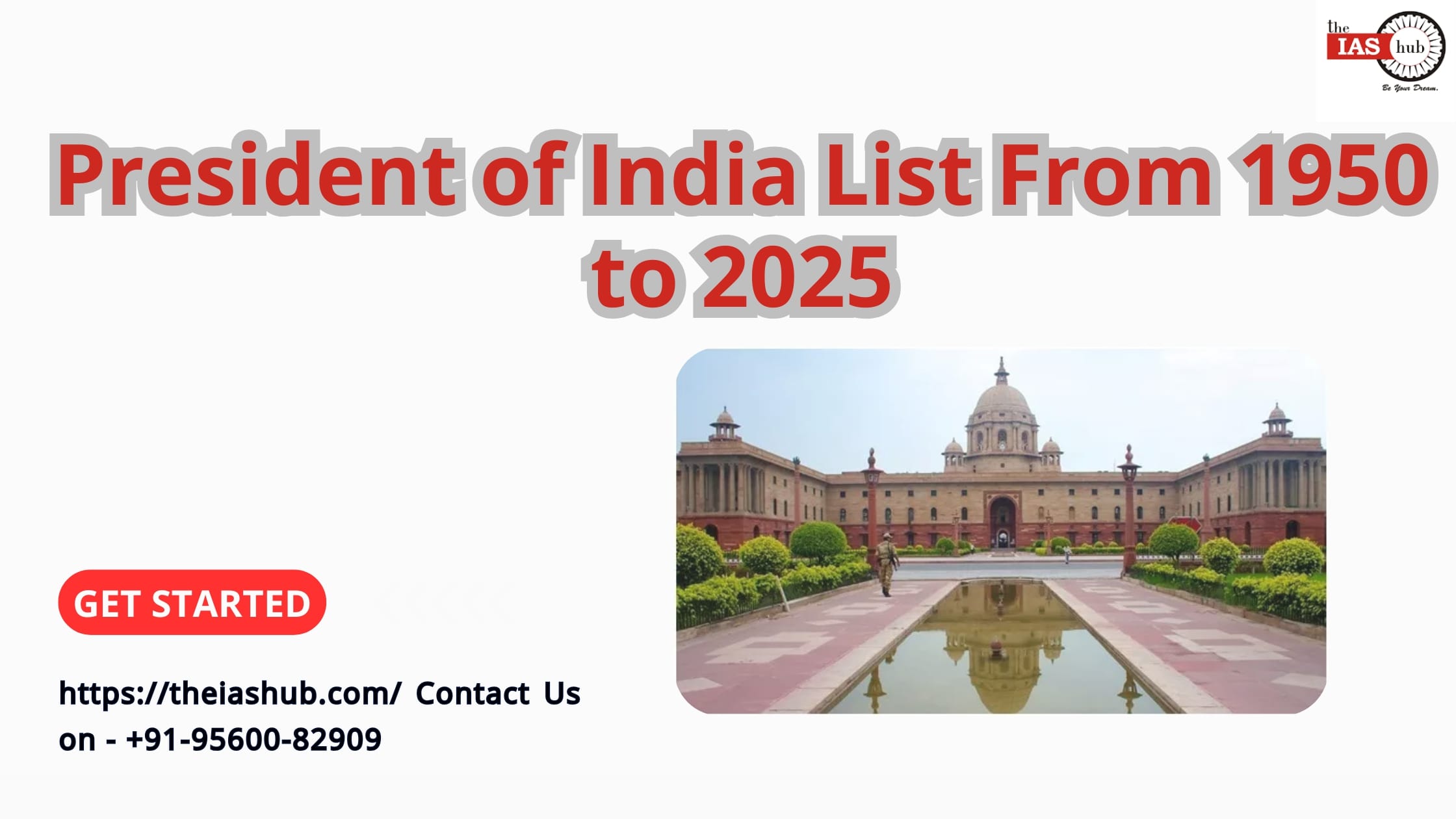

President of India, the head of state. He is indirectly elected every five years by an electoral college consisting of the elected members of both houses of India’s parliament Lok Sabha ( Lower house of the parliament) and the Rajya Sabha(Upper house of the parliament) as well as the elected representatives of all legislative assemblies of the states of India and the union territories of Delhi, Puducherry and Jammu Kashmir. The president is the first citizen of India and serves as the de facto commander-in-chief of the Indian Armed Forces. The president is elected for a five-year term, and there is no limit on the number of times the president can be reelected to office. There have been 15 Presidents of India from 1950 to 2025.
Also read – President of India
Office of the President of India stands as the paramount embodiment of the Republic’s sovereignty, unity, and integrity. Instituted under Article 52 of the Constitution, the President serves as the Head of State, exercising powers and duties delineated under Part V, Chapter I, There have been 15 presidents of India till now detailed list is given below:
| Number | President Of India |
| 1 | Dr. Rajendra Prasad |
| 2 | Dr. Savepalli Radhakrishnan |
| 3 | Dr. Zakir Husain |
| 4 | V.V. Giri |
| 5 | Fakhruddin Ali Ahmad |
| 6 | Neelam Sanjiva Reddy |
| 7 | Giani Zail Singh |
| 8 | R. Venkataraman |
| 9 | Dr. Shankar Dayal Sharma |
| 10 | K. R. Narayanan |
| 11 | Dr. A.P.J. Abdul Kalam |
| 12 | Pratibha Devisingh Patil |
| 13 | Pranab Mukherjee |
| 14 | Ram Nath Kovind |
| 15 | Droupadi Murmu |
Also read – Important personalities of India

Dr. Rajendra Prasad served as the first President of India, holding the office from January 26, 1950, until May 13, 1962. Born on December 3, 1984. He was also the President of the Constituent Assembly. Dr. Rajendra Prasad’s legacy as a freedom fighter, statesman, and India’s first President continues to inspire. His humility, dedication, and profound commitment to the principles of democracy remain the touchstone of public service in India.
He was awarded the Bharat Ratna in 1962.

Sarvepalli Radhakrishnan was a scholar and statesman who was President of India from 1962 to 1967. He also held the position of vice-chancellor of the Andhra University and Banaras Hindu University. A renowned philosopher and academic, His birthday is celebrated as Teacher’s Day in India, and he was awarded the Bharat Ratna in 1954.

Zakir Husain vice third President of India and the first Muslim to become President of India (1967–69) (born February 8, 1897, Hyderabad, India—died May 3, 1969, New Delhi) was an Indian politician who also served as the second vice President of India (1962–67). He was a passionate proponent of educational reforms. After independence, he held several significant political positions, including as the Governor of Bihar. His tenure strengthened democratic values and institutional integrity. His presidency remains a symbol of India’s commitment to unity in diversity, inspiring future generations.


Varahagiri Venkata Giri (V V Giri) was the fourth President of India, took the oath of the President on 24th August 1969, entered Rashtrapati Bhawan and remained in the office for the full term. Before this, he, as the Vice-President, took the role of acting President on the death of then-President Zakir Hussain in May 1969. As an acting President, he remained in the office for three months. Historically, he was the only person to have been elected as an independent candidate for the presidency. His work in the sphere of labour rights and his tenure as President was marked by this unwavering commitment.

Fakhruddin Ali Ahmed was the fifth President of India (1974–77) was a lawyer by profession and a statesman by work. He participated in the Indian national movement, including the Quit India movement. Before becoming president, he served in several ministerial positions with the Congress Party. As the President of India, he declared the emergency on June 25, 1975, on the advice of Prime Minister Indira Gandhi, initiating a turbulent period in the country’s history. He was widely criticised for his decision after emergency foundational changes took place to protect the civil liberty of the citizens.

Neelam Sanjiva Reddy served as the sixth President of India. He was a stalwart politician of the state of Andhra Pradesh. he was 2 times the chief minister of Andhra Pradesh, a member of Parliament, and twice the speaker of Lok Sabha. He was the first person to be elected to this high office unopposed. His presidency was marked by his commitment to the values enshrined in the Indian Constitution and his dedication to national unity.

Giani Zail Singh served as the seventh President of India. He was involved in the freedom movement and participated in the Quit India movement in 1942. Post-independence he became Minister in Punjab and later became the l the Chief Minister of the state. He also served as the Union Home Minister under Indira Gandhi. His tenure as Home Minister saw him dealing with many challenging situations, including issues related to law and order and internal security.

Ramasamy Venkataraman, widely known as R. Venkataraman, served as the eighth President of India from July 25, 1987, to July 25, 1992. He was an active participant in the Quit India Movement of 1942 and was detained for two years for his activities. After India gained independence, Venkataraman’s political career began in earnest. He was elected four times to the Lok Sabha and served in various ministerial roles, including as Minister of Defence and Minister of Finance, under the cabinets of Prime Ministers Indira Gandhi and Rajiv Gandhi. His term as president was characterised by his legal acumen and keen understanding of constitutional law.

Dr Shankar Dayal Sharma served as the ninth President of India. He was elected to the Madhya Pradesh Legislative Assembly thrice and served as the Chief Minister of the state from 1956 to 1957. He was a union minister and vice president of India before becoming president of India. Dr. Sharma was also a noted poet and writer. His eloquence, combined with a keen intellect and strong sense of ethics, was evident in his speeches and writings.

Kocheril Raman Narayanan was the tenth President of India, Narayanan began his career in the Indian Foreign Service. Entering the political sphere, Narayanan was elected to the Lok Sabha in 1984. His political career saw him serving in various ministerial positions under the cabinets of Prime Ministers Indira Gandhi and Rajiv Gandhi. In 1997, Narayanan was elected as the President of India, becoming the first person from Kerala to hold the post and the first Dalit to ascend to this high office. His presidency is remembered for his meticulous adherence to constitutional proprieties and his maintenance of the dignity and independence of the office. He was a deep thinker and an erudite speaker, known for his extensive knowledge of both Indian and world affairs.

Avul Pakir Jainulabdeen Abdul Kalam was the 11th president of India from 2002 to 2007. He was an Indian aerospace scientist and statesman. He contributed to the development of India’s first indigenous Satellite Launch Vehicle (SLV-III), which successfully injected the Rohini satellite, making India an exclusive member of the Space Club. He was responsible for the development and operation of AGNI and PRITHVI Missiles and for building indigenous capability in critical technologies through the networking of multiple institutions. He was the Scientific Adviser to the Defence Minister and Secretary, of the Department of Defence Research & Development during this period. India led to the weaponisation of strategic missile systems and the Pokhran-II nuclear tests, which made India a nuclear weapons State. He has been awarded the coveted civilian awards Padma Bhushan (1981) and Padma Vibhushan (1990), and the highest civilian award, Bharat Ratna (1997).

Smt. Patil was the first woman to have been elected to this august office. She was a lawyer and politician. Before becoming president, she was the governor of Rajasthan. Her presidency focused on women’s empowerment and education. Notable actions include commuting 35 death sentences and advocating for gender equality.

Shri Pranab Mukherjee, crowning a political career of over five decades of exemplary service to the nation in Government as well as Parliament. Shri Mukherjee is a man of unparalleled experience in governance with the rare distinction of having served at different times as Foreign, Defence, Commerce and Finance Minister. A powerful orator and scholar, Shri Mukherjee’s intellectual and political prowess, as well as his remarkable knowledge of international relations, financial affairs and parliamentary process, are widely admired.

Shri Ram Nath Kovind was sworn in as the 14th President of India on 25 July 2017. A lawyer by profession, he had been the Governor of the State of Bihar before he took over the highest constitutional office. Shri Kovind brings to the office a rich experience of working across the spectrum of the republic, from the grassroots to the apex court and parliament. He has been an ardent champion of equality in society and integrity in public life.

Droupadi Murmu is the present and 15th President of India. She is the first tribal (Santhal) and the second woman to hold the office, as well as the youngest president and the firstborn in independent India. Hailing from Uparbeda village in Odisha’s Mayurbhanj district, she overcame poverty to earn a Bachelor of Arts degree from Rama Devi Women’s University. Starting as a junior assistant and teacher, she joined the BJP in 1997, served as an MLA (2000–2009), Jharkhand Governor (2015–2021), and as the president, she now focuses on tribal welfare and social justice.
Also read – Constitution Bodies in India
First female president of India was Pratibha Patil served as president of India from 2007 to 2012. Before her election as president, Patil served as the governor of Rajasthan from 2004 to 2007 and became the first female governor. Patil was born on December 19, 1934, in Nadgaon village of Jalgaon District, Maharashtra. She also worked actively for the welfare of women and children and the underprivileged sections of society. She has set up hostels for working women in Mumbai and Delhi, and an Engineering College at Jalgaon for rural youth.

Zakir Husainvice third President of India and the first Muslim to become President of India (1967–69) (born February 8, 1897, Hyderabad, India—died May 3, 1969, New Delhi) was an Indian politician who also served as the second vice President of India (1962–67). He was a passionate proponent of educational reforms. After independence, he held several significant political positions, including as the Governor of Bihar. His tenure strengthened democratic values and institutional integrity. His presidency remains a symbol of India’s commitment to unity in diversity, inspiring future generations.

India’s first Dalit President was K. R. Narayanan. he overcame caste-based discrimination to become a diplomat, serving as ambassador to several countries, and later a parliamentarian. As President, Narayanan championed social justice, education, and the rights of marginalised communities, emphasising constitutional values. He actively engaged in policy debates, ensuring the presidency was a voice for the underprivileged. His legacy lies in breaking caste barriers, inspiring social equity, and reinforcing India’s democratic ethos, leaving an enduring impact on inclusivity and justice.

Droupadi Murmu, India’s first tribal woman President (2022–till now), embodies resilience and public service. Born in a Santhali family in Odisha, she rose from humble beginnings to become a two-term MLA and Jharkhand’s first woman governor (2015–2021). As governor, she safeguarded tribal land rights by rejecting amendments to tenancy acts and approved the Freedomm of Religion Bill to protect vulnerable communities. As President, she promotes tribal empowerment, education, and inclusivity, symbolising hope for marginalised groups. Her legacy reflects constitutional integrity, democratic values, and advocacy for Indigenous rights, inspiring millions while strengthening India’s commitment to unity and diversity.

Are you preparing for UPSC 2026? Join IAShub’s UPSC coaching batches to boost your preparation. Enroll now!
Dr. Rajendra Prasad, serving from January 26, 1950, to May 13, 1962, was the first President and the only one to serve two terms.
Pratibha Patil, serving from 2007 to 2012, was the first woman President. Droupadi Murmu is the second.
India has had 15 Presidents since 1950, with three acting Presidents (V.V. Giri, Mohammad Hidayatullah, and B.D. Jatti) serving briefly.
The President is indirectly elected by an Electoral College comprising elected members of Parliament (Lok Sabha and Rajya Sabha) and state legislative assemblies, using a single transferable vote system.
The President serves a five-year term and is eligible for re-election with no term limit.

Refine your answer writing skills and elevate your UPSC preparation with personalized support and expert feedback.
Fill out the form to get started with the program or any other enquiries !
Are you dreaming of becoming an IAS officer? Then, IAShub can be your best guide. It is one of the Best IAS Coaching in Delhi. Many students who want to clear the UPSC exam join IAShub for learning. The institute gives both online and offline classes. Their teachers are experienced and helpful. They easily explain every topic. Students also get notes, tests, and tips to do well in the exam.
IAShub is in Delhi and is trusted by many UPSC students. It offers coaching for every part of the UPSC exam – Prelims, Mains, and Interview. The classes are simple and easy to understand. The teachers are experts and guide students in the right way. IAShub is also known for its helpful notes, test series, and answer-writing practice. IAShub is the best coaching in Delhi and also gives UPSC Online Classes. This helps students from any place in India to learn. The online classes are live and also recorded. So, students can watch them anytime. These classes cover the full UPSC syllabus.
Here are some important services provided by IAShub:
The UPSC Civil Services Exam has three parts:
This exam is tough, but with the right guidance, it becomes easy to manage. Students must study smart and stay regular.
IAShub supports students from the beginning to the end. It gives the right books, tests, and notes. The classes are easy to follow, and the teachers are always ready to help. Students get personal doubt sessions too. The test series and answer checking help students learn where they need to do better. Also, free study materials save time and money.
IAShub also guides students during the final stage – the interview. Experts take mock interviews and give useful tips. This full support makes IAShub one of the best IAS coaching in Delhi.