Learn what Madhubani paintings are, their history, styles, techniques, famous artists, and what makes this traditional art from Bihar, India, so special. Explore themes, natural colours, and materials used in Madhubani painting.
 theIAShub | 15 Jul, 2025 | 2502 | 0 |
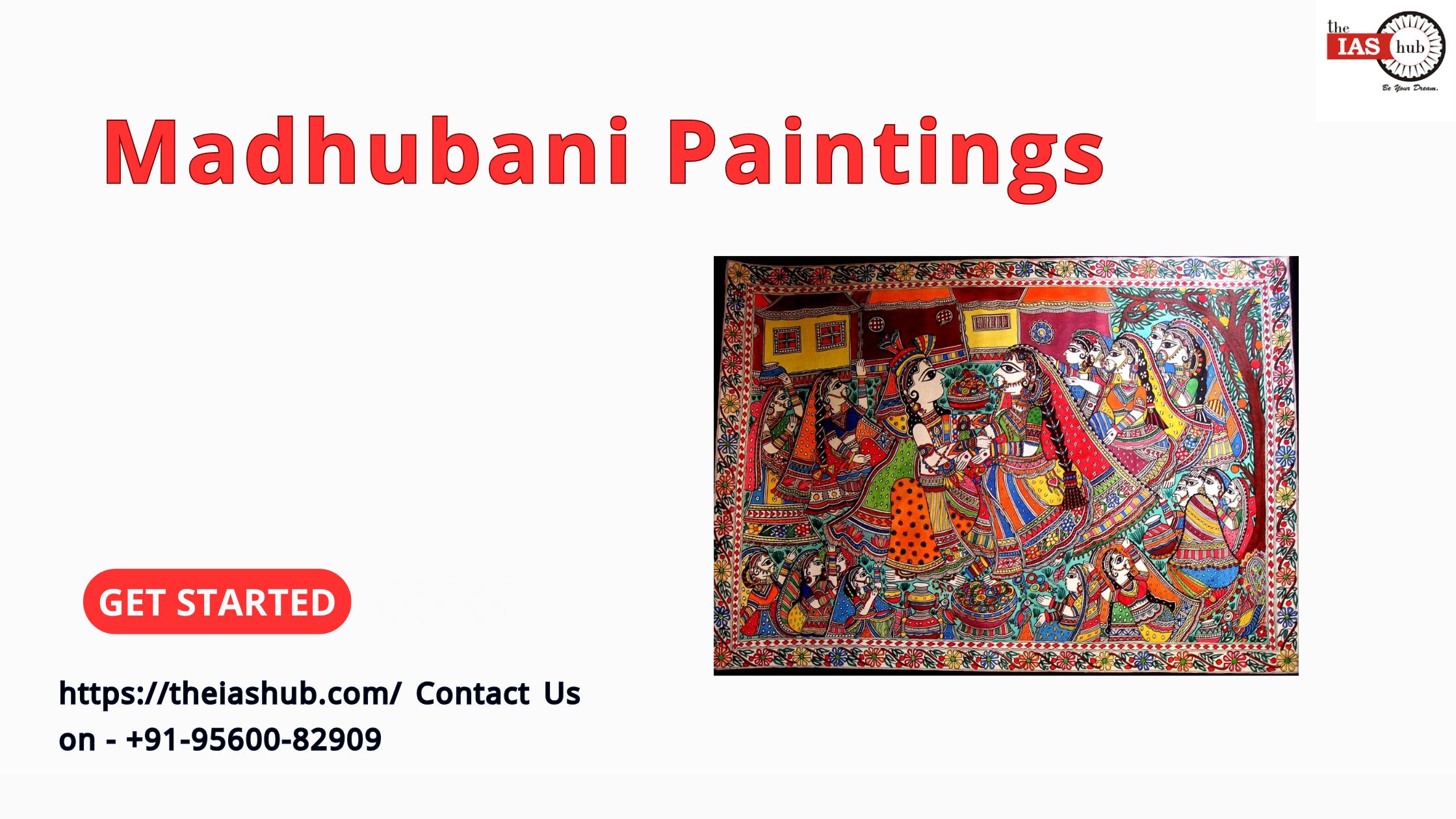


Madhubani paintings, also known as Mithila Art, is a traditional Indian art form important for its use of local plants for colours, cow dung to treat the paper and bamboo sticks that serve as brushes, not to mention the beauty and simplicity of the paintings themselves.. This style of painting has been traditionally done by the women of the region, though today men are also involved to meet the demand. These paintings are popular because of their tribal motifs and use of bright, earthy colours. These paintings are done with mineral pigments prepared by the artists. The work is done on a freshly plastered or a mud wall.
Also read Indian Paintings
Madhubani paintings, also known as Mithila paintings, have their origin in the Mithila area of Bihar, India. It is a type of folk art made with natural dyes and pigments, and it has detailed, vibrant designs that represent everyday life, mythology, and traditional Indian motifs.
In Madhubani painting use of vivid colours, elaborate geometric and floral patterns, and double lines to convey depth and perspective is the defining characteristic of Madhubani art. The patterns, which are typically painted on walls, floors, or paper, sometimes include pictures of Hindu gods and goddesses as well as creatures, birds, and other natural elements.
Women in the Mithila region generally produce madhubani art, which is passed down from mother to daughter. It has become more and more well-known in recent years and is now regarded as a distinctive and exquisite type of Indian art.
Also read Art and Culture revision
Madhubani paintings history goes back to ancient history. Madhubani paintings are ceremonial folk paintings of the ancient Mithila region of Bihar that depict Nature and Mythological events. Madhubani paintings are drawn in accordance with a fixed theme, and accordingly, symbols, lines, and patterns are drawn. For instance, the symbol fish stands for fertility, good luck and procreation, whereas peacocks usually indicate love, religion and romance, and serpents stand for divine protectors. Madhubani painting history is given below:
Also read Indian Paintings
Madhubani paintings are a Vivid and distinctive art form known as Madhubani art, often referred to as Mithila painting, has its origin in the Mithila area of Bihar, India. The following are some essential aspects of Madhubani art:
Strong and vivid hues: The intricate and colourful designs of Madhubani art are created using bold and brilliant colours. These hues are frequently created using locally occurring natural components, including minerals, leaves, and flowers.
Balance and symmetry are prominent in Madhubani art, which frequently has both symmetrical and unbalanced compositions. These components contribute to the paintings’ impression of order and harmony.
Fine lines and dots are frequently used in the creation of the intricate patterns and intricacies that make up Madhubani art. These particulars give the paintings more depth and texture as well as a sense of motion and energy.
Natural and mythological themes are prevalent in Madhubani art, which frequently displays images from Hindu mythology and the natural world. These topics represent the Mithila region of India’s cultural heritage and traditions and have a significant role in the local way of life.
Many viewpoints and layers are frequently used in Madhubani art, which gives the works a sense of depth and complexity. With the use of this method, the painting can better capture the viewer’s attention and imagination.
Generally speaking, Madhubani art is a rich and colourful art form that mixes vivid hues, minute patterns, and sophisticated ideas to produce an original and engrossing visual experience.

Madhubani paintings originated in the Mithila area of Bihar, India. It is a type of folk art made with natural dyes and pigments, and it has detailed, vibrant designs that represent everyday life, mythology, and traditional Indian motifs.. There are mainly five types of Madhubani paintings- Bharni, Kachni, Godna, Tantrik and Kohbhar.
Bharni – More than just an art form, Bharni style serves as a sacred ritual and social expression. Madhubani painting is identified by the Bharna (filling) of vivid colours and details. The stories of the Bharni style are from Indian mythology and folklore, and these paintings are traditionally done by Brahmin women.

Kachni – Kachni Madhubani is a very delicate art form that requires a steady hand and a very keen eye. This work is drawn using a thin bamboo stick or a handmade brush. These paintings are simpler in make, with monochromatic colours (black and white), and are detailed, with neat lines defining the subject. The popular elements of the Kachni style of Madhubani are flowers, trees, and other natural themes.

Godna – Tattoo or Godna art is a popular element of many local cultures across India. Madhubani Godna artists use natural colours derived from bark, leaf, flowers, seeds of plants and trees, clay and cow dung. They use geometric and simple patterns, symbolic designs, and a few colours.

Tantrik – originated from the Hindu Tantra tradition, Tantrik paintings are inspired by the Shakta or goddess worship culture. Pictures of Durga, Kali, Lakshmi, Saraswati, and their Yantras are drawn on special occasions such as Navaratri, as ritual art style represents the traditional and religious texts in a very precise manner. Tantra is an original text describing the Hindu religion and its aspects..

Kohbhar – Kohbhar Madhubani is made specifically during marriage rituals. In Kohbar paintings, Shiva and Parvati represent a powerful union and a metaphor for a stable marriage. Colourful and detailed, Kohbhar is painted to bless the newlywed through the power of symbolism, and traditional auspicious motifs such as flowers, plants, fish, and birds are popular in this style.

Also read Patachitra Paintings
Themes for the paintings differ depending on the function or the event for which they are painted. However, the central theme remains love and fertility. All deities of the Hindu pantheon and the rural local traditions can be found in the art.
Parrots represent romantic love.
Turtles symbolise the union of lovers.
Fish signify fertility.
The sun and moon are depicted for their life-sustaining qualities.
Lotuses and bamboo represent femininity and masculinity, respectively.
Madhubani paintings are made from components found nearby. In Madhubani art, certain hues are frequently employed, such as:
Red: Used to symbolise love, marriage, and fertility, this colour is often created from vermilion or kumkum.
Yellow: Used to denote joy, serenity, and purity, this colour is frequently created from turmeric or mustard.
Green: The colour green is often derived from leaves and is associated with nature, fertility, and wealth. The deity, the cosmos, and knowledge are all represented by the colour blue, which is frequently produced from indigo.
Black: The outlines and details in Madhubani paintings are usually created using this soot-based pigment.
White: In Madhubani paintings, this colour, which is frequently created from rice powder, is utilised to emphasise and accent certain areas.

Sita Devi was a famous Madhubani artist. Her colourful paintings of elegant, elongated gods and goddesses surrounded by lush vegetation were done with natural pigments. Sent to represent India in cultural festivals in Europe and the United States, Sita Devi’s success and distinctive style became an inspiration for many other women. She was known for her use of vibrant colours and intricate patterns.
Ganga Devi

Ganga Devi was a pioneer of Madhubani painting. She is known for her unique style, which incorporates elements of folk art and tribal art. Devi was awarded the National Award in 1984. Specialising in the kachni (line drawing) style. She travelled abroad with her art and was a part of the Festival of India in the United States, which yielded a number of paintings under the title, America series, including Moscow Hotel, Festival of American Folk Life, and Ride in a Roller Coaster.
Mahasundari Devi:

Mahasundari Devi was one of the most talented and most awarded Madhubani painting artists among Jagdamba Devi, Sita Devi, Dulari Devi and Godavari Dutta. She is known for her innovative use of natural dyes and her ability to capture the essence of everyday life in her paintings. Devi received the Padma Shri award, one of India’s highest civilian honours, in 2011.

Jagdamba Devi was a master of Madhubani painting. She was born in Jitwarpur village, Madhubani district, and has done her pioneering effort to popularise the folk art form of painting.. She is known for her ability to capture the emotions and expressions of her subjects. Devi was awarded the Padma Shri in 1975.

Baua Devi was a respected Madhubani artist. She is known for her use of bold colours and simple forms. Baua Devi uses modern motifs (peep the red hearts in the painting above) and topical issues to make her canvases brim with urgency and life. Devi was awarded the National Award in 1981. Was recently awarded the Padma Shri in 2017.
Madhubani paintings are a 2500-year-old art that finds its roots in the Ramayana, and is also known as ‘Mithila art’. It is believed that King Janak asked an artist to paint Sita’s wedding with Ram. Madhubani paintings are produced on handmade paper or cloth using natural materials that can be obtained in the area. Among the materials frequently utilised in Madhubani art are:
Madhubani paintings used to decorate the walls and floors during auspicious events like weddings, festivals and religious ceremonies, Madhubani art has found a place in museums and studios across the world. Though this art form has completely changed with the increased use of acrylic colours in place of natural dyes, and is a part of mass production. It can be seen everywhere from sarees, dupattas, Kurtis to various home decor items and furnishings.
Are you preparing for UPSC 2026? Join IAShub’s UPSC coaching batches to boost your preparation. Enrol now!

Madhubani painting originated in the Mithila region, dating back to ancient times, with references in the Ramayana where King Janaka commissioned artists to create paintings for Sita’s wedding. It was historically practised by women to decorate homes during festivals, weddings, and rituals.
Madhubani has five distinct styles:
Traditionally, artists used natural materials like cow dung and mud for surfaces, and natural dyes from plants, charcoal, or minerals. Modern Madhubani uses paper, canvas, or cloth with acrylic paints, brushes, and pens for precision.


Refine your answer writing skills and elevate your UPSC preparation with personalized support and expert feedback.
Fill out the form to get started with the program or any other enquiries !


Are you dreaming of becoming an IAS officer? Then, IAShub can be your best guide. It is one of the Best IAS Coaching in Delhi. Many students who want to clear the UPSC exam join IAShub for learning. The institute gives both online and offline classes. Their teachers are experienced and helpful. They easily explain every topic. Students also get notes, tests, and tips to do well in the exam.
IAShub is in Delhi and is trusted by many UPSC students. It offers coaching for every part of the UPSC exam – Prelims, Mains, and Interview. The classes are simple and easy to understand. The teachers are experts and guide students in the right way. IAShub is also known for its helpful notes, test series, and answer-writing practice. IAShub is the best coaching in Delhi and also gives UPSC Online Classes. This helps students from any place in India to learn. The online classes are live and also recorded. So, students can watch them anytime. These classes cover the full UPSC syllabus.
Here are some important services provided by IAShub:
The UPSC Civil Services Exam has three parts:
This exam is tough, but with the right guidance, it becomes easy to manage. Students must study smart and stay regular.
IAShub supports students from the beginning to the end. It gives the right books, tests, and notes. The classes are easy to follow, and the teachers are always ready to help. Students get personal doubt sessions too. The test series and answer checking help students learn where they need to do better. Also, free study materials save time and money.
IAShub also guides students during the final stage – the interview. Experts take mock interviews and give useful tips. This full support makes IAShub one of the best IAS coaching in Delhi.