Explore the history and evolution of Indian Civil Services from British-era ICS to modern IAS. Know the role of Lord Cornwallis as Father of ICS and Satyendranath Tagore as the first Indian ICS officer. Understand its legacy in shaping India's governance.
 theIAShub | 24 Jun, 2025 | 14557 | 0 |
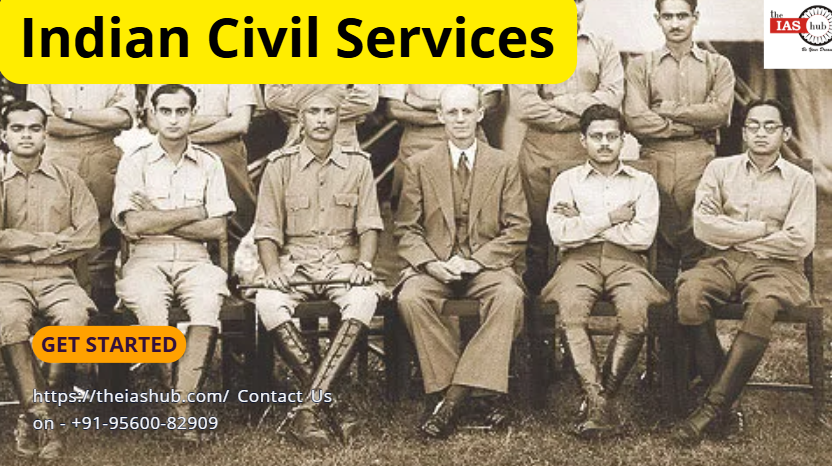


Indian Civil Service (ICS) has served as the cornerstone of India’s governance framework since the colonial era and remains pivotal in shaping the country’s administrative system after independence. Widely regarded as one of the most esteemed services, the Indian Civil Service functions as a vital instrument for executing and enforcing governmental laws and policies.Aspiring candidates are encouraged to explore the following comprehensive overview of the Indian Civil Service, detailing its historical development, organizational structure, and its significance in modern India, while integrating key historical and technical dimensions.
Indian Civil Service (ICS) is a group of permanent, professional bureaucrats who manage the administrative framework of the Government of India. It includes services like the Indian Administrative Service (IAS), Indian Police Service (IPS), Indian Foreign Service (IFS), and others, collectively known as All India Services and Central Civil Services. These officials are selected through competitive exams, primarily conducted by the Union Public Service Commission (UPSC), and are responsible for implementing government policies, managing public administration, and ensuring governance across central and state levels.
Also Read: IAS Salary Per Month in India 2025
Indian Civil Service (ICS) is the backbone of India’s governance, comprising professional bureaucrats who administer central and state functions. Evolving from the British colonial ICS (1858–1947), it now includes All India Services like IAS, IPS, and IFoS, alongside Central and State Services. Selected through rigorous UPSC exams, civil servants ensure policy implementation, public administration, and development. Known for neutrality and integrity, the ICS manages India’s diverse, 1.4 billion-strong nation with a focus on efficiency and reform. Brief overview of Indian civil service given below:
| Indian Civil Service Overview | |
| Aspects | Detail |
| Definition | Permanent Executive managing India’s administration at central/state levels |
| Key services | All India: IAS, IPS, IFoS; Central: IFS, IRS, IAAS; State Civil Services |
| Selection | UPSC, in state level State PSC |
| Qualifications | Bachelor’s degree; age 21–32 (general category, relaxations for others) |
| Trained | LBSNAA (IAS/IFS), SVPNPA (IPS), and in state specialized state institutions |
| Historical background | Colonial ICS (1858–1947): “Steel frame” of British rule; reorganized post-1947 |
| Key features | Neutrality, integrity, transferable cadre system, federal-state balance |
| Critice for | Bureaucratic delays, political interference, occasional corruption |
| Officer strength | ~5,000 IAS officers; manages 1.4B+ population; focus on e-governance, reforms |
| Full form | Indian civil service |
ICS stands for Indian Civil Service. Initially set up during British governance, ICS was the top-tier administrative body in colonial India. It was renowned for its strict selection criteria, esteemed status, and critical function in executing imperial directives throughout the region. In contemporary times, the term carries historical importance, as it served as the precursor to the modern Indian Administrative Service (IAS) and other civil services operating within the democratic structure of the Republic of India.
Also Read: Youngest IAS Officers in India
Indian Civil Service (ICS) has its origins in the colonial period, designed to strengthen British control over India Or colonization of India and manage its extensive regions effectively. The framework was established to streamline governance. The introduction of the civil service in India can be linked to the Charter Act of 1853, which pioneered a merit-based examination process for selecting candidates.
| History of Indian Civil Service | |||
| Phase/year | Key figure / act | Year | Detail |
| Origins under EIC
1600–1757 |
Warren Hastings (Governor-General) | 1600- 1757 | East India Company (EIC), founded in 1600, began with trade-focused roles (writers, agents). Post-Battle of Plassey (1757), EIC officials took on governance, managing revenue and justice, laying the groundwork for the ICS. “Civil service” distinguished administrative tasks. |
| Early Formalization
System1793 |
Lord cornwallis | 1793 | Lord Cornwallis structured the Covenanted Civil Service for senior roles, reserved for Europeans. Indians were limited to lower posts. Introduced merit-based system and fixed salaries to enhance efficiency and reduce corruption. |
| Charter Act Reform
1853 |
Lord Dalhousie | 1853 | The Charter Act of 1853 centralized EIC governance and introduced competitive exams for ICS entry, theoretically open to Indians. London-based exams posed barriers for Indian candidates. |
| Macaulay’s Merit 1854–1855 | Macaulay’s, Satyendranath Tagore (first Indian ICS officer, 1864) | 1854-1855 | Macaulay’s committee established a rigorous, merit-driven ICS through exams in England (from 1855). The ICS became an elite service, but Indian access remained limited due to logistical and cultural challenges. |
| Indiana civil service act 1961 | Satyendranath Tagore (first Indian ICS officer, 1864 | 1961 | Indians with 7 years of residence in India to be appointed to civil posts (limited implementation) |
| Statutory civil service 1879 | 1879 | Created separate services for India recruits with narrow power | |
| Formation of Indian National congress 1885 | Dada bhai naroji and others | 1885 | Demanded Simultaneous exam exam in England and India |
| Aitchison Commission 1886–1887 | Aitchison | 1886-1887 | Reviewed Indian inclusion, recommending modest Indian recruitment while maintaining European dominance. Created Provincial and Subordinate Services for Indians to expand opportunities. |
| Islington Commission
1912–1915 |
Islington | 1912-1915 | Proposed increased Indian representation but retained London exams. World War I delayed implementation, slowing Indianization efforts. |
| Montagu-Chelmsford Reforms 1919 | Government of Indian act 1919 | 1919 | Introduced All India services aspect,Allowed ICS exams in India from 1922, targeting 50% Indian posts by 1930. |
| First ICS exam held in India 1922 | 1922 | Exam held under Civil service commission , recruitment done in India but trained in England | |
| Transition to IAS 1947 | 1947 | With independence, ICS transformed into the Indian Administrative Service (IAS). British officers phased out by the 1950s. Indian officers shaped the IAS as a unified, democratic service. | |
| Constitution of India 1950 | Implementation of Constitution of india | 1950 | Article 312 talk about creation of All India services such as IAS, IPS, IFOS |
| First UPSC civil service examination 1951 | 1951 | First time All India civil service exam held in India by Union public service Commission ( UPSC) | |
Charter Act of 1853 formally established the Indian Civil Service in its distinct form. Subsequently, the Macaulay Committee (1854) was set up to devise the examination framework and eligibility standards. This legislation and later reforms organized civil governance based on meritocracy and professional expertise.

Sources – Wikipedia
Also Read: UPSC Selection Process 2025

British established the Indian Civil Service in India, with Lord Cornwallis, often called the pioneer of civil service in India, playing a key role. His governance reforms from 1786 to 1793 set the stage for an organized and disciplined administrative system. The Indian Civil Service was officially instituted through the Charter Act of 1853, which eliminated the practice of favoritism and introduced a merit-based, competitive recruitment process. This legislation was a significant milestone in the administrative evolution of British India, forming the basis for a contemporary civil service framework.

Sources – Wikipedia
Satendra nath Tagore was the first Indian to qualify for the coveted Indian civil service in 1963.He was a versatile scholar, excelling as a poet, composer, and advocate for social change. His patriotic composition Mile Sabe Bharat Santan inspired national unity, while his commitment to the Brahmo Samaj fueled his efforts toward gender equality, notably empowering his wife, Jnanadanandini Devi, to break societal conventions. Serving primarily in western India, Satyendranath’s legacy as an administrator, intellectual, and reformer continues to illuminate India’s historical landscape.

Source – Wikipedia
Indian Civil Service (ICS) evolved significantly under British rule, British changed shape ,structure and function of ICS broadly due to Two reasons one for their own Administrative convenience l.e.Colonisation of India and second due to force created by Indian during freedom struggle beginning with
Indian reclaimed freedom at the midnight of 15 august , thereafter it underwent complete overhaul and transformed from servant of the British queen to services of the Indian people to make India an egalitarian society.Changes given below :
Indian Civil Service remains crucial in shaping the country’s administration and progress:
Evolution of the Indian Civil Service, from its colonial origins to its democratic transformation, mirrors India’s wider political and administrative development. Initially established to advance British imperial objectives, the post-independence civil services strive to embody democratic principles and serve the public. From the Indian Civil Service to its first Indian officer, this legacy profoundly influences contemporary India. Post-independence, the ICS has become an emblem of responsibility, honesty, and outstanding governance.

All India Services (AIS)—Indian Administrative Service (IAS), Indian Police Service (IPS), and Indian Forest Service (IFoS)—are recruited through a rigorous and highly competitive process managed by the Union Public Service Commission (UPSC).
All India Services (AIS) are a group of prestigious civil services in India that operate under both the central and state governments. They are distinct from other civil services due to their unique structure, where officers are recruited by the central government but assigned to various state cadres, with the flexibility to serve both state and central governments. As of now, there are three All India Services,l.e.IAS,IPS IFOS,established under the All India Services Act, 1951,
Civil Services Day in India is observed annually on April 21 to commemorate the contributions of civil servants in nation-building and public administration. It marks the day in 1947 when Sardar Vallabhbhai Patel, India's first Home Minister, addressed the first batch of Indian Administrative Service (IAS) officers at the Metcalfe House in Delhi, referring to them as the "steel frame of India."
Indian Civil Services are the cadre of career bureaucrats in India’s executive branch, encompassing All India Services (IAS, IPS, IFoS), Central Civil Services (e.g., IRS, IFS), etc.

Refine your answer writing skills and elevate your UPSC preparation with personalized support and expert feedback.
Fill out the form to get started with the program or any other enquiries !
Are you dreaming of becoming an IAS officer? Then, IAShub can be your best guide. It is one of the Best IAS Coaching in Delhi. Many students who want to clear the UPSC exam join IAShub for learning. The institute gives both online and offline classes. Their teachers are experienced and helpful. They easily explain every topic. Students also get notes, tests, and tips to do well in the exam.
IAShub is in Delhi and is trusted by many UPSC students. It offers coaching for every part of the UPSC exam – Prelims, Mains, and Interview. The classes are simple and easy to understand. The teachers are experts and guide students in the right way. IAShub is also known for its helpful notes, test series, and answer-writing practice. IAShub is the best coaching in Delhi and also gives UPSC Online Classes. This helps students from any place in India to learn. The online classes are live and also recorded. So, students can watch them anytime. These classes cover the full UPSC syllabus.
Here are some important services provided by IAShub:
The UPSC Civil Services Exam has three parts:
This exam is tough, but with the right guidance, it becomes easy to manage. Students must study smart and stay regular.
IAShub supports students from the beginning to the end. It gives the right books, tests, and notes. The classes are easy to follow, and the teachers are always ready to help. Students get personal doubt sessions too. The test series and answer checking help students learn where they need to do better. Also, free study materials save time and money.
IAShub also guides students during the final stage – the interview. Experts take mock interviews and give useful tips. This full support makes IAShub one of the best IAS coaching in Delhi.