
















According to the official UPPSC Exam Calendar 2026, the UPPSC PCS Prelims 2026 is scheduled for December 6, 2026. This marks a shift in the traditional cycle, giving candidates a unique window to refine their strategy.
 theIAShub | 01 Apr, 2026 | 132597 | 0 |
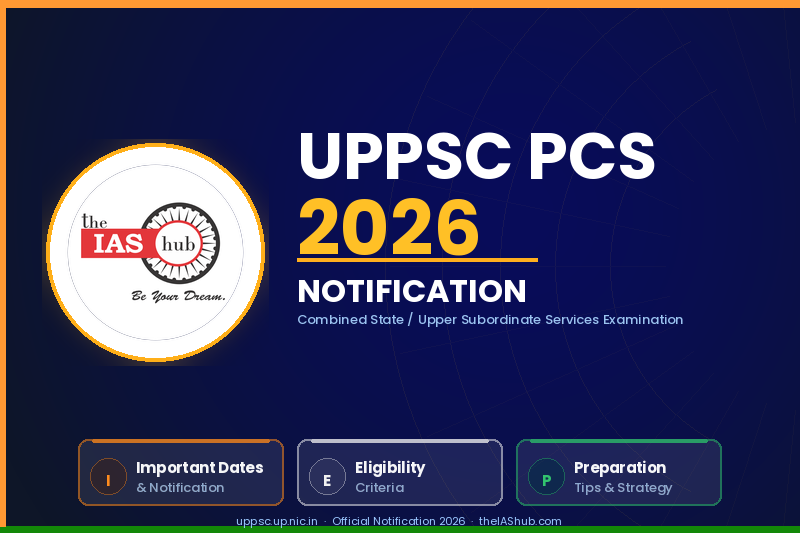

The Uttar Pradesh Public Service Commission (UPPSC) has officially laid out its roadmap for one
of the most sought-after state-level civil services exams in India — the Combined State / Upper
Subordinate Services (PCS) Examination 2026. Whether you are a first-time aspirant or a
seasoned candidate, understanding every detail of this exam — from important dates to syllabus
changes — is the first step toward securing a prestigious government post.
The UPPSC PCS examination is conducted annually to recruit candidates for Group A and Group B Gazetted posts in various state government departments of Uttar Pradesh. Coveted posts like Deputy Collector, DSP, Block Development Officer (BDO), Sub-Registrar, and District Commandant Home Guard fall under this examination.
As per the official UPPSC Exam Calendar 2026, released on January 30, 2026, the UPPSC PCS Prelims 2026 is scheduled for December 6, 2026. This gives aspirants a well-defined window to plan and streamline their preparation.
The commission has officially announced the exam calendar for the 2026 recruitment cycle. Below are the key tentative dates every aspirant must note:
| Event | Tentative Date |
|---|---|
| Official Notification Release | Released — June 25, 2026 |
| Online Application Window Opens | June 25, 2026 |
| Last Date to Apply | July 27, 2026 |
| Application Correction Window | Until August 3, 2026 |
| UPPSC PCS Prelims 2026 | December 6, 2026 |
| UPPSC PCS Mains 2026 | Expected Q1 2027 |
| Interview / Personality Test | To Be Announced |
Important Note: The UPPSC PCS Prelims for the 2025 cycle was rescheduled to March 14, 2026, and the Mains was conducted from March 29 to April 1, 2026 for 200 advertised vacancies. Candidates should regularly monitor the official website uppsc.up.nic.in for any schedule updates.
Approximately 500 vacancies across roughly 36 administrative, technical, and law-related Group B posts.
Before filling out the application form, candidates must verify that they meet all the eligibility requirements as outlined below:
| Category | Minimum Age | Maximum Age |
|---|---|---|
| General / EWS | 21 years | 40 years |
| SC / ST / OBC | 21 years | 45 years (5-year relaxation) |
| PwD (Persons with Disability) | 21 years | 55 years (15-year relaxation) |
| Skilled Sportsmen | 21 years | 45 years (5-year relaxation) |
| Ex-Servicemen | As per UP Government norms | — |
Final-year students may also apply. However, they must possess their degree/mark sheet at the time of the Mains application (DAF filling).
The UPPSC has significantly revamped its selection process in recent years, aligning it more closely with the UPSC Civil Services Examination. The most notable change is the removal of optional subjects from the Mains examination, replaced by two new UP-specific General Studies papers (GS Paper V & VI).
The selection process consists of three stages:
The Prelims serves purely as a screening test. Marks scored here are not counted in the final merit list.
| Paper | Subject | Questions | Marks | Duration |
|---|---|---|---|---|
| Paper I | General Studies (GS I) | 150 | 200 | 2 Hours |
| Paper II | CSAT (GS II) | 100 | 200 | 2 Hours |
Key Points:
Prelims GS Paper I Syllabus Highlights:
Prelims CSAT (Paper II) Syllabus Highlights:
The Mains is the merit-deciding stage, with candidates evaluated on answer-writing quality, analytical depth, and subject knowledge. It consists of 8 compulsory papers totaling 1500 marks.
| Paper | Subject | Marks | Nature |
|---|---|---|---|
| Paper 1 | General Hindi | 150 | Qualifying (30% minimum) |
| Paper 2 | Essay | 150 | Merit-counting |
| Paper 3 | General Studies I (History, Geography, Demography) | 200 | Merit-counting |
| Paper 4 | General Studies II (Indian Constitution, Governance, Social Justice) | 200 | Merit-counting |
| Paper 5 | General Studies III (Technology, Economy, Environment, Biodiversity) | 200 | Merit-counting |
| Paper 6 | General Studies IV (Ethics, Integrity, Aptitude) | 200 | Merit-counting |
| Paper 7 | General Studies V (UP: History, Art, Culture, Architecture, Governance) | 200 | Merit-counting |
| Paper 8 | General Studies VI (UP: Economy, Geography, Demography, Natural Resources) | 200 | Merit-counting |
Key Points:
| Component | Marks |
|---|---|
| Personality Test (Interview) | 100 |
The interview assesses a candidate’s personality, expression, general awareness, and suitability for public service. Questions relate to current social/administrative issues, academics, and general interest topics. The marks scored here are added to Mains marks to prepare the final merit list.
Expected Cut-offs (Based on Previous Trends): Prelims GS I — approximately 110–120 marks; Final Mains merit — approximately 700–800 marks.
Follow these steps once the notification and application window go live:
Step 1 — OTR (One Time Registration): Visit uppsc.up.nic.in and complete your One Time Registration (OTR). This is mandatory for all UPPSC applications. Your OTR number is the only registration ID for all future UPPSC applications.
Step 2 — Fill the Application Form: Log in using your OTR ID, verify personal and academic details, and select the PCS 2026 Examination.
Step 3 — Fee Payment:
| Category | Application Fee |
|---|---|
| General / OBC | ₹125 |
| SC / ST | ₹65 |
| PwD | ₹25 |
Step 4 — Final Submission: Carefully review all details before clicking the final submit button. Take a printout of the submitted application form and fee receipt for future reference.
A correction window is typically opened after the application deadline — candidates may use this to rectify errors in uploaded documents or personal details.
OTR must be completed at least 72 hours before submitting the online application (per the notification)
UPPSC PCS posts come with attractive pay scales and career growth opportunities:
| Service Level | Pay Scale | Grade Pay |
|---|---|---|
| General PCS Posts | ₹9,300 – ₹34,800 | ₹4,600 |
| Higher PCS Posts | ₹15,600 – ₹39,100 | ₹5,400 |
| Asst. Conservator of Forest | ₹15,600 – ₹39,100 | ₹5,400 |
| Range Forest Officer | ₹9,300 – ₹34,800 | ₹4,800 |
In addition to the base pay, officers receive Dearness Allowance (DA), House Rent Allowance (HRA), Travel Allowance (TA), and other state government perks.
The UPPSC PCS exam demands consistent, disciplined preparation across a vast syllabus. Here is a structured approach:
Start by downloading the official UPPSC Syllabus PDF from uppsc.up.nic.in. A clear understanding of topic-wise weightage helps avoid over-preparation in low-yield areas.
Read NCERT books (Classes 6–12) for History, Geography, Polity, and Economics. These build conceptual clarity essential for both Prelims and Mains.
GS Papers V and VI cover Uttar Pradesh’s history, art, architecture, culture, governance, economy, geography, and demography. This UP-specific content forms 20–30% of the questions and is often overlooked by candidates. Read the UP Economic Survey, Census reports, and UP-specific magazines regularly.
Follow at least one national newspaper daily (The Hindu / Indian Express). For UP current affairs, track Dainik Jagran/Amar Ujala and subscribe to monthly UP current affairs compilations.
Start answer writing practice early — do not wait until after Prelims. Practice writing 150–250 word answers regularly. For the Essay paper, practice structuring 700-word essays on social, administrative, and national topics.
Do not underestimate Paper II (CSAT). Solve 50 questions daily, focusing on comprehension, logical reasoning, and basic numeracy to maintain well above the 33% qualifying threshold.
Solve at least 5 years of UPPSC PCS previous year question papers. Enroll in a reliable test series (Target PCS, Drishti IAS) for mock tests and performance analysis.
A typical daily study plan should include:
| Subject | Recommended Resource |
| History | NCERT (Old) Class 11–12 + Spectrum Modern India |
| Geography | NCERT Class 11–12 + Certificate Physical Geography (G.C. Leong) |
| Polity | Indian Polity — M. Laxmikanth |
| Economy | Indian Economy — Ramesh Singh |
| Environment | Environment — Shankar IAS |
| UP-Specific GK | UP Special GK — Lucent / UP government publications |
| Current Affairs | Yojana, Kurukshetra, PIB, UP Economic Survey |
| Ethics (GS IV) | Ethics, Integrity & Aptitude — G. Subba Rao |

Yes. Optional subjects have been completely removed from the Mains exam. In their place, two new papers (GS Paper V and VI) have been introduced, focusing entirely on Uttar Pradesh's history, geography, governance, and economy.
Yes. Final-year students can apply, provided they possess their degree certificate or marksheet at the time of the Mains application (DAF filling).
There is no restriction on the number of attempts, as long as the candidate falls within the permissible age bracket (21–40 years, with category-wise relaxations).
Paper II (CSAT) is qualifying in nature. Candidates must score at least 33% (66 marks out of 200) to be eligible. CSAT marks are not counted in the final merit.
The final merit list is prepared based on Mains (1500 marks) + Interview (100 marks) = 1600 marks total. Prelims marks are not considered.
No. Negative marking of 1/3rd applies only in the Prelims examination. There is no negative marking in the Mains.

Refine your answer writing skills and elevate your UPSC preparation with personalized support and expert feedback.
Fill out the form to get started with the program or any other enquiries !



Are you dreaming of becoming an IAS officer? Then, IAShub can be your best guide. It is one of the Best IAS Coaching in Delhi. Many students who want to clear the UPSC exam join IAShub for learning. The institute gives both online and offline classes. Their teachers are experienced and helpful. They easily explain every topic. Students also get notes, tests, and tips to do well in the exam.
IAShub is in Delhi and is trusted by many UPSC students. It offers coaching for every part of the UPSC exam – Prelims, Mains, and Interview. The classes are simple and easy to understand. The teachers are experts and guide students in the right way. IAShub is also known for its helpful notes, test series, and answer-writing practice. IAShub is the best coaching in Delhi and also gives UPSC Online Classes. This helps students from any place in India to learn. The online classes are live and also recorded. So, students can watch them anytime. These classes cover the full UPSC syllabus.
Here are some important services provided by IAShub:
The UPSC Civil Services Exam has three parts:
This exam is tough, but with the right guidance, it becomes easy to manage. Students must study smart and stay regular.
IAShub supports students from the beginning to the end. It gives the right books, tests, and notes. The classes are easy to follow, and the teachers are always ready to help. Students get personal doubt sessions too. The test series and answer checking help students learn where they need to do better. Also, free study materials save time and money.
IAShub also guides students during the final stage – the interview. Experts take mock interviews and give useful tips. This full support makes IAShub one of the best IAS coaching in Delhi.
Join 50,000+ UPSC Aspirants! 🚀
Get Free UPSC/IAS Study Materials, Daily Current Affairs, Editorial Summaries & Exam Updates.
Join Telegram Channel