
















Explore the complete UPSC Subject List 2026 for IAS Prelims, Mains, and optional papers. Learn about compulsory General Studies subjects, optional disciplines, and tips to choose the best UPSC subjects for effective preparation.
 theIAShub | 16 Oct, 2025 | 6584 | 0 |
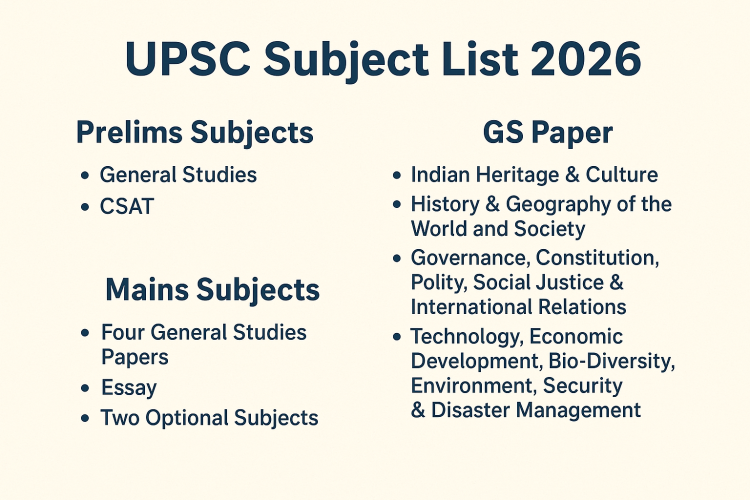

UPSC Civil Services Exam (IAS exam) has a wide syllabus. Aspirants must know multiple UPSC subject list across two stages – Prelims and Mains – before the Interview. The UPSC Subject List includes History, Geography, Economy and more, divided between compulsory General Studies papers and a chosen Optional subject.
Also Read: UPSC Exam Syllabus
The UPSC Preliminary Exam has two compulsory papers. A table of key subjects is:
| Prelims Paper | UPSC Subject List |
| General Studies (Paper I, 200 marks) | Current events; History of India & Indian National Movement;
World & Indian Geography (physical, social, economic); Indian Polity & Governance (Constitution, political system, public policy, rights, Panchayati Raj); Economic & Social Development (sustainable development, poverty, inclusion, demographics, social sector); Environmental Ecology, Biodiversity & Climate Change; General Science. |
| CSAT (Paper II, 200 marks, qualifying) | Comprehension; Interpersonal skills/communication;
Logical reasoning & analytical ability; Decision-making & problem solving; General mental ability; Basic numeracy (class X level); Data interpretation (charts, graphs, tables, data sufficiency – class X level). (Note: CSAT requires a minimum 33% to qualify; only GS Paper I marks count toward Prelims ranking.) |
Also Read: UPSC Prelims Syllabus
The UPSC Subject List for GS 2026 (Prelims) outlines the complete range of topics candidates must prepare for the Civil Services Examination. Understanding the subject list in advance helps aspirants plan their preparation strategically, allocate study time effectively, and practice topic-wise for better results:
| GS Paper | Subject Areas Included (Broad Topics) | Key Focus Areas (Examples) |
| GS Paper | Indian Heritage & Culture, History & Geography of the World and Society | Indian Art & Culture • Ancient, Medieval, Modern History of India • Freedom Struggle • World History (Industrial Revolution, World Wars) • Indian Society, Diversity & Social Issues • Physical, Economic & Human Geography of India & World |
| GS Paper | Governance, Constitution, Polity, Social Justice & International Relations | Indian Constitution & Amendments • Parliament & State Legislatures • Judiciary, Executive & Local Governance • Rights Issues, DPSPs, Schemes & Policies • International Relations, Treaties, India & Neighbours |
| GS Paper | Technology, Economic Development, Bio-Diversity, Environment, Security & Disaster Management | Indian Economy & Planning • Agriculture & Inclusive Growth • Infrastructure & Investment Models • Science & Technology, Space, IT • Environment & Climate Change • Internal Security, Disaster Preparedness |
| Current Affairs | Current affairs of national and international importance | Focusing on recent historical findings, polity, economy, geography, science and technology etc. |
The UPSC Subject List for CSAT 2026 (Prelims Paper II) highlights the essential skills and topics candidates must prepare for the Civil Services Preliminary Examination. This paper evaluates comprehension, reasoning, decision-making, and basic numeracy skills rather than factual knowledge.
| Section | Topics Covered | Skills Tested |
| Comprehension | Reading comprehension passages based on current, social, and administrative issues | Analytical thinking, understanding complex texts, identifying key ideas |
| Interpersonal Skills & Communication | Questions on interpersonal communication, social skills | Decision-making, empathy, leadership understanding |
| Logical Reasoning & Analytical Ability | Data-based questions, reasoning puzzles, pattern recognition | Critical thinking, logic application |
| Decision Making & Problem Solving | Situational questions with practical administrative scenarios | Ethical decision-making, prioritization skills |
| General Mental Ability | Questions on analytical thinking, sequencing, and pattern recognition | Conceptual clarity, reasoning |
| Basic Numeracy (Class X level) | Numbers, percentages, averages, ratios, time & work, time & distance | Basic mathematics and data interpretation |
| Data Interpretation | Graphs, charts, and tables | Extracting and analyzing numerical data quickly |
[metaslider id=”5575″]
The Mains exam consists of four General Studies papers along with Essay and 2 Optional papers. Each GS paper has a distinct focus.
| UPSC Mains Paper | UPSC Subject List |
| Essay (Paper I, 250m) | Essay on multiple topics (analytical, current issues) – no fixed subject list. |
| GS Paper I (250m) | Indian Heritage & Culture;
History of India (Medieval to Modern); World History; Indian Society; Geography of India & World. |
| GS Paper II (250m) | Governance & Constitution;
Political Science; Social Justice; International Relations; Public Policy; Panchayati Raj. |
| GS Paper III (250m) | Indian Economy;
Technology; Economic Development; Environment & Ecology; Disaster Management; Security (internal & external); Biodiversity. |
| GS Paper IV (250m) | Ethics, Integrity & Aptitude;
moral thinkers; emotional intelligence; public service values; ethics case studies. |
Also Read: UPSC Prelims PYQs
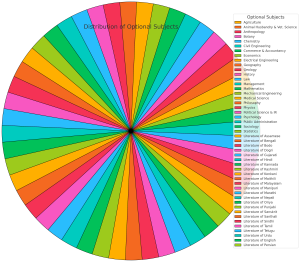
Aspirants have to choose one Optional subject for the Mains, which has two papers of 250 marks each. UPSC provides a wide list of UPSC Subject List for optional subjects – over 20 disciplines – from sciences to humanities.
Below is the full UPSC Subjects list for Optional Mains:
| UPSC Subject List Sciences & Other Subjects | UPSC Subject List Literature (Language) Subjects |
| Agriculture | Assamese |
| Animal Husbandry & Veterinary Science | Bengali |
| Anthropology | Bodo |
| Botany | Dogri |
| Chemistry | Gujarati |
| Civil Engineering | Hindi |
| Commerce & Accountancy | Kannada |
| Economics | Kashmiri |
| Electrical Engineering | Konkani |
| Geography | Maithili |
| Geology | Malayalam |
| History | Manipuri |
| Law | Marathi |
| Management | Nepali |
| Mathematics | Oriya |
| Mechanical Engineering | Punjabi |
| Medical Science | Sanskrit |
| Philosophy | Santhali |
| Physics | Sindhi |
| Political Science & IR | Tamil |
| Psychology | Telugu |
| Public Administration | Urdu |
| Sociology | English |
| Statistics | (Any other literary language in 8th Schedule) |
| Zoology |
Also Read: UPSC Mains Question Paper
UPSC Subject List IAS Know How Many Subjects in the UPSC Exam
Following is the brief breakup of UPSC Subject list for IAS:
Also Read: UPSC Mains Answer Writing
Selecting the right Optional is important for success. Most often the question that gets asked is: Which is the easiest UPSC optional subject and which is the toughest Optional?
We would like to caution that “easy” can be subjective – one person’s easiest may be another’s hardest. However, trends and coaching advice highlight some patterns:
Philosophy is considered as one of the easiest optionals, owing to its short syllabus. Others consider Public Administration, Sociology, Anthropology, Geography to be easier for average aspirants, since these have straightforward concepts and available study material.
[metaslider id=”5575″]
By contrast, Mathematics, Physics, and other sciences optional subjects are frequently called the toughest optional due to its vast, technical syllabus.
We recommend considering factors beyond ease/difficulty. Key criteria include:
Are you preparing for UPSC 2026? Join IAShub’s UPSC coaching batches to boost your preparation. Enroll now!
But there is no universally “best” optional – it depends on personal fit. Many say the “easiest” optional is the one you are passionate about and prepared for. Likewise, “toughest” subjects demand strong effort regardless of one’s background.
Candidates can view the official UPSC Subject List on the UPSC website under “Examinations → Civil Services (Mains) Exam.” The list provides details of 48 optional subjects for selection.
The UPSC Subject List is generally stable, but the commission may revise or add new subjects occasionally. Aspirants should always check the latest UPSC notification for updates.
Candidates should select an optional subject from the UPSC Subject List based on their interest, academic background, and scoring trends to maximize marks in the Mains exam.
Yes, the UPSC Subject List includes literature subjects in various Indian languages. Candidates can opt for these if they meet eligibility criteria and prefer writing Mains papers in a regional language.

Refine your answer writing skills and elevate your UPSC preparation with personalized support and expert feedback.
Fill out the form to get started with the program or any other enquiries !



Are you dreaming of becoming an IAS officer? Then, IAShub can be your best guide. It is one of the Best IAS Coaching in Delhi. Many students who want to clear the UPSC exam join IAShub for learning. The institute gives both online and offline classes. Their teachers are experienced and helpful. They easily explain every topic. Students also get notes, tests, and tips to do well in the exam.
IAShub is in Delhi and is trusted by many UPSC students. It offers coaching for every part of the UPSC exam – Prelims, Mains, and Interview. The classes are simple and easy to understand. The teachers are experts and guide students in the right way. IAShub is also known for its helpful notes, test series, and answer-writing practice. IAShub is the best coaching in Delhi and also gives UPSC Online Classes. This helps students from any place in India to learn. The online classes are live and also recorded. So, students can watch them anytime. These classes cover the full UPSC syllabus.
Here are some important services provided by IAShub:
The UPSC Civil Services Exam has three parts:
This exam is tough, but with the right guidance, it becomes easy to manage. Students must study smart and stay regular.
IAShub supports students from the beginning to the end. It gives the right books, tests, and notes. The classes are easy to follow, and the teachers are always ready to help. Students get personal doubt sessions too. The test series and answer checking help students learn where they need to do better. Also, free study materials save time and money.
IAShub also guides students during the final stage – the interview. Experts take mock interviews and give useful tips. This full support makes IAShub one of the best IAS coaching in Delhi.
Join 50,000+ UPSC Aspirants! 🚀
Get Free UPSC/IAS Study Materials, Daily Current Affairs, Editorial Summaries & Exam Updates.
Join Telegram Channel