
















UPSC Mains GS 2 Paper Analysis 2025 Out by IAShub provides a comprehensive review of question trends, difficulty level, and subject-wise weightage across Polity, Governance, Social Justice, and International Relations, helping aspirants decode the GS Paper 2 for better preparation.
 theIAShub | 25 Aug, 2025 | 14985 | 0 |

UPSC Mains GS 2 Paper Analysis 2025: UPSC Mains GS Paper 2 Analysis 2025 is out by the IAShub expert faculty immediately after the GS 2 Mains Paper 2025 concluded. As the UPSC Mains GS Paper 2 is concluded on 23 August 2025, General Studies Paper 2 of the UPSC Civil Services Mains Examination 2025 plays a pivotal role in shaping a candidate’s final ranking. It assesses a candidate’s in-depth understanding of Indian polity, governance frameworks, social justice initiatives, and international relations.
As a critical component of the civil services examination, GS2 UPSC mains checks candidates’ deep understanding of both the conceptual clarity and the current dynamics of Indian governance and societal issues.
|
UPSC GS 2 Question Paper 2025 |
Also Read: UPSC Mains Question Paper 2025
UPSC Mains 2025 GS Paper 2 checks candidates’ conceptual clarity, analytical depth, and current affairs integration across Polity, Governance, Social Justice, and International Relations. Candidates who possess static knowledge with current affairs updates and practised answer writing are better positioned to score above the average (85–100 marks). UPSC Mains GS 2 Paper Analysis 2025 is given below:
|
UPSC Mains 2025 GS Paper 2 Analysis Overview |
|
| Paper Name | General Studies Paper 2 (GS II) |
| Date of UPSC GS Paper 2 Exam | 23 August 2025 |
| Total marks in UPSC GS Paper 2 | 250 |
| Total Questions in UPSC GS Paper 2 | 20 Questions |
| Total Duration of GS Paper 2 | 3 hours (180 minutes) |
| Difficulty Level of UPSC GS Paper 2 2025 | Moderate to Difficult |
Also Read: UPSC EASSY Paper 2025
UPSC Mains 2025 GS Paper 2 question papers PDF Out is available to download. The UPSC Mains 2025 GS Paper 2 question paper concluded on 23 August 2025. Question papers have been released, the candidates can access and save the PDF directly from the table below, and can also explore the UPSC Mains 2025 GS Paper 2 question paper Analysis 2025.
|
UPSC Mains 2025 GS Paper 2 Question Paper Download |
UPSC Mains 2025 GS paper 2025 was conducted on 23 August 2025. After going through UPSC Mains 2025 GS Paper 2, IAS HUB has noted down the subject-wise trend and focused topics in UPSC Mains GS Paper 2 2025 as given below:
|
UPSC Mains 2025 GS 2 Paper Analysis |
||
| Subject | Focused Area in UPSC Mains GS Paper 2 |
Number Of Questions |
| Indian Polity & Constitution | Constitution, Union and the States, Judiciary, Comparison of Constitutions, Governor, Federalism, Constitutional, Non-constitutional bodies | 9-12 |
| Social Justice | Development and management of Social Sector/Services, Welfare schemes | 2-4 |
| Governance | Development processes, Government policies, Role of Civil Service, Bureaucracy, Current Affairs | 2-5 |
| International Relations | Foreign Policy, Global Institutions, India-US Relations, India-Russia Relations, India-China Relations, India’s Neighbourhood, India-Canada Relations, Trade war, Israel-Hamas war, Israel-Iran War, | 3-4 |
UPSC Mains GS 2 Paper Detailed Analysis :
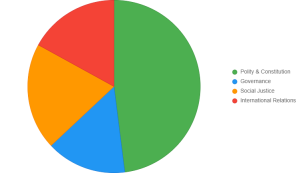
Section-wise weightage
– Polity & Constitution: 125 marks
– Governance & Social Justice: 75 Marks
– International relations: 50
Overall Impressions:
– Balanced Coverage: Questions are spread across Polity & Constitution, Governance, Social Justice, and International Relations.
– Analytical Tilt: More emphasis on conceptual clarity + contemporary application rather than pure theory.
– Static + Current Mix: Many questions originate in static constitutional provisions (e.g., AGI, Pardon, Tribunals, Collegium) but require current linkages (tribunal reforms 2021, J&K reorg, UN reforms).
– Questions are on usual lines.
Polity & Constitution: 125 marks
Topics Covered-
Representation of the People Act, 1951, President’s Pardon Powers, Jammu & Kashmir Legislative Assembly, Attorney General’s Role, Constitutional Morality, Parliament’s Amending Power, Collegium System, Centre-State Financial Relations, Administrative Tribunals,
Key Trend
[metaslider id=”5575″]
Governance – 50 marks
Topic Covered-
E-Governance Bias, Civil Society Organisations (CSOs), Decentralised Decision-Making.
Key Trend
International Relations – 5o Marks
Topic Covered-
India-Africa Digital Partnership: Waning Globalisation, Energy Security, UN Reforms.
Key Trend
Social Justice- 25 Marks
Topic Covered-
Women’s Social Capital, Poverty Paradox, Environmental Pressure Groups, National Commission for Protection of Child Rights (NCPCR)
Key Trend
GS Paper II carries 250 marks and includes 20 compulsory questions (10 questions worth 10 marks each and 10 questions worth 15 marks each), including Polity and Constitution, Governance, Social Justice, and International Relations. Subjects- Wise Weightage in UPSC GS Paper 2 2025 is given below:
|
Subjects- Wise Weightage in UPSC GS Paper 2 2025 |
|
| Indian Polity & Constitution In UPSC Mains GS Paper 2 | 125 marks |
| Social Justice In UPSC Mains GS Paper 2 | 25 Marks |
| Governance In UPSC Mains GS Paper 2 | 50 Marks |
| International Relations In UPSC Mains GS Paper 2 | 50 marks |
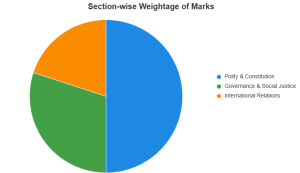
Section-wise weightage
– Polity & Constitution: 125 marks
– Governance & Social Justice: 75 Marks
– International relations: 50
Overall Impressions:
– Balanced Coverage: Questions are spread across Polity & Constitution, Governance, Social Justice, and International Relations.
– Analytical Tilt: More emphasis on conceptual clarity + contemporary application rather than pure theory.
– Static + Current Mix: Many questions originate in static constitutional provisions (e.g., AGI, Pardon, Tribunals, Collegium) but require current linkages (tribunal reforms 2021, J&K reorg, UN reforms).
– Questions are on usual lines.
Nature of Questions
– Direct Conceptual + Applied: Many questions take a constitutional concept and ask for application in today’s context (e.g., constitutional morality → judicial independence/accountability balance).
– Comparative Approach: Repeated comparisons (India–US pardon, India–US collegium/appointments, India–Africa partnership).
– Critical Evaluation Needed: Words like critically examine, assess, evaluate appear frequently → demands balanced pros & cons, not one-sided answers.
– Data & Examples Expected: For governance & IR, answers must cite current schemes, laws, reports, committees, SC judgments.
Key Takeaways for future aspirants:
– Polity must go beyond the bare Constitution → link with recent SC judgments, commissions, reforms.
– Governance → focus on applied dimensions (civil society, e-governance, NCPCR, social capital).
– IR → UPSC emphasises India’s role in a multipolar order, digital & energy diplomacy, and UN reforms.
– Writing style → Balance of theory (Article provisions, constitutional terms) + current affairs (laws, committees, policies).
-With good answer writing skill, one can score above average marks.
UPSC Civil Services Mains General Studies Paper 2 (GS Paper II) is a crucial component of the Mains examination, carrying 250 marks and covering topics such as Polity and Constitution, Governance, Social Justice, and International Relations. It consists of 20 compulsory questions (10 questions worth 10 marks each, answered in 150 words, and 10 questions worth 15 marks each, answered in 250 words), with a duration of 3 hours.
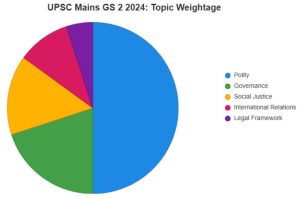
UPSC Mains GS 2 Paper Analysis 2024 |
|||
| Subject | Topic | weightage |
Analysis |
| Polity | Electoral reforms, Centre-State relations, role of the Comptroller and Auditor General (CAG), parliamentary supremacy, and the cabinet system | Approx 45-50%(8- 10 questions) | Polity retained its dominance, with questions related to constitutional provisions, federal dynamics, and institutional roles. Statement-based questions demanded in-depth knowledge and analytical skills, favouring candidates with a strong grasp of constitutional developments and landmark judgments. |
| Governance | Role of local bodies, public charitable trusts, and public service ethics. | 10-15 % (3-4 Questions) | Governance questions focused on grassroots reforms and systemic issues. They required candidates to connect theoretical frameworks (e.g., good governance principles) with practical challenges |
| Social Justice | Poverty and malnutrition, health, education, gender equality, and inclusive growth. | 10-15%(2-3 Questiopns) | Questions were straightforward but required interlinking with current schemes and policies (e.g., NEP 2020). Topics like human development and public health infrastructure were prominent, reflecting a focus on inclusive growth and government initiatives for vulnerable sections |
| International Relations (IR) | India’s relations with Central Asian Republics (CARs), strategic partnerships, and global supply chain dynamics | 15-20%(3-5 Questions) | R questions emphasised India’s growing global role, with a focus on multilateral organisations (e.g., BRICS, UN) and strategic alliances. Some questions included organisations not directly linked to India, testing broader awareness of global geopolitics |
UPSC Mains GS 2 paper covered topics from Polity, Governance, Social Justice, and International Relations. Detailed analysis of UPSC Mains 2023 GS 2 paper given below:
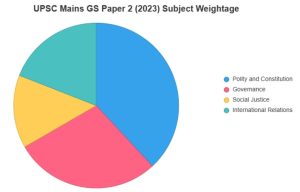
UPSC Mains GS 2 Paper Analysis 2023 |
|||
| Subject | Topic | weightage |
Analysis |
| Polity | constitutional principles, judicial independence, and parliamentary sovereignty | 40-50% of questions (approximately 4–8 questions) | Questions were analytical, requiring candidates to connect constitutional provisions with real-world applications (e.g., judicial independence, parliamentary sovereignty). |
| Governance | government policies, e-governance, and institutions like the Competition Commission of India. | 15-20% (5–6 questions) | Governance sections mainly focused on e-governance initiatives. New schemes, and Important bodies like CCI |
| Social Justice | gender justice, human resource development, and legal aid mechanisms like NALSA. | 10-12% (3–4 questions) | Questions on social justice were relatively straightforward but required interlinking with governance and polity (e.g., NALSA’s role tied to constitutional rights) |
| International Relations (IR) | International organisations like the SCO and India’s role in global forums | 15-20% (4–5 questions) | IR questions were heavily inspired by current events, such as CCI cases, SCO dynamics, and e-governance challenges. Candidates needed to stay updated with recent developments and judgments |
[metaslider id=”5575″]
UPSC Mains 2022 GS 2 Paper was a balanced mix of polity, governance, social justice, and international relations, with a moderate difficulty level. Detailed analysis of UPSC Mains GS 2 Paper 2022 is given below:
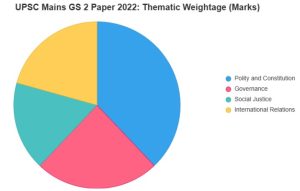
UPSC Mains GS 2 Paper Analysis 2022 |
|||
| Subject | Topic | weightage |
Analysis |
| Polity | Constitutionalization of Environmental Problems, Right of Movement and Residence, Role of Vice President as Chairman of Rajya Sabha, National Commission for Backwards Classes, National vs. Regional Political Parties, Presidential Election in India vs. France, Election Commission and Model Code of Conduct | (4–8 questions, ~100–120 marks)
5–6 questions, ~60–80 marks) |
Questions focused on fundamental constitutional concepts and their practical applications. |
| Governance | Decentralisation of Power, government policies, such as the Gatishakti Yojana | 5–6 questions, ~60–80 marks) | Topics included government policies, decentralisation, and public administration. |
| Social Justice | Right of Children to Free and Compulsory Education Act, 2009, gender equality, health, or marginalised communities. | (3–4 questions, ~40–60 marks) | Questions addressed education, health, and marginalised communities. |
| International Relations (IR) | I2U2 Grouping (India, Israel, UAE, USA), Clean Energy Initiatives, India-Sri Lanka Relations, BIMSTEC vs. SAARC | (4–5 questions, ~50–70 marks) | Questions covered India’s foreign policy, bilateral relations, and global initiatives |
UPSC Mains 2021 GS Paper 2 was a well-balanced paper that tested candidates’ conceptual understanding, analytical abilities, and awareness of current affairs. Detailed analysis of UPSC Mains GS 2 Paper 2021 is given below:
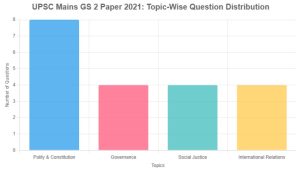
UPSC Mains GS 2 Paper Analysis 2021 |
|||
| Subject | Topic | weightage |
Analysis |
| Polity | Indian Constitution, fundamental rights, directive principles, and federalism. Constitutional Morality | ~8 questions | The questions were straightforward and aligned with topics from the syllabus, such as the Indian Constitution, fundamental rights, directive principles, and federalism |
| Governanc | public policy, accountability, and the role of institutions. Comptroller and Auditor General (CAG) or the Election Commission, the role of pressure groups in India | ~4 questions | Candidates were expected to integrate real-world examples, such as successful governance models or case studies, |
| Social Justice | women’s empowerment, social equity, and welfare schemes | ~4 questions | Questions required candidates to link societal issues with policy outcomes, such as the role of microfinancing in women’s empowerment or the impact of welfare schemes on the vulnerable section |
| International Relations (IR) | bilateral relations, global institutions, and India’s foreign policy, AUKUS | 4 questions | The questions were more conceptual, focusing on India’s relations with its neighbours and the role of international organisations |
Are you preparing for UPSC 2026? Join IAShub’s UPSC coaching batches to boost your preparation. Enrol now!

UPSC Mains GS Paper 2 2025 focused on static topics with recent developments and global events. Candidates with strong current affairs preparation (e.g., through resources like the IAS QEP programme) were better equipped to write well.
Current affairs in the UPSC Mains General Studies Paper 2 (GS Paper II) for 2025 roughly 45- 55%, approximately 9-11 out of 20 questions. This translates to 125–150 marks out of the total 250 marks of GS paper 2.
Governance in UPSC Mains GS Paper 2 2025 typically accounts for 4–6 questions means 20–30% of the paper, translating to approximately 50–75 marks out of the total 250 marks.
Polity questions in UPSC Mains GS Paper 2 2025 are around 6-8 out of 20 questions (approximately 30–40% of this section). This translates to 80–100 marks out of the total 250 marks of GS paper 2.
In IR, current affairs were the Focused area, which accounts for 3-5 questions, approximately 50–60 marks in UPSC Mains GS Paper 2 2025.

Refine your answer writing skills and elevate your UPSC preparation with personalized support and expert feedback.
Fill out the form to get started with the program or any other enquiries !




Are you dreaming of becoming an IAS officer? Then, IAShub can be your best guide. It is one of the Best IAS Coaching in Delhi. Many students who want to clear the UPSC exam join IAShub for learning. The institute gives both online and offline classes. Their teachers are experienced and helpful. They easily explain every topic. Students also get notes, tests, and tips to do well in the exam.
IAShub is in Delhi and is trusted by many UPSC students. It offers coaching for every part of the UPSC exam – Prelims, Mains, and Interview. The classes are simple and easy to understand. The teachers are experts and guide students in the right way. IAShub is also known for its helpful notes, test series, and answer-writing practice. IAShub is the best coaching in Delhi and also gives UPSC Online Classes. This helps students from any place in India to learn. The online classes are live and also recorded. So, students can watch them anytime. These classes cover the full UPSC syllabus.
Here are some important services provided by IAShub:
The UPSC Civil Services Exam has three parts:
This exam is tough, but with the right guidance, it becomes easy to manage. Students must study smart and stay regular.
IAShub supports students from the beginning to the end. It gives the right books, tests, and notes. The classes are easy to follow, and the teachers are always ready to help. Students get personal doubt sessions too. The test series and answer checking help students learn where they need to do better. Also, free study materials save time and money.
IAShub also guides students during the final stage – the interview. Experts take mock interviews and give useful tips. This full support makes IAShub one of the best IAS coaching in Delhi.

Join 50,000+ UPSC Aspirants! 🚀
Get Free UPSC/IAS Study Materials, Daily Current Affairs, Editorial Summaries & Exam Updates.
Join Telegram Channel