
















World Day Against Child Labour 2025 will be observed on June 12 with the theme “Progress Is Clear, But There’s More to Do.” Learn its history, theme, child labour data, and legal framework in India aimed at eliminating child labour by 2025.
 theIAShub | 12 Jun, 2025 | 8084 | 0 |
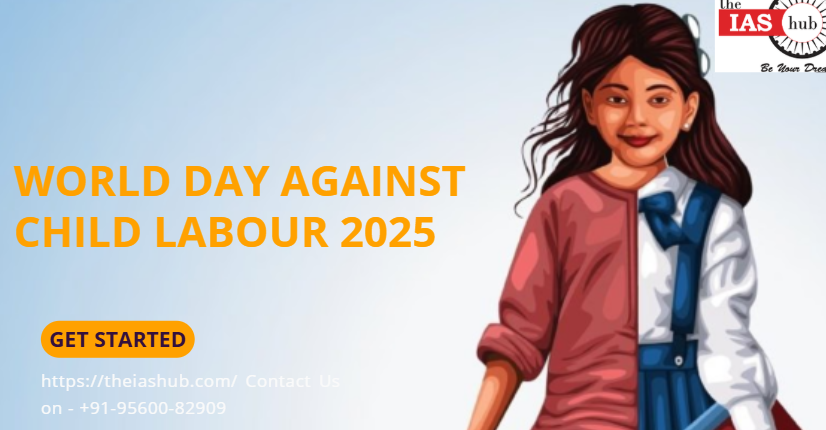

The World Day Against Child Labour is observed every year on 12 June to raise awareness of child exploitation and mobilize efforts to abolish it worldwide. First declared in 2002, the day emphasizes the need to create an environment where children can grow, learn, and live in dignity, not work. It supports the goal of ending child labour in all its forms by 2025 under Sustainable Development Goal (SDG) 8.7.
About 152 million children globally are in child labour, almost one in ten. This figure reinforces the urgency of the campaign. Each year, the day brings together governments, civil society, and citizens in the shared belief that every child deserves a safe and secure future.
Also Read: National and International Days 2025
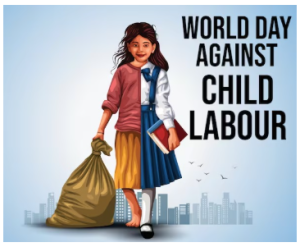
Also Read: World Ocean Day
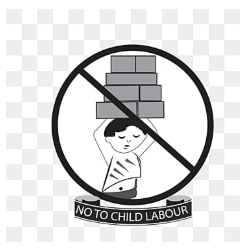
World Day Against Child Labour 2025 is being observed today globally. This day highlights the grave issue of child exploitation and mobilises efforts to eradicate it. The theme for this year is – “Progress is clear, but there’s more to do: let’s speed up efforts.
Also Read: List of Important Days in June 2025
2025 marks over two decades since the global agreement on eliminating the worst forms of child labour. This year’s theme urges governments, employers, communities, and individuals to speed up progress to ensure children are in school, not in labour.
Also Read: World Brain Tumor Day
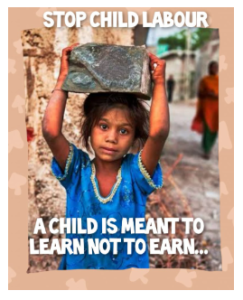
The 2025 World Day will focus on a key milestone: the release of the 2025 global estimates and trends of child labour. This ILO and UNICEF joint report will provide a comprehensive overview of where we stand in our global commitments to eliminate child labour. Although the detailed data are not yet available, the estimates and trends identified will guide policy debates and calls for renewed commitment and investment.
On this World Day, we will call for full ratification of ILO Convention No. 138 on the Minimum Age and the implementation of ILO Convention No. 182 on the Worst Forms of Child Labour. Their effective ratification and implementation remain essential to achieving the goals set by the Durban Call to Action, which urges us to aim for strengthened prevention, protection, and partnerships to eliminate child labour.
Also Read: World Food Safety Day
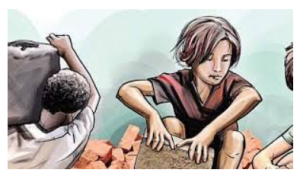
Child labour remains widespread. Around 160 million children (aged 5–17) are engaged in child labour globally. Of these, nearly half are in hazardous work.
| Indicator | Global | India |
| Children in child labour | 160 million (ages 5–17) | 10.12 million (ages 5–14) |
| In hazardous work | ~72 million | 5.8 million (ages 5–17) |
| Share of child population | ~9% | ~4% (5–14 age group) |
| South Asia child workers (5–14) | 41 million | – |
Despite the decline, millions of Indian children are still forced to work, especially in informal sectors.
Also Read: World Environment Day
[metaslider id=”5575″]
Child labour in India is driven by a mix of poverty, education gaps, and lack of enforcement. Key contributors include:
Children work in agriculture, construction, domestic labour, manufacturing, and family enterprises. Rural areas are the most affected.
India has the largest number of child workers globally in absolute terms. Even when the percentage is low, the numbers are high due to population size.
India has strong constitutional and legal measures to combat child labour.
| Legislation / Policy | Year | Focus / Scope |
| Article 24, Constitution | 1950 | Prohibits hazardous work for children under 14 |
| CLPR Act | 1986/2016 | Prohibits work for under-14s; restricts hazardous jobs for teens |
| Right to Education Act | 2009 | Compulsory schooling for ages 6–14 |
| National Policy on Child Labour | 1987 | Phased elimination; rehabilitation via education |
| National Child Labour Project (NCLP) Scheme | 1988 | Rescue, bridge schooling, and stipends for withdrawn children |
| PENCIL Portal | 2017 | Online platform for reporting and enforcement |
India has launched several schemes to rescue, educate, and rehabilitate child workers.
| Policy/Scheme | Year | Key Features | Impact/Reach |
| National Policy on Child Labour | 1987 | • Focus on rehabilitation through special schools • Income support for families • Public awareness campaigns |
First formal policy addressing child labour |
| National Child Labour Project (NCLP Scheme) | 1988 | • Bridge education for children (9–12 years) • Health checks & midday meals • ₹400/month stipend per child • Vocational & life skills training • Mainstreaming into formal schools |
Operational in 300+ districts, reached 1.2 million children |
| PENCIL Portal | 2017 | • Online platform for reporting child labour violations • Tracks rescue, education, and rehabilitation • Improves data & coordination |
Enhances real-time monitoring & enforcement |
Child labour is a social issue, not just a legal one. Awareness is key to change:
World Day Against Child Labour 2025 serves as a stark reminder: while we’ve made progress, child labour still exists at scale. This year’s theme – “Progress is clear, but there’s more to do: Let’s speed up efforts!” – calls for urgency.
Are you preparing for UPSC 2025? Join IAShub’s UPSC coaching batches to boost your preparation. Enroll now!
India’s legal and policy framework – including Article 24, the Child Labour Prohibition & Regulation Act, the National Policy on Child Labour, the NCLP scheme, and the PENCIL portal – creates the infrastructure for action. But the real test lies in consistent enforcement and public participation.

The theme of World Day Against Child Labour 2025 is “Progress is clear, but there’s more to do: Let’s speed up efforts,” highlighting the need to intensify global and local actions to end child labour.
India has made progress in reducing child labour, with numbers declining from over 10 million in 2011 to about 3.3 million by 2018–19, but it still remains a concern, especially in informal sectors.
Key laws include Article 24 of the Indian Constitution, the Child Labour Prohibition & Regulation Act, and the Right to Education Act, all of which aim to eliminate child labour and ensure children's right to education and safety.
The National Child Labour Project scheme provides bridge education and rehabilitation for rescued child labourers, while the PENCIL portal enables reporting, monitoring, and coordination to ensure law enforcement and child protection.

Refine your answer writing skills and elevate your UPSC preparation with personalized support and expert feedback.
Fill out the form to get started with the program or any other enquiries !



Are you dreaming of becoming an IAS officer? Then, IAShub can be your best guide. It is one of the Best IAS Coaching in Delhi. Many students who want to clear the UPSC exam join IAShub for learning. The institute gives both online and offline classes. Their teachers are experienced and helpful. They easily explain every topic. Students also get notes, tests, and tips to do well in the exam.
IAShub is in Delhi and is trusted by many UPSC students. It offers coaching for every part of the UPSC exam – Prelims, Mains, and Interview. The classes are simple and easy to understand. The teachers are experts and guide students in the right way. IAShub is also known for its helpful notes, test series, and answer-writing practice. IAShub is the best coaching in Delhi and also gives UPSC Online Classes. This helps students from any place in India to learn. The online classes are live and also recorded. So, students can watch them anytime. These classes cover the full UPSC syllabus.
Here are some important services provided by IAShub:
The UPSC Civil Services Exam has three parts:
This exam is tough, but with the right guidance, it becomes easy to manage. Students must study smart and stay regular.
IAShub supports students from the beginning to the end. It gives the right books, tests, and notes. The classes are easy to follow, and the teachers are always ready to help. Students get personal doubt sessions too. The test series and answer checking help students learn where they need to do better. Also, free study materials save time and money.
IAShub also guides students during the final stage – the interview. Experts take mock interviews and give useful tips. This full support makes IAShub one of the best IAS coaching in Delhi.

Join 50,000+ UPSC Aspirants! 🚀
Get Free UPSC/IAS Study Materials, Daily Current Affairs, Editorial Summaries & Exam Updates.
Join Telegram Channel