
















Explore Manipur State, its history, demography, polity, ethnic conflict, rivers, dams, wildlife, and cultural heritage. Discover Loktak Lake, Keibul Lamjao National Park, and its vibrant local festivals.
 theIAShub | 05 May, 2025 | 6303 | 0 |

Ethel St. Clair Grimwood, a British woman who became renowned as “the heroine of Manipur.” She once described Manipur as “a pretty place more beautiful than many of the world’s showplaces.” The late Prime Minister Jawaharlal Nehru also famously referred to it as the “Jewel of India“.
Manipur, located in northeastern India, situated between Myanmar to the east and the Indian states of Nagaland, Mizoram, and Assam. Covering an area of 22,327 square kilometers, it is a landlocked state located at an average altitude of 790 meters above sea level. The state’s population stands at approximately 2.72 million people.
The capital city, Imphal, serves as the cultural and political hub of the state. Manipur’s diverse landscape consists of lush valleys, hilly terrains, and several mountain passes that connect it to neighboring regions. The state’s prominent rivers include the Irang, Chindwin, and Barak, which provide vital water resources to the region.
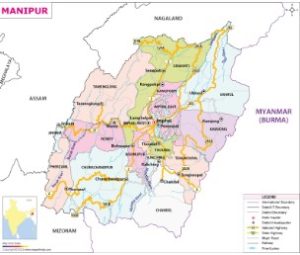
Manipur’s climate is influenced by its subtropical and monsoon conditions, with an average annual rainfall of 1,467.5 mm. The monsoon season, from May to October, brings heavy rainfall, transforming the region into a lush, green paradise.
Also Read: Digital Arrest
Manipur has a long and storied history that spans centuries. Originally a kingdom with prosperous trade routes, it was annexed by the British after the Anglo-Manipuri War of 1891, and became a Princely State under British colonial rule. Following India’s independence in 1947, Manipur was merged into the Indian Union on October 15, 1949, and became a full-fledged state on January 21, 1972.
Manipur has a Legislative Assembly with 60 seats, 20 of which are reserved for Scheduled Tribes and one for Scheduled Castes. Manipur is also represented in the Indian Parliament by two members in the Lok Sabha and one member in the Rajya Sabha. Due to its strategic location on the border with Myanmar, Manipur serves as an important gateway to Southeast Asia.
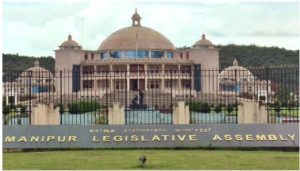
In the 2022 Manipur Legislative Assembly elections, Biren Singh led the BJP to a decisive victory, increasing their seat tally from 21 in 2017 to 32 out of 60 seats, and continued as Chief Minister. However, due to escalating violence and unrest in the state, Biren Singh resigned on February 9, 2025, leading to a period of President’s Rule in Manipur. The central government took direct control over the state’s administration in response to the violence and instability, which left the political situation uncertain for a time.
Keibul Lamjao National Park, located in Manipur’s Bishnupur district, is the world’s only floating national park, covering 40 km² within Loktak Lake. Established as a sanctuary in 1966 and designated a national park in 1977, it is home to the endangered Eld’s deer (Sangai). The park’s unique floating ecosystem, formed by phumdi (organic floating islands), supports various plant and animal species. Other wildlife includes hog deer, wild boar, and hooded cranes. The park faces threats from the Ithai Barrage, water pollution, and human encroachment. Conservation efforts and ecotourism aim to protect its biodiversity.
Keibul Lamjao Conservation Area, located near Loktak Lake in Manipur, is listed on India’s Tentative List for UNESCO World Heritage status. This unique site, nominated in 2016, is a mixed natural and cultural property. The area represents a rare combination of aquatic, wetland, and terrestrial ecosystems, with several villages and settlements located on the shores and phumdis, making it a significant cultural and ecological landmark.
[metaslider id=”5575″]
Manipur Wildlife Sanctuaries are rich in biodiversity, with several notable areas dedicated to protecting endangered species and unique ecosystems.
Loktak Lake, located in Moirang, Bishnupur district of Manipur, is the largest freshwater lake in Northeast India. It is renowned for its phumdis—floating islands made of vegetation, soil, and organic matter. The lake is home to the unique Keibul Lamjao National Park, the world’s only floating national park, and serves as the last natural refuge of the endangered Sangai deer. Covering 40 km², it is a popular global tourist destination, with the Sendra tourist hub situated nearby. Loktak Lake was designated a Ramsar Site on 23 March 1990.
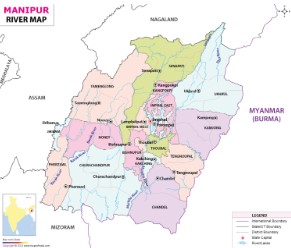
Manipur is blessed with several important rivers, which are crucial for its water resources and ecological balance. Some of the major river basins are:
Also Read: Biosphere Reserves In India
Here are the key dams in Manipur:
Manipur’s culture is a vibrant fusion of indigenous traditions, classical art forms, and unique social practices. The state’s pride lies in its classical dance form, Ras Lila, created by King Rajashree Bhagyachandra, is based on the divine love story of Lord Krishna and Radha. Thabal Chongba, a traditional Manipuri folk dance, is another highlight, often performed during festivals such as Yaoshang (Dol Jatra), a celebration marking the arrival of spring.
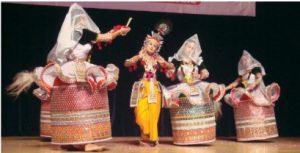
Image: Ras Lila
The state’s rich cultural diversity is reflected in its festivals, art, music, and martial arts, with Polo being one of its most notable contributions to the world. Invented in the 16th century, Polo was a game originating from Manipur, which has gained international acclaim.
Manipur Official Language: The official language of the state is Manipuri, though English is also widely spoken and understood.
Manipur is a land of festivals, and the people celebrate a wide variety of cultural, religious, and seasonal events throughout the year. These festivals are a reflection of the state’s rich cultural heritage and offer a glimpse into the daily lives, beliefs, and practices of its diverse communities.
Also Read: List of Indian States And Their Capitals
[metaslider id=”5575″]
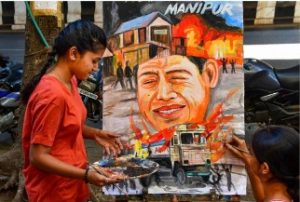
Ethnic conflict in Manipur, which began on May 3, 2023, has been a tragic chapter in the state’s history, marked by violence between the Meitei community, predominantly residing in the Imphal Valley, and the Kuki-Zo tribal groups living in the surrounding hills. The conflict erupted amid long-standing tensions over issues like land rights, political representation, and the demand for Scheduled Tribe status by the Meitei people.
As of November 22, 2024, government reports stated that the violence in Manipur had resulted in the loss of 258 lives and displaced around 60,000 people. Many homes were destroyed, with nearly 4,800 buildings damaged. Hundreds of religious sites, including temples and churches, were also vandalized. Over 1,000 people were injured, and 32 are still missing.
The conflict has deepened ethnic divisions in Manipur, with both groups blaming each other for the violence and discrimination. While the official numbers are already tragic, some believe the true impact could be even worse. This violence has not only caused immense suffering but also created a complex political and social crisis in Manipur, with no clear solution in sight.
Are you preparing for UPSC 2025? Join IAShub’s UPSC coaching batches to boost your preparation. Enroll now!
Related Articles |
|
|---|---|
| Central Vigilance Commission | Representation of People Act |
| Cooperative Federalism | National Parks In India |
| Mission Karmayogi | Major Ports In India |

Ethnic conflict erupted in May 2023 between the Meitei and Kuki-Zo communities over issues like land rights, political representation, and the Meitei’s demand for Scheduled Tribe status.
Ras Lila is a classical Manipuri dance depicting the divine love story of Lord Krishna and Radha. It is a major cultural and spiritual expression in Manipur
Manipur is home to a variety of ethnic groups, including the Meitei community, Kuki-Zo tribal groups, and Nagas. These diverse communities contribute to the state's rich cultural heritage
Cheiraoba, the Manipuri New Year, is celebrated in April. People clean their homes, prepare special dishes, and seek blessings from deities for prosperity in the coming year.

Refine your answer writing skills and elevate your UPSC preparation with personalized support and expert feedback.
Fill out the form to get started with the program or any other enquiries !



Are you dreaming of becoming an IAS officer? Then, IAShub can be your best guide. It is one of the Best IAS Coaching in Delhi. Many students who want to clear the UPSC exam join IAShub for learning. The institute gives both online and offline classes. Their teachers are experienced and helpful. They easily explain every topic. Students also get notes, tests, and tips to do well in the exam.
IAShub is in Delhi and is trusted by many UPSC students. It offers coaching for every part of the UPSC exam – Prelims, Mains, and Interview. The classes are simple and easy to understand. The teachers are experts and guide students in the right way. IAShub is also known for its helpful notes, test series, and answer-writing practice. IAShub is the best coaching in Delhi and also gives UPSC Online Classes. This helps students from any place in India to learn. The online classes are live and also recorded. So, students can watch them anytime. These classes cover the full UPSC syllabus.
Here are some important services provided by IAShub:
The UPSC Civil Services Exam has three parts:
This exam is tough, but with the right guidance, it becomes easy to manage. Students must study smart and stay regular.
IAShub supports students from the beginning to the end. It gives the right books, tests, and notes. The classes are easy to follow, and the teachers are always ready to help. Students get personal doubt sessions too. The test series and answer checking help students learn where they need to do better. Also, free study materials save time and money.
IAShub also guides students during the final stage – the interview. Experts take mock interviews and give useful tips. This full support makes IAShub one of the best IAS coaching in Delhi.
Join 50,000+ UPSC Aspirants! 🚀
Get Free UPSC/IAS Study Materials, Daily Current Affairs, Editorial Summaries & Exam Updates.
Join Telegram Channel