The Sagarmala Programme is India’s flagship initiative to modernize ports, boost trade, and enhance coastal infrastructure. Learn about its objectives, key pillars, port list, ministry, launch date, and current status.
 theIAShub | 03 Apr, 2025 | 4830 | 0 |

The Sagarmala Programme, initiated by the Ministry of Ports, Shipping and Waterways, is a strategic effort by the Government of India to revolutionize the maritime sector. Leveraging the country’s vast coastline, navigable waterways, and key trade routes, the programme seeks to harness these resources for port-driven development and the advancement of coastal communities.
Also Read: UPSC Exam Syllabus
The Sagarmala Programme is a national effort to enhance port connectivity, develop inland waterways, and drive industrial growth near coastal areas. The program focuses on optimizing logistics for both domestic and international trade.
India has a 7,500 km coastline, yet its ports have faced inefficiencies. The Sagarmala Project addresses these challenges by upgrading infrastructure, improving last-mile connectivity, and integrating ports with roads and railways.
Sagarmala Programme Objectives
The Sagarmala Programme has four key objectives:
Also Read: Mechanical engineering optional Syllabus
A question often asked in UPSC is that what are the four pillars of the Sagarmala Programme? Its answer is The Sagarmala Programme operates on Overall set of projects which are divided into 5 pillars and 24 categories:
Also Read: Statutory Bodies in India
[metaslider id=”5575″]
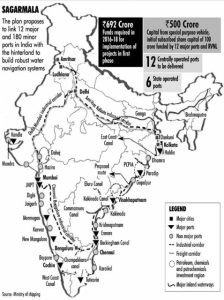
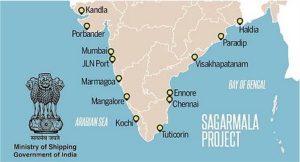
The Sagarmala Project covers 12 major ports and over 200 non-major ports. Some key ports under the program include:
India has 13 major ports, distributed across the eastern and western coasts. These ports are key to facilitating trade and managing cargo traffic efficiently.
The Sagarmala Programme’s institutional framework facilitates a collaborative role for the Central Government. It serves as a platform for the Central, State Governments, and Local Authorities to align their efforts, promoting coordination under the principles of cooperative federalism. This approach ensures the achievement of the programme’s goals and supports port-led development.
| Governing Body | Membership | Responsibilities |
| National Sagarmala Apex Committee | – Headed by Union Minister of Ports, Shipping & Waterways – Includes relevant Central Ministers – Comprises Maritime States’ Chief Ministers/Port Ministers |
– Provides strategic direction – Ensures inter-ministerial coordination – Approves master development plan – Oversees program implementation – Conducts periodic progress reviews |
| State Sagarmala Committee | – Led by State Chief Minister/Port Minister – Includes state department heads – Involves implementing agencies |
– Executes state-level projects – Facilitates inter-department coordination – Implements NSAC directives – Prioritizes critical initiatives |
Also Read: Constitutional bodies in India
With over 90% of India’s trade volume moving through maritime routes, modernizing port infrastructure is crucial for boosting manufacturing growth and supporting the ‘Make in India’ initiative. India’s port network comprises 12 major ports (managed by the Central Government) and about 200 non-major ports (administered by State Governments).
The Sagarmala Programme has initiated 234 port modernization projects worth ₹2,91,622 crore:
o Honavar (Karnataka)
o Chhara (Gujarat)
o Kakinada SEZ (Andhra Pradesh)
o Vadhavan (Maharashtra)
o Andaman Transhipment Port
o Ramayyapatnam (Andhra Pradesh)
o Bhavnagar CNG Terminal
o Mechanization
o Digital transformation
o Process optimization
o Financial support for 8 projects
o 100% funding for Puducherry port dredging
o Alang shipyard upgrade
o Andaman & Nicobar facilities
o Cochin Shipyard expansions
o Chennai and Karaikal Port developments
Also Read: Cooperative Federalism in India
Despite progress, the Sagarmala Project faces challenges:
The government plans to accelerate projects, attract private investment, and ensure sustainable development.
The Sagarmala Programme is transforming India’s maritime sector by modernizing ports, improving logistics, and boosting coastal economies. With hundreds of projects underway, it plays a vital role in India’s trade growth. For more details, visit the official Sagarmala portal.
Are you preparing for UPSC 2025? Join IAShub’s UPSC coaching batches to boost your preparation. Enroll now!
The Sagarmala Programme, initiated by the Ministry of Ports, Shipping and Waterways, is a strategic effort by the Government of India to revolutionize the maritime sector. Leveraging the country’s vast coastline, navigable waterways, and key trade routes, the programme seeks to harness these resources for port-driven development and the advancement of coastal communities.
Also Read: UPSC Exam Syllabus
The Sagarmala Programme is a national effort to enhance port connectivity, develop inland waterways, and drive industrial growth near coastal areas. The program focuses on optimizing logistics for both domestic and international trade.
India has a 7,500 km coastline, yet its ports have faced inefficiencies. The Sagarmala Project addresses these challenges by upgrading infrastructure, improving last-mile connectivity, and integrating ports with roads and railways.
Sagarmala Programme Objectives
The Sagarmala Programme has four key objectives:
Also Read: Mechanical engineering optional Syllabus
A question often asked in UPSC is that what are the four pillars of the Sagarmala Programme? Its answer is The Sagarmala Programme operates on Overall set of projects which are divided into 5 pillars and 24 categories:
Also Read: Statutory Bodies in India
The Sagarmala Project covers 12 major ports and over 200 non-major ports. Some key ports under the program include:
India has 13 major ports, distributed across the eastern and western coasts. These ports are key to facilitating trade and managing cargo traffic efficiently.
The Sagarmala Programme’s institutional framework facilitates a collaborative role for the Central Government. It serves as a platform for the Central, State Governments, and Local Authorities to align their efforts, promoting coordination under the principles of cooperative federalism. This approach ensures the achievement of the programme’s goals and supports port-led development.
| Governing Body | Membership | Responsibilities |
| National Sagarmala Apex Committee | – Headed by Union Minister of Ports, Shipping & Waterways – Includes relevant Central Ministers – Comprises Maritime States’ Chief Ministers/Port Ministers |
– Provides strategic direction – Ensures inter-ministerial coordination – Approves master development plan – Oversees program implementation – Conducts periodic progress reviews |
| State Sagarmala Committee | – Led by State Chief Minister/Port Minister – Includes state department heads – Involves implementing agencies |
– Executes state-level projects – Facilitates inter-department coordination – Implements NSAC directives – Prioritizes critical initiatives |
Also Read: Constitutional bodies in India
With over 90% of India’s trade volume moving through maritime routes, modernizing port infrastructure is crucial for boosting manufacturing growth and supporting the ‘Make in India’ initiative. India’s port network comprises 12 major ports (managed by the Central Government) and about 200 non-major ports (administered by State Governments).
The Sagarmala Programme has initiated 234 port modernization projects worth ₹2,91,622 crore:
o Honavar (Karnataka)
o Chhara (Gujarat)
o Kakinada SEZ (Andhra Pradesh)
o Vadhavan (Maharashtra)
o Andaman Transhipment Port
o Ramayyapatnam (Andhra Pradesh)
o Bhavnagar CNG Terminal
o Mechanization
o Digital transformation
o Process optimization
o Financial support for 8 projects
o 100% funding for Puducherry port dredging
o Alang shipyard upgrade
o Andaman & Nicobar facilities
o Cochin Shipyard expansions
o Chennai and Karaikal Port developments
Also Read: Cooperative Federalism in India
[metaslider id=”5575″]
Despite progress, the Sagarmala Project faces challenges:
The government plans to accelerate projects, attract private investment, and ensure sustainable development.
The Sagarmala Programme is transforming India’s maritime sector by modernizing ports, improving logistics, and boosting coastal economies. With hundreds of projects underway, it plays a vital role in India’s trade growth. For more details, visit the official Sagarmala portal.
Are you preparing for UPSC 2025? Join IAShub’s UPSC coaching batches to boost your preparation. Enroll now!

The project aims to reduce logistics costs, enhance domestic and international trade, create jobs, develop infrastructure, and strengthen coastal communities through port-led development.
The Sagarmala Programme is implemented by the Ministry of Ports, Shipping, and Waterways.
The five pillars are Port-led Industrialization, Coastal Community Development, Coastal Shipping & Inland Water Transport (IWT), Port Modernization, and Port Connectivity.
The project has over 234 port modernization initiatives worth ₹2.91 lakh crore, with 94 completed projects, 65 ongoing, and 14 new ports identified for development.

Refine your answer writing skills and elevate your UPSC preparation with personalized support and expert feedback.
Fill out the form to get started with the program or any other enquiries !






Are you dreaming of becoming an IAS officer? Then, IAShub can be your best guide. It is one of the Best IAS Coaching in Delhi. Many students who want to clear the UPSC exam join IAShub for learning. The institute gives both online and offline classes. Their teachers are experienced and helpful. They easily explain every topic. Students also get notes, tests, and tips to do well in the exam.
IAShub is in Delhi and is trusted by many UPSC students. It offers coaching for every part of the UPSC exam – Prelims, Mains, and Interview. The classes are simple and easy to understand. The teachers are experts and guide students in the right way. IAShub is also known for its helpful notes, test series, and answer-writing practice. IAShub is the best coaching in Delhi and also gives UPSC Online Classes. This helps students from any place in India to learn. The online classes are live and also recorded. So, students can watch them anytime. These classes cover the full UPSC syllabus.
Here are some important services provided by IAShub:
The UPSC Civil Services Exam has three parts:
This exam is tough, but with the right guidance, it becomes easy to manage. Students must study smart and stay regular.
IAShub supports students from the beginning to the end. It gives the right books, tests, and notes. The classes are easy to follow, and the teachers are always ready to help. Students get personal doubt sessions too. The test series and answer checking help students learn where they need to do better. Also, free study materials save time and money.
IAShub also guides students during the final stage – the interview. Experts take mock interviews and give useful tips. This full support makes IAShub one of the best IAS coaching in Delhi.