
















The National Judicial Appointments Commission (NJAC) aimed to replace the collegium system for judicial appointments but was struck down as unconstitutional. Learn why NJAC was rejected and how it impacted judicial independence.
 theIAShub | 02 Apr, 2025 | 5128 | 0 |

The National Judicial Appointments Commission (NJAC) was introduced through the 99th Constitutional Amendment Act, 2014, to reform the process of appointing judges to the higher judiciary in India. It aimed to replace the collegium system with a more transparent and accountable mechanism. However, the Supreme Court struck down the National Judicial Appointments Commission (NJAC) as unconstitutional in 2015, restoring the collegium system. This article explores the structure, function, and reasons behind the invalidation of the NJAC.
Before the National Judicial Appointments Commission (NJAC), judicial appointments in India were primarily governed by the collegium system, which was established through Supreme Court judgments in the Three Judges Cases. This system granted the Chief Justice of India and senior judges control over the appointment and transfer of judges, ensuring judicial independence but also raising concerns about transparency.
Also Read: UPSC Prelims Syllabus
Article 124 of the Indian Constitution deals with the establishment and constitution of the Supreme Court of India. The article lays down the framework for the number of judges in the Supreme Court, their appointment process, qualifications, and removal. Here’s a simplified explanation:
Also Read: UPSC Study Material for IAS Exam 2025
The National Judicial Appointments Commission (NJAC) was introduced to make the appointment of judges to the Supreme Court and High Courts more structured and transparent. It was designed to make the appointment process more accountable and reduce judicial overreach.
| Feature | Description |
| Established By | 99th Constitutional Amendment Act, 2014 |
| Purpose | To appoint judges of the Supreme Court and High Courts |
| Members | Chief Justice of India (CJI), two senior SC judges, Law Minister, two eminent persons |
| Replaced System | The previous Collegium System |
Also Read: UPSC Eligibility
The full form of NJAC is the National Judicial Appointments Commission. This body was constituted to bring reforms in the appointment and transfer of judges, reducing the exclusive control of the judiciary in selecting its own members.
Also Read: UPSC Exam 2025
Understanding the difference between the collegium system and NJAC is crucial for legal and UPSC aspirants.
| Feature | Collegium System | NJAC System |
| Authority | Supreme Court judges | Judicial and executive members |
| Transparency | Confidential process | More transparent |
| Composition | CJI and senior SC judges | CJI, two senior SC judges, Law Minister, two eminent persons |
| Public Accountability | Limited | Increased due to external involvement |
The NJAC was seen as a way to balance judicial independence and executive participation in appointments, while the collegium system retained judicial supremacy.
Also Read: UPSC Syllabus
[metaslider id=”5575″]
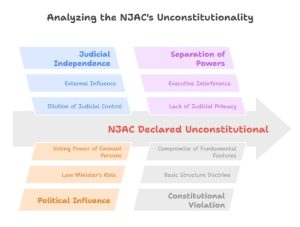
The Supreme Court of India struck down the NJAC in 2015 through a landmark judgment in Supreme Court Advocates-on-Record Association v. Union of India. The key reasons were:
This ruling reinstated the collegium system, ensuring that judges retain control over judicial appointments.
The NJAC was declared unconstitutional as it violated the basic structure doctrine of the Indian Constitution. The Supreme Court ruled that judicial independence is a fundamental feature, and any system that compromises this principle is invalid.
| Reason | Explanation |
| Violation of Separation of Powers | Executive interference in judicial appointments |
| Lack of Judicial Primacy | Judges lost sole authority over appointments |
| Political Influence | Law Minister and eminent persons had voting power |
The decision ensured that the judiciary remained independent and free from political pressure, safeguarding democracy.
After the NJAC was struck down, the collegium system was reinstated, continuing as the prevailing method for appointing judges. Despite criticisms of opacity and favoritism, no alternative mechanism has replaced it. Recent discussions focus on introducing greater transparency and accountability in judicial appointments.
The National Judicial Appointments Commission (NJAC) was an ambitious attempt to reform the judicial appointment process, making it more transparent and accountable. However, the Supreme Court’s decision to strike it down highlighted the need to uphold judicial independence. While the collegium system continues, discussions on improving judicial appointments remain relevant to ensuring a fair and impartial judiciary in India.
Are you preparing for UPSC 2025? Join IAShub’s UPSC coaching batches to boost your preparation. Enroll now!
The Supreme Court ruled the NJAC unconstitutional in 2015, citing concerns over judicial independence and executive interference in judicial appointments.
The collegium system is an internal judiciary-led appointment process, whereas the NJAC included members from the executive and eminent persons to enhance transparency.
Reviving the NJAC would require a constitutional amendment that ensures judicial independence while addressing the concerns that led to its rejection.
After the NJAC was struck down, the collegium system was reinstated as the method for appointing Supreme Court and High Court judges.

Refine your answer writing skills and elevate your UPSC preparation with personalized support and expert feedback.
Fill out the form to get started with the program or any other enquiries !



Are you dreaming of becoming an IAS officer? Then, IAShub can be your best guide. It is one of the Best IAS Coaching in Delhi. Many students who want to clear the UPSC exam join IAShub for learning. The institute gives both online and offline classes. Their teachers are experienced and helpful. They easily explain every topic. Students also get notes, tests, and tips to do well in the exam.
IAShub is in Delhi and is trusted by many UPSC students. It offers coaching for every part of the UPSC exam – Prelims, Mains, and Interview. The classes are simple and easy to understand. The teachers are experts and guide students in the right way. IAShub is also known for its helpful notes, test series, and answer-writing practice. IAShub is the best coaching in Delhi and also gives UPSC Online Classes. This helps students from any place in India to learn. The online classes are live and also recorded. So, students can watch them anytime. These classes cover the full UPSC syllabus.
Here are some important services provided by IAShub:
The UPSC Civil Services Exam has three parts:
This exam is tough, but with the right guidance, it becomes easy to manage. Students must study smart and stay regular.
IAShub supports students from the beginning to the end. It gives the right books, tests, and notes. The classes are easy to follow, and the teachers are always ready to help. Students get personal doubt sessions too. The test series and answer checking help students learn where they need to do better. Also, free study materials save time and money.
IAShub also guides students during the final stage – the interview. Experts take mock interviews and give useful tips. This full support makes IAShub one of the best IAS coaching in Delhi.

Join 50,000+ UPSC Aspirants! 🚀
Get Free UPSC/IAS Study Materials, Daily Current Affairs, Editorial Summaries & Exam Updates.
Join Telegram Channel