
















Know the detailed UPSC Prelims Pattern 2026 for GS Paper I and CSAT. Check exam format, marking scheme, subject-wise weightage, recent trends, and expert preparation tips.
 theIAShub | 12 Jul, 2025 | 14114 | 0 |

The Union Public Service Commission (UPSC) Civil Services Examination is of three stages i.e. preliminary, mains examination, and personality test each stages have a different pattern. The first stage is the Preliminary Examination, which has defined the UPSC Prelims Pattern which acts as a screening test for aspirants.
Understanding the UPSC Prelims Pattern is essential for developing a focused preparation strategy. equipping aspirants with the necessary knowledge to clear this crucial first stage.
The UPSC Prelims consists of two papers conducted on the same day. It consists of two papers: General Studies (GS) Paper I and General Studies Paper II (CSAT). 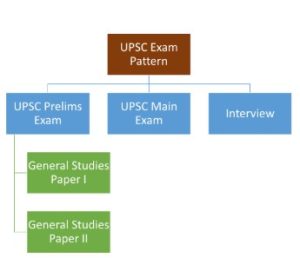
| Detailed Overview of UPSC Prelims Exam Pattern 2026 | |||
| UPSC Prelims Paper | General Studies Paper I- It Tests the candidate’s knowledge of various subjects and their application to current events. | ||
| General Studies Paper II (CSAT)- It tests the analytical ability, reasoning, and comprehension ability of candidates. | |||
| Duration | 2 hours | ||
| Timings | 9:30 AM to 11:30 AM | ||
| Shift | First Shift (Morning) | ||
| Mode | Offline | ||
| Evaluation Mode | General Studies Paper I | Marks considered for prelims cut-off marks | |
| General Studies Paper II (CSAT) (Qualifying | Qualifying in Nature (need 33% of total marks) | ||
| Marks Distribution | General Studies Paper I | 200 marks | 100 Questions |
| General Studies Paper II (CSAT) | 200 marks | 80 Questions | |
Also Read: UPSC Prelims Syllabus
UPSC Prelims Pattern of both the papers are objective type, with multiple-choice questions (MCQs), and each is conducted for two hours.
The UPSC Prelims Pattern of General Studies (GS) Paper I tests aspiring candidates’ general knowledge and awareness. It includes the following themes:
The UPSC Prelims Pattern of General Studies (GS) Paper II is also referred to as the Civil Services Aptitude Test (CSAT). It includes the following themes:
As stated earlier in this article UPSC Prelims Pattern consists of two papers. One of the papers is General Studies 1 and the other is CSAT. UPSC Prelims paper I is considered for evaluation and the cut-off marks for the qualifying prelims stage are based on the number scored in this paper.
UPSC Prelims Pattern 2026 Marking System |
|
| GS Paper I: Each correct answer carries equal marks, while 1/3rd of the marks assigned to a question are deducted for every incorrect answer.
The GS Paper I cut-off varies yearly based on the difficulty level and number of vacancies. Candidates need to focus on maximizing their scores in this paper. |
CSAT Paper II: Also includes negative marking but is a qualifying paper requiring only 33% to pass. |
Since the prelims examination of the UPSC IAS exam, the deciding paper is GS Paper I and CSAT, which is qualifying and needs attention. So, here are some key features of the UPSC Prelims Pattern
Also Read: UPSC Prelims Previous Year Question Papers
[metaslider id=”5575″]
Since 2011 the UPSC Prelims Pattern has changed a lot. So here are some changes and evolution of the UPSC Prelims pattern which will help candidates to understand its nature.
After the final changes in the pattern of the UPSC CSAT paper here are some analysis of the UPSC Prelims Pattern.
To get decent marks in the UPSC prelims exam so that candidates can clear the prelims exam with flying colours needed a detailed understanding of the UPSC Prelims Pattern. Here are some recommendations for aspiring candidates.
This is the most important segment of UPSC Prelims preparation, how aspiring candidates can prepare for UPSC Prelims so that he/she can clear UPSC Prelims in one go and start practicing for the next stage which is the main examination. Here are a few steps:
Also Read: UPSC Prelim Prepartion Tips
Considering and analyzing the last few years the UPSC Prelims Pattern of both paper, GS and CSAT following things can be concluded:

The UPSC Prelims comprises two papers: General Studies Paper I (General Awareness) and General Studies Paper II (Civil Services Aptitude Test or CSAT).
Scoring 120 marks in the preliminary exam requires answering 60 questions correctly. However, achieving this requires great accuracy as each incorrect answer carries a penalty of 0.66 marks.
In the UPSC exam, a 1/3 negative marking rule implies that for each incorrect answer, one-third of the marks allotted to that question are deducted from the total score, discouraging arbitrary guessing.
Yes, the IAS prelims exam is only qualifying in nature. For the General Studies Paper-1, the cut-off varies from year to year. However, for the CSAT paper, 33% is the qualifying criteria.

Refine your answer writing skills and elevate your UPSC preparation with personalized support and expert feedback.
Fill out the form to get started with the program or any other enquiries !



Are you dreaming of becoming an IAS officer? Then, IAShub can be your best guide. It is one of the Best IAS Coaching in Delhi. Many students who want to clear the UPSC exam join IAShub for learning. The institute gives both online and offline classes. Their teachers are experienced and helpful. They easily explain every topic. Students also get notes, tests, and tips to do well in the exam.
IAShub is in Delhi and is trusted by many UPSC students. It offers coaching for every part of the UPSC exam – Prelims, Mains, and Interview. The classes are simple and easy to understand. The teachers are experts and guide students in the right way. IAShub is also known for its helpful notes, test series, and answer-writing practice. IAShub is the best coaching in Delhi and also gives UPSC Online Classes. This helps students from any place in India to learn. The online classes are live and also recorded. So, students can watch them anytime. These classes cover the full UPSC syllabus.
Here are some important services provided by IAShub:
The UPSC Civil Services Exam has three parts:
This exam is tough, but with the right guidance, it becomes easy to manage. Students must study smart and stay regular.
IAShub supports students from the beginning to the end. It gives the right books, tests, and notes. The classes are easy to follow, and the teachers are always ready to help. Students get personal doubt sessions too. The test series and answer checking help students learn where they need to do better. Also, free study materials save time and money.
IAShub also guides students during the final stage – the interview. Experts take mock interviews and give useful tips. This full support makes IAShub one of the best IAS coaching in Delhi.

Join 50,000+ UPSC Aspirants! 🚀
Get Free UPSC/IAS Study Materials, Daily Current Affairs, Editorial Summaries & Exam Updates.
Join Telegram Channel