
theIAShub
22 Jul, 2025
Article List
- India and WTO: Disruption and Convergence
- Impeachment of a High Court Judge
- China Mega Dam On Brahmputra
- Female Labour Force Participation: A Paradox
- SASCI Scheme
- Meri Panchayat App
- Meghna River
- Bima Sakhi Scheme
- Comptroller and Auditor General (CAG) of India
- National List of Essential Diagnostics (NLED) 2025
- Pale-Capped Pigeon
1. India and WTO: Disruption and Convergence
Context
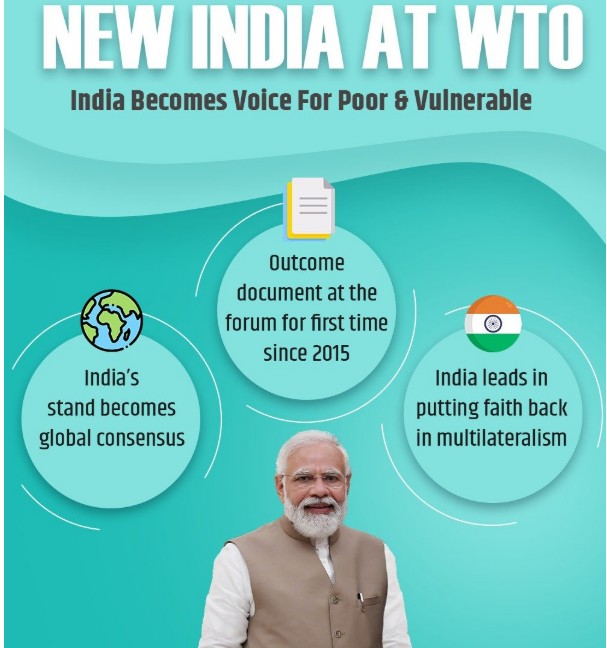
- India's influence at the World Trade Organization has grown following a notable decline ofU.5.power within the organization, but its in opportunisın and obstructionism could weaken its potential to benefit fully from the international trading system.
About the Update
- India is a contradiction in the World Trade Organization (WTO): both a norm-breaker and a deal maker.
- When the WTO was established in 1995, India had already begun a series of economic reforms to help it take advantage of the benefits of global trade and grow into a force to be reckoned with in international institutions.
- However, India has both resisted and embraced multilateralism depending on the balance of its offensive and defensive trade interests.
- As reforms slowed down in the 2000s and the multilateral trade negotiations called the Doha round failed in 2011, India became a force for obstruction, partnering with different groups of countries to lead by disrupting the WTO.
- Furthermore, the notable decline of U.S. power in the organization and disinterest in the multilateral trading system has left a substantial governance gap and increased India's influence.
Major concerns raised by India
- Agriculture & Food Security: Insists on a permanent solution for public stockholding programs (like its food security buffer) that exceed current WTO subsidy limits. Views this as critical for feeding its population.
- E-commerce Moratorium: Strongly opposes extending the moratorium on customs duties for electronic transmissions, arguing it erodes developing countries' policy space and potential revenue.
- Development Issues: Resists new rules (like on investment or ecommerce) without resolving old issues like agriculture and Special and Differential Treatment (S&DT) for developing countries.
India as a strategic navigator of WTO
- Engaging Selectively: Participates actively in areas it deems strategically important (e.g., fisheries subsidies).
- Building Coalitions: Forms coalitions with other developing countries (like the G33 on agriculture) to amplify its voice.
- Leveraging Size: Uses its massive market size and strategic importance to extract concessions.
- Finding Alternatives: Pursues policy goals outside the WTO when blocked internally (e.g., imposing digital service taxes after opposing the e-commerce moratorium).
Way Forward
- Permanent Solution on Food Security: Finding a legally binding, permanent solution for public stockholding programs.This requires significant flexibility from major agricultural exporters (like the US, EU, Canada, Australia).
- Meaningful S&DT: India and other developing nations demand that Special and Differential Treatment be practical and effective, not just symbolic. New rules need to genuinely account for different development levels.
WTO Reforms needed
- Realistic Negotiating Agendas: The WTO needs to prioritize achievable outcomes rather than overly ambitious, comprehensive rounds. Focusing on narrower issues where consensus is possible (like the fisheries subsidies success) might be more productive.
- Plurilateral Agreements (with Safeguards): While India historically opposes plurilaterals (smaller groups negotiating new rules), the article suggests it might tolerate them if:
- Reviving Dispute Settlement: Restoring a functional Appellate Body is crucial for the rules-based system India also relies on. India has an interest in this but has blocked appointments alongside the US.
- Balancing the often conflicting demands of farmers, domestic industries, and a growing digital/services sector requires clearer internal trade-offs and a more cohesive national strategy presented at the WTO.
About WTO
- It is an international institution that oversees the rules for global trade among nations.
- WTO has 164 member countries[with Liberia and Afghanistan the most recent members, having joined in 2016] and 25 observer countries and governments.
- It officially began operations on January 1, 1995, in accordance with the 1994 Marrakesh Agreement, thus replacing the 1948 General Agreement on Tariffs and Trade (GATT).
2. Impeachment of a High Court Judge
Context
- The impeachment of Justice Yashwant Varma - the ex-Delhi High Court judge at whose home "piles of burnt Rs 500 notes" were found began Monday afternoon after 145 MPs, from ruling and opposition parties, submitted a memorandum to Lok Sabha Speaker Om Birla.
About Impeachment
- The term ‘impeachment’ means the process followed in deciding the removal of a person in a position from exercising all the powers and responsibilities that the position demands. The entire process of removal is impeachment.
- In India, the impeachment is used in two contexts:
- Impeachment of President
- Impeachment of Judges (However, the Constitution does not use the word ‘impeachment‘ for removal of Judges).
Removal of Judges In India
Ground for Removal
- Constitutional Provisions: Article 124(4) and Article 218 provide the legal basis for the removal of Judges of the Supreme Court and High Court, respectively.
- Criteria: Removal is permitted only on grounds of proven misbehaviour or Incapacity.
- The Constitution does not define the terms ‘proved misbehaviour’ or ‘incapacity.’
- The Supreme Court has opined in various cases that wilful misconduct in office, corruption, lack of integrity or any other offence involving moral turpitude would constitute misbehaviour. Incapacity here means a medical condition that may include physical or mental incapacity.
Removal of Judges: The Process
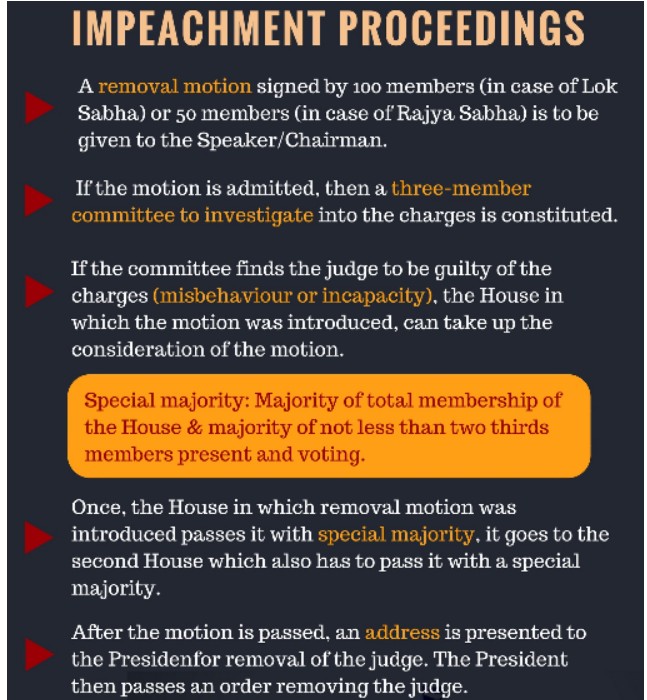
- The Judges Inquiry Act 1968 regulates the procedure for removing an SC judge and an HC judge.
- Requires a motion signed by at least 100 MPs in Lok Sabha (LS) or 50 MPs in RS. The Chairman/Speaker may, after due consideration and consultation, admit or refuse to admit the motion. If admitted, a three-member committee (Committee of Inquiry) would be constituted.
- Committee of Enquiry:
- Comprises the CJI or SC judge, a High Court CJ, and a distinguished jurist.
- Investigates charges, frames allegations, examines evidence and cross-examines witnesses.
- Report findings to the Speaker/Chairperson.
Parliamentary Vote
- Each House must pass the motion with at least two thirds of the members present and voting and more than 50% of total membership in favour.
- If both Houses agree, the President issues the removal order.
- Termination of Proceedings: If the committee finds the judge not guilty, the matter is dropped.
- From the above, it is clear that the procedure for the impeachment of a high court judge is the same as that for a judge of the Supreme Court.
Limitations with the Process
- No Success: Despite six impeachment attempts, no judge has been impeached since independence.
- High Bar for Removal: The stringent voting requirement makes impeachment rare.
- Political Nature: The process often involves political negotiations and alliances.
Way Forward
- Judicial Training: Initiatives to ensure sensitivity and ethical conduct among judges.
- Depoliticization of Process: Measures to reduce political influence in judicial impeachment proceedings.
- Strengthening Accountability: Regular performance reviews and clearer guidelines for judicial conduct.
3. China Mega Dam On Brahmputra
Context
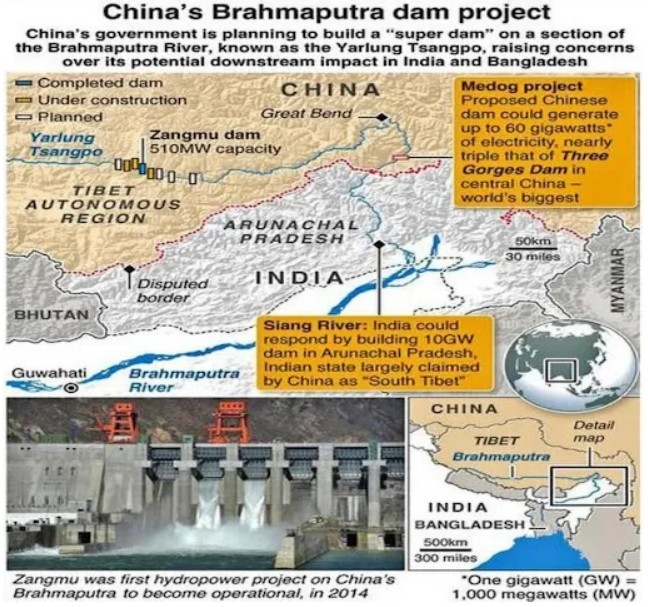
- China officially commenced construction of a massive hydropower project on the Brahmaputra River in Tibet, near the Indian state of Arunachal Pradesh.
About Project
- The dam is being built across a huge gorge in the Himalayas where the river makes a U-turn near India’s border (Arunachal Pradesh).
- The project is being hailed as the largest infrastructure development of its kind globally.
- Project Details:
- It comprises five cascade hydropower stations.
- Total estimated investment: 1.2 trillion yuan (approx. USD 167.8 billion).
- Expected power generation: 300 billion kilowatt-hours annually — enough to power 300 million people.
- Location: Situated in the Yarlung Tsangpo Grand Canyon (Brahmaputra in Tibet), where the river takes a U-turn near the India-China border before entering Arunachal Pradesh and eventually Bangladesh.
- The region is seismically active and ecologically sensitive.
Key Concerns associated with the Dam
- Disaster Risk: This increases the threats related to earthquakes. The Tibetan plateau frequently experiences earthquakes as it is located over the tectonic plates.
- Geopolitical Concerns: India and Bangladesh are lower riparian states.
- Both rely heavily on the uninterrupted flow of the Brahmaputra for agriculture, drinking water, and ecosystem stability.
- Concerns centre around disruptions to water flow, blocking of nutrient-rich silt, and potential ecological damage.
- It could also enable China to release large amounts of water flooding border areas in times of hostilities.
- Cultural Challenges: Project threatens indigenous tribes like Adi Tribe in Arunachal Pradesh
Coordination Mechanism between both Nations
- There is an umbrella Memorandum of Understanding on cooperation on transboundary rivers, and two separate MoUs on the Brahmaputra and Sutlej.
- The Brahmaputra MoU, renewable every five years, lapsed in 2023.
- The umbrella MoU was signed in 2013, and has no expiry date.
- China and India have the Expert Level Mechanism (ELM) since 2006 for hydrological data sharing, but lack a comprehensive treaty.
- None of the riparian nations (China, India, Bhutan, Bangladesh) are signatories to the UN Convention on the Law of the Non-navigational Uses of International Watercourses (1997).
Way Forward
- Strengthen diplomatic dialogue: Between China, India, Bhutan, and Bangladesh for transparent water-sharing agreements.
- Institutional Mechanism: Establish a permanent transboundary river management authority for data-sharing on water flow, dam operations, and disaster forecasting.
- Disaster Preparedness: Enhance regional cooperation for disaster management, including shared resources for relief efforts.
- India’s Counter-Strategy: India is accelerating its own hydropower projects on the Brahmaputra in Arunachal Pradesh as part of regional infrastructure and border development.
4. Female Labour Force Participation: A Paradox
Context
- Despite India’s high female literacy —especially in urban areas—labour force participation among women remains low.
- PLFS 2023–24 highlights a stark rural-urban disconnect and a widening literacy–employment gap, raising concerns over inclusive economic growth.

Key Trends in Report
- Urban female literacy: 84.9%, yet FLFPR: 28%
- Rural literacy–FLFPR gap: ~22%, Urban gap: ~57%
- National female literacy: 74.6%, with a 33-point employment gap
- India lies between developed (40-point gap) and developing (25-point gap) nations
Causes behind Low FLFPR
- Most urban jobs, especially in services, lack flexibility for family responsibilities, deterring women’s sustained participation.
- Unsafe public spaces and lack of reliable transport limit women’s access to formal work environments in cities.
- A majority of urban women work in informal sectors with low pay and no benefits, leading to job exit during life events.
- With 61.3% urban households being nuclear (NFHS-5), lack of crèches forces women to prioritize caregiving over employment.
- Absence of re-entry programs or part-time opportunities leads to permanent dropout post-childbirth, creating a “care penalty.”
Implications for Equity and Economy
- Underutilisation of half the population weakens India’s long-term productivity and growth potential weakening India’s Demographic Dividend.
- Low female employment slows gains in child health, nutrition, education, and gender equity showing Stunted Social Development.
- Higher incomes reinforce traditional norms, causing women to withdraw from jobs when money isn’t essential.
- Economic exclusion reinforces patriarchal structures and denies women equal access to opportunity and dignity.
Way Forward
- Expand anganwadis and urban crèches to support working mothers in both urban and peri-urban areas.
- Promote part-time work, gig platforms, and remote work to align with women’s time and caregiving constraints.
- Launch nationwide efforts to normalize shared caregiving roles and women’s right to work.
- Invest in safe transport, women-only toilets, and creche-linked workplaces to make cities gender-inclusive.
Key Employment and Unemployment Indicators
- LFPR: It is defined as the percentage of persons in the labour force (i.e. working or seeking or available for work) in the population.
- WPR: It is defined as the percentage of employed persons in the population.
- UR: It is defined as the percentage of persons unemployed among the persons in the labour force.
5. SASCI Scheme
Context
- Recently, the Ministry of Tourism released the operational guidelines for the Special Assistance to States for Capital Investment (SASCI) - a flagship initiative aimed transforming iconic tourist destinations into world-class centres.
About SASCI Scheme
- This scheme operates under the broader umbrella of the Union Government's infrastructure push, specifically aimed at economic revival through tourism-led development.
Aim
- To create globally competitive, iconic tourist centres by enhancing infrastructure, branding, marketing, and sustainable operations.
Key Features: End-to-End Development
- Holistic improvement of tourist sites, from entry to exit experience.
- Funding Assistance: Financial support to state-identified and Centre-approved proposals.
- Tourist Value Chain Strengthening: Focus on accommodation, transport, experiences, and digital connectivity.
- Design Expertise: Involvement of reputed agencies for planning and execution.
- Sustainability Focus: Emphasis on environmental safeguards and long-term viability
- Strict Timelines: All projects must be completed within 2 years, and Central funding available until 31st March 2026.
6. Meri Panchayat App
Context
- Recently, India's Meri Panchayat mobile application was honoured with the prestigious WSIS Champion Prize 2025 at the WSIS+20 High-Level Event held in Geneva, Switzerland.
- The award, conferred under the Action Line Category: Cultural Diversity, Linguistic Identity & Local Content, signifies a major global recognition of India's model for rural digital empowerment.
About Meri Panchayat App
- Launched by the Ministry of Panchayati Raj in collaboration with the National Informatics Centre (NIC).
- A mobile governance (m-Governance) platform developed to digitally empower India's rural local bodies and citizens.
Key Highlights
- Designed to digitally empower 2.65 lakh Gram Panchayats across India.
- Aims to benefit 25 lakh elected representatives and over 950 million rural citizens.
- Promotes transparency, accountability, and citizen engagement in local governance.
- Serves as a scalable digital governance model, decentralizing information and enhancing access to Panchayat-level services.
- Provides Panchayat-level weather data for better local planning. Citizens can submit project ideas, rate works, and view Gram Sabha outcomes.
- Enables bottom-up governance by placing information directly in the hands of rural citizens.
Global Recognition at WSIS 2025
- The WSIS Forum 2025 was co-hosted by major global institutions including ITU, UNESCO, UNDP, UNCTAD, and the Swiss Confederation.
- The forum marked 20 years of global efforts to create inclusive and equitable information societies.
- It celebrated digital innovations that address cultural, linguistic, and accessibility divides.
- This recognition highlights India's commitment to rural digital empowerment and participatory local governance.
7. Meghna River
Context
- Recently, experts, policymakers, civil society groups, and indigenous organisations from India and Bangladesh are set to convene for a multi-stakeholder dialogue to address climate change risks and strengthen community resilience in the Meghna River Basin.
- Themed "Building Community and Ecosystem Resilience to Climate Change", the event will be facilitated by the Meghna Knowledge Forum II, with support from the IUCN, South Asian University, and the Asian Institute of Technology.
About Meghna River
- Formed by the confluence of the Surma and Kushiyara rivers Bangladesh.
- Indian Connection: In Karimganj district of Assam, India, the Barak River splits into the Surma and Kushiyara streams, which later reunite at Kishoreganj district in Bangladesh form the Meghna.
- Upper and Lower Meghna: From Kishoreganj to Chandpur, it is called the Upper Meghna.
- After meeting the Padma River at Chandpur, it becomes the Lower Meghna.
- Major Watercourse: Principal distributary in the Padma (Ganga) River delta in Bangladesh.
Course
- Flows almost due south from Bhairab Bazar after receiving the Old Brahmaputra Ο channel.
- It joins the Padma and Jamuna (Brahmaputra) rivers near Chandpur.
- Travels about 164 miles (264 km) before emptying into the Bay of Bengal.
Ecological and Economic Role
- Supports fisheries, navigation, and local livelihoods.
- Plays a vital role in the regional ecosystem.
8. Bima Sakhi Scheme
Context
- Recently, the Life Insurance Corporation of India (LIC) signed a Memorandum of Understanding (MoU) with the Department of Rural Development under the Union Ministry of Rural Development to scale up the Bima Sakhi Yojana across rural areas.
About Bima Sakhi Yojana
- Launched by the Life Insurance Corporation of India (LIC) promotes financial inclusion and women's empowerment.
- The scheme targets women aged 18 to 70 years who have completed at least Class 10 education.
- Selected candidates receive specialised training and a monthly stipend over three years to promote financial literacy and insurance awareness.
- Stipend Structure: 7,000 per month in the first year
- 6,000 per month in the second year
- 5,000 per month in the third year.
Additional Income
- Bima Sakhis are also eligible for commissions, with up to 48,000 (excluding bonuses) in the first year.
- The scheme aims to appoint two lakh Bima Sakhis over a span of three years.
- After completing training, Bima Sakhis can work as LIC agents, and those with graduation qualifications may also be considered for roles as development officers in LIC.
- Relatives of existing LIC agents or employees, as well as retired LIC employees, are eligible to apply under this scheme.
9. Comptroller and Auditor General (CAG) of India
Context
- Recently, the Comptroller and Auditor General (CAG) of India highlighted major financial irregularities and operational inefficiencies in Indian Railways, with total lapses amounting to 570+ crore.
About CAG
- Established under Article 148 of the Constitution.
- Acts as the guardian of the public purse and oversees the entire financial system of the Centre and States.
- Ensures adherence to the Constitution and laws enacted by Parliament in matters of financial administration.
- Serves as a bulwark of India's democratic system by ensuring financial accountability and transparency.
Audits all expenditures from
- Consolidated Fund of India, State, and Union Territories.
- Contingency Fund and Public Account of both Centre and States.
Article 148
- CAG appointed by the President through a warrant under his hand and seal.
- Ineligible for any further appointment to any office under the Central or State Government after completing their tenure.
- All expenditures related to the CAG's office, including salaries, allowances, and pensions, are charged on the Consolidated Fund of India (CFI).
- Term of Office: The CAG holds office for a term of six years or until attaining the age of 65 years, whichever is earlier.
- Resignation: The CAG may resign at any time by submitting a written resignation to the President of India.
- Removal: The CAG can be removed by the President in the same manner and on the same grounds as a judge of the Supreme Court, ensuring a high level of protection and independence.
10. National List of Essential Diagnostics (NLED) 2025
Context
- Recently, the Indian Council of Medical Research (ICMR) released the revised National List of Essential Diagnostics (NLED) 2025, marking a major step forward in decentralising healthcare testing across the country.
About NLED
- The ICMR introduced the first NEDL in 2019, recognising diagnostics as a core component of the healthcare system.
- Specifies the most basic and essential diagnostic tests that should be accessible at all levels of healthcare, right from village-level sub-health centres and health & wellness centres to primary health centres and beyond.
- India is the first country in the world to formally release a national list of essential diagnostics.
List includes
- General laboratory tests for a wide range of common conditions.
- Disease-specific tests for major communicable and non-communicable diseases such as HIV, hepatitis, tuberculosis, dengue, malaria, and region-specific diseases.
- Since 2018, the World Health Organization (WHO) has recommended that countries develop and adopt their own NEDL to ensure access to In-Vitro ContextDiagnostics (IVDs) at various levels of the healthcare system, including facilities without on-site laboratories.
- Key additions to the 2025 NLED include diagnostics for sickle cell anaemia, thalassaemia, hepatitis B, syphilis, dengue, tuberculosis, diabetes, hypertension, and latent TB infections.
11. Pale-Capped Pigeon
Context
- Recently, in a significant development for birdwatchers & conservationists, the elusive Pale-capped Pigeon was photographed in Dehing Patkai National Park, Assam.
About Pale-Capped Pigeon
- Also known as the purple wood pigeon. this large, dark purplish-maroon bird is a rare species.
Distribution
- Northern and northeastern India, Bangladesh, Myanmar, Thailand, Laos, Cambodia, and Vietnam.
Habitat
- Prefers primary and secondary evergreen forests, bamboo groves, and nearby agricultural fields. Found from lowlands up to 1,600 meters elevation.
Diet
- Frugivorous, often seen in small flocks foraging in tree canopies.
Conservation Status
- 'Vulnerable' on the IUCN Red List.
About Dehing Patkai National Park
- Located in Dibrugarh and Tinsukia districts of Assam, lies at the foothills of the Patkai Range, alongside the Dehing River and near Namdapha Wildlife Sanctuary. Nicknamed the "Amazon of the East", it contains India's longest stretch of tropical lowland rainforest.
- Climate: Tropical with over 4,000 mm annual rainfall.
- Vegetation: Deciduous rainforest with semi-evergreen and dense flora
- Flora: Includes Hollong, Nahor, Mekai, Paroli, Simul, orchids, ferns, cane, and bamboo
- Fauna: Rich wildlife including Asian elephant, Royal Bengal tiger, Indian leopard, clouded leopard, gaur, Chinese pangolin, slow loris, and multiple macaque species
- Communities: Home to diverse ethnic groups like the Tai Phake, Singpho, Ahom etc.

2026-27 UPSC Mains English QEP Power Pages
View DetailsSubmit Your Details to Learn More



