Impeachment of a High Court Judge

Impeachment of judges in India involves a complex process under Articles 124(4) and 218, requiring proven misbehaviour or incapacity and parliamentary approval.

upsc-daily-current-affairs
THEIASHUB
Get an Instant Call Back from Our Expert Mentors Now!
+91

Context

  • The impeachment of Justice Yashwant Varma - the ex-Delhi High Court judge at whose home "piles of burnt Rs 500 notes" were found began Monday afternoon after 145 MPs, from ruling and opposition parties, submitted a memorandum to Lok Sabha Speaker Om Birla.

About Impeachment

  • The term ‘impeachment’ means the process followed in deciding the removal of a person in a position from exercising all the powers and responsibilities that the position demands. The entire process of removal is impeachment.
  • In India, the impeachment is used in two contexts:
  • Impeachment of President 
  • Impeachment of Judges (However, the Constitution does not use the word ‘impeachment‘ for removal of Judges).

Removal of Judges In India

Ground for Removal

  • Constitutional Provisions: Article 124(4) and Article 218 provide the legal basis for the removal of Judges of the Supreme Court and High Court, respectively.
  • Criteria: Removal is permitted only on grounds of proven misbehaviour or Incapacity.
  • The Constitution does not define the terms ‘proved misbehaviour’ or ‘incapacity.’
  • The Supreme Court has opined in various cases that wilful misconduct in office, corruption, lack of integrity or any other offence involving moral turpitude would constitute misbehaviour. Incapacity here means a medical condition that may include physical or mental incapacity.
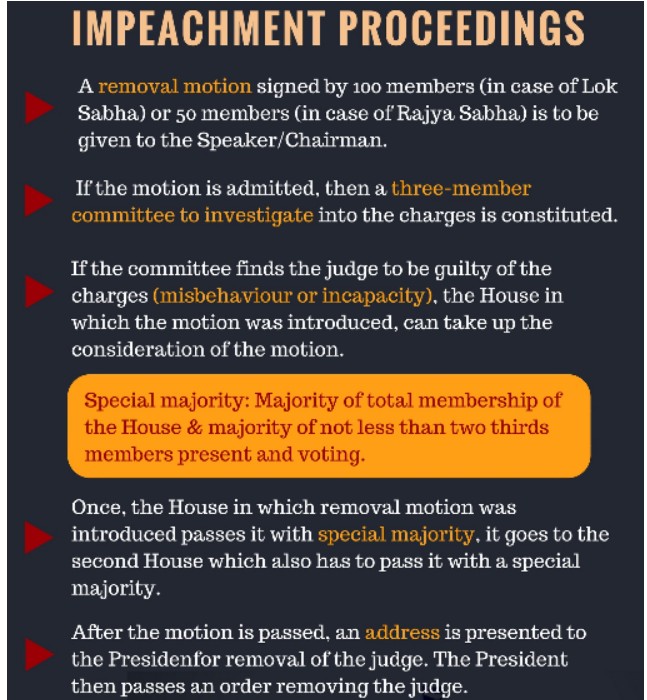
Removal of Judges: The Process

  • The Judges Inquiry Act 1968 regulates the procedure for removing an SC judge and an HC judge.
  • Requires a motion signed by at least 100 MPs in Lok Sabha (LS) or 50 MPs in RS. The Chairman/Speaker may, after due consideration and consultation, admit or refuse to admit the motion. If admitted, a three-member committee (Committee of Inquiry) would be constituted.
  • Committee of Enquiry:
  • Comprises the CJI or SC judge, a High Court CJ, and a distinguished jurist.
  • Investigates charges, frames allegations, examines evidence and cross-examines witnesses.
  • Report findings to the Speaker/Chairperson.

Parliamentary Vote

  • Each House must pass the motion with at least two thirds of the members present and voting and more than 50% of total membership in favour.
  • If both Houses agree, the President issues the removal order.
  • Termination of Proceedings: If the committee finds the judge not guilty, the matter is dropped.
  • From the above, it is clear that the procedure for the impeachment of a high court judge is the same as that for a judge of the Supreme Court.

Limitations with the Process

  • No Success: Despite six impeachment attempts, no judge has been impeached since independence.
  • High Bar for Removal: The stringent voting requirement makes impeachment rare.
  • Political Nature: The process often involves political negotiations and alliances.

Way Forward

  • Judicial Training: Initiatives to ensure sensitivity and ethical conduct among judges.
  • Depoliticization of Process: Measures to reduce political influence in judicial impeachment proceedings.
  • Strengthening Accountability: Regular performance reviews and clearer guidelines for judicial conduct.


UPSC QEP 2026 Batch 5 - English
Buy now View Details
Submit Your Details to Learn More
I agree to give my consent to receive updates through SMS/Email & WhatsApp*.

NEEV GS + CSAT Foundation 2026/27
Buy now View Details


Join theIAShub’s Mains Answer Writing Program

Refine your answer writing skills and elevate your UPSC preparation with personalized support and expert feedback.

Fill out the form to get started with the program or any other enquiries !

I agree to give my consent to receive updates through SMS/Email & WhatsApp*.

Best IAS Coaching In Delhi, UPSC Online & Offline Classes by IAShub

Are you dreaming of becoming an IAS officer? Then, IAShub can be your best guide. It is one of the Best IAS Coaching in Delhi. Many students who want to clear the UPSC exam join IAShub for learning. The institute gives both online and offline classes. Their teachers are experienced and helpful. They easily explain every topic. Students also get notes, tests, and tips to do well in the exam.

UPSC Online Classes by IAShub

IAShub is in Delhi and is trusted by many UPSC students. It offers coaching for every part of the UPSC exam – Prelims, Mains, and Interview. The classes are simple and easy to understand. The teachers are experts and guide students in the right way. IAShub is also known for its helpful notes, test series, and answer-writing practice. IAShub is the best coaching in Delhi and also gives UPSC Online Classes. This helps students from any place in India to learn. The online classes are live and also recorded. So, students can watch them anytime. These classes cover the full UPSC syllabus.

Key Offerings Provided by IAShub

Here are some important services provided by IAShub:

  • UPSC Prelims: IAShub teaches for Prelims with a focus on basics. It also gives daily current affairs and monthly magazines.
  • Classroom Courses: IAShub has classroom learning for students in Delhi. The environment is good and peaceful for study.
  • Live Classes: Students who live far can join live UPSC online classes. These classes are just like real classes.
  • QEP for Mains: The Quality Enrichment Program (QEP) is special for Mains preparation. It helps students write better and faster.
  • Answer Writing: Regular answer writing practice is given. Teachers also check answers and give tips to improve.
  • Free Resource: IAShub gives free notes by toppers and helpful Main Booster material.
  • Test Series: Test series are available for every subject. These help students know their weak points and improve.
  • Interview Guidance Session: IAShub also gives interview practice sessions with experts. These help students feel confident.

UPSC Exam Overview

The UPSC Civil Services Exam has three parts:

  • Prelims: It has two papers: General Studies and CSAT.
  • Mains: It has nine papers, including essays and optional subjects.
  • Interview: It tests the personality and confidence of the student.

This exam is tough, but with the right guidance, it becomes easy to manage. Students must study smart and stay regular.

How IAShub Helps in the UPSC Journey

IAShub supports students from the beginning to the end. It gives the right books, tests, and notes. The classes are easy to follow, and the teachers are always ready to help. Students get personal doubt sessions too. The test series and answer checking help students learn where they need to do better. Also, free study materials save time and money.
IAShub also guides students during the final stage – the interview. Experts take mock interviews and give useful tips. This full support makes IAShub one of the best IAS coaching in Delhi.

Best IAS Coaching In Delhi FAQs

Yes, IAShub offers live and recorded online classes. Students can attend from any part of India.

Classes are available in both English and Hindi, so students can choose the language they are comfortable with.

The classroom centre is located in Delhi. Students can visit and join offline batches there.

IAShub gives interview guidance sessions to help students prepare for the final round of UPSC.