
theIAShub
16 Jul, 2025
Article List
- Nationwide Financial Inclusion: Saturation Campaign sees a Significant Progress
- Dowry Deaths In India: An Ongoing Pandemic with less Convictions
- Decarbonising Global Shipping: India as a Key Player
- Regionalism: Its inherent Dangers
- GW231123: A Black Hole Merger
- Implementation Of The Protection of the Law
- GE-F404 Engine
- Patriot Missile
- Renewable Energy of India
- Splashdown and Post-Space Reconditioning
1. Nationwide Financial Inclusion: Saturation Campaign sees a Significant Progress
Context
- The Department of Financial Services (DFS), Ministry of Finance, launched a three-month nationwide saturation campaign, effective from 1st July 2025 to 30th September 2025 to bolster the outreach of flagship schemes such as Pradhan Mantri Jan Dhan Yojana (PMJDY).
- It also included Pradhan Mantri Jeevan Jyoti Bima Yojana (PMJJBY), Pradhan Mantri Suraksha Bima Yojana (PMSBY), and Atal Pension Yojana (APY)..
Aim
- This campaign seeks to achieve comprehensive coverage across all Gram Panchayats (GPs) and Urban Local Bodies (ULBs), ensuring that every eligible citizen is able to avail the intended benefits of these transformative schemes.
About Financial Inclusion: What is it?
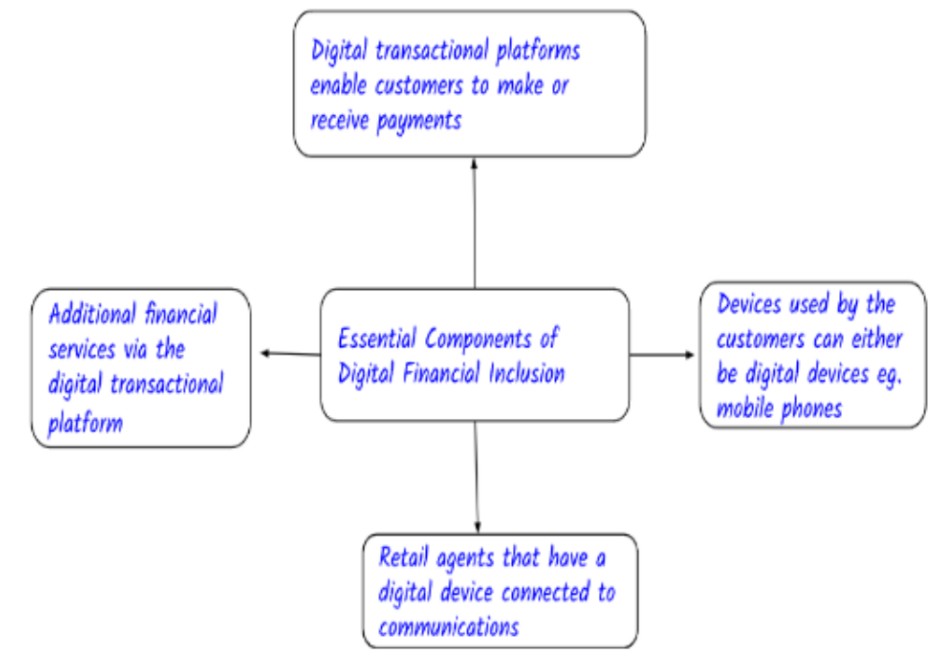
- Financial inclusion refers to ensuring that individuals and businesses can access essential financial products and services, such as savings accounts, loans, insurance, and payment services, at affordable prices.
- Financial inclusion aims to eliminate the barriers that prevent people from participating in the financial sector and using its services to improve their lives. It is also known as inclusive finance.
- Financial inclusion can refer to geographical regions, consumers of a particular gender, consumers of a certain age, or other marginalised groups. Financial inclusion may result in increased overall innovation, economic growth, and consumer knowledge.
Objective
- Financial inclusion aims to offer essential financial services, including basic no-frills accounts for payments, savings and pension products, simple credit and overdrafts, money transfer options, micro-insurance, and micro-pension solutions.
- Financial inclusion ensures accessible, affordable financial services for all, regardless of income or location.
- It promotes economic stability by enabling universal access to banking, credit, and insurance, empowering individuals to participate in the formal financial system.
Status of Financial Inclusion In India
India has made significant strides in promoting financial inclusion, but gaps remain. In consultation with the concerned stakeholders, including the government, the Reserve Bank of India constructed FI-Index to capture the extent of financial inclusion across the country.
- Overall Banking: According to the World Bank Global Findex Database (2021), about 78% of Indian adults have bank accounts.
- However, account usage and access to credit continue to be low.
- Digital Payment: UPI has transformed digital payments nationwide; at a compound annual growth rate (CAGR) of 129%, UPI transaction volume increased from 92 crore in FY 2017–18 to 13,116 crore in FY 2023–24.
- Gender Disparity: According to the National Statistical Office‘s “Women and Men in India 2023” report, women account holders account for only 20.8%, or roughly one-fifth, of total bank deposits in India.
- Presence of Informal Banking: Despite progress, disparities in financial inclusion persist, with rural and low-income groups having limited access. Many still depend on informal, often costly financial services like moneylenders and savings groups.
Initiatives for Financial Inclusion In India
The Government of India has implemented various financial inclusion initiatives to enhance access to banking and financial services, such as PMJDY, PM Mudra Yojana, UPI, and Kisan Credit Card, ensuring financial empowerment for all citizens.
- Pradhan Mantri Jan Dhan Yojana (PMJDY): Launched in 2014, PMJDY is the world’s largest financial inclusion initiative, aiming to provide bank accounts to every household in India.
- The scheme offers zero-balance accounts, accident insurance up to Rs 1 lakh, and overdraft facilities of up to Rs 10,000, providing financial security and emergency support to eligible holders.
- Under PMJDY, over 53 crore bank accounts have been opened by August 2024, ensuring basic savings, overdraft facilities, and accidental insurance.
- This ambitious program forms a crucial pillar of the JAM trinity (Jan Dhan-Aadhaar-Mobile), which serves as a powerful tool for direct benefit transfers and financial inclusion.
- Pradhan Mantri Mudra Yojana: This scheme provides loans to micro and small enterprises to help them start or expand their businesses. Since its inception, as of April 2023, MUDRA has disbursed over ₹23 lakh crore to MSMEs, fueling entrepreneurship and employment in low-income communities.
- Unified Payments Interface (UPI): UPI revolutionised digital transactions in India by providing a real-time payment system through smartphones.
- By 2023, UPI processed over 14 billion transactions per month.
- Banking Correspondents Model: It promotes financial inclusion by deploying representatives to offer banking services in remote, unbanked areas. These agents handle deposits, withdrawals, microfinance loans, and essential banking functions.
- Kisan Credit Card: The Kisan Credit Card (KCC) scheme is a financial inclusion initiative launched by the Government of India in 1998 to provide easy and hassle-free credit to farmers to meet their short-term and medium-term credit needs.
- The scheme allows farmers to access credit from banks and financial institutions through a simple and convenient process, eliminating the need for collateral or other guarantees.
Challenges for Financial Inclusion
- Demand Side Factors: Lower income or asset holdings, lack of awareness about the financial products, high transaction costs, etc.
- Supply side challenges: Financial institutions' refusal to serve low-value and non-profitable consumers with uneven income.
- Digital and Infrastructure Gaps: The digital divide, inadequate mobile connectivity, and frequent power failures particularly in remote areas.
- Regulatory challenges, such as stringent Know-Your-Customer (KYC) requirements, make it difficult for low-income individuals to access financial services.
- Lack of Financial Literacy: Many potential users lack the basic financial literacy needed to effectively use formal financial services, which can lead to the exclusion of vulnerable groups.
- For instance, due to poor financial literacy, around 20% of the PMJDY Accounts are dormant and approximately 8.4% of the accounts currently have a zero balance.
Significance of Financial Inclusion
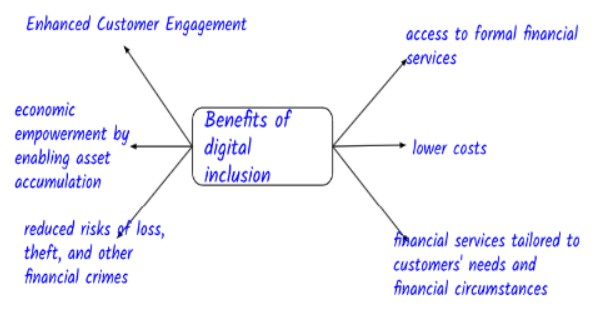
- Plugging the Credit gap: Access to formal and adequate credit from the formal banking channels can fuel the enterprising spirit of the masses in order to create economic output and enhance income levels at the grassroots.
- It allows MSMEs to access credit, which can enhance their capacity to grow, generate jobs, and contribute to national GDP.
- Encouragement of Saving Habits: With access to banking services, people are encouraged to save money regularly.
- This can help increase capital formation in the country and provide an economic boost.
- Inclusive growth: Financial inclusion is critical for poverty reduction as this helps in transferring the benefits of economic growth and development to the lowest strata of the population.
- It creates a multiplier effect by encouraging investment in education and health, driving long-term economic development.
- Plug the subsidy gaps: The Government's push for Direct cash transfers to the recipient's bank accounts instead of providing subsidies inefficiently.
Way Forward
- Foster Public-Private Partnerships: Collaborations between governments, financial institutions, and telecom companies can accelerate financial inclusion.
- Public policies should encourage private sector involvement in providing mobile money services and digital payment platforms.
- Promote Financial Literacy: RBI, in coordination with other banks and educational institutions, scan ensure financial inclusion as a subject from school to higher levels of education.
- Leverage Fintech Innovations: Fintech solutions like mobile banking, digital payments, and alternative credit scoring models can cater to unbanked populations by providing low-cost, scalable financial services.
- Tailored Financial Products: Financial institutions can offer customized products suited to the needs of low-income groups, such as microinsurance and pension schemes. E.g. PM Atal Pension Yojana.
2. Dowry Deaths In India: An Ongoing Pandemic with less Convictions
Context
- Despite decades of legislation and activism, dowry continues to claim lives, particularly among young married women.
About Dowry
- The Dowry Prohibition Act, 1961 defines dowry as ‘any property or valued security given or agreed to be given, directly or indirectly, to either partner in a marriage, to the other party’s parents, to any other person, is referred to as dowry’.
- Dowry-related violence and deaths are symptoms of deep-rooted patriarchy, and remains one of the most persistent forms of gender-based crimes in India.
- In many cases, women are subjected to mental and physical abuse, culminating in suicide or murder — often by burning, poisoning, or hanging.
- Existing Legal Frameworks
- Dowry Prohibition Act, 1961 criminalizes giving, taking, or demanding dowry.
- Section 304B of IPC defines dowry death and prescribes punishment (minimum 7 years to life imprisonment).
- Section 498A of IPC penalizes cruelty by husband or relatives.
Dowry Deaths In India, Current Statistics
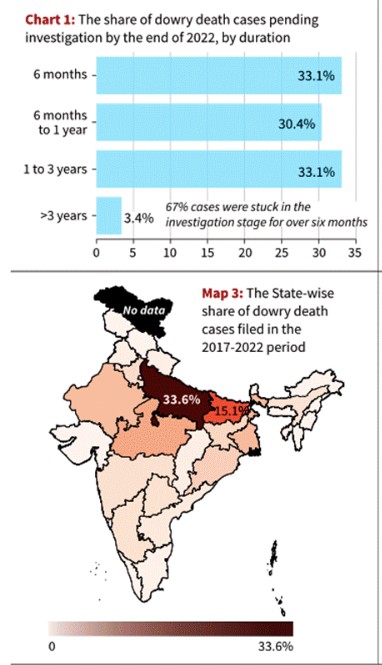
- High-Burden States: According to NCRB data for 2022, 6,450 dowry deaths were registered across India;
- Uttar Pradesh (highest), Bihar, Jharkhand, Madhya Pradesh, Odisha, Rajasthan, and Haryana together contributed 80% of all dowry death cases.
- From NCW’s 2024 complaint data: 4,383 cases of dowry harassment (17% of total complaints): 292 cases of dowry deaths.
- Over 60% of dowry murders occurred in West Bengal, Odisha, and Bihar.
- Cities with Highest Cases: Delhi alone accounted for 30% of all dowry death cases among India’s 19 major cities.
- Other high-reporting cities include Kanpur, Bengaluru, Lucknow, and Patna.
Causes Behind Dowry Deaths
- Cultural Acceptance: Dowry is still seen as a customary obligation, especially in arranged marriages.
- Economic Exploitation: Dowry is often used to secure financial gain or status for the groom’s family.
- Gender Inequality: Women are viewed as financial burdens, leading to coercive demands and abuse.
- Districts with skewed sex ratios show higher dowry death rates (Sex ratio imbalance).
- Illiteracy and Lack of Awareness: Many women are unaware of their legal rights or fear retaliation (Lower levels correlate with increased vulnerability).
- Delayed Justice: Investigations are often slow, and convictions rare, weakening deterrence.
- Caste and kinship structures: Hypergamy and patrilocality intensify dowry pressures.
Institutional Gaps and Policy Limitations
- Police Apathy: Investigation delays and inadequate FIRs weaken prosecution.
- Judicial Delays: Lack of fast-track courts for such gender-based crimes.
- Witness Protection: Lack of support leads to witness intimidation or withdrawal.
- Forensic and Medical Negligence: Inadequate evidence due to improper post-mortem or forensic procedures.
Concerns and Issues
- Policing and Investigations: Of the 7,000 yearly cases, only 4,500 were charge-sheeted.
- Many cases were dropped due to reasons like ‘insufficient evidence’, ‘false complaints’, or ‘misunderstanding’.
- By the end of 2022, 67% of pending dowry death investigations had been stalled for over six months.
- Delay in Charges and Trials: In 2022, 70% of the charge-sheets were filed after two months or more, showing procedural inefficiencies.
- From 6,500 trials initiated annually, only around 100 led to convictions.
- Over 90% of cases remain pending in courts.
- Acquittals, plea bargains, and withdrawn complaints account for a large number of unresolved cases.
Way Forward
- Reform Investigative Procedures:
- Enforce time-bound charge-sheeting and mandatory oversight on delayed investigations.
- Improve coordination between police, medical officers, and forensic labs.
- Strengthen Legal Infrastructure:
- Fast-track courts for dowry and domestic violence cases.
- Training police and judiciary on gender-sensitive protocols.
- Societal Intervention:
- Gender-sensitization programs in schools, colleges, and panchayats.
- Reward dowry-free marriages through public recognition and incentives.
- Institutional Support to Victims:
- Expand helplines, safe houses, and victim compensation schemes.
- Legal aid and counseling centres at district level.
- Data Transparency and Monitoring:
- Disaggregated data publication by NCRB including details on pendency, conviction, withdrawal, and state-wise bottlenecks.
3. Decarbonising Global Shipping: India as a Key Player
Context
- Global shipping aims for decarbonisation by 2040–50, shifting from Very Low Sulphur Fuel Oil (VLSFO), diesel, and LNG to green fuels like green ammonia, e-methanol, and biofuels.
About Green Shipping
- Green shipping refers to environmentally sustainable practices and technologies used in the maritime industry to reduce the environmental impact of shipping activities.
- It includes cutting greenhouse gas (GHG) emissions, improving energy efficiency, and minimizing marine pollution.
Need for Green Shipping
- Global Emissions: The shipping industry emits around 1 billion tonnes of GHG annually, accounting for about 2.8% of global emissions
- Future Projections: Emissions may increase by 50–250% by 2050 if unchecked.
- Measures Already Enforced:
- Energy Efficiency Design Index (EEDI): Sets efficiency standards for new ships.
- Energy Efficiency Management Plan (SEEMP): Operational plans to cut emissions.
- Mandatory fuel oil consumption reporting: Improves accountability and transparency.
Production of Green Fuel
- Green hydrogen is produced via water electrolysis using renewable energy.
- For shipping, more stable alternatives like green ammonia (from green hydrogen and nitrogen) and green methanol (from green hydrogen and industrial carbon dioxide) are preferred.
- India promotes green ammonia to reduce LNG imports in fertilizer production.
Green Methanol as Preferred Fuel
- Shipping is gradually adopting green methanol as its primary decarbonisation fuel due to its ease of use and lower carbon emissions—about 10% compared to conventional fuels.
- Green methanol can largely replace VLSFO without major engine modifications, unlike green ammonia, which, despite emitting no greenhouse gases, requires complex onboard handling.
- Over 360 methanol-capable ships are already operational or on order, supported by major companies like Maersk, CMA CGM, and Evergreen.
- Demand for green methanol is projected to exceed 14 million tonnes by 2028, while supply is expected to lag at around 11 million tonnes, adding further price pressure.
India’s Shipping Decarbonisation Strategy and Global Green Fuel Ambitions.
- India plans to decarbonise its domestic shipping by promoting green fuels for container ships and establishing green fuel bunkering hubs at ports like Tuticorin (V.O. Chidambaranar) and Kandla.
- The government also aims to produce and export green fuels to Singapore, a major global ship fuelling hub handling nearly 25% of the world’s ship fuel needs.
- With its large solar power capacity and expertise, India is positioning itself as a key global supplier of green fuels to support international shipping’s shift towards sustainability..
Reviving Indian Shipbuilding Through Green Fuel Initiatives
- To boost shipbuilding and shipowning, India is offering demand-side support and incentives for foreign partnerships, especially with South Korean and Japanese shipbuilders.
- The focus is on building new ships and retrofitting existing ones for green fuel compatibility.
- India has committed $10 billion to purchase over 110 ships, with plans to ensure 10–20% of these are green fuel-capable, built in Indian shipyards, and fly the Indian flag.
- This strategy aims to scale up local shipbuilding while aligning with global decarbonisation goals.
4. Regionalism: Its inherent Dangers
Context
- The Supreme Court of India stated that promoting regionalism for electoral gain is as dangerous as communalism, warning against political parties inciting regional divisions that threaten national unity.
About Regionalism: What is it?
- Regionalism refers to loyalty or political movement prioritizing a region interest over National Integration.
- It can turn divisive when used for vote bank politics overturning constitutional values of integrity and Unity.
Other Facets of Regionalism
- Shared Identity: Regionalism reflects a shared sense of identity among people in a specific geographical area.
- It often originates among groups in particular areas due to distinct ethnic, linguistic, economic, and cultural consciousness.
- Evolution in India: Roots of regionalism in India can be traced back to the colonial period which deepened regional disparities across the country.
- First form of regionalism in post-independent India was the demand for the creation of linguistic states, sparked by the hunger strike of Potti Sriramalu, who fasted unto death in 1952.
- Later on, the creation of the states of Jharkhand, Chhattisgarh, and Uttarakhand in 2000, and formation of Telangana state separated from Andhra Pradesh in 2014, are some of the recent chapters in the trajectory of regional movements in India.
Types and Manifestations
- Demand for Autonomy: Gorkhaland or Bodoland.
- Sub Regional Identity Politics: Maharashtra Sons of Soil Campaigns.
- Language Based: Anti-Hindi agitation in Tamil Nadu.
Factors Behind Regionalism
- Linguistic and Cultural Identity: For example, the Dravidian movements in Tamil Nadu stemmed from linguistic identity.
- Ethnocentrism: Natives presume that they possess the authenticity over the regional issues and they imagine a sort of body politics that includes themselves and exclude the 'other' as outsiders.
- For instance, the construct of Marathi Manoos, which is meant to imply those persons who are natives of Maharashtra belonging to Maharashtra, thus excluding persons of other states.
- Tribal Identity: Socio-economical differences in tribal life accentuates regional tendencies.
- The rationale for creation of the state of Jharkhand was partly based on its tribal cultural heritage. Unequal distribution of resources: For example, Gorkha Nationalist Liberation Forum (GNLF) emerged in Darjeeling due to the feeling of regions underdevelopment compared to South Bengal.
- Development and Administrative Issues: Some regions feel left out while taking policy decisions for the entire region such as water distribution, budget allocations, employment opportunities etc.
- These were driving factors for the formation of state of Telangana from Andhra Pradesh.
Impact of Regionalism (National Unity and Regionalism)
Positive Impact
- Strengthening Federalism: Promotes a stronger federal structure by encouraging states to assert their rights and seek greater autonomy.
- Enhanced Political Representation: Gives voice to local issues and marginalized communities that national parties may overlook.
- Promotion of Cultural Diversity: Preserves and promote India's cultural, linguistic, and ethnic diversity by championing local traditions, languages and customs, etc.
- Conflict Resolution and Integration: Provides a platform for expressing regional grievances and aspirations within the democratic framework, reducing the likelihood of violent conflicts.
Negative Impact
- Threat to National Unity: Extreme regionalism can foster divisive sentiments, leading to conflicts between states or between regional and national interests and in extreme cases it also leads to rise of Secessionist Movements.
- Bias and Discrimination: Regionalism often encourages identity-based politics.
- For example, Driven by the spirit of 'Son of the Soil,' demands for job reservations for locals have been raised. There have been many instances where attacks on migrant laborers led to their mass exodus.
- Political Fragmentation: The proliferation of regional parties often leads to fragmented electoral outcomes, making it difficult to form stable governments.
- Prioritization of Regional over National Interests: The narrow focus on regional interests can lead to resource allocation imbalances and policies that serve regional rather than national goals.
Way Ahead
- Fostering National Unity: Encourage an inclusive national identity through education programmes and promote cultural exchange programmes.
- Cultural Integration: Frequent cultural contacts should be promoted to break the regional barriers and to develop the nationalist spirit.
- For example, Ek Bharat Shreshtha Bharat programme enhances interaction & promote mutual understanding between people of different states/UTs.
- Strengthening Federalism: Empowering states and local bodies and promoting Cooperative Federalism can help in accommodating regional aspirations within the national framework.
- Inclusive Development: Implement targeted programs and infrastructure projects to boost economic activity and create jobs in under-developed areas.
- Functioning Autonomy: Union Government must not interfere in the affairs of the state unless it is unavoidable for national interest.
5. GW231123: A Black Hole Merger
Context
- Recently, an international team of astrophysicists announced the discovery of an exceptionally rare black hole merger, identified as GW231123.
About Black Hole Merger
- Occurs when two black holes, incredibly dense regions with gravity so strong that not even light can escape, come close and begin orbiting each other.
- As they orbit, they emit gravitational waves, ripples in spacetime predicted by Einstein's theory of general relativity, causing them to lose energy and gradually move closer.
- Eventually, their orbits decay, leading to a final collision where they merge into a single, more massive black hole.
- This powerful event releases a burst of gravitational waves, detectable by observatories like LIGO (USA), Virgo (Italy), and KAGRA (Japan).
About GW231123:
- Two black holes - one around 137 times and the other 103 times the mass of the Sun - merged to form a supermassive black hole.
- The combined mass falls in the "mass gap" (100-150 solar masses), where existing models predict very few black holes should exist.
- Both black holes were observed to be spinning at extremely high speeds, challenging current theories of black hole formation and angular momentum.
About Black Holes
- Are extremely dense cosmic objects with gravitational forces so intense that not even light can escape. The existence of black holes was first predicted by Albert Einstein in 1916 through his general theory of relativity.
- Black holes grow by accreting nearby matter, pulling in stars, gas, and dust through their intense gravitational field.
- The central point of infinite density where the black hole's entire mass is concentrated.
6. Implementation Of The Protection of the Law
Context
- Recently, the Union government's 2022 annual report on the Implementation Of The Protection Of Civil Rights Act (PCR Act), 1955, revealed a decline in the number of criminal cases registered for offences related to "untouchability.
Key Highlights
- Only 13 cases were registered under the PCR Act in 2022, compared to 24 in 2021 and 25 in 2020.
- Cases in 2022 were reported from Jammu and Kashmir (5), Karnataka (5), Maharashtra (2), and Himachal Pradesh (1).
- High Pendency and Low Convictions: Over 97% of cases remain pending in courts.
- ✓ Of 31 cases disposed of in 2022, only 1 resulted in conviction, while 30 ended in acquittals.
- All 37 cases disposed of between 2019 and 2021 ended in acquittals.
Police Investigations
- Out of 51 cases pending with police, charge-sheets were filed in only 12 during 2022.
- Untouchability-Prone Areas: No State or Union Territory declared any area as "untouchability prone".
- Comparison with SC/ST (PoA) Act, 1989: In contrast, 62,500 cases were registered under the SC/ST (Prevention of Atrocities) Act in 2022.
- Pendency stood at over 17,000 cases with police and 2.33 lakh cases in courts.
- Inter-caste Marriage Incentives: 18,900 inter-caste couples received 2.5 lakh each in financial support under the PCR Act.
- Financial support under the PCR Act. States with No or NIL Data Submission: Bihar, Punjab, Uttar Pradesh, Jharkhand: Did not submit data on inter-caste marriage incentives.
- Arunachal Pradesh, Meghalaya, Mizoram, Nagaland, Lakshadweep: "NIL" reports.
7. GE-F404 Engine
Context
- Recently, India received the second GE-F404 Engine from the United States, marking a significant milestone in the country's defence indigenisation efforts. The engine is part of the ongoing programme to power the Light Combat Aircraft (LCA) Tejas Mk-1A.
About Tejas LCA Mk1A
- An upgraded variant of India's indigenous Light Combat Aircraft, developed by Hindustan Aeronautics Limited (HAL).
- It includes over 40 improvements over the Mk1 variant, enhancing combat performance, survivability, and operational efficiency.
- Equipped with Active Electronically Scanned Array (AESA) radar systems: Israeli EL/M-2052 AESA Radar and Indigenously developed Uttam AESA Radar.
- Electronic Warfare Systems: Features a Unified Electronic Warfare Suite (UEWS)
- Includes an Advanced Self-Protection Jammer Pod for improved survivability.
- Digital Fly-by-Wire System: Uses an upgraded Digital Flight Control Computer (DFCC Mk1A) for better maneuverability and flight stability.
- Weapons Capability: Equipped with nine hardpoints to carry a variety of weapons including:
- Beyond Visual Range (BVR) missiles
- Air-to-Air and Air-to-Ground missiles
- Advanced Short Range Air-to-Air Missiles (ASRAAM).
About GE F404-IN20 Jet Engine
- Originally selected in 2004, it is a high-thrust variant of the F404 engine family.
- Key features include: Higher-flow fans, Single-crystal turbine blades and Components tailored for the Indian Air Force (IAF).
8. Patriot Missile
Context
- Recently, U.S. President Donald Trump announced that Ukraine will be provided with Patriot missile defence systems as part of a new U.S. military aid package. The decision received strong approval from Kyiv, which continues to endure persistent Russian aerial attacks.
About Patriot Missile
- Stands for Phased Array Tracking Radar for Intercept on Target.
- It is an all-altitude, all-weather, surface-to-air missile defense system developed by Raytheon Technologies Corp.
- Originally designed to counter aircraft, modern variants now defend against ballistic missiles, cruise missiles, loitering munitions, and enemy aircraft.
- It is the most advanced air defence system of the U.S. Army and is also used by many allied nations.
Technological Features
- Utilizes a Track-Via-Missile (TVM) guidance system.
- Midcourse corrections are provided by the mobile engagement control center.
- Interceptor Variants: PAC-2 interceptor: Uses a blast-fragmentation warhead.
- PAC-3 interceptor: Features hit-to-kill technology for precision targeting.
- Range and Reach: : Reach altitudes of over 24 kilometers.
- Strike targets at distances up to 160 kilometers, depending on the version.
- The radar system has a range of over 150 kilometers (93 miles).
- First deployed during the 1991 Gulf War, defending Saudi Arabia, Kuwait, and Israel.
9. Renewable Energy of India
Context
- Recently, India achieved a major milestone in its energy transition journey, with over 50% of its installed electricity generation capacity now coming from non fossil fuel sources. This achievement comes five years ahead of India's 2030 target under the Paris Agreement.
Key Highlights
- Solar capacity has seen a 4,000% increase over the past decade.
- Previous data (June 2025): Total capacity was 476 GW, with non-fossil fuels contributing 49%
- Major Policy Drivers: PM-KUSUM Scheme: Promotes solar-powered agriculture and feeder-level solarisation.
- PM Surya Ghar: Muft Bijli Yojana: Launched in 2024, aims to install rooftop solar systems in 10 million households.
- Solar Parks and Hybrid Renewable Policies: Enabled cost-effective, large-scale deployment.
- Wind Energy: Plays a major role in meeting peak demand in states like Gujarat and Tamil Nadu.
- India aims to achieve 500 GW of non-fossil fuel capacity by 2030 and reach net-zero emissions by 2070 as part of its long-term clean energy goals.
About Paris Agreement
- A legally binding international treaty on climate change.
- Adopted by 195 Parties during the UN Climate Change Conference (COP21) in Paris, France, on 12 December 2015.
- Officially entered into force on 4 November 2016.
Objectives
- The primary goal is to limit the global average temperature increase to well below 2°C above pre-industrial levels.
- It also aims to pursue efforts to limit the temperature rise to 1.5°C above pre-industrial levels.
10. Splashdown and Post-Space Reconditioning
Context
- Recently, Group Captain Shubhanshu Shukla of the Indian Air Force safely returned to Earth after an 18-day mission aboard the International Space Station (ISS) as part of Axiom-4. He completed 288 orbits before safely splashing down in the Pacific Ocean with his crewmates aboard SpaceX's Dragon spacecraft 'Grace'.
About Splashdown
- Term used to describe the landing of a spacecraft in water, usually in the ocean, after it returns to Earth from space.
- Enhanced Safety and Simplicity: Spacecraft re-enter Earth at extremely high speeds (over 27,000 km/h).
- Landing in water offers a softer impact than solid ground, as the ocean acts as a cushion, helping to protect both the crew and onboard equipment during the high-speed descent.
About Post-Space Reconditioning
- After spaceflight, astronauts follow a personalised recovery plan to restore balance, spatial orientation, and physical strength affected by microgravity.
- In space, the brain adapts by ignoring gravity signals, which disrupts balance on return, causing motion sickness, spinal discomfort, and muscle weakness.
- It involves physical, medical, nutritional, and psychological support to help astronauts readjust to Earth's gravity.
- NASA Data on Post-Space Health: Over 90% of astronauts face health issues post-mission, with 50% reporting disc herniation, muscle strain, fatigue, and balance problems.

2026-27 UPSC Mains English QEP Power Pages
View DetailsSubmit Your Details to Learn More



