

- Economic Growth, Development, Inequality, Inclusive Growth
- Economic Planning in India: History, Achievements, Challenges & NITI Aayog
- Mobilization of Resources in India: Types, Challenges & Solutions
- Banking Sector in India
- Fiscal Policies
- Overview of Indian Agriculture: Major Crops, Current Scenario & Challenges
- Genetically Modified Crops
- Agriculture Credit in India: Trends, Challenges & Government Initiatives
- Urban Agriculture
- Irrigation in India: Types, Importance, Challenges & Government Schemes
- Transport of Agricultural Produce: Importance & Government Initiatives in India
- E-Technology in Agriculture: ICT Innovations Empowering Indian Farmers
- Agriculture Subsidy in India: Types, Benefits, Issues & Government Schemes
- Minimum Support Price (MSP): Objectives, Issues, Significance, Crops, Reforms
- Economics of Animal Rearing in India: Livestock, Dairy & Fisheries Sector Overview
- LPG Reforms in India: Causes, Policies & Impact on Economy
- Energy Poverty in India
- External sector and India’s Trade
- Inclusive Growth in India: Policies, Challenges & the Way Forward
- Financial Inclusion in India: Meaning, Challenges, Government Initiatives & Way Forward
- Non - Banking Financial Institutions (NBFCs)
- Non -Performing Assets (NPA) Crisis in India
- Bad Bank: Addressing Non-Performing Assets (NPAs) for a Resilient Banking System
- Microfinance in India: Definition, Evolution, Challenges, Significance
- Privatization of Banks: Opportunities and Challenges
- Bank Recapitalization
- Insolvency and Bankruptcy Code (IBC) Reforms: GN Bajpai Committee’s Key Recommendations, Impact
- Digital Banks: A Proposal for Licensing & Regulatory Regime for India
- Neo banks
- Card Tokenization
- Cropping Pattern in India: Types, Factors, Issues & Crop Diversification Explained
- Northward Shift in Sugarcane Production, Climate Smart Agriculture in India
- Millets in India: Benefits, Challenges & Global Recognition
- Jute sector
- Natural Farming
- Organic Farming in India: Principles, Practices, Challenges & Initiatives
- Primary agriculture credit societies
- Groundwater in India: Challenges, Solutions & Government Initiatives
- Storage, Transport & Marketing of Agricultural Produce in India
- Agricultural Marketing in India: Challenges, e-NAM & Future Roadmap
- Supply Chain Management in Food Industry: Importance, Challenges & Solutions
- APMC Act vs Model APLM Act 2017: Unified Agri-Market & Role of FPOs
- Doubling Farmers' Income in India: Goals, Strategies & Government Initiatives
- Public Distribution System (PDS) in India: Food Security & One Nation One Ration Card
- Food Processing Industry in India: Growth, Challenges & Government Initiatives
- Buffer Stock of Food Grains in India: Concept, Advantages, Issues & Way Forward
- Food Storage
- Changes in Industrial Policy in India and their Effects on Industrial Growth
- Need for Economic Reforms 2.0
- Industry 4.0 in India: Revolutionizing Manufacturing & Digital Economy
- MSME Sector in India: Importance, Challenges, Classification & Government Initiatives
- Introduction to Special Economic Zones (SEZs) in India: Features, Challenges & Reforms
- Semiconductor Industry in India: Opportunities, Challenges & Policies
- Fintech in India: Growth, Opportunities, Government Initiatives & Challenges
- E-commerce in India: Growth, FDI Policy, Challenges & Government Initiatives
- National Technical Textiles Mission: Boosting India's Potential in the Technical Textiles Sector
- Power Sector DISCOMs in India: Challenges & Reforms
- India's Push Towards a Gas-Based Economy
- India’s Renewable Energy Revolution: Growth, Policy & Future
- Inland Waterways: Unlocking India's Transport Potential
- India Road Infrastructure: Development, Challenges, Future Plans
- Electric Vehicles in India: Growth, Challenges & Government Initiatives
- Hybrid Electric Vehicle
- Vehicle Scrapping Policy
- National Infrastructure Pipeline (NIP) & PM Gati Shakti: Paving the Way to a $5 Trillion Indian Economy
- Multi-Modal Logistics Park (MMLP) in India: Advantages, Challenges, Way Forward
- Forex reserves
- Depreciation of Indian rupee
- Global trade in Rupees
- New Foreign Trade Policy 2023
1. Economic Growth, Development, Inequality, Inclusive Growth
Economic growth: Economic growth refers to the increase in a country's real gross domestic product (GDP) over time. It represents the expansion of the economy's productive capacity and is typically measured as the percentage change in GDP from one period to another, usually on an annual basis.

Phases of Economic Growth: The economy moves through different periods of activity. This movement is called the “business cycle.” It consists of four phases:
|
Inequality and Growth: Context- As per the World Inequality Report (2022), the Covid pandemic has further exacerbated global inequalities with the top 1 percentile accounting for 38 per cent of all the additional wealth accumulated since the mid-1990s and this trend has become more pervasive since 2020 with wealth inequality remaining at extreme levels world over. Reasons behind the inequality in India, including:  Reasons why high growth may not necessarily lead to a decrease in inequality
Way Forward
|
Economic Development
Economic development refers to the process of positive and sustainable change that leads to the improvement of various aspects of society, including economic, social, and environmental conditions, to enhance the overall well-being and quality of life for individuals and communities.


Positive aspects and notable achievements of India's development story
- Economic Growth: India has achieved significant economic growth, becoming one of the fastest-growing major economies globally. India’s is currently the fifth largest economy in the world.
- Technological Advancements: India is a leader in the IT and software industry, with a thriving technology sector and successful startups. Indian software product industry is expected to reach US$ 100 billion by 2025.
- Demographic Dividend: India's large and youthful population provides a potential workforce for innovation and economic productivity. About, 67% of India’s population is between the age of 15 to 64 years
- Space and Nuclear Technology: India has made remarkable strides in space exploration and satellite technology. For eg, India is one of the only six countries including US, France, Russia, China, and Japan which have developed their own cryogenic engines.
- Healthcare and Medical Research: India is rightly termed as ‘ pharmacy of world’ with third rank worldwide for pharmaceutical production by volume and has emerged as a dependable nation when it comes to health crises.
- Renewable Energy: India has made notable progress in renewable energy, particularly in solar and wind power, reducing dependence on fossil fuels. This is reflected in important initiatives like the International Solar Alliance.
Conclusion: India's economy is hindered by many issues. India's full potential and people's well-being depend on addressing these challenges and pursuing inclusive and sustainable development. India can achieve balanced development by reducing inequalities, investing in education and infrastructure, promoting environmental sustainability, and strengthening governance.
2. Economic Planning in India: History, Achievements, Challenges & NITI Aayog
Economic Planning In India refers to the strategic allocation of resources through long-term plans aimed at ensuring balanced economic growth and social equity. India formally adopted economic planning in 1951 with the launch of the First Five-Year Plan, influenced by leading economists and policymakers like Jawaharlal Nehru and P.C. Mahalanobis. The Planning Commission, established in 1950, played a central role in shaping the direction of India’s development until it was replaced by NITI Aayog in 2015. Over the decades, economic planning has contributed to substantial progress in agriculture, industry, infrastructure, and human development. However, persistent challenges such as poverty, unemployment, regional disparities, and administrative inefficiencies continue to test the efficacy of planning frameworks. This article explores the journey of economic planning in India, evaluates its key achievements and limitations, and highlights the role of NITI Aayog in reshaping India’s policy landscape in the 21st century.
Economic Planning in India Evolution
|
Achievements of Economic Planning in India

- Achieved above the target growth rate-First five-year plan was a success as it achieved a growth rate of 3.6 per cent against a target of 2.1 percent growth rate in national income.
- Agricultural development: Food grain production increased from 51 million tonnes in the first plan to 257.4 million tonnes in 2011-12.
- Industrial development: a major achievement has been the diversification of Indian industries., expansion of transport and communications, growth in generation and distribution of electricity etc
- large expansion roads and railway networks, domestic air travel has increased significantly.
- Expansion of irrigation and hydro-electric projects has given a boost to agricultural production.
- Increase in urban infrastructure-There has been growth in establishment of towns and cities due to increase in urban infrastructure.
- Communication networks: in the form of mobile telephony, internet has expanded tremendously.
- Gross enrolment rate has been increased to over 98%.
- Literacy rate has increased from 18% in 1950s to 74.04 per cent as per the Census 2011.
- Increase in technical and skilled manpower.
- Pioneering Space research like Chandrayaan, Mars Orbiter Mission, private sector taking roots in the space sector.
- Impetus to nuclear and other renewable energy-it is now able to send technical experts to many foreign countries in the middle east, Africa etc.
- Due to industrialization in the country, India’s dependence on import of capital goods has declined.
- India’s overall export crossed $750bn from being negligible at the time of independence.
Drawbacks of Economic Planning in India
Besides the achievements as told above, there are many unfulfilled tasks which the planning in India is yet to achieve completely.
- Failure to Remove Poverty and Inequality completely: 21. 9 % population under poverty in 2011 as per last official estimates. Just 5 per cent of Indians own more than 60 per cent of the country’s wealth (OXFAM 2023 report).
- Problem of Unemployment Persists:
- Huge backlog of unemployment: lack of creation of required number of jobs every year.
- Lack of skillful population: Only around 5% of the workforce
- Female labour force participation was just around 25.1% in 2020-21
- Sluggish Industrial development:
- Despite major focus on industrialisation in the 5-year plans, contribution of industry to the GDP is less than 25%
- Lack of development of labour-intensive sector due to strict labour laws leading to unemployment and poverty.
- Failure to Curtail Corruption and Black Money:
- Rampant corruption and red tapism. Corruption perception index- 85/180.
- Black money in the system is around 50% of the GDP, according to the IMF, which is also the root cause of inequality in distribution of income.
Planning Commission of India
Planning commission was a non-constitutional and non- statutory organization set up by government resolution on 15th March 1950 which was given the authority to formulate the five-year plans for economic growth.
|
It had the following functions
|
Achievements of the planning commission
|
Issues with the Planning commission
|
NITI Aayog
NITI Aayog (National Institute for Transforming India) was established as a successor of the Planning Commission as an extra-constitutional body created by an executive resolution. It has been created as a premier policy think tank of the government providing both directional and policy inputs.
Achievements of NITI Aayog

- Strategy and vision depicted under action agenda beyond 12th five-year plan- 7-year strategy document and 3-year action agenda.
- Reforms in agriculture-
- Through Model land leasing act 2016 to recognise rights of tenant and safeguard interest of landowners
- Agricultural Marketing and Farmer Friendly Index—to sensitise states to market reforms, land lease, forestry, etc.
- Reforming Medical education- Recommended scrapping the Medical Council of India and proposed National Medical Commission making it more representative and accountable.
- Digital Payment Movement- To promote financial inclusion:
- Recommended cashback and referral bonuses through BHIM UPI.
- Launched Digi Dhan Vyapar Yojana to promote digital payments.
- Promoting innovation- Atal Tinkering Labs and Incubation Centres launched to foster youth innovation and entrepreneurship.
- Indices Measuring states’ performances in health, education and water management- to foster competitive federalism like Healthy states, progressive India index
Way forward
- The NITI Aayog need to function as an independent think tank without any political interference.
- It needs to be empowered with adequate financial powers.
- Making the NITI Aayog answerable to the Parliament would make it more accountable.
- The NITI Aayog need to focus and strengthen the aspects of decentralized planning and development.
3. Mobilization of Resources in India: Types, Challenges & Solutions
Mobilization of Resources in India refers to the process through which the potential of the resources are unlocked and are utilised for achieving the developmental agendas of the country. It is the identification, organisation and utilisation of the available resources so that the economic growth is maintained.
Components of Mobilization of Resources in India

Types of resources
- Natural resources- Naturally occurring substances that are considered valuable in their natural form. It could be further divided into: -
- Abiotic resources- Sunlight, water, soil etc
- Biotic resources- Forests, animals etc
- Mineral resources—Coal, oil, iron—require processing before use. India has over 20,000 mineral deposits
- Human resources- The economy's workforce turns natural resources into valuable resources using skill, knowledge, and technology. Indians are 60% working-age.
- Financial resources- Economic resources measured in terms of money for its utilization in improving the production capacity of the economy. Ex- Bank deposits, disinvestment, FDI etc.
Need for Mobilization of Resources in India
- Unlock the potential of the resources available- Ex- Monetisation of assets for unlocking the potential of the unused asset like land, buildings etc
- Fulfil the developmental needs of the country- Ex.
- Crucial for the sustenance of the economy- Resource mobilisation helps in maintaining a level of economic growth required to deal with issues like poverty, hunger etc
- Improvement of the available services- Ex- Increased investment on digital transaction would ensure financial inclusion.
- To fulfil the goals defined under the budget- Ex- liberalising FDI norms are required for the development of various sectors and generate employment.
- Ensures justice for all- optimum utilisation of resources are necessary so that it could be accessible to all. Ex- increased taxation on the upper class so that the benefits could be percolated downwards.
- Deal with contemporary issues like climate change, pandemics etc. Ex- exploration of lithium resources to promote EV so that pollution could be reduced.
- Minimising dependencies on others- Ex- shortage of semiconductor during the pandemic
Sources of Mobilization of Resources in India
- Public sector mobilises resources through following ways-
- Tax revenues- which includes direct tax (taxes paid by households and companies like income tax and corporate tax) and indirect tax (taxes paid via a third party like GST).
- Non tax revenues- dividends from PSUs, fines, examination fees etc.
- External sources- through Foreign Direct Investment and Foreign Institutional investors, Sovereign borrowings etc.
- Mobilising human capital through education, skilling etc
- Private sector mobilizes resources through following ways-
- Borrowings from financial institutions, cooperatives, credit union etc
- Angel investors, venture capital fund etc
- Capital market like IPO, debentures etc
- Borrowing from international trade financing companies like External Commercial Borrowings etc
Challenges in Mobilization of Resources in India
- Limited utilisation of domestic public resources- especially in natural resources, where administrative barriers, land acquisition issues, development-displacement conflicts, and Lack of technology.
- Weak taxation and fiscal policies- taxes are not broad-based
- Major incidences of tax evasion leading to generation of black money and corruption→ unaccounted money
- Very low (4%) tax base in the country.
- Revenue forgone due to various exemptions provided like non taxation of agriculture.
- Lack of proper financial inclusion -Inaccessible areas are devoid of bank branches, Digital divide between urban and rural India
- International tax evasion
- Through e-commerce - Base Erosion and Profit Shifting
- Fugitive economic offenders dilute the tax coverage.
- Parking of illicit funds in tax- haven countries.
- Lack of investment in human capital
- Investment in education still forms only 4% of the GDP (Target- 6%)
- Governments eexpenditure on health is hovering around 2.1% of GDP in FY 2023
- Expenditure on R&D- around 0.67%
- Inefficient administrative mechanism- Subsidy leakage, Unidentified beneficiaries, Bureaucratic delays and project start-up, Implementation lacks innovation.
Steps to Improve Mobilization of Resources in India
- Building human capital- through skill development, apprentice training, building ITIs, aligning STEM education with industry needs, encouraging women to work, digital education through digishiksha, etc.
- Attaining resource efficiency- through adoption of latest technology, investment in R&D, collaboration with international organisations for technology transfer, expediting documentation, land titling, etc.
- Promotion of circular economy- by utilising lifecycle approach of the products to reduce wastage of essential resources.
- Industrial cluster development- for savings, simplifying connectivity, and lower consumer prices.
- Tax reforms- end-to-end digitisation and tax loophole management. Financial literacy education.
- Agreement with international organisation for tax valuation (ex-Global Minimum Tax Rate) and extradition of economic fugitives.
4. Banking Sector in India
Introduction: The Indian economy has benefited greatly from the evolution of the banking sector. The history of banking begins in the ancient world. What began as a straightforward barter system and gift economy has evolved into an internet-based, technology-driven, globalised banking system.
Recent developments in Banking sector-
- Post 2014, new initiatives were launched to achieve financial inclusion like PM Jan Dhan Yojana, PM MUDRA yojana, etc.
- Introduction of Insolvency and bankruptcy code in 2016.
- Monetary policy committee formed after Urjit Patel committee recommendations.
- Two types of niche bank- Small Finance Banks and Payment Banks came up after Nachiket Mor committee recommendations.
- Mergers- 10 PSBs have been merged into 4 banks in 2019. India now has 12 Public sector banks.
- Emergence of new forms of banking systems like neo banks, digital banks etc.
Functions of the Banking Sector:
The banking sector is an essential part of every country’s financial system. It affects the country’s economy by providing credit, infrastructure, and investment.
Indian banking has a big role in the growth of the economy of India. Every country’s economy lies in the banking system. When the bank functions well, only then it benefits in nation-building.
- Business Growth: Indian banks facilitate trade and commerce. It offers payment facilities to various local and international businesses.
- Financial Stability: RBI being the central regulator helps in bring stability to the system through various methods, the most important among it is monetary policy recommendations.
- Advancement of Credit and Cash Management-It permits banks to provide money transfers and quick cash and people with different services.
- Crowding in of private sector- It helps banks handle the money transfer carried out for many industrial units and various business houses.
- Financial Security: Offering loans at competitive rates, paying reliable remittance services, etc.- to improve savings.
- Manage Assets: such as gold, silver, diamonds, etc.
- Agency functions of bank- It includes transfer of money, periodic collection of dividends, salary, pension etc. Manages the portfolio of its clients
- Specialized institutions for specialized services- Export and import functions are covered by the EXIM bank, Agricultural investments and credit is looked upon by NABARD etc
- Promoting social justice and act as harbingers of change - Banking sector of a country has the ability to maintain a sustainable level of economic growth if properly governed by the regulator as well as the central government. Thus, giving the banks flexibility to grow and bring grass root revolution would bring progress in the long run.
5. Fiscal Policies
- Asset monetisation is the process of creating new sources of revenue for the government and its entities by unlocking the economic value of unutilised or underutilized public assets.
- A public asset can be any property owned by a public body, roads, airports, railways, stations, pipelines, mobile towers, transmission lines, etc., or even land that remains unutilized.
- As a concept, asset monetization implies offering public infrastructure to the institutional investors or private sector through structured mechanisms.
- In India, the idea of asset monetisation was first suggested by a committee led by economist Vijay Kelkar in 2012 on the roadmap for fiscal consolidation. The committee had recommended that the government should start monetisation to raise resources for further development and financing infrastructure needs.
Asset Monetization is not same as Privatization:
- Monetization is different from ‘privatization’, in fact, it signifies ‘structured partnerships’ with the private sector under certain contractual frameworks.
- Asset monetization has two important motives:
- Firstly, it unlocks value from the public investment in infrastructure, and secondly, it utilises productivity in the private sector.
- Asset monetization aims to tap the private sector investment for new infrastructure creation.
|
Objectives of Asset Monetization:
|
Benefits of asset monetisation
|
Challenges
- Administrative issues: Asset register not well maintained, Lack of proper land titling, Delayed clearances, Lack of inter departmental coordination and Corruption and political influence.
- Difficult to assess the real value of the assets,
- Lack of independent regulator,
- Ensuring accountability of private sector for citizens as India is a welfare nation
- Inefficient dispute resolution mechanism,
- Federal issues- taking states into confidence.
National Monetisation pipeline
National Monetisation pipeline has been introduced as a part of Union Budget 2021-22 to evolve a road map for monetisation of core assets.
- NMP is a roadmap for identifying potential monetization- Ready projects across various infrastructure sectors.
- Strategic Objective - To unlock value in brownfield public sector projects by tapping private sector capital and efficiencies, transferring to them revenue rights but not ownership in the projects, and using the funds so generated for greenfield infrastructure creation across India.
- Assets to be monetized - Core assets of the Central Government
- Monetisation through disinvestment & monetisation of non-core assets are not included under NMP.
- Framework:
- De-risked assets - These brownfield assets have been de-risked from execution risks & have stable revenue streams.
- Monetization of ‘Rights’ NOT ‘ownership’
- Primary ownership continues to be with the Govt.
- The private players will be taking on the operational risks and the assets will be handed back to the public authority at the end of transaction life (Thus, it is not a case of Privatization).
- Period of NMP: Co-terminus with National Infrastructure Pipeline (NIP) – 4 years (2022-25).
- 5 sectors (by estimated value) capture ~83% of the aggregate pipeline value, including Roads (27%) followed by Railways (25%), Power (15%), oil & gas pipelines (8%) and Telecom (6%).
- Instruments to be used in roll out of NMP:
- Direct contractual instruments such as public private partnership concessions.
- Capital market instruments such as InvIT or REIT.
- Implementation & Monitoring Mechanism: An empowered Core Group of Secretaries on Asset Monetization (CGAM) under the chairmanship of Cabinet Secretary has been constituted.
- Real time monitoring through the asset monetisation dashboard.
- The top 5 sectors (by estimated value) capture ~83% of the aggregate pipeline value. These top 5 sectors include: Roads (27%) followed by Railways (25%), Power (15%), oil & gas pipelines (8%) and Telecom (6%).
Key Objectives of NMP are
- Serve as a medium-term roadmap for the line ministries and agencies.
- Provide medium-term visibility to investors on infrastructure assets pipeline.
- Provide a platform for ministries to track asset performance.
- Bring in greater efficiency and transparency in public assets management
Challenges
|
Structural challenges-
|
Regulatory challenges
|
Financial challenges
|
Way ahead:
- Former NITI Aayog CEO recommends focusing on three areas to boost monetization. First, implementation must be relentless. Second, brownfield models and frameworks will speed things up. Finally, driving states and collaborating on structured monetisation.
- According to experts, if the government achieves to collect the targeted money, then NMP will be marked among the biggest and boldest reforms initiated in the infrastructure sector of all times.
- This initiative aims to enable "Infrastructure Creation through Monetisation," where the public and private sectors work together to boost socio-economic growth and quality of life.
FDI Policy in India
Foreign Direct Investment means investment through capital instruments by a person resident outside India in an unlisted Indian company; or in ten per cent or more of the post issue paid-up equity capital on a fully diluted basis of a listed Indian company.
FDI routes in India:
- Foreign Direct Investments (FDI) can be made under two routes—Automatic Route and Government Route.
- Under the Automatic Route, the foreign investor or the Indian company does not require any approval from RBI or the Government of India for the investment.
- Under the Government Route, prior approval of the Government of India, Ministry of Finance, Foreign Investment Promotion Board (FIPB) is required.
|
Evolution of FDI Policy in India since 1991: Liberalization Phase (1991-2000)
Globalization Phase: 2000-2014:
Radical Liberalization: since 2014
Current Policy: The currently effective Consolidated FDI Policy Circular was issued by Department for Promotion of Industry and Internal Trade (DPIIT) on October 15, 2020.
Foreign Trade Policy, 2023 Aims at:
Four Pillars of FTP – 2023
|
Status of FDI in India:
- Foreign Direct Investment (FDI) is considered as a major source of non-debt financial resource for the economic development. FDI flows into India have grown consistently since liberalization.
- The total FDI inflows received in the last 9 years (April 2014- March 2023) was $ 595.25 bn which amounts to nearly 65% of total FDI inflow in last 23 years.
- According to the World Investment Report 2022, India was ranked eighth among the world's major FDI recipients in 2020.
- Mauritius (26%), Singapore (23%), USA (9%), Netherland (7%) and Japan (6%) emerge as top 5 countries for FDI equity inflows into India FY 2022-23.
- Top 5 sectors receiving highest FDI Equity Inflow during FY 2022-23 are Services Sector (16%), Computer Software & Hardware (15%), Trading (6%), Telecommunications (6%) and Automobile Industry (5%).
Issues:
- Fluctuations in the flow of FDI negatively affects the industry: For instance, FDI inflows fell by 16% in during 2022 due to weak global economic situation. This is the first such fall in a decade.
- The UNCTAD’s Global Investment report has warned that investor uncertainty and risk aversity could put significant downward pressure on global FDI.
- Regional Disparity: FDI flow is mostly concentrated in few developed states of India. For instance, major recipient states of FDI Equity inflow are Karnataka (53%), Delhi (17%) and Maharashtra (17%) during FY 2021-22.
- Sectoral concentration: For e.g. Computer Software & Hardware’ has emerged as the top recipient sector of FDI Equity inflow during FY 2021-22 with around 25% share followed by Services Sector (12%) and Automobile Industry (12%) respectively.
- Tax haven like Mauritius as top FDI sources.
Current initiatives promoting FDI in India:

Way forward:
- As per UNCTAD’s World Investment report despite slowdown in FDI flows India remains an attractive market for the FDI.
- According to Deloitte, India must enact more reforms to ensure FDI flows not only continue but also play a meaningful role in attaining the US$5 trillion economy target.
- India must continue to enact reforms and initiatives that drive improvement, building confidence in and enhancing the competitiveness of India’s economy.
- FDI In Manufacturing: To endure higher gross capital formation India needs to increase FDI flows in the manufacturing sector.
- Need for Diversification of Source: India needs to diversify its sources of foreign capital besides current partners the US and the UK. Diversification of source of FDI will provide a broad-based networking and access to technology and help to mitigating geopolitical risks.
Disinvestment
Disinvestment or divestment is when the government sells its assets or a subsidiary, such as a Central or State public sector enterprise.
- Minority disinvestment, majority disinvestment, and complete privatisation are the three main approaches to disinvestment.
- On fruition of minority disinvestment, the government retains a majority in the company, typically greater than 51%, thus ensuring control over the management.
- In the case of majority divestment, the government hands over control to the acquiring entity but retains some stake in the enterprise.
- In complete privatisation, 100% control of the company is passed on to the buyer.
- Strategic disinvestment- giving up majority stake as well as management control to the private sector.
- The Union Finance Ministry has a separate department for undertaking disinvestment-related procedures called the Department of Investment and Public Asset Management (DIPAM).
|
Evolution of disinvestment policy in India: Period from 1991-92 - 2000-01:
Period from 2001-02 - 2003-04:
Period from 2004-05 - 2008-09:
Period from 2009-10 to 2020-21:
|
Objectives of Disinvestment:
- Improve corporate governance.
- Realize the productive potential of CPSEs through improved efficiency and profitability.
- CPSE's wealth should rest in the hands of the people.
- Raise resources for the Government.
Current Status and Targets of Disinvestment: 
Strategic Disinvestment Policy 2021:
Fulfilling the governments’ commitment under the Atma Nirbhar Package of coming up with a policy of strategic disinvestment of public sector enterprises,
- Existing CPSEs, Public Sector Banks and Public Sector Insurance Companies to be covered under it.
- Two-fold classification of Sectors to be disinvested:
- Strategic Sector: Bare minimum presence of the public sector enterprises and remaining to be privatized or merged or subsidiarized with other CPSEs or closed.
Current Disinvestment Targets
- In the Union Budget for 2023-24, the government has set a disinvestment target of ?51,000 crore, the lowest target in seven years.
Issues and challenges:
According to Finance Ministry in its annual report that stake sale process in FY 23 were stalled by global as well as domestic issues 
- Global Challenges: COVID-19 pandemic seriously impacted transactions in 2020 and 2021, followed by the Ukraine conflict last year, which hurt minority as well as strategic stake sales.
- Domestic Issues: Strategic disinvestment transactions have to deal with matters such as resolving land title, lease and land use issues with State government authorities, disposal of non-core assets, excess manpower and labour unions, protection of process and functionaries etc.
- Frequent use of Exchange Trade Funds: Between 2016-17 and 2019-20, the government had raised almost ?99,000 crore from ETFs with underlying shares of CPSEs.
- Lack of clarity in policies: For instance, the privatization of BPCL in 2022 was stalled after two bidders walked out over issues such as lack of clarity in fuel pricing.
Conclusion: Divestment should not be viewed as a short-term budgetary solution but rather as a long-term strategy to increase India's output of products and services. The regulatory structure that supports efficient market conditions needs to be enhanced by the government.
6. Overview of Indian Agriculture: Major Crops, Current Scenario & Challenges
India is a global agricultural powerhouse. It is the world’s largest producer of milk, pulses, and spices, and has the world’s largest cattle herd (buffaloes), as well as the largest area under wheat, rice and cotton. It manages to handle 65% rainfed area effectively.
It is the second largest producer of rice, wheat, cotton, sugarcane, farmed fish, sheep & goat meat, fruit, vegetables and tea.
Current Scenario of Indian Agriculture
|
Major Crops and Cropping Pattern in Indian Agriculture
India is a country with an agrarian economy, with over 54% of the country’s land classified as arable and agriculture industry comprising half of labour market. India's climate varies from humid and dry tropical in the south to temperate alpine in the northern reaches. This diverse climate supports a variety of crops.

Major Crops in Indian Agriculture
|
CROPS |
CHARACTERISTICS |
CLIMATE |
Issues |
|
RICE |
India 2nd largest producer in World. West Bengal is the largest producer in India. Other major producers are Uttar Pradesh and Punjab. |
It is Kharif crop which requires high temperature (above 25) and high humidity with annual rainfall above 100 cm |
Loss in the productivity due to repeated areas under the same crops. Depletion of nutrients from soils . |
|
WHEAT |
India is the 2nd largest Wheat producer. Important Wheat growing regions – Ganga – Satluj in North West and black soil region of Deccan Second most important cereal crop |
Rabi crop requires a cool growing season and 50-60cm rainfall |
Imbalance in the use of fertilizers especially nitrogen fertilizers. Low water use efficiency, problems of soil degradation. |
|
SUGARCANE |
Second largest producer after Brazil. Major producers are Maharashtra, Uttar Pradesh, Karnataka,Tamil Nadu |
It is tropical as well subtropical crop grows well hot and humid climate with temperature of 21-27 and annual rainfall between 75-100cm. |
Depletion of Ground Water resources, soil degradation |
|
Cotton |
India got 1st place in the world in cotton acreage with 120.69 Lakh Hectares area under cotton Cultivation. Gujarat is currently the leading producer of cotton in India followed by Maharashtra. |
It is tropical crop grows well in hot and humid climate with temp of 21-27? and annual rainfall between 75-100cm. |
Heavy use of pesticides, pest infestation, rising cost of seeds, farmer indebtedness-suicides. |
|
MAIZE |
Both used as food and fodder. Third most important food crops after rice and wheat. Andhra Pradesh (20.9 %), Karnataka and Rajasthan are major producers |
Kharif crop which requires temp between 21-27? and grows well in old alluvial soil. |
High input cost, pest infestation e.g. Fall Army Worm Poor weed management. |
|
MILLETS (coarse grains) |
India is the largest producer of millets in the world. Jowar, Bajra and Ragi are important millets. Major producers: Rajasthan, Karnataka, Maharashtra, Uttar Pradesh |
They are rainfed crops grown mostly in moist areas which hardly needs irrigation. |
Droughts and erratic rainfall Lack of irrigation facilities Attack of pest and diseases, low price realization by famers |
|
PULSES |
India is the largest producer, importer and consumer of pulses. Rajasthan, Madhya Pradesh, Maharashtra are the major producers. Arhar (Tur), Urad (Blackgram) and Moong (Greengram) are major produce of pulses in India. |
Grown both as kharif and rabi crop. Needs less moisture and survives even in dry condition. |
Lack of high yielding varieties of seeds, attack of pests and diseases, unfavorable prices |
|
OILSEEDS |
Major oil seeds are Mustard, soybean, sesamum. India is the 4th largest producer in the World. |
Almost 72% of the total oilseeds area is confined to rainfed farming cultivated mostly by marginal and small farmers. |
Soil acidity problem, particularly in North east, lack of mechanization of operations |
7. Genetically Modified Crops
Recently the government had cleared the ‘environmental release’ of a genetically modified (GM) variety of mustard, DMH-11, developed by the Centre for Genetic Manipulation of Crop Plants (CGMCP) at Delhi University.
GM CROPS: Genetically modified organisms (GMOs) can be defined as organisms (i.e., plants, animals or microorganisms) in which the genetic material (DNA) has been altered in a way that does not occur naturally by mating and/or natural recombination. The technology is often called “modern biotechnology” or “gene technology”.
GM crops in India
- GM crops in India: BT cotton, BT Brinjal, DMH 11 Mustard.
- Till now (except DMH-11) no GM food crop has ever been approved for commercial cultivation in the country.
- BT cotton is the only genetically modified (GM) crop that has been approved for commercial cultivation in India.
Regulation
- India is a signatory of Cartagena Protocol on Biosafety.
- Regulation for biotechnology products was started in 1982 and converted into the Department of Biotechnology (DBT) under the Ministry of Science and Technology in 1986.
- MoEF drafted and notified ‘the rules for the manufacture, use, import, export and storage of hazardous microorganisms, genetically engineered organisms or cells in 1989.
- The Genetic Engineering Appraisal Committee (GEAC) is the highest body constituted in the Ministry of Environment, Forest and Climate Change under the Environment Protection Act, 1986.
|
ADVANTAGES OF GM CROPS |
CHALLENGES ASSOCIATED WITH GM CROPS |
|
Health Concerns: Various studies have shown relation between GM crops and birth defects, cancers, kidney injury, diabetes, autism, and Alzheimer etc.
|
Conclusion: "Strengthening of plant breeding programmes including the use of new genetic technologies such as GE technology is important for meeting emerging challenges in Indian agriculture and ensuring food security while reducing foreign dependency
8. Agriculture Credit in India: Trends, Challenges & Government Initiatives
Agricultuiral Credit scenario: Agricultural credit is critical input to agriculture and helps in creating environment for the adoption of modern production technology and encouraging private investments on the farms.
Trends and Patterns in Agriculture Credit in India
- During 2019-20, the institutional credit flow to the agriculture sector in India was to the tune of Rs.13.93 lakh crore against the target of Rs.13.50 lakh crore.
- NABARD All India Rural Financial Inclusion Survey conducted for 2015-16 also reported that institutional sources accounted for only 72 percent of the loans taken by an average farm household (HH), and the remaining 28 percent came from non-institutional sources .
Problems with Agriculture Credit in India
- Regional Disparities in Credit Dispensation: The share of Southern Region in the total agriculture credit flow has increased continuously from the year 2016-17 whereas the share of other regions except Eastern and Northeast Regions has decreased from 2013-14 to 2019-20.
- Low coverage of Small and Marginal Farmers: Their share in loan disbursed by Commercial Banks is at a lower level of around 47.3 per cent during 2019-2020.
- Dependency on non-institutional credit- due to the complex and rigid process of the banking sector, lack of collateral.
- Diversion of loans to non-Agriculturalal purposes due to extra expenditure to other day to day expenses.
- Red Tapism: Credit institutions are still adopting cumbersome rules and formalities for advancing loan to farmers which ultimately force the farmers to depend more on costly non-institutional sources of credit.
Key Government Initiatives for Agriculture Credit in India
- Kisan Credit Card Scheme: To provide adequate and timely credit support from the banking systems to the farmers for their cultivation and other needs like- Post harvest expense; Produce marketing loan.
- Modified Interest Subvention Scheme (MISS): Under this scheme, farmers are given KCC loan at interest rate of 7% per annum for loans unto Rs 3 Lakhs.
- Scheme for financing of Joint Liability Groups of Tenant Farmers: It was started by NABARD to give 100 percent refinance support to banks.
- Priority Sector Lending: 18% of loans of commercial banks to agricultural sector.
Way forward
- Widen reach of agriculture credit- by digitization and updating land records, strong and federal institution like GST for undermining process and implementation of reforms.
- Address regional disparity - by giving more focus and allocation to lagged states.
- Use of FPO and other initiatives to increase risk bearing ability of farmers.
- Credit for small and marginal farmers: It recommended that the lending target for small and marginal farmers should be revised from the existing 8% to 10% with a roadmap of two years.
- Policies regarding loan waiving - the central and state governments should undertake a holistic review of agricultural policies and input subsidies in order to improve the overall viability and sustainability of agriculture.
9. Urban Agriculture
Urban Agriculture
Also called urban gardening or urban farming, it refers to the practice of cultivating crops, raising animals, or growing food in urban areas. It involves utilizing available urban spaces such as rooftops, balconies, community gardens, and vacant lots for agricultural purposes.
Significance
- Food security: Urban agriculture can help to increase access to fresh, healthy, and locally-grown food.
- Environmental benefits: Urban agriculture can help to reduce greenhouse gas emissions by reducing the distance that food needs to travel, helps to mitigate the effects of urban heat islands.
- Economic Benefits: By creating job opportunities, supporting small-scale businesses, and stimulating the local economy by supporting farmers' markets, urban farm-to-table initiatives, and agri-tourism.
- Health benefits: Urban agriculture can provide opportunities for physical activity and can also help to promote healthy eating habits.
- Resilience: Urban agriculture can help communities to become more resilient in the face of natural disasters or other disruptions to the food system.
- Urban Revitalization: By transforming vacant lots into productive and aesthetically pleasing areas. For eg, Guerrilla gardening initiatives beautify abandoned urban spaces.
Challenges of urban agriculture 
- Land Availability and Cost: High land prices and competition for space make it difficult to establish large-scale farms. For eg, Rising land prices, as seen in the case of Vadicherla, Telangana, make urban agriculture economically unviable.
- Soil quality: Urban soils may be contaminated with pollutants, making it difficult to grow healthy crops without proper remediation.
- Access to resources: Access to resources such as water, seeds, and tools, which may be difficult to obtain in urban areas.
- Zoning and regulatory challenges: Urban agriculture may face zoning and regulatory challenges, such as restrictions on land use or limitations on the sale of produce.
- Lack of knowledge and skills: Many urban residents may lack the knowledge and skills needed to start and maintain an urban farm.
- Financial constraints: Urban agriculture may require significant upfront investment in infrastructure and equipment, which may be a barrier for some individuals or communities.
|
Best practices
|
The growing urban population, climate change, and the scarcity of natural resources are major world-wide challenges. In the coming years, we must ensure that more food is available to feed Earth’s growing population and in this urban agriculture would be big saviour.
10. Irrigation in India: Types, Importance, Challenges & Government Schemes
Irrigation is the practice of applying controlled amounts of water to land to help grow crops, landscape plants, and lawns. It helps to grow agricultural crops, maintain landscapes, and revegetate disturbed soils in dry areas and during periods of less than average rainfall.
Agricultural Irrigation: Present Status
- About 80 percent of the current water use is drawn by agriculture.
- Irrigated area accounts for nearly 48.8 per cent of the 140 million hectare (mha) of agricultural land in India, the remaining 51.2 percent is rainfed.
Types of Irrigation System

MICRO IRRIGATION SYSTEM
Micro irrigation is a modern method of irrigation; by this method water is irrigated through drippers, sprinklers, foggers and by other emitters on the surface or subsurface of the land.
Need for Micro Irrigation
- Up to 60% of water used for sugarcane, banana, okra, papaya, bitter-gourd and few other crops could be saved if drip irrigation system is employed for cultivation (average penetration of micro irrigation stands at meagre 19% in the country).
- Presently, India has over 2.3 crore pumps drawing water for agriculture with 70 percent of all groundwater and 80 percent of freshwater in India being used for inefficient flood irrigation and other irrigation purposes.
- Flood irrigation delivers only 35-40 percent water use efficiency, as opposed to micro-irrigation which has up to 90 percent efficiency.
Types Of Micro Irrigation
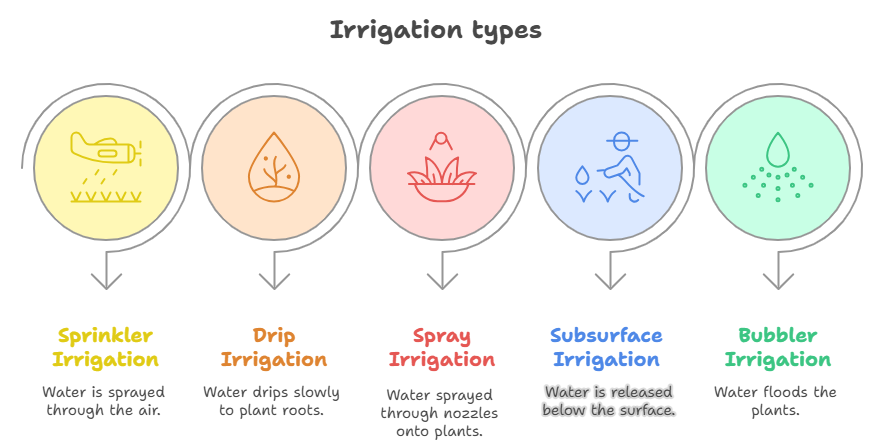
There are majorly 5 types of Micro Irrigation Systems
- Sprinkler Irrigation
- Drip Irrigation
- Spray Irrigation
- Subsurface Irrigation
- Bubbler Irrigation
Benefits of Micro-Irrigation System
- Increases yield and cost savings: According to ICAR, farmers adopting micro irrigation technology in wheat crop saved water by 15% and improved yield by 21% as compared to the farmers using flood irrigation.
- Water use efficiency: water-saving is achieved up to 36-68% over the conventional flow irrigation systems.
- Improves the quality of crops due to reduced consumption of fertilisers through fertigation .
- Weed control: due to targeted application of water to roots.
- Energy efficient due to reduction in consumption in energy required for lifting water from irrigation wells.
Challenges /Constraints in Adoption of Micro Irrigation
- High initial investment: According to a study by ICAR: About 55 % non-adopters of the system perceived that MI required high initial investment.
- Free energy availability discourage the adoption of MI as it fails to incentivize farmers to save energy and water by adopting efficient technologies.
- High cost of maintenance: Soil particles, algae, or mineral precipitates can clog the emission devices thus impacting the efficiency.
- Inadequate promotional and information efforts: Lack of information about location specific and crop-specific irrigation and fertigation scheduling limits scaling up of the MI technology
- Poor integration with farm irrigation system.
Government Initiative for Irrigation
- Micro irrigation fund- dedicated micro irrigation fund with NABARD.
- Pradhan Mantri Krishi Sinchayee Yojana- Enhance physical access of water on farm and expand cultivable area under assured irrigation, improve on-farm water use efficiency, introduce sustainable water conservation practices, etc.
- Rainfed area development program -Focuses on Integrated Farming System (IFS) for enhancing productivity and minimizing risks associated with climatic variabilities.
Way forward
- Capacity building program should be an integral part of MIS.
- Awareness and mass contact programs should be a continuous process, so that more farmers can be brought in ambit of MI.
- The firms supplying the system must be made responsible for the maintenance and supply of spares at least for five years.
- Region specific demonstration farms may be supported and organized for successful adoption of MI systems.
Pradhan Mantri Krishi Sinchayee Yojana
Ensuring access to water to every farm (“Har Khet Ko Pani”).Improving water use efficiency (“Per Drop More Crop”).
Per Drop More Crop: Under Ministry of Agriculture; focuses on water conveyance and precision water application in the farm (Jal Sinchan).Integrated Watershed Management Programme (IWMP): Under Ministry of Rural Development; focuses on development of rainfed portions and culturable wastelands. |
Conclusion
It is time that India in her concern for the environment, ecology, social/human, and rights relating to water shifts the subject of water to the concurrent list of the Constitution and frames policy that aims at transforming the country into a Sujalam [richly watered], Suphalam [richly fruited] and Sasya Shyamalan [richly harvested].
11. Transport of Agricultural Produce: Importance & Government Initiatives in India
Transport of Agriculture Produce is a critical element in the agriculture marketing concerned with delivering agricultural products from farms to markets and to cities worldwide. Transport allows farmers to invest more, increase production and reach the prospective consumers.
Importance of Transport of Agriculture Produce

Issues and Challenges in Transport of Agricultural Produce

Steps taken by the govt to improve Transport Infrastructure
- PM-Gram Sadak Yojana: To improve transport and connectivity in rural India.
- Kisan Rail: First-ever multi-commodity train service to carry vegetables like capsicum, cauliflower, cabbage, chilies, drumsticks, onion, etc., and fruits like grapes, banana, pomegranate.
- Krishi UDAN 2.0: It facilitates and incentivizes movement of Agri-produce by air transportation.
- Transport and Marketing Assistance (TMA): Aims to provide assistance for the exporting produce to certain countries in Europe & North America by reimbursing certain portion of freight charges.
Conclusion
Henry C. Wallace, one of the former Secretaries of Agriculture of the United States, had rightly remarked, “Agriculture is our greatest industry, transportation our second greatest. These two industries are dependent upon one another, and the national well-being is dependent on both”.
12. E-Technology in Agriculture: ICT Innovations Empowering Indian Farmers
The integration of e-technology in agriculture marks a transformative shift in how Indian farmers access information, services, and markets. By harnessing Information and Communication Technologies (ICTs), the sector is becoming more efficient, inclusive, and resilient. This digital push is aligning with the government's vision of modernizing Indian agriculture for sustainable growth.
E-Technology in the Aid of Farmers
The prime minister's vision
Modernisation in the field of agriculture is the need of hour. This decade could be the best time for a multitude of factors including the futuristic vision for agriculture at Apex level in the government of India.
e-agriculture involves designing, developing and applying innovative ways to use information and communication technologies (ICTs) with a primary focus on agriculture. ICTs that can be harnessed for e-agriculture may include devices, networks, services and applications.
Role of ICT in E-Technology in Agriculture
ICT in Agriculture, also known as e-Agriculture, is a branch of agricultural technology that focuses on enhancing communication and information flow within the agricultural sector. By integrating digital tools and platforms, ICT is transforming how farmers access, share, and utilize agricultural knowledge.

Initiatives Taken in India to Promote E-Technology in Agriculture
- Agricultural extension and advisory service: IFFCO Kissan Sanchar Limited (IKSL) offers the farmer access to a unique Value-Added Service (VAS) platform that will broadcast five free voice messages, based on farmers’ requirements, on market prices, farming techniques, weather forecasts, dairy farming, animal husbandry, rural health initiatives and fertilizer availability etc. on a daily basis.
- National e-Governance Plan in Agriculture (NeGPA): For rapid deployment of ICT in agriculture. Some initiatives include one Stop Window Farmers Portal for dissemination of information on various agricultural related matters
- Strengthening/Promoting Agricultural Information System (AGRISNET): It is the scheme for strengthening of IT infrastructure of the Department and its offices.
- Development of Android Apps:
- KISAN SUVIDHA: Weather related information
- PUSA KRISHI APP: solutions to problems of agriculture.
- KISAN CALL CENTRES: To address the queries of famers on a telephone call in their local dialect.
- Sandesh Pathak- The application, developed jointly by C-DAC Mumbai, IIT Madras, IIT Hyderabad, IIT Kharagpur, and C-DAC Thiruvananthapuram will enable SMS messages to be read out loud, for the benefit of farmers who may have difficulty in reading.
Successful Models of E-Technology in Agriculturee-Choupal is an initiative of ITC Limited, a unique web-based page, to link directly with rural farmers via the Internet. RML FARMER- KRISHI MITRA: Developed by a private player, Reuters Market Light, it is useful farming app where farmers can keep up with the latest commodity and mandi prices, precise usage of pesticides and fertilizers, farm and farmer-related news, weather forecasts, and advisory. As per the official, users can choose from over 450 crop varieties, 1300 mandis, and 3500 weather locations across 50,000 villages and 17 states of India. |
Issues and Challenges in E-Technology in Agriculture

Way ahead
- Low-cost technology: Lowering the cost of technology so that it is available and affordable for the smaller farmers.
- Easily portable hardware: Plug and play hardware (ensuring mobility) has better chances of succeeding in India due to small farm sizes and prevalence of tenancy.
- Renting and sharing platforms for agriculture equipment and machinery: Due to both limited financial resources and small farm plots, renting and sharing platforms rather than outright purchase for ICT equipment.
- Bridging the Digital Divide between the rural and urban India as well as among different sections of rural society.
- Localization of data and applications: Information in local languages and customized inputs will help in rapid dissemination of technology.
Conclusion
Digital Agriculture can improve information access and knowledge sharing for farmers and agrarians. Technology affordability, ease of access and operation, system maintenance, timely grievance redressal, and policy support should underpin the initiatives.
13. Agriculture Subsidy in India: Types, Benefits, Issues & Government Schemes
Agriculture subsidy in India plays a pivotal role in supporting farmers by reducing their input costs and enhancing their income. These subsidies, both direct and indirect, aim to ensure food security, promote sustainable agriculture, and address regional disparities. However, their implementation also brings several challenges that require strategic policy reforms.
Issues related to Direct and Indirect Farm Subsidies
An agricultural or farm subsidy is a financial aid provided by the government to the farmers, agribusiness owners, and agricultural raw material suppliers.
A survey shows that around 21% income of the farmers per hectare is facilitated by the government subsidy.
Types of Agriculture Subsidy in India
- Direct subsidies- Which are provided to farmers directly in cash or kind. Eg . PM KISAN, Farm loan waiver.
- Indirect subsidies - Which are provided to farmers by giving discount on agriculture purchase. eg. fertilizer, irrigation, seeds.
The total subsidy offered to the Indian farmers accounts for 2% of the total GDP of India.
Advantages of Agriculture Subsidy
|
Direct subsidies
|
Indirect subsidies
|
Issues Related to Agriculture Subsidy
|
Direct subsidies
|
Indirect subsidies
|
Measures to Address Issues in Agriculture Subsidy

Fertilizer subsidy in India
The difference between the cost of production and actual amount of fertilizer is the amount of subsidy borne by the government.
- Urea Subsidy Scheme: At present the Urea is being provided to the farmers at a statutorily noti?ed Maximum Retail Price (MRP) of Rs.242 per 45 kg bag of urea The di?erence between the delivered cost of urea at farm gate and net market realization by the urea units is given as subsidy to the urea manufacturer/importer by the Government of India. Accordingly, all farmers are being supplied urea at the subsidized rates.
- Nutrient Based Subsidy Scheme: Fertilizers are provided to the farmers at the subsidized rates based on the nutrients (N, P, K & S) contained in these fertilizers.
Issues related to Fertilizer Subsidy
- Overuse of fertilizers: which can degrade soil quality, harm the environment, and reduce long-term agricultural productivity. For instance, current NPK ratio is 6.7:2.4:1, which is highly skewed towards Nitrogen as against the ideal ratio of 4:2:1.
- Inefficient distribution system: distributed through a complex network of intermediaries, which can result in inefficiencies, delays, and high transaction costs.
- Fiscal burden: fertilizer subsidies are putting extra pressure on the fiscal health. For instance, the subsidy bill is likely to cross Rs 200,000 crore in 2022-23.
- Black marketing in Urea: Urea is often found to be smuggled for industrial and other purposes
Recent developments/initiatives:
- One Nation One Fertiliser Scheme:
- The government has introduced a “Single Brand for Fertilizers and Logo” under the fertilizer subsidy scheme named “Pradhanmantri Bhartiya Janurvarak Pariyojna” (PMBJP).
- Under the new “One Nation One Fertiliser” scheme, companies are allowed to display their name, brand, logo and other relevant product information only on one-third space of their bags.
Rational for the scheme:
- The maximum retail price of urea is currently fixed by the government, which compensates companies for the higher cost of manufacturing or imports incurred by them.
- To unify fertilizer brands nationwide, regardless of the company that manufactures achieve uniformity in the fertilizer market and ensure product differentiation under the same type of brand.
- To prevent the interlaced movement of fertilizers and save transit time and cost as a single brand name will aid in lowering freight costs and guarantee their availability all year long regardless of brand preferences.
- Direct Benefit Transfer (DBT) project for fertilizer subsidy payment:
- Department of Fertilizers (DoF) has implemented Direct Bene?t Transfer (DBT) project for fertilizer subsidy payment with a view to improve fertilizer service delivery to farmers. Under the fertilizer DBT system, 100% subsidy on various fertilizer grades is released to the fertilizer companies on the basis of actual sales made by the retailers to the bene?ciaries.
- “PM Programme for Restoration, Awareness, Nourishment and Amelioration of Mother Earth” (PM-PRANAM) scheme was announced in Budget 2023-24 with the objective to incentivize the States and UTs to promote usage of alternative fertilizers and balanced use of chemical fertilizers.
- Nano Urea: Nano urea is a liquid fertilizer developed by IFFCO. Government of India has recently notified the specifications of Nano nitrogen under Fertilizer Control Order, 1985.
Way forward
- Need of uniform policy- for all the nutrients which are necessary for crop production.
- Addition of other nutrients and micronutrients which can improve not Only yield but also the health of soil.
- Revival of the Chemical Fertilizer Plants: to improve the availability of fertilizers in India.
- Other alternatives -Efforts should be made to promote organic farming, biofertilizers etc.
Fertilizers are critical inputs to increase output of agriculture, designing of fertilizer subsidy should be framed while keeping in mind about health of soil and environmental impacts.
Direct Benefit Transfer Scheme
What is DBT?
Direct Benefit Transfer (DBT) was introduced on 1 January 2013 with the main aim of improving the Government's delivery system and redesigning the current procedure in welfare schemes by making the flow of funds and information faster, secure, and reduce the number of frauds.
Advantages of DBT
- Fast and easy transfer of money- by Aaadhar card payment is getting easy and seamless.
- Better beneficiaries’ identification -Biometric system solves the problem of ghost beneficiaries and duplication.
- Expanded Coverage - Aadhar to all improved the coverage of banking and telecom sector.
- Improve social security - eg.PM AWAS YOJANA, UJWALA YOJANA
- Equitability- in terms of services such as Aadhar gives everyone the same access.
- Free to choose- beneficiaries got an opportunity to choose what they need.
Limitation of DBT
- Accessibility - to banking facilities and ATM’s
- Unproductive use- diversion of money to another unintented purpose kills the purpose of DBT
- Exclusion - eg, Telangana Rythu Bandhu scheme - exclusion of tenants.
14. Minimum Support Price (MSP): Objectives, Issues, Significance, Crops, Reforms
Minimum Support Price is minimum price set by government at which commodities are procured from farmers by government.
- Government fixes Minimum Support Prices (MSP) for 22 mandated agricultural crops and Fair and Remunerative Price (FRP) for sugarcane on the basis of the recommendations of the Commission for Agricultural Costs and Prices (CACP), after considering the views of State Governments and Central Ministries/Departments concerned and other relevant factors

Factors in Determining Minimum Support Price
- The CACP takes into account various factors including demand and supply; cost of production; market trends; a minimum 50% margin over cost of production; and likely implications of MSP on consumers.
- The CACP calculates three types of costs — A2, A2+FL and C2 — for each mandated crop for different states.
- The lowest of these costs is A2, which is the actual paid-out cost incurred by a farmer. Next is A2+FL, the actual paid-out cost plus imputed value of family labour.
- The highest of the three costs is C2, defined as ‘Comprehensive Cost including Rental Value of Own Land (net of land revenue and interest on value of own fixed capital assets (excluding land))’.
Objectives of Minimum Support Price
Refer diagram ???? ????

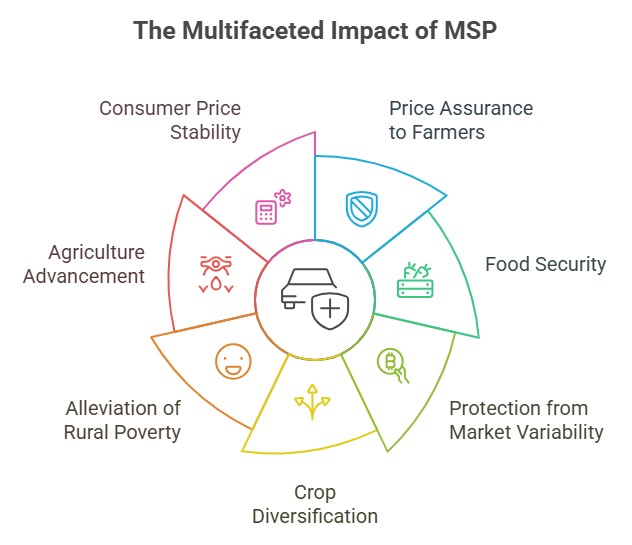
Significance of Minimum Support Price
- Price assurance to farmers- MSP provides safety net to farmers and prevent suicides and poverty.
- Food security - can be achieved through stable production. e.g.- India’s foodgrains production touched a record 315.7 million tonnes in 2021-22
- Protection of farmers from market variability such as unwarranted fluctuations in price.
- Crop diversification - guaranteed MSP to pulses, oilseeds, coarse cereals encourage farmer to cultivate new crops.
- Alleviation of rural poverty -fixed price for farm produce prevent migration and increase economic capacity of farmers.
- Agriculture advancement - new technology, improvement is possible due to assured prices.
- Maintain prices of commodity for consumer.
List Of Crops Covered Under MSP
The Government of India announces the Minimum Support Price (MSP) for 22 major crops every year to safeguard farmers against any sharp fall in farm prices. This system ensures that farmers receive a fair return on their produce, promoting agricultural stability and income security. In addition to these 22 crops, Toria and de-husked coconut are also covered under MSP, determined on the basis of rapeseed & mustard and copra prices respectively.
The crops covered under MSP are categorized into Kharif crops, Rabi crops, and commercial crops as given below.
List Of Kharif Crops Covered Under MSP
Kharif crops are typically sown with the onset of the monsoon and harvested in autumn. The following 14 Kharif crops are covered under MSP:
- Paddy
- Jowar
- Bajra
- Ragi
- Maize
- Tur (Arhar)
- Moong
- Urad
- Groundnut
- Sunflower Seed
- Soyabean (Yellow)
- Sesamum
- Nigerseed
- Cotton
List Of Rabi Crops Covered Under MSP
Rabi crops are sown in the winter season and harvested in the spring. The government provides MSP for the following 6 Rabi crops:
- Wheat
- Barley
- Gram
- Masur (Lentil)
- Rapeseed & Mustard
- Safflower
List Of Commercial Crops Covered Under MSP
Commercial crops are cultivated primarily for sale rather than personal consumption. The government announces MSP for the following 2 commercial crops:
- Copra
- Sugarcane (Fair and Remunerative Price - FRP is announced instead of MSP)
Issues and Challenges Associated with Minimum Support Price
- Distortion of cropping pattern - though MSP announced for several crops but procurement is majorly wheat, rice and sugarcane centric.
- Distort supply demand- due to frequent increase and decrease in MSP.
- Burden on FCI- excessive procurement burden due to cereal and PDS.
- Dependency on middle man- Such as commission agent, APMC officials hence difficult for marginal farmer to get access.
- Regional imbalance- procurement is more in Northern states like Punjab and Haryana.
- Environment impact- due to monocropping of wheat, rice.
- Low awareness and accessibility - according to Shanta Kumar committee only 6% countries farmers get benefitted from MSP.
- Challenges in WTO - MSP claimed to be trade distorting and there is pressure from WTO to minimise it.
Legalization of Minimum Support Price
Legalisation of MSP means legal obligations on the government to buy commodities for which MSP is announced. After repealing three contentious farm laws farmers had put the demand of legalising MSP.
Reasons behind demand of legalising MSP
- Limited procurement - procurement is largely limited to only wheat and rice and out of which also only 6% of the farm household sell rice and wheat at MSP to govt.
- Regional disparity - Half of commodities procured are from Punjab and Haryana.
- Less benefits than MSP-MSP has no statutory backing hence many of times farmers get less than MSP.
- MSP for horticulture - MSP should be extended to fruits and vegetables.
- Variable msp according to agro climatic zones- calculation based on varied inputs rates in different agro climatic zone.
Recommendations of Swaminathan Committee on Minimum Support Price
- To fix minimum support prices (MSP) for crops at least 50% more than the weighted average cost of production.
- Govt. has announced its decision to ensure that farmers receive MSP = 1.5 times of production cost.
Way Forward
- Bridge the price gap - between MSP and market price hence
- Price assurance - assurance regarding MSP, grains procurement and market intervention of government as and when necessary.
- Market reforms - need for improving market efficiency by strengthening FPOs, cooperative etc.
- Price deficiency payment - differences between MSP and actual price.
- Promotion of cooperative - to increase bargaining power of farmers.
Rather than legalisation of MSP focus should be on infrastructure development and strengthening institutions and guarantee farmers to increase their income.MSP provided safety net to the farmers via market against uncertainties but there is a need to make advancement in the process according to the need.
Recent developments/initiatives:
- The Central government has expanded the procurement of pulses and oilseeds by central agencies.
- PMASHA Scheme which include procurement under:
- Price Support Scheme (PSS);
- Price Deficiency Payment (PDP);
- Private Procurement and Stockists Scheme as a Pilot Scheme;
- State level Initiatives: For example, Bhavantar Bhugtan Yojana of Madhya Pradesh where the government pays farmers the difference between official Minimum Support Price and the rate at which they sell their crops
Way Forward
- Agriculture expert Ramesh Chand has suggested three ways to help farmers get fair prices for their crops: Enabling fair, competitive, and remunerative prices through market mechanisms, public intervention, and a combination of both.
- NITI Aayog has suggested the 'Price Deficiency Payment' (PDP) system among other reforms.
- Reduce regional imbalance- by decreasing information asymmetry and state level interventions.
- Information and awareness - through Krishi Vidyan Kendra, krushi seva Kendra s.
- Use of modern warehousing infrastructure - modern weighing machienes etc.
15. Economics of Animal Rearing in India: Livestock, Dairy & Fisheries Sector Overview
Animal rearing is a vital part of India’s agricultural economy, supporting millions of rural livelihoods and contributing significantly to food security. The livestock, dairy, and fisheries sectors play a crucial role in employment, income generation, and nutrition across the country.
Economics of Animal Rearing
Livestock production and agriculture are dependent on the other and both are crucial for overall food security of the nation. Livestock sector is an important sub-sector of Indian agricultural economy. It is an integral part of livelihood activity for most of the farmers and help sustaining farm activity.
Potential of Animal Rearing in India
|
Challenges to Livestock Sector
- Productivity -As per Integrated Sample Survey average annual productivity of cattle in India during 2019-20 is 1777 kg per animal per year as against the world average of 2699 kg per animal per year during 2019
- Disease: Livestock are susceptible to a variety of diseases that can reduce productivity and even lead to death.
- Deficit of fodder: There is a deficit of 23.4% in the availability of dry fodder, 11.24% for green fodder and 28.9% for concentrates.
- Environmental degradation: e.g., Overgrazing, deforestation, and other forms of environmental degradation led to loss of pastureland and reduced productivity.
- Lack of infrastructure: such as roads, electricity, and water supply can make it difficult to transport feed and other inputs, and to access markets for livestock products.
- Limited access to credit- many small-scale producers have limited access to credit, which can limit their ability to expand their operations.
Government Initiatives for the Livestock Sector

How India can enhance its livestock productivity?
- Improve productivity- The effective ways to improve livestock productivity are crossbreeding, upgrading and selective breeding.
- Feed strategies strategic supplementation of limiting macro and micro nutrients, probiotics/ prebiotics, feed additives (enzymes, methane inhibitors etc.), development of Total Mixed Ration technology for improving efficiency
- Climate adaptability -The goal of increasing productivity without impacting environment can be attained through diversification and selection of inputs and management practices that foster positive ecological relationships.
- Health management - Wider and effective immunization for important economic diseases and compulsory deworming programme should be practiced. Also concepts like veterinary ambulance should be carried out.
- Processing and value addition of livestock products: Value addition of milk and milk products with the integration of fruit, vegetables and cereals has a large potential.
- Extension and training: call for delivery of services and inputs at the farmer’s door.
India with highest number of livestock have immense potential for harnessing the advantage associated with it by adopting technological solutions and prioritizing their development.
Dairy Sector
India's dairy sector is characterized by "production by masses" more than "mass production". India is the largest milk-producing country on the basis of the efforts of these small farmers with one, two or three cattle. This sector provides employment to more than 8 crore families in India. India is the Largest Producer of Milk: India contributes 23% of global milk production.
India’s dairy sector: status
|
India’s Global Position |
Largest producer of milk in the world, since 20 years. |
|
India’s share in Global Market |
>20% of world’s milk production |
|
Annual growth rate of Milk production (in last 6 years) |
6% (growth rate of world milk production is 1.5%) |
|
Livestock Contribution to Agriculture GDP (%) |
25-30% |
|
Contribution to country’s GDP |
5% |
|
Employment generation |
80 million farmers directly |
|
Per capita availability of milk (2021-22) |
444 grams per day (more than world average) |
|
Nature of Milk distribution industry |
Organized sector - 40% (cooperatives & private dairies) & unorganised sector - 60% |
|
Nature of Milk processing Industry |
Organized sector - 20% & unorganised sector - 80% |
Operation Flood and Anand Pattern
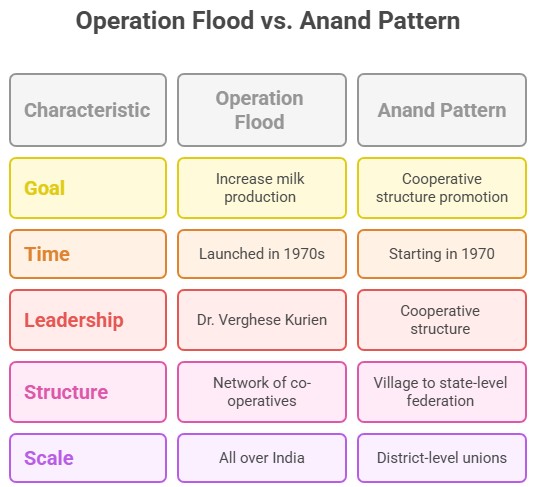 Milk production in 1950-51 stood at merely 17 million tonnes (MT). In 1968-69, prior to the launch of Operation Flood, milk production was only 21.2 MT which increased to 30.4 MT by 1979-80 and 51.4 MT by 1989-90. Now it has increased to 210 million tonnes in 2020-21. |
Significance of Dairy Sector
- Economic Growth: The sector contributes about 5% to the country's GDP.
- Employment – 80 million households are dependent on dairy farming for livelihood.
- Tool for Inclusive growth - Livestock distribution is more equitable than land distribution. 85% of the small & marginal farmers own 45% of the land, but 75% of the bovine.
- Women Empowerment: Women have over 70% participation in the dairy sector.
- Additional Income for Farmers: About 20-30 % of the total income of farmers comes from the dairy sector.
- Savior for dryland Agriculture
- Processing demand - for cheese, paneer and other products.
- Nutritional Security - Milk contains nutrients that meet the body’s needs for calcium, magnesium, riboflavin, vitamin B12 etc.
- Sustainable agriculture by promoting integrated farming systems. For eg. Manure from dairy animals can be utilised as organic fetiliser.
Challenges to Dairy Sector
- Informal sector-large share of milk (70–85%) of marketable surplus goes through informal channel where quality is a big concern
- Farmers less share in benefits - Farmers do not share in the benefits of high demand because of poor governance of cooperatives.
- Low productivity per animal – 1,700 kg compared to global average of 2700 kg.
- Inadequate healthcare and veterinary – Frequent occurrence of deadly diseases. E.g. Foot & Mouth disease, black-leg etc. Poor veterinary services, lack of diagnostic labs, spurious medicines, etc.
- Fragmented supply- production scattered over large no of farmers at miniscule.
- Perishability- dairy requires more complex supply chain operations and logistics to ensure freshness and safety.
- Infrastructure - modern cold chain storage, transport storage facilities etc.
- Reducing grazing land- due to industrial growth.
- Fodder- availability and affordability.
- Limited financial resources - as majority dependent on small and marginal.
Creating Opportunities in Dairy Sector
- Upstream supply management- for securing a reliable, high-quality milk procurement
- Milk Processing Opportunities-Milk can be processed into a range of high-value-added products.
- Downstream supply management-need for a secure supply and a reliable distribution infrastructure
- Private participation - will boost credit supply and quality
- Processing potential - should be direct link between farmers and industries.
- Marketing - Organize traders collecting milk at the farm into groups and create joint facilities – testing, processing and storing their milk supplies.
- Promote value-addition ????Enriching milk with other nutrients and vitamins.
- Additional marketing for healthy A2A2 type milk (milk from indigenous breeds).
- Promote exports – Create rational export policy on lines of Agriculture Export Policy to enable farmers get higher prices. Adherence to international standards through mechanized and hygienic production.
- Dairy quality - Training on clean milk practices, develop milk testing infrastructure, adequate cooling facilities along with power supply, processing plant certification to build consumer confidence.
- Shift towards technology driven environment - Eg: Israeli Technology has made its country’s “Super Cows” world famous – producing more milk than any other country, up to 10.5 tons a year.
- For eg. Milk Mantra in Odisha enabled traceability and efficient supply chain management.
- Other measures – Strengthen women participation, diversify dairying to India’s Eastern Region, strengthening dairy cooperatives and encourage farmers to sell fine manure as natural fertilizer to organic farming.
Government initiatives
- Special Livestock Sector Package - Merger of Schemes into three broad categories:
- Development Programmes: It includes Rashtriya Gokul Mission, National Programme for Dairy Development (NPDD), National Livestock Mission (NLM), Livestock Census etc. as sub-schemes.
- Disease Control Programme: It is renamed as Livestock Health and Disease Control (LH & DC)
- Infrastructure Development Fund: The Animal Husbandry Infrastructure Development fund (AHIDF) and the Dairy Infrastructure Development Fund (DIDF) are merged.
- e-Gopala App - A comprehensive breed improvement marketplace & information portal for farmers.
- For Ensuring Milk Quality: Unified Dairy Mark developed by Bureau of Indian Standards.
- Dairy Entrepreneurship Development Scheme- being implemented through NABARD.
- Gopal Ratna Award 2021 – To encourage farmers, artificial insemination technicians and Dairy cooperatives.
- Quality mark - To the dairy plants of cooperatives adhering to the process standards across the dairy value chain.
- E-Pashuhaat Portal - To connect breeders and farmers regarding availability of bovine germplasm.
- Dairy Entrepreneurship Development Scheme - To generate self-employment and provide infrastructure for dairy sector.
- "Dairy Sahakar" scheme - to extend financial support by NCDC to eligible cooperatives for activities such as bovine development, branding, marketing, exports of dairy products within the overall objectives of "Doubling the farmers income" and "Atmanirbhar Bharat.
- National Animal Disease Control Programme (NADCP) -
Dairying has become an important secondary source of income and is considered as one of the activities aimed at alleviating poverty and unemployment for marginal and women farmers especially, in the rural areas and in the rain-fed and drought-prone regions of India. The progress in this sector will result in a more balanced development of the rural economy.
Fisheries Sector
India is the 3rd largest fish producing and 2nd largest aquaculture nation in the world after China. The Blue Revolution in India demonstrated importance of Fisheries and Aquaculture sector. The sector is considered as a sunrise sector and is poised to play a significant role in the Indian economy in near future.
Status and Trends in Fisheries Sector in India
- India’s fish production hit an all-time high of 162.48 lakh ton in fiscal year 2021-22.
- India’s fish production has grown 22-fold since independence, from 7.5 lakh ton in 1950-51 to a record-breaking 162.48 lakh ton in 2021-22.
- Till 2000, marine fish production dominated India's total fish production.
- However due to practice of science-based fisheries, Inland fisheries in India has seen a turnaround and presently contributes ~70 % of total fish production.
- Inland fish production, predominantly driven by aquaculture, has witnessed an extraordinary surge. In 2000-01, inland fish production stood at 28.23 lakh tonne, which rose to 121.21 lakh tonne in 2021-22, marking a remarkable 400% increase.
Importance of Fisheries Sector
- Economic growth-The contribution of fisheries sector to the GDP/GVA has gone up from 0.46 per cent in 1950-51 to 1.24 per cent in 2018-19.
- Employment generation- The sector provides livelihood to about 16 million fishers and fish farmers at the primary level and almost twice the number along the value chain.
- Export potential - India is 4th largest fish exporting nation.
- Hunger and nutrition - fish is an affordable and rich source of Animal protein.
- Fish biodiversity - India have more than 10% of global fish biodiversity.
- Increased demand - due to increased standard of living and incomes.
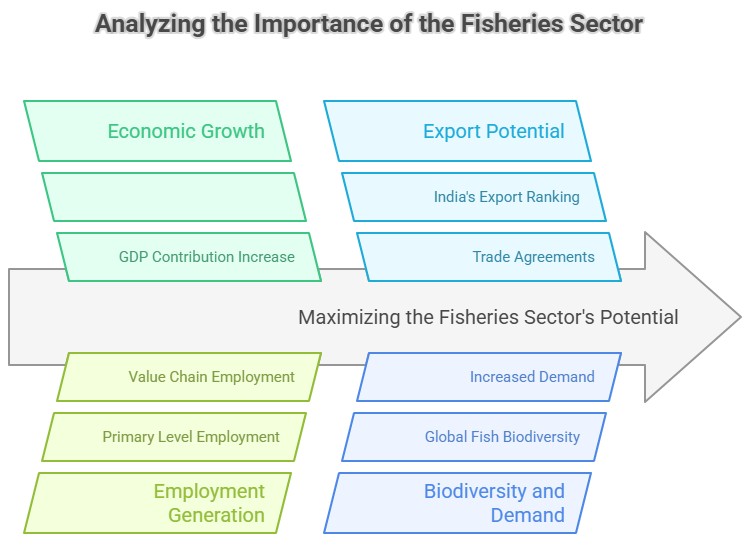
Challenges of Fisheries Sector
- Unregulated fishing - overfishing without proper regulations threats sustainability.
- Infrastructure bottlenecks - insufficient cold storage and transportation.
- Lack of resource-specific fishing vessels, thus, fish stocks in deep-sea waters remain untapped.
- Weak linkages between R&D and fish farmers community - Limited number of species grown.
- Inadequate mechanization- without proper technology, freezing, transport.
- Illegal, Unreported and Unregulated (IUU) fishing - IUU fishing accounts for 40% of total marine fish catch in Indian waters.
- Bottom trawling and improper demarcation of coastal boundaries leading to disputes with neighbouring nations, For eg, Katchatheevu island dispute.
- Increased demand- is not proportional to meet the rising demand.
- Low productivity - stagnated yield
Government Initiatives
- Blue Revolution Scheme: For Integrated Development and Management of Fisheries'
- Aquaculture Infrastructure Development Fund (FIDF): For creation of fisheries infrastructure facilities both in marine and inland fisheries sectors and augment the fish production
- Pradhan Mantri Matsya Sampada Yojana (PMMSY) (2020-21 to 2024-25):
- Harnessing of fisheries potential in a sustainable, responsible, inclusive and equitable manner
- Modernizing and strengthening of value chain
- Social, physical and economic security for fishers and fish farmers
- Robust fisheries management and regulatory framework
- National Policy on Marine Fisheries, 2017' (NPMF) which provides guidance for promoting 'Blue Growth Initiative'.
- Establishment of separate Ministry for animal husbandry, dairy and fisheries in 2019
- Kisan Credit Card (KCC): Extended to fishers and fish farmers to help them meet their working capital and short-term credit needs.
Way forward
- The Meena Kumari Committee on deep sea fishing has recommended strengthening of the fisheries institutions, terms of manpower, human resource development and wherewithal.
- India will be able to optimally exploit its fisheries resources in the EEZ as also ensure that the resources are sustained and inter-generational equity is not compromised. Such an approach would also ensure realization of the ‘Blue Revolution’ from the Indian seas.
- Neel kranti to arthakranti is vision to achieve economic prosperity of country and nutritional food security of India and unleash the potential of India
16. LPG Reforms in India: Causes, Policies & Impact on Economy
The Liberalization, Privatization, and Globalization (LPG) reforms, introduced in 1991, marked a turning point in India’s economic history. Triggered by a severe balance-of-payments crisis, these reforms aimed to stabilize the economy and integrate it with the global market. Initiated under the New Economic Policy, LPG reforms dismantled regulatory barriers, encouraged private enterprise, and opened up the economy to foreign investment. While they accelerated growth and modernization, they also brought challenges like inequality and jobless growth.
LPG Reforms and Effects in India
- The Liberalization, Privatization and Globalization (LPG) reforms were introduced in India in the early 1990s to deal with economic and financial crisis. India approached the International Bank for Reconstruction and Development (IBRD), popularly known as World Bank and the International Monetary Fund (IMF), and received $7 billion as loan to manage the crisis.
LPG Reforms in India: Causes of the Balance-of-Payment Crisis
- High Fiscal Deficit: The fiscal deficit in 1990 and 1991 was approximately 8.4% of GDP
- Impact of Crude Oil Prices and Gulf War: The invasion of Kuwait by Iraq in 1990 and 1991 caused a surge in oil prices,
- High Inflation: Rapid increase in the money supply led to a rise in inflation from 6.7% to 16.7
- Rising Internal Debt: As a consequence of the high fiscal deficit, the government's internal debt soared. It surged from 35% of GDP in 1985-86 to 53% of GDP in 1990-91
- Depleted Forex Reserves: By June 1991, India had less than $1 billion in forex reserves, just enough to cover three weeks of imports, posing a significant challenge for conducting international business and worsening the balance of payment crisis.
- Capital Flight: Investors swiftly withdrew their investments from India as they perceived the worsening economic conditions. This exacerbated the crisis, leading to a negative cycle of economic decline.
LPG Reforms in India: Introduction of the New Economic Policy, 1991
- In response to the crisis, the Indian government announced the New Economic Policy in 1991, which served as a foundation for economic reforms known as the LPG reforms (Liberalization, Privatization, Globalization).
- The LPG model included various reforms in different sectors:
- Industrial Policy Liberalization: Reductions in import tariffs, elimination of the license-permit raj (restrictive industrial licensing), and other measures to promote industrial growth and competitiveness.
- Privatization Initiatives: Deregulation of markets, reforms in the banking sector, and other measures to encourage private participation and improve efficiency.
- Globalization Measures: Changes in exchange rates, liberalization of trade and foreign direct investment policies, and removal of mandatory convertibility to stimulate international trade and investment.
LPG Reforms in India: Goals of Liberalization
The objectives of liberalization in the Indian economy were to
- Encourage Private Businesses, Facilitate Global Integration, Address Balance-of-Payments Issues, Enhance Private Sector Participation, Attract Foreign Direct Investment, Promote Competition
Policies of Liberalization
The liberalization policies that contributed to the expansion of the Indian economy included:
- Financial Sector Reforms: Deregulation of the banking sector, introduction of market-based interest rates, and liberalization of capital markets.
- Industrial Sector Reforms: Reduction of industrial licensing requirements, simplification of regulations, and encouragement of private sector participation.
- External Sector Reforms: Liberalization of trade policies, reduction of import tariffs, and relaxation of restrictions on foreign exchange transactions.
- Foreign Exchange Reforms: Introduction of market-determined exchange rates, easing restrictions on capital movements, and simplification of foreign exchange regulations.
- Trade and Investment Policy Reforms: Opening up of key sectors to foreign investment, streamlining investment procedures, and encouraging export-oriented industries.
Impact of Liberalization on the Indian Economy
- Increased Economic Growth: From 1991 to 2020, the country's GDP grew at an average rate of 6.7%, compared to an average rate of 3.5% in the preceding three decades.
- Higher Foreign Investment: FDI inflows increased from $97 million in 1990-91 to $81.72 billion in 2020-21, according to the Ministry of Commerce and Industry.
- Improvement in Industrial Productivity: The Indian manufacturing sector's productivity increased by 6.8% annually between 1991 and 2006, as per a study by the Reserve Bank of India.
- Expansion of the Services Sector: The services sector's contribution increased from 37.2% in 1990-91 to 54.3% in 2020-21, according to the Ministry of Statistics and Programme Implementation.
- Increase in per capita income: The average monthly per capita expenditure of Indian households increased significantly from Rs. 206 in 1987-88 to Rs. 2,446 in 2017-18, based on a study by the National Sample Survey Office.
- Agriculture: Availability of modern Agro- technologies, Rise in production and productivity, Growth of Agro-exports (USD 43.37 billion in 2023).
Negative Impacts of Liberalization
- Widening Income Inequality: The top 1% of the population held 22% of the country's wealth in 1991, which rose to 42.5% in 2018, while the bottom 50% saw a decline in their share of wealth from 14% to 12.5%.
- Jobless Growth: India had job growth of 3% per annum in the 1970s and when the economy grew at 3-3.5 % however over the last three decades despite growth over 5-8% the job growth is only close to 1% per annum.
- Environmental Degradation: The industrialization and economic growth resulting from the reforms contributed to increased pollution levels in India. The country ranked 177th out of 180 countries in terms of air quality in 2020, according to the Environmental Performance Index.
- Dependence on Foreign Investment: The FDI inflows increased from $97 million in 1990-91 to $81.72 billion in 2020-21
- Agriculture: The status of Indian agricultural sector indicates that globalization did not yield the desired results in India.
17. Energy Poverty in India
Introduction
India recently achieved 100% village electrification, marking a significant milestone in its development. However, the country has faced challenges in reaching this goal, despite dedicated efforts and public spending. According to World Economic Forum, Energy poverty refers to the lack of access to sustainable modern energy services and products.
Link between Human Development and Energy Use
- Energy plays a crucial role in human development, as it is essential for fulfilling basic human needs such as clean air, health, food, water, education, and human rights.
- Energy is essential for economic growth. However, geopolitical tensions worldwide have raised energy prices, preventing equitable access.
Energy Scarcity Amid Technological Advancements
- Despite the revolutionary advancements in Liquefied Petroleum Gas (LPG) and Light-emitting Diode (LED) technologies in India, access to energy remains limited, particularly among rural households.
- This paradox of energy scarcity amidst plenty calls for a deeper understanding of energy poverty in the Indian context and the exploration of alternative energy sources.
Causes of Energy Poverty in India:
- Lack of Energy Infrastructure: Inadequate modern energy infrastructure, such as power plants and transmission lines, hinders energy access in rural areas.
- Dependence on traditional biomass fuels like wood and crop residue is common due to the absence of infrastructure for delivering natural gas.
- Lack of Affordability: Lower-income households rely on cheap but inefficient and polluting fuels, as they are unable to afford cleaner alternatives.
- Inefficiency of Energy: High energy loss during conversions contributes to energy poverty. Energy poverty rates tend to drop by 0.21% when energy efficiency index scores increase by 1 point, thus showing the direct effect of energy efficiency in energy poverty.
- Geopolitical Tension: Geopolitical instability disrupts the global energy supply chain, affecting energy prices and availability.
- India's oil import bill increased significantly to 119 billion dollars in the fiscal after the Ukraine conflict, reflecting the impact of geopolitical tensions.
Impacts of Energy Poverty in India
- Vicious Labyrinth: Insufficient energy access hampers agricultural and manufacturing development, trapping affected populations in a cycle of poverty.
- Health Hazard: Traditional fuel burning causes indoor air pollution, leading to significant health risks. India experiences a high number of premature deaths, 1 of every 4 of the annual global premature deaths caused by from Household Air Pollution (HAP), with women being particularly vulnerable (approx. 90%).
- Energy Crisis: Escalating energy demand and dependence on fossil fuels contribute to resource depletion and carbon dioxide emissions. Rising greenhouse gas concentrations contribute to global temperature increases.
Measures to Curb Energy Poverty
- Global Intergovernmental Organization: Powerful platforms like the G-20 and the BRICS need to focus more on energy access, poverty, and security.
- It is crucial to establish a global intergovernmental organization dedicated to energy transition, access, justice, and climate action.
- Creation of Database for Effective Policy Making: Collecting comprehensive data on intra-household and collective differences is vital for policy makers and stakeholders.
- Shifting the Focus Towards Renewable Energy Sources: Emphasizing the use of renewable energy sources such as solar energy and biogas is essential for combating energy poverty.
- Robust Institutional Mechanism: Establishing strong linkages between different sectors like energy, manufacturing, health, and finance is crucial.
- These linkages will enable the provision of energy-efficient machinery and subsidies to households in India.
- Collaborative efforts among institutions in different sectors can offer bundled packages of services to alleviate energy poverty effectively.
- Translating Goals into Implementable Action: Conduct awareness campaigns to educate the public about subsidies and technological advancements for efficient energy consumption.
- Establish a monitoring mechanism to ensure policy implementation.
Initiatives Shaping India's Energy Transition
|
Category |
Initiative |
|
Electrification |
|
|
|
|
|
|
|
|
Renewable Energy |
|
|
|
|
|
|
|
|
|
|
Energy Efficiency |
|
|
Clean Cooking |
|
|
Industrial Decarbonisation |
|
|
Sustainable Transport |
|
|
Climate Smart Cities |
|
|
Global Initiatives |
|
|
|
|
Conclusion
By addressing the causes of energy poverty, focusing on renewable energy sources, and implementing comprehensive measures, India can make significant progress in alleviating energy poverty and achieving sustainable development.
18. External sector and India’s Trade
Status of the Export Sector in IndiaTrade Status
- Jamnagar in Gujarat: The leading exporting district in India, contributing about 24% of India's exports in value terms in FY23 (till January).
- Surat in Gujarat and Mumbai Suburban in Maharashtra rank second and third, accounting for only about 4.5% of the country's exports during the same period.
- The remaining districts in the top 10 are Dakshina Kannada (Karnataka), Devbhumi Dwarka, Bharuch, and Kachchh (Gujarat), Mumbai (Maharashtra), Kancheepuram (Tamil Nadu), and Gautam Buddha Nagar (Uttar Pradesh).
Status of the Export Sector in India

Status of Trade
- The merchandise trade deficit (the gap between exports and imports) increased by over 39% in 2022-23, reaching USD 266.78 billion, compared to USD 191 billion in 2021-22.
- Merchandise imports rose by 16.51% in 2022-23, while merchandise exports grew by 6.03%.
- However, the overall trade deficit stood at USD 122 billion in 2022-23, compared to USD 83.53 billion in 2022, benefiting from a trade surplus in services.
India’s Major Export Arenas
- Engineering Goods: Exports in this sector experienced a remarkable growth of 50%, reaching USD 101 billion in FY22.
- Agriculture Products: The government's efforts to meet global food demand during the pandemic have boosted agricultural exports. India's rice exports alone amount to USD 9.65 billion, the highest among agricultural commodities.
- Textile and Apparels: In FY22, India's textile and apparel exports, including handicrafts, reached USD 44.4 billion, marking a significant 41% year-on-year increase.
- Government schemes like the Mega Integrated Textile Region and Apparel (MITRA) Park are providing strong support to this sector.
- Pharmaceuticals and Drugs: India ranks as the third-largest producer of medicines by volume and the largest supplier of generic drugs.
- India supplies over 50% of Africa's generic drug needs, 40% of US generic demand, and 25% of UK medicines.
Challenges Related to Export Sector
- Access to Finance: Obtaining affordable and timely finance is crucial for exporters.
- Limited Diversification of Exports: India's export basket is concentrated in a few sectors, such as engineering goods, textiles, and pharmaceuticals, making it vulnerable to fluctuations in global demand and market risks.
- Rising Protectionism and Deglobalisation: The Russia-Ukraine War and supply chain weaponization are reducing India's export capacity.
Way Forward
- Investment in Infrastructure
- Enhancing export competitiveness requires improved infrastructure and logistics.
- India should prioritize investments in transportation networks, ports, customs clearance processes, export promotion zones, and specialized manufacturing zones.
- Skill Development and Technology Adoption
- Implement skill development programs to ensure the availability of skilled labour in export-oriented industries.
- Incentivize and promote the adoption of technology, such as automation, digitization, and Industry 4.0 technologies, to boost productivity, competitiveness, and innovation in the export sector.
- Exploring Joint Development Programs
- In the current wave of deglobalization and slowing growth, exports alone cannot be the sole engine of growth.
- India can explore joint development programs with other countries in sectors like space, semiconductors, and solar energy to improve its medium-term growth prospects.
19. Inclusive Growth in India: Policies, Challenges & the Way Forward
The former President of India, Pranab Mukherjee once said, “Inclusive growth should not be a mere slogan but a fundamental driving force for sustainable development.”
Definition of Inclusive Growth in India
- The United Nations Development Program (UNDP) defines inclusive growth as “the process and result of all groups of people participating in the organization of growth and benefiting equally from it.”
- SDG 10 focuses on ensuring equal opportunity and reduce inequalities of outcome, including by eliminating discriminatory laws, policies and practices and promoting appropriate legislation, policies and action in this regard.
Inclusive Growth in India through Five-Year Plans
- The Eleventh five year Plan (2007-12) in India for the first time gave importance to Inclusive growth.
- The Twelfth Five-year plan (2012-2017) was launched with the slogan “Faster, More Sustainable, and More Inclusive Growth.”
- The plan observed Inclusive growth should result in lower incidence of poverty, broad-based and significant improvement in health outcomes, universal access for children to school, increased access to higher education and improved standards of education, including skill development.
- It should also be reflected in better opportunities for both wage employment and livelihood, and in improvement in provision of basic amenities like water, electricity, roads, sanitation and housing.
Elements of Inclusive Growth: Skill development, Empowerment of vulnerable sections, Economic growth, financial inclusion, technology advancement.
Need for Inclusive Growth in India

Government Initiative to Achieve Inclusive Growth in India
- Mahatma Gandhi National Rural Employment Guarantee Act (MGNREGA), Pradhan Mantri Jan Dhan Yojana (PMJDY), Pradhan Mantri Ujjwala Yojana (PMUY).
- Pradhan Mantri Awas Yojana (PMAY): This housing scheme aims to provide affordable housing to urban and rural poor, with a focus on economically weaker sections and low-income groups.
- Skill India Mission: skill training and entrepreneurship development programs to bridge the skill gap and promote job creation.
- Digital India: This program aims to transform India into a digitally empowered society and knowledge economy by promoting digital infrastructure, digital literacy, and digital services accessible to all citizens.
- Beti Bachao, Beti Padhao: This campaign seeks to address gender discrimination and promote the education and welfare of the girl child, with a focus on improving the sex ratio and enhancing girl's access to education.
- Swachh Bharat Abhiyan: This nationwide cleanliness campaign focuses on improving sanitation, constructing toilets, and promoting hygiene practices to enhance health outcomes and quality of life.
- Start-up India: This initiative aims to promote entrepreneurship and innovation by providing support, funding, and incentives to start-ups, facilitating job creation and economic growth.
- Pradhan Mantri Kisan Samman Nidhi (PM-KISAN): This income support scheme provides direct cash transfers to farmers to ensure a minimum income and address agricultural distress.
- Atmanirbhar Bharat Abhiyaan
Challenges in Achieving Inclusive Growth in India
- Service Sector Dominance, Social Divisions, Unequal Access to Education and Skills, Rural-Urban Disparities, Informal Sector Challenges, Governance and Corruption
Way Forward
- Enhancing education and skills, Promoting financial inclusion, Implementing targeted social welfare programs, Addressing gender inequality, Investing in rural development and agriculture, Strengthening governance and accountability and Encouraging public-private partnerships.
Atmanirbhar Bharat AbhiyaanAtmanirbhar Bharat Abhiyaan or self-reliant India campaign is the vision of new India envisaged by the Prime Minister to move towards a self-reliant India. Objective of Atmanirbhar Bharat Abhiyaan
Way Forward
 |

Global Economic RecessionRecently IMF Chief Kristalina Georgieva in an interview mentioned that around one-third of the global economy will face a recession in 2023, leading to a slowdown in economic growth compared to previous years. Major economies worldwide are experiencing a decline in growth, contributing to this trend. Is the world heading towards a global recession? Various viewpoints
Reasons behind current Global Economic Recession
Way Forward
|
Concept of Green Growth
The Ministry of Finance has outlined key priorities for promoting green growth in its budget submission for the fiscal year 2022-2023.
Green Growth
- It refers to a framework for economic development that promotes sustainable and environmentally friendly practices.
- It recognizes the interdependence between economic growth, environmental protection, and social well-being to achieve economic prosperity while ensuring the long-term sustainability of natural resources, reducing environmental degradation, and mitigating climate change.
Principles and challenges of Green Growth:

Government Initiatives for Green Growth
- Green Hydrogen Mission: Aims to transition the economy to low carbon intensity.It will help to reduce dependence on fossil fuel imports.
- Green Credit Programme: The 'green credit programme' under the Environment (Protection) Act will incentivize environmentally sustainable and responsive actions by companies, individuals and local bodies.
- PM-PRANAM: A new “PM Programme for Restoration, Awareness, Nourishment and Amelioration of Mother Earth”. It will incentivize States and Union Territories to promote alternative fertilizers and balanced use of chemical fertilizers.
- Gobardhan scheme: GOBARdhan supports the villages in safely managing their cattle waste, agriculture waste and organic waste in Rural areas. It also helps villages convert their waste to wealth, improve environmental sanitation and curb vector borne diseases
Conclusion
Green growth can help governments, businesses, and communities thrive while reducing environmental impact. It involves balancing economic growth, environmental sustainability, and social well-being. We do so to build a resilient, sustainable, and beneficial future.
20. Financial Inclusion in India: Meaning, Challenges, Government Initiatives & Way Forward
Financial inclusion refers to the accessibility and availability of financial services and products to all individuals and businesses, particularly those who are marginalized or underserved.
Financial Inclusion in India Present Status
- As per RBI’s Financial Inclusion Index (FY22), FI stands at 56.4 as against 53.9 for FY21.
- According to working paper by the IMF, India’s household debt is a little less than 10% of the GDP compared to 150% in the US and 44% in China.
Need of Financial Inclusion
- Poverty reduction, Economic growth and development, Social empowerment, Financial stability and resilience, Government benefits and social welfare, Innovation and technological advancement.
Challenges to Financial Inclusion
- Limited access: Many people lack physical access to financial services due to inadequate infrastructure. According to World Bank report, about 190 million adults in India do not have a bank account, making India the world’s second largest nation in terms of unbanked population after China.
- Low financial literacy: Lack of basic financial knowledge hinders individuals' ability to make informed decisions. According to a survey, more than 75% of Indian adults do not adequately understand basic financial concepts & more than 80% women are financially illiterate .
- High costs: Traditional banking services are expensive and unaffordable for many low-income individuals.
- McKinsey estimates that Indians lose more than US$ 2 billion a year in forgone income simply because of the time it takes travelling to and from a bank.
- Identification requirements: Lack of proper documentation makes it difficult to access formal financial services.
- Limited credit availability Insufficient collateral and credit history restrict access to loans.
- Technological barriers: Limited technology access and digital literacy impede financial inclusion.
Government Initiatives for Financial Inclusion
JAM Trinity
- The combination of Aadhaar, PMJDY (Pradhan Mantri Jan Dhan Yojana), and mobile communication has transformed access to government services and financial inclusion.
- As per the RBI’s Financial Inclusion Index, JAM trinity – Jan Dhan, Aadhaar, and Mobile – have enabled the Indian government to improve financial inclusion from 43.4 in 2017 to 56.4 in 2022.
- As of August 2022, out of a total of 46.25 crore PMJDY accounts have been opened.
- About 5.4 crore PMJDY account holders receive direct benefit transfer (DBT) from the government.
- e-RUPI: Person and purpose-specific digital payment solution; it is a QR code or SMS string-based e-voucher that is sent to the beneficiary’s cell phone. Users of this one-time payment mechanism will be able to redeem the voucher at the service provider without the usage of a card, digital payments app, or internet banking access.
Financial Inclusion in Rural and Semi-Rural Areas
- Opening Bank Branches: The RBI and NABARD have facilitated the establishment of bank branches in remote areas, ensuring accessibility to banking services for rural communities.
- Kisan Credit Cards (KCC): The issuance of Kisan Credit Cards has been instrumental in providing farmers with a convenient and affordable source of credit.
- Business Correspondents Model to extend banking services to areas were setting up a brick-and-mortar branch may not be feasible.
- Jan Dhan Darshak: To help citizens locate and view banking touchpoints such as ATMs, bank branches, bank mitras, post offices and common services centres (CSCs).
Promoting Financial Inclusion Through Financial Literacy
- Project Financial Literacy: The project educates students, women, rural and urban poor, defence personnel, and seniors about the central bank and general banking concepts.
- Pocket Money: SEBI financial literacy programme for schoolchildren. The programme teaches students about money, saving, investing, and financial planning.
Digital Financial Inclusion in India
- It involves the deployment of cost-saving digital means to reach currently financially excluded and underserved populations with a range of formal financial services suited to their needs that are responsibly delivered at a cost affordable to customers and sustainable for providers.
Issues and Challenges in Digital Financial Inclusion

The World Bank has observed following risks with Digital Financial Inclusion
- Novelty risks for customers due to their lack of familiarity.
- Agent-related risks due to the new providers offering services are not subject to the consumer protection provisions.
- Digital technology-related risks can cause disrupted service and loss of data, including payment instructions.
- Issues of Cyber security and financial frauds.
- Regulatory issues like anti-money laundering and countering financing of terrorism (AML/CFT) rules, regulation of e-money, consumer protection.

Way Forward
- Need to focus on enhancing digital connectivity and infrastructure particularly in remote and rural areas.
- Appropriate regulations and procedures regarding digital operations.
- Cyber security through adoption of appropriate technologies eg. Tokenization cards in India
- Providing digital skills and training program and awareness creation.

Conclusion
Inclusive growth is crucial for equitable development, requiring measures to address inequality, promote social inclusion, empower marginalized communities, and embrace sustainable practices. By fostering an inclusive society, nations can unlock the full potential of their citizens and build a more prosperous and sustainable future for all.
21. Non - Banking Financial Institutions (NBFCs)
Introduction
- NBFCs are company registered under the Companies Act and provide various financial services and products, including loans, insurance, and asset management, but do not have a banking license.
- Business areas: Business of loans and advances, acquisition of shares/stocks/bonds/debentures/securities issued by Government or local authority or other marketable securities of a like nature, leasing, hire-purchase, insurance business, chit business
- Does not include: Institution whose principal business is that of agriculture activity, industrial activity, purchase or sale of any goods (other than securities) or providing any services and sale/purchase/construction of immovable property.
- Regulator: By RBI under RBI Act, 1934.
Types of Non-banking financial institutions
1. Non-banking financial company- Micro Finance institutions
- Asset finance companies
- Factoring companies
- Infrastructure finance companies
- Core investment companies
- Infrastructure debt companies
3. Miscellaneous Non-banking companies, ex.-Chit funds
|
Significance of NBFCs
|
Issues with NBFCs
|
Way Ahead
- FSLRC recommendations: creating a body to monitor risk cutting across the sector.
- Timely project clearance: reducing bureaucratic hurdles in infrastructural projects, plug and play facilities, infrastructure clusters, corridors etc.
- Allowing large NBFCs to seamlessly become banks by bringing consistency in regulations like similar CAR requirements.
- A coordinated and consultative approach to address infrastructural credit issues.
- RBI has proposed
- Creation of a 4 layers regulatory framework. The degree of regulation depends on the perception of risk in every layer.
- Classification of NPAs of base NBFCs from 180 days to 90 days overdue.
Conclusion
The need of the hour is the holistic reboot of the oversight mechanism of banks and NBFCs to retain public confidence and financial stability.
22. Non -Performing Assets (NPA) Crisis in India
Non-Performing Assets are assets that stop paying investors for a set time (NPA). India's public sector banks hold 90% of NPAs. Due to long-term operations, infrastructure generates most NPAs.
As per the recent data by RBI, the Scheduled commercial banks' net non-performing assets (NPA) ratio fell to a 10-year low of 3.9 per cent in March 2023.
|
Possible reasons behind NPAs-
|
Impacts of NPAs-
|
|
Government steps-
|
Need of the hour-
- Technology and data analytics to identify the early warning signals.
- Mechanism to identify the hidden NPAs.
- Development of internal skills for credit assessment.
- Forensic audits to understand the intent of the borrower
NPA always creating trouble in financial inclusion and also reduces bank efficiency in credit system. Strong credit management and debt recovery will reduce burden of NPA.
23. Bad Bank: Addressing Non-Performing Assets (NPAs) for a Resilient Banking System
Introduction
- Bad banks, formally called Asset Reconstruction Companies (ARC), are specialized financial institutions that buy the stressed and non-performing assets (NPA) of the bank to help clean up their balance sheet.
- Establishment and Regulations of ARC
- Incorporated under the Companies Act and registered with RBI under the Securitization and Reconstruction of Financial Assets and Enforcement of Security Interest (SARFAESI) Act, 2002.
- Regulated by RBI as a Non-Banking Financial Company (NBFC) under RBI Act, 1934.
New Bad Bank Structure
- Announced in Budget 2021-22 – It proposes the following dual structure of the New Bad Bank:
- Incorporated under the Companies Act & has been set up by the banks. Public Sector Banks (PSBs) to maintain 51% ownership in it.
- It will acquire bad debts from the lead bank and pay 15% upfront in cash, and issue the balance 85% as government-guaranteed tradable security receipts (SR).
- IDRCL is a service company to manage the asset and engage market professionals and turnaround experts. PSBs & Public Financial Institutions - 49% stake; Private sector lenders - 51% stake.
- Role of Government Guarantee - Government guarantee will be invoked if the bad bank is unable to sell bad loan, or sells it at a loss. Government will not hold any equity in the Bad Bank.
Benefits of a Bad Bank
- Provides additional option - Existing ARCs have helped in resolution of NPAs for smaller value loans. But considering the large stock of legacy NPAs, NARCL will enable resolution of large NPAs above ?500 crore
- Reduced Burden on Banks: As the bad bank sells these "assets" in the market, commercial banks can resume lending.
- Quicker resolution - The aggregation of bad assets at one place will make it easy for the buyer to deal with one unified ARC rather than dealing with multiple lenders, improving the chances of resolution.
- Solving Economic Aftershocks of the Pandemic: After the COVID-19 pandemic, a private-lender-backed bad bank can manage NPAs and their economic impact.
- Multiplier impact – With the existing undercapitalized ARCs reluctant to take up NPAs, the New Bad Bank aims to fill this void, entailing several economy wide benefits:
- Improved banks’ liquidity, free up management bandwidth to focus on core business etc. ???? enhanced lending to productive sectors to ‘jump start’ economy & employment ???? accelerates bank recovery.
Concerns with Bad Bank
- Governance concerns & Implementation delays – No clarity on exactly how the new bad bank will be structured and how its functioning will be governed.
- There is a concern that bad banks may prioritize easily recoverable loans and neglect critical loans that are difficult to recover.
- No sunset clause - It is not clear whether the bad bank has a finite end date.
- For e.g., in the US, the bad banks had a sunset clause and worked with a finite timeline (a reason for their success).
- Uncertainty over the secondary market - Banks will have the freedom to sell the security receipts, but secondary market for such securities is not yet evolved.
- Does not address core issue - The bad bank will not help in preventing future NPAs, nor does it aim to improve the ‘credit culture’ of the PSBs.
- Former RBI Governor Raghuram Rajan opposed the idea of a bad bank in which banks hold a majority stake.
- Lack of buyer demand - The success of the bad bank depends on its ability to sell the stressed assets in the market. However, the current economic distress and lack of liquidity may discourage the buyers.
- PSBs will be both shareholders & customer - It leads to the danger of the bad bank being nothing more than a means to shift some bad debt from one book to another.
- It also means a mere shift of bad loans from government owned banks (PSBs) to government backed Bad Bank (NARCL).
- Profitability of Banks: Bad banks' high margins may reduce other banks' profits, affecting their lending.
- Moral Issues: Under the pressure to recover loans, bad banks may resort to unethical practices.
Way forward
- Multi-pronged measures - For the bad bank to work as intended will require strong and impartial leadership, a high degree of financial expertise, and roping in relevant professionals with right skill set.
- Setting up an NPA transaction platform - that would act as a central repository of data on stressed assets from participating banks. This will serve to enhance liquidity by making transaction data standardized & transparent & allowing investors to take informed decisions.
- Learning from successful international experiences
- Malaysia government-owned Bad bank, Danaharta, established after the Asian crisis in 1998.
- US launched Troubled Asset Relief Program (TARP) just after the Lehman crisis in 2008.
- UBS of Switzerland transferred bad assets to a government fund after the Global Financial Crisis.
- Sunset Clause - After a predefined period, when the company’s operations are no longer deemed necessary, it should be wound up.
- Holistic reforms - The bad bank is a one-time solution and cannot be in perpetuity. Holistic banking sector reforms, including improved governance of PSBs, is critical to avert another cycle of bad loans.
Conclusion
Establishing a bad bank can help reduce NPAs and strengthen the banking sector, but public sector banks need comprehensive governance and lending reforms. A bad bank and other measures can reduce NPAs and ensure a resilient banking system that supports economic growth.
24. Microfinance in India: Definition, Evolution, Challenges, Significance
The term "microfinancing" was coined during the growth of Bangladesh's Grameen Bank in the 1970s, founded by Muhammad Yunus.
Microfinance plays a crucial role in providing credit access to rural citizens and small entrepreneurs, promoting balanced and inclusive growth. To address the issues, the government must step in and support the sector.
What is Microfinance?
- Microfinance provides small loans and other financial services to poor and low-income households.
- The definition of "small loans" varies, and in India, loans below Rs. 1 lakh are considered microloans.
- Institutional channels - (i) Scheduled commercial banks (SCBs) (including small finance banks (SFBs) and regional rural banks (RRBs)), (ii) cooperative banks, (iii) non-banking financial companies (NBFCs), and (iv) microfinance institutions (MFIs) registered as NBFCs.
- Components of Microfinance: Microcredit, Micro Insurance, Micro Saving
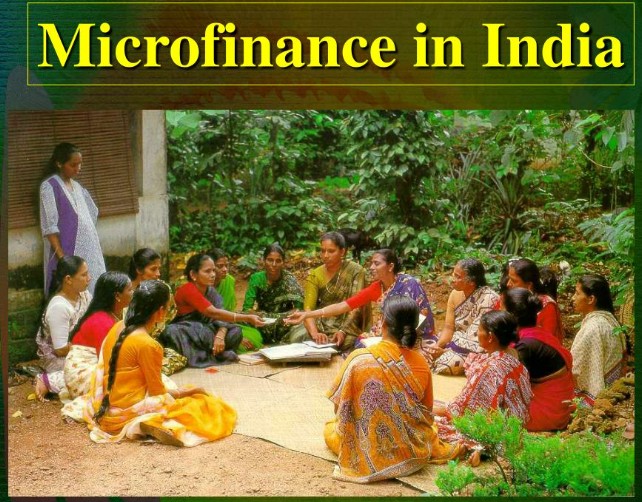
Microfinance Sector in India- Present Status
- Contribution to GDP: Around 2 % of India’s GVA in 2018-19.
- Growth: Witnessed growth of over 13 percent in the last quarter of fiscal year 2021-22; year-on-year (YoY) growth stood at 5 percent.
- SHG-Bank Linkage Programme: Covers around 15 crore families through SHGs (around 87% of which are women).
- Employment: to 13 million jobs (direct and indirect).
- Portfolio: 78 percent coverage in rural areas and 22 percent in urban areas.
Evolution of Microfinance in India (1987-2022) |
||
|
INITIATION (1992-2002) |
CONSOLIDATION (2003-2012) |
INNOVATION (2013- 2022) |
|
|
|
About Microfinance Institutions (MFIs)

- The microfinance sector in India has experienced rapid growth, serving approximately 102 million accounts, including those held by banks and small finance banks.
- Various providers, including NGOs, cooperatives, banks, and telecommunication companies, offer microfinance services.
- NBFC-MFIs in India are regulated by the Non-Banking Financial Company - Micro Finance Institutions (Reserve Bank) Directions, 2011.
- Major Business Models - Joint Liability Group, Self Help Group, Grameen Model Bank, Rural Cooperatives
Significance of Microfinance in India
- Credit to Low-Income Borrowers
- Collateral-Free Loans
- Financial Inclusion
- Income Generation
- Women Empowerment
- Rural Development
- Encourage Self-Sufficiency and Entrepreneurship
Challenges of Microfinance in India

- Fragmented Data: While loan accounts have increased, data on MFI clients' poverty-level improvement remains fragmented, making it difficult to assess microfinance's impact on poverty reduction.
- Limited outreach - Penetrating remote rural regions with financial services remains a challenge due to inadequate infrastructure, connectivity, and low levels of financial literacy.
- For Ex. MFI outreach in India is extremely low, at only 8%, compared to 65 percent in Bangladesh.
- Higher Rate of Interest than Mainstream Banks – According to a report by the Reserve Bank of India (RBI), average interest rate charged by microfinance institutions (MFIs) in India ranged from 20% to 26%, which is higher than the rates charged by traditional banks (8-12%).
- Impact of Covid-19: The MFI sector has been affected by the pandemic, with collections initially declining and disbursals facing challenges.
- Overlooking social objectives: In pursuit of growth and profitability, some MFIs may overlook their social objective of improving the lives of marginalized communities.
- High operational costs: Study conducted by the Reserve Bank of India, it was found that operational expenses constituted around 25-30% of the total expenses for MFIs.
- Over indebtedness: Borrowers taking loans from multiple microfinance institutions (MFIs) and informal sources can lead to a debt trap.
- For Ex. Andhra Pradesh microfinance crisis in 2010 occurred due to aggressive lending practices and coercive recovery methods, leading to borrower distress.
- Loans for Non-income generating purposes: Loans used for non-income-generating purposes may exceed the regulatory limit of 30%, trapping borrowers in debt.
- Financial illiteracy: Lack of awareness about various MFIs and their services due to financial illiteracy hampers the participation of the economically disadvantaged.
- Inability to generate funds: MFIs face difficulty raising sufficient funds due to their not-for-profit nature, limiting access to private equity investors and other market-based sources.
- Heavy dependence on banks: Around 80% of the Microfinance institution's funds came from commercial banks.
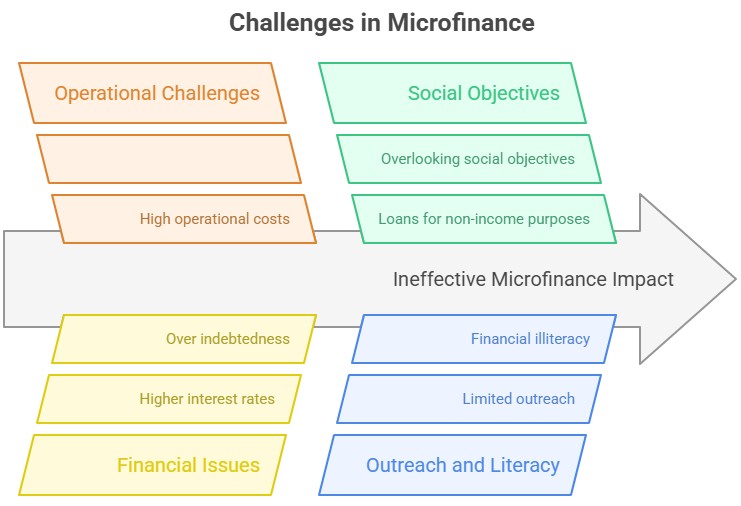
Way Forward
- Regulation: Establishing a comprehensive regulatory framework for the Microfinance sector instead of reactive initiatives is essential due to its significant expansion.
- Strengthen Credit Assessment and Risk Management: To mitigate the risk of over-indebtedness and ensure that loans are provided to borrowers who can repay them.
- Interest Rate Transparency: MFIs should transparently inform borrowers about interest rates and additional charges levied on loans.
- Encourage Microfinance Penetration: Providing financial assistance to MFIs to open new branches in areas with low Microfinance penetration will increase outreach.
- Expand Product Range: MFIs should provide all financial products and non-financial services to underserved populations.
- Use of Technology: Adopting new technologies, IT tools, and applications can help MFIs reduce operational costs.
- Diversify Funding Sources: To finance their loan portfolios, MFIs should consider becoming a for-profit company (NBFC).
Conclusion
Microfinance institutions support marginalised people and inclusive growth. To maximise impact, establish comprehensive regulations, ensure interest rate transparency, encourage expansion in underserved areas, diversify product offerings, leverage technology, and explore diverse funding sources.
25. Privatization of Banks: Opportunities and Challenges
Background
In 1969, 14 banks were nationalised and in 1980, another 14. The goal was to expand financial services and boost economic growth, but it was already failing. Private banks emerged after reforms of 1991.
12 public sector banks and 21 private sector banks control 70% of the market. The Union Budget 2021-22 aimed at privatizing two public sector banks.
Opportunities
- Effective Regulations- Government ownership makes it difficult for RBI to regulate the sector, according to NCAER.
- Credit growth- According to economic survey 2020, PSB credit growth has declined since 2013 while new private banks had significant credit growth (between 15 percent and 29 percent).
- Complacency followed by recapitalization- Government controls all PSB operations. This implies bank liability bailout.
- The ex-government recapitalized PSBs with 3.1 lakh crore capital infusion over five years, burdening the state exchequer.
- Decreased risk Appetite- PSB officers are subjected to scrutiny by CVC and CAG making them wary of taking risks
- Strengthening banks –Effective management through private sector participation would create big banks as economic survey suggests India should have at least 6 banks in global top 100 based on its size.
- To deal with banking frauds – PSBs commit 92.9 percent of corporate lending fraud due to poor screening and monitoring.
- Effective management of NPAs – India's banking system's NPAs were 80% PSBs in 2019. 14.6% of loans are gross NPAs.
- More market value- Private banks fetch five times as much value as that of a rupee invested in PSBs.
Challenges
- Against financial inclusion objectives- Under PM JDY-as of July 2022, more than 45cr beneficiaries have been covered and 78% of these accounts were in PSBs
- Resilience – Indian PSBs were more resilient during the 2008 subprime lending crisis and have also fared well during the Covid crisis.
- Unemployment- Uncertainty in employment prospects of the already employed in PSBs, fear of possible retrenchment might lead to protest from the labour unions.
- Socialistic objectives- PSBs' ATMs in rural areas are twice as many as private banks.
- Labour cost efficiency - PSBs produced more with less labour, according to RBI's recent report.
- Public sector banks played a major role in boosting public confidence due to government guarantees.
- Long history of failures in private banks - EX- RBI had to rescue YES bank by pumping capital by other entities to save the bank.
Way Forward
- NCAER suggested that the banks chosen for privatization must be the ones with the highest returns on assets and equity and the lowest NPAs in the last 5 yrs.
- Research paper by RBI suggested for a more gradual approach towards privatization instead of full exit
- Economic survey suggested that the efficient of the PSBs could be increased by adopting fintech technology across all banking functions and employee stock ownership across all levels.
- P J Nayak committee recommended that government must reduce its stake in PSBs to less than 50%, establishment of bank investment company to run PSBs.
- Effective usage of data analytics like geo tagging of collateralized assets, connecting lenders all across the banking system through legal identifier system.
- Using credit analytics for prevention of large proportion of NPAs.
- Economic survey suggested for creating a PSB network on line with GSTN for recognizing credit patterns, screening the corporate for fresh loans etc.
Initiatives taken for banking sector reforms-
|
Conclusion
According to RBI's report, privatisation isn't a cure-all, so a more nuanced approach to bank privatisation is needed to promote economic growth and welfare.
26. Bank Recapitalization
Recapitalizing banks helps them meet Reserve Bank of India capital adequacy requirements. Since 2016-17, the Union Budget includes bank recapitalization. The Centre injected Rs.3.31-lakh crore into banks between FY17 and FY21.
|
Need-
|
Benefits-
|
|
Impact of the previous recapitalization exercise
|
Challenges-
|
Way ahead-
- Reskilling and recruitment of specialists as advisors.
- PSBs should be given adequate operational flexibility.
- Effective monitoring of the intended objective
- Creation of Bank Investment Company for professional management of PSBs.
- Decreasing bureaucratic interference.
Conclusion-
Union budget 2023-24 does not set a bank recapitalisation target due to bank efficiency. While Bank Recapitalisation was necessary during the banking crisis, more attention should be given to improving work culture and making banking staff equal stakeholders for the banks' proper functioning, which requires an administrative overhaul.
27. Insolvency and Bankruptcy Code (IBC) Reforms: GN Bajpai Committee’s Key Recommendations, Impact
The GN Bajpai committee recently recommended that the Insolvency and Bankruptcy Board of India (IBBI) create a standardised framework for the five-year-old IBC (IBC). This framework needs a real-time data bank with time, cost, recovery rates, and macroeconomic indicators. To evaluate and improve law implementation.
Objectives of the Insolvency and Bankruptcy Code (IBC)
The committee emphasizes that resolving distressed assets remains the primary objective of the IBC. It is followed by promoting entrepreneurship, ensuring credit availability, and balancing the interests of stakeholders.
Understanding Insolvency and Bankruptcy Code, 2016
- Introduced in 2015 and implemented in 2016, the Code aims to provide a unified framework for resolving insolvency and bankruptcy cases in India.
- Insolvency refers to the inability of individuals or organizations to fulfil their financial obligations.
Insolvency Resolution Process under the Insolvency and Bankruptcy Code (IBC)
- For individuals, the insolvency resolution process differs from that of companies. Either the debtor or the creditors can initiate these processes.
- Resolution process for companies and limited liability partnerships:
- Must be completed within a maximum of 180 days from case registration, with a possible 90-day extension upon agreement by 75% of financial creditors.
- Involves negotiations between debtors and creditors to draft a resolution plan.
- Concludes when a resolution plan is agreed upon by the majority of creditors and submitted to the adjudicating authority or when the negotiation period expires
- Resolution process for individuals and partnerships:
- Debtors may apply for debt forgiveness if their assets fall below a limit set by the central government. This process must be completed within six months.
- Insolvency resolution negotiations between debtors and creditors are supervised by insolvency professionals.
- If negotiations succeed, a repayment plan approved by the majority of creditors is submitted to the adjudicator. Failure leads to bankruptcy resolution.
Need for the Insolvency and Bankruptcy Code (IBC) in India
- Delay in insolvency resolution: As of 2015, Indian insolvency resolution averaged 4.3 years. This is much higher than the UK (1 year) and US (1.5 years).
- Scattered laws relating to insolvency and bankruptcy: Before IBC, India had many insolvency and bankruptcy laws. The resolution process was delayed and ineffective. SARFAESI, RDDBFI, and Companies Acts are examples.
Recent Amendments in the Insolvency and Bankruptcy Code (IBC)
- Representative of financial creditors: During the insolvency resolution process, a Committee of Creditors (CoC) is formed to make decisions through voting. Representatives of financial creditors participate and vote on their behalf.
- Undischarged insolvents, willful defaulters, convicted criminals, and Companies Act-disqualified directors are ineligible. Prohibited selling defaulter's property to such individuals during liquidation.
- Lower voting threshold for routine decisions: The voting threshold for routine decisions by the CoC was reduced from 75% to 51%.
- Recognition of homebuyers as financial creditors: Homebuyers who have paid advances to a developer are now considered as financial creditors.
- Withdrawal of resolution application: With 90% CoC approval, the amendment lets the NCLT withdraw a resolution application.
- Applicability of the Code to MSMEs: Micro, Small, and Medium Enterprise resolution applicants are exempt from NPA and guarantor ineligibility criteria (MSMEs).
- Time-limit for resolution process: The Code requires insolvency resolution to be completed within 180 days, extendable by 90 days.
- This Amendment adds that the resolution process must be completed within 330 days. This includes time for any extension granted and the time taken in legal proceedings in relation to the process.
- Additional threshold for initiating resolution process: Added a threshold for certain financial creditors, including real estate project allottees. At least 10% or 100 must start the process together.
- Continuation of critical goods and services supply: Empowered resolution professionals to require suppliers to continue providing essential goods and services during the insolvency resolution process.
- Suppliers must receive payment for their current dues to continue supplying.
- Liability protection for new owners: If management or control changes, a company in insolvency resolution is not liable for prior offences.
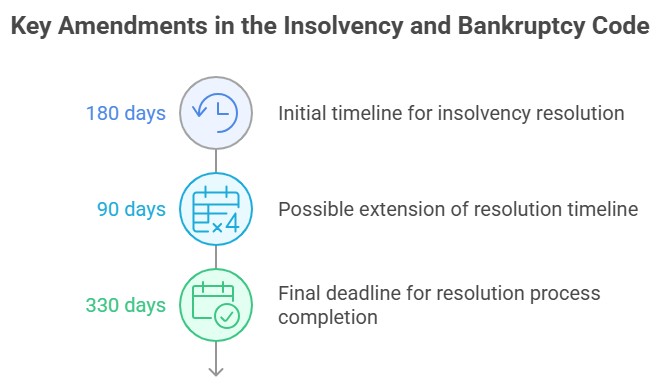
Proposed Amendments in 2022
- Appointing Common Resolution Professional
- Redesigning Fast-Track Corporate Insolvency Resolution Process (FIRP)
- Special framework for resolution of real estate to limit IBC proceedings to insolvent projects.
- Electronic platform.
- Empowering IPs to transfer ownership of property.
- Extension of pre-packaged insolvency resolution framework to larger entities.
- Multiple resolution plans for single stressed firm.
How the Insolvency and Bankruptcy Code (IBC) Benefits Stakeholders
- For debtor: It promotes entrepreneurship, as IBC framework facilitates easy exit for loss making companies.
- Maximization of the value of assets of corporate persons.
- It helps in reviving the company in a time-bound manner.
- For creditors: It protects the interest of creditors, and consequently increases the credit supply in the economy
- Timely recovery procedure helps banks/financial institutions to reduce their NPAs
- For Government: Helps in reducing number of time-consuming litigations
- Simplifying procedure: It consolidates and amends all existing insolvency laws in India, hence simplify and speed-up the Insolvency and Bankruptcy proceedings.
Successes of the Insolvency and Bankruptcy Code (IBC)
- High recovery rate: Before enactment of the IBC, the recovery mechanisms available to lenders were through Lok Adalat, Debt Recovery Tribunal and SARFAESI Act.
- According to a World Bank statement, IBC has improved the recovery rate of stressed assets to 48% in two years from 26% in the pre-IBC era
- Higher credit realization: Till June 2020, 250 companies had been rescued and 955 others referred for liquidation. According to IBBI, the resolution plans yielded about 191% of the realizable value for financial creditors
- Improvement in ease of doing business ranking: IBC played an indisputable role in improving India’s Ease of Doing Business (EODB) ranking from 130 in 2016 to 63 in 2020.
Issues
- Poor compliance to timelines: Despite the extension, resolution plans continue to cross the deadline. On average, it takes 380 days for resolution plans to reach a conclusion.
- Institutional issues
- Limitation of DRTs/NCLT – Inadequate manpower (50% posts in NCLT lying vacant), sluggish disposal of cases, huge pending cases, inadequate infrastructural facilities etc.
- Poor & insufficient infrastructure of the Information Utilities (IU) that provides access to credible and transparent evidence of default.
- Inadequate number of Insolvency Professionals (IPs) to manage the rising number of cases.
- Underdeveloped Secondary asset market – To find buyers for stressed assets.
- Complex nature: IBC process also involves a number of stakeholders with competing interests, which further makes resolution complex and time-consuming.
- Issue in order of priority to distribute assets during liquidation: Unsecured creditors have priority over trade creditors, and government dues will be repaid after unsecured creditors.
- Fragmented information in multiple IUs: Code provides for the creation of multiple IUs. However, it does not specify that full information about a company will be accessible through a single query from any IU.
- Performance bond: The Joint Committee of Parliament, which examined the Code, noted that requiring a performance bond may deter IPs and IPAs from entering the sector.
- Conflict of interest in IPAs: Code allows for multiple IPAs to operate simultaneously, which could enable competition in the sector.
- Accountability of Committee of creditors (CoC) – Even though the CoCs have significant discretion in the resolution process, there is no mechanism to ensure accountability and transparency of its decisions.
- Burden for small creditors: All operational creditors must submit financial information to IUs, which may be difficult for small creditors to do.
Way Forward
- Adopting recommendations of the GN Bajpai committee: Setting up specialized National Company Law Tribunal benches to hear only IBC matters
- Digitalizing IBC platforms in order to make the resolution process faster and maximise the realisable value of assets.
- Enhance institutional capacity of the NCLT benches: There is a need to increase the number of appointments of judicial members/experts.
- Overcoming pendency: Provide funds and functionaries to DRTs and NCLT for timely disposal of cases.
- Leveraging greater expertise by appointing judicial members of NCLT at least at the level of High Court judges & Specialised NCLT benches to hear only IBC matters.
- Background checks in terms of conflict and integrity should be done for insolvency professionals, with timelines being set to complete proceedings
- Encouraging pre-packaged insolvency - to streamline resolution process and reducing burden on NCLT.
- Capacity Building - Training of the lawyers, IPs, IPAs, and IUs to implement the law in its letter & spirit.
- Robust technological infra & data collection – End-to-end digitization of processes & improved data gathering by IUs to make the resolution process faster, and maximise the realisable value of assets.
- Draft Framework for Cross Border Insolvency, recently published by Min. of Corporate Affairs, based on UN Commission on International Trade Law (UNCITRAL) Model Law, to be expeditiously finalised.
- Other reforms – Continuous review of IBC, holistic banking sector reforms etc.
GN Bajpai Committee: Key Recommendations on Insolvency and Bankruptcy CodeEstablishing the ‘Priority order’ of IBC Objectives – (1) Resolution of the distressed asset, (2) Promotion of entrepreneurship, (3) Availability of credit, (4) Balancing the interests of stakeholders.
|
28. Digital Banks: A Proposal for Licensing & Regulatory Regime for India
"Digital Banks: A Proposal for Licensing & Regulatory Regime for India" by NITI Aayog emphasises the need for digital banks and a comprehensive regulatory framework. This proposal seeks to improve credit penetration among MSMEs and advance financial inclusion.
Digital Bank
The proposed definition of a digital bank within the Banking Regulation Act, 1949, emphasizes its unique characteristics:
- Separate Legal Existence: A digital bank will possess its own balance sheet and legal identity.
- Compliance with Prudential and Liquidity Norms: Digital banks must adhere to prudential and liquidity norms similar to those imposed on existing commercial banks.
- Objective - To provide maximum services with minimum infrastructure, digitally without involving any paperwork.
Rationale for Digital Banks
The establishment of digital banks is driven by the following factors:
- Credit Gap: Despite digital payments, India's micro, small, and medium businesses still need credit.
- Reliance on Digital Channels: Digital banking channels empower under-banked small businesses and build retail consumer trust.
- Challenges Faced by existing Neo-Bank Models like revenue generation and long-term viability.
Digital Banking Units (DBUs)
Overview of DBUs
- Digital Banking Units (DBUs) are set up by the Scheduled commercial banks .
- DBUs provide digital infrastructure for digital banking products and self-service financial products.
- In DBU, the products and services are offered to customers in two modes:
- Self-Service Mode (available on 24*7*365 basis)
- Digital Assistance Mode
- Objective - To ensure the benefits of digital banking reach every nook and corner of the country.
Benefits of DBUs
- Improved Accessibility: DBUs enable individuals without Information and Communications Technology (ICT) infrastructure to access banking services digitally.
- Assistance for Non-Tech Savvy: DBUs support individuals who are not technologically proficient in adopting digital banking.
Differentiating DBUs from Traditional Banks
- 24/7 Digital Banking Services: DBUs provide round-the-clock banking services, including cash deposits and withdrawals.
- Digital Service Delivery: DBUs offer services exclusively through digital platforms.
- Paperless Transactions: DBUs allow individuals without connectivity or computing devices to conduct banking transactions in a paperless manner.
- Assisted Banking: Bank staff is available at DBUs to assist and guide users in their banking transactions.
- Promoting Digital Literacy: DBUs contribute to digital financial literacy and raise awareness of digital banking adoption.
Difference between Digital Banks & Digital Banking Units (DBU)
|
Basis |
Digital Banking Units (DBUs) |
Digital Banks |
Legal Status |
|
Digital Banks have a balance sheet and legal personality and are proposed to be duly licensed banks under the Banking Regulation Act, of 1949. |
Innovation and Competition |
|
The licensing and regulatory framework for Digital banks is more enabling along with competition and innovation dimensions. |
Significance of Digital Banking
Enhanced Rural Credit Flow, Greater Access for the Poor, Cost-Effective Solution, Enhanced Technical Support, Reduced Manpower Requirement, Steady Profits for Banks, Enhancing Digital Literacy.
Challenges of Digital Banking
- Low Awareness and Internet Penetration: Low internet penetration and awareness make digital banking difficult in lower-tier cities.
- Vulnerabilities and Hacks: Phishing, pharming, identity theft, and keylogging can affect digital banking platforms.
- Technological infrastructure: Ensuring uninterrupted availability, managing technological upgrades, limited internet connectivity, preventing system failures, and protection against cyber threats.
- Lack of Financial Literacy: According to the National Centre for Financial Education (NCFE) survey of 2019 only 27 % of adults in India are financially literate.
- Regulatory Compliance: Adhering to know-your-customer (KYC) requirements, anti-money laundering (AML) regulations, and data privacy laws.
Way Forward
- Infrastructure Development: Improving internet connectivity, digital infrastructure in both urban & rural areas,
- Enhance Customer Experience: Prioritize seamless and user-friendly interfaces, personalized services, and efficient customer support.
- Embrace Technological Advancements: Forge partnerships and collaborations with fintech companies, payment processors, e-commerce platforms, and other ecosystem players, conduct workshops, training sessions, and awareness campaigns.
- Financial Inclusion: Collaborate with governments, NGOs, and other stakeholders to address the digital divide, expand access to affordable digital devices, developing user-friendly interfaces, simplifying processes.
- Ensure Regulatory Compliance: Adhere to RBI guidelines, maintain strong relationships with regulatory bodies, and stay updated on evolving regulations.
- Prioritize Cybersecurity: To build trust and reduce cyber risks, implement strong security, audit regularly, and protect customer data.
Conclusion
Digital banks and units can revolutionise Indian banking. These banks serve underserved rural and remote populations. India can lead the fintech industry and empower all with the right strategies and partnerships.
29. Neo banks
Neo banks are online only financial technology companies that have no traditional bank branch.
Features
- Partners with incumbent licensed banks to offer specific banking services such as deposits, cards and payments etc.
- They are not present physically.
- Customers can easily sign up for accounts on their website/App and use their services.
- Gets investment adviser licenses for wealth management.
- No formal regulatory license for neo banks in India.
Difference between traditional bank and Neo banks
- Digital- As mentioned earlier, Neo banks are completely digital, while traditional banks have physical branches coupled with online banking services.
- Licensing- Traditional banks are fully licensed and chartered, while very few neobanks have banking licenses. To ensure their products, neobanks usually partner with traditional banks.
- Low cost- Neobanks charge very low fees for their services while traditional banks tend to overwhelm customers with various types of complicated fees.
- Services- Neobanks typically offer checking and savings accounts, money transfer and payment services, and some financial education tools (e.g., budgeting apps). Traditional banks offer more services, including lines of credit, financial advisors, credit cards, investing, and more.
- Relationships- Traditional banks place a greater emphasis on building deep, long-lasting relationships while neo banks tend to have mostly flexible, short-term contracts and relationships.
Benefits
- Better consumer experience- Neo-banks ensure a seamless online experience by incorporating a digital and experiential layer on top of traditional banking.
- Tech-driven- customers can easily sign up for accounts on their website/App and use their services.
- Enhanced service experience-Neo-banks bridge the gap between traditional bank services and digital customer expectations.
- Lesser transaction costs-Since they're online only, customer fees are much lower.
- Customer focused solutions-Customer-focused neo-banks offer personalised technology-powered services.
- Data analytics-They can track and analyse neo-banking customer activity better due to their advanced platforms.
- Quick International Payments: Traditional banks may not issue global debit cards. Neo-banks makes cards compatible.
- Manage finances-Neo-banks lets you track your spending and set a savings goal. This improves financial management.
- Business friendly- Easy business loan payment and disbursement without complicated processes.
Issues
- Poor data architecture—disintegrated data storage requires consolidation to improve user experience.
- Organizational resistance—it may threaten traditional banking.
- No cutting-edge technology = no R&D investment.
- Digital divide—53% rural broadband coverage—may neglect rural market.
- No branches—customers may have trouble getting help.
- Financial data theft, cyberattacks, etc.
Conclusion: Neobanking can enhance financial inclusion efforts. Neo Banks have the potential to disrupt banking and financial services, but to become profitable, they must convince traditional banks to invest in new technology and re-engineer processes to provide seamless and fast customer experiences.
30. Card Tokenization
Introduction: Card Tokenization is the process of replacing original card details with an alternative code called a "token" that should be unique and provides an additional degree of protection for customer credit card details. Recently, RBI has made tokenization mandatory for all credit and debit cards used in online, POS and in-app transaction.
Features-
- It involves giving each payment method a special token that is unique to it.
- The customer is not required to pay any fees in order to use this service for tokenization and de-tokenization.
- Actual card data, token and other relevant details are stored in a secure mode by the authorized card networks.
- Token requestor cannot store Primary Account Number (PAN), i.e., card number, or any other card detail.
- The customer may use any card registered with the token requestor app to complete a transaction, and they are also free to set and change daily and per-transaction quotas for tokenized card transactions.
- Tokens will also be a 16-digit number but consumers do not have to remember these.
- Merchants need to create a token reference number so that fraud could be detected and eliminated in the specified time.

Benefits-
- Safer-Since the actual card data are not given to the merchant during transaction processing, tokenized card transactions are regarded to be safer.
- Speed-Aids merchants in delivering a consistent user experience and higher transaction approval rates with speed and security.
- Consumer experience-Lowers hassle in the checkout process as consumers will no longer be required to repeatedly enter their card information once a token has been issued.
- Innovation- along with UPI, it is inculcating advanced innovation in payment system providing impetus to digital India.
Challenges-
- Inadequate user awareness
- Apprehensions that it may reduce online card payments and may give fillip to wallet transactions.
- Major hit on the provisions of instant pay outs and cashback given in credit card transactions.
Conclusion- In India, tokenization is a fundamental shift that requires all the stakeholders in the payment ecosystem – acquirers, issuers, card networks, banks, and fintech’s, among others – to do their part to help ensure a secure digital payment environment.
31. Cropping Pattern in India: Types, Factors, Issues & Crop Diversification Explained
Cropping Pattern in India is defined as spatial representation of crops rotations, or the proportion of land under cultivation of different crops at different times of the year. Cropping pattern mainly determined by the rainfall, temperature, climate and soil types.
Cropping Pattern in India and Cropping System
- Cropping pattern: It is the proportion of area under various crops at a point of time in a unit area. It includes yearly sequence and spatial arrangement of crops and fallow on a given area.
- Cropping system: Cropping pattern and its management to derive benefits from a given resource base under specific environmental conditions is called cropping system. It is location specific, so it changes when place and environment are changed.
Types of Cropping System in India
|
Factors Affecting Cropping Pattern in India
Physical factors: Soil, Climatic, Temperature
Technological factors
- Irrigation facilities: For Ex. Punjab and Haryana emerged as rice growing states due to irrigation facilities
- Quality seed: For Ex. Bt seeds in Vidarbha altered cropping pattern towards cotton-based economy.
- Green house technology: Vegetable based and horticulture based cropping pattern.
- Processing technology: Ketchup industry in Maharashtra, Tomato cropping.
- Storage technology: More toward perishable crops like flavour savour tomato.
Economic factors
- Availability of credit by institutional and non-institutional factors. Ex., Sugarcane based in western Maharashtra.
- Landholdings size of land of farmers helps in choice and cropping patterns.
- Inputs- Ex., credit and loans for input directly affect area under different crops.
Government policies
- Minimum Support Price (MSP): For Ex. higher MSP for rice and Wheat have resulted in higher area under cultivation of these crops.
- Subsidies on farm inputs eg. subsidies on power leads to adoption of water intensive crops like sugarcane.
- Export import policies of government Ex. Area under onion and sunflower in 2022 got affected by government policies
Social factors: Food habits, For eg, preference of Wheat/rice over traditional millets in India has resulted in decrease in area under Millets cultivation.
Issues with the Current Cropping Patterns
Refer diagram ????????????

Remedies to current issues in cropping pattern:
- Crop diversification
Crop diversification is a strategy applied to grow more diverse crops from shrinking land resources with an increase in productivity in the same arable land.
Approaches to Crop Diversification in India
- Vertical Crop Diversification: Vertical crop diversification stresses upon the development of allied sectors and shift of burden from cultivation to allied activities e.g., animal husbandry, horticulture, floriculture, food and fruit processing etc.
- Horizontal Crop Diversification: It stands for inclusion of more and varied crops in the cropping system, using multiple cropping techniques, rather than concentrating on repetition of few crops.

Measures of Crop diversification
Benefits
- Maximisation of income- 84% of farmers in India are small and marginal. With small landholding profit maximisation can be possible with crop diversification.
- Mitigate natural calamities – Mixed cropping is useful to fight sudden erratic rainfall, increased temperature, climate change etc.
- Increase economic stability- Crop subsidisation with more economical crops helps farmers in maintaining economic stability of farming system.
- Environment conservation: Iimproves soil fertility, minimizes water stress, decreases soil pollution leading to reduced chances of pest attack.
- Food and nutritional security as it enables farmers to grow surplus produce.
Challenges
- Overuse of resources: like land, water may amplify resource consumption degrading the sustainability of agriculture.
- Over-dependence on Monsoon: Around 55% of Cultivable Land is Rain-fed with heavy dependence on monsoon resulting in adverse impact on crops as some crops may not be able to survive in the prevailing environmental conditions.
- Inadequate infrastructure for improving cropping pattern such as road, market, supply chain, post-harvest handling technology ,irrigation practice.
- Lack of technology: Inadequate trained human resources, modern technology & mechanization of agriculture, illiteracy of farmers etc.
- Research: Climate specific varieties, drought resistant varieties of different crops need to be done.
- Linkages: Inadequate forward and backward linkages due to inadequate infrastructure and modern mechanisms.
Govt Measures for Encouraging Crop Diversification

Conclusion
Crop diversification is demand driven, need based situation specific and national goal seeking dynamic and iterative concepts that incorporate spatial, temporal and value addition and resource complementary techniques. That will ensure food security of Indian and provide sustainable solutions for agricultural problems.
32. Northward Shift in Sugarcane Production, Climate Smart Agriculture in India
Six sugarcane-producing northern Indian states saw a 42 per cent increase in their output value between 2011 and 2020 while that of five states from the south declined 32.4 per cent during the same period, according to the latest National Statistical Office (NSO) report.
Reasons of Northward Shift in Sugarcane Production
- Climate: With the changing climate patterns, the traditional sugarcane-growing regions in the south are becoming drier and hotter, making it difficult to grow sugarcane.
- Soil: The northern regions have fertile alluvial soils that are suitable for sugarcane cultivation.
- Water availability: Sugarcane require huge quantities of water for growth, and the northern regions have better irrigation facilities compared to the southern regions.
- Government policies: The government has been promoting sugarcane cultivation in the northern regions by providing subsidies and other incentives to farmers.
- Market demand: The demand for sugarcane is increasing due to the growth of the sugar industry in the northern regions.
Impact of Northward Shift
|
Government Initiatives for Sugarcane Farmers
- Fair and Remunerative Price (FRP): It is the minimum price that the sugar mills have to pay to farmers. It is determined based on recommendations of the Commission for Agricultural Costs and Prices (CACP) and after consultation with State Governments and other stakeholders.
- Ratooning: In this method, during the first harvest, the sugarcane is cut, leaving a little bit of the stalk in the soil with the roots. The stem soon puts out new shoots or ratoons.
- Sustainable sugarcane initiative: It is an innovative credit-plus approach of NABARD, which helps integrate the twin drip irrigation system with resource-efficient sugarcane agricultural practices.
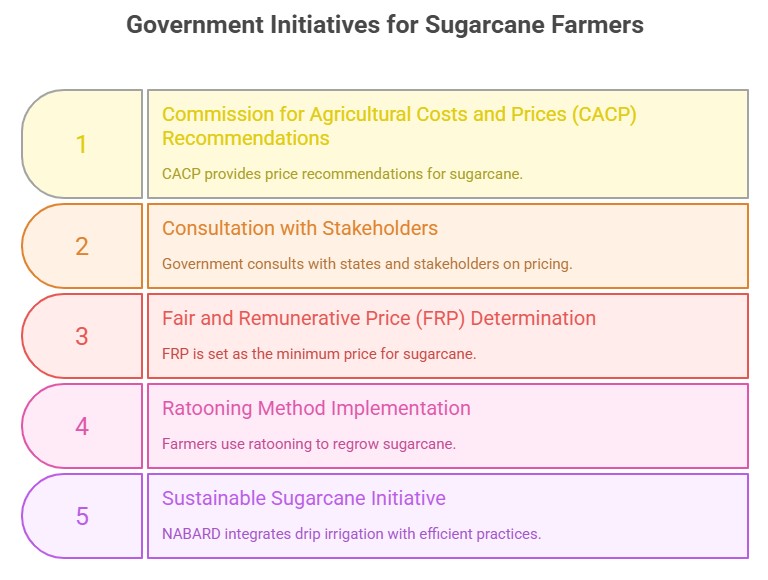
Climate Smart Agriculture: An Overview
- An integrated approach to managing landscapes to mitigate climate change impacts, adapt to climate variability, and promote sustainable development.
- Encompasses range of techniques and approaches that optimize productivity, resilience, and sustainability of agricultural systems in the face of climate change.
- It pursues the triple objectives of sustainably increasing productivity and incomes, adapting to climate change and reducing greenhouse gas emissions where possible; however, it does not necessarily result into “triple wins” at every location.
3 Pillars of Climate Smart Agriculture
|
Sustainable agriculture: |
Climate adaptation |
Climate mitigation |
|
|
|
Overall, CSA aims to promote sustainable and resilient agricultural systems that contribute to food security and mitigate climate change.
Significance of Climate Smart Agriculture
|
Agricultural |
Ecological |
Economical |
|
|
|
Government Initiatives for Promoting Climate Smart Agriculture
The Indian government has launched several initiatives to promote climate smart agriculture in the country.
- National Innovation on Climate Resilient Agriculture (NICRA): To enhance the resilience of agriculture to climatic variability through development and application of improved production and risk management technologies.
- Pradhan Mantri Fasal Bima Yojana (PMFBY): For reducing vulnerability to climate-related risks.
- Soil Health Card Scheme: to promote sustainable agriculture practices by providing farmers with information on soil health and nutrient management.
- National Mission for Sustainable Agriculture (NMSA) is a flagship program that aims to promote climate-resilient farming practices such as conservation agriculture, agroforestry, and integrated farming systems.
National Innovations in Climate Resilient Agriculture (NICRA)
|
|
Key facts An increase in temperature by 1.5° C and decrease in the precipitation of 2 mm, reduces rice yield by 3 to 15 percent.
|
Horticulture Sector
It is the science of the development, sustainable production, marketing and use of high-value, intensively cultivated food, and ornamental plants. 
Horticulture sector in India: Present Status
- It contributes about 35% to Agricultural GDP, from just 16% of the total cropped area, and supports 20% of the agriculture labour force.
- Production has more than doubled from 146 million tonnes in 2001-02 to 340 mt in 2021-22.
- Significant Expansion in Acreage (18%) Vis A Vis Foodgrains (5%) – (2010 – 2015).
- Global Position - India is the 2nd largest producer of fruits and vegetables in the world (after China).
India has emerged as world leader in the production of a variety of fruits like mango, banana, guava, papaya, etc.
Government Measures for Horticulture Development
- Mission for Integrated Development of Horticulture (MIDH): For holistic growth of the horticulture sector covering fruits, vegetables, root & tuber crops, mushrooms, spices, flowers, aromatic plants, coconut, cashew, cocoa and bamboo.
- Institutional Support: National Horticulture Board (NHB), Coconut Development Board (CDB), Central Institute for Horticulture (CIH), etc.
- Rastriya Krishi Vikas Yojana supports horticulture activities.
- Mission Organic Value Chain Development in North Eastern Region: Ginger, Turmeric, King Chilly, Pineapple & Lemon are being exported from India to Swaziland, Australia, USA, UK & Dubai.
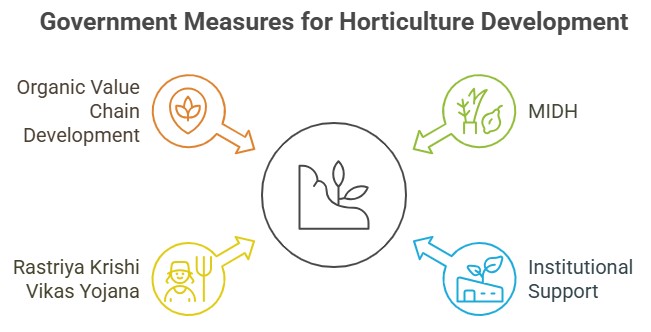
Challenges in the Horticulture Sector
- Low Productivity - Due to small, segregated farms with low per-hectare yields, lack of access to quality seed materials.
- Multiplicity of Intermediaries leads to high consumer prices on one hand, and low-price realization by farmers on the other.
- Distress Sale faced by excess production, and difficulty in access to markets produce to contain losses.
- High Post-harvest Losses - Due to perishable nature of the produce, lack of market support and paucity of the post production infrastructure for distribution, storage and value-addition.
- Lack of institutional finance for investments in micro-irrigation systems, construction of green houses and grading and packaging.
- Lack of private investment due to problem of land leasing & contract farming and cooperative farming.
- Impact on Exports – Low exportable surplus, poor quality produce, gap in market intelligence, high tariff/non-tariff barrier etc. affect market access for export of horticultural commodities.
- Climate change – Drought, flood, high temperature, salinity and new pathogens.
- Marketing issues leading to fluctuations in prices (Cobweb phenomenon)
Way Ahead
- Ensuring availability of quality seeds/planting material for better quality and yield of produce.
- Strengthening of horticulture support industry like food processing, logistics, packaging, etc
- Diversification of horticultural crops along with other activities viz. bee keeping, backyard poultry etc.
- Popularisation of cooperative farming in horticultural crops for round the year supply.
- Infusion of recent Scientific Advances on Crop Production Technologies – to improve operational efficiency and reduce costs ???? Promote Technologies at grassroot level.
- Promote Sustainable farming practices such as organic farming, drip irrigation etc.
- Stable policy regime to prevent violent price fluctuations.
- Promotion of horti-tourism in states like J&K, HP, Uttarakhand, and north-eastern state
Conclusion
The development of horticulture sector in India holds importance in ensuring food and nutrition security and doubling farmers’ incomes.
33. Millets in India: Benefits, Challenges & Global Recognition
Millets, popularly called “mota anaj” in Hindi, are a collective group of small seeded annual grasses that are grown as grain crops, primarily on marginal land in dry areas of temperate, subtropical, and tropical regions.
India has a rich tradition of consumption of millets.
Year 2023 marks the celebration of the Iinternational Year of Millets 2023. Recognizing the enormous potential millets, which also aligns with several UN Sustainable Development Goals in terms of being climate resilient, nutritious, and water efficient crops, the government of India has been prioritizing millets.
Types of Millets
- Major Millets- sorghum(jowar), pearl millet (bajra), finger millet (ragi/mandua)
- Minor Millet- foxtail millet (kangani/kakun), proso millet (cheena), kodo millet,barnyard
- Pseudo millet –Buckwheat (kuttu)and amaranth (chaulai)
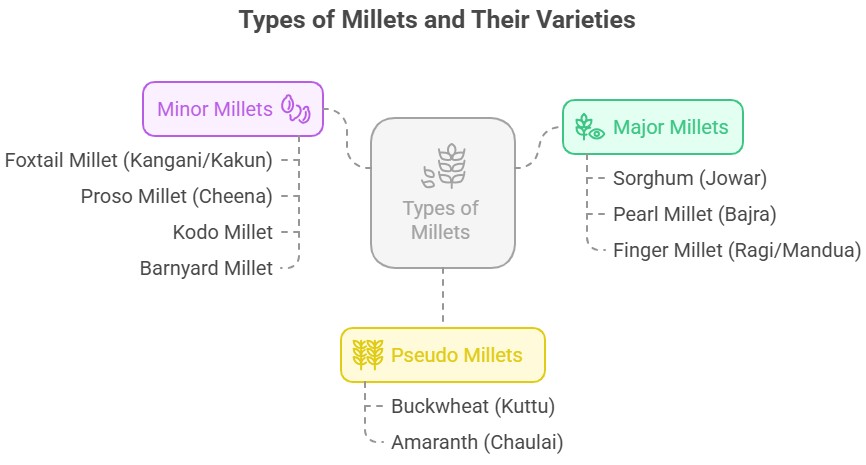
Millets Production: Data and Trends
|
Importance of Millets
- Nutritional benefits –Storehouse of nutrition as they are good sources of calcium, zinc, magnesium, phosphorus, copper, vitamins. They are gluten free and also considered good for celiac patients.
- Climate friendly crop- Millets are resilient to climate change as they are pest free, adapted to a wide range of temperatures and moisture regimes.
- Low water footprints. Requiring minimum rainfall for even sustain in drought prone areas.
- Viable options for small farmers: Low investment needed for production of millets.
- Multiple uses - as Food, fodder and feed, biofuels etc. For eg. Jowar & Bajra based biofuel can help in achieving target of 20% ethanol blending with petrol by 2025.
- Aligned with International commitment
- Focus on Millet production is in line with India’s commitment to SDG goals of eradication of hunger & UN Decade of Action on Nutrition from 2016 to 2025.
Millets Case StudyPopularising Millets in Telangana Komaram Bheem Asifabad is a tribal district under the project SAMPOORNA focused on ensuring the availability of traditional and local food like millets. Under decentralized Millet Village Circular Economic Model, millets are grown ,procured , processed, packaged and sold locally to villagers at cheaper price. |
International Year of Millets 2023
- The United Nations General Assembly has declared the year 2023 as a “International Year of Millets”.It will help in creating awareness throughout the world about the significant role of millets in sustainable agriculture and its benefit as smart food and superfood.
- IYM aims to contribute to the UN 2030 Agenda for sustainable Development ,particularly SDG 2 (zero hunger)SDG 3(good health and wellbeing), SDG 8 (decent work and economic growth) SDG 2 (responsible consumption), SDG 13 (climate action) and SDG 15 (life on land).
Challenges to the Millets Economy
- Reduced area under millet cultivation: Millet's area under cultivation decreased from 35 bn ha to 15 bn ha.
- Unavailability of the market and very little share in the processing sector.
- Lower shelf life - Processed Millets (like millet flour) have poor shelf life due to its intrinsic enzyme activity that causes rapid development of rancidity and bitterness.
- Consumer perception: Millets are increasingly seen as “poor person’s food”, thus, lower demand with rise in incomes and urbanization (rice and wheat seen as ‘aspirational foods’).
- According to NSSO household consumption expenditure survey, less than 10% of rural and urban households reported consumption of millets.
- Other Challenges - low remunerative prices, lack of input subsidies and MSP, yield variability, weak supply chain linkages & marketing, subsidised supply of fine cereals PDS system etc.
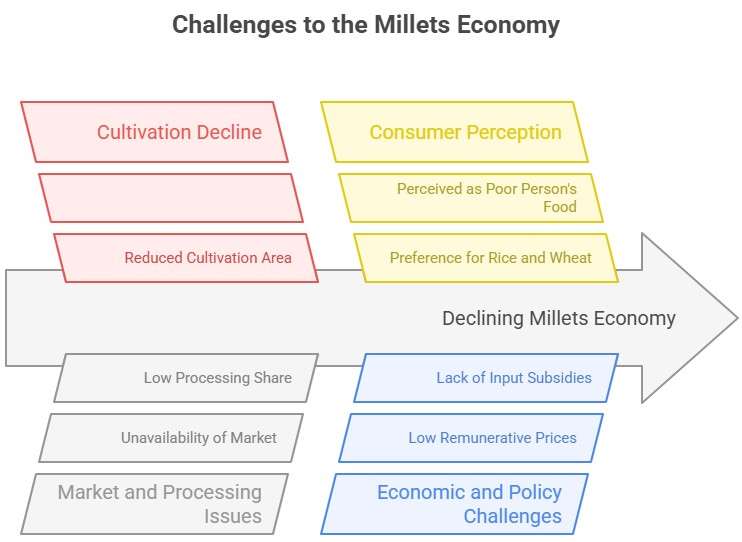
Maharshi Initiative (Millets and Other Ancient Grains Initiative)In news- Recently G20 MACs meeting (meetings of agriculture chief scientists) 2023 in varanasi under India’s presidency launch the MAHARSHI (Millets and Other Ancient Grains Initiative) Objective-To promote research and awareness about agro-biodiversity, food security and nutrition in line with the international year of millets 2023.
|
Conclusion
Millet farming still needs ecosystem-level interventions. Millets promote women farmers and their farming knowledge. Millets can be revived in India by educating farmers and the public about their many benefits.
34. Jute sector
- India is the largest producer of jute followed by Bangladesh and China.
- According to the third advance estimates released by the Union ministry of agricultures and Farmers welfare in May 2022, area under jute production has fallen by over 13% in the past decade.
- West Bengal leads in jute cultivation, along with Bihar, Assam, Orissa, Andhra Pradesh, Tripura, and Meghalaya.
Issues in Jute sector of India
- Lower yields due to high production costs and insufficient capital supply. Average yield per hectare is 1.3 tonnes in India (Bangladesh - 1.62 tones, China- 1.78 tones, Taiwan - 2 tonnes).
- Competition from synthetic fibres (are cheaper, more durable, and easier to produce than jute).
- Iinfrastructural constraints related to retting, farm mechanisation, lack of availability of certified seeds and varieties suitable for the country’s agro-climate.
- Other issues: Poor quality jute due to impacts of climate change, heavy reliance on monsoon, lack of modernization in the sector, low labour productivity, fluctuations in demand etc.
Government initiatives
- ISAPM (Incentive scheme for acquisition of plants and machinery) for modernisation of technology in the existing jute industry.
- JID (jute integrated development)- to provide basic and advanced training cum production centre
- JRMB (Jute raw material bank)- to supply raw jute materials to MSME units and artisans who are engaged in producing jute.
- EMDA (Export market development assistance) – to register agri exports for participation in international fairs.
- Central research institute for jute and allied sectors under ICAR developed a model resting tank with slow moving water.
Way ahead
- Diversification: For eg, Jute can be popularized as an alternative to Plastic and innovating new products such as Jute Geo Textiles made through special treatment & weaving processes.
- Modernization: This will require collaboration between the government, private sector, and international organisations to provide funding and technical assistance.
- Sustainability: This includes reducing pesticide use, improving water management, and promoting organic farming practices.
- Implementing recommendations of Tariff commission report to reduce the losses of the mill owners and prevent their closure.
35. Natural Farming
PM Modi bats for natural farming, calls it basis for economic success, he said the mass movement to adopt natural farming will be widely successful and the sooner farmers join this change, the more they will reap its benefits
Understanding the concept of natural farming:
- Natural Farming is a chemical-free farming system rooted in Indian tradition enriched with modern understanding of ecology, resource recycling and on-farm resource optimization.
- It is considered as an agroecology based diversified farming system which integrates crops, trees and livestock with functional biodiversity.
|
Benefits of natural farming
- Improved yield- As per a new study, Zero Budget Natural Farming (ZBNF) in Andhra Pradesh has led to significantly higher crop yield compared to organic or conventional farming.
- Employment generation - Across the agricultural value chain, from production, distribution, and retail of natural mixtures to market linkages for such produce.
- Environmental sustainability - Reduced chemical pollution, enhanced soil fertility and structure, preservation of biodiversity, conservation of water resources.
- Healthier food - No pesticide residues, higher nutritional value, reduced risk of chemical exposure.
- Economic viability - Reduced input costs in the long term, strengthened resilience to market fluctuations, improved farm profitability and sustainability.
- Climate change mitigation - Carbon sequestration, reduced greenhouse gas emissions, increased resilience to climate variability.
- Social advantages - Community health and well-being, Farmer empowerment by increasing their self-sufficiency and resilience, preserving traditional knowledge.
Issues involved with natural farming
- Lack of scientific validation to support its effectiveness in improving crop yields and soil health.
- Limited scalability: Natural farming practices require a high level of expertise and labor
- Limited access to inputs such as cow dung, compost, and other organic materials required for natural farming.
- Lack of market demand: which may affect the profitability of farmers practicing this method.
- Certification and Market Access - Meeting the certification requirements for organic farming, compliance with strict standards, certification costs, and establishing market linkages.
- Climate variability - Water scarcity, extreme weather events, and weather fluctuations, such as droughts, floods, or extreme temperatures.
|
Government initiatives
|
Zero budget natural farming
- Zero budget natural farming (ZBNF) is a farming method that aims to eliminate the use of synthetic inputs such as fertilizers and pesticides, and instead relies on natural processes such as crop rotations, intercropping, and composting.
- It was originally promoted by Maharashtrian agriculturist Subhash Palekar, who developed it in the mid-1990s as an alternative to the Green Revolution.
- The government has launched a national program to promote ZBNF, with a target of converting 10 million hectares of farmland to this method by 2025.
Pillars of ZBNF
- Jeevamrutha/jeevamrutha
- Bijamrita/beejamrutha
- Acchadana – mulching
- Whapasa – moisture
Challenges in implementation of ZBNF-
- Lack of proper training and capacity building programs for farmers to learn the principles and techniques of ZBNF.
- Limited access to organized markets and fair pricing mechanisms for ZBNF produce, making it difficult for farmers to sell their products at competitive prices.
- Inadequate availability of essential infrastructure such as storage facilities, processing units, and transportation networks, which affects the post-harvest management of ZBNF crops.
- Challenges in scaling up ZBNF practices to larger agricultural landscapes, as it requires coordination among multiple stakeholders and sustained efforts.
- Lack of research and development - many of private investment are not ready to invest in natural farming due to output constraints.
Successes of ZBNF:
- Andhra Pradesh: Farmers in villages like Palempalle have reported significant improvements in soil fertility, reduced input costs, and increased crop yields.
- Karnataka: Farmers in village of Shiramagondanahalli have witnessed improved soil health, reduced water consumption, and decreased dependency on external inputs. This has led to higher profits and better quality produce.
- Maharashtra: In the village of Niphad, farmers practicing ZBNF have seen a significant reduction in production costs, increased crop yields and improved soil structure.
36. Organic Farming in India: Principles, Practices, Challenges & Initiatives
Organic farming, sustainable agricultural system that uses ecologically based pest controls and biological fertilizers derived largely from animal and plant wastes and nitrogen-fixing cover crops.
Organic Farming in India: key facts
- India’s rank in terms of number of organic farmers- 1st (home to 30% of total organic producers in the world); in terms of world’s organic agriculture land globally - 5th.
- Area under Cultivation: only 2% of net sown area.
- Top 3 states - MP, Maharashtra & Gujarat account for largest area organic certification; in terms of production - MP, Maharashtra & Rajasthan.
- India’s exports of organic products- USD 1.04 billion during 2020-21.
- Sikkim became the first State in the world to become fully organic and other States including Tripura and Uttarakhand have set similar targets.
Principles of Organic Farming

Similarities between Organic Farming and Natural Farming
- Both focuses on using natural inputs and processes to improve soil health, reduce environmental impact, and produce healthy crops.
- Both avoid the use of synthetic pesticides and fertilizers and promote biodiversity by using native crops and crop rotation.
- Both practices prioritize animal welfare and aim to produce food that is free from harmful chemicals.
Difference between Organic Farming and Natural Farming
|
Organic farming |
Natural farming |
|
Organic fertilizers and manures, such as compost, vermicompost, and cow dung manure, are utilized and applied to farmlands in organic farming. |
Natural farming does not use chemical or organic fertilizers on the soil. In reality, no additional nutrients are put into the soil or given to the plants |
|
Basic agro practices like ploughing, tilling, weeding is performed |
No ploughing, tilling and weeding No pesticides, No herbicides, No pruning |
|
Organic farming is still costlier due to the necessity of bulk manures, and it has an ecological footprint on the surrounding. |
Natural agriculture is an extremely low-cost farming method that completely Molds with local wildlife. |
Challenges of Organic Farming

Initiatives for the promotion of Organic Farming in India
- National Programme for Organic Production: APEDA, Ministry of Commerce & Industries, Government of India is implementing the National Programme for Organic Production (NPOP).
- Participatory Guarantee Systems (PGS), as defined by IFOAM, are "locally focused quality assurance systems.
- They certify producers based on active participation of stakeholders and are built on a foundation of trust, social networks and knowledge exchange."
- Paramparagat Krishi Vikas Yojana:
- The scheme stresses on end-to-end support to organic
- Post-harvest management support including processing, packing, marketing is made an integral part of these schemes to encourage organic farmers.
- Under PMKVY, farmers are provided financial assistance of Rs 50,000 per hectare/ 3 years, out of which Rs. 31,000 (62%) is provided directly through DBT for inputs.
- Regulations for Organic Food Products, 2017 issued by FSSAI.
- Jaivik Bharat/PGS Green logo given by FSSAI to chemical free produce under transition to ‘organic’.
- Organic e-commerce platform www.jaivikkheti.in for directly linking farmers with retail & bulk buyers.
37. Primary agriculture credit societies
The Union Budget 2023-2024 has announced Rs 2,516 crore for computerisation of 63,000 Primary Agricultural Credit Societies (PACS) over the next five years, with the aim of bringing greater transparency and accountability in their operations and enabling them to diversify their business and undertaking more activities.
What is PAC?
- A Primary Agricultural Credit Society (PACS) is a basic unit and the smallest cooperative credit institution in India. The main aim of PACS is to provide short term and medium term loan to farmers for various agriculture activities. It works at the grassroots gram Panchayat and village level.
- A report published by the Reserve Bank of India on December 27, 2022 stated the number of PACS at 1.02 lakh. At the end of March 2021, only 47,297 of them were in profit.
Importance of PAC’s:
- Customized Credit Products: They design and offer tailored credit products to address these needs effectively. For instance, they provide crop loans to support seasonal agricultural operations etc.
- Cooperative Development: Farmers join together to form the PACS and participate in decision-making → enables farmers to negotiate better for credit, access markets collectively.
- Collective Bargaining Power: By pooling their resources and forming a cooperative, farmers can negotiate better terms for credit, purchase agricultural inputs collectively at lower prices etc.
- Risk Mitigation: Provide insurance that safeguard farmers against natural calamities, crop failures etc. For e.g., a PACS may offer crop insurance to protect farmers' investments in case of adverse weather etc.
- Economic Empowerment: Access to credit allows farmers to invest in farm inputs, modern technologies, and infrastructure, improving agricultural productivity and income levels.
- Institutional Support: Cooperative banks, such as DCCBs and State Cooperative Banks provide refinancing and credit linkage support to PACS.
Aim of Digitization of PAC’s:
- Financial inclusion and strengthening service delivery to farmers especially Small & Marginal Farmers.
- Improve Transparency- by seamless process of banking and lack of any form of fraud intermediaries.
- Increase efficiency, and will also facilitate the accounting of multipurpose PACS.
- It is nodal center for various programmes such as DBT, PM FBY, KCC etc which helps to improve productive and efficient delivery of policies.
Issues with PAC
- Politicization: Since PACS are cooperative bodies, political compulsions often trump financial discipline.
- Organizational Weakness:
- Inadequate coverage- The rural population covered as members is only 50% of all the rural households.
- Weak units - inadequate memberships, Inadequacy of credit limits
- Dependence on Refinancing Institutions: Challenges faced by DCCBs and SCBs, such as financial instability or delayed disbursal of funds, can have a direct impact on the functioning and credit availability of PACS.
- Inadequate and Restricted Credit: First, the PACS provide credit to only a small proportion of the total rural population. Second, societies do not provide full credit even for all productive agricultural activities.
- Limited Outreach: There are still 1.6 lakh Panchayats without PACS, leaving some farmers without access to formal credit facilities.
Digitization will help to create a strong base to PACS business integrating it with members and thus, become a real institution of rural development.
38. Groundwater in India: Challenges, Solutions & Government Initiatives
Groundwater is a crucial hidden resource that supports 80% of India’s drinking water and two-thirds of its irrigation needs. However, unregulated extraction and pollution threaten its availability, making sustainable management vital for the country’s water security.
- Groundwater is a hidden resource which accounts for 62% of total water and 30% of freshwater on earth.
- Groundwater is the backbone of India's agriculture and water Security in rural and urban areas.
- Nearly 80% of country's drinking water need satisfied by GW.
- It fulfils almost 2/3rd the need for irrigation.
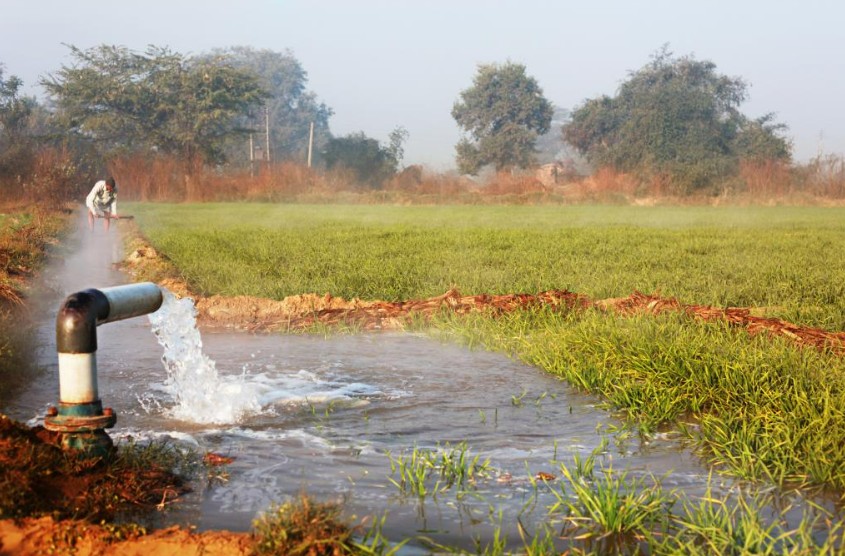
Groundwater Resources in India: Challenges
- Unregulated extraction- Availability of cheap electricity shifted farmers’ dependency from surface water to groundwater. For instance, of the total irrigated area in Punjab, only 26.2% is irrigated by surface water.
- Declining water tables- Data by CGWB- 30% of Wells have reported decline in GW level mostly in range 0-2 m.
- Groundwater pollution- Water quality data obtained by the Central Ground Water Board shows that groundwater in as many as 154 districts across 21 states has arsenic contamination.
- Excessive Withdrawal for Irrigation- Irrigation alone accounts for 87% of the total groundwater used in India today.
- Inadequacy of data on groundwater resources lead to difficulty in groundwater management.
Solutions to Groundwater Depletion in India
- Promote sustainable agriculture practices such as drip irrigation, crop rotation, and use of organic fertilizers.
- Promote rainwater harvesting to recharge groundwater resources.
- Improve monitoring and regulation by setting up a centralized database of groundwater resources, implementing stricter regulations on drilling of new wells, and imposing penalties for over-extraction of groundwater.
- Increase investment in water conservation and management technologies such as water-efficient irrigation systems, desalination plants, and water recycling systems.
- Raise awareness through campaigns to educate people about the importance of conserving groundwater resources.
Government Initiatives for Groundwater Conservation
By implementing these measures, India can ensure sustainable use of its groundwater resources and prevent further depletion. It is important for the government to take immediate action to address this issue before it becomes a major crisis.
Amrit Sarovar Mission

- Mission Amrit Sarovar was launched on 24th April, 2022 in the 75th year of Independence as a part of ‘Azadi Ka Amrit Mahotsav’.
- Objective:
- To construct/ rejuvenate at least 75 Amrit Sarovars in each district across the country and to overcome the water crisis in rural areas of the country.
- A target of construction of 50,000 Amrit Sarovars was set to be completed by 15th August, 2023.
- ‘Jan Bhagidari’ has been the core of this Mission and involves people’s participation at all levels.
39. Storage, Transport & Marketing of Agricultural Produce in India
Agricultural Produce Storage in India: Storage is a part of agriculture marketing that involves holding and preserving goods from the time they are needed for consumption.
Storage capacity in India
- The total storage capacity available with Food Corporation of India (FCI) and the State Agencies (both owned and hired capacity), is 819.19 LMT.
- However, these government agencies use 66% (60 MMT) of India’s total agri storage capacity which also includes hired capacity of 23 MMT.
- FAO estimates that more than 40% of food produced in India is wasted due to lack of proper cold storage facilities.
Significance of Agricultural Produce Storage
- It ensures a continuous flow of goods in the market, even for perishable products.
- Ensures food security by maintaining continuous supply of food grains in the market, even for perishable and semi perishable products.
- Helps in price stabilization in the market by adjusting demand & supply of commodities.
Importance of warehouses

Challenges in Agricultural Produce Storage
- Inadequate storage infrastructure: With many storage facilities lacking proper ventilation, pest control, and temperature control.
- Regional Disparity in Storage capacity: More than 60% of storage capacity of FCI located in large procurement states like Punjab, Haryana, Andhra Pradesh, Uttar Pradesh and Chhattisgarh.
- Poor maintenance: According to CAG 2013, food grains in centre pool in Punjab and Haryana are damaged due to inadequate, scientific and safe storage.
- Lack of Private Investment resulting in inadequate investment in storage infrastructure and maintenance.
Government Initiatives to Improve Agricultural Produce Storage
- Negotiable Warehouse Receipt (NWR) system: Warehousing Development and Regulatory Authority (WDRA), Government of India ensures implementation of the NWR.
- Loans for construction of storage facilities (warehouses, market yards, godowns and silos) are included under the Priority Sector lending (PSL) norms.
- Private Entrepreneurs Guarantee Scheme to incentivize construction of godowns by the Private players
- Subsidy for the construction of cold storage facilities
Way forward
- Shanta Kumar Committee has recommended Modernization of storage infrastructure by replacing covered and plinth storage with silo technology and conventional methods.
- Private sector participation to increase competition and improve efficiency.
- Decentralization of storage to reduce transportation costs and minimize spoilage.
- Use of technology such as GPS tracking and remote sensing to monitor food grain storage facilities and prevent losses.
- Capacity building by training its staff in modern storage practices and management techniques.
- Rationalization of buffer stocks by reducing excess stocks and maintaining only the required minimum levels.
Apart from all the infrastructure and subsidy support the farmer community needs to be educated to form cooperatives and organize into larger bodies that would construct storage capacity and various production pockets.
40. Agricultural Marketing in India: Challenges, e-NAM & Future Roadmap
Agriculture marketing refers to the services involved in moving agricultural products from the farm to consumer. It involves various interconnected processes, including production planning, planting and grading, harvesting, checking and packaging, shipping, storage, agri food processing & dissemination of market information.
Main Constraints of Agricultural Marketing in India
- Fragmentation of Markets: Agriculture marketing is a state subject and every state has its own Agriculture Pricing Market Committees Acts (APMCs) which has led to fragmentation of markets.
- Fragmented supply chain: fragmented with multiple intermediaries between farmers and consumers.
- Lack of storage and processing facilities which limits the ability of farmers to add value to their products and access higher-value markets.
- Limited market access and market information due to a lack of transportation infrastructure, as well as regulatory barriers and market distortions.
- Price volatility: With fluctuations driven by factors such as weather conditions, government policies, and market speculation.
- Limited access to credit: Due to a lack of penetration of financial institutions in rural areas, as well as regulatory barriers and high interest rates.
Government Initiatives to Promote Agricultural Marketing in India
E- NAM
- National Agriculture Market (e-NAM) is a pan-India electronic trading portal which networks the existing APMC mandis to create a unified national market for agricultural commodities.
- Small Farmers Agribusiness Consortium (SFAC) is the lead agency for implementing eNAM under the aegis of Ministry of Agriculture and Farmers’ Welfare, Government of India.
Applications

Constraints in Implementing e-NAM in Agricultural Marketing in India
- To implement e-NAM many the states have to make amendments in their APMCs acts. As of Feb 2022, Currently, 1,000 markets located in 21 states and three union territories (UTs) are integrated into the e-NAM network.
- A significantly lower share of trade in APMCs takes place on e-NAM. It is the traders themselves who trade in both online and offline platforms.
- Lack of knowledge and awareness among farmers: Online trading benefits farmers without digital media knowledge. e-NAM benefits commission agents, not farmers, due to such restrictions.
- Operational Issues: In some states, the e-NAM portal reported inconsistent arrival and traded quantity, commodity prices (minimum, maximum, and moral values), etc. Thus, e-NAM mandis are computerised but not fully implemented.
Way Forward to Strengthen Agricultural Marketing in India via e-NAM
- Digital interventions and training services are needed to increase farmers’ integration into e-NAM-enabled markets.
- Efforts should be taken reduce the role of traders and commission agents (CAs), who take away a major chunk of the values from the farmers and the mandis.
- The e-NAM should be fully integrated with Artificial Intelligence and the Internet of Things (IoT) to provide real-time information.
- Efforts should be made to develop a mobile app in the vernacular language which can be used by the farmer-sellers.
- All information related to mandi timing, online trading timings- opening and closing (commodity-wise, if it is different) should be standardized and well publicized.
With all these measures, e-NAM would be fully able to achieve the vision of “One Nation One Market” for Indian farmers. e-NAM has the potential to be their true “inam (reward)”
41. Supply Chain Management in Food Industry: Importance, Challenges & Solutions
Supply chain management is the management of the flow of goods and services and includes all processes that transform raw materials into final products. It is crucial for the food industry as it involves the coordination and management of various activities from food supply to consumption.
Importance of Supply Chain Management
- Improving efficiency-helps in streamlining processes, reducing waste, and improving productivity
- Reducing Costs and Waste-by optimizing inventory levels, minimizing transportation costs, and improving supplier relationships.
- Managing Risks-identifying and mitigating risks.
- Competitive Advantage-by enabling them to respond quickly to market changes, innovate faster.
- Better inventory management
- Improved customer service-ensures that products are delivered on time and in the right condition.
Constraints of Supply Chain Management
- Fragmented supply chain: result in wastage and price escalation.
- Lack of visibility make it difficult to identify bottlenecks, track inventory levels, and monitor supplier performance.
- Limited resources: such as budget, staff, and technology can limit the ability of businesses to implement effect.
- Lack of infrastructure: leading to post harvest losses.
- Complexities in global supply chains: multiple stakeholders, complex regulations, and cultural differences that can make it challenging to manage effectively.
- Unavailability of insurance: to protect goods
- Dependence on external factors: such as weather conditions, geopolitical events, and supplier performance, which can be unpredictable.
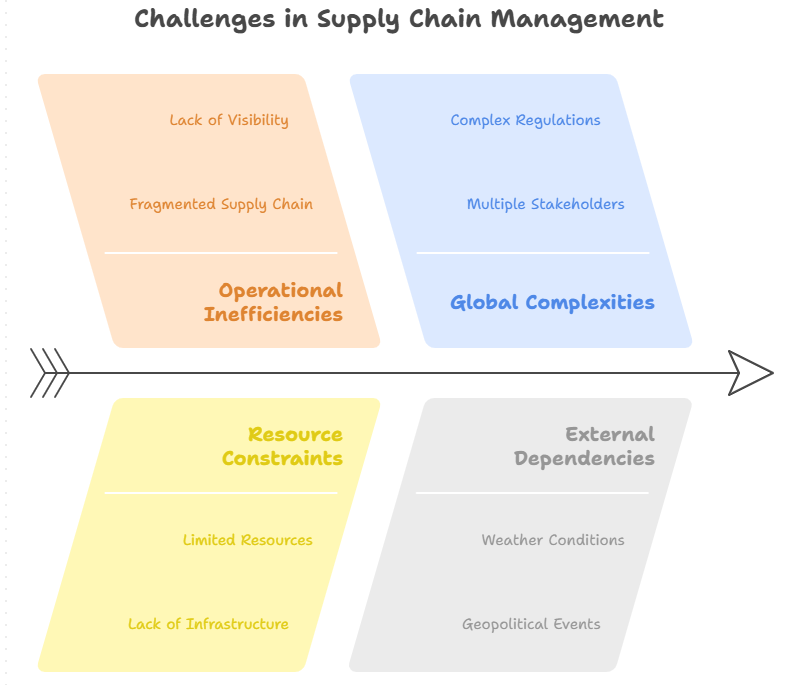
Way forward
- Risk hedging strategies: to reduce cost.
- Profit optimisation: by eliminating non-value-added activities, leading to scale economies.
- Flexible and responsive chain: to meet the changing needs of customers.
- Remove logistics bottlenecks: removed by focusing on road and port development.
- Single point of contact: to ensure that information is neither lost nor deteriorates.
- Market information: for effective flow and monitoring.
42. APMC Act vs Model APLM Act 2017: Unified Agri-Market & Role of FPOs
The Model Agriculture Produce and Livestock Marketing (Promotion and Facilitation) Act, 2017 (APLM act) was proposed in April 2017 to replace the APMC Act (Agricultural Produce Marketing Committee) 2003.As, this Act aims at developing a state-level unified market through acquisition of at least nine essential areas of rehabilitation.
Salient Features of APMC Act ,2017
- Abolition of fragmentation of market within the State/UT by removing the concept of notified market area in so far as enforcement of regulation by Agricultural Produce and Livestock Market Committee (APLMC) is concerned (State/UT level single market).
- Full democratization of Market Committee and State/UT Marketing Board.
- Disintermediation of food supply chain by integration of farmers with processors, exporters, bulk retailers and consumers
- Clear demarcation of the powers and functions between Director of Agricultural Marketing and Managing Director of State/UT Agricultural Marketing Board.

Scope of Improvement
- Speedy uptake of this act is needed at state level.
- Introducing an online platform, which can be done through the pre-existing National Agriculture Market or e-NAM, would allow better price realisation for farmers for the growth of the agriculture sector.
- Infrastructure creation -the government is needed to create probing, grouping and grading infrastructure at the mandis.
- To strengthen the markets, the government can adopt Electronic Negotiable Warehouse Receipts (e-NWRs)
The model APLM Act was enacted in 2017 with an aim to, liberalise agri-market by creating a single agri-market where with single licence one can trade agri-produce as well as livestock, set up a wholesale market at every 80 km, end the monopoly of APMC and allow more producers to set up markets and create a healthy competition so that farmers can accordingly discover prices and sell their produce.
agriculture Produce .
Farmer Producer Organizations (FPOs)
- A Farmer Producer Organisation (FPO) is a group of farmers who come together to form a company or an organisation, with the aim of increasing their bargaining power and improving their economic status.
- The Government of India has approved and launched the Central Sector Scheme of “Formation and Promotion of 10,000 Farmer Producer Organizations (FPOs)” to form and promote 10,000 new FPOs till 2027-28
Role of the Farmer Producer Organisation (FPO)
- Inputs-Provide quality production inputs like seed, fertiliser, pesticides, and other inputs at wholesale rates that are reasonably lower
- Machinery and equipment -Make production and post-production machinery and equipment, such as cultivators, tillers, sprinkler sets, combine harvesters, and others, available on a custom hiring basis to members to reduce per-unit production costs
- Offer value-added services- such as cleaning, assaying, sorting, grading, packing, and farm-level processing facilities at affordable user charges. Additionally, storage and transportation facilities may be provided
- complementary activities -Engage in higher income-generating activities like seed production,
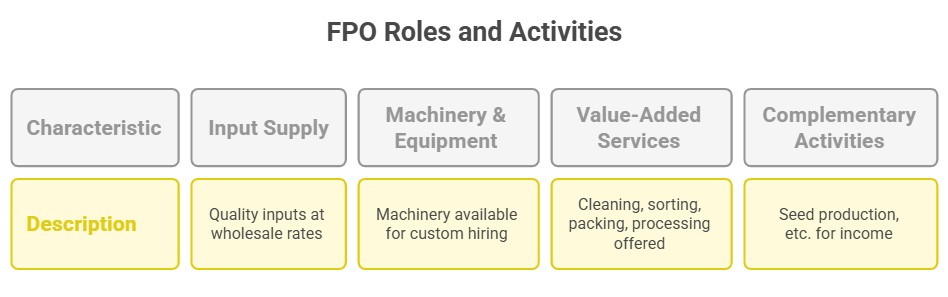
Challenges for FPO
- Lack of technical skills, Weak financial, Lack of professionally trained personnel, Inadequate credit access,Lack of risk mitigation mechanism, Inadequate access, Inadequate access to infrastructure
FPO has been considered as a way to boost agriculture income and manage the risk and vulnerabilities of farming and provide them with good bargaining power.
43. Doubling Farmers' Income in India: Goals, Strategies & Government Initiatives
Doubling Farmers’ Income is a flagship initiative by the Government of India aimed at improving the economic well-being of farmers. It focuses on increasing agricultural productivity, reducing costs, ensuring fair prices, and diversifying income sources.
- Doubling farmers' income is a government initiative aimed at increasing the income of farmers in India.
- Goal - to double the income of farmers by 2022, which is the 75th year of India's independence.
- Objective -The objective is to ensure that farmers get a fair price for their produce and are able to earn a sustainable income from farming.
|
As per the survey results, the average monthly income per agricultural household, from all sources, was estimated at ?10,218 when compared to ?6,426 in 2012-13. In other words, the farm income had risen by 59 per cent till 2019. |
Key Drivers for Doubling Farmers' Income
The major sources of growth operating within agriculture sector are:
- improvement in productivity
- resource use efficiency or saving in cost of production
- increase in cropping intensity
- diversification towards high value crops
Sources outside Agriculture
- shifting cultivators from farm to non-farm occupation.
- Improvement in terms of trade for farmers.
Strategy for Doubling Farmers' Income
The premise of the strategy for doubling farmers income is based on the following primary principles:
- Increasing total output across the agricultural sub-sectors through realising higher productivity.
- Rationalizing/reducing the cost of production.
- Ensuring remunerative prices in the agricultural produce.
- Effective risk management.
- Adoption of sustainable technologies.
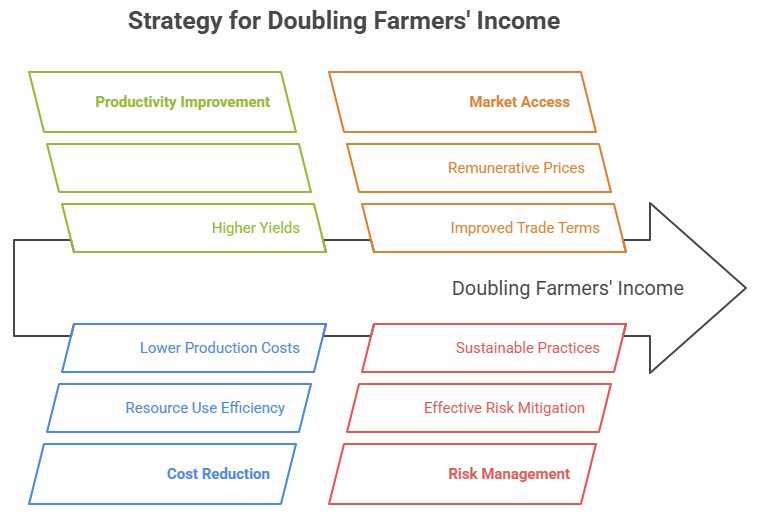
Why Doubling Farmers' Income is Crucial
From self-sufficient food production to self-sufficient farmer -
- Past strategy for development of the agriculture sector in India has focused primarily on raising agricultural output and improving food security.
- The net result has been a 45 per cent increase in per person food production, which has made India not only food self-sufficient at aggregate level, but also a net food exporting country.
- Strategy to promote farmers welfare-
- Farmer poverty, Reason of agrarian distress, Low farm investment
Challenges in Doubling Farmers' Income
- Poor infrastructure-with inadequate irrigation facilities, storage structure, transportation network results in low return to farmer.
- Fragmentation of land- 86% of India's farmer are small farmers which ask difficult to scale up the operation.
- Agriculture policies issue- sometimes policies adopted by government are in support of trade and opening market which hurt Farmer
- Low productivity - low productivity of agriculture compared with other countries.
- Lack of institutional support ,Dependency on monsoon, Climate change, Price fluctuations
Way forward
- The Dalwai Committee in Doubling the Farmers income had recommended substaintial reforms in Marketing structure including reforms in APMCs, and placing agricultural marketing in the Concurrent list
- Aligning policies-eg. greater procurement of millets instead of cereal centric procurement will help to increase income.
- Crop diversification - including high value crop which increase farmers income
- Technological innovation - to increase productivity and profitability.
- Extention -to provide farmers with information regarding adoption of new technology.
- Food processing industries - will help farmers to decrease post handling loss and assured prices of products.
- Integrated farming systems- such as beekeeping, apiculture , sericulture etc.
- Promotion of FPOs- for better risk management and greater bargaining power.
- Diverting the excess manforce - would help to reduce burden on agriculture.
Government Initiatives Supporting Doubling Farmers' Income
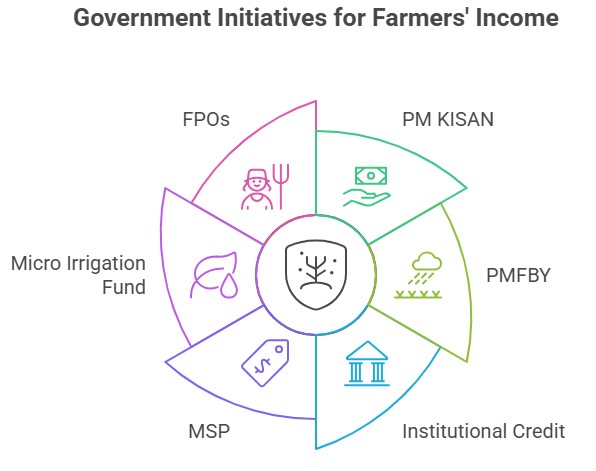 |
It is apparent that income earned by a farmer from agriculture is crucial to address agrarian distress (Chand 2016) and promote farmers welfare. In this background, the goal set to double farmers' income by 2022-23 is central to promote farmers welfare, reduce agrarian distress and bring parity between income of farmers and those working in non-agricultural professions.
44. Public Distribution System (PDS) in India: Food Security & One Nation One Ration Card
The public distribution system is a food security system established under ministry of consumer affairs, food and public distribution. It includes within its fold a government sponsored chain of appx 5.35 lakh fair price shops entrusted with work of distributing basic food and non-food commodities to needy section of society at very cheap price.
The responsibility of PDS is jointly shared by central and state governments
- Central government - through FCI, undertake procurement, storage, transportation and bulk allocation of food grains to the state governments.
- State government - identification of beneficiaries, issues of ration cards, supervision of functioning of price shops.
Under PDS, presently the commodities namely wheat, rice and kerosene are being allocated to states / UTs for distribution.
Objective of Public Distribution System
- To provide essential consumer goods at cheap and subsidized prices to the consumer.
- To insulate them from the impact of rising prices of these commodities.
- To maintain the nutritional status of our population.
- To put indirect check on the open market price of various items.
Evolution of Public Distribution System
- Public Distribution System in 1960s: PDS, with its focus on distribution of foodgrains in urban scarcity areas, had emanated from the critical food shortages of 1960s. As the national agricultural production had grown in the aftermath of Green Revolution, the outreach of PDS was extended to tribal blocks and areas of high incidence of poverty in the 1970s and 1980s.
- Revamped Public Distribution System (RPDS):1992
- With a view to strengthen and streamline the PDS as well as to improve its reach in the far-flung, hilly, remote and inaccessible areas where a substantial section of the poor live.
- It covered 1775 blocks wherein area specific programmes such as the Drought Prone Area Programme (DPAP),
- Integrated Tribal Development Projects (ITDP),
- Desert Development Programme (DDP) were being implemented and in certain Designated Hill Areas (DHA) which were identified in consultation with State Governments for special focus.
- Targeted Public Distribution System (TPDS): 1997
- With focus on the poor families. The scheme, when introduced, was intended to benefit about 6 crore poor families for whom a quantity of about 72 lakh tonnes of food grains was earmarked annually.
- Antodaya Anna Yojana (AAY):
- AAY was a step in the direction of making TPDS aim at reducing hunger among the poorest segments of the BPL population. The scale of issue that was initially 25 kg per family per month was increased to 35 kg per family per month with effect from 1st April 2002.
National Food Security Act, (NFSA) 2013
- Coverage and entitlement -NFSA covers up to 75% of the rural population and 50% of the urban population
- Priority households are entitled to 5 kg per person per month to around 82 crores of population.
- One of the guiding principles of the Act is its life-cycle approach wherein special provisions have been made for pregnant women and lactating mothers and children in the age group of 6 months to 14 years.
- Entitling them to receive nutritious meal free of cost through a widespread network of Integrated Child Development Services (ICDS) centers, called Anganwadi Centers under ICDS scheme and also through schools under Mid-Day Meal (MDM) scheme.
- Pregnant women and lactating mothers are further entitled to receive cash maternity benefit of not less than Rs. 6,000 to partly compensate for the wage loss during the period of pregnancy and also to supplement nutrition.
- Foodgrains under NFSA were to be made available at subsidized prices of Rs. 3/2/1 per kg for rice, wheat and coarse grains respectively.
Limitations of Public Distribution System
- Identification of beneficiaries - according to expert group, PDS suffers from nearly 61% error of exclusion and 25% inclusion of beneficiaries.
- Urban bias-mostly limited to urban areas though rural expansion is also increasing.
- The burden of subsidy- due to rise in procurement price and issue price getting lower.
- Loss of food grains- according to planning commission around 36% leakage of PDS rice ,wheat at all India level.
- PDS result in price increase-due to larger procurement net quantities available in market is less results in increase in price.
- Inefficiencies in the operations of FCI- audit by CAG revealed a serious shortfall in the government's storage capacity.
- Larger procurement due to MSP has put lot of pressure on FCI godowns.
- Aadhar validation issues- such as biometric, spelling on aadhar leads to exclusion of real beneficiaries.
- Challenges in delivery mechanisms: -such as card issues, quantity and quality issue, measurements issue and record maintenance.
Recent Public Distribution System Reform
|
One nation one ration card (ONORC)
- The ONORC scheme is being implemented by the Department for the nation-wide portability of ration cards under National Food Security Act (NFSA). Through this all-eligible ration card holders/beneficiaries covered under NFSA can access their entitlements from anywhere in the country.
- The Partha Mukhopadhyay working group on migration recommended for portability of public distribution system and its benefits in 2017.
- Later, govt launched Integrated Management of Public Distribution system in April 2018.
- Benefits - The new system will identify beneficiaries through biometric authentication on electronic point of sale (ePos) devices installed at FPS.
- Under this migrant will be allowed to buy maximum of 50% of family quota.
- Inter-state as well as intra state portability of ration cards.
- Inter-state portability at IMPDS portal.
- Intra state Annavitran portal -to display electronic transaction made through ePos for distribution of subsidized foodgrains to beneficiaries.
- Can control food subsidy bill by preventing leakages.
- Removes bogus ration card holders through integrated online system.
Challenges in Implementing One Ration Card
- Technological
- Aadhar authentication - only 85.41% of ration cards linked with Aadhar but still there is a gap.
- Internet connectivity - specially in remote areas prove to be hurdle.
- ePOS - out of 79,050 only 37,392 FPS have ePos machines and it is further low in west Bengal and Bihar.
- Huge gap in data on migration - unplanned distressed migration and lack of proper mechanism to keep the record of patterns of migration.
- Federal relations - engagement of central and state government on the implementation may pose challenges of encroachment in each other's area.
- Disincentivizing state govt to provide the additional benefits to their population in terms of nutritional requirements.
Way forward
- Providing nutritional security - along with food security a broader perspective of nutritional security should also be considered.
- Integration of schemes - PDS can be integrated with mid-day meal. ICDS, immunization under one nation one ration cards.
- Use of technology - to handle operations such as Bharat net, separate AI platform.
- Constant monitoring - with the help of village panchayat and social auditing to decrease exclusion error.
- Alternative delivery mechanism - if emergencies appeared to hamper ration shops alternative delivery mechanism can be considered.
- Idea of food coupon - instead of ration card, food coupon can be solutions in longer term.
As ONORC have many challenges for its implementation but still india with larger migration and vulnerable section have potential to achieve the sustainable development goal 2 i,e. Zero hunger by 2030.
45. Food Processing Industry in India: Growth, Challenges & Government Initiatives
The Food Processing Industry (FPI) acts as a crucial link between agriculture and industry, driving economic growth and employment in India. With rising demand for processed foods and supportive government initiatives, the sector is poised for significant expansion.
"There is a need for post-harvest revolution or food processing revolution, and value additions." - PM MODI (while inauguration of PM SAMPADA Scheme)
The food processing Industry (FPI) provides a vital linkage between agriculture and Industry.
|
Current scenario
|
Significance of Food Processing Industry
- A Sunrise Sector: India’s food processing sector is one of the largest in the world and its output is expected to reach $535 Bn by 2025-26.
- Economic Growth: The Indian food sector contributes about 8% of GDP.
- Export potential - accounts for 13% of GDP .
- Employment generation- both direct and indirect employment.
- Farmers income - by adding value to the product.
- Reduce wastage - UN stated that 40 % of production is lost through food wastage .
- Reduce malnutrition - by fortifying with minerals and vitamins.
- Rural development - FPI directly contributes to development to the rural economy.
- Crop diversification - different inputs required hence scope to crop diversification.
- MSME's- accelerate their growth and scale
Scope of Food Processing Industry
- Huge Production base to become leading food supplier - India ranks 1st in the world in the production of Milk, Ghee, Ginger, spices, Bananas, Guavas, Papayas and Mangoes.
- It ranks 2nd in the production of Rice, Wheat and other vegetables & fruits.
- Geographical advantage – Diverse agro-climatic zones, soil types, and largest arable land in the world.
- Increase in Demand for processed food – that is convenient, hygienic and high quality, due to socio-economic transition i.e. rising disposable income, changing consumption and demographic patterns, increase in nuclear families, working women, media penetration etc.
- Rapid growth in Organised retail – Ensuring productivity gains across the supply chain through disintermediation and superior technology. Emergence of tier 1 & 2 cities and “shopping mall culture”.
- Exponential growth of Online food delivery industry – Estimated to grow at 30%, especially buoyed by COVID induced preference for ‘no-contact delivery’. For eg. Zomato, Swiggy, FoodPanda etc.
- Favourable Government Policies and incentives – To boost the “sunrise” food processing Industry. For eg. Relaxation of FDI limits, tax breaks, introduction of new schemes, reforms in agriculture sector etc.
- Rising demand of Indian products in international market – For eg. Companies like Haldiram’s & Bikarnervala have a presence in over 70 countries.
- Abundant agriculture produce - by setting up processing units closer to agriculture hubs, post-harvest losses can be minimized.

Upstream and Downstrean Requirements of Food Processing Industry
- The upstream stage of the production process deals with procurement of raw materials.
- This stage is not concerned with the processing of the product but simply with searching and extracting of the raw material.
- The downstream stage consists of processing the materials collected during the upstream stage into a finished product.
- The downstream stage further includes the actual sale of that product to other businesses, governments or private individuals.

Reasons for Low Performance of Food Processing Industry
- Lack of cutting-edge infrastructure: Many operate in the small and medium enterprises (SMEs), which often lacks the resources needed to upgrade their facilities and machinery to the latest technology.
- Inefficient supply chains: Lack of adequate infrastructure leads to wastage. The NITI Aayog cited a study that estimated annual post-harvest losses close to Rs 90,000 crores.
- Lack of access to credit and financing: Traditional banks and financial institutions often have stringent lending criteria, making it difficult for SMEs to access funding.
- Informalisation: The sector is very unorganized and every unorganized sector comes with its own set of challenges like employment is subject to high degree of insecurity.
- Lack of organized retail – 90% of retail consists of “mom & pop” shops ????low quality products, lack of variety & choice, poor shopping experience, etc.
- Export problems – fragmented supplier base & non-uniform quality, high import duties on raw material, poor adherence to food safety laws, etc. leading to high cost & low competitiveness in global markets.
- Small size of food processing units – >40% of FP sector is unorganised ???? poor economies of scale, high production costs, difficulty in access to credit, inability to compete with MNCs???? Low profits ???? inability to spend on marketing, R&D, Technology, Quality improvement etc.
- Skills and technical know-how deficit - As per report of National Skill Development Corporation the industry faces skill gap of 10 million workers.
Key Initiatives of Government for Food Processing Industry
- Pradhan Mantri Kisan Sampada Yojana (PMKSY):
- Mega Food Parks Scheme: modern food processing infrastructure for the processing units based on a cluster approach.
- Integrated Cold Chain: Promotion of cold chain facilities without any break from the farm gate to the consumer
- Scheme for Creation of Infrastructure for Agro Processing Clusters: Two basic components i.e., Basic Enabling Infrastructure (roads, water supply, power supply, drainage, ETP etc.) and Core Infrastructure/Common facilities.
- Production Linked Incentive Scheme for Food Processing Industry (PLISFPI): to support creation of global food manufacturing champions
- Pradhan Mantri Formalisation of Micro food processing Enterprises (PMFME) Scheme: Basic Enabling Infrastructure (roads, water supply, power supply, drainage, ETP, etc.) and Core Infrastructure/Common Facilities.
- One District One Product- to leverage scale in input procurement, common services, and district-level product marketing.
- Inclusion of food & agro-based processing units and cold chain as agricultural activity under Priority Sector Lending (PSL)
- 100 percent Foreign Direct Investment (FDI) approval under automatic route has been permitted for the food processing sector.
- Marketing reforms - Operation Greens (‘Top to Total’), Developing & upgrading existing rural haats into Gramin Agricultural Markets (GrAMs), One District, One Product (ODOP), Agri Law Reforms, e-NAM, etc.
- Food Standards - rationalization of food laws & enactment of Food Safety & Standards Act, 2006.
- Investment facilitation - Nivesh Bandhu portal, developed by the MoFPI to assist investors.
- Credit & finance - Special ‘Food processing Fund’ in NABARD to make available affordable credit. 100% FDI under the automatic route is allowed in the sector and inclusion of food and agro-based processing units as agricultural activity under Priority Sector Lending.

Way Forward
- Efficient infrastructure- efficient supply chain that, inter alia, include cold storages, refrigerated vans, better road facilities, and uninterrupted power supply is a prerequisite
- Boost export- in respect of production and quality of processed foods, consumer safety and public health.
- Regulation- business-friendly administration and customer-oriented promotional measures.
- Formalization of FPI- technology up-gradation and improvement in infrastructural facility.
Food processing sector has been identified as one of the key and priority sector of the Government’s ambitious “Make in India” campaign. Special efforts are being undertaken to improve the competitiveness of the private and public sector units, so that they can integrate well with global value chain and global markets.
46. Buffer Stock of Food Grains in India: Concept, Advantages, Issues & Way Forward
Buffer stock refers to a reserve of a commodity that is used to offset price fluctuations and unforeseen emergencies. Buffer stock is generally maintained for essential commodities and necessities like food grains, pulses etc.
The concept of a buffer stock was first introduced during the 4th Five Year Plan (1969-74) and a buffer stock of 5 million tonnes of food grains was envisaged. The buffer stock figures are normally reviewed after every 5 years.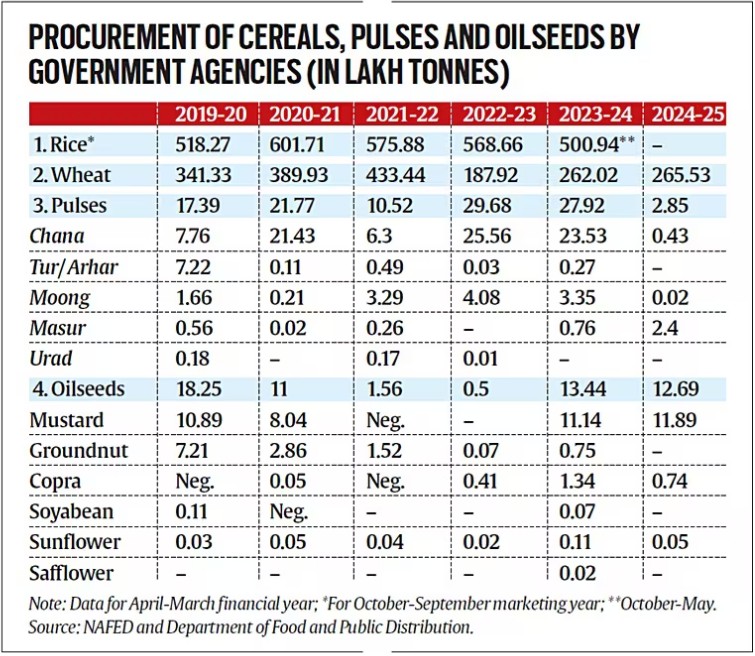
Purpose of Buffer Stock of Food Grains in India
Buffer stock of food grains in the Central Pool is maintained by the Government of India...
- Meeting the prescribed minimum buffer stock norms for food security
- Monthly release of food grains for supply through Targeted Public Distribution System (TPDS) and Other Welfare Schemes (OWS)
- Meeting emergency situations arising out of unexpected crop failure, natural disasters, etc.
- Price stabilisation or market intervention to augment supply so as to help moderate the open market prices.
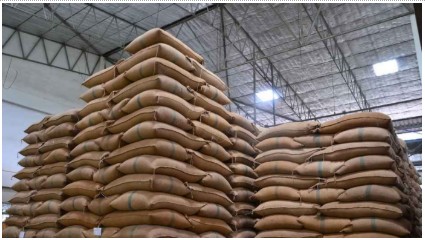
Advantages of Buffer Stock of Food Grains in India
- Stable prices help maintain farmers’ incomes. A rapid drop in prices can make farmers go out of business, which leads to structural unemployment.
- Investment in agriculture due to stable income of farmers.
- Positive externalities e.g., helps rural communities. A drop in price could cause a negative multiplier effect within rural areas.
- Prevent excess prices for consumers and help reduce food inflation.
- It helps to maintain food supplies and avoid shortages.
- Government making profit- If it buys during a glut and sells during a shortage, it can make a profit.
- Food security - fulfill the goal of providing food grains to every citizen.
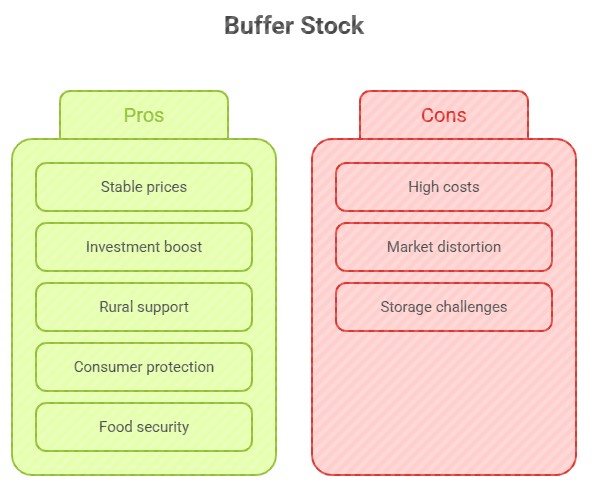
Problems Associated with Buffer Stock of Food Grains in India
- Fiscal burden- Cost of buying excess supply could become quite high for the government and may require higher taxes.
- Environmental impacts-It could even encourage excess use of chemicals to maximise yields
- High cost of maintenance - such as logistics, storage and administrative cost.
- Issues of leakages - it is sometimes diverted to black marketing, ghost beneficiaries.
- Some goods cannot be stored in buffer stocks, e.g., fresh milk, meat etc.
- Inefficient storage management - Warehouse are not technically updated, malpractices, corruption at field level.
- Trade distorting practices - many of the countries think that procurement and maintaining buffer stock would distort market.
Way forward
A 6 member committee formed i.e., Shanta Kumar committee for improving operational efficiency of FCI and maintaining storages.
- Adopting DBT - So that MSP and food subsidy amount can be directly transfers into the account of beneficiaries.
- Reduction in no of beneficiaries - under NFSA from 67-40%
- Private participation - to procure and store grains.
- Transfer of procurement - to the states which have higher capacity e.g. Maharashtra ,UP etc.
- Abolition of levy rice and allow mills to sell in market.
- Greater flexibility to FCI - for procuring and dealing with operational stocks.
47. Food Storage
Context: The Union Cabinet approved the establishment and empowerment of an Inter-Ministerial Committee (IMC) for the facilitation of the “World’s Largest Grain Storage Plan in the Cooperative Sector”.
|
Government initiatives for augmentation of grain storage capacity
|
Need for an effective food grain storage system
- Backward and forward linkages: An effective storage system aids farmers as well as forward linkage systems such as the food processing sector.
- Improper local storage systems: The household sector retains about 70% of the total production and substantial quantities of foodgrains are wasted due to improper storage at the farm level.
- Lack of storage management: Often the stock stored in the warehouses remains in storage for more than its shelf life and such long storage, makes grains prone to rodents, moisture, birds, and pests.
- Lack of mechanised storage: About 80% of handling and warehousing facilities are not mechanized and traditional manual methods for loading, unloading, and handling food grains and other commodities are used.
- Insufficient number of storage facilities: The FCI has insufficient grain silos and covered godowns with adequate storage capacities. The country's current godown facilities can store only up to 47 percent of the produce.
- Issues with cold storage: India’s cold storage capacity is unorganized and dominated by traditional cold storage facilities. The distribution of cold storage is highly uneven with the majority of the cold storage is limited to Uttar Pradesh, Gujarat, Punjab, and Maharashtra.
Way forward
- Improve efficiency at farmgate: Building aggregation units (i.e. modern pack-houses and pooling points) at the village level with transport links should be promoted.
- Participation of States and local government: More responsibility can be shared with States which are performing well such as Haryana, Punjab, Andhra Pradesh, Chhattisgarh, Madhya Pradesh etc.
- Focus on drying, aeration, and temperature control: Moisture and temperature determine how long the grain can remain in storage without losing its quality. Therefore, altering storage methodologies and management in accordance with these indicators.
- Strengthening traditional means of storage methods: Traditional means of storage should be strengthened with modern inputs like Bamboo structures and Mud and earthen structures.
- Phase out of Covered and Plinth (CAP) storage: CAP should be gradually phased out with no grain stocks remaining in CAP for more than 3 months. Silo bag technology and conventional storage should be used instead.
- Encouraging private participation: Government can also provide credit facilities for Farmer’s Producer Organizations (FPOS) to invest in storage warehouses, cold chain storage, etc.
- Modern and cutting-edge technology in food storage: Adoption of technologies like Internet of Things, Blockchain, and Artificial Intelligence can aid food grain management. Sensors-based data can be used to assess the quality of grains in real-time and maintain the temperature and moisture control variables accordingly.
48. Changes in Industrial Policy in India and their Effects on Industrial Growth
According to IMF “Industrial policy” refers to government efforts to shape the economy by targeting specific industries, firms, or economic activities. This is achieved through a range of tools such as subsidies, tax incentives, infrastructure development, protective regulations, and research and development support.
Goals of Industrial Policy in India

Evolution of Industrial Policy in India
|
Industrial Policy Resolution 1956 (IPR 1956): This resolution classified industries into three categories.
|
Industrial Policy Resolution 1977 (IPR 1977):
|
India’s Industrial Policy Statement, 1980:
|
New Industrial Policy in India During Economic Reforms of 1991
Features of the New Industrial Policy
- De-reservation of Public Sector: Sectors that were previously exclusively reserved for the public sector were reduced in scope. However, certain core areas, including arms and ammunition, atomic energy, mineral oils, rail transport, and mining, retained the pre-eminent position of the public sector.
- De-licensing: Currently, industrial licenses are required for only four industries related to security, strategic concerns, and environmental issues, which include electronic aerospace and defence equipment, specified hazardous chemicals, industrial explosives, and cigars and cigarettes of tobacco and manufactured tobacco substitutes.
- Disinvestment of Public Sector: The government reduced its stakes in Public Sector Enterprises (PSEs) to enhance their efficiency and competitiveness.
- Liberalization of Foreign Investment: The new industrial policy marked the first-time foreign companies were allowed to have majority ownership in India. Up to 51% Foreign Direct Investment (FDI) was permitted in 47 high-priority industries, and for export trading houses, FDI up to 74% was allowed.
- Foreign Technology Agreements: Automatic approvals were granted for technology-related agreements. The Monopolies and Restrictive Trade Practices (MRTP) Act was amended, removing asset threshold limits for MRTP companies and dominant undertakings. The MRTP Act was subsequently replaced by the Competition Act of 2002.
|
Outcomes of the New Industrial Policies 1. Reduction of Bureaucratic Hurdles 2. Limited Role of the Public Sector 3.Easier Entry of Multinational Companies and Privatization 4. Focus on Export Promotion |
Limitations of Industrial Policies in India 1. Stagnation of the Manufacturing Sector 2. Distortions in Industrial Pattern 4. Absence of Incentives for Efficiency 5. Vaguely Defined Industrial Location Policy |
Way Forward
- Shift from Socialistic to Capitalistic Industrial Policies: India's industrial policies have transitioned from a predominantly socialistic pattern in 1956 to a more capitalistic approach since 1991. The current industrial policy regime in India emphasizes increased foreign investment and reduced regulations.
- Positive Reforms and Campaigns: Reforms related to insolvency resolution (Bankruptcy and Insolvency Act, 2017) and the Goods and Services Tax (GST) have yielded positive outcomes for the industrial sector. Initiatives like Make in India and Start-up India have contributed to enhancing the business ecosystem in the country.
- Ongoing Challenges: Challenges such as electricity shortages, high prices, credit constraints, labor regulations, political interference, and other regulatory burdens continue to hinder the growth of the industrial sector in India.
- Need for a New Industrial Policy: To boost the manufacturing sector, there is a need for a new industrial policy in India. The government recognized this necessity in December 2018 and expressed the intention to introduce a comprehensive industrial policy that would serve as a roadmap for all business enterprises in the country.
49. Need for Economic Reforms 2.0
The Indian economy has faced a slowdown since the early 2010s, further aggravated by the COVID-19 pandemic. Achieving the goal of a $5 trillion economy by 2025 necessitates further economic reforms.
Key Reforms for Achieving the Target
- Simplify and Streamline the Tax System: India ranks 115th out of 190 countries in the ease of paying taxes, according to the World Bank's Ease of Doing Business Report 2022.
- Boost Manufacturing: Efforts should be made to increase the share of manufacturing in GDP, which currently lags behind other major economies.
- Increase Foreign Investment: India should strive to improve its attractiveness to foreign investors by creating a conducive investment environment.
- Encourage Entrepreneurship: Efforts should be made to address the challenges faced by entrepreneurs in starting and scaling businesses.
- Increase Agricultural Productivity: India's agriculture sector has untapped potential that needs to be harnessed.
- Invest in Education and Skills: India's human capital quality ranks 116th out of 174 countries, according to the World Economic Forum's Human Capital Index 2020.
- Promote Exports: India's export performance needs to be enhanced to remain competitive in the global market.
Target of $5 Trillion Economy by 2025
The goal of achieving a $5 trillion economy by 2025 was set by the Government of India to propel the country's economic growth. To reach this target, several areas of focus have been identified:
- Infrastructure Development: Massive investments in infrastructure are planned to create employment opportunities, attract foreign investment, and improve productivity.
- Digital Transformation: Promoting digitalization across sectors can drive innovation, improve efficiency, and create new business opportunities.
- Skill Development: Skilling programs aim to create a skilled workforce capable of meeting industry demands and contributing to economic growth.
- Promoting Entrepreneurship: Support for entrepreneurs through access to funding, mentorship, and resources can foster innovation and create new business ventures.
- Ease of Doing Business: Simplifying regulations, reducing bureaucratic hurdles, and streamlining processes to improve the ease of doing business in India.
Schemes Launched by the Government
The Government of India has implemented several economic programs to promote growth, development, and social welfare. Some notable programs include:
- Make in India: Launched in 2014 to promote manufacturing and attract foreign investment.
- Digital India: Launched in 2015 to transform India into a digitally empowered society and knowledge economy.
- Skill India: Launched in 2015 to provide skill training and vocational education to the youth.
- Pradhan Mantri Jan Dhan Yojana: Launched in 2014 to promote financial inclusion and provide banking services to all.
- Atmanirbhar Bharat Abhiyan: Launched in 2020 to promote self-reliance and self-sufficiency in various sectors.
While achieving the $5 trillion economy target is challenging, the government continues to implement reforms and measures to boost economic growth and development in India.
50. Industry 4.0 in India: Revolutionizing Manufacturing & Digital Economy
Industry 4.0 marks the fourth industrial revolution, blending automation, IoT, machine learning, and real-time data to transform manufacturing and supply chains. In India, this revolution promises to boost the digital economy and create millions of jobs while presenting unique challenges to overcome.
Introduction to Industry 4.0 in India
- The concept of 'Industry 4.0' was initially formulated by the German government back in 2011.
- Industry 4.0 signifies a novel stage in the Industrial Revolution, concentrating mainly on intercommunication, automation, application of machine learning, and instantaneous data.
- Industry 4.0 integrates the Industrial Internet of Things (IoT) and smart manufacturing, merging physical procedures and production with intelligent digital technologies, machine learning, and extensive data.
- Objective: To develop a comprehensive and more interconnected ecosystem for businesses that are centered around manufacturing and supply chain management.
- Companies and organizations today face a common challenge: the need for interconnectedness and real-time data across processes, partners, products, and personnel. This is where Industry 4.0 becomes crucial.

Fourth Industrial Revolution and Industry 4.0 in India: Status
- The digital economy is projected to reach $1 trillion by 2025, contributing around 25% of India's GDP. (Source: McKinsey Global Institute).
- Industry 4.0 technologies have the potential to create 90 million jobs in India by 2030. (Source: BCG and World Economic Forum).
Challenges to Industry 4.0 in India
- Cybersecurity issues: The increased connectivity in this revolution exposes vulnerabilities to cybersecurity threats.
- Reduction in low-skill jobs: Automation and artificial intelligence technologies can replace repetitive and manual tasks, resulting in a shift in the workforce and potentially fewer opportunities for low-skill jobs.
- Industry and market disruption: Companies that fail to adapt and embrace innovation may struggle to survive in the new competitive landscape.
- Rise in social inequalities: This can lead to heightened social tensions and widen the gap between different socio-economic groups.

India-Specific Challenges to Implementing Industry 4.0
- Infrastructure and connectivity: Insufficient power supply and high-speed internet, especially in rural areas, limit digital infrastructure. Skilled workforce development is crucial.
- Data quality: Inconsistent standards and a significant informal sector affect the reliability and accuracy of data, impacting decision-making and policy implementation.
- Limited research and development: India's inadequate investment in R&D hampers innovation and the ability to address challenges and opportunities in the Fourth Industrial Revolution.
Government Initiatives Supporting Industry 4.0 in India
- SAMARTH Udyog Bharat 4.0 Initiative
- It is an Industry 4.0 initiative by the Department of Heavy Industry, Ministry of Heavy Industry & Public Enterprises.
- The goal is to establish an ecosystem for the adoption of Industry 4.0 technologies in Indian manufacturing by 2025, including MNCs, large, medium, and small-scale Indian companies.
- Centre of Excellence (CoE) on IT for Industry 4.0
- The CoE serves as a knowledge center for entrepreneurs and startups, promoting the concept of IT and its application in the Fourth Industrial Revolution (IR 4.0).
- Centre for Fourth Industrial Revolution
- World Economic Forum has established its fourth Center for Fourth Industrial Revolution in Mumbai, India.
- This center will collaborate with NITI Aayog (National Institution for Transforming India) to co-design new policies and protocols for emerging technologies.
- National Mission on Interdisciplinary Cyber-Physical Systems (NM-ICPS)
- Launched by the Union government in 2018 and implemented by the Department of Science & Technology.
- The mission addresses society's technological needs and considers international trends and roadmaps for next-generation technologies.
- National Strategy on Artificial Intelligence
- NITI Aayog has adopted a three-pronged approach under the strategy:
- Undertaking exploratory proof-of-concept AI projects in various areas
- Crafting a national strategy for building a vibrant AI ecosystem in India
- Collaborating with experts and stakeholders
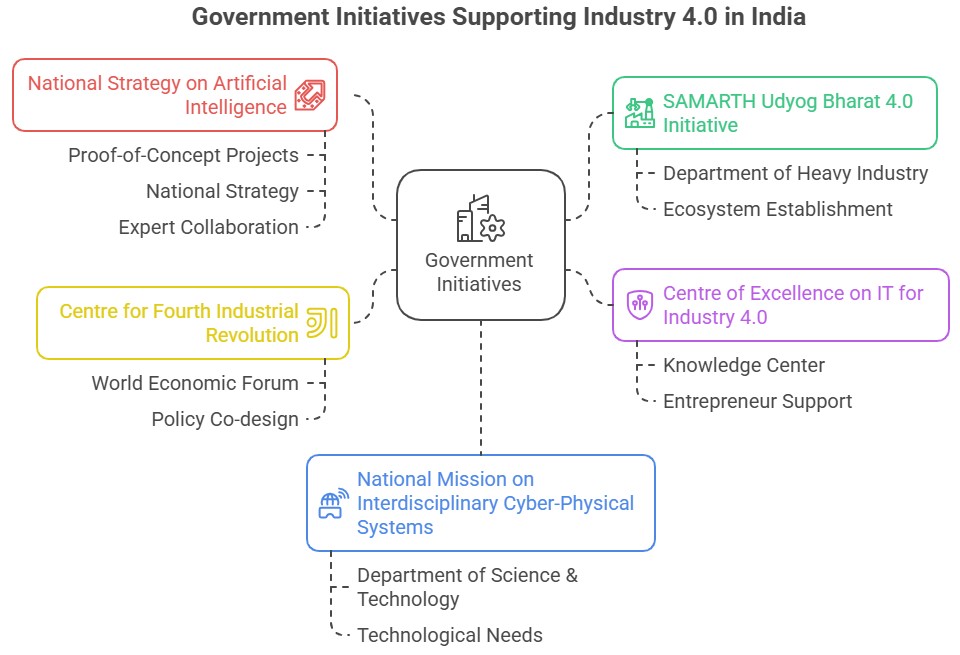
Way Forward
- Foster international collaboration:
- A joint platform between ministries, state governments, and industry bodies can be considered.
- Promote industry-academia collaboration
- Introduce a compulsory apprenticeship program at the higher secondary level to provide hands-on experience in technology.
- Increase investments.
- Focus on improving productivity: Embrace digitalization by fostering competitive advantages along value chains. Prioritize productivity and address productivity gaps to enhance global competitiveness.
Conclusion
- The Fourth Industrial Revolution offers more than just technological advancements; it presents an opportunity to create an inclusive, human-centred future.
- It is essential for leaders, policymakers, and people from all income groups and nations to harness converging technologies for positive impact.
51. MSME Sector in India: Importance, Challenges, Classification & Government Initiatives
The Micro, Small and Medium Enterprises (MSMEs) sector plays a vital role in the Indian economy. The sector contributes almost 8% of the country's GDP, around 45% of manufacturing production, and about 40% of exports.
MSMEs currently employ over 46.6 million people, as per the national sample survey (2019).
Despite its significance, the sector faces numerous challenges, including low registration on the UDYAM Platform, heterogeneity, fragmentation, and informalization. To unlock the full potential of MSMEs and propel the Indian economy towards higher growth, targeted policies in infrastructure development, technology adoption, and backward and forward linkages are necessary.
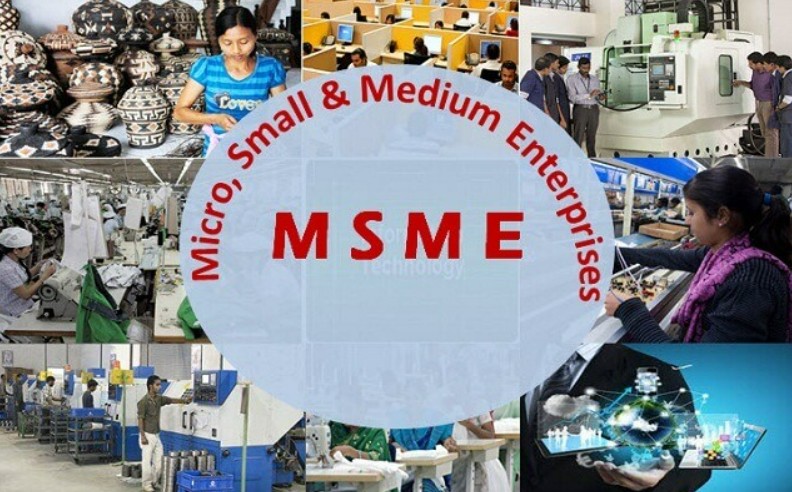
Revised MSME Classification |
|||
|
Composite Criteria: Investment & Annual Turnover |
|||
|
Classification |
Micro |
Small |
Medium |
|
Manufacturing & Services |
Investment < Rs. 1 crore Turnover < Rs. 5 crore |
Investment < Rs. 10 crore Turnover < Rs. 50 crore |
Investment < Rs. 50 crore Turnover < Rs. 250 crore |
MSME Status & Significance in MSME Sector in India
- Economic Significance
- Composition - > 99% of MSMEs are in ‘Micro’ sector, 94% of MSME are unregistered with the government, 55% of MSME in rural areas.
- Diversity of MSME sector - products ranging from traditional to high –tech precision items.
- Comprises key sunrise sectors – such as electronics industry, chemicals, leather, textiles, agro and food processing, pharmaceuticals, transport and tourism industries, etc
- High Labour Intensity - Provides employment to 80% population with just 20% investment. Generates 2nd highest employment, after Agriculture sector. Thus, key to poverty alleviation and to prevent distress migration.
- Growth Potential: There are over 36.1 million MSME units in India, with the Ministry aiming to increase its GDP contribution to 50% by 2025 as India's economy grows to $5 trillion.
- Key to Inclusive growth - Creating employment opportunities for special segments such as women, physically challenged, traditional industries, etc.
- Strategic significance - MSME is a key component in ‘Make in India’, Digital India, Start-up India, Stand up India, Indigenous Defence production, Foreign Trade Policy, & e- commerce initiatives of GoI.
Significance of MSME Sector in India
- Boon for Rural Development: MSMEs have contributed to the industrialization of rural areas with minimal capital cost, leading to socio-economic growth and complementing major industries.
- Front Runner in Make in India Mission: MSMEs are crucial in making the 'Make in India' initiative successful by adhering to global quality standards and becoming the backbone of the mission.
- Simple Management Structure for Enterprises: Compared to large corporations, MSMEs offer a flexible management structure that allows for easy decision-making and efficiency.
- Economic Growth and Leverage Exports: MSMEs significantly contribute to India's GDP, accounting for 8% of it. Moreover, they have the potential to create linkages between India's MSME base and larger companies by supplying semi-finished and auxiliary products.
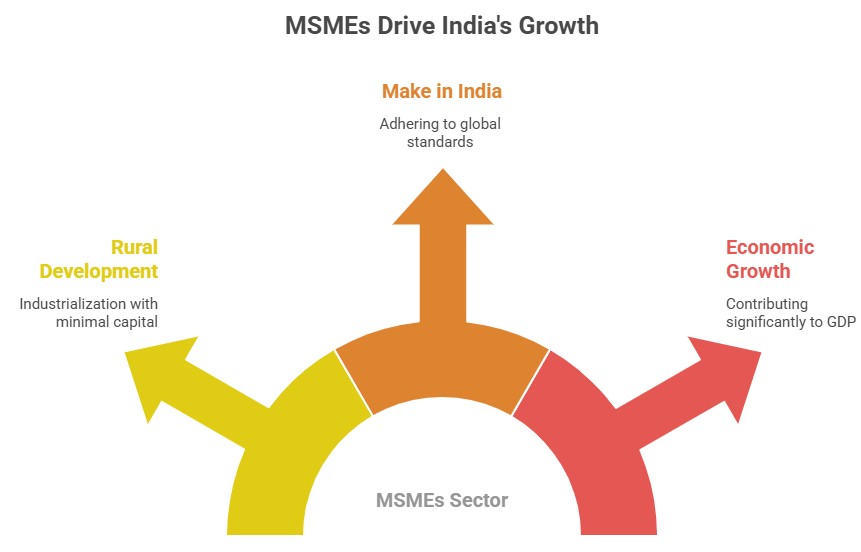
Factors Leading to the Growth of MSME Sector in India
- Promoting Innovation and Competitiveness: MSMEs provide opportunities for aspiring entrepreneurs to develop innovative products, fostering competitiveness and driving growth.
- Government Campaigns: Initiatives like Make in India, Startup India, Skill India, and Digital India aim to level the playing field and promote increased production.
- Adapting to Labor Market Trends: Younger generations are moving away from agriculture and entering businesses, creating employment opportunities.
- New Definition: The new definition and classification eliminate the need for frequent inspections and provide transparency and impartiality.
- Digitization: Growing internet use and digital payment comfort, supported by B2C e-commerce firms, facilitate MSME sector expansion.
- Collateral-Free Financing: Partnerships with modern non-banking finance enterprises offer MSMEs easier access to financing.
Various Government Initiatives for MSME Sector in India
- Udyami Mitra Portal: Launched by SIDBI to improve credit accessibility and provide handholding services to MSMEs.
- MSME Sambandh and MSME Samadhaan: Monitor and address delayed payments by central ministries/departments/CPSEs/state governments.
- Digital MSME Scheme: Enables MSMEs to access common and tailor-made IT infrastructure through cloud computing.
- Revamped Scheme of Fund for Regeneration Of Traditional Industries (SFURTI): Organizes traditional industries and artisans into clusters to enhance competitiveness.
- A Scheme for Promoting Innovation, Rural Industry & Entrepreneurship (ASPIRE): Creates new job opportunities and promotes an entrepreneurship culture.
- Micro & Small Enterprises Cluster Development Programme (MSE-CDP): Implements a cluster development approach to increase productivity and competitiveness.
- Credit Linked Capital Subsidy Scheme (CLCSS): Upgrades technological expertise of MSMEs.
Current Challenges in MSME Sector in India
- Financial Constraint: Access to timely finance remains an issue, with only 16% of SMEs having such access, leading to heavy reliance on their own resources.
- Lack of Innovation: MSMEs struggle with outdated technologies and low productivity due to a lack of entrepreneurial spirit and innovation.
- Majority of Small Firms: Micro and small businesses constitute over 80% of MSMEs, but they often struggle to take advantage of government initiatives.
- Communication gaps and lack of awareness hinder their access to emergency credit lines, stressed asset relief, equity participation, and fund of funds operations.
- Lack of Formalization Amongst MSMEs: A significant number of MSMEs in India operate without formal registration, leading to credit gaps and limited access to support.
- Approximately 86% of manufacturing MSMEs remain unregistered, hindering their ability to avail themselves of benefits and services.
- The Goods and Services Tax registration rate for MSMEs is relatively low, with only about 1.1 crore entities registered.
- Mounting NPAs in MSMEs: The MSME sector has witnessed a rise in non-performing assets (NPAs) during recent times.
- As per the Reserve Bank of India (RBI), bad loans of MSMEs account for 9.6% of gross advances, up from 8.2% in 2020.
- Many MSMEs did not benefit from restructuring schemes and relief packages, aggravating their financial distress.
- Lack of Infrastructure and Technology: Inadequate infrastructure and outdated technology pose significant challenges for MSMEs in India.
- Power supply issues, including poor quality and unscheduled cuts, impede smooth operations.
- Insufficient substations, inadequate road networks, Lack of proper transport facilities, ineffective storm water drainage, and limited sewage treatment plants further hamper growth.
Remedial Measures for MSME Sector in India
- New Definition of MSMEs: The Indian government has provided a new definition for MSMEs.
- Promotion of ATMANIRBHAR Bharat and Make in India: The government has prohibited global procurement contracts of up to INR 200 crores and promoted ATMANIRBHAR Bharat.
- Emergency Credit Line Guarantee Scheme: Providing loans with a 100% guarantee to eligible MSME borrowers to address capital shortages.
- Access to Digital Platforms: Private sector and government support provide MSMEs with access to digital platforms for marketing and payments.
- E-commerce websites have also encouraged the onboarding of MSMEs.
- Open Network for Digital Commerce creating opportunities for MSMEs to access technology and diversify their target markets.
- Sign of Robust Recovery: Greater formalization and growth in GST collections indicate a positive recovery. More than 10 million MSME units have registered on the Udyam portal since July 2020.
- Udyam Portal: The online registration portal has facilitated the registration of over 10 million MSME units since its launch.
- MSME registration process is fully online, totally free, paperless and based on self-declaration and is a step towards Ease of Doing Business for MSMEs.
- No documents or proof are required to be uploaded for registering an MSME. With Udyam number banks can categorize lendings to MSMEs as priority sector loans.
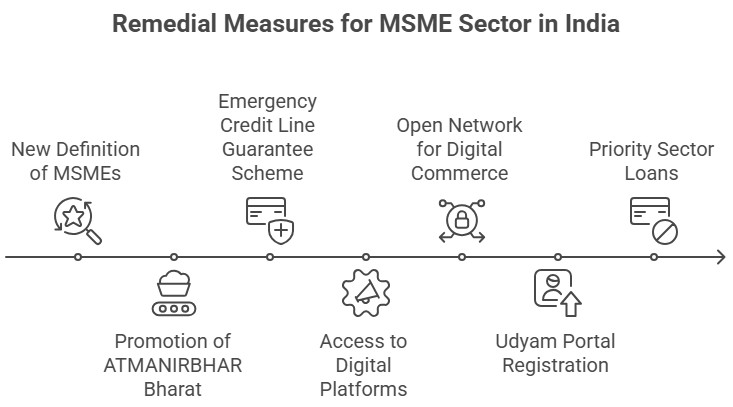
Way Forward
- Regulatory Mechanism
- Establishment of an independent body to safeguard MSMEs from economic shocks and promote their growth.
- Supply Chain Finance
- Provide MSMEs with access to working capital through technology-enabled platforms and encourage Zero Defect & Zero Effect practices.
- Enables MSMEs to invest in expansion, procure raw materials, and update inventories.
- Linking Government Projects with Local MSMEs
- Foster domestic manufacturing capabilities by leveraging public procurements and projects.
- Close linkage between initiatives like Sagarmala, Bharatmala, and industrial corridors with the MSME sector.
- Promotes collaboration between the government and MSMEs for enhanced growth and employment opportunities.
- Industry-Academia Channel
- Strengthen collaboration between government, industry, and academia to identify manufacturing requirements and develop a skilled workforce aligned with Industrial Revolution 4.0.
- Bridge the gap between education and industry needs, fostering innovation and driving technological advancement.
- Dedicated MSME Portal
- Creation of a dedicated portal for MSME formalization and registration to enhance transparency and reduce fraudulent activities.
- Use of Aadhaar or PAN as a unique identifier for compliance purposes and simplification of the annual registration process.
- E-Courts for Dispute Resolution
- Strengthen the NCLT framework by introducing alternative methods of debt resolution, including e-courts.
- Faster resolution of cases to reduce financial burdens on MSMEs and enhance their overall competitiveness.
- Incentivizing Digital Adoption Within the Sector
- Provide incentives for digital adoption, especially in disruptive technologies like artificial intelligence and quantum technology.
- Encourage innovation, efficiency, and competitiveness within the MSME sector.
Conclusion
MSMEs are the backbone of the Indian economy, providing resilience against global economic shocks. To revive the economy and address the challenges faced by MSMEs, a comprehensive approach is required, including easing regulatory burdens, fiscal support, and ensuring a level playing field. By prioritizing the interests of MSMEs, India can unlock their full potential and foster inclusive growth.
52. Introduction to Special Economic Zones (SEZs) in India: Features, Challenges & Reforms
An SEZ, or Special Economic Zone, is an area within a country that offers fiscal concessions and different business and commercial laws to encourage investment and create employment. SEZs are established to address infrastructural and bureaucratic challenges and improve the ease of doing business.
SEZs in India
|
Types of Special Economic Zones (SEZs)

Salient Features of Special Economic Zones
- A Special Economic Zone is a designated duty-free area deemed to be foreign territory for the purpose of trade operations, duties & tariffs.
- There is no requirement for a license for import.
- Other notable features are:
- The units in SEZ must become net foreign exchange earners within a period of 3 years.
- Full freedom for subcontracting.
- Special Economic Zones are allowed for trading, manufacturing, and other service activities.
SEZs in India enjoy several facilities and incentives, such as:
- Duty-free import/domestic procurement of goods for development, operation, and maintenance of SEZ units.
- 100% Income tax exemption on export income for SEZ units under the Income Tax Act for first 5 years, 50% for next 5 years thereafter and 50% of the ploughed back export profit for next 5 years.
- Exemption from Central Sales Tax, Service Tax, and State sales tax (now subsumed into GST).
- Other levies imposed by respective State Governments.
- Single window clearance for approvals at the Central and State levels.

Government Measures to Revamp Special Economic Zones
- Baba Kalyani Committee
- The government has constituted Baba kalyani committee to study the existing SEZs of India and prepare a policy framework to adopt strategic policy measures.
- Recommendations of Baba Kalyani committee 2018
- Rename SEZs in India as 3Es- Employment and Economic Enclave.
- Framework shift from export growth to broad-based employment and economic growth
- Separate rules and procedures for manufacturing and service SEZs
- Ease of Doing Business (EoDB) in 3Es such as one integrated online portal for new investments
- Extension of Sunset Clause and retaining tax or duty benefits
- Unified regulator for IFSC
- Dispute resolution through arbitration and commercial courts
- Development of Enterprise and Service Hubs (DESH) Bill 2022
- It is an outcome of the recommendations of Baba Kalyani committee constituted in 2018.
- Objectives:
- It will replace the SEZ Act of 2005 and aims to develop more inclusive economic hubs.
- SEZs will be renamed as ‘Development hubs’. They will facilitate both export-oriented and domestic investment. It combines the role of the domestic tariff area and SEZ.
- DESH legislation provides for an online single-window portal for the grant of time-bound approvals for establishing and operating the hubs.
- A larger role for State boards would be set up to oversee the functioning of the hubs.
- It allows partial denotification of SEZ to free up unused built-up area & idle land inside SEZ for other economic activities.
Challenges with Special Economic Zones
- International competition - SEZs in India have not been as successful as their counterparts in many other countries. ASEAN countries have tweaked their laws to attract investments at the cost of Indian SEZs.
- Limited exports SEZs account for only 30% of India’s total exports (China – > 60%).
- Challenges of Manufacturing SEZ - SEZs have failed to bolster manufacturing and only IT SEZs have been successful to some extent. For eg. more than 60% of SEZ are in IT/ITES sector.
- Dismal performance - Most manufacturing SEZs in India have performed below par due to their poor linkages with the rest of the economy.
- Under - utilization of Area - About 50% of land has remained unutilized in SEZs due to presence of sector specific constraints in utilization of land.
- Disparity between States - Majority of the SEZs are in just in coastal states while NE states, Bihar and Jharkhand have a minimum number of SEZs and very low FDI.
- Barrier in Single Window Clearance System - as many states have not synced their state laws with central SEZ Act leading to delayed approvals.
- Unfavourable Tax regime - Uncertainty in government policies, specifically tax ie. withdrawal of MAT, Dividend Distribution Tax benefit, introduction of sunset clause etc.
- Other challenges - Lack of a robust policy design, efficient implementation and effective monitoring have seriously jeopardized India’s effort to industrialise through SEZs.
Way Forward
- Promotion of MSME investments in SEZs by linking with MSME schemes and allowing alternate sectors to invest in sector-specific SEZs is among the recommendations by the Baba Kalyani Committee on SEZs.
- It had also batted for additional enablers and procedural relaxations as well as granting SEZs infrastructure status to improve their access to finance and enable long-term borrowings.
Conclusion
Special Economic Zones are globally recognized tools for promoting economic growth. They offer various incentives to attract investment and boost exports. Although SEZs in India face challenges, the benefits they provide far outweigh the drawbacks.
53. Semiconductor Industry in India: Opportunities, Challenges & Policies
Semiconductors are vital for electronics and computing, but there's a global shortage due to high demand exceeding supply. This shortage impacts economic growth and jobs. To address vulnerabilities, India aims to become the global hub for Semiconductor Design, Manufacturing, and Technology Development. However, the shortage of semiconductor chips has exposed vulnerabilities in the semiconductor supply chain, underscoring the need to bolster domestic manufacturing capacity.
What are Semiconductor Chips?
- Semiconductors are materials that exhibit a conductivity level between conductors and insulators. They can be pure elements such as silicon or compounds like gallium arsenide.
- Significance: Semiconductor chips serve as the fundamental building blocks and the "heart and brain" of modern electronics and information and communication technology (ICT) products.
Semiconductor Industry in India: Present Status
- India has become the hub for semiconductor design with nearly 2,000 chips being designed per year.
- Worth (nearly $23.3 billion in 2021; expected to reach $80 billion by 2023).
- Expected Consumption: India's own consumption of semiconductors is projected to exceed $80 billion by 2026 and $110 billion by 2030.
- Employment potential - generate 6 lakh employment opportunities by 2030; an exceptional semiconductor design talent pool making up to 20% of the world’s semiconductor design engineers.
- Consumption of semiconductors is expected to reach India $110 billion by 2030.

Need for Promoting the Semiconductor Industry in India
- Foundation of Digital Transformation: Semiconductors and displays are at the core of modern electronics, driving the next phase of digital transformation under Industry 4.0.
- Export potential - leveraging manufacturing capabilities can help tap the global market and contribute to export earnings → narrowing trade deficit.
- Employment generation - in domains like design, fabrication, assembly, testing.
- National security - By reducing dependence on imported semiconductors, safeguarding critical infrastructure, defense system, sensitive data from vulnerabilities.
- Sustainable development - by enabling energy-efficient technologies and solutions contributing to low carbon footprint.
- Spillover effects - Enabling digital transformation in healthcare, energy, agriculture.
Disruptions in the Semiconductor Industry in India and Global Market
Semiconductor manufacturing operates within a complex global ecosystem, making its supply chain vulnerable to macroeconomics, geopolitics, and natural disasters.
Several factors have contributed to recent disruptions
- Demand Hike: During the COVID-19 pandemic, with people spending more time at home and remote work becoming the norm, there was a surge in demand for consumer electronics such as laptops.
- Global Scramble: such as the automotive sector, began competing for the same raw materials, intensifying the shortage.
- Production Bottlenecks: The increased demand outpaced the supply of semiconductor chips, leading to shortages of consumer durables and vehicles, which were previously unheard of.
- Supply-Chain Constraints: Palladium and neon are crucial resources for semiconductor chip production, with Russia supplying over 40% of the world's palladium and Ukraine producing 70% of neon.
- Geopolitical Tensions: Taiwan accounts for 92% of advanced semiconductors. Ongoing trade tensions between the United States and China have impacted chip production in Taiwan.
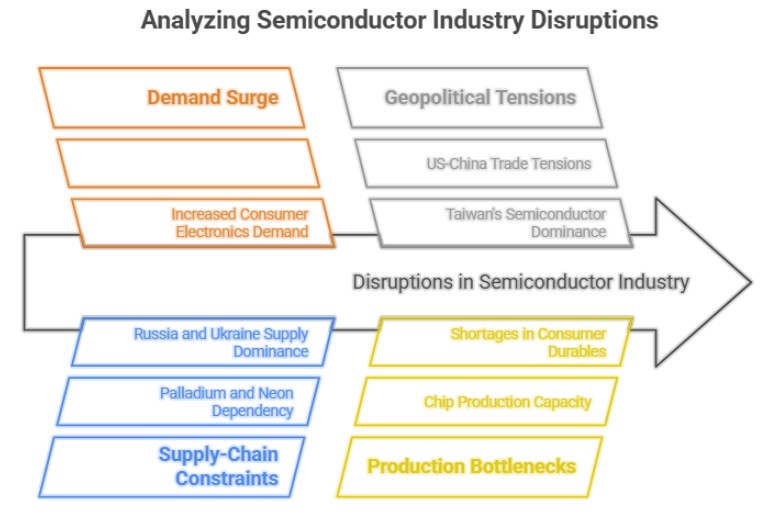
Challenges in Developing the Semiconductor Industry in India
Several challenges need to be addressed to establish a robust semiconductor industry in India
- Highly capital-intensive - As semiconductor fabrication units undertakings costing billions of dollars for large facilities.
- High maintenance: They require high-quality supply of water, electricity, and insulation from the elements, reflecting the high degree of capital needed to make sophisticated circuits.
- Lack of highly-skilled labor and technology: Semiconductor fab is a multiple-step sequence by which electronic circuits are gradually created, which requires high skills and technology in which India is lagging.
- Scarcity of raw materials: From a value-chain perspective, it needs silicon, Germanium & Gallium arsenide, and Silicon carbide which are not available in India and needs to be imported.
- Adverse effect on the environment: Many toxic materials are used in the fabrication process such as arsenic, antimony, and phosphorous, that consists a hazardous impact on the environment.
- Disposal of Hazardous Waste: The semiconductor fabrication process involves the use of toxic materials such as arsenic, antimony, and phosphorus, which can have adverse environmental effects

Policy Initiatives for the Semiconductor Industry in India
India has implemented several policy initiatives to foster the growth of the semiconductor industry
- Make in India: This initiative aims to transform India into a global hub for Electronic System Design and Manufacturing (ESDM).
- Production-Linked Incentive (PLI) Scheme: In December 2021, the Indian government sanctioned ?76,000 crore under the PLI scheme to encourage the domestic manufacturing of various semiconductor goods.
- Design-Led Incubation (DLI) Scheme: The DLI scheme offers financial incentives and design infrastructure support at different stages of semiconductor design and development, including Integrated Circuits (ICs), Chipsets, System on Chips (SoCs), Systems & IP Cores, and semiconductor-linked design.
- Digital RISC-V (DIR-V) Program: This program aims to enable the production of microprocessors in India, achieving industry-grade silicon and design wins by December 2023.
- India Semiconductor Mission (ISM): The ISM envisions building a vibrant semiconductor and display design and innovation ecosystem to establish India as a global hub for electronics manufacturing and design.
- Semicon India program: It aims to provide attractive incentive support to companies that are engaged in semiconductor industries.
- Scheme for Promotion of Manufacturing of Electronic Components and Semiconductors (SPECS): For the manufacturing of electronic components and semiconductors.
Way Forward
- Becoming a Key Player: India should strive to become a significant player in a trusted, plurilateral semiconductor ecosystem that excludes key adversaries.
- Favourable trade policies play a critical role in establishing such an ecosystem.
- Fiscal Support: Given India's talent and experience, focusing fiscal support on other parts of the chip-making chain, such as design centres, testing facilities, and packaging
- Maximizing Self-Reliance: Future chip production should encompass the entire value chain, from design to fabrication, packaging, and testing
- Connectivity and Capability: Connecting related industries and enhancing national capabilities are crucial steps to build a robust chip manufacturing ecosystem in India.
- Collaboration between Industry and Government: Industry-government collaboration is essential to leverage existing capabilities,
Conclusion
To fulfil the global demand for semiconductors and enhance India's capabilities, it is imperative to build upon existing strengths, implement robust policy mechanisms, and foster a collaborative environment between industry and government. Central and state governments must cooperate on policy priorities and execution to achieve this goal.
54. Fintech in India: Growth, Opportunities, Government Initiatives & Challenges
India's Fintech sector has experienced rapid growth over the past decade and is currently at the forefront of the Fintech Revolution. The traditional cash-dependent Indian economy has undergone a significant transformation due to the convenience and efficiency of digital services.
What are Fintechs?
- Fintech is a combination of "financial technology" and refers to new technologies that aim to enhance and automate the delivery and use of financial services.
- At its core, fintech utilizes specialized software and algorithms to assist companies, business owners, and consumers in managing their financial operations and processes more effectively.

Key Fintech Products
- Digital Public Infrastructure (DPI): DPI refers to digital solutions that facilitate essential functions such as collaboration, commerce, and governance, which are crucial for public and private service delivery.
- Digital Public Goods (DPGs): DPGs encompass open-source software, open data, open AI models, open standards, and open content that adhere to privacy and best practices.
Current State of the Fintech Sector in India
|
Significance of Fintech in India
- Enabling Financial Inclusion
- Fintech has reached under-banked and unserved segments, where traditional banks struggled to penetrate.
- Increased transparency through adaptable, multilingual options and a robust interface has expanded the consumer base.
- Reduced friction between financial institutions and retail customers.
- Attracting Capital Flows
- Fintech has drawn capital flows into the Indian economy.
- Bridging Gender and Accessibility Gap
- Fintech has addressed challenges faced by women during the pandemic, such as mobility restrictions and loss of employment.
- The ease of signing up, making transactions, and obtaining credit offered by fintech services has resonated with women.
- Fintech Unicorn and Soonicorn Valuations
- The Indian market has witnessed a rise in fintech unicorn and soonicorn valuations.
- This is attributed to the regulatory sandbox regime introduced by the Reserve Bank of India (RBI) in 2019, paving the way towards a $5 trillion economy.

Government Initiatives Driving Fintech Growth
- Jan Dhan Yojana
- It has facilitated financial inclusion with over 450 million beneficiaries gaining access to various financial services.
- Fintech players have leveraged this initiative to develop technology products for the large consumer base in India.
- India Stack
- India Stack, a collection of APIs, has empowered governments, businesses, startups, and developers to address India's challenges through digital solutions.
- The India Stack has been a catalyst for the rapid evolution of fintech in India.
- Unified Payments Interface (UPI)
- UPI, a mobile app-based payment system, enables fund transfers between bank accounts.
- Digital Rupee
- India recently introduced the Central Bank Digital Currency (CBDC), known as the digital rupee or e-rupee.
- The digital rupee, an electronic version of cash, is expected to accelerate the growth of the fintech market in India.
India Post Payments Bank Launches 'Fincluvation'
- India Post Payments Bank (IPPB), a government-owned entity under the Department of Posts (DoP), has introduced Fincluvation, a collaborative initiative with the Fintech Startup community.
- Aim: To co-create and innovate financial inclusion solutions.
- Startups are encouraged to develop solutions aligned with the following tracks:
- Creditization: Create innovative and inclusive credit products that cater to the needs of target customers and deliver them through the Postal network.
- Digitization: Enhance convenience by merging traditional services with Digital Payment Technologies. For example, transforming the traditional Money Order service into an Interoperable Banking service.
- Market-led Solutions: Propose problem-solving ideas related to IPPB and/or DoP, benefiting the target customers.
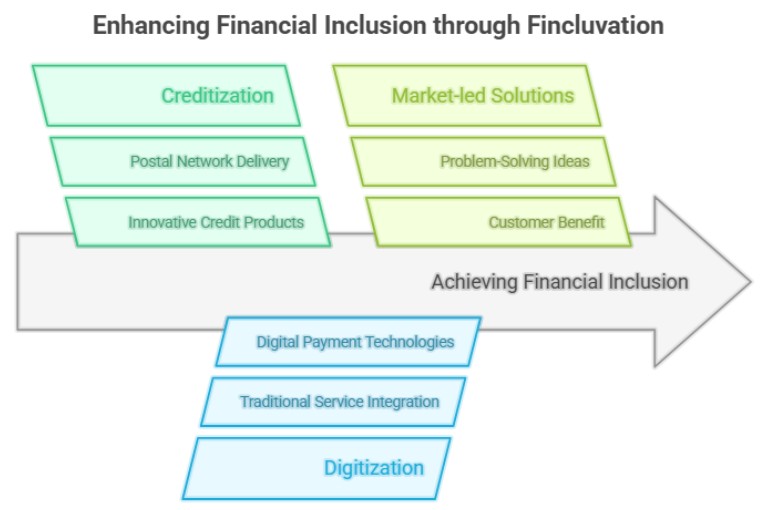
Associated Challenges
- Cyber-Attacks:
- Recent incidents of hacks targeting debit card companies and banks highlight the ease with which hackers can access systems and cause irreparable harm.
- Data Privacy Concerns: Consumers are primarily concerned about the responsibility for cyber-attacks and the misuse of personal and financial information.
- Regulatory Difficulties: Regulation poses challenges in the emerging realm of FinTech, particularly in relation to cryptocurrencies.
Regulating Fintech: Finding the Right Approach
- To address these risks, regulators have begun examining the operations of fintech firms and implementing supervisory measures.
Steps Taken by India for Fintech Regulation
India has implemented following measures to regulate fintech activities:
- Zero-MDR Guidelines: These guidelines aim to promote small ticket debit card merchant transactions.
- Buy Now Pay Later (BNPL) Criticism: The Reserve Bank of India's decision to prohibit prepaid instruments with credit lines related to BNPL has faced criticism for potentially hindering fintech growth and innovation.
- Cryptocurrency Transactions: The RBI's strict stance on cryptocurrency transactions has also drawn criticism from fintech firms. X.
Way Forward
- Guarding Against Cybercriminals: Strict law and monitoring tools to be brought
- Educating Consumers: Consumer awareness regarding using of Apps, software to be raised
- Data Protection Law: Thorough debate and deliberation are necessary for the passage of the Personal Data Protection Bill, 2019
- Increase in Domestic capability: Further increase in manufacturing and software development within India boost Fintech development
Conclusion
While the Indian fintech sector holds immense growth potential and promises to bring about positive changes in the economy, it is crucial to approach its expansion with caution. The accompanying regulatory challenges must be acknowledged and addressed effectively to ensure a secure and sustainable fintech ecosystem.
55. E-commerce in India: Growth, FDI Policy, Challenges & Government Initiatives
E-commerce (electronic commerce) enables businesses and individuals to engage in buying and selling activities as well as the transmission of funds or data, conducted over electronic networks through the Internet.
Driven by the increased adoption of smartphones, the introduction of 4G networks, and the growing affluence of consumers, the Indian e-commerce market is projected to reach a value of US$ 200 billion by 2026, a significant rise from 2017, exhibiting an annual growth rate of 51%, the highest in the world.
The Indian e-commerce industry has been on an upward trajectory and is expected to surpass the United States, becoming the world's second-largest e-commerce market by 2034.
FDI Policy in India for E-commerce
The e-commerce sector in India is classified into two groups based on FDI policy:
- Marketplace Model
- E-commerce entity acts as a facilitator between buyers and sellers on a digital platform.
- Multiple sellers interact with buyers and sell goods.
- Marketplace charges commission from sellers.
- Examples: Naaptol, Shopclues
- Inventory Model
- E-commerce entity owns inventory and sells directly to consumers.
- Sellers are e-commerce companies sourcing from brands and sellers.
- Example: Myntra
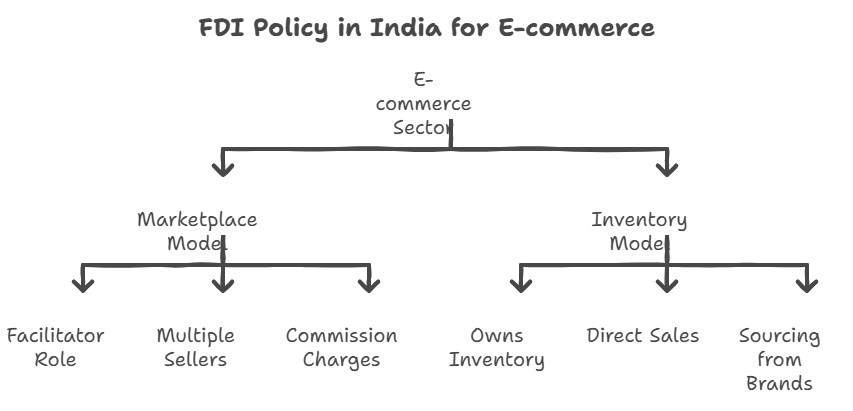
E-commerce Industry in India: Status & Facts
- India’s E – Commerce market: Indian e-commerce is expected to grow at a CAGR of 27 per cent, almost three times the overall retail market and expected to surpass the US to become the 2nd largest E-commerce market in the world by 2034.
- Nascent stage – India’s online retail market is just 3% of the total retail market and 25% of organized retail market.
- Greater Adoption - India has the third largest online shopper base of 150 million (2021) after China and US and is expected to reach 350 million by 2026.
- Huge Employment potential – Directly & indirectly through backward linkages (MSME, Textile, Leather, Farmers, craftsmen etc) & forward linkages (Logistics, packaging, transport, storage, advertising etc.)
- Sunrise sector - Fashion, grocery, general merchandise sector would capture nearly two-thirds of the Indian e-commerce market by 2027.
Significance of E-commerce in India
- Enhancing Competitiveness of Indian Goods
- Boosting Exports
- Efficient Service Delivery
- Revolutionizing Logistics
- Employment Generation
- Increasing Disbursal Income for Low-Income Households
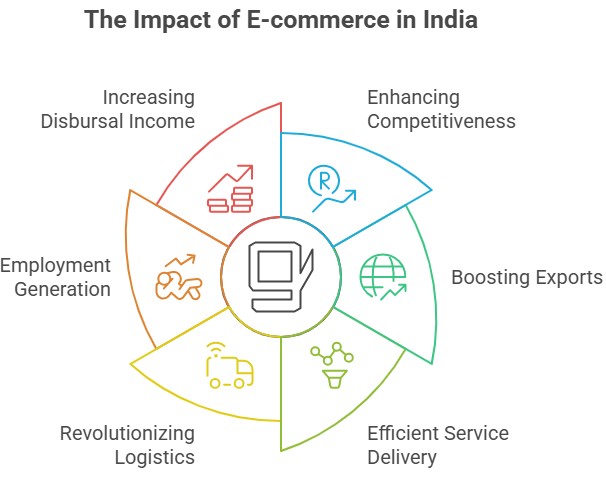
Regulatory Framework for E-commerce in India
- Business Regulation
- Foreign Direct Investment (FDI) policy and Foreign Exchange Management Act (FEMA) govern foreign investments and business setups in India's B2B e-commerce sector.
- Market and inventory-based models in India must adhere to specific rules outlined in the FDI policy.
- Other regulations governing e-commerce in India include the Companies Act, Payment and Settlement Act, RBI regulations on payment mechanisms, labelling and packaging rules, and more.
- Taxation Related
- Income Tax Act, 1961
- Double Taxation Avoidance Agreement
- Goods and Services Tax (GST)
- Legal Issues
- Indian Copyright Act, 1957: Copyright protection is provided to original creative works shared or sold through e-commerce platforms.
- The Patents Act, 1970: Regulations under this act govern the protection and enforcement of patents related to e-commerce innovations.
- Labor laws: E-commerce platforms must comply with labour laws concerning employment practices, working conditions, and employee benefits.
- Data and Associated Issues
- Information Technology Act, 2000 (IT Act): The IT Act regulates various aspects of e-commerce, including electronic contracts, digital signatures, and cybercrime.
- Section 84A and Section 43A: These sections of the IT Act specifically address the obligations of entities dealing with sensitive personal data or information.
- The Information Technology (Reasonable security practices and procedures and sensitive personal data or information) Rules, 2011: These rules provide guidelines for the protection of sensitive personal data and information collected and stored by e-commerce platforms.
- The Information Technology (Guidelines for Intermediaries and Digital Media Ethics Code) Rules, 2021: Recently introduced rules focus on regulating digital media intermediaries, including e-commerce platforms.
- Consumer Protection Act, 2019, and Consumer Protection (E-Commerce) Rules, 2020: These regulations aim to safeguard the interests of consumers in e-commerce transactions V. Benefits of E-commerce
Benefits of E-commerce
- Availability and flexibility: E-commerce sites are accessible 24/7, allowing customers to shop at their convenience without any time restrictions.
- Speed of access: Physical stores often face overcrowding, leading to slower purchasing activities.
- Wide range of options: Range of products can be accessed at single application. Ex. Flipkart, Amazon
- No geographical barrier: Delivery of products are being taken place in the remotest part of the country.
- Lower cost: Due to decrease in miscellaneous expenses and increase in economy of scale, cost of the products also gets reduced.
- Personalization and product recommendation: Feedback, remarks system prove an idea to customers to know about the products in a better way.
- For business: Advantages include an expanded customer base, increased sales, extended business reach, and the convenience of recurring payments and instant transactions.
Limitations of E-commerce
- Lack of Security: Inadequate security measures in online transactions instil fear and apprehension among users.
- Lack of Privacy: The absence of robust encryption methods to safeguard personal data, identity, and financial transactions hinders widespread acceptance of e-commerce shopping habits.
- Limited Customer Service: Resolving complaints and assessing product suitability is more straightforward in physical stores compared to e-commerce sites.
- Regulatory Issues: Ambiguity surrounding cyber laws regulating online purchases fosters mistrust between buyers and consumers.
- Limited Knowledge about Product Suitability: Online purchases lack the advantage of physically experiencing products, relying solely on electronic images. Discrepancies may arise between the delivered product and the electronic images displayed, leading to unfulfilled buyer expectations.
- Wait Period in Product Delivery: Unlike physical stores where customers can purchase and take products home instantly, online shoppers must wait for delivery. Although shipping times have improved with next-day and even same-day delivery, instantaneous fulfilment is not yet achievable.
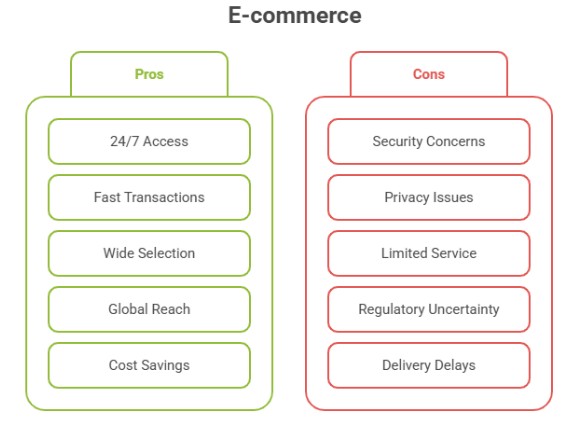
Government Initiatives Boosting E-commerce Sector in India
Digital India, Make in India, Start-up India, Skill India, and Innovation Fund
- These schemes were launched to provide a significant impetus to the e-commerce sector.
- They aim to foster digital transformation, encourage domestic manufacturing, support startups, promote skill development, and provide funding for innovation.
Policy Support
- FDI Policy:
- B2B e-commerce allows 100% FDI.
- Marketplace model of e-commerce permits 100% FDI under the automatic route.
- Clarity in FDI policy definitions related to e-commerce, e-commerce entities, marketplace-based model, and inventory-based model is a positive step.
Digital India Initiatives
- Under the Digital India movement, several initiatives such as Umang, Start-up India Portal, and Bharat Interface for Money (BHIM) were launched to drive digitization and enhance digital accessibility.
Encouraging Domestic Participation
- The equalization levy rules of 2016 were amended to promote domestic participation.
- Foreign companies operating e-commerce platforms in India are required to have Permanent Account Numbers (PAN).
Consumer Protection (E-commerce) Rules, 2020
- Ban on Flash Sale: The draft rules seek to ban “specific flash sales” by e-commerce entities.
- Fall-back Liability: The rules have also introduced the concept of “fall-back liability”, which says that e-commerce firms will be held liable in case a seller on their platform fails to deliver goods or services due to negligent conduct, which causes loss to the customer.
- Restricting Manipulation: The rules also propose to restrict e-commerce companies from “manipulating search results or search indexes”.
- Consumer Consent: E-commerce companies will also be restricted from making available to any person information pertaining to the consumer without express and affirmative consent.
- Provide Domestic Alternatives: Further, the companies will have to provide domestic alternatives to imported goods, adding to the government’s push for made-in-India products.
- National Consumer Helpline: The draft amendment also proposes to ask e-commerce firms to mandatorily become a part of the National Consumer Helpline.
- Mandatory Registration: Any online retailer will first have to register itself with the Department of Promotion for Industry and Internal Trade (DPIIT).
- No Differential Treatment: The rules propose mandating that no logistics service provider of a marketplace e-commerce entity shall provide differentiated treatment between sellers of the same category.
- Associated Enterprise: Any entity having 10 percent or more common ultimate beneficial ownership will be considered an “associated enterprise” of an e-commerce platform.
- Time-bound Information: The draft rules propose that the information sought by the government agency will have to be produced by the e-commerce company “within 72 hours of the receipt of an order from the said authority”.
- Open Network for Digital Commerce (ONDC):
- Launched by the Department for Promotion of Industry and Internal Trade (DPIIT) under the Ministry of Commerce and Industry.
- Investment in Fiber Network for 5G:
- The Government is heavily investing in rolling out a fibre network for 5G technology, which will contribute to the growth of e-commerce in India.
Challenges in the E-commerce Sector
- Consumer Vulnerability, Dynamic Pricing and Regulatory Models, Impact on Banks, Balancing Innovation and Protectionism, Policy Challenges
Way Forward
- Risk-Based Regulations: There is a need for a risk-based regulatory framework to address emerging challenges in e-commerce.
- Strengthen Competition Commission of India (CCI): Efforts should be made to enhance the capacity of the Competition Commission of India to effectively regulate the e-commerce sector.
- Nurturing Start-ups and SMEs: The government must create an enabling ecosystem that nurtures online start-ups and small and medium enterprises (SMEs).
- Focus on Infrastructure: The government should prioritize the development of data centers and cloud infrastructure to support the growth of the e-commerce sector.
- Consumer Protection: Strengthening consumer protection measures is crucial to instill trust and confidence in the e-commerce ecosystem.
Conclusion
E-commerce in India is experiencing remarkable growth and is poised to become the world's second-largest market by 2034. It encompasses various types of transactions, driving competitiveness, boosting exports, and revolutionizing logistics. However, challenges such as security concerns, limited customer service, and regulatory issues need to be addressed.
56. National Technical Textiles Mission: Boosting India's Potential in the Technical Textiles Sector
Introduction
Technical textiles play a vital role in various industries, providing functional fabrics designed for specific applications. They find applications in sectors such as automobiles, civil engineering, agriculture, healthcare, industrial safety, and personal protection. The demand for technical textiles is closely linked to a country's development and industrialization. The Ministry of Textiles recently approved 23 strategic research projects worth approximately Rs 60 crores under the National Technical Textiles Mission.
India's Position in the Technical Textiles Sector
- India is the 5th largest producer of technical textiles in the whole world with a market size of nearly $22 billion, which we hope to build up to $300 billion when we turn 100 by 2047.
- Technical textiles account for more than 25% of all fiber consumed and nearly 50% of total textile activity in certain industrialized countries.
- Asia, particularly China, Japan, Korea, Taiwan, and India, is rapidly establishing itself as a technological textile’s powerhouse in terms of production and consumption.
India's Domestic Technical Textiles Landscape
- India currently utilizes products from all 12 technical textile segments, but not all of them are manufactured domestically.
- India excels in the production of technical textiles in the Packtech, Clothtech, Hometech, and Sportech segments.
- However, many technical textile products are heavily imported, unlike the traditional textile industry, which relies on exports.

Market Size and Consumption of Technical Textiles in India
- Technical textile accounts for approximately 13% of India's total textile and apparel market and contributes to India's GDP at 0.7%.
- Packtech is the most important segment, accounting for around 36% of domestic consumption. Clothtech represents about 17% of total technical textile consumption.
- Mobiltech and Hometech account for 8% and 12% of total consumption, respectively. The growth rate for these segments is expected to be 11-12% per year over the next five years.
About the National Technical Textiles Mission (NTTM)
- The National Technical Textiles Mission (NTTM) was granted approval by the Cabinet Committee on Economic Affairs (CCEA) in 2020, with a substantial budget of Rs.1480 Crore.
- Spanning four years, from FY 2020-21 to FY 2023-24, the NTTM aims to elevate India's standing as a global leader in Technical Textiles, propelling the domestic market size from USD 40 billion to USD 50 billion by 2024.
- Additionally, the mission supports the 'Make in India' initiative by fostering domestic manufacturing of machinery and equipment related to technical textiles.
Key Components of NTTM
- Research, Development, and Innovation: Research activities will focus on both fiber-level exploration and application-based advancements in various sectors.
- Market Promotion and Development: The mission seeks to achieve an average growth rate of 15% to 20% per annum by 2024, thus increasing the adoption and utilization of technical textiles within the country.
- Export Promotion: NTTM places significant emphasis on export promotion, aiming to escalate technical textile exports from Rs 14,000 crores to Rs 20,000 crores by 2021-2022, with a consistent annual growth rate of 10% until the conclusion of the mission.
- Education, Training, and Skill Development: The fourth component focuses on nurturing expertise in technical textiles through education and skill development at higher engineering and technology levels, with a specific focus on areas related to technical textiles and their applications.
Implementation and Governance
The NTTM will be executed through a three-tier institutional mechanism, comprising the following entities:
- Mission Steering Group: This group holds the authority to approve financial norms, schemes, components, and programs associated with the mission as well as Scientific and technological research projects under the mission.
- Empowered Programme Committee: Responsible for approving projects (excluding research projects) within the financial limits set by the Mission Steering Group.
- Committee on Technical Textiles on Research, Development & Innovation: Tasked with identifying and recommending research projects to the Mission Steering Group for approval. These projects primarily focus on strategic sectors such as space, security, defense, paramilitary, and atomic energy.
Issues in Textile Sector:
Shortage in supply of raw material, increase in cost of raw material, Inflexible labor laws, Pressure to meet stringent social and environmental norms, Infrastructural bottlenecks, highly fragmented, Uneven regional development:
Other Initiatives Related to Technical Textile
- Production Linked Incentive (PLI) Scheme for Textiles Sector
- The government has approved the PLI Scheme for Textiles products which aims to enhance India's manufacturing capabilities and boost exports with an approved financial outlay of Rs 10,683 crore over five years.
- Harmonized System of Nomenclature (HSN) Codes for Technical Textile
- In 2019, the Government of India dedicated 207 HSN codes to technical textiles to monitor import and export data, provide financial support, and offer incentives to manufacturers.
- 100% FDI under Automatic Route
- The Indian government allows 100% Foreign Direct Investment (FDI) under the automatic route.
- Technotex India
- Technotex India is a flagship event organized by the Ministry of Textiles in collaboration with the Federation of Indian Chambers of Commerce & Industry (FICCI).
- It includes exhibitions, conferences, and seminars involving stakeholders from the global technical textile value chain.
- PM MITRA Park Scheme
- The PM MITRA parks are Mega Integrated Textile Region and Apparel parks to be established in different states.
- These parks align with the vision of 'Atma Nirbhar Bharat'. The parks will be developed by a Special Purpose Vehicle (SPV) in a Public-Private Partnership (PPP) mode.
- The parks are inspired by the '5F' vision of the Prime Minister of India, which encompasses farm to fibre, fibre to factory, factory to fashion, and fashion to foreign.
Way Forward
- Addressing the technological gap in the field of technical textiles should be a priority.
- Identifying research areas in technical textiles through industry interaction and promoting their use through conferences, exhibitions, and buyer-seller meetings are crucial for increasing exports and domestic usage.
Conclusion
The technical textiles sector in India is projected to grow at a rate of 12% per year. To achieve its potential of nearly 20% annual growth, proactive measures are needed, including expanding the market, promoting the use of technical textiles in government schemes, raising awareness among citizens and institutions, adopting advanced technology, fostering foreign collaboration, and investing in domestic demand.
57. Power Sector DISCOMs in India: Challenges & Reforms
Power generation, transmission, and distribution are integral processes in the power sector. Distribution Companies (DISCOMs) act as intermediaries, connecting power producers with households and serving as the interface between utilities and consumers. In India, DISCOMs are primarily owned by state governments, although a few private DISCOMs operate in select cities.
Challenges Faced by Power Sector DISCOMs
- Power losses: High technical and commercial aggregate (AT&C) losses of 17% (FY 2022) due to inadequate infrastructure, theft, and unpaid bills. AT&C losses encompass energy losses during transmission and distribution, theft, billing inefficiencies, collection inefficiencies, and payment delays.
- Financial losses: Over 15 years through FY2021, public discoms were found to have suffered a cash-basis loss of ?10 lakh crore.
- Poor cash flow: Delayed consumer payments result in insufficient cash income, preventing timely payments to energy generators. This leads to operational liabilities with power and transmission companies.
- Missing measurements: Inadequate measurement at different levels of the distribution chain makes it difficult to identify areas of loss and take corrective action.
- Competition with renewable energy: Long-term power purchase agreements (PPAs) and the declining price of electricity, particularly from coal-based power generation, have created financial rigidity for DISCOMs, resulting in losses.
- Rise of informal credit: DISCOMs have increasingly delayed payments to producers and other stakeholders.
- Ambitious projects without sufficient support: Expansion plans to provide electricity to all citizens require a review of the cost structure and an expansion of the distribution network.
- Profitability: The gap between the average cost of supply and the average realized revenue for DISCOMs is currently estimated at Rs. 0.49 per unit, resulting in accumulated losses and delayed payments to generators.
- Foreign investor averse to invest despite 100% FDI – due to lack of visible reforms, financial incompetency, long gestation period, huge delays in commissioning, etc.
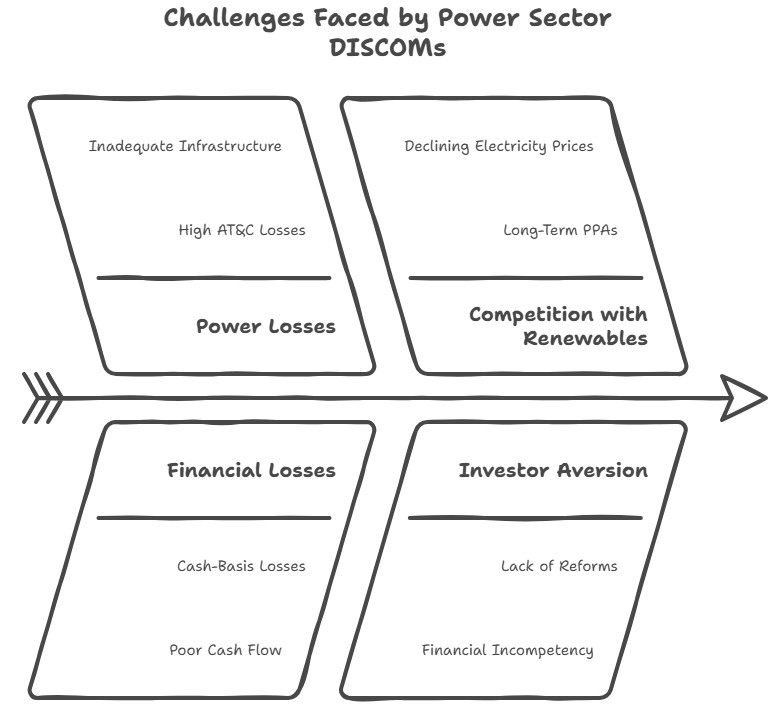
Private Sector Participation in Power Sector DISCOMs
- Operational autonomy - This can lead to rationalisation of fares and revival of fiscal health of DISCOMS.
- Efficiency and profit motive - Profit driven approach also creates a more efficient value chain. Private sector usually carry acumen in reducing losses and building sustainability through profits.
- Innovation mechanism like smart metering can be brought by the private sector.
- Better Customer Service - increased revenue, reduced inefficiencies, and introduction of better technologies and more competition will help provide a better overall consumer experience.
- For eg. Smart prepaid meters will allow transparency for consumers, help DISCOMs reduce AT&C losses, and ensure billing accuracy which leaves no scope for human errors.
- Nuanced planning - The private sector’s ability to strategize for the long-term is essential in an area like power distribution.
- Opportunity to start afresh – The standard bidding document puts forth that the winning entity will be provided with a clean balance sheet, free of accumulated losses and all unserviceable liabilities.
- Diversified options for attracting investment - Private participation in power distribution can follow various models: licensing, distribution franchisee, etc. Various PPP models will be tested and will assist in generating private sector appetite amongst Indian and international investors.
- Technological advancements - deployment of advanced metering infrastructure, smart grids, and distribution automation systems for better monitoring of electricity consumption, reduced losses, and improved billing accuracy.
- Successful example – Delhi privatised DISCOMs in 2002 and witnessed a complete turnaround ???? AT&C losses have come down from 55% in 2002 to about 9% in 2022.
Government Initiatives for Power Sector DISCOMs
- Revamped Distribution Sector Reform Scheme (RDSS): Launched in July 2021, this central government grant-based program aims to improve the operational efficiencies and financial sustainability of DISCOMs (excluding private sector DISCOMs).
- It provides conditional financial assistance to strengthen the supply infrastructure of DISCOMs.
- The program allocates half of its budget to better feeder and transformer metering and prepaid smart consumer metering.
- RDSS consolidates existing power sector reform schemes, including the Integrated Power Development Scheme, DDU Gram Jyoti Yojana, and Pradhan Mantri Sahaj Bijli Har Ghar Yojana.
- The Rural Electrification Corporation and Power Finance Corporation are responsible for implementing this program.
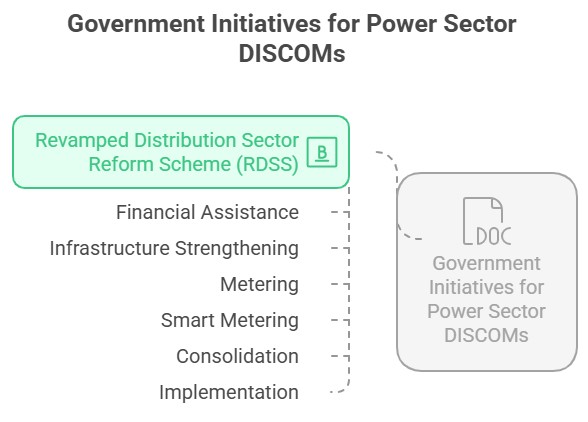
Issues Associated with RDSS
- RDSS inherited design issues from previous schemes, including complex processes and conditions for fund disbursal. Only 60% of the allocated grants in past schemes were disbursed.
- UDAY Scheme: Launched in November 2015, the Ujjwal DISCOM Assurance Yojana (UDAY) was designed to turn around the financial position of DISCOMs.
- The state governments took over 75 % of the debt of their DISCOMs, issuing lower-interest bonds to service the rest of the debt.
- In return, DISCOMs were given target dates (2017-19) to meet efficiency parameters like reduction in power lost through transmission, theft and faulty metering.
- Reforms-Linked, Result-Based Scheme for Distribution (RLRBSD): In budget 2021-22, the Union government had announced the launch of a “reforms-based and results-linked” scheme for improving the financial health and operational efficiency of discoms.
- Under the scheme, AT&C losses will be brought down to 12-15% by 2025-26, from 21-22%.
- Operational efficiencies of discoms will be improved through smart metering and upgradation of the distribution infrastructure, including the segregation of agriculture feeders and strengthening the system.
- Liquidity Scheme: To help these DISCOMs, the Centre in May 2020, announced a Liquidity Infusion Scheme (Aatmanirbhar Bharat Abhiyan), under which loans of ?1,35,497 crore have been sanctioned.
Way Forward
- Strengthening Rural Networks: Investing in rural network infrastructure is crucial to meet the growing demand for electricity, especially in rural areas.
- Fulfilling Agricultural Consumer Requirements: The PM-KUSUM scheme aims to provide day-time, low-cost power supply to farmers by installing large-scale solar plants.
- Automatic metering of distribution feeders: Equipping all feeders with meters capable of communicating readings without manual intervention can enhance accuracy in loss estimation
- Role of states: States should identify implementation issues, devise suitable metering strategies, and create frameworks to assess the benefits and costs of prepaid and postpaid metering.
Conclusion
By addressing the challenges faced by DISCOMs requires a multi-pronged approach involving strengthening rural networks, fulfilling agricultural consumer requirements, implementing automatic metering, and active participation of states in strategizing and evaluating initiatives. With these efforts, the power sector can move towards financial sustainability and provide reliable electricity supply to all consumers.
58. India's Push Towards a Gas-Based Economy
Introduction
Prime Minister Narendra Modi aims to increase India's share of natural gas in its energy mix from 6.2% to 15% by 2030, as part of the country's commitment to achieving net-zero carbon emissions by 2070 with a planned $60-billion investments in gas infrastructure by 2024. A gas-based economy implies making natural gas the primary commercial energy source in India's energy mix.
Understanding Natural Gas
- Natural gas is a fossil fuel primarily composed of methane and is considered the cleanest among fossil fuels.
- It is used as a feedstock in the production of fertilizers, plastics, and other essential chemicals, as well as a fuel for electricity generation, heating purposes in industries, and transportation.
Importance of Natural Gas in India
- Energy Efficiency: Natural gas provides more energy per unit compared to other fossil fuels.
- Cleaner Fuel: It is an environment-friendly, safer, and more affordable fuel option compared to coal and liquid fuels.
- Economic Benefits: Compressed Natural Gas (CNG) is cheaper than petrol or diesel, promoting cost savings for consumers.
- Emission Commitments: India committed to reducing carbon emissions by 33%-35% of 2005 levels by 2030 under the COP-21 Paris Convention.
- Diverse Applications: Natural gas can be used for domestic cooking, transportation, and as a fuel in fertilizer industries and commercial units.
- Supply Chain Convenience: Natural gas is supplied through pipelines, eliminating the need for cylinder storage in households and saving space.
- Global Progress: Switching to natural gas globally has shown positive results. According to the International Energy Agency (IEA), natural gas surpassed coal in electricity production for the first time.
Natural Gas Scenario in India
- Domestic Gas Sources: India relies on domestic gas from oil and gas fields located in the western, southeastern, and northeastern regions viz. Hazira basin, Mumbai offshore & KG basin as well as North East Region (Assam & Tripura).
- India has 26 sedimentary basins. However, only a small percentage of the sedimentary basin area has been explored, resulting in limited domestic production.
- LNG Imports: To meet the growing demand, India imports Liquefied Natural Gas (LNG) through the Open General License (OGL) regasification terminals located in various ports.
- Gas Pipelines: The development of a National Gas Grid aims to ensure the availability and equitable distribution of natural gas across the country.
- Pricing: India links local gas prices to global benchmarks to incentivize gas producers and boost local output.
Statistics of Natural Gas in India
- Current Consumption: India's natural gas consumption is projected to grow by 8% annually, reaching around 34,949 million standard cubic meters in the current calendar year. City Gas Distribution (CGD) accounts for the largest consumption, followed by fertilizers, power, and other industrial sectors.
- High Prices: Local gas prices and ceiling rates are at a record high, and global gas price surges due to geopolitical tensions may further increase prices.
Kirit Parikh Committee
- Objective: The committee, led by energy expert Kirit Parikh, aims to ensure fair prices for consumers and establish a market-oriented, transparent, and reliable pricing regime to support India's gas-based economy.
|
RECOMMENDATIONS OF KIRIT PARIKH COMMITTEE ON GAS PRICING
|
Challenges Facing India's Natural Gas Reserves
- Lack of Infrastructure, Import Dependence, consumption relies on imported LNG, Safety Concerns: Domestic Issues and Delays, Underutilization, Less Feasible Power Alternative, Ecological Concerns:
- Energy Trilemma: India must balance affordability and access, energy security, and environmental sustainability.
Natural Gas Marketing Reforms
- Objective: The reforms aim to establish a standard procedure for discovering market prices through transparent and competitive processes. It permits affiliates to participate in bidding and grants marketing freedom to certain Field Development Plans.
- Aim: To provide standard procedure for sale of natural gas in a transparent and competitive manner to discover market price by issuing guidelines for sale by contractor through e-bidding.
Various Government initiatives
|
Government Initiatives |
Description |
|
Hydrocarbon Exploration and Licensing Policy (HELP) |
|
|
National Gas Grid Development |
|
|
Pradhan Mantri Urja Ganga Pipeline Project |
|
|
Pradhan Mantri Ujjwala Yojana |
|
|
Revival of TAPI Pipeline |
|
|
Reforms in the Gas Sector |
|
|
Clean Mobility Solutions |
|
Way Forward
- Seizing Opportunities: India should take advantage of low gas prices and enter into contracts with gas-rich countries through pipelines.
- Aggressive Reforms: More dynamic reforms are needed, including subsidy restructuring and improved production.
- Empowering Producers and Buyers: Allowing greater control over pricing and marketing, and introducing e-bidding systems.
- Focus on Electricity: Encouraging greater reliance on electricity as a cleaner alternative to natural gas and other fuels.
- Government as Facilitator: The government should facilitate resource development, improve quality and quantity, and reduce import dependence.
- Subsidy Reforms: Directly transferring fertilizer subsidies to farmers' accounts and granting marketing and pricing freedom to the fertilizer industry.
- Extending Policies: The policy reforms should cover the entire gas sector, moving away from administrative pricing mechanisms.
- Effective Implementation: Governments play a crucial role in driving energy sector growth, and India's gas market is still in its early stages. Ensuring effective implementation of policies is essential for the transition to a gas-based economy.
Conclusion
India's ambition to transition to a gas-based economy presents significant challenges, including infrastructure limitations, import dependence, safety concerns, and underutilization. However, with aggressive reforms, empowering stakeholders, and a focus on clean and affordable energy solutions, India can progress towards its goal.
59. India’s Renewable Energy Revolution: Growth, Policy & Future
Power plays a pivotal role in the economic prosperity and welfare of nations. A robust and sustainable power sector is indispensable for fostering India's economic growth.
As per the recent report "Investing for Impact: Renewable Energy & Cleantech" by Aspire Circle, an investment of $350 billion in renewable energy and cleantech ventures can potentially enable India to generate a staggering $212 billion in revenue, create 3.4 million jobs, and positively impact the lives of 919 million individuals by 2030.
Renewable Energy in India
Renewable energy encompasses energy derived from natural resources that replenish themselves over time.
- It comprises various sources, such as solar energy, wind energy, hydroelectric power, wave energy, ocean thermal energy conversion, tidal energy, and biomass power.


The Role of REN21 in Promoting Renewable Energy
- The Renewable Energy Policy Network for the 21st Century (REN21) assumes a crucial role in accelerating the global transition to renewable energy.
- It facilitates the formulation of effective policies, fosters knowledge exchange, and promotes collaborative action among governments, NGOs, research institutions, international organizations, and businesses.
- REN21 acts as a catalyst to expedite the widespread adoption of renewable energy.
- According to REN21, renewable energy generation witnessed a substantial growth of nearly 7% in the past year, thereby accounting for 29% of the global electricity generation mix, up from 27% in 2019.
India's Renewable Energy Focus for the Next 5 Years
Methanol and Biomass
- Emphasis on utilizing alternative options like methanol-based economies and biomass. Government's target of bio-CNG vehicles with a 20% gasoline blend.
- Biomass energy generation as a cleaner option to reduce reliance on fossil fuels. Biomass-based fuels offer high calorific value and are cleaner compared to traditional biomass.
The Dual Challenge
- India faces the challenge of providing more and cleaner energy to its population. Focus on manufacturing solar panels under the Atma Nirbhar Bharat initiative.
- Developing the entire supply chain for components other than the manufacturing sector.
Hydrogen-based Fuel Cell Vehicles (FCV)
- Transitioning to Hydrogen-Based Fuel Cell Vehicles as a key area of focus.
- Expected to transform the renewables landscape.
Benefits of Renewable Energy in India
- Private sector involvement: Government's target of 450GW from renewables opens opportunities for private sector involvement in design and manufacturing, boosting profits.
- Low cost of maintenance: Renewable energies like wind energy, biopower or solar energy requires almost zero maintenance and thus provide longer working hours and reduced labor cost.
- Environment friendly: as they have almost nil carbon footprint and does not emit any harmful pollutants like PM2.5 or PM10 or greenhouse gases like carbon dioxide, NOx etc.
- Fulfill several government objectives: like achieving the Panchamrit goals, SDGs, Make in India, INDC of Paris Climate Deal and employment generation.
- Decentralized: Renewable energy plants can be located near the location of demand for energy
- For example, UT Daman has been receiving its energy completely from solar energy generated inside and in the vicinity of the city, thus reducing its dependence on the national power grid.
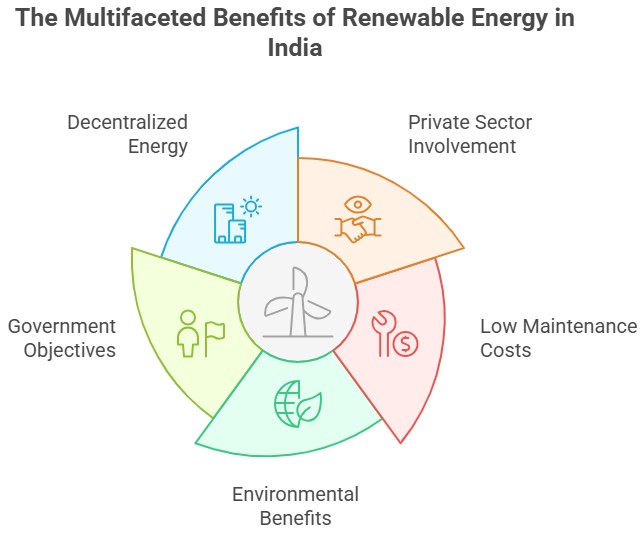
Factors Increasing Renewable Energy Demand in India
- Waiver of Inter-state Transmission Charges: The sale of solar and wind power is exempted from inter-state transmission charges, boosting demand.
- Renewable Purchase Obligation (RPO) Targets: State DISCOMS are obligated to meet renewable purchase targets, stimulating demand for renewable energy.
- Foreign Direct Investment (FDI): Permitting FDI in the renewable sector has accelerated progress and attracted investment.
- Rebound in Economy: The rising demand for electricity following the COVID-19 lockdowns has contributed to increased demand for renewable energy.
- Falling Prices of Renewable Energy: The cost of renewable energy has significantly decreased, with solar energy tariffs reduced by up to 80% since 2008.
- Government Support for Manufacturing Solar Photovoltaic Modules: Schemes, such as Production Linked Incentive schemes, aim to boost competitiveness and attract investment in manufacturing solar modules.
Need for Transition to Renewable Energy
- Addressing the Climate Crisis: The continuous burning of fossil fuels for power generation contributes to climate disruption. Transitioning to renewable energy can limit climate change and enhance energy security.
- Volatile Supplies of Non-renewable Energy: Regional conflicts and international sanctions on major energy producers like Iran and Russia have led to unstable supplies of non-renewable energy sources.
- Promoting Sustainable Development: Shifting to renewable energy reduces pollution externalities and promotes a green economy, aligning with sustainable development goals.
- Commitments to International Agreements: As a signatory to the Paris Climate Agreement, India is committed to increasing its renewable energy capacity to 450 GW by 2030.
- Government Targets: The Indian government has set targets to reduce carbon emissions, decrease carbon intensity, achieve net-zero emissions by 2070, and expand renewable energy capacity to 450 GW by 2030.
Renewable Energy Prospects in India
- Attractiveness for Renewable Energy Investment: EY's Renewable Energy Country Attractiveness Index ranks India as the third most attractive destination, behind the USA and China.
- Wind Energy Potential: India has an estimated wind energy potential of 102,788 MW at a height of 80m. The current installed capacity is 22,645 MW.
- Wave and Tidal Energy Potential: India's coastline of 7,500 km holds an estimated wave energy potential of about 40,000 MW. Additionally, there is a potential of 8,000 MW of tidal energy.
- Ocean Thermal Energy Conversion (OTEC) Potential: India's OTEC potential is estimated at 180,000 MW, accounting for 40% of gross power considering parasitic losses.
- Biomass Energy Potential: India possesses a significant biomass energy potential of 19,500 MW, including biogas-based cogeneration and surplus biomass. Currently, 537 MW is commissioned, and 536 MW is under construction.
- Private Sector Interest: Major Indian private companies, such as Reliance Power, are showing interest in the renewable energy sector, with plans to invest Rs 5 lakh crore in green energy projects.
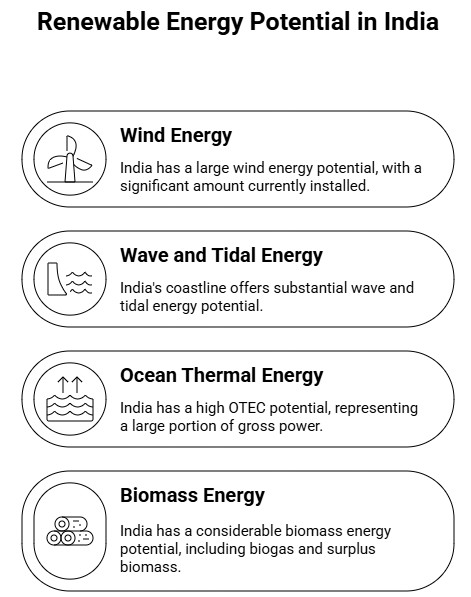
India's Achievements in the Renewable Energy Sector
- Investment Attraction: Over the past six years, India has attracted a staggering investment of more than Rs 4.7 lakh crore in the renewable energy sector.
- Impressive Growth: India has witnessed a remarkable 20% compound annual growth rate (CAGR) in renewable energy generation since FY16. In comparison, the overall electricity generation in the country grew at a rate of 4.3% during the same period.
- Reduced Cost: The cost of energy from large-scale solar projects, known as Levelized Cost of Energy (LCOE), has dropped significantly in India.
- Global Position: India currently holds the fourth position worldwide in terms of overall installed renewable energy capacity. Renewable energy contributes 26.53% to the country's total installed generation capacity.
- Capacity Expansion: Over the last 7.5 years, India has experienced an impressive 286% increase in renewable energy installed capacity.
- World's Largest Renewable Energy Park: Gujarat is home to the installation of the world's largest solar-wind hybrid project, with a capacity of 30 GW.
Challenges of Renewable Energy in India
- High Initial Installation Cost: Compared to coal-based power plants, wind-based plants require higher initial investments, making the cost per MW approximately Rs 6 crore, given a capacity utilization of 25%.
- Reliability Concerns: Solar and wind energy, due to their variable nature, require support from conventional power sources to ensure consistent availability.
- Storage Infrastructure: Investing in affordable, high-capacity batteries is crucial to overcome the intermittency of renewable energy sources.
- Funding Constraints: The need for large-scale projects to achieve economies of scale presents a deterrent for private companies to initially invest in the renewable energy sector.
- Limited Social Acceptance: Despite government subsidies for solar water heaters and lighting systems, urban India has yet to fully embrace renewable-based energy systems.
- Weak Domestic Manufacturing Capability: Enhancing manufacturing capacity within India is crucial to reduce reliance on imports and promote self-sufficiency, resulting in job creation.
- Sustainability: Balancing reliable energy access, affordability for consumers, and financial stability for DISCOMs is a vital aspect of India's transition towards renewable energy.
India's Facilitation of the Green Energy Transition
India, as the world's third-largest energy-consuming country, is taking significant steps towards a green energy transition. While the majority of energy demand is still met by coal, oil, and solid biomass, India is actively pursuing renewable energy alternatives. Key initiatives include:
- Ambitious Capacity Expansion: India has set a target to reach 450 GW of installed renewable energy capacity by 2030.
- Production Linked Incentive Scheme (PLI): The government's PLI scheme aims to boost the manufacturing sector by encouraging the production of raw materials for renewable energy.
- PM-KUSUM: The Pradhan Mantri-Kisan Urja Suraksha evam Utthaan Mahabhiyan focuses on providing financial and water security to farmers by harnessing 30,800 MW of solar energy capacity by 2022. This initiative includes the solarization of water pumps for distributed power supply.
- Akshay Urja Portal and India Renewable Idea Exchange (IRIX) Portal: The Ministry of New and Renewable Energy hosts these online platforms, promoting the exchange of ideas and fostering collaboration among energy-conscious Indians and the global community.
Challenges Related to India’s Energy Sector
- Energy Poverty and Inequality
- Approximately 77 million households still rely on kerosene for lighting.
- Rural areas are particularly affected, with up to 44% of households lacking electricity access.
- Import Dependence and Weaponization of Supply Chain
- India's crude oil import bill increased by 76% to USD 90.3 billion in the first half of 2022-23, accompanied by a 15% rise in total import quantity.
- India's reliance on foreign countries like China for solar modules exacerbates the issue, as there is no backward integration in the solar value chain.
- Climate Change Induced Energy Crisis
- Climate change has a direct impact on fuel supply, energy requirements, and the resilience of existing and future energy infrastructure.
- Women’s Health at Risk
- The use of non-clean energy sources increases the risk of respiratory, cardiovascular, and psychological diseases for women, as well as maternal and infant mortality.
- Widening Gap Between Demand and Supply of Coal
- Data from the Ministry of Coal in 2021 show a growing disparity between the demand and domestic supply of coal.
- Increasing Demand, Increasing Energy Cost
- Urbanization and industrialization lead to an increasing demand for energy in India, projected to rise by more than 3% annually.
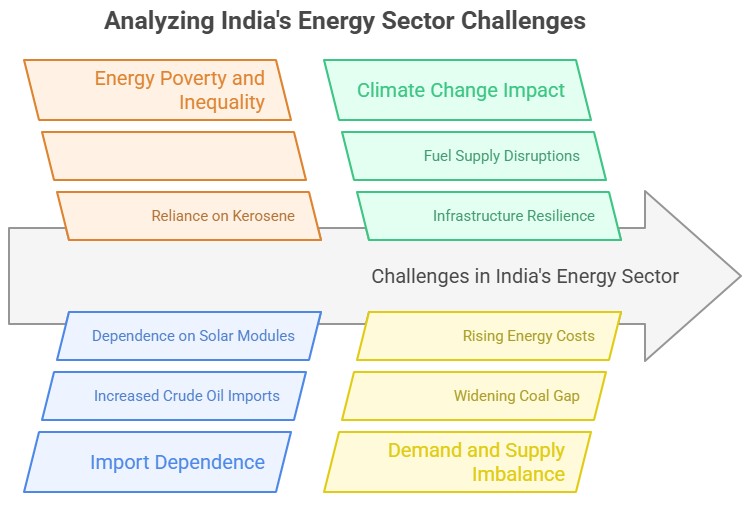
Government Policies for the Promotion of Renewable Energy in India
- Renewable Energy Certificate (REC) Mechanism
- The REC mechanism is a market-based instrument that promotes renewable energy and facilitates compliance with renewable purchase obligations (RPO).
- It aims to address the mismatch between renewable energy availability and RPO requirements.
- Green Hydrogen Mission
- The mission focuses on meeting climate targets and establishing India as a green hydrogen hub.
- The goal is to produce 5 million tonnes of green hydrogen by 2030, along with the development of renewable energy capacity.
- Production Linked Incentive (PLI) Scheme
- The PLI scheme aims to promote renewable energy storage infrastructure and manufacturing capacity through the National Programme on Advanced Chemistry Cell (ACC) Battery Storage.
- Green Term Ahead Market (GTAM)
- The pan-India GTAM is an alternative model introduced to sell renewable power in the open market without long-term power purchase agreements (PPAs).
- It contributes to greening the short-term power market.
International Efforts
- The India Energy Modeling Forum was launched under the US-India Energy partnership.
- The International Solar Alliance, a treaty-based inter-governmental organization, mobilizes investment for solar energy deployment.
- Solar Energy Corporation of India (SECI)
- SECI facilitates the implementation of the National Solar Mission and the development of renewable energy technologies throughout India.
- National Offshore Wind Energy Policy, 2015
- The Ministry of New & Renewable Energy (MNRE) explores and promotes offshore wind farms in the Exclusive Economic Zone (EEZ).
Way Forward
- Interlinking Women Empowerment with Green Energy
- Promoting women's empowerment and leadership in the energy sector can accelerate the transition to a low-carbon economy.
- Gender equality should be integrated into the "just transition" to ensure equal opportunities in green jobs.
- Women can contribute to the green energy transition through entrepreneurship and policy-making.
- Diversifying Green Supply Chain
- Clean energy supply chains should be diversified across a larger number of countries beyond developed nations.
- Climate finance under COP27 can aid in managing the shift of revenues and employment from traditional energy sources to renewable energy.
- Incentivizing Least-Cost Energy Solutions
- Encouraging university-level innovations can drive economically viable clean energy transition.
- India's demographic dividend can be utilized by promoting research and innovation in clean energy.
- Programs like UJALA and campaigns promoting sustainable lifestyles contribute to this objective.
- Focusing on Green Transport
- Restoring confidence in public transport, adopting e-buses, and developing electric freight corridors are crucial.
- Tightening emission norms and promoting biofuels can replace fossil fuels in the transportation sector.
- Multisectoral Approach to Energy Transition
- India should focus on energy system design, urban development, industrial growth, and supply-chain management to achieve future resilience.
- Gradual reduction of commodity imports and promotion of domestic manufacturing can enhance self-sufficiency.
- Leveraging Make in India can transform India into a self-sufficient and globally competitive green energy export hub.
Conclusion
Renewable energy is the future and holds the potential to eliminate fossil fuel-based energy by 2050, leading to improved environmental health. A clear policy guideline is crucial to efficiently integrate energy sources into the grid and achieve maximum efficiency.
60. Inland Waterways: Unlocking India's Transport Potential
Introduction
Inland water transport, which involves the movement of people, goods, and materials through rivers, canals, and lakes within a country's borders, offers significant advantages. Despite its potential, it remains underutilized in India, accounting for only 2% of the country's transportation mix.
MARITIME INDIA VISION 2030
- It is a ten-year blueprint for the maritime sector (released in 2020).
- It will supersede Sagarmala initiative.
- Sagarmala aims to reduce logistics costs for EXIM and domestic trade with minimal infrastructure investment.
- Objective: To boost waterways, give a fillip to the shipbuilding industry and encourage cruise tourism in India.
- Development of green sustainable ports; increasing the share of renewable energy to over 60 per cent by 2030 from current less than 10 per cent.
- Focusses on promoting waste to wealth through sustainable dredging and domestic ship recycling.
- Emphasises on 'Make in India, Make for the world'.
- Setting up Maritime Development Fund for enhancing cruise infrastructure by developing dedicated cruise terminals at 12 selected ports.
INLAND WATERWAYS IN INDIA: POTENTIAL
- Cost effective: According to World Bank, inland waterways in India can be up to 60% cheaper than road transport and 20-30% cheaper than rail transport.
- Fuel efficiency: It consumes approximately 0.1 liters of fuel per ton-kilometer, while road transport consumes around 2.5 liters and rail transport consumes around 0.6 liters.
- Economic impact: Varanasi-Haldia stretch of NW-1 had direct impact on the industries in Uttar Pradesh, Bihar, Jharkhand, and West Bengal.
- Connectivity and Trade facilitation: NW 2 opened up new trade routes and enabled transportation of goods to and from neighboring countries like Bangladesh.
- Decongestion of Roads and Railways: Transportation of coal on the NW-1 from Haldia to Farakka reduced the number of trucks on the road by approximately 2,25,000 per year, easing road congestion and reducing pollution.
- Ecologically sustainable: Study by World Bank found that inland water transport emits 10 times less carbon dioxide per ton-kilometer compared to road transport in India.

Scope of Inland Waterways in India
- India boasts an extensive network of inland waterways spanning over 20,000 kilometers, encompassing rivers, canals, and backwaters. These waterways hold immense promise for both passenger and cargo transportation.
- Notably, the development of National Waterway-1 under the Jal Vikas Marg Project (JVMP), including Arth Ganga, is expected to provide a boost of Rs 1,000 crore in economic activity over the next five years.
- Furthermore, promoting inland waterways aligns with Prime Minister's vision of making India a zero-carbon emission country by 2070.
Advantages of Water Transport
Cost-effectiveness, Energy efficiency, Suitable for bulky goods, Friction-free, Eco-friendly, Catalyst for growth, Safety and accessibility
Challenges of Water Transport
Despite its potential, inland water transport in India faces several challenges:
- Limited navigability: Some rivers are seasonal and do not offer year-round navigability. Around 20 out of the 111 identified national waterways have been deemed unviable due to this reason.
- Capital and maintenance dredging: All identified waterways require extensive capital and maintenance dredging, which may face resistance from local communities due to environmental concerns and displacement fears, posing implementation challenges.
- Competing water needs: Water has competing uses, including domestic needs, irrigation, and power generation. Local governments and stakeholders must balance these needs, potentially affecting the development of inland water transport.
- Jurisdictional complexities: The Central Government has exclusive jurisdiction over shipping and navigation on national waterways declared by Parliament.
Role of Inland Water Transport in Regional Development
Inland water transport can significantly contribute to regional development:
- Cost-effective regional connectivity: Inland water transport is a cost-effective mode of transport requiring minimal maintenance investments, making it conducive to regional development.
- It played a crucial role in pre-colonial times, fostering trade and regional development in North India. Today, it can help reduce production costs for industries.
- Facilitating development in challenging areas: In regions like the deltaic regions of Ganga, where constructing roads and bridges across numerous distributaries is difficult and expensive, water transport can serve as a vital mode of transportation, promoting economic development.
- Rural water transport (RWT) and poverty reduction: RWT, a sub-sector of inland water transport, holds particular importance in reducing isolation and poverty.
- Small family-owned boats operating on rivers and canal networks provide transportation services, employment opportunities, and support fishing. Additionally, boat making generates additional employment.
Types of Waterways
Inland water transport encompasses rivers, canals, and lakes. Noteworthy points about inland waterways include:
- It is the cheapest mode of transport.
- It faces competition from roadways and railways.
- Water diversion from rivers can hinder navigation, reducing competitiveness.
- Approximately 5,200 km of rivers and 4,000 km of canals are navigable by mechanized crafts, accounting for 1% of overall transport.
- Out of 3,700 km of navigable rivers, only 2,000 km are utilized.
- Canals are regulated by the Inland Waterways Authority of India.
Ocean Transport
- Ocean transport is essential for foreign trade, connecting nations and facilitating the global market. It operates on natural sea tracks without the need for infrastructure investments.
National Waterways
The National Waterways Act, enacted in 2016, proposed the development of 106 additional National Waterways. Currently, there are six National Waterways in India, including:

- National Waterway 1 (NW1): Stretching from Allahabad (Prayagraj) to Haldia, spanning 1,620 km, NW1 runs through the Ganges, Bhagirathi, and Hooghly River system.
- National Waterway 2 (NW2): NW2 covers a distance of 891 km along the Brahmaputra River, from Sadiya to Dhubri in Assam.
- National Waterway 3 (NW3): Located in Kerala, NW3 runs from Kollam to Kottapuram, encompassing the 205 km long West Coast Canal.
- National Waterway 4 (NW4): NW4 connects Kakinada to Pondicherry via Canals, Tanks, and the Godavari and Krishna rivers.
- National Waterway 5 (NW5): NW5 links Odisha to West Bengal, utilizing stretches of the Brahmani River, East Coast Canal, Matai River, and Mahanadi River Delta.
- National Waterway 6 (NW6): Proposed in Assam, NW6 aims to connect Lakhipur to Bhanga in the Barak River, covering a distance of 121 km.
Measures Taken for the Development of Inland Waterways in India:
- Legislations and Policies
- The Inland Waterways Authority of India Act, 1985: The Inland Waterways Authority of India (IWAI) was formed in 1986 to undertake projects for the development and maintenance of infrastructure on national waterways with grants from the Ministry of Shipping.
- The Indian Vessels Act of 1917 (amended in 2007): This act addresses the survey and registration of inland vessels, removal of obstructions in navigation, carriage of goods and passengers, and the prevention and control of pollution.
- The Inland Water Transport Policy 2001: This policy highlights the economic, fuel-efficient, and environmentally friendly nature of inland water transport (IWT). It recommends substantial private sector involvement in infrastructure creation and fleet operations.
- The National Waterways Act 2016: This act designates 111 rivers or river stretches, creeks, and estuaries as national (inland) waterways. It empowers the Central Government to regulate these waterways for development in terms of shipping, navigation, and transport using mechanically propelled vessels.
- Laws Related to Environmental and Other Impacts
Several laws and notifications are in place to address environmental and other impacts:
- Forest Act 1980
- Environmental Protection Act 1986 and relevant notifications, such as the EIA Notification 2006 and the Coastal Regulation Zone (CRZ) Notification 2011.
Initiatives
- Jal Marg Vikas Project: This project aims to enhance the navigational capacity of National Waterway-1 (NW-1). It is being implemented by the Government of India with technical and investment assistance from the World Bank.
- Sagarmala Project: Alongside the development of coastal shipping routes, this project focuses on inland waterways to stimulate industrial development. Its objective is to increase the share of domestic waterways in the modal mix from the current 6% to reduce logistics costs.
- Interlinking of Rivers Programme: This program is expected to provide transportation benefits through navigation in the transport sector.
Conclusion
India's transportation system could benefit from inland waterways' cost-effectiveness, energy efficiency, and regional development. Inland water transport must overcome navigability, maintenance, competing water needs, and jurisdictional issues. India can maximise its transport potential and sustain economic growth by developing and using waterways.
61. India Road Infrastructure: Development, Challenges, Future Plans
India boasts the second-largest road network globally, covering a vast expanse of 5.89 million kilometres (kms). With road transportation serving as a vital artery for the movement of goods and passengers, it plays a pivotal role in the country's economic development. Over the years, India has witnessed significant growth in road mobility, supported by improved connectivity between cities, towns, and villages. 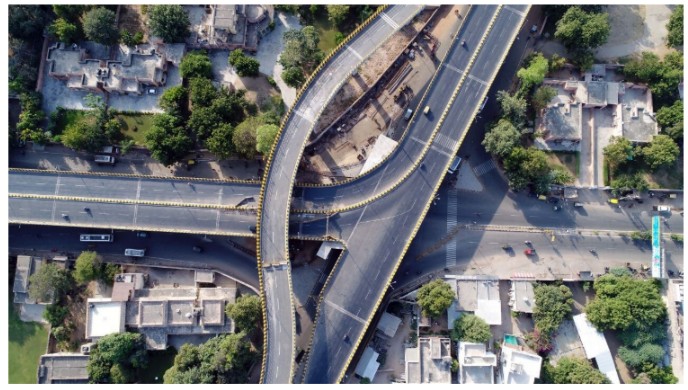
Government Initiatives Driving India Road Infrastructure Development
- National Infrastructure Pipeline: The government has allocated Rs. 111 lakh crores for FY 2019-25, with the roads sector projected to account for 18% of the capital expenditure during this period.
- Public-Private Partnerships (PPP): India's well-developed framework for PPPs in the highway sector has been ranked first in operational maturity by the Asian Development Bank.
- Bharat Mala Pariyojana: This ambitious project aims to construct 66,100 km of economic corridors, border and coastal roads, and expressways, bolstering the national highway network.
- Growth Potential: The roads and highways market are projected to exhibit a Compound Annual Growth Rate (CAGR) of 36.16% during 2016-2025, showcasing promising opportunities for development.
- PPP Projects: Roads accounted for almost 40% of the 1,824 PPP projects awarded in India until December 2019, emphasizing the significance of private sector involvement.
- Hybrid Annuity Model (HAM): Over 60 HAM projects worth over $10 billion have balanced risk between private and public partners, encouraging PPP activity.
- Digital Transformation: The National Highways Authority of India (NHAI) has embraced digitalization with a cloud-based, AI-powered Big Data Analytics platform, streamlining project management and documentation processes.
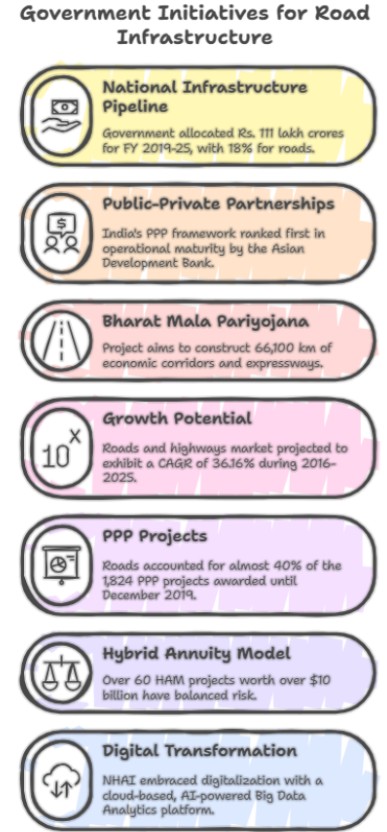
Challenges in India Road Infrastructure
- Land Acquisition: The process of acquiring land for road projects is time-consuming and costly, accounting for 25-30% of project expenses.
- Project Delays: For instance Bharatmala Pariyojana's Phase I, crucial for coastal and port connectivity, has been postponed from 2021-22 to 2025-26, affecting project timelines.
- Funding Challenges: MoRTH relies heavily on budgetary support and borrowings, lacking alternative revenue sources.
- Private Sector Participation.
- Remote Area Development: Construction projects in remote areas pose challenges in terms of equipment and raw material mobilization.
Way Forward
- Increased Investment: Road sector development requires increased budgetary allocations, private sector participation, and alternative financing models like PPPs and TOT.
- Focus on Road Maintenance: Prioritizing regular maintenance activities such as resurfacing, pothole filling, and drainage system upkeep ensures road longevity and enhances safety.
- Streamlined Land Acquisition: Simplifying land acquisition processes, ensuring transparency, and providing fair compensation to landowners expedite projects and reduce costs.
- Technological Advancements: Leveraging technology like sensors, intelligent transport systems, and smart road infrastructure optimizes road safety and traffic management.
- Road Safety Promotion: Creating awareness, enforcing traffic laws, and implementing safety measures like speed limits, pedestrian crossings, and crash barriers contribute to reducing road accidents.
- Institutional Capacity Building: Strengthening the capacity of government agencies involved in road development and maintenance enhances efficiency and effectiveness. Training and skill development, streamlined procedures, and adopting best practices from other countries are crucial in this regard.
Conclusion
- A robust road network plays a vital role in India's economic growth. The government's commitment to strengthening road infrastructure is commendable. However, efforts should focus on talent development and research in this sector. Improved roads will not only boost the economy but also reduce accidents and enhance travel efficiency.
62. Electric Vehicles in India: Growth, Challenges & Government Initiatives
EVs are vehicles that run solely on electricity, utilizing electric motors instead of internal combustion engines. India, currently the fifth largest car market in the world, has the potential to become one of the top three in the near future.
- A transportation revolution is needed in India to achieve Net Zero Emissions by 2070, focusing on walkability, public transportation, railways, roads, and better electric cars.
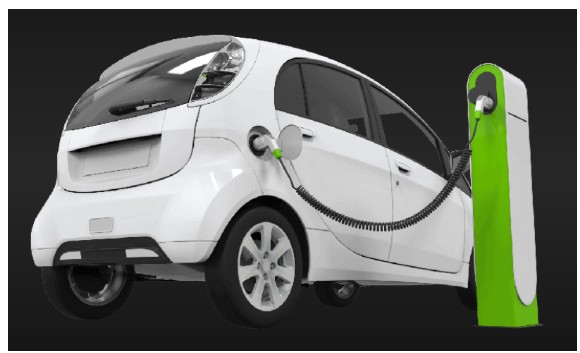
Global Status of Electric Vehicles in India and Worldwide
|
Need for Electric Vehicles in India
Climate change
- The need to reduce the use of fossil fuels and their associated emissions has arisen due to the problem of rapid global temperature increase.
- By 2030, India has committed to reducing its GHG emissions intensity by 33% to 35% below 2005 levels.
Clean and Low Carbon Energy
- The cost of electricity generation has been reduced through the adoption of better technologies,
- The shift towards renewable energy sources has led to cost reduction from better electricity generating technologies.
Energy security
- Over 80 percent of India's transport fuel is covered by oil imports.
- Electric vehicles (EVs) can decrease reliance on imported crude oil, promoting India's energy security.
Rapid urbanization
- According to a recent study by WHO, 14 out of the world's 20 most polluted cities are located in India. EVs can help address this problem by reducing local concentrations of pollutants in cities.
Innovation
- Adoption, adaptation, and research and development will encourage the implementation of cutting-edge technology in India.
- The manufacturing capacity of EVs will promote global scale and competitiveness.
Employment: The promotion of EVs will foster employment growth and create more opportunities in the country.
India’s Support to Electric Vehicles in India
- India supports the global EV30@30 campaign, aiming for at least 30% new vehicle sales to be electric by 2030.
- At the COP26 summit in Glasgow, India advocated for "Panchamrit," including renewable energy fulfilling 50% of India's energy needs, reducing carbon emissions by 1 billion tonnes by 2030, and achieving net-zero emissions by 2070.
- The Indian government has implemented various measures to develop and promote the EV ecosystem, such as –
- Faster Adoption and Manufacturing of Electric Vehicles (FAME II) scheme
- Production-Linked Incentive (PLI) schemes for Advanced Chemistry Cell (ACC) and Auto and Automotive Components
Challenges Faced by Electric Vehicles in India
- Lack Battery Manufacturing Capacity: India imported Li-Ion batteries worth US$ 1.2 billion during 2018-22, which is expected to increase by around 50 percent by 2030.
- Consumer Related Issues: As of January 23, 2023, India had only 5,254 public electric vehicle (EV) charging stations, to cater to a total of 20.65 lakh EVs.
- Additionally, the cost of purchasing a basic electric car is higher compared to a conventional fuel-powered vehicle.
- Lack of Technology and Skilled Labor: India lags behind in technological capabilities for the production of essential electronic components for EVs, such as batteries, semiconductors, and controllers.
- Unavailability of Materials for Domestic Production: Dependence on other countries for importing lithium-ion batteries hinders the goal of becoming self-reliant in the battery manufacturing sector.
- Lack of Stable EV Production Policy: The lack of a stable policy framework for EV production creates uncertainty for manufacturers, making long-term planning and profitability challenging.
- High Production Cost: The rapid depreciation of the Indian rupee has led to high production costs due to the increased import costs of inputs.
- Electric vehicles are costlier than gasoline-powered vehicles within the same range primarily due to the expensive lithium-ion batteries.
- Additionally, maintenance costs are higher due to the new technology involved and the need for skilled labour.
- Dependence on China: India heavily relies on China for 90% of electric scooter components. As EV adoption increases, the dependence on imports is projected to rise to 70% or more, increasing the reliance on Chinese imports.
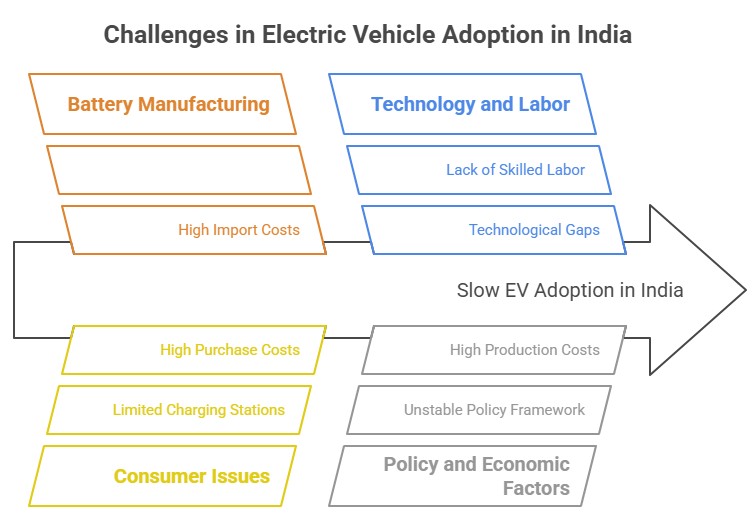
Central Government Initiatives on Electric Vehicles in India
- Target for EV Sales
- The central government has set a target of 30% of new sales of cars and two-wheelers to be electric vehicles (EVs) by 2030.
- National Electric Mobility Mission Plan (NEMMP)
- The NEMMP was launched in 2013 to promote hybrid and EVs in the country and achieve national fuel security. The goal is to achieve 6-7 million sales of hybrid and EVs year on year from 2020 onwards.
- Faster Adoption and Manufacturing of (Hybrid &) Electric Vehicles in India (FAME India)
- It focuses on four areas: technology development, demand creation, pilot projects, and charging infrastructure.
- Standards Development
- Organizations like the Bureau of Indian Standards (BIS), Department of Heavy Industry, and Automotive Research Association of India are working on designing and manufacturing standards for EVs, Electric Vehicle Supply Equipment (EVSEs), and charging infrastructure.
- These standards will facilitate in-house production of EVs.
- Establishment of Charging Stations
- Charging stations are proposed to be set up on major highways, connecting city clusters on both sides of the road, with an interval of about 25 km between each station.
- This will ensure convenient access to charging infrastructure for EV owners traveling between cities.
Way Forward
- Electric Vehicle as Way Forward: EVs will contribute to improving the overall energy security situation as the country imports over 80% of its overall crude oil requirements, amounting to approximately $100 billion.
- Opportunities for Battery Manufacturing and Storage: With recent technology disruptions, battery storage has great potential to promote sustainable development in the country, considering government initiatives to promote e-mobility and renewable power (450 GW energy capacity target by 2030).
- Increasing R&D in EVs: The Indian market needs encouragement for indigenous technologies that are suited for India from both strategic and economic standpoints.
|
The Ministry of Power has prescribed at least one charging station to be present in a grid of 3 km and at every 25 kms on both sides of the highways. The Ministry of Housing and Urban Affairs under the Model Building Bye-laws, 2016 (MBBL) has mandated setting aside 20% of the parking space for EV charging facilities in residential and commercial buildings. |
Conclusion
With government initiatives and the increase in crude oil prices, the Indian EV industry is gaining momentum as people seek alternative sources to reduce their expenses. However, for a widespread transition from internal combustion engine (ICE) vehicles to EVs, there is a need to expand infrastructure, including charging stations, and improve the range of vehicles.
63. Hybrid Electric Vehicle
Introduction
An HEV utilizes both an internal combustion engine (ICE), such as a petrol or diesel engine, and one or more electric motors to operate. It can be powered solely by the electric motor, which draws energy from stored batteries, or by the ICE, or a combination of both.
Regenerative Braking System (RBS)
- RBS utilizes various methods for energy recovery. A kinetic system captures energy lost during braking and uses it to recharge the high-voltage battery.
- An electric system generates electricity through a motor during sudden braking. A hydraulic system stores the vehicle's kinetic energy in pressurized tanks, offering a high energy recovery rate suitable for heavy vehicles.
Key Advantages
- Fuel Efficiency: Hybrid vehicles with this technology offer superior fuel efficiency, increased power, and reduced emissions.
- Increased Mileage: Hybrid vehicle design, featuring smaller engines and lighter weight compared to ICE vehicles, leads to improved mileage, meeting the demand for such vehicles.
- Instant Torque: HEVs deliver instant torque and maintain high torque even at low speeds due to the overall increase in power and torque.
- Transition in the Auto Industry: Rising fossil fuel prices, clean mobility solutions, and strict government emission controls are driving the EV market.
Challenges for Hybrid Technology
- Higher Cost: HEVs' higher price is a problem in India and other cost-sensitive markets. ICE-only vehicles are cheaper than battery-powered ones. HEVs cost more due to the RBS.
- Infrastructure Limitations: India still faces obstacles in its journey toward a fully electric ecosystem, such as inadequate infrastructure and a lack of high-performing EVs.
- Robust Manufacturing Ecosystem: EV revolution challenges include a weak manufacturing ecosystem for EV-related materials and supply chain concentration in specific regions.
Conclusion
SHEVs help reduce fossil fuel use, carbon emissions, and pollution. They also create a local EV parts manufacturing ecosystem. HEVs protect significant investments and jobs in ICE parts manufacturing, ensuring a smooth and fast transition to new technologies. SHEVs and BEVs share electric powertrain components, enabling local manufacturing and accelerating their adoption. This synergy lowers SHEV and BEV costs, making electrified vehicles viable.
64. Vehicle Scrapping Policy
Introduction
- All vehicles owned by central and state governments older than 15 years will be de-registered and scrapped starting April 1 2023.
- The Ministry of Road Transport & Highways has announced this through a notification.
- Special purpose vehicles used for defense and law enforcement are exempted from this rule.
- The vehicles should be disposed of through a Registered Vehicle Scrapping Facility after 15 years from the initial registration.
- The Union Budget 2021-22 announced the policy, which includes fitness tests after 20 years for personal vehicles and 15 years for commercial vehicles.
- States and Union Territories will provide up to 25% tax rebate on road tax for new vehicles purchased after scrapping old vehicles.
Categorization of vehicles concerning scrappage
- Government Vehicles
- The Scrappage Policy for government vehicles was approved in January 2021.
- Vehicles owned by the Centre and State Government that are more than 15 years old will be scrapped from April 1, 2022.
- Commercial Vehicles
- Commercial vehicles used for transportation purposes will need to undergo a fitness test after 15 years.
- If considered unfit, the vehicle will be scrapped according to the commercial vehicle scrap policy rules.
- Private Vehicles
- Private vehicles used for commuting will need to undergo a fitness test after 15 years.
- Vintage Vehicles
- Vintage cars and bikes, although older, will be considered separately based on their condition regarding scrapping directives.
Fitness Tests for Vehicles
- Similar to the Pollution Under Control (PUC) test, vehicles will need to undergo an automated Fitness Test after 15 years for private vehicles.
- The test's validity will be five years, and it will cost around Rs. 40,000.
- A Green Cess will also be charged, varying by location.
Need for introduction of vehicle scrappage policy
- Rise in demand for new cars:
- Incentives for Vehicle owners
- Employment growth
- Safer vehicles:
- More recycling & better air quality
- Best price for scrap
Challenges
- Entire onus on State Governments, Funding support, BS 6 transition for heavy-duty vehicles, Replacement with electric vehicles, Infrastructure, De-registering vehicles
Way Forward
- The scrappage policy can contribute to the government's target of electrifying 30-40% of the vehicle fleet by 2030.
- A comprehensive plan is needed to remove end-of-life vehicles from the road and support freight transporters financially.
- The benefits of implementing BSVI vehicles can only be fully realized when old fleet vehicles are taken off the road.
- Adequate support for electric vehicles, including infrastructure development, is crucial for sustainability.
- The scrappage scheme should incentivize the replacement of old vehicles with electric vehicles and discourage the purchase of traditional petroleum-powered vehicles.
Conclusion
- Ecological scrapping aims to recover materials, reduce air pollution, and promote green technologies.
- Vehicle scrappage can stimulate economies and support the transition to electric vehicles.
- It aligns with the goal of achieving net zero emissions by mid-century and supports India's complex automobile ecosystem.
65. National Infrastructure Pipeline (NIP) & PM Gati Shakti: Paving the Way to a $5 Trillion Indian Economy
India's pursuit of a 5 trillion Economy hinges greatly on the crucial role of infrastructure development. In a bid to accomplish this goal, the country has launched the 'National Infrastructure Pipeline (NIP)' initiative, aiming to bolster infrastructure and foster employment opportunities.
Furthermore, India has unveiled the 'PM Gati Shakti Master Plan', a monumental project worth Rs. 100 lakh crores, designed to holistically develop infrastructure and establish an integrated pathway for the country's economy.
Focus areas of the PM Gati Shakti Master Plan
- Boosting local manufacturers: The plan aims to elevate the global profile of local manufacturers and enable them to compete with their counterparts worldwide. It will serve as a National Infrastructure Master Plan for India.
- Economic zones: It opens up possibilities for the establishment of new economic zones, promoting both manufacturing and exports.
- Infrastructure development: Infrastructure development has a multiplier effect, with every rupee invested yielding higher returns.
- Employment opportunities: The plan aims to create job opportunities for the youth in the future.
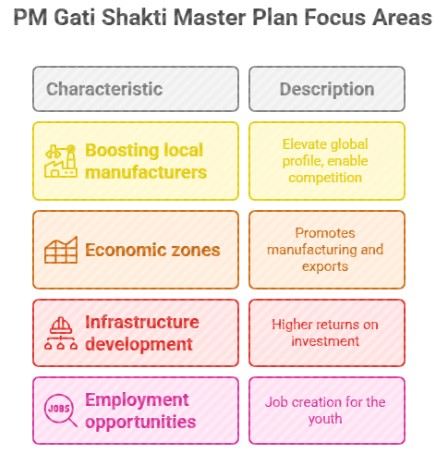
Need for the National Infrastructure Pipeline and Gati Shakti Plan
- Infrastructure development boosts capital spending and economic growth. It generates jobs and economic growth.
- Quality infrastructure is crucial for inclusive growth and improving the standard of living.
- Inadequate infrastructure not only hampers economic development but also burdens people with additional costs and difficulties in accessing essential services.
National Infrastructure Pipeline (NIP)
- NIP encompasses economic and social infrastructure projects.
- Sectors such as Energy (24%), Roads (19%), Urban (16%), and Railways (13%) are projected to account for around 70% of the capital expenditure in infrastructure in India from 2020 to 2025.
- The plan outlines an investment of over ?102 lakh crore in infrastructure projects by 2024-25, with the Centre, States, and the private sector sharing the capital expenditure in a 39:39:22 formula.
Why the National Infrastructure Pipeline Matters More Than Ever
- Pandemic-induced slowdown: The slowdown caused by the pandemic presents an opportunity to invest in infrastructure and boost economic growth.
- Multiplier effect on job creation and the economy: Infrastructure spending stimulates economic activity and job creation.
- Inclusive growth: Quality infrastructure is crucial for both economic growth and inclusive development.
- Access to essential social services: Inadequate infrastructure not only hinders economic development but also imposes additional costs on people trying to access essential services.
Key Benefits of the National Infrastructure Pipeline
- Economic benefits: A well-planned NIP will increase infrastructure projects, business growth, job creation, quality of life, and equitable infrastructure access, fostering inclusive growth.
- Government benefits: Infrastructure boosts economic activity, government revenue, and productive spending.
- Benefits for developers: NIP improves project supply understanding, bidding preparation, aggressive bids, project delivery failures, and investor confidence, which increases finance access.
- Benefits for banks/financial institutions/investors: Better-prepared projects boost investor confidence and reduce stressed exposures. This reduces NPAs (NPAs).
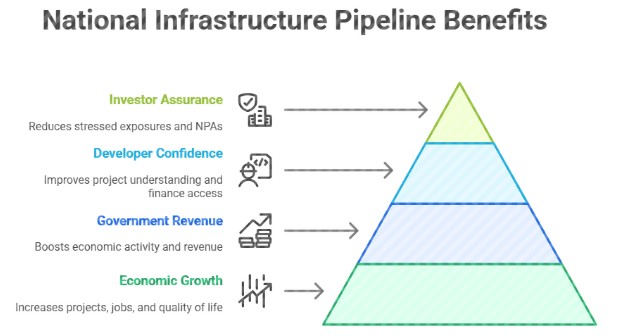
Constraints in Implementing the National Infrastructure Pipeline
- Revenue shortfall: Slippage in revenue estimates due to lower-than-anticipated increases in GDP growth, direct tax buoyancy, and disinvestment targets.
- Reduced funds for states: The vertical share of tax devolution from the centre to states has been reduced from 42% to 41% as per the 15th Finance Commission report.
- Increasing fiscal deficit: Fiscal stimulus may cause high inflation, crowding out, and international rating downgrades due to India's infrastructure development.
- Structural problems: Land acquisition, compensation payment, and approvals like land access and environmental clearances take time and cause cost overruns. Court cases delay infrastructure projects.
Task Force Vision 2025: Supporting the National Infrastructure Pipeline
The task force has proposed the following components under its Infrastructure Vision 2025, which encompasses strategic goals, innovative strategies, and standardized frameworks:
- Affordable and Clean Energy
- Ensuring uninterrupted 24x7 power availability.
- Reducing pollution through the widespread adoption of green and renewable energy sources.
- Promoting environment-friendly fuels for transportation.
- Digital Services
- Ensuring universal access to digital services.
- Achieving 100% population coverage for telecom services.
- Providing high-quality broadband connectivity to empower citizens socioeconomically.
- Quality Education
- Establishing world-class educational institutions dedicated to teaching, research, and technology-driven learning.
- Convenient and Efficient Transportation and Logistics
- Enhancing road connectivity, including expressways, major economic corridors, strategic areas, and tourist destinations.
Housing and Water Supply for All
- Ensuring housing for all by 2022, minimizing slum populations.
- Providing piped water to all households meeting national standards by 2024.
- Agriculture Infrastructure
- Expanding irrigation and micro-irrigation coverage.
- Establishing integrated agro-logistics systems to enhance the storage, processing, and transportation of agricultural produce.
- Good Health and Well-being
- Establishing superior healthcare facilities, including robust electronic health records infrastructure.
- Strengthening primary, secondary, and tertiary healthcare infrastructure across India, aligned with the goals of the National Health Policy 2017.
Issues with the report
- Finance: While the report suggests diversifying financing sources, it does not address the economic slowdown and job losses that India is currently facing.
- Neglecting the health sector: The allocation for the health sector in the final report is lower than recommended in the interim report, despite the inadequacies highlighted by the COVID-19 pandemic.
Way Forward
- Striking a balance between physical and social infrastructure is crucial for achieving both economic growth and human development.
- The government's vision of a $5 trillion economy is achievable through massive infrastructure development.
- Capacity creation and expansion in various sectors are necessary for sustainable growth and improving the quality of life for all.
Conclusion
Economic growth and public well-being require infrastructure development. India's economic goals are advanced by the National Infrastructure Pipeline and Gati Shakti Master Plan. India can boost economic growth and job creation by investing in infrastructure. These initiatives must address implementation issues, secure adequate funding, and prioritise the health sector to succeed. India can reach a $5 trillion economy with a well-executed plan that benefits urban and rural areas and improves citizens' lives.
66. Multi-Modal Logistics Park (MMLP) in India: Advantages, Challenges, Way Forward
A Multi-Modal Logistics Park (MMLP) as an inter-modal freight-handling establishment comprising warehouses, dedicated cold chain facilities, freight or container terminals and bulk cargo terminals.
It eases and optimizes merchandise movement via road, rail, waterway and air.

Advantages & Significances of Multi-Modal Logistics Park
- Minimise Costs of Logistics: It aims to reduce India’s logistics costs from the current about 14% of GDP to less than 10% of GDP, on par with international standards.
- Reduce cost of storage and trans-shipment: Shifting warehouses, currently being operated inside city limits, to logistics parks will enable reduction in warehousing cost, driven by lower rentals in logistics parks situated outside the city limits.
- Efficient Inventory planning: Regional logistics parks can provide end-to-end visibility of inventory, collaboration, agility and optimization. o Often, companies are unable maintain inventories for contingencies due to the dearth of storage infrastructure at the local level.
- Optimize efficiency through technology: MMLP’s with appropriate information technology infrastructure and integrated Application Programming Interface (APIs) based platforms, can help in digitizing the traditional supply chain, supporting big data analytics and disruptive technology such as AI. o This can in turn help in achieving on-time performance and reduce cost to serve.
- Maximise Utilisation of Assets: It helps in the proper utilisation of assets as the transit time is less and the goods vehicles and the other hardware are free to use for the other business or purposes.
- Environment Friendly: Increased freight movement on higher sized trucks and rail will enable in reduction in CO2 emissions.
- Social Benefit: Create employment opportunities and Help with the development and expansion of Small and Medium Enterprises (SME).
Challenges in Multi-Modal Logistics Park
- Availability of Affordable land: Availability of land at an affordable rate and the issues with land acquisition.
- Issues with material handling infrastructure: Warehousing landscape is highly unorganized with the presence of many small, private, and unorganized warehouses.
- Poor Skill set: Efficiency is compromised as many firms try to compete through the factor advantage of low wages which have led to hiring poorly skilled personnel thereby hampering service quality.
- Red Tapism in the departmental works: Multiplicity of government agencies involved in setting up MMLPs which may hamper ease of business. Numerous approvals are mandatory from several Central and State ministries for the fulfilment and carrying out of these MMLPs.
- Skewed modal transportation mix: In India, 60% of freight moves by road, which is significantly larger than in many developed economies. Contribution of inland waterways is negligible, Rail transport is marginal, despite being 45% cheaper per ton–km than road.
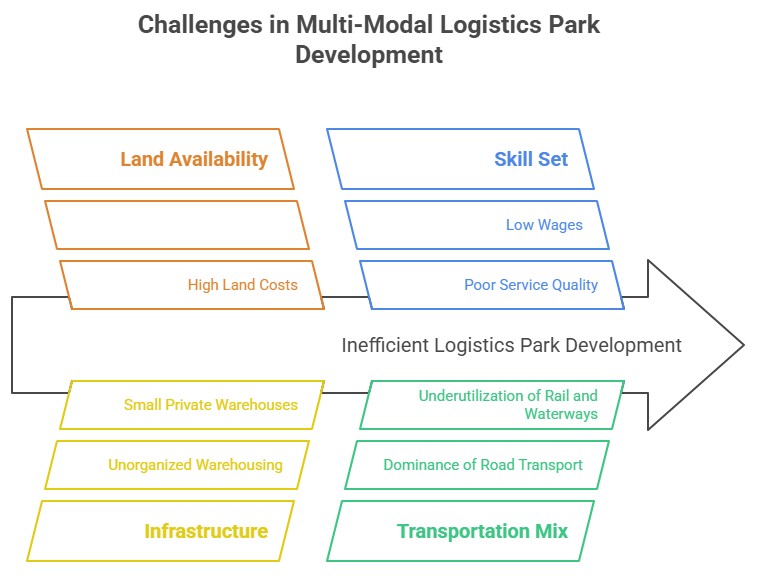
Way Forward
- Promote private sector participation (PPP Model): The PPP is the preferred mode of implementing MMLPs. To encourage greater private participation, the MMLPAI could develop a model PPP framework to define the role and interdependencies between central and state governments and private players.
- Single window Clearance: Centralize MMLP approvals. A single window would facilitate the process of clearances.
- Selection of Best suited location: Optimize the location of park and easy land availability. The location should not only have the requisite infrastructure but should also house industries.
- Using of Modern cutting-edge Technology: Cutting edge information technology for delivery management also plays an important role for MMLPs to work effectively.
- Develop Efficient connectivity: Identify gaps in trunk and multimodal interlinkages and bridge them while developing terminals for efficient multimodal freight transfer.
67. Forex reserves
Introduction
- Forex reserves serve as the barometer of a country's economic health.
- These reserves consist of assets like foreign currencies, gold reserves, and treasury bills, managed by the central bank.
- Forex Reserves can be classified into four categories: Foreign currency assets (FCA), Investment in gold, Special drawing rights (SDRs) IMF, Reserve Tranche Position.
Objectives of Holding Forex Reserves
There are several objectives of holding forex reserves:
- To support the country's balance of payments: A country with a balance of payments deficit can use its forex reserves to buy back its currency to prevent depreciation.
- To stabilize the exchange rate: The central bank can stabilise exchange rates by buying and selling foreign currencies.
- To provide a cushion in times of economic crisis: A country can use its forex reserves to finance imports, prevent bank runs, and stabilise the economy during an economic crisis.
Role of RBI in Forex Reserves
- Custodian, Regulator and Player, Dollar/Rupee Rate, Exchange Control, stabilisation of Currency Volatility
Real Problem
- Import/Export Policy: Depletion of forex reserves can be attributed to import licenses granted by the Ministry of Commerce, rather than RBI interventions.
- Twin Deficits: India's trade and current account deficits need to be addressed by aligning trade control and exchange control regulations.
- Further Depletion: India's forex reserves may decrease further due to a growing current account deficit and central bank interventions.
Government Initiatives to Boost Forex Reserves
- Atma Nirbhar Bharat: India aims to become self-reliant, reducing the need for imports and improving forex reserves.
- Schemes like Duty Exemption, Remission of Duty or Taxes on Export Product (RoDTEP), and Nirvik have been launched.
- India has attracted significant Foreign Direct Investment, contributing to increased forex reserves.
Understanding the Rupee's Exchange Rate
- The exchange rate is influenced by India's trading activities with other countries.
- Demand for US dollars corresponds to the demand for rupees in the market.
- A higher demand for dollars due to increased imports may lead to rupee depreciation.
Impact of Rupee's Exchange Rate
- Weaker Rupee Benefits: A weaker rupee supports India's exporters.
- Stronger Rupee Challenges: A stronger rupee hampers India's goal of becoming a global export hub.
Way Forward
- Measures to Boost Forex Inflows: Increasing borrowing limits for companies, attracting deposits from NRIs, and relaxing rules for foreign investments in local-currency bonds.
- RBI's Role in Smoothing Volatility: The RBI intervenes in the forex market to stabilize exchange rate fluctuations, ensuring credibility in India's currency.
- Promote Export-Oriented Industries: Encouraging industries that have a competitive advantage in international markets will boost export earnings, leading to higher forex inflows.
- Attract Foreign Direct Investment (FDI): Implement policies and reforms to attract foreign investments across various sectors, which will contribute to increased forex reserves.
- Enhance Skill Development: Invest in skill development programs to enhance the competitiveness of the workforce, leading to higher productivity and export potential.
- Maintain Macroeconomic Stability: Pursue prudent fiscal and monetary policies to ensure macroeconomic stability, which fosters investor confidence and attracts foreign investments.
Conclusion
Economic stability and resilience depend on forex reserves. They protect against financial crises, manage currencies, and boost market confidence. The RBI manages exchange control regulations and currency volatility and holds India's forex reserves. To avoid depletion of forex reserves, import/export policies, twin deficits, and the need for a balanced approach to trade and exchange controls must be addressed.
68. Depreciation of Indian rupee
Introduction
Currency depreciation—a country's currency losing value relative to foreign reference currencies—can hurt an economy. The depreciation of the Indian rupee against the US dollar has raised concerns and needs further investigation into its causes, effects, and solutions.
Understanding Currency Depreciation
Under a floating exchange rate regime, a country's currency depreciates against one or more foreign currencies. It can boost exports by lowering prices. Currency depreciation can affect neighbouring countries and the economy.
Reasons for Indian Rupee's Depreciation:
Several factors have contributed to the current depreciation of the Indian rupee against the US dollar:
- Trade deficit growth: The increase in imports, particularly due to rising oil prices, has led to India's trade deficit reaching a record high.
- Policy differences between central banks: The Fed's low interest rates and optimistic economic outlook have strengthened the US dollar, diverging US and Indian central banks' policies.
- Reserve accumulation: The Reserve Bank of India (RBI) has been actively purchasing US dollars to build reserves and prepare for potential future turbulence.
- Capital exodus and market uncertainties: The benchmark stock index, S&P BSE Sensex, has declined by almost 10% from its peak, driven by capital outflows. Concerns regarding the Omicron variant and geopolitical tensions have also contributed to market uncertainties.
- Global factors: Various global factors, including the conflict between Russia and Ukraine, rising crude oil prices, and tightening global financial conditions, have played a role in the depreciation of the Indian rupee.
Impact of Depreciation on Indian Economy
The depreciation of the Indian rupee has both positive and negative implications:
Positive impact:
- Theoretically, a weaker rupee should boost India's exports. However, in the current global uncertainty and weak demand scenario, higher exports may not materialize.
Negative impact:
- Risk of imported inflation, Challenges for interest rate management, Increased cost of imports, Adverse impact on oil and gas industry, Inflationary pressure, Impact on various sectors
Role of Reserve Bank of India (RBI)
The RBI plays a crucial role in managing currency volatility and supporting the rupee. Some steps taken by the RBI include:
- Monitoring foreign currency markets and intervening when necessary.
- Relaxing restrictions on foreign ownership of government bonds and increasing borrowing limits for businesses to attract foreign currency inflows.
- Proposing rupee settlement methods to reduce the demand for US dollars in international trade.
Measures to Address Rupee Depreciation
To address rupee depreciation, several steps can be considered:
- Encouraging foreign investment, Relaxing foreign investment caps, Selling foreign currency reserves, Promoting industrial growth, Export promotion and import reduction, Rationalizing foreign currency expenditure, Attracting NRI investments
Outlook for the Rupee in 2023
- While the near future outlook for the rupee remains weak, considering factors such as high inflation and uncertainties, the depreciation may not persist indefinitely.
- As India maintains its position as the fastest-growing economy, the tide may eventually turn once the tightening of monetary policies by the US Federal Reserve concludes.
Way Forward
- Inclusion of Indian corporations in global indices: Promoting the inclusion of large-cap companies in global indices can offset foreign portfolio outflows and enhance foreign investments.
- Entry into bond indices: Expediting India's entry into bond indices can attract foreign inflows and positively impact interest rates.
- Adequate forex reserves management: Maintaining a comfortable level of foreign exchange reserves and employing timely interventions to control volatility can safeguard the rupee's value.
- Fiscal discipline and inflation control: The government should focus on limiting borrowing, while the RBI concentrates on inflation control as mandated by law.
- Enhancing export competitiveness: Improving infrastructure, logistics, and export incentives to make Indian exports more competitive.
Conclusion
The Indian rupee depreciation affects many sectors and the economy. Imported inflation and trade deficits can hinder export competitiveness. Long-term stability requires fiscal discipline and inflation control. India's resilient economy may improve the rupee's outlook, but careful monitoring and proactive measures are needed to overcome the challenges.
69. Global trade in Rupees
Introduction
The Reserve Bank of India's recent announcement of a new arrangement for settling imports and exports in rupees aims to boost global trade, with a focus on promoting Indian exports and meeting the growing interest of the global trading community in the Indian Rupee.
Background: Russia-Ukraine War
- India, being a trade deficit country, imports more than it export, necessitating the maintenance of large forex reserves as international trade still primarily relies on US dollars.
- The RBI has previously allowed international trade in rupees during the sanctions on Iran, resulting in trade between the two countries being conducted in rupees instead of dollars.
- The ongoing Russia-Ukraine war and subsequent sanctions provide another opportunity for the RBI to advocate for trading in rupees.
US Dollar: The Global Currency
- The US dollar has been the dominant global currency since World War II, with approximately half of international trade, loans, and global debt securities being denominated in USD.
- The USD became the official reserve currency of the world in 1944 through the Bretton Woods Agreement.
- Despite challenges faced by the US economy in the 1980s, such as fiscal and external deficits, the dollar's share of global reserves remained stable and even grew over time.
- The dollar's dominance is supported by robust and credible institutions, deep markets, and its freely convertible nature.
- Nearly 40% of the world's debt is issued in dollars, leading to a high demand for dollars by foreign banks for conducting business, as seen during the 2008 financial crisis.
Why such a move?
- Trade facilitation: This arrangement will facilitate trade with countries facing sanctions, such as Russia.
- Forex savings: India, as a net importer, will save foreign currency through this new settlement system.
- Rupee appreciation: The rupee's historic low against the dollar can be stabilized through this initiative.
- Mitigating war impact: Following the Russia-Ukraine war and the cutoff of Russia from the SWIFT payment gateway, exporters faced difficulties with payments, which this system aims to alleviate.
- Convertibility easing: This move can be seen as a stepping stone toward achieving 100% convertibility of the rupee.
- Energy security: Access to discounted crude oil from Russia, which constitutes 10% of all imported crude, is facilitated.
- Export promotion: This mechanism will promote Indian exports effectively.
Which countries would prefer this system?
- War-affected Countries: Trade settlements in rupees are expected to be limited to countries like Russia and Iran facing Western sanctions.
- Economically challenged countries: Countries experiencing economic turmoil, like Sri Lanka, may benefit from this arrangement as India has been extending lines of credit to them.
- Immediate neighbours: Other countries, particularly India's neighbouring nations, may also consider this system.
- Preference for Rupees over Dollars: The preference for trading with India in rupees arises from the strength of the US dollar against most currencies worldwide, making imports expensive for many countries.
- Sri Lanka’s example: Sri Lanka's economy has suffered greatly, with its currency falling 83% against the US dollar, while the fall against the Indian rupee has been comparatively lower at 70%.
- Trade surplus countries' preference: The Indian government and RBI must address why countries with a trade surplus with India would want to trade in rupees.
- Negative trade balance: China, with a trade surplus of $100 billion with India in 2022, would hold a significant amount of idle Indian rupees if it were to trade in rupees.
Way Forward
- In a multipolar world with frequent Free Trade Agreements (FTAs), reducing the dominance of the dollar seems desirable for governments concerned about US global primacy, forming coalitions against it.
- Sanctions against Russia may indicate a decline in the dollar's status as the reserve currency.
Conclusion
While this move will not dismantle the dollar's dominance overnight, the demand for the rupee depends on India's ability to export. Only if all nations collectively stop using the dollar will its significance decline.
70. New Foreign Trade Policy 2023
Introduction
The Foreign Trade Policy 2023 was recently launched by Union Minister of Commerce and Industry Shri Piyush Goyal. The policy has undergone extensive stakeholder consultations and aims to address the needs of the trade.
About Indian exports
- India's overall exports, including services and merchandise exports, have already surpassed US$ 750 billion and are projected to exceed US$ 760 billion this year.
- The value of India's exports in the financial year 2021-22 witnessed a growth of about 41% to reach 400 billion dollars compared to the pandemic-hit year of 2020-21.
Background of the policy
- The Foreign Trade Policy (2023) is a dynamic policy document that builds upon successful schemes and adapts to changing trade requirements.
- The FTP 2015-20 underwent revisions based on emerging situations, even without the announcement of a new FTP, emphasizing a responsive approach and incorporating feedback from the trade and industry.
- Going forward, revisions to the FTP will be made as necessary, while continuous efforts will be made to streamline processes, update the policy, and ensure compliance with WTO rules.
Aims and objectives of the new policy
- The FTP 2023 focuses on process re-engineering and automation to improve the ease of doing business for exporters.
- It aims to increase exports and strengthen India's position in the global value chain.
- The policy is based on four pillars: incentive to remission, export promotion through collaboration, ease of doing business, and emerging areas like e-commerce and SCOMET policy.
Key highlights of the policy
- Process Re-Engineering and Automation: The new policy emphasizes export promotion through automated IT systems and collaboration, moving away from an incentive regime.
- Towns of Export Excellence: Four new towns have been designated as Towns of Export Excellence, which will have priority access to export promotion funds and other benefits.
- Recognition of Exporters: Exporter firms recognized with 'status' based on export performance will contribute to capacity-building initiatives by providing trade-related training.
- Promoting export from the districts: The policy aims to build partnerships with state governments and promote exports at the district level through institutional mechanisms.
- Streamlining SCOMET Policy: The export control regime is being strengthened to implement international treaties and agreements.
- Facilitating E-Commerce Exports: The policy outlines plan for establishing e-commerce hubs and raising the cap on consignment-wise e-commerce exports.
- Merchanting trade: Provisions for merchanting trade have been introduced to develop India as a merchanting trade hub.
Current Export Schemes and Changes
(A) Facilitation under the Export Promotion of Capital Goods (EPCG) Scheme
- The EPCG Scheme is being further rationalized and includes new schemes and products eligible for benefits.
- The PM MITRA scheme and exemptions for the dairy sector and green technology products have been added.
(B) Facilitation under the Advance Authorization Scheme
- Provisions have been added to facilitate export orders in the Apparel and Clothing sector and extend benefits to status holders.
Possible positive outcomes of the scheme
- Supporting MSMEs to grow: The policy facilitates easy access to export benefits, reducing fee structures and implementing IT-based schemes.
- Creating new export centres: The addition of new towns for export excellence is expected to boost the exports of specific industries.
- Educating exporters: The recognition norms have been re-calibrated, enabling more firms to achieve higher ratings and better branding opportunities.
- Providing access to dual-use high-end goods and technologies: A robust export control system will benefit Indian exporters.
- Growth of GIFT city: Certain places like GIFT city can become major merchanting hubs.
- Reduce litigation burden: The amnesty scheme aims to provide relief to exporters by addressing default on export obligations.
Limitation of NFT Policy
- The policy falls short in offering more targeted measures and a well-defined road map to meet the 2030 export target.
Conclusion
- With India's modest share in global trade, there is ample room for improvement.
- The Foreign Trade Policy 2023, along with additional measures, can enhance trade performance and help achieve the ambitious $2 trillion export target by 2030.
- Monitoring policy implementation and addressing potential challenges are vital to fully benefit businesses.

2026-27 UPSC Mains English QEP Power Pages
View DetailsSubmit Your Details to Learn More



