1. Evolution of Indian Architecture: From Indus Valley to Modern Era
The Ancient India encompassed a large area which incorporated present Pakistan, Afghanistan, Burma and parts of Indo-China. It was flanked by the Himalayas on the North-East, the Hindukush on the North-West and the Arabian sea, Indian ocean and the Bay of Bengal around the peninsula.
Evolution of Indian Architecture
The evolution of Indian architecture spans a rich and diverse history, influenced by various cultural, religious, and historical developments. A brief overview of the evolution of Indian architecture:
- Indus Valley Civilization (2500 BC - 1500 BC)
- Rock cut Architecture
- Indo- Islamic Architecture
- Colonial Architecture
Indus Valley Civilization: Foundations of Indian Architecture
- The Indus Valley Civilization, also known as the Harappan Civilization, was one of the world's earliest urban civilizations. It flourished around the Indus River basin.
- The Harrapans' architecture is regarded as being avant-garde.
- Kot Diji in Sind, Kalibangan in Rajasthan, Rupar in the Punjab, Banawali in Haryana, Lothal, Surkotada, and Dholavira—all three of which are in Gujarat—are a few additional significant archaeological sites from this time period.
Features of Indus Valley Civilization
Features:
- Town Planning: Indus cities were well planned. The excavations at Harappa and Mohenjo-Daro have shown a lot of evidence of this. The city had two parts, i.e., the citadel and the outer city.
- Citadel: The citadel was built on an elevated area. While certain major cities, such Harappa, Mohenjodaro, Kalibangan, Banawali, Rakhigarhi, Lothal, and Dholavira, had a citadel and lower town, this was not the case in the majority of them.
- The outer city was at a lower level.
- Roads: The roads were wide and straight cutting each other at right angles.
- Drainage System: They also had a perfect drainage system.
- Drains: Each house had a well-constructed sink from which water flowed into the underground drains.
- The hydraulic engineering skills of the Harappans were expert. They created the successful system.
- To facilitate self-cleaning, the drains were built with drops at regular intervals.
- The small drains went into huge drains, while the private drains went into smaller drains. The huge drains transported all of the city's waste water to ponds or open spaces outside.
- Some sewers had huge bricks or stones covering them. The crucial parts of the drainage system included soakage jars, man-hole cesspools, etc.
- Houses: Houses were of different types, small and large.
- Burnt bricks: Burnt bricks were extensively' used.
- Wells and bathrooms: Houses were also provided with ‘wells and bathrooms.
- Gateways: The gateways were of two types, one simple entrance for vehicular activities while the other had some special importance.
- Water management: The Harappan people’s-built canals to increase productivity and protect their crops from unfavourable weather.
- They also built a hydraulic device to collect it for rainwater. At several locations, some evidence including dams, canals, and reservoirs was discovered.
- Building a synthetic dock for berthing ships was the Lothal engineers' greatest contribution to the advancement of science and technology.
- Great Bath: The Great Bath is one of the most remarkable structures discovered at the archaeological site of Mohenjo-Daro. It is located east of the granary, a significant building complex in the ancient city. The floor of the bath has five levels. It is still functional today. It was probably used for religious celebrations and events.
Rock Cut Indian Architecture: A Timeless Legacy
Indian art and architecture have a long and rich history, spanning around five thousand years. Recent archaeological findings suggest that the roots of art, architecture, and water management in India can be traced back to the Harappan and Indus Saraswati Civilization. The Mauryan Empire further advanced these traditions in the third century BCE.

Evolution of Rock Cut Architecture
- About 2500 years ago, some Janapadas became more important than others, and were known as Mahajanapadas. Most Mahajanapadas had a capital city and many of these were fortified.
- The development of rock-cut structures in India gained prominence during the Mauryan Empire in the late 4th century BCE.
- Both the types, structural temples (oval or apsidal in shape) and rock-cut ones flourished side by side.
- The earliest rock-cut caves in India, attributed to the Mauryan period under Ashoka, include both Buddhist and non-Buddhist sites. Inscriptions found on the caves at Barabar and Nagarjuni hills in Bihar provide strong evidence for this.
Buddhist Rock Cut Architecture
The Buddhists made two types of sacred structures, Stupa and Chaityagriha. They also established Viharas, that were monasteries for the monks to live in.
Stupas in Indian Architecture
The term Stupa is widely used by Buddhists. Stupa is a Sanskrit word that means “pile-up” or mound. Therefore, Stupa is an earthen mound heaped over the remains of dead. In that sense, it is a burial monument.

- The Stupa structure of pre-Common Era was composed of a hemispherical dome called anda.
- The dome was erected on a low platform of stone.
- It was surmounted by a kiosk with railing called Harmika.
- It was further crowned by three discs (Chatras) of reducing sizes, the smallest being on the top.
- The Chatras were mounted on a supporting mast called Yasti. A circumambulatory path called Pradaksinapatha encircles the Stupa.
- It was meant to undertake sacred circumambulation on the ground level. The entire complex was then fenced by a railing called Vedika.
- Examples: Stupa architecture of Andhra Pradesh, Stupas of Amrawati and Nagarjunikonda, both on river Krishna, have box like projections on all the four cardinal directions of the Stupa.
Sanchi Stupa (Madhya Pradesh)

- It features an upper and lower Pradakshinapatha.
- It showcases four beautifully decorated Toranas depicting events from Buddha's life and the Jataka tales.
- The stupa's figure compositions display high relief with naturalistic postures and prominent projection of heads
- The stupa's foundation was most likely set by Ashoka.
Amravati Stupa (Andhra Pradesh)

- Its surfaces were carved in the Bharhut style, but some characteristics of the Mathura and Gandhara sculptures were also adopted.
- It has carved panels narrating the story of the life of Buddha.
- Limestone with a white marble finish was utilised in the building.
Rock Cut Caves: Heritage of Indian Architecture
The rock-cut caves of Barabar and Nagarjuni hills, along with the Swarna Bhandar cave in Rajgir, Bihar, are among the oldest in India and date back to the Mauryan period.
- The Barabar and Nagarjuni caves were dedicated to the Ajivika sect founded by Gopala, a contemporary of Buddha and Mahavira.
- Lomas Rishi cave, an early example, replicates unknown wooden architecture using grooved rafters and curved frames and finials, screens and low-relief sculptural decorations.
- an Age also witnessed the Buddhist rock-cut architecture.
Chaitya-Grihas and Viharas: Buddhist Contributions to Indian Architecture
The Chaitya-Grihas and the Viharas are two major types of the Buddhist rock cut architecture.
Though the process required much skill and patience, the technique involved in creating rock-cut architecture was simple.
- The chaityas belonging to the period from 2nd century BCE to around 50 BCE do not depict Buddha in human form, rather he was represented by symbols alone.
- These symbols were associated with the life of Buddha himself, like stupa, Vajrasana (his seat of meditation), Pipal Tree or Bodhi Vriksha, feet, turban, etc.
- While some of the main rock-cut caves of the Mahayanists are Cave nos. 19 and 26 at Ajanta and the Vishwakarma cave no.10 at Ellora, the main Hinayanist rock-cut caves are at Bhaja, Kondane, etc
Viharas
Vihara, etymologically meaning ‘dwelling place’ was meant for the Buddhist monks.
- The rock-cut vihara comprises of a central hall for worship and a few cells around it for the monks to live in. The square or rectangular hall is entered through a rock-cut doorway and a pillared verandah.
- Hinayanist viharas are majorly found in the Western Ghats, at sites like Ajanta and Ellora.
- Hinayana viharas also include those at Bedsa, Kondane and Pitalkhora, and cave no. 3, 8 and 15 at Nasik. The highly decorated facades, i.e., frontals as well as sculptural panels and friezes are the noteworthy elements of these viharas.
|
Nalanda University: An ancient mahavihara in India, known from Xuan Zang's writings, founded in the 5th century CE by Kumargupta I.Sirpur In Chhattisgarh: It is an early-Odisha style structure from the 550–800 era that has both Hindu and Buddhist shrines.
|
Jain Rock Cut Architecture
Khandgiri-Udayagiri is one of the most prominent siddhakshetras of Digambara Jain community. It is believed that Lord Kharavela has developed these caves around 2000 years prior for the resting of Jain priests. There are 18 caves in Udayagiri and 14 caves in Khandgiri.
- The most important and prominent architectures are the Hathi Gumpha cave with the inscriptions of Kalinga king Kharavela of the Chedi tradition, the Rani Gumpha, Svargapuri and Manchapuri caves, Ganesa-Gumpha.
- The caves in Udayagiri especially the Rani and Ganesa Gumpha describe the Jaina legends, mythology and iconography.
- The representation of Kalinga real figures can be witnessed in the Rani Gumpha and Manchapuri caves.
Hindu Rock Cut Architecture
The rock-cut shrines at Badami, Ellora, Elephanta, Mamallapuram, Aurangabad, and Aihole are important in the evolution of Indian rock-cut architecture. They thrived during the rule of the Chalukyas, Pallavas, and Rashtrakutas.
Chalukyan Rock Cut Architecture: Chalukyan architecture includes rock-cut shrines and structural Hindu temples.
- The rock-cut caves in Badami and Aihole influenced the later structural temples in Bijapur, Karnataka.
- Chalukyan temples have common features like a front porch, main hall, and a deep-cut sanctum cell, with Badami having four cave shrines, three of them dedicated to Brahmanical deities.
- Cave number 3 is dedicated to Vishnu and was the largest and earliest shrine carved during the rule of Chalukya king Mangalesa (CE 578).
Ellora Caves

- Cave number 15 of Ellora belongs to the period of Rashtrakuta Dantidurga.
- Lord Shiva and Lord Vishnu are mostly represented in this cave in many forms. This two-story building features a sizable courtyard where a monolithic Nandi mandapa is located.
- Great Kailasa temple of Cave 16 at Ellora was carved under the direction of Krsna I (CE 757-83), the successor of Dantidurga.
- The Kailasa temple is a magnificent example of rock-cut architecture. It is a huge temple complex with walled compound. It consists of the entrance gateway (mukha- mandapa), the oblong (gopuram) with barrel-vault (sikhara), Nandi Madapa and Garbha- grha. The temple is west facing and rests on a raised rectangular platform in east-west direction.
- The history of rock cut architecture at Ellora is older than the arrival of the Rashtrakutas. Cave number 1 to 10 and Cave 21 belong to the period of the Kalacuris of Mahismati.
Ajanta Caves: They are collection of 29 rock-cut caves near the Waghora River in Maharashtra, developed between 200 BCE and 650 CE with Vakataka dynasty patronage for Buddhism.
Elephanta Caves: These Caves in Mumbai date back to the eighth century AD. The three-faced figure of Shiva is a masterpiece, along with depictions of Ravana shaking Kailasa, Shiva and Parvati's marriage, the Tandava dance, and Ardhanariswara.
Pallava Rock Cut Architecture
Pallavas of Kanci was a powerful royal house during the second half of sixth century. It reigned over the Telugu and northern part of Tamil region till the end of ninth century.
- The Pallavas pioneered the Dravidian temple style using hard rock hills for their intricate rock-cut and structural temples.
- These temples, called mandapas, feature beautiful carved sculptures and are divided into mukha mandapa and mahamandapa.
- Its architecture includes the Trimurti Mandapa, honoring Lord Brahma, Lord Vishnu, and Lord Shiva; the Mahishamardini Mandapa, honoring Goddess Durga and the Govardhanadhari panel, depicting Lord Krishna supporting the Govardhana hill.
- The famous Pandava Rathas and the Draupadi Rathas were chiselled out during the time of Narasimhavarman I Mamalla.
Temple Architecture

Evolution of Temples
- Architecture of temples have developed out of the types of houses such as huts (Neolithic period) and different ground plan such as round, square, rectangular, the apsidal and oval.
- This occurred in the reign of Sunga-Kusana, i.e., from 200 BCE through CE 200.
- Influence of foreigners belonging to the ruling and business classes can be seen in the architectural remains with decorative elements excavated from Mathura.
Nagara Style Temples
Nagara style temples are the north Indian temples with curvilinear shikhara. They are majorly recognised as temples built by Guptas, Chandelas, Odishan temples, temples of Rajasthan and Gujarat and temples of Rajput period.
Features:
- Tallest Tower: The tallest tower is always exactly beneath the garbhagriha.
- The installation of Amalaka or Kalash on Shikhara is a distinguishing element.
- Examples: Kandariya Mahadev Temple in Madhya Pradesh, Sun Temple in Konark and Sun Temple in Modhera, Gujarat.
- A main Rekha-Prasad Shikara and one or more rows of smaller steeples are located on either side of the main spire. Mini Shikaras are also present at the base and corners.
Dravidian Style Temples
Dravida style temples in South India have a stepped vimana with six or eight sides and a round stupi (well fashioned boulder) at the top.

Features:
- The Chola temples have some similar elements of the Pallava and Chalukya architectural traditions.
- A compound wall encloses the Dravida temple.
- Gopuram: A Gopuram, or entrance doorway, is located in the middle of the front wall.
- Vimana: Instead of the curved shikhara of North India, the vimana, or main temple tower, is shaped like a stepped pyramid that rises up geometrically in Tamil Nadu.
- Stupika: As with the amalak and kalasha of North Indian temples, the name "shikhara" is only used to refer to the crowning part at the top of South Indian temples, which is typically formed like a tiny stupika or an octagonal cupola.
- Entrance: The entrance to the garbhagriha is adorned with fierce Dvarapalas, or the doorkeepers, guarding the temple.
- Examples: Shiva temple of Thanjavu, Annamalaiyar Temple in Tiruvannamalai, Tamil Nadu, Meenakshi temple in Tamil Nadu, Airavatesvara temple etc.
Vesara Temples
The most recognized of all the temples at Belur is the Cennakesava temple built by the Hoyasala king Visnuvardhana in CE 1117.

Features:
- These temples stand in an enclosure with a usual garbha-grha fronted by an antrala and a pillared mandapa known as navaranga/gudha-mandapa.
- Some temples also have mukha-mandapa or sabha-mandapa.
- The navaranga are specially known for its “lantern ceilings” because they have deep niches or domes constructed by means of stone beams placed diagonally across the corner of the square. The navaranga of the Amrtesvara temple has forty-eight domes with carvings.
- Examples: Brahmadeva temple, Savadi, remarkable for being entirely stellate; Mallikarjuna temple, Sudi (and Joda-kalasha temple); Ramalingesvara temple, Gudur; Mahadeva temple, Ittagi; Kasivisvesvara temple, Lakkundi (and several other temples at Lakkundi);
- The crowning achievement of Chalukyan architecture is the Virupaksha temple in Pattadakal, which was modelled after Kailashnath temple.
Indo-Islamic Architecture
Indian architecture (1206-1761 C.E.) blended native and foreign influences under Muslim patronage.
Evolution of Indo-Islamic Architecture
Indo-Islamic architecture is categorized into three phases:
- Delhi or Imperial Style (1200-1500 AD) under dynasties like Slave, Khilji, Tughluq, and Lodi
- Provincial Style practiced by independent Subedars
- Mughal Style developed by Mughals representing the pinnacle of Indo-Islamic expression.
Stylish Evolution of Architecture
Indo-Islamic architecture began with the Turks' occupation of Delhi in 1192 AD.
- Qutbuddin Aibak captured Lal Kot and constructed a Jami Masjid (1198).
- Other structures like Qutab Minar (1199-1235), Arhai Din Ka Jhoupra (c. 1200), and Iltutmish's tomb (1233-4) showcase Islamic details in decoration.
Khilji Dynasty (1290-1320 AD) introduced Seljuk architecture.
- Red sandstone was commonly used, seen in structures like Alai Darwaja and Siri Fort.
- 'Lotus-bud' fringe under arches, a Seljuk feature, appeared.
Tughluq Dynasty saw a new architectural style.
- Stone rubble as the main building material with plastered walls.
- Battered walls and bastions, particularly noticeable at the corners.
- An experimental use of the four-centered arch, often reinforced with a supporting beam.
- Introduction of pointed domes with a distinct neck, in contrast to the previous style's more subdued domes.
Lodhi Dynasty witnessed the development of double domes.
- Multiple domes strengthened structures and reduced inner dome height.
- Graves were austere, lacking ornate decoration.
- Sikandar Lodi founded Agra and Lodi Gardens.
Provincial Style
Features:
- They developed buildings in this style of architecture, which persisted for 250 years, using locally available materials and fusing regional designs with conventional Muslim characteristics like domes, arches, minarets, and mihrabs.
- They initially constructed on the remains of Hindu and Jain temples before creating their own architectural style.
Mughal Style
Features:
- The Mughal style was a thriving architectural movement in India from the middle of the 16th century until the early 17th century.
- It is a distinctive fusion of Turkish, Persian, and Indo-Islamic design.
- The structures were excellent, strikingly symmetrical in form, homogeneous in pattern, and ornately decorated.
Types of Architecture
Forts
- Building monumental forts with embattlements was a regular feature in medieval times, often symbolising the seat of power of a king.
- Some examples of strong, complex edifices which still exercise the imagination of the visitor are the forts of Chittor, Gwalior, Daulatabad, earlier known as Devgiri and Golconda. Commanding heights were utilised to great advantage to construct forts.
- Daulatabad had several strategic devices to confound the enemy, such as staggered entrances so that gates could not be opened even with the help of elephants.
- It also had twin forts, one within the other but at a higher elevation and accessed by a complex defence design arrangement.
- The Gwalior Fort was invincible because its steep height made it impossible to scale. It had many habitations and usages.
- An interesting aspect associated with forts is that within the palace complexes stylistic and decorative influences were absorbed most liberally.
Minars
In the subcontinent, another form of tower known as the minar was commonly seen. Two remarkable minars from medieval times are the Qutub Minar in Delhi and the Chand Minar at Daulatabad Fort.

Features:
- The everyday use of the minar was for the azaan or call to prayer.
- It’s phenomenal height, however, symbolised the might and power of the ruler.
- The Qutub Minar also came to be associated with the much-revered saint of Delhi, Khwaja Qutbuddin Bakhtiyar Kaki.
- It is characterised by highly decorated balconies and bands of inscriptions intertwined with foliated designs.
- Chand Minar, built in the fifteenth century, is a 210- feet-high tapering tower divided into four storeys.
- Painted peach now, its façade once boasted of chevron patterning on the encaustic tile work and bold bands of Quranic verses.
Tombs
Monumental structures over graves of rulers and royalty were a popular feature of medieval India. Some well-known examples of such tombs are those of Ghyasuddin Tughlaq, Humayun, Abdur Rahim Khan-i-Khanna in Delhi, Akbar and Itmaduddaula in Agra.
- According to Anthony Welch, the idea behind the tomb was eternal paradise as a reward for the true believer on the Day of Judgement.
- This led to the paradisiacal imagery for tomb construction.
- Beginning with the introduction of Quranic verses on the walls, the tomb was, subsequently, placed within paradisiacal elements such as a garden or near a body of water or both, as is in the case of the Humayun’s tomb and the Taj Mahal, which follows the charbagh style.
Sarai
A hugely interesting feature of medieval India was the sarais which ringed cities and dotted the vast space of the Indian subcontinent.

- Sarais were largely built on a simple square or rectangular plan and were meant to provide temporary accommodation to Indian and foreign travellers, pilgrims, merchants, traders, etc.
- In effect, sarais were public domains which thronged with people of varied cultural backgrounds.
- This led to cross-cultural interaction, influences and syncretic tendencies in the cultural mores of the times and at the level of the people.
Modern Architecture
The Europeans came to India as traders and over gained power and established as rulers. They brought in the effects of industrial revolution as well as the European architectural styles, In the early 20th century some Indian architects also trained and adapted the European styles. Corbusier and Louis Kahn who were commissioned for projects in India also influenced many architects in India and started a trend in Modem Architecture.
Evolution of Modern Architecture
Portuguese
Few places can rival the grandeur of the magnificent religious and secular works in Goa, which served as the prosperous seat of the Portuguese in India from 1530 to 1835.
- Among the surviving churches, Church of the Holy spirit is most important.
- The Portuguese introduced Gothic and Baroque architecture in India.
- With its three floors and baroque design, the Basilica do Bom Jesus in Old Goa is reminiscent of late Renaissance architecture.
- The large Golden Bell is housed at the Cathedral de Santa Catarina, which combines Tuscan and Corinthian architectural elements.
- The Church of Saint Francis of Assisi, Convent of Santa Monica, Chapel of the Weeping Cross, Sanctuary of Saint Joseph Vaz, and other religious buildings constructed during their rule also heavily use Portuguese architectural elements.
- The Bandel Church, located on the banks of the River Hooghly in West Bengal, is another well-known Portuguese structure in India.
French
- Numerous locations in India display Parisian architectural designs.
- French architecture utilised regionally-sourced materials and took local climatic factors into account.
- The French style included French shutter windows, carvings on archways, and thin street fronts.
British
- The British officer wanted to implement the Palladian style in the 18th century. Constantia, a well-known example of a structure in this style, was built by General Martin in Lucknow.
- A trend to incorporate the greatest features of Indian and Western architecture emerged in the 19th century.
- Example: It can be seen in the Moor Market in Chennai and the Museum in Jaipur.
- The Gateway of India in Mumbai was designed by G Wittet, who used a number of Mughal features.
Significance of Architecture
|
Physical Importance
- Style of Building: Shaped by local climate and environmental factors.
- Materials: Determined by availability and societal values.
- Mood: Design impacts occupant health, mood, and productivity.
- Architectural Evolution: Various eras and styles, from rock-cut to Indo-Islamic to colonial architecture.
|
Social Importance
- Societal Representation: Architecture reflects values and the rise and fall of civilizations.
- Social Insight: Buildings provide insight into the lives of past inhabitants.
- Cultural Significance: Architecture is a part of our culture and shapes our environment.
- Disciplinary Nature: Architecture is a distinct discipline.
- Conservation: Architecture preserves cultural and historic values.
- For example, the building material used in mosques is characteristic of Islamic architecture, which is distinct from that of temples
- Time Logs: Building materials act as records of artistic and construction evolution.
|
Political Importance
Politics and architecture have always had a symbiotic relationship with each other.
- Power Dynamics: Power play through architecture is not limited to only legislative buildings. For example: to assert their power on Hindu population, Islamic rulers builds mosque to show symbol of Islam.
- Economic Prosperity: Monuments like the Taj Mahal symbolize the economic wellbeing of a state.
- Tourism Revenue: Preserved architecture attracts tourism, generating economic income.
- Local Employment: Building ornamentation provides employment and fosters artistic talent.
|
Recent Developments in Indian Architecture
- Under the Communicating India's Scientifically Validated Traditional Knowledge to the Society (SVASTIK) initiative, CSIR-NIScPR hosted the first meeting of the Indian Architectural Heritage sub-committee in January 2023. Members discussed dissemination of traditional knowledge and scientific validation of architectures. Suggestions included talks, special journal issues, and classroom integration.
- Indian World Architecture Festival 2022 shortlists on eco-designs for the future.
- The Architects Act (1972) was passed to help build the modern profession of architecture.
- The government only conceded to protect the title ‘architect’, which only qualified and registered professionals can use.
- National Education Policy (NEP): NEP’s mission to restructure undergraduate education as a three-year, liberal, broad-based education bodes well for architecture.
- NEP seeks a close connection between education and profession, and directs professional bodies such as the CoA to set standards that education will strive to meet.
- The central government is expected to reintroduce the Ancient Monuments and Archaeological Sites and Remains (AMASR) (Amendment) Bill.
- The AMASR Act was passed by the Parliament in 1958 for the purpose of protection and preservation of archaeological and historical monuments and sites.
- It also provides for the regulation of archaeological excavations and for protection of sculptures, carvings and other such objects.
- The original Act prohibits construction in an area of 100 metres around protected monuments, and the central government can extend this area beyond 100 metres.
- The AMASR (Amendment) Bill passed by the Lok Sabha in 2017 allows the government to take up infrastructure projects within prohibited areas around protected monuments
Conclusion
Indian art has existed from the beginning of civilization. Several structures are now well-known tourist attractions. India has a long history of producing distinctive patterns and artwork. There have been various historical artefacts found on the Indian subcontinent. The setting is therefore thought to be perfect for preserving historical artefacts.
2. Evolution and Importance of Indian Pottery: From Indus Valley to Modern Craft
In the early villages of Mehrgarh, pottery from the Indus Valley Civilization (3300 BCE– 1500 BCE) has been found. In India, this cultural art form is being actively practised today. In the study of culture and the reconstruction of the past, pottery is important.
Evolution of Indian Pottery
Neolithic Age
- Pottery or ceramic ware emerged in the Neolithic period and became more advanced in the post-Neolithic era, spreading across the globe.
- The shaping of pots can be achieved through handmade or wheel-made techniques, while decorations and paintings, ranging from geometric to naturalistic designs, can be applied before or after firing.
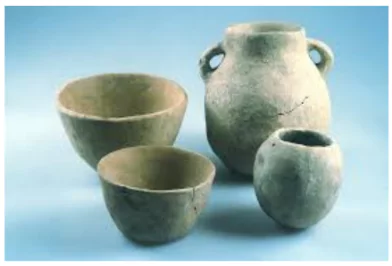
Chalcolithic Period
- Malwa ware: A characteristic pottery type of Malwa Chalcolithic culture. It is a wheel made pottery with buff or cream slip and has painted patterns in dark brown or black colour.
- Painted Grey Ware (PGW): It is a characteristic pottery of early Iron Age in India, the other being NBP. This is produced from well-levigated clay and on a fast wheel. A thin slip is applied on both surfaces and the vessels baked at 600° C under reducing conditions producing the smooth ashy surface.
- Northern Black Polished ware (NBP): This is made on a fast wheel from well-levigated clay, well-baked with a blackish-grey and occasionally reddish core, and is thin and sturdy. Its distinctive feature is its glossy surface with mirror effect.
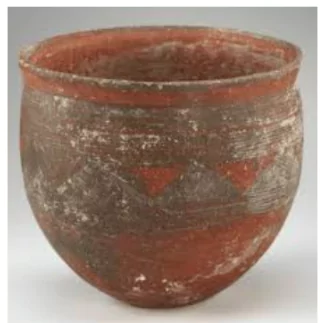
Pottery of the Indus Valley Civilization
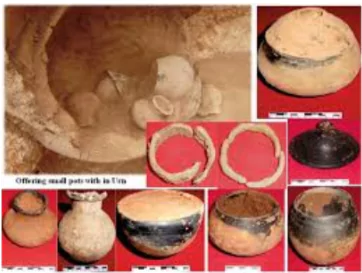
- The characteristic pottery is black and red ware with black painted designs.
- The most popular design is a series of intersecting circles.
- The other common types are plain ware and plain red ware, both glazed and unglazed.
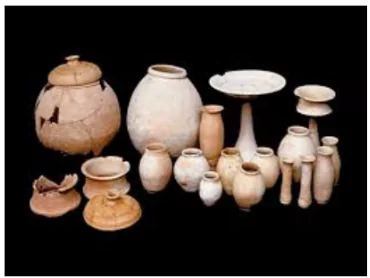
Iron Age Pottery
- Iron technology in South Asia including India is primarily associated with late prehistoric or early historic cultural periods.
- Archaeologically, Painted Grey Ware culture of Northern India is considered as iron using group in the sub-continent.
- In Northern India, Painted Grey Ware and Northern Black Polish were the earliest Iron Age cultures; at some sites, a pre-Painted Grey Ware known as Black and Red ware is said to mark the beginning of Iron Age.
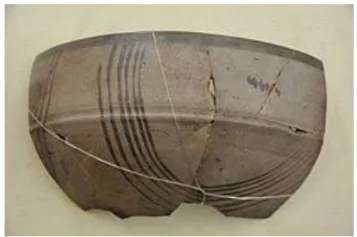
Painted Grey Ware (PGW)
- PGW is a very fine ware, fired under reducing condition, which gives it a grey colour.
- PGW is usually associated with cultures of rural areas.
- PGW was first discovered in Ahichchatra in 1944.
- Over 400 sites have been discovered in Ravi-Sutlej basin, Ghaggar basin and Ganga-Jamuna Doab. Important excavated sites of PGW are Hastinapur, Ahichchatra, Alamgirpur, Atranjikere, Noh, Jodhpur, Bhagwanpur, Indraprastha, Kurukshetra, Panipat and Tilpat.
- PGW people were agriculturists with cattle breeding as their principal occupation.
- They domesticated the cow, buffalo, pig, goat, sheep and horse.
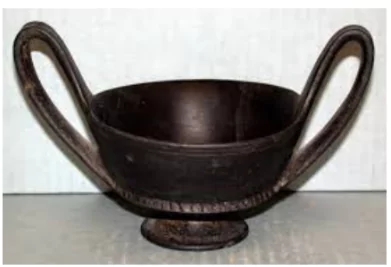
Northern Black Polish Ware (NBPW)
- NBP is made on a fast wheel from well-levigated clay, and it is well baked.
- The quality of NBP is quite remarkable. Its distinctive feature is the glossy surface with mirror effect.
- NBP is usually associated with cultures of cities.
- NBP saw emergence of cities and the first political entities known as Mahajanapadas in the Ganga plains in the 6th century BCE.
- This was the location of the second major Hindu epic, Ramayana and the rise of Buddhism and Jainism.
- This period witnessed the second urbanisation.
- NBP is seen throughout Northern India but its main occurrence is in the Ganges plains in Uttar Pradesh and Bihar.
- It is found in small quantities in Central, Southern and Eastern India, as well as Bangladesh and Sri Lanka. This pottery was probably carried off to far places by Buddhist monks and high officials.
- Mauryan Period: The ceramic wheel gained popularity. Ceramics from the Mauryan era come in a wide variety of styles. The most sophisticated method, however, may be seen in a type of pottery called Northern Black Polished Ware (NBP), which was well-liked in the earlier and early Mauryan times.
- Kushana Period: The Kushan cultural epoch in Bengal and North India brought about a new era in pottery. This phase's pottery is characterised by a characteristic red polished ware with stamped design as well as a sizable amount of dull or strong redware.
- Guptas Period: Remains of Gupta pottery found in Ahichchhatra, Rajgarh, Hastinapur, and Bashar are remarkable examples of their ceramic prowess. The most recognisable style of pottery from this era is redware.
- Mughal and Rajput Period: Glazed pottery with Persian and Indian designs are found in Gujarat and Maharashtra and date to the Sultanate era. Modern Jaipur's Blue Pottery is frequently regarded as a traditional Jaipur craft.
Importance of Pottery
- Cultural Importance: Pottery reveals past cultures. Historically, Style changes with distinct cultures. It reflects social, economic and environmental conditions. Also, Helps understand history.
- Social Importance: Pottery provides insights into the use of fire, cooking, storage, and trade. It reflects the lifestyle and settlement patterns of ancient societies. Pottery evolves into an artistic form of expression. It helps in understanding social stratification and societal organization.It reveals the belief in gods and deaths.
Recent Government Developments in Pottery
- ASI prepares third season excavation at Purana Qila, Delhi. Led by Shri Vasant Swarnkar. Earlier campaigns found artifacts such as painted grey ware (900 BC) to pottery from various periods like the Maurya, Shunga, Kushana, Gupta, Rajput, Sultanate, and Mughal periods.
- Keeladi in Tamil Nadu reveals ancient urban civilization. Excavations show pottery industry.
- India, which has the largest craft concentration in the world, has only 2% of the global handicraft market share (Business Economic 2020).
- “Industhan’s passive cooling tiles, which are made by adding small quantities of rejected and broken pieces of sinks and toiletware.
- The Manamadurai pottery recently earned a Geographical Indication (GI) tag.
- A unique type of clay is sourced from water bodies like Nedunkulam, Nathapurakki, Sundaranadappu, Seikalathur to make these pots.
- While making these pots, the five elements of nature namely earth, water, fire, sun and air are used.
- ASI finds Kushan and Gupta pottery at Unnao fort excavation at the dilapidated fort of Raja Ram Baksh Singh at Unnao in Uttar Pradesh.
Way Forward
- E-commerce: In addition, as the industry develops and receives more traction, leveraging e-commerce for online visibility and operational efficiencies will show to be a crucial success factor.
- Enhance conditions of craftsmen: The government has already made enormous achievements by enacting policies that would make handcraft items competitive globally and enhance the conditions of our craftsmen, notwithstanding the precarious state of artisans needing attentive interventions for their uplift.
Conclusion
In the study of culture and the reconstruction of the past, pottery is important. Pottery has changed over time in response to various civilizations. It depicts the social, economic, and environmental circumstances in which civilization arose and developed, assisting historians and archaeologists in understanding our past.
3. Indian Paintings
4. Classical Dances of India: Forms, History, Cultural Significance
Classical dances of India are a timeless blend of devotion, expression, and storytelling, rooted in ancient traditions. Recognized for their grace and spiritual depth, these art forms reflect the rich cultural heritage of the country.
Classical Dances of India: An Overview
Indian classical dancing emerged in India around 200 BCE, characterized by its joyful and celebratory nature. It often serves as a form of devotion to Hindu deities, with performances intricately choreographed to depict historical events and mythological tales. The various forms of Indian classical dance are known for their energetic movements, expressive gestures, and spiritual significance. These dance performances are commonly showcased at festivals, colleges, cultural events, and other venues, serving as a vibrant expression of India's rich cultural heritage.
In India, there are eight officially recognized classical dance forms as identified by the Sangeet Natak Akademi, the primary organization for the preservation of Indian arts. These include Bharatanatyam, Kathak, Kuchipudi, Odissi, Kathakali, Sattriya, Manipuri, and Mohiniyattam.
- Additionally, the Indian Ministry of Culture recognizes Chhau as a classical dance form, bringing the total to nine recognized styles.
The three primary parts are:
- Natya, which is the dramatic aspect of the dance (character impersonation),
- Nritta, which is the fundamental form of the dance movements.
- Nritya (part of expressiveness; gestures or mudras).
Different Forms of Classical Dances of India
Bharatnatyam (Tamil Nadu)

- Bharatanatyam has been practised for more than 2000 years.
- The state of Tamil Nadu is where the dance genre first emerged.
- Bharatanatyam was originally the domain of female temple dancers.
- 'Bharatanatyam' is a type of dance that combines Bhav, Rag, Ras, and Taal.
- Revival of Bharatnatyam: A Renaissance was brought about by Rukmini Devi Arundale.
- This art had almost completely died before her. She elevated the puritanical standards of this art form.
- Yamini Krishnamurthy, Meenakshi Sundaram Pillai, Saroja Vaidyanathan, Janaki Rangarajan, and others are well-known Bharatanatyam dancers.
Kathak (North India particularly Uttar Pradesh)
- The word Katha, which signifies a story, is the origin of the name Kathak. The dancers typically performed in religious or rural settings, narrating stories from historic texts.
- The Ramayana, Mahabharat, and Krishna stories are central to Kathak's themes. Kathak also includes talks on a variety of topics. Braj's Raslila is quite similar to Kathak.
- Features:
- Nritya and Nritta divisions: Key aspects of Kathak dance.
- Group dance: Increasing popularity as a solo and group performance.
- Kathak revival: Golden age under Nawab Wajidali Shah's reign who himself was superb artist.
- Active support: Nawab Wajidali Shah's patronage and artistic talent.
- Raigarh Gharana: Finest contribution, created by Raja Chakradhar Singh.
- Notable dancers: Sitara Devi, Rohini Bhate, Maya Rao, Mandvi Singh, Shama Bhate, Shovana Narayan, Achhan Maharaj, Shambhu Maharaj, Gopi Krishna, Pandit Birju Maharaj, Pandit Rajendra Gangani.
Kathakali (Kerela)
Kathakali dramatises stories, many of which are taken directly from Indian epics. It combines dance, music, and acting.

- Makeup: The employment of heavy makeup and beautiful costumes is common.
- Features: With specific makeup and costumes, the dancers play the parts of the stories—kings, gods, demons, etc.—while the vocalists tell the legend and the percussionists play the instruments.
- Facial colours: Different facial colours denote various mental states and character traits, such as green for nobility, black for wickedness, and red patches for a combination of royal nobility and evil.
- Kerala Kalamandalam: The primary hub for Kathakali artists is Kerala Kalamandalam.
- Dance style similarities: Kathakali shares similarities with other dance forms like the Japanese "Noh" and "Kabuki."
- Famous artists: Notable Kathakali artists include Ramankutty Nair and Kalamandalam Gopi.
Mohiniattam (Kerela)
The traditional solo dancing style of Kerala is called Mohiniyattam, or the dance of Mohini (a form of Lord Vishnu).

- References: Vyavaharamala (1709) by Mazhamagalam Narayanan Namputiri and Ghoshayatra by poet Kunjan Nambiar mention Mohiniyattam.
- Characteristics: Delicate, lyrical, and graceful dance style.
- Comparison: Shares grace and beauty with Bharatanatyam.
- Revival: Kerala's prohibition on temple dancing was lifted in 1930 with the support of nationalist Malayalam poet Vallathol Narayan Menon, who also founded the Kerala Kalmandalam dance academy and encouraged its instruction and practise.
Kuchipudi (Andhra Pradesh)
The Kuchipudi is a well-known dance-drama style that has its roots in the Krishna district of Andhra Pradesh, where it was first performed in the third century BCE

- Presentation: Includes solo and group performances.
- Significance: Jewellery, accessories, and costumes play a role.
- Different Forms: Manduka Shabdam (frog maiden narrative), Balgopala Taranga (dancing on the edges of a brass plate while holding a pitcher of water on top of his head), and Tala Chitra Nritya (dancing toes making pictures) are the solo performances.
- Famous Artists: Yamini Krishnamurthy and Raja Reddy
Manipuri (Manipur)
The Manipuri dance form is named after its region of origin, 'Manipur'. This dance form is also known as ‘Jogai’.
- Manipuri typically portrays the love between Radha and Krishna through Raaslila in the form of a dance-drama on devotional tunes.
- Manipuri is a synthesis of South-East Asian and Indian cultures.
- Tandav or Lasya are two categories for the Manipuri dance style.
- Costumes: The female dancers dress in elaborate barrel-shaped drum-like long stiff skirts that are embellished from top to bottom. A traditional veil is worn over hair that drapes beautifully over the face, which is covered by a dark-colored velvet top.
- Famous Artists: Guru Bipin Sinha and Nirmala Mehta
- Revival or recent development: Manipuri dance instruction is offered by a number of commercial institutions as well as a select number of government-sponsored facilities.
- The most notable of these is the Jawaharlal Nehru Manipuri Dance Academy in Imphal, which is a part of the Delhi-based Sangeet Natak Academy.
Odissi (Odisha)
Sensuous and lyrical, Odissi is a dance of love and passion touching on the divine and the human, the sublime and the mundane.

- The Natya Shastra mentions many regional varieties, such as the south-eastern style known as the Odhra Magadha which can be identified as the earliest precursor of present day Odissi.
- This Bhakti-inspired dancing style was once performed at Jagannath temples as a means of worship to God. Thus, inside the temple, one discovers numerous sculptures in various dance poses.
- Feature: A gentle dance with calming lyrics that shares mudras and facial gestures with Bharatanatyam.
- Famous Artists: Sonal Mansingh and Kelucharan Mohapatra.
Sattriya (Assam)
This dance was created by Assamese Vaishnava saint and reformer Sankaradeva for Vaishnava religion in 15th century A.D.

- Name and Affiliation: Name Sattriya due to its religious nature and affiliation with the Sattras.
- Themes: Performances center around Radha-Krishna and mythology.
- Revival: Transitioned to contemporary stage in 20th century. It gained support inside and outside India.
- Sattriya Kendra Guwahati, an affiliate of Sangeet Natak Akademi: Founded to support and preserve Sattriya.
Chhau (Odisha)
The Chhau is a synthesis of martial, tribal, and folk arts. The name "Chhau" comes from the Sanskrit word "Chaaya," which means "shadow," "image," or "mask." Additionally, Sitakanta Mahapatra claims that the word "Chhau" is derived from the Odia word "Chhauni" (Military Camp).

- Performed traditionally by male-only troupes.
- Themes: Vaishnavism, Shaivism, shaktism
- Revival: Chhau was included on the Representative List of the Intangible Cultural Heritage of Humanity maintained by UNESCO in 2010.
- Government Chhau Centre was established in Seraikella in 1960, and Myurbhanj Chhau Nritya Pratishthan was founded in Baripada in 1962.
- In Baripada, Odisha, the Sangeet Natak Academy founded the National Centre for Chhau Dance.
Folk Dances of India
Indian folk dances are traditional, celebratory, and expressive. They are performed globally for social events like weddings, festivals, and seasons. Both genders participate, often with musicians playing as dancers sing. Elaborate clothing is common. There are numerous structured, old-fashioned folk and tribal dances, but many more are developing right now.
Indian folk dances, with their elaborate costumes and jewellery, form an integral part of the country's cultural heritage. Among them is Dumhal, a traditional dance from Kashmir, and Ras lila, performed during Janmashtami festivals.
The different types of folk dances are:
|
States
|
Folk dances
|
|
Andhra Pradesh
|
Bhamakalpam and Kolattam
|
|
Arunachal Pradesh
|
Wancho
|
|
Assam
|
Bihu, Naga dance
|
|
Bihar
|
Jata-jatin
|
|
Chhattisgarh
|
Gaur Maria, Kapalik
|
|
Gujarat
|
Garba, Dandiya Raas and Bhavai
|
|
Goa
|
Tarangamel, Koli
|
|
Haryana
|
Jhumar, Phag
|
|
Himachal Pradesh
|
Jhora, Dhaman
|
|
Jammu & Kashmir
|
Kud Dandi Nach
|
|
Jharkhand
|
Agni, Jhumar
|
|
Karnataka
|
Yakshagana, Karga
|
|
Kerala
|
Ottam Thullal
|
|
Maharashtra
|
Lavani, Koli
|
|
Madhya Pradesh
|
Jawara, Matki
|
|
Manipur
|
Thang Ta, Lai Haraoba, Pung Cholom
|
|
Meghalaya
|
Nongkrem
|
|
Mizoram
|
Zangtalam, Chailam
|
|
Nagaland
|
Bamboo Dance, Rangma
|
|
Odisha
|
Savari, Ghumara
|
|
Punjab
|
Bhangra, Giddha
|
|
Rajasthan
|
Ghumar, Kalbelia
|
|
Tamil Nadu
|
Kumi, Kolattam, Kavadi
|
|
Uttar Pradesh
|
Nautanki, Raslila
|
|
Uttarakhand
|
Garhwali, Kumayuni
|
5. Indian Music: Dhrupad, Khayal, Carnatic, Folk, Dance Traditions
Music is the soul of any culture, and India boasts a rich history of innovative music. According to legend, Narada Muni introduced music to the world. Evidence of a seven-holed flute from the Indus Valley Civilization signifies its ancient presence. The Sama Veda and Gandharva Veda, further emphasize music's spiritual significance and scientific aspects.
- The Gandharva Veda, or the science of music, is an Upaveda of the Sama Veda.
History of Indian Music
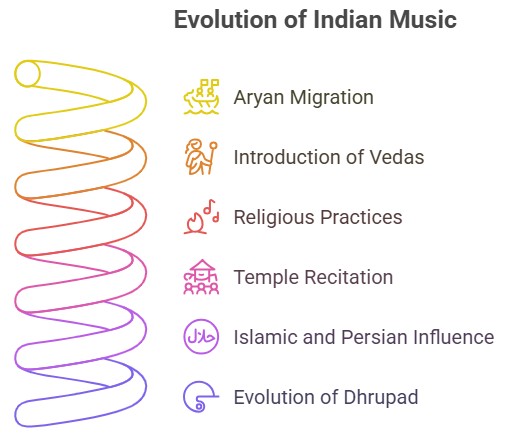
- It is generally accepted that the religious practices of the Aryan people, who came in India around 3,000 years ago, are where the roots of Indian classical music may be found.
- The Vedas, which literally translates as "knowledge," are the foundational writings of ancient Hindu scriptures that the Aryans brought with them. Their worship ceremonies essentially revolved upon the well planned and ordered recital of these lines.
- Hindu temple recitation shaped music's genesis.
- The appearance of North Indian music was altered by the introduction of Islamic and Persian components. For instance, by the 15th century, the Dhruvapad or devotional style had evolved into the Dhrupad style.
Classical Music is of Two Types
- Hindustani Music:
- The Hindustani school of music places more emphasis on the structure of the music as well as its improvisational potential.
- Hindustani music has ten primary vocal genres, including the "Dhrupad," "Dhamar," "Hori," "Khayal," "Chaturang," "Ragasagar," "Tarana," "Sargam," and "Thumri."
Dhrupad
- One of Hindustani classical music's oldest and most opulent genres.
- It has reference in Natyashastra (c. 200 BC–c. 200 AD).
- Reached its pinnacle in the court of Akbar, the Mughal emperor.
- Tansen, along with other renowned musicians like Swami Haridas and Baba Gopal Das, were employed and supported by Akbar. Tansen is regarded as one of the Navaratna or nine diamonds of the Mughal court.
Khayal
- This fashion industry's inception was credited to Amir Khusrau.
- It is used by artists because it allows for more room for improvisation.
- Based on a collection of brief songs with two to eight lines, it is also known as a "Bandish."
- Khayal also features a brief narrative and is composed in a certain raga and tala.
- Major Gharanas: Bhendibazaar Gharana, Gwalior, Kirana, Patiala, Agra
Tarana Style
- The rhythm of this technique is highly important.
- The melody serves as the structure.
- It has a lengthy vocabulary and is sung quickly.
- The singers must have particular training and expertise in manipulating rhythms because it concentrates on producing rhythmic concerns.
- Amir Khusro (13th–14th century) created it, and Guru Gobind Singh (10th Sikh Guru) incorporated it into his works.
Sub Classical Styles of Classical Music
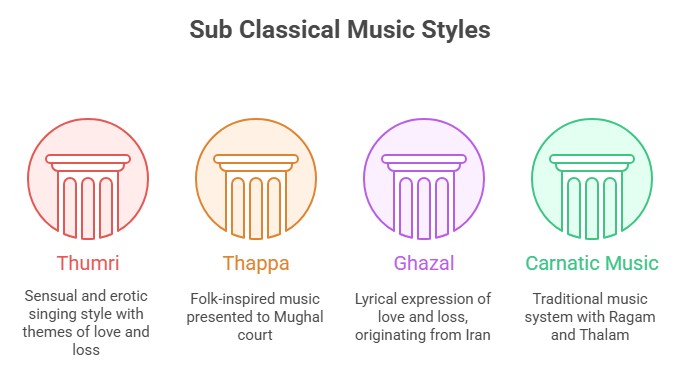
Thumri
- "The lyric of Indian classical music" is another name for this sensual and erotic singing style.
- The majority of the poems deal with love, loss, and dedication.
- Unique feature: Erotic content that is picturesquely portrayed from the many events in Lord Krishna and Radha's life.
Thappa
- It gained legitimacy as it was presented to the Mughal court of Emperor Muhammad Shah.
- Originated from the folk songs of the North-West Indian camel riders.
Ghazal
- Used as a lyrical phrase to portray the pain of separation and loss as well as the beauty of love despite suffering.
- Reached its pinnacle under the Mughal era.
- Had its beginnings in Iran in the 10th century.
- Prominent poets who wrote ghazals during the 13th century include Rumi, who was a Persian poet and mystic, and Amir Khusro, who is often credited as the first expounder of the ghazal.
- Other famous personalities: Muhammad Iqbal and Mirza Ghalib.
- Carnatic Music
- The Sanskrit word Karnâtaka Sangîtam, which refers to "traditional" or "codified" music, is whence Carnatic music gets its name.
- It has a long history and tradition and is made up of a system of Ragam (Raga) and Thalam (Tala).
- Tamil Nadu, Kerala, Andhra Pradesh, and Karnataka are south Indian states where Carnatic Sangeet has flourished. These states are renowned for giving Dravidian culture a powerful portrayal.
Folk Music
Every State has a distinct musical style that is built on the cultural affirmation of its residents. The folk tradition has no set rules; it is the music of the people.
|
State
|
Music
|
|
Bengal
|
Baul
|
|
Jammu & Kashmir
|
Wanawan
|
|
Madhya Pradesh
|
Alha & pai
|
|
Rajasthan
|
Panihari
|
|
Maharashtra & Goa
|
Ovi
|
|
Rajasthan
|
Maand
|
Recent Developments in Indian Music
Classical art forms hold significant cultural capital, attracting the socio-cultural elite and signifying social status.
- SPIC MACAY, founded in 1977, promotes classical arts alongside other forms, emphasizing yoga and meditation.
- Youth Association for Classical Music: It is an initiative in Chennai that focused on providing a performance platform for artists below the age of 30 and taking Carnatic music to school children.
- Various organizations now aim to engage the youth using updated technology.
- However, classical music faces challenges rooted in its intimidating culture:
- Everyone invested in these musical forms refuses to look within and reflect on how the culture we exude is intimidating and fear inducing.
- Caste and class overflow in every activity associated with classical music.
Importance of Dance and Indian Music
Cultural Importance
- Religious ideas: In traditional Indian culture the function of dance was to give symbolic expression to religious ideas.
- The figure of Lord Shiva as Nataraja represents the creation and destruction of the cosmic cycle. It clearly shows the popularity of dance form on the Indian people.
- Celebrate the festivals: They were an essential part of celebrating a festival.
- Different instruments: The Ancient people used many types of musical instruments like balag, cymbals, rattles, flutes, drums, etc.
- A bronze image of a dancer was found in the excavation at Mohen-jo-daro is evidence that dance too, was important in the Harappan Civilization.
- Communication: They were seen as an essential component of creation since they could communicate with the gods and convey all kinds of life and death.
Recent Developments by Government
- The development of the classical dances was aided by the founding of the Sangeet Natak Akademi in Delhi and its affiliated centres.
- Prestigious festivals like Khajuraho, Konark, Dhauli Kalinga, Kalidas, Mukteshwar, Soorya, Ellora, and Nishagandhi showcase the exquisite portrayal of Indian classical dances.
- With the establishment of Music and Dance Universities like Indira Kala Sangeet Vishwavidyalaya in Khairagarh, Raja Mansingh Tomar University in Gwalior, etc., as well as numerous Institutions like Akhil Bharatiya Gandharva Mahavidyalaya Mandal and Prayag Sangeet Samiti, the classical dances flourished and advanced.
- Odissi dancer-Guru Jaya Mehta pens her new book Nritya Katha Dance Stories for Children after her debut as an author with The Poetic Saree, a collection of dance poems.
- The 80-page picture book published by the National Book Trust of India narrates the stories of nine Indian dance forms. “A child discovers an Indian classical dance form through every story,”.
- Bharatnatyam, Kuchipudi, Manipuri, Kathakali, Kathak, Chhau, Mohiniyattam and Sattriya are the dance forms featured. Jaya has also added a bit of the Bihu dance form, in the Sattriya story.
- For the past 11 years, the National Centre for the Performing Arts (NCPA) has steadfastly been trying to familiarise people with culture from different regions of the country via the medium of local folk traditions.
- Ghoomar from Rajasthan, Dandiya and Garba are among the list of the world’s top 10 most amazing local dances from India.
- Lavani became well known outside Maharashtra — throughout India and even outside the country — following its use in popular media such as cinema.
Promotion of Indian Arts, Culture and Heritage:
- Centre for Cultural Resources and Training (CCRT) organizes various training programmes on regular basis towards sensitizing in-service teachers for promotion and preservation of Indian Arts, Culture and Heritage.
- In each Training Programme regular sessions are held on various Classical Dances, Carnatic Classical Music and Hindustani Classical Music.
- The CCRT also organizes programmes for govt. & non-govt. (NGOs) school students under its Extension and Community Feedback programme in which sessions on Performing Arts are organized.
- In addition to this, CCRT paid a token honorarium and conveyance to the Experts and his/her accompanists to promote and encourage the Art and Artists.
- CCRT is also implementing following scholarship/fellowship schemes in various performing, visual & literary art fields:
- Cultural Talent Search Scholarship Scheme
- Award of Scholarships to Young Artists (SYA)
- The Fellowship Scheme for the Award of Fellowship to outstanding persons in the Field of Culture
Conclusion
Classical dance is a performing art that serves both entertainment and instructional purposes. Its origins can be traced back to early dance styles performed during religious festivals and rituals. Classical dance, being deeply rooted in classical ballet and opera, holds a significant place in the world of art. These dance styles have a rich and illustrious history in ancient Greece and Rome.
Classical music is undeniably complex, but it is not the only one. Classical music cannot become ‘mass’ but it needs to reflect the diversity in Indian society. Today, when corporations insist on diversity in recruitment, it is time social diversity becomes an active action plan in classical music.
6. Important Modern History Events in India Before 1857: Mughals to British Expansion
The period before 1857 marks a crucial phase in Indian history, witnessing the decline of the Mughal Empire and the steady rise of British colonial power. It was shaped by political fragmentation, European rivalries, major battles, and early socio-cultural reforms.
Important Modern History Events: Later Mughals
- Aurangzeb's Reign (1658-1707): Aurangzeb was the last powerful Mughal ruler.
- Succession Crisis: Following Aurangzeb's death in 1707, a succession crisis ensued among his sons, leading to a series of conflicts and power struggles. Weak rulers and infighting weakened the central authority of the Mughal Empire.
- Regional Fragmentation: As the Mughal central authority weakened, regional governors (subadars) and local rulers began asserting their independence.
- Decline and Disintegration: The later Mughal emperors faced constant invasions and conflicts with regional powers, including the Marathas, Sikhs, and Afghans. The empire's financial instability, administrative corruption, and lack of effective leadership contributed to its decline.
- British Intervention: The British East India Company took advantage of the weakened Mughal Empire and gradually expanded its influence and control over parts of India.
Important Modern History Events: Arrival of Europeans
- In 1600, the East India Company obtained a charter granting it a monopoly on trade with the East.
- Despite competition from other European powers, including the Portuguese and Dutch, the Company ventured into the Indian Ocean.
- By the early seventeenth century, the Dutch too were exploring the possibilities of trade in the Indian Ocean.
- Soon the French traders arrived on the scene.
Competition and Conflict in European Trade in India
- In their pursuit of profitable trade, European companies faced intense competition for Indian goods, resulting in higher prices and reduced profits.
- Demand for Indian Goods in Europe: The exquisite cotton and silk fabrics of India found a significant market in Europe, while spices like pepper, cloves, cardamom, and cinnamon were also highly sought after.
- Fierce battles, ship sinkings, blockades, and fortifications were common as companies sought to eliminate rivals.
- The blending of trade and politics led to conflicts with local rulers, making it challenging to separate economic interests from political considerations.
|
Interesting Facts:
Portuguese Arrival:
- Vasco da Gama reached Calicut in 1498 AD but the political rise of Portuguese and East started with Albuquerque as governor.
- They issued licenses known as Cartazes for the eastern trade.
British East India Company:
- Their first factory in South India came to be established at Masulipatnam in 1611.
|
Important Modern History Events: Anglo-French Rivalry
- Economic Competition: British and French competed for control over lucrative trade routes and resources, including textiles and spices.
- Political Influence: Both powers sought alliances with Indian rulers to gain political leverage and secure their interests.
- Colonial Ambitions: The British East India Company and French East India Company aimed to establish colonial dominance in India.
- Military Conflicts: Battles like the Carnatic Wars and the Seven Years' War witnessed direct clashes between British and French forces.
- Support to Indian Allies: Both sides supported rival Indian rulers, using them as proxies in their struggle for supremacy.

Important Modern History Events: Anglo-French Rivalry
- They gradually gained the upper hand through a series of military victories and strategic alliances.
- The defeat of the French forces in the Battle of Wandiwash in 1760 and the Treaty of Paris in 1763 marked significant turning points in favor of the British.
Reasons for the success of British:
- Commercial and naval superiority of the English.
- The French East India Company lacked adequate support from the French government.
- The English had a strong base in Bengal while the French were supported only in the Deccan.
- Unity of objective of British officials like Robert Clive, Sir Eyre Coot, etc.
- England’s victory in the European wars decided the destiny of the French in India.
Important Modern History Events: Regional Kingdoms in 18th Century
The trend of making independent authority is clearly visible in different regions whether directly under the Mughals or not in the first half of the 18th century. The states that emerged during this period can be classified into three broad categories:
- The states which broke away from the Mughal Empire:
- Example: Awadh, Bengal, Hyderabad
- Autonomous governance within Mughal framework.
- The new states set up by the rebels against the Mughals:
- The 'new states' emerged in protest against the Mughals.
- They include the Marathas, Punjab, and the Jat State.
- These states challenged Mughal authority and diversified political power in India.
- Independent states:
- They emerged primarily due to the destabilization of imperial control.
- These included the kingdoms of Mysore, the Rajputs, and Kerala.
Important Modern History Events: Battle of Plassey and the Company's Victory

- In 1756, Sirajuddaulah becomes Nawab of Bengal.
- The Company seeks a puppet ruler but fails.
- Sirajuddaulah confronts the Company, captures officials, and blockades ships.
- Robert Clive leads Company's forces to defeat Sirajuddaulah at Plassey in 1757.
- Mir Jafar's support aids in victory.
- First major Company triumph in India.
Consequences
- Bengal became a sponsored and plundered state.
- East India company became capable of deciding the fate of incumbents i.e., puppet nawabs.
- Misuse of trading privileges.
- Weakening of Mughal Empire's authority in Bengal.
- Mir Jafar was proclaimed as the Nawab of Bengal by Clive but was soon replaced by Mir Kasim as the new Nawab of Bengal.
|
Interesting Facts:
The Black Hole Tragedy (June 20, 1756) in Calcutta:
- After the capture of Calcutta by Nawab Sirajuddaulah of Bengal, a large number of British prisoners were allegedly confined overnight in a small prison cell known as the "Black Hole." The cell had limited space and inadequate ventilation, resulting in the deaths of many prisoners due to suffocation and heat exhaustion.
|
Important Modern History Events: Battle of Buxar (1764)
It took place between the forces of the British East India Company, led by Hector Munro, and a coalition of Indian rulers comprising the Nawab of Bengal, the Nawab of Awadh, and the Mughal Emperor Shah Alam II in which the coalition was defeated. The war led to Treaty of Allahabad in 1765.
Reasons and Consequences of War
- Mir Jafar as Nawab: Sirajuddaulah assassinated, Mir Jafar installed as nawab. Company faces challenges with puppet nawabs' cooperation
- Mir Qasim and Battle of Buxar: Mir Qasim replaces Mir Jafar briefly. Defeated at the Battle of Buxar in 1764. Mir Jafar reinstated as nawab
- Consequences of the Battle of Buxar:
- Company secured diwani rights over Bengal, Bihar, and Orissa through the Treaty of Allahabad (1765).
- Weakening of the Mughal Empire.
- Expansion of British Territory over significant parts of Bengal, Bihar, and parts of Awadh.
- The company intensified its economic exploitation leading to economic drain and impoverishment of the region.
|
Interesting Facts:
- By the time Mir Jafar died in 1765, the mood of the Company had changed.
- Having failed to work with puppet nawabs, Clive declared: “We must indeed become nawabs ourselves”.
|
Important Modern History Events: British Confrontation and Expansion in India
|
Keywords from Aaj Ka Quality Enrichment (http://bit.ly/aaj-ka-enrichment)
Threat to British interests, Alliance, Battle of Seringapatam, Subsidiary alliance, Treaty of Seringapatam, Influence over strategic territories, Third Battle of Panipat, Maratha Confederacy, Treaty of Salbai
|
British Confrontation with Mysore
- Mysore, led by powerful rulers Haidar Ali and Tipu Sultan, posed a threat to British interests.
- Mysore controlled profitable trade on the Malabar coast, disrupting Company's access to pepper and cardamom.
- Tipu Sultan halted the export of sandalwood, pepper, and cardamom, and refused trade with the Company.
- He formed an alliance with the French and modernized his army.
- Four wars were fought with Mysore (1767–69, 1780–84, 1790–92 and 1799)
- Battle of Seringapatam:
- Tipu Sultan died defending his capital, Seringapatam.
- Mysore came under the Wodeyar dynasty, and a subsidiary alliance was imposed by the British.
|
Interesting Facts:
Treaty of Seringapatam (1792):
- Agreement signed between the British East India Company and Tipu Sultan.
The treaty followed the Third Anglo-Mysore War (1790-1792).
- It resulted in the cession of territories by Tipu Sultan, payment of war reparations, the alliance with the British, surrender of weapons, and British control over the Malabar region.
|
British Expansion in North-West
- War with Afghanistan (1838-1842): The British fought a prolonged war with Afghanistan to establish indirect Company rule. The objective was to prevent any potential Russian advancement and maintain control over the region.
- Annexation of Sind (1843): Following the war with Afghanistan, the British annexed Sind in 1843. This further strengthened their hold in the north-west and ensured their influence over strategic territories.
- Wars with the Sikh Kingdom: Maharaja Ranjit Singh's rule in Punjab deterred the British from immediate expansion. After his death in 1839, two prolonged wars were fought with the Sikh kingdom to assert British dominance.
- Annexation of Punjab (1849): In 1849, the British successfully annexed Punjab, ending the Sikh kingdom's sovereignty. This marked a significant milestone in British expansion, securing their control over the north-western region.
British Confrontation with the Marathas
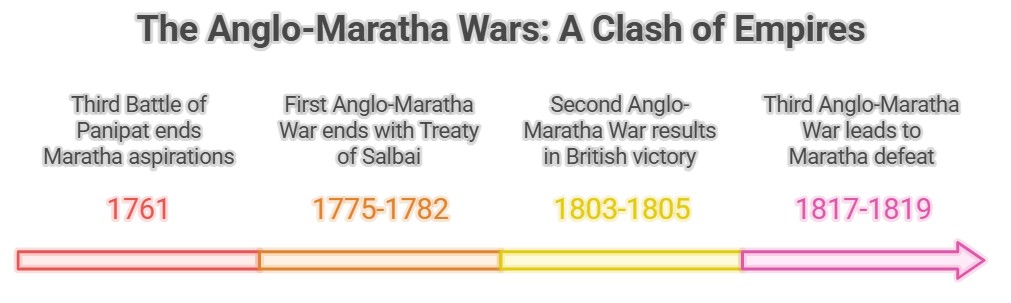
- Marathas after the Third Battle of Panipat:
- The Marathas suffered a significant defeat in the Third Battle of Panipat in 1761, ending their aspirations of ruling from Delhi.
- The Maratha Empire fragmented into various states under different chiefs, including Sindhia, Holkar, Gaikwad, and Bhonsle.
- Maratha Confederacy and Peshwa:
- The Maratha chiefs were united in a confederacy under the leadership of the Peshwa, who held military and administrative control from Pune.
- Mahadji Sindhia and Nana Phadnis emerged as prominent Maratha soldiers and statesmen during the late 18th century.
- First Anglo-Maratha War (1775-1782):
- It ended with the Treaty of Salbai in 1782 but did not yield a clear victor.
- Second Anglo-Maratha War (1803-1805):
- Fought on multiple fronts, the British emerged victorious, gaining territories such as Orissa and regions north of the Yamuna River, including Agra and Delhi.
- Third Anglo-Maratha War (1817-1819):
- It led to the crushing defeat of the Marathas, resulting in the removal of the Peshwa and his exile to Bithur near Kanpur.
- The British now had complete control over territories south of the Vindhyas.
Important Modern History Events: Impact of British Rule on India: Economic, Social, and Cultural (1757-1857 and beyond)
|
Keywords from Aaj Ka Quality Enrichment (http://bit.ly/aaj-ka-enrichment)
Land Revenue Policy and Settlements, Commercialization of Agriculture, Drain of Wealth, Rise of New Money-lending Class, Rise of New Middle Class, Deindustrialisation of traditional industries, Impact of Modern Ideas, Reform Movements and Radical, Revivalist, Reformist movements
|
Economic
- Textile Industry and Trade:
- Massive import of machine-made clothes from England to India.
- British goods sold at lower prices, causing threat to Indian handicrafts.
- India became importer of British clothes, exporter of raw cotton.
- Indian handloom industry collapsed, leading to unemployment and rural pressure.
- Land Revenue Policy and Settlements:
- British increased land revenue to finance their policies and administration.
- Different land revenue experiments caused hardship to cultivators.
- Permanent, Mahalwari, and Ryotwari settlements introduced.
- Commercialization of Agriculture:
- Introduction of commercial crops for British trade.
- British controlled opium and indigo markets, limited profit for Indian producers.
- Tea plantations brought hardships for workers.
- Commercialization increased transfer of land ownership and exploitation.
- Drain of Wealth: Taxes, trade profits, and salaries benefited the East India Company and British Empire.
- Rise of New Money-lending Class: Moneylenders exploited peasants, leading to transfer of land ownership.
- Rise of New Middle Class:
- British commercial interests created opportunities for a new elite.
- Landed aristocracy and professionals emerged.
- Spread of British power created job opportunities.
- Transport and Communication:
- British built railways for trade and transportation.
- Railways benefited British capitalists and facilitated trade.
- Railways played a role in national awakening and modernization.
- Deindustrialisation of traditional industries and introduction of few modern industries controlled by them.
- Impact of Modern Ideas: India adopted ideas of liberty, equality, human rights, science, and technology from the West. Modernization accelerated through transport and education.
Important Modern History Events: Socio-Cultural Reforms
The socio-cultural reforms in 19th and 20th-century India were pivotal in challenging regressive customs, advocating for social progress, and setting the stage for a more inclusive and egalitarian society.

Social Practices and Reform Movements
- British rule led to the prevalence of regressive social practices in India.
- Reform movements emerged to challenge practices like female infanticide, child marriage, sati, polygamy, and the caste system.
- Visionary Indians such as Raja Ram Mohan Roy, Sir Syed Ahmed Khan, Aruna Asaf Ali, and Pandita Ramabai played significant roles in these movements.
- Legal measures were introduced to improve the status of women, including banning sati, permitting widow remarriage, and discouraging child marriage.
Social and Cultural Policy
Western ideas were perceived as modern and superior, leading to a clash with Indian traditions.
- Some British radicals advocated for India's integration into the modern world.
- The British government pursued cautious reforms to avoid reactions against religious beliefs and social customs.
- English language promotion and education aimed to create a loyal class of Indians and increase the market for British goods.
- Western ideas influenced reformers like Raja Ram Mohan Roy, Ishwar Chandra Vidyasagar, and Swami Vivekananda.
Approaches to social religious reforms
- Radical: Contemptuous attitude towards traditional norms and values. Favoured the policy of westernisation as a solution to social cultural evils.
- Ex: Young Bengal movement led by Henry Vivian Derozio.
- Revivalist: Glorifying the traditional norms and values. Conceptualised pure forms of their respective religions.
Examples of Revivalist
Dharma Sabha: Founded by Pandit Radha Kanta Deb in first half of 19 century. Opposed western education and abolition of Sati and was against the reformist agenda of Raja Ram Mohan Roy.Arya Samaj: Found by Swami Dayanand Saraswati in 1875 in Bombay. Led Hindu revivalism but criticised Puranic evils like polytheism, idol, worship,superstitious beliefs,etc.
Revivalism among Muslims:
Wahabi movement:
Founder- Syed Ahmed of Bareilly.Emphasised upon puritan reconstruction of the Islam.Stood for the right of every man to read and interpret the religious text.
Faraizi movement:
- Started by Haji Shariatullah in 1819.
- An effort by Muslims in Eastern Bengal to prevent un-Islamic behaviour and carry out their religious obligations.
Deoband Movement:
launched by Muhammad Qasim Nanautavi and Rashid Ahmad Gangohi in 1866.
- Preserving spirit of warfare against foreign rulers and disseminating the clear teachings of the Quran and Hadis among Muslims.
|
Reformist
- Neither favoured a blind revival of the past, nor the blind imitation of the West.
- Impressed by modern values like humanism, rationalism, liberalism.
|
Reformism among Hindus:
- Educational reforms: Ishwar Chandra Vidyasagar opened 36 schools for girls and introduced modern education in Sanskrit College in Bengal.
- Social religious reforms: Brahmo Samaj founded by Raja Ram Mohan Roy in 1828, which advocated monotheism, rejected idol worship, etc.
- Religious modernism: Organizations, like Ramakrishna Mission, tried to combine traditional Hindu knowledge with modern curriculum through educational institutions.
- Women's rights and empowerment: Prarthana Samaj by Atmaram Pandurang in Bombay in 1867, focused on social reform, education, and women's rights.
Reformism among Muslims
Educational Reform: Reformists established educational institutions, such as Aligarh Muslim University by Sir Syed Ahmad Khan, to provide Western and scientific education alongside Islamic teachings. Socio-Religious Reform: They worked towards the abolition of practices like polygamy, purdah, etc and progressive reinterpretation of religion, Syed Ahmad Khan and Abdul Latif, advocated for women's empowerment.Interfaith Harmony: Reformist Muslims, like Sir Syed Ahmad Khan, emphasized the cordial relations between Muslims and Hindus by promoting interfaith dialogue, cultural exchanges, etc.Religious Modernism: A section of reformist Muslims sought to reconcile Islamic teachings with scientific knowledge and rationality.Political Awareness: They advocated for political participation, representation, and social justice.
Overall, the reforms played a crucial role in shaping the intellectual, social, and political landscape of the country and laid the foundation for the broader nationalist movement in the early 20th century.
|
7. The Revolt of 1857: Causes, Leaders, Suppression & Consequences, First War of Independence
The 1857 revolt was a watershed moment in Indian history. It emerged as a spontaneous uprising against various grievances and injustices inflicted by the British East India Company.
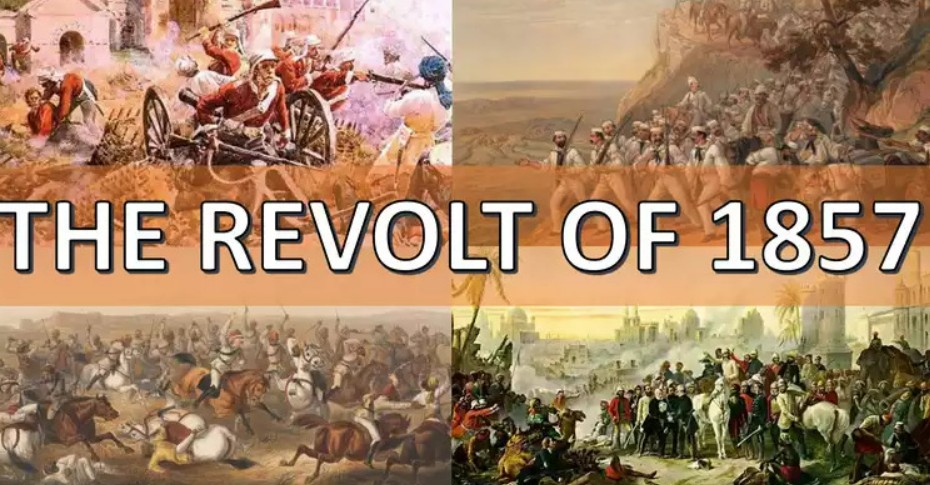
Interesting Facts about the Revolt of 1857
- According to Jawaharlal Nehru, he maintained that the Revolt of 1857 was essentially "a feudal uprising, though there were some nationalistic elements in it."
- V.D. Savarkar considered the Revolt of 1857 as the First War of Independence.
- R.C. Majumdar expressed his perspective on the Revolt of 1857 by stating, "The Revolt of 1857 is neither First, nor National, nor a War of Independence."
|
Political Causes of the Revolt of 1857
- Annexation of Princely States through various instruments such as doctrine of lapse, subsidiary alliance among others.
- Discontent among Sepoys due to various acts of Britishers, such as General service enlistment act, use of greased cartridges in Enfield rifles.
- Loss of Power and Prestige of the Mughal Emperor as well as Zamindar due to British policies such as doctrine of lapse and heavy taxes on land respectively.
Interesting Facts
Doctrine of Lapse and the Revolt of 1857
- Introduced by: Lord Dalhousie, Governor-General from 1848 to 1856.
- The doctrine stated that if an Indian ruler died without a male heir, his kingdom would be annexed by the East India Company.
- Kingdoms annexed under this: Satara (1848), Sambalpur (1850), Udaipur (1852), Nagpur (1853), and Jhansi (1854).
|
- Economic Causes: The peasants suffered due to high revenue demands and the strict revenue collection policy. Artisans and craftsmen suffered from the influx of inexpensive British goods. The loss of royal patronage displaced those pursuing religious and cultural pursuits, resulting in a loss of livelihood. Zamindars were discontented due to high land taxes and stringent collection methods.
- Socio-religious Causes: Racial discrimination caused resentment among Indians. Displacement of elites led to loss of status. Interference in Religious Practices through acts such as Abolition of Sati act of 1829, Hindu widow remarriage act of 1856.Protection of Religious Identity.
- Immediate Cause: Use of Enfield rifle and greased cartridges and the rumours around them.
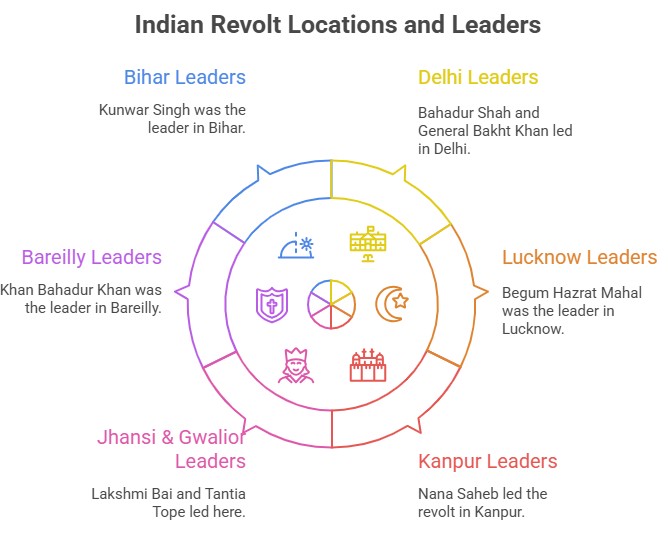
Places of the Revolt of 1857 and Indian Leaders
- Delhi-Bahadur Shah, General Bakht Khan
- Lucknow-Begum Hazrat Mahal
- Kanpur-Nana Saheb
- Jhansi & Gwalior-Lakshmi Bai & Tantia Tope
- Bareilly-Khan Bahadur Khan
- Bihar-Kunwar Singh
British Suppression of the Revolt of 1857
- The British faced significant challenges in suppressing the 1857 rebellion in India. Special laws were enacted, suspending ordinary legal processes and imposing harsh punishments, including death, for rebellion.
- The Reconquest Efforts:
- The British launched a two-pronged attack to recapture Delhi, recognizing its symbolic value.
- One force moved from Calcutta into North India, while another advanced from the Punjab.
- British attempts to recover Delhi began in June 1857, with the city finally captured in late September.
- Heavy fighting and losses occurred due to rebels from across North India converging to defend the capital.
- Progress in the Gangetic plain was slow, as the British had to reconquer the area village by village.
- The countryside and local population were hostile, demonstrating widespread popular support for the uprising.
- The Use of Military Power:
- The British employed massive military force to suppress the rebellion.
- However, they also utilized other strategies alongside military operations.
- Breaking Unity and Rewarding Loyalty: In regions of present-day Uttar Pradesh, where big landholders and peasants united in resistance, the British aimed to divide them.
- Promises were made to return estates to loyal landholders while dispossessing rebel landholders.
- Loyal landholders were rewarded, while those who fought or fled to Nepal faced death from illness or starvation.

Consequences of the Revolt of 1857
- Transfer of power from company to crown through 1858 act
- Expansionist policies came to be abandoned under the act.
- Abandonment of the policy of cultural interference.
- Increasing decentralisation at all aspects of administration, legislative, executive,etc.
- Military organisation on the policy of divide and rule.
- Increased proportion of white soldiers in army.
The 1857 revolt itself did not achieve immediate independence but left an indelible mark on India's history, shaping the trajectory of its freedom struggle.
Act of Good Governance of 1858 after the Revolt of 1857
- Transfer of Power
- The Act transferred the powers and territories held by the East India Company to the British Crown.
- The British government assumed direct control over India.
- Establishment of Secretary of State for India
- The Act created the position of Secretary of State for India, who was a member of the British cabinet and responsible for overseeing Indian affairs.
- Abolition of Company's Rule:
- The Act abolished the East India Company's rule and dissolved its administrative and military functions.
8. Growth of Nationalism in India: Causes & Key Movements
The growth of nationalism in India during the 19th and early 20th centuries was a multifaceted process shaped by political, economic, social, and cultural factors. It emerged both as a response to colonial exploitation and as an assertion of India’s national identity. The spread of Western education, press, and modern infrastructure played a pivotal role in mobilizing public opinion. Additionally, reactionary British policies and pre-congress political organizations laid the foundation for a united national movement.
Reasons of Growth of Nationalism in India
Nationalism emerged in 19th-century British India both in emulation of and as a reaction against the consolidation of British rule and the spread of Western civilization.
Political reasons
- Political unification of the country under the banner of congress.
- Modern means of transport and communication led to exchange of political ideas and mobilisation of public opinion on various issues.
Economic reasons
- Economic critique of colonialism as in Dadabhai Naoroji in his “Poverty and un British rule in India” and RC Dutt’s “Economic history of India”.
- Economic integration of the country as economic fate of different regions got linked together.
Administrative reasons
- Codification of Indian laws under Lord Macaulay led to the legal uniformity in the subcontinent.
- Introduction of All India services led to administrative uniformity in the country.
Growth of Nationalism in India through Western Thought and Education
- The middle-class intelligentsia got exposed to modern politics based on mass participation, and modern institutions provided leadership to the Indian political associations.
- The English language helped nationalist leaders from varied linguistic backgrounds to effectively communicate with each other
Role of Press and Literature in Growth of Nationalism in India
- Newspapers and journals like "Bengal Gazette," "Amrita Bazar Patrika," raised awareness and fostering a sense of unity among Indians.
- Literary works like “Geethanjali” of Rabindranath Tagore conveyed a deep appreciation for India's past glory.
Reactionary Policies and Racial Arrogance of Rulers in Growth of Nationalism in India
- Lytton’s reactionary policies such as reduction of age limit for ICS exam, Vernacular press act 1878, etc provoked opposition in the country.
- Illbert Bill controversy exposed the racial superiority mindset of the British.
Pre-Congress Organization
Before the formation of the Indian National Congress (INC) in 1885, several organizations and movements emerged in India that laid the foundation for the nationalist movement.
- Indian Association (1876): It was founded by Surendranath Banerjee and Ananda Mohan Bose in Calcutta. It aimed to provide a platform for political discussions, promote national unity, and work towards political reforms.
- Madras Mahajan Sabha (1884): It, established by M. Veeraraghavachariar and G. Subramania Iyer, sought to address social and political issues and create awareness among the masses. It advocated for civil liberties, education, and representation in the government.
- Poona Sarvajanik Sabha (1870): It was a social and political organization founded by Mahadev Govind Ranade and others. It focused on social reforms, education, and improving the conditions of the lower castes.
- Bombay Presidency Association (1885): It, led by Pherozeshah Mehta, was formed to address political and economic grievances of the people in the Bombay Presidency. It emphasized constitutional methods and worked towards increasing Indian representation in governance.
- Anjuman-e-Islam (1874): Founded by Badruddin Tyabji, it was a Muslim organization that aimed to promote education and social welfare among the Muslim community. It later played an active role in the national movement.
Formation of Indian National Congress
Initiated by Allan Octavian Hume on December 28, 1885, the INC emerged as the first organized political platform that aimed to unite the diverse voices and aspirations of Indians under one banner.
Formation of Indian National Congress (1885):
- Founded by Allan Octavian Hume, a retired Civil Service Officer.
- Aimed to provide a safe, constitutional outlet for Indian political consciousness.
- Supported by Lord Dufferin and eminent Indians.
Early Leadership and Objectives
- Womesh Chandra Banerjee elected as the first President.
- Leaders had faith in British Government and its sense of justice.
- Believed in peacefully presenting grievances to the government.

Limited Social Base (1885-1905)
- Influence confined to urban educated Indians.
- Early aims focused on communication with the British government and voicing grievances.
- Referred to as the era of the Moderates.

Rise of Radical Nationalists (1905-1918)
- Shift from Moderate Policies: Moderate policies of the Congress led to the emergence of passionate, radical nationalists known as the 'Garam Dal.'
- Critique of the Moderates: The radicals criticized the Moderates for their failure to define clear political goals and their mild and ineffective methods.
- Focus on Self-Governance: The radicals aimed to free India from foreign rule and advocated for self-governance.
|
Interesting Facts:
Bal Gangadhar Tilak gave slogan: "Freedom is our birthright, and we must have it."
|
Moderates and Extremists: A Comparative Insight in the Growth of Nationalism in India
|
Basis
|
Moderates
|
Extremists
|
|
Phase
|
1885-1905
|
1905-1920
|
|
Aim
|
1. Aimed at administrative and constitutional reforms.
2. Wanted greater autonomy and self-rule while still under the nominal rule of the British crown.
3. They were secular in their attitudes.
|
1. Aim of getting Swaraj
2. Wanted to end the tyranny rule of British.
|
|
Ideology
|
1. Believed in the efficacy of constitutional agitation.
2. Had great faith in the British sense of justice and fair play.
3. They imbibed western ideas of liberalism, democracy, equity and freedom.
|
1. Radical in their approach.
2. Ideological inspiration was Indian History, Cultural heritage,etc. Hence, they revived the Ganapati and Shivaji festivals.
|
|
Methodology
|
1. They follow the principles of 3P: Petition, Prayer and Protest.
2. They believed in cooperation and reconciliation.
|
1.Guided by 4 principles Swarajya, Swadeshi, Boycott of foreign goods and National education to make Indians aware.
2. Believed in atmashakti as a weapon against domination.
|
|
Social support
|
Zamindars and Upper middle classes in towns.
|
Educated middle and lower middle classes in towns.
|
|
Leaders
|
Surendra Nath Banerjee, Dadabhai Naoroji, Gopalakrishna Gokhale
|
Lala Lajpat Rai, Lokmanya Bal Gangadhar Tilak. Bipin Chandra Pal, Aurobindo Ghose
|
|
Contribution
|
1. Economic Critique of British Imperialism
2. Constitutional Reforms and Propaganda in Legislature
3. Campaign for General Administrative Reforms
4. Defence of Civil Rights
|
1. Demand of Swaraj
2. Mass movement
3. Spread of national education
4. Upliftment of downtrodden
5. Nationalism
6. Support to revolutionary movements
|
|
Some Important Personalities associated with Lower Class Movements:

- Jyotiba Phule: He challenged social inequalities and untouchability, founding Satyashodhak Samaj to promote education and fight caste discrimination. He opened schools for girls and lower castes, campaigned against child marriage and widow remarriage.
- Narayana Guru: He was a social reformer from Kerala who fought against caste-based discrimination and promoted social equality. He emphasized the importance of education and worked to uplift the lower castes through spiritual and social reforms. He also advocated for the rights of the Dalits and fought against untouchability.
- Dr. B.R. Ambedkar: He fought against caste discrimination and worked towards the empowerment of the Dalits. He also played a crucial role in drafting laws and provisions to protect the rights and welfare of the lower classes in the Indian Constitution.
|
9. Swadeshi and Boycott Movement 1905, Bengal Partition, Indian Nationalism
The Swadeshi Movement, born out of the 1905 Partition of Bengal, marked a turning point in India’s freedom struggle. It ignited the spirit of self-reliance, economic nationalism, and mass resistance against British colonial rule.
Swadeshi Movement and Boycott Movement in India
The partition of Bengal in 1905 stands as a watershed moment in India's fight against colonial rule, symbolizing the spirit of resilience, unity, and the unyielding pursuit of freedom. It was announced by Lord Curzon, the viceroy of India at the time, on July 20th, 1905, and went into effect on October 16th, 1905, only to be reversed six years later.
Administrative Motives: The British government justified the partition on administrative grounds, citing the need for better governance and improved efficiency in the administration of the vast Bengal province. The Bengal Presidency was British India's largest province, with a population of 78.5 million people.
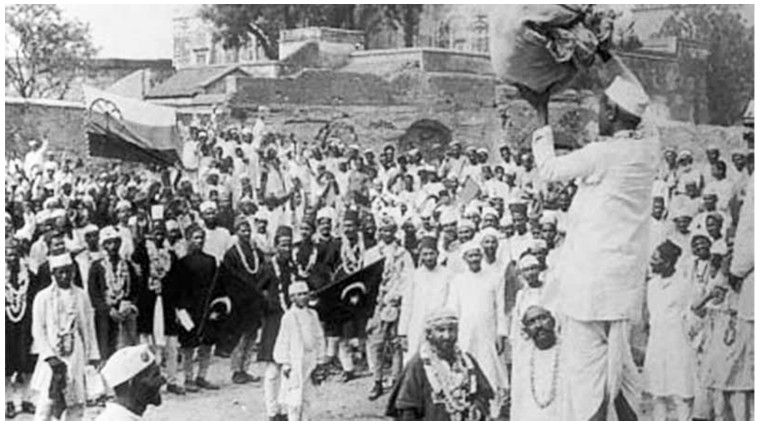
Territorial Division: The Bengal Presidency included the states of Bengal, Bihar, and parts of Chhattisgarh, Orissa, and Assam. It was divided into two separate provinces: Bengal with a Hindu majority and Eastern Bengal and Assam with a Muslim majority.
Impact of the Bengal Partition
- Curzon's partition of Bengal caused political turmoil and strong opposition.
- Bengalis rallied for unity, while the Indian National Congress criticized the division on religious grounds.
- West Bengal’s Bengali-speaking population opposed becoming a linguistic minority within their province due to an increase in Odia and Hindi speakers.
- Some Bengali Muslims supported the partition, anticipating benefits in education, economy, and politics due to their majority status in the newly created province.
- Nationally, the partition was condemned as a divisive tactic.
- The partition aimed to foster discord between religious communities, thus weakening India’s national unity and solidarity.
- Protests and agitations commenced well ahead of the partition’s implementation. Rabindranath Tagore encouraged unity by urging Hindus and Muslims to tie Rakhis (traditional bands symbolizing protection) to each other.
- The Swadeshi and Boycott movements, pivotal in India’s fight for independence, emerged as a consequence of the partition.
- The populace initiated a boycott of British products, which were inundating the Indian market to the detriment of local industries.
- The partition achieved its goal of sowing sectarian divides and facilitated the establishment of the Muslim League in 1906.
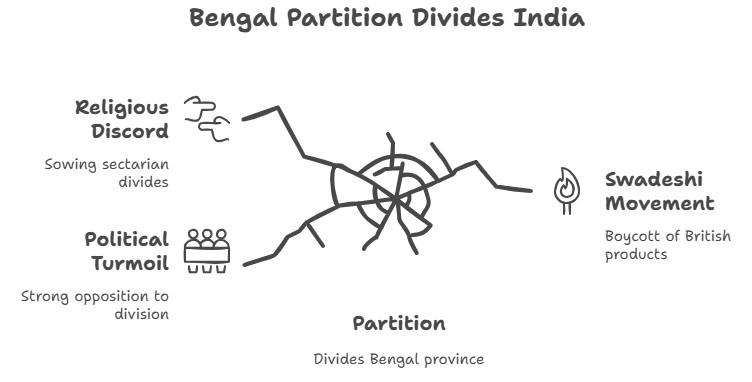
|
Interesting Fact:
- Rabindranath Tagore composed the iconic song ‘Amar Sonar Bangla’, which eventually became the national anthem of Bangladesh.
|
Significance of the Swadeshi Movement
- Curzon’s contentious decision to divide Bengal, coupled with the rise of the 'Extremist' faction within Congress, catalyzed the advent of Muslim separatist politics.
- Separate electorates for Muslims and Hindus in 1909 created distinct political entities. Muslims held a dominant position in the Legislature due to their substantial population.
- The Swadeshi Movement, initiated in 1905 and lasting until 1908, was a self-sufficiency campaign significantly influencing Indian nationalism.
- It commenced as a united backlash against the British Government’s announcement of Bengal's partition in December 1903, aiming to reduce dependence on foreign products by promoting domestic production.
- The leaders in Bengal realized that mere protests and resolutions were insufficient; more tangible actions were needed to demonstrate the depth of public sentiment.
- The movement encouraged the use of Indian-made goods (Swadeshi) and boycotting British goods. Mass meetings were organized across Bengal to take pledges for this cause.
- Public bonfires of foreign clothing and picketing outside shops selling foreign goods were widespread.
- The movement emphasized self-reliance, known as 'Atma Shakti'.
- National education was an important constituent of the movement, promoting self-sufficiency.
- Bengali students were prominent in the movement, advocating for Swadeshi and leading picketing against foreign goods. The government, however, sought to suppress them through punitive measures, including fines, expulsions, and arrests.
- Women's active involvement, particularly from the urban middle class, was a noteworthy element of the Swadeshi movement.
- Some prominent Muslims, such as Abdul Rasul, Liaquat Hussain, and Guznavi, supported the movement. However, others, like the Nawab of Dhaka, remained neutral or supported the partition due to communal interests.
- Lord Curzon acknowledged that partition aimed to give Muslims in Eastern Bengal a sense of unity, reminiscent of earlier Muslim rule.
|
Interesting Fact:
- The British government employed repressive measures to quell the Swadeshi Movement, including banning rallies, censoring newspapers, and imprisoning leaders.
- Various acts were passed to hinder the movement, such as the Seditious Meeting Act (1907), Criminal Law Amendment Act (1908), and Indian Press Act (1910).
|
Impact of the Swadeshi Movement
- Significant decline in foreign imports during 1905-1908.
- Growth of extremism amongst youth who took to violence and wanted to bring an instant end to British dominance.
- Forced the British dispensation to offer some concessions to Indians in the form of Morley-Minto reforms in 1909.
- Inspired by Rabindranath Tagore’s Shantiniketan, the Bengal National College and a number of Swadeshi Institutions were set up.
- Growth in Swadeshi Industries such as banks, insurance companies, etc.
- Boycott of Buyers and Sellers of foreign goods including clothing, sugar, etc.
Reasons for Limited Success of the Swadeshi Movement
The movement eventually faltered due to several factors:
- The British government's harsh repression.
- Absence of a formal organizational structure.
- Arrest of key leaders.
- The retirement of influential leaders like Aurobindo Ghosh and Bipin Chandra Pal.
- Disunity among leaders after the Surat split in 1907.
- Failure to sustain public engagement and extend its reach beyond the upper-middle class.
- Inability to effectively implement non-cooperation and passive resistance.
- Gradual decline in momentum and enthusiasm.
Though the movement fizzled out it demonstrated the power of mass mobilization, united action, and economic nationalism in challenging British authority. It ignited a sense of national pride and laid the foundation for a united and resolute fight against British colonialism.
Surat Split (1907)
- The discord among the various factions within the Indian nationalist movement reached its peak with the Surat Split in December 1907 during the Congress session presided over by Rash Behari Ghosh.
- At the Surat session, the Congress leaders split into two groups: the Moderates, who favoured constitutional reforms and gradual change, and the Extremists, who advocated for more assertive methods such as passive resistance and boycotting British goods and institutions.
- This division was already evident during the 1905 Banaras Session of Congress, where leaders like Bal Gangadhar Tilak criticized the approach of the Moderates.
- The Surat Split was, in part, a consequence of the British Divide and Rule policy, which aimed to weaken the Indian nationalist movement.
Following the split, the British felt they had regained control over the Indian National Congress (INC), with the Moderates continuing to lead the Congress while the Extremists operated separately.
Reasons for the Split
- Controversy over the Presidential Election: The moderates supported the re-election of Ras Bihari Ghosh, while the extremists pushed for Bal Gangadhar Tilak.
- Ideological differences and clash of methods: Moderates emphasized constitutional methods and dialogue with the British, while extremists advocated assertive and radical methods.

While the split weakened the organization temporarily, it also paved the way for a more assertive and radical phase of the nationalist movement, setting the stage for future struggles for independence.
Impact of the Surat Split
- The absence of the Extremists left Congress stagnant for over a decade, as the Moderates were unable to make significant strides.
- The re-entry of the Extremists in 1916 and subsequent departure of the Moderates in 1918 revitalized the Congress.
International Influence on Nationalist
Indian nationalists drew inspiration from the nationalist movements in Ireland, Japan, Egypt, Turkey, Persia, and China, as these movements shattered the illusion of European invincibility.
|
Country
|
Nationalist Movement
|
Key Points
|
|
Ireland
|
Irish Land War (1870-1882) & Home Rule Movement (1870s-1910s)
|
- Land reforms to favor tenants
- Advocacy for self-government for Ireland within the UK
|
|
Japan
|
Meiji Restoration (1868, continued into 1870s)
|
- Modernization, industrialization, and westernization
- Abolition of the feudal system
|
|
Egypt
|
Orabi Revolt (1879-1882)
|
- Anti-European and anti-Ottoman revolt led by Ahmed Orabi
- British intervention led to a British protectorate
|
|
Turkey
|
Young Turk Revolution (1908)
|
- Restoration of the Ottoman constitution
- Beginning of modernization and reduction of European influence
|
|
Persia
|
Persian Constitutional Revolution (1905-1911)
|
- Demanded a constitution and parliament
- Aimed at reducing foreign influence and modernizing Persia
|
|
China
|
Hundred Days' Reform (1898) and anti-foreign Boxer Rebellion (1899-1901)
|
- Short-lived reform movement and anti-foreign uprising
- Efforts to modernize and reduce foreign influence
|
Morely Minto Reforms or Indian Councils Act of 1909
The act was passed in the wake of the Swadeshi movement and was seen as a response to the nationalist challenges to colonial legitimacy and authority during the Swadeshi movement.
Provisions:
- Legislative councils expanded at both federal and provincial levels.
- Members of provincial legislative councils were indirectly elected by local bodies through an electoral college, which in turn elected members of the Central Legislative Council.
- Various stakeholders such as local governments, chambers of commerce, landlords, colleges, trade organizations, and Muslims were represented among the elected members.
- The majority of members in provincial councils were non-official, but due to the nomination of non-official members, there was a non-elected majority overall.
- The Imperial Legislative Council included Indian members for the first time.
- Muslims had separate electorates; certain seats were reserved for Muslims, where only Muslim voters could elect Muslim representatives.
- The introduction of the ‘separate electorate’ system institutionalized communal representation for Muslims. Lord Minto was dubbed the Father of Communal Electorate as the Act legalized communalism.
- Legislative councils could debate the budget, propose resolutions, discuss issues of public interest, and seek clarifications.
- Matters pertaining to foreign policy or relations with princely states were not open for discussion.
- Satyendra Prasanna Sinha became the first Indian member of the Viceroy's Executive Council, following strong advocacy from Morley.
- The Secretary of State's Council on Indian Affairs included two additional Indian members.
Evaluation of the reforms: The ‘constitutional’ reforms were aimed at dividing the nationalist ranks by confusing the Moderates and at checking the growth of unity among Indians. The Government aimed at rallying the Moderates and the Muslims against the rising tide of nationalism.
- The system of election was too indirect and it gave the impression of infiltration of legislators through a number of sieves. While parliamentary forms were introduced, no responsibility was conceded.
Importance of reforms: It effectively allowed the election of Indians to the various legislative councils in India for the first time. The introduction of the electoral principle laid the groundwork for a parliamentary system.
Congress was largely unsatisfied with the reforms. Only some members like Gokhale put to constructive use the opportunity to debate in the councils. The reforms of 1909, gave the people of the country, a shadow rather than substance. The people had demanded self-government but what they were given was ‘benevolent despotism’.
Morely Minto Reforms – as a beginning of communalism in India
The growth of communalism in India can be traced back to historical factors such as the partition of Bengal in 1905, the Morley-Minto Reforms, and the policy of separate electorates. These events created divisions along religious lines and provided platforms for communal politics.
Reasons leading to the growth of communalism:
- Role of British Divide and Rule Policy: They often manipulated communal tensions to maintain control and weaken the nationalist movement.
- Communalism in history writing: Communal interpretation of history portrayed the ancient face as the Hindu face and the medieval phase as the Muslim phase.
- Influence of Leaders and Organizations: Organizations like the All-India Muslim League and Hindu Mahasabha advocated for the interests of specific religious communities.
- Side effects of social-religious reform movements: Reform movements such as the Wahabi movement, and the Shuddhi movement made the religious role more vulnerable.
- Side effects of militant nationalism: Activities like Ganpati and Shivaji festival were linked to Hindu culture creating a feeling of 'Majority and Minority'.

10. Events led to Non-Cooperation Movement
Montague Chelmsford Reforms (1919)
The Government of India Act 1919 represents an important milestone in the constitutional progress of India under colonial rule.
Provisions of the act:
- Expansion of both provincial & imperial legislature.
- Establishment of elected majority at both, provincial and central levels.
- Introduction of a system of direct election
- Enfranchisement of the woman for the first time.
- Voting rights were available only to a very small part of the Indian population due to property criteria.
- Bicameral legislature at the Centre.
- Division of subjects into the Central and provincial lists.
- Introduction of diarchy in the provinces.
|
Response of Congress:
- The Congress met in a special session in August 1918 at Bombay under Hasan Imam's presidency and declared the reforms to be “disappointing” and “unsatisfactory” and demanded effective self-government instead.
- The 1919 reforms did not satisfy political demands in India.
|
Evaluation:
- No Swaraj was granted.
- Introduction of responsible governance on a very limited scale.
- Transfer of non-sovereign subjects in the Indian hands.
- Wide powers given to the Governor general and the governor.
- Extension of the system of separate electorates.
- Extremely limited franchise.
|
While they expanded the legislative councils and introduced limited self-governance, they fell short of meeting the aspirations of Indian nationalists for complete independence and a truly representative system of government
Rowlatt Act (1919)
The Rowlatt Act, also known as the Anarchical and Revolutionary Crimes Act of 1919, was enacted by the British colonial government in India.
Objective:
- It empowered the authorities to suppress revolutionary activities and curb dissent against British rule. It provided the government with powers to arrest without trial.
Opposition and Protests:
- The enactment of the Rowlatt Act led to widespread protests across India. A large peaceful crowd had gathered at Amritsar's Jallianwala Bagh to protest the arrests of pro-Indian independence leaders Dr. Saifuddin Kitchlew and Dr. Satya Pal. In Amritsar, Punjab, the protests culminated in the infamous Jallianwala Bagh Massacre in April 1919. British troops, under the command of General Reginald Dyer, opened fire on a peaceful gathering, resulting in the deaths of hundreds of unarmed Indians.
Impact on the Nationalist Movement:
The Rowlatt Act and the subsequent Jallianwala Bagh Massacre became a turning point in the Indian nationalist movement:
- It deepened public discontent with British rule and increased demands for self-governance and independence.
- It played a significant role in shaping Mahatma Gandhi's decision to launch the Non-Cooperation Movement in 1920.
- The movement aimed to boycott British institutions, courts, and government offices as a form of peaceful resistance.
The Rowlatt Act highlighted the repressive nature of British colonial rule and played a crucial role in mobilizing public sentiment and galvanizing the movement against British rule in India.
Rowlatt Satyagraha:
- In response to the Rowlatt Act of 1919, Gandhi established the Rowlatt Satyagraha Sabha, which represented a shift in the nationalist movement from agitation to active resistance, through non-cooperation and civil disobedience.
- The limited Montford Reforms and the repressive Rowlatt Act, which Gandhi dubbed the "Black Act", came as a betrayal to Indians who expected progression towards self-rule for their support in the war effort.
- Gandhi’s call for an all-India protest through Satyagraha was met with violent anti-British demonstrations in various cities.
- The National Congress transformed into an action-oriented organization, with the struggle for independence increasingly involving peasants, artisans, and the urban poor, reflecting a shift in focus to the masses, who were encouraged to become politically active.
- Gandhi emphasized the importance of self-sufficiency and the dignity of labor through khadi (hand-spun and handwoven cloth) as a symbol. He encouraged nationalists to connect with rural India and awakened the masses for political activism, with protests involving nationwide strikes, fasting, prayer, and civil disobedience.
11. Khilafat and Non-Cooperation Movement
The Khilafat and the Non-Cooperation movement, despite having different issues, adopted a unified plan of action of non-violence and non-cooperation during 1919-22.
Causes of the Movements:
- Government Hostilities: The Rowlatt Act, martial law in Punjab, and the Jallianwala Bagh massacre exposed the brutal and uncivilized face of foreign rule.
- Discontented Indians: The Montagu-Chelmsford Reforms with their ill-conceived scheme of Dyarchy failed to satisfy the rising demand of the Indians for self-government.
- Post-war Economic Hardships: Rise in prices of commodities, high taxes, etc strengthened the anti-British attitude.
Khilafat Issue (1919-1924):
- The Khilafat Movement was launched by Indian Muslims in support of the Ottoman Caliphate, which was threatened by the disintegration of the Ottoman Empire after World War I.
- Turkey was dismembered and the Khalifa was removed from power, and this incensed Muslims all over the world including India.
- The movement united Hindu and Muslim communities, with Mahatma Gandhi recognizing it as an opportunity for unity in independence.
Non-Cooperation Movement (1920-1922):
- The Non-Cooperation Movement was a mass civil disobedience campaign launched by Mahatma Gandhi in response to the Khilafat issue and the repressive Rowlatt Act.
- The movement aimed to boycott British institutions, including educational institutions, courts, and government offices.
- It marked a significant shift in the nationalist movement towards nonviolent resistance and mass mobilization.
- In 1922, Gandhi suspended the movement due to violence in Chauri Chaura, in order to maintain its nonviolent character.
The Khilafat and Non-Cooperation Movements significantly impacted India's independence struggle by uniting the diverse groups against British rule, mobilizing the masses, fostering Hindu-Muslim unity, and shaping the nationalist movement trajectory.
12. Post NCM course of action and debate about the strategy
Swarajists and No Changers:
|
Parameters
|
Swarajists
|
No-Changers
|
|
Founders
|
CR Das, Motilal Nehru and Ajmal Khan
|
Rajendra Prasad and Vallabh Bhai Patel
|
|
Objective
|
Use legislative councils to expose the government weakness.
|
Concentrate on constructive work.
|
|
Method
|
By protesting within council rather than boycotting. Giving hate speeches which expose the British exploitation. Obstructing house proceedings
|
Prepare everyone for the next phase of civil disobedience movement.
|
|
Ideological position
|
They worked within Congress under Gandhiji presidency but with a caveat that they work from council.
|
They continued to work within Congress under Gandhiji presidency
|
|
Achievements
|
Outvoted the Government several times on several issues. Defeat of the Public Safety Bill in 1928.
|
Ashrams sprang up. Popularised charkha and khadi. National schools and colleges were set up. Ensured Hindu-Muslim unity.
|
|
Similarities
|
- Both Groups were determined to end Colonial Government in India and demanded Independence from British Rule.
Both of the Groups were aware of a Bitter Division of Congress as Surat Split of 1907 and were determined to work as Different Wings of Congress under Gandhi Ji. |
The Emergence of New Forces – Socialistic Ideas, Youth &Trade Unionism
The 1920s and 1930s marked a significant period in Indian history. Indians participated actively in the national movement. And India saw the emergence of new forces including youth and trade unionism.
Influence of Marxism and Socialism:
- Young nationalists were influenced by the Soviet Revolution.
- Criticized Gandhian ideas and sought radical solutions to India's problems.
- The Communist Party of India was founded in 1920 in Tashkent.
- Many communists were imprisoned in 1924 (Kanpur Bolshevik Conspiracy Case).
- Government crackdown on communists in 1929 (Meerut Conspiracy Case).
- The Activism of Indian Youth: Formation of student leagues and conferences. Jawaharlal Nehru's significant role in engaging students.
- Peasant Agitations: Demanded revision of tenancy laws, lower rents, protection from eviction, and debt relief. Major uprisings in United Provinces, Andhra, Rajasthan, Bombay, and Madras. Vallabhbhai Patel led Bardoli Satyagraha in Gujarat (1928).
- Growth of Trade Unions: All-India Trade Union Congress (AITUC) was founded in 1920. Major strikes in Kharagpur, Tata Iron and Steel Works, and Bombay Textile Mills. May Day was first observed in India in Madras in 1923.
- Caste Movements: Expressions of societal contradictions through caste associations. Notable movements: Justice Party, Self-respect Movement, Mahars under Ambedkar.
- Revolutionary Activities: Groups dissatisfied with nonviolence sought armed struggle. Hindustan Republican Association in Punjab-UP-Bihar. Surya Sen led revolutionary groups in Bengal.
North Indian revolutionaries realized that armed conflict necessitated propaganda, recruitment, and arms, and the upsurge in youth activism played a significant role in facilitating the spread of socialist ideas.
Revolutionaries Activities:
The revolutionary activities were a defining aspect of the country's quest for freedom from British colonial rule, driven by a desire for liberty and armed resistance, forming a distinct nationalist force.
Ideology of Revolutionaries: Strike terror in the hearts of rulers, Freedom through revolution, Heroic actions, supreme sacrifice, assassinate unpopular British officials, Expel British with force
|
Reasons:
- Economic exploitation of Indians by the British Government and the Partition of Bengal amplified the spirit of nationalism among the countrymen.
- Fallout of the Swadeshi and Boycott Movement was the immediate reason.
- Leadership’s failure to tap the revolutionary energies of the youth.
- Government repression left no peaceful avenues open for the protest.
- Inspired by the individual heroic action along the lines of Irish nationalists or Russian nihilists.
|
Impacts:
- Secret societies of the revolutionaries came up all over the country. E.g., The Anushilan Samiti created revolutionary centers all over India.
- It had an impact on the Congress’ strategy to involve the youths in the short-term program of rural reconstruction.
- Their sacrifices aroused the emotions of the Indians which helped the building up of the national consciousness.
- It could not mobilize the masses. They believed in individual heroism.
|
Though the revolutionary movement failed it made a valuable contribution to the growth of nationalism in India. Bhagat Singh, Chandrashekhar Azad, Rajguru, etc. became a household name of the Indian people and aroused patriotism among the masses.
|
Revolutionary Movement
Ghadar Movement (1913)
The Ghadar Movement was an early 20th-century, international political movement founded by expatriate Indians such as Lala Hardayal, Sohan Singh Bakhna, and other leaders to overthrow British rule in India and establish an independent and democratic nation.
|
Interesting Fact:
Ghadar Party, initially called the Pacific Coast Hindustan Association, was founded on July 15, 1913, in the United States by Lala Har Dayal and others.
|
Ghadar Party:
- Ghadar Party aimed to assassinate officials, publish anti-imperialist literature, work with Indian troops abroad, acquire arms, and incite revolts in British colonies.
- With the onset of World War I in 1914, Ghadar Party members went to Punjab to incite an armed revolution.
- They smuggled weapons and stirred mutiny among Indian soldiers in the British Army.
- The uprising, known as the Ghadar Mutiny, was suppressed by the British, executing 42 mutineers in the Lahore Conspiracy Case trial.
- The party fought against colonialism from 1914 to 1917, with support from Germany and the Ottoman Empire.
- It also published a weekly newspaper called The Ghadar, rallying for rebellion against British rule.
- The Komagata Maru Incident in 1914, involving Canadian anti-Indian immigration laws, motivated thousands of Indians in the United States to support Ghadar Party.
Causes of Failure
- Many Ghadar leaders were arrested upon arriving in India. The British government, as well as native Punjabi populations, did not support the Ghadar movement.
- Sikhs, who were significant in the British Army and benefited from it, did not align with Ghadar leaders. Ghadar leaders were surprised by the loyalty of their countrymen to the British and realized the importance of gaining support from native Punjabis.
The Ghadar Party’s success lay in its ideological stance, promoting militant nationalism while being secular. It failed politically and militarily due to a lack of organized leadership, underestimation of preparation needed, and the potential unsuitability of Lala Har Dayal as an organizer.
|
Simon Commission:
|
Objectives:
- The British government established the Simon Commission to review the Government of India Act of 1919 and suggest further reforms.
- It aimed to foster communal divisions to destabilize India's social unity.
- The commission intended to delay the transfer of governance powers to Indians.
- It aimed to encourage regional movements to weaken national movements.
|
Impact:
- Mobilized a new generation of young people into political action.
- Radical forces demanded total independence and extensive socio-economic reforms.
- Political parties unified in response to Lord Birkenhead's challenge to create a mutually agreed constitution.
- The Commission's report led to the promise of dominion status for India and the Government of India Act 1935, which influenced the current Indian Constitution.
- The first provincial elections were held in 1937, resulting in Congress-led governments in most provinces.
- The Commission's arrival invigorated the Indian independence movement.
|
|
Group
|
Key Response
|
|
Congress
|
Resolution to boycott the commission at every stage and form during the Madras session in December 1927; Declaration of complete independence as Congress's goal
|
|
Other Groups
|
Hindu Mahasabha liberals, Jinnah-led Muslim League faction supported Congress's boycott call; Muslim League held two sessions, one opposing and one supporting the commission; Punjab Unionists, Justice Party chose not to boycott
|
|
Public
|
Nationwide hartal on the commission's arrival in Bombay on February 3, 1928; Black flag protests, hartals, 'Simon Go Back' chants; Lala Lajpat Rai led a protest in Lahore, was injured by lathi-charge, later died; Dr. B.R Ambedkar submitted a report on the education of oppressed classes
|
Criticism:
- The entirely British composition of the Commission was seen as a slight to Indian nationalism, leading to a boycott by the Indian National Congress.
- The British government justified the Commission's composition by stating that it had to report to the British Parliament.
- This argument was contested due to the existence of Indian members in the British Parliament.
- The British government claimed that the lack of unanimous Indian opinion on constitutional development made it impossible to appoint an Indian member to the Commission
Nehru Report (1928):
- The Motilal Nehru Report of 1928 was prepared under the leadership of Pt. Motilal Nehru, in response to a request from Lord Birkenhead, India's Secretary of State, for Indian leaders to draft a constitution for the nation.
- The report was thoroughly discussed by Congress and advocated for the conferment of Dominion Status upon India.
- Its main objective was to secure dominion status for India within the British Commonwealth.
Key Features:
- Dominion status: Dominion status for India within the British Commonwealth, with a parliamentary system of government.
- Fundamental Rights: The report advocated for the protection of fundamental rights, including freedom of speech, religion, and equality before the law.
- Provincial Autonomy: It proposed a federal structure with substantial autonomy for the provinces, allowing them to govern their internal affairs.
- Representation and Franchise: The report recommended universal adult suffrage, without any discrimination based on gender, religion, or property ownership.
- Minority Safeguards: It included provisions for protecting the rights of religious and linguistic minorities, and preserving their cultural and educational interests.
|
Muslim League’s Response:
- The Muslim League, led by Mohammad Ali Jinnah, largely rejected the Nehru Report.
- In 1929, Jinnah put forth his Fourteen Points as core demands for the Muslim community's engagement in an independent united India.
- One major concern was the Nehru Report's dismissal of separate electorates and weightage for Muslims, which was previously granted in the 1916 Lucknow Pact between the Congress and the Muslim League.
- Contrary to the Nehru Report, the Muslim League demanded that residuary powers be delegated to the provinces. The Muslim League criticized the Committee for adopting a policy they believed jeopardized the political future of Muslims.
- Jinnah’s Fourteen Points emerged as a pivotal document for the Muslim League’s stance
|
Indian Response:
- The Nehru Report was widely accepted by Indian political parties and marked a significant step in presenting a united Indian demand for self-rule and constitutional reforms.
- While the Simon Commission failed to satisfy Indian aspirations for self-governance and was met with strong protests, the Nehru Report emerged as a crucial document representing the Indian demand for a comprehensive and inclusive constitutional framework.
|
13. Civil Disobedience Movement (1930–1934): Causes, Impact, Role in India’s Freedom Struggle
The Civil Disobedience Movement (1930–1934), led by Mahatma Gandhi, was a landmark phase in India’s freedom struggle. Beginning with the Dandi March, it united millions in defying British laws and demanding complete independence (Purna Swaraj).
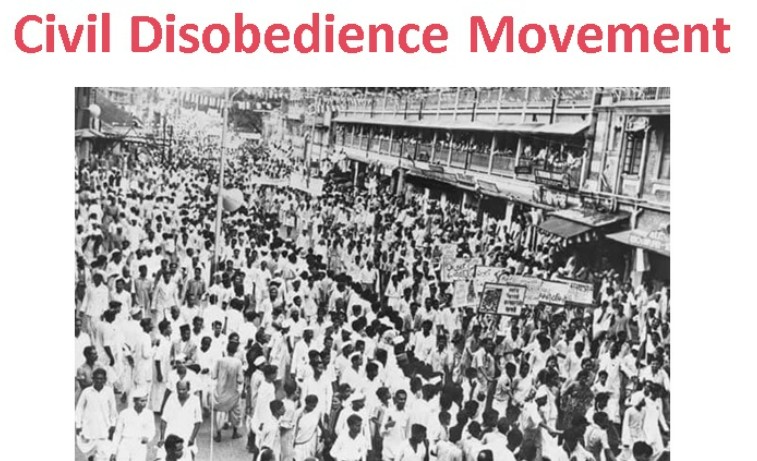
Civil Disobedience Movement (1930–1934)
- On April 6, 1930, Mahatma Gandhi initiated the Civil Disobedience Movement by collecting salt at the end of the Dandi March from Sabarmati Ashram to Dandi, breaking the government's salt law.
- His leadership galvanized widespread grassroots involvement in the freedom movement.
- The movement gained momentum nationwide as people rebelled against the salt tax. During the initial stage of the movement, salt-making emerged across the nation, symbolizing public resistance against the government.
Objective of the Civil Disobedience Movement
The movement aimed to challenge British salt laws and unfair taxation policies, while also demanding complete independence for India.
Negotiations and Truce: After several months, negotiations took place between the British and Indian leaders, leading to the Gandhi-Irwin Pact in 1931, which temporarily halted the movement.
Compared to Non-Cooperation Movement
- The stated objective this time was complete independence and not just remedying two specific wrongs and a vaguely-worded swaraj.
- The methods involved a violation of the law from the very beginning and not just non-cooperation with foreign rule.
- There was a decline in forms of protests involving the intelligentsia, such as lawyers giving up practice, and students giving up government schools to join national schools and colleges.
- Muslim participation was nowhere near the Non-Cooperation Movement level.
- No major labor upsurge coincided with the movement.
Round Table Conferences
Nevertheless, the conferences played a role in shaping the political discourse and highlighting the diverse interests and challenges in India's struggle for self-rule.

|
First Round Table Conference (1930-1931)
|
Second Round Table Conference (1931)
|
Third Round Table Conference (1932)
|
|
Dates
|
November 12, 1930 - January 19, 1931
|
September 7, 1931 - December 1, 1931
|
November 17, 1932 - December 24, 1932
|
|
Key Participants
|
- Ramsay MacDonald (British Prime Minister)
- B.R. Ambedkar
- Tej Bahadur Sapru
- Aga Khan III
- Srinivasa Sastri
- Sarojini Naidu
- Various Princes and Representatives from Indian States
|
- Mahatma Gandhi
- B.R. Ambedkar
- Madan Mohan Malaviya
- Sarojini Naidu
- Sir Mohammad Iqbal
- Aga Khan III
- Ramsay MacDonald (British Prime Minister)
|
- B.R. Ambedkar
- Tej Bahadur Sapru
- Sir Mohammad Iqbal
- Various Representatives from Indian States
|
|
Main Discussions
|
- The structure of government in British India
- Representation of the provinces
- The role of native princes in governance
- Minority representation and rights
|
- Representation in the central legislature
- Minority rights and representation
- The Federal Structure
- Gandhi-Irwin Pact & its implications
|
- Awarding a separate electorate to the 'Depressed Classes' (Scheduled Castes)
- Representation of minority communities
- Drafting of a new constitution for India
|
|
Key Outcomes
|
- It was decided that India should have a federal structure with autonomy for provinces.
- Agreement on the need for communal representation.
|
- Disagreements, mainly between Congress and other parties, led to no significant outcomes.
- The British government began to lose faith in the Congress as the sole representative of Indian interests.
|
- Communal Award declared, granting separate electorates to minorities, including the Depressed Classes.
- B.R. Ambedkar and Mahatma Gandhi reached the Poona Pact, which revised the Communal Award by increasing representation for Depressed Classes
|
Communal Award and Poona Pact (1932)
Communal Awards
- Provincial legislature seats were set to be doubled.
- Separate electorates for minorities were maintained.
- Muslims received additional representation in areas where they were a minority.
- In all provinces except NWFP, 3% of seats were reserved for women.
- Depressed classes, Dalits, and untouchables were officially recognized as minorities.
- Specific allocations were made for labor, landlords, traders, and industrialists.
- Various groups, including Muslims, Europeans, Sikhs, Indian Christians, Anglo-Indians, Depressed Classes, and Marathas, received separate electorates.
- Depressed classes were allocated seats through elections from constituencies where only they could vote, but they could also vote in general elections.
- Special electorates were established for sectors like labor, commerce, industry, mining, plantations, and landowners.
- In Punjab, Sikhs, who comprised 13.2% of the population, were allocated 32 out of 175 seats.
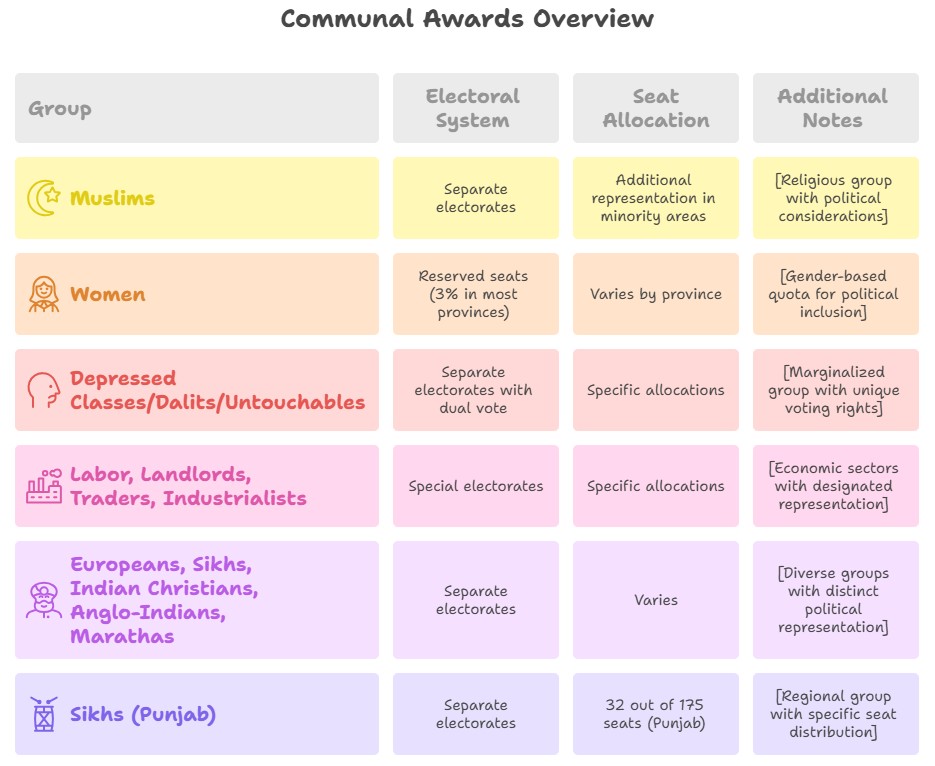
|
Responses:
- Muslim leaders welcomed it as it ensured separate representation for Muslims, while many Hindu leaders criticized it for perpetuating caste divisions.
- The award was seen as a threat to Hindu unity and the political aspirations of the depressed classes.
- Mahatma Gandhi strongly opposed the Communal Award and undertook a fast unto death in protest.
|
Poona Pact:
- The Poona Pact was an agreement reached between Mahatma Gandhi and Dr. B.R. Ambedkar in September 1932.
- Aimed to address the issue of separate electorates for the depressed classes as proposed by the Communal Award.
- The agreement proposed a reservation of seats for the depressed classes within the general electorate instead of separate electorates.
- Gandhi and Ambedkar reached a compromise to ensure the political representation of the depressed classes while preserving the unity of Hindus.
|
Government of India Act 1935
The Government of India Act 1935 was a significant piece of legislation enacted by the British Parliament to address the growing demands for greater Indian participation in the governance of the country.
Major Provisions
- Federal Structure: Establishment of a federal structure for India, with power divided between the central government and the provinces. This federation never fructified since princely states did not join it.
- Provincial Autonomy: It granted a significant degree of autonomy to the provinces, empowering them with legislative and executive authority over a range of subjects.
- Separate Electorates: It retained the provision of separate electorates for religious minorities, ensuring representation for Muslims, Sikhs, Christians, and Anglo-Indians.
- Franchise: The Act introduced limited electoral reforms, expanding the electorate by extending voting rights to a larger segment of the population.
- Central Government: It established a bicameral legislature at the centre, consisting of the Federal Assembly and the Council of States.
- Reserved Subjects: It assigned reserved subjects, exclusively to the central government's jurisdiction, including defence, foreign affairs, and the administration of tribal areas.
- Provincial Governors: It introduced the concept of provincial governors, who held significant powers and acted as representatives of the British Crown.
- All India Federation: It proposed the formation of an All-India Federation, which would include both the British Indian provinces and the princely states.
Significance
The Government of India Act 1935 served as a significant step towards constitutional reforms in India. Although it did not fully meet the aspirations of Indian nationalists for self-governance and complete independence, it laid the foundation for future constitutional developments and played a role in shaping India's political landscape.
Participation in Elections of Provincial Assemblies (1937)
- Provincial elections were held in British India in winter of 1936-37, as mandated by the Government of India Act 1935. The elections took place in eleven provinces: Madras, Central Provinces, Bihar, Orissa, United Provinces, Bombay Presidency, Assam, NWFP, Bengal, Punjab, and Sindh.
- From 1936-1939, the Indian National Congress shifted from confrontation to constitutional politics. This was a period of trial for constitutional methods, as the mass movement of the second phase of the Civil Disobedience Movement (from 1932 onwards) had not garnered as much response as the earlier phase.
- As the mass movement was on a decline, voices within Congress began advocating for a return to constitutional methods. Following a significant debate, Congress decided to participate in the 1937 elections and successfully formed governments in seven provinces.
- Prior to the 1937 elections, the Congress had been participating in Assembly and local body elections since 1934. These elections helped the Congress test its popular base, gain experience in election organization, planning, and management, and test its allies for the required electoral funds.
- The Congress session at Lucknow in April 1936, presided over by Jawaharlal Nehru, resolved to contest elections on a manifesto basis and affirmed that the people of every part of India should have the same political, civil, and democratic liberties and the right to self-determination.
- For the 1937 elections, every member of the Congress made a concerted effort to ensure the success of the party's candidates. The election results were generally favourable for the Congress, with the party faring well in all regions except Bengal, Punjab, and Sindh. The Congress emerged as the single largest party in Bengal, NWFP, Assam, and Bombay. However, the Congress did not do well in elections to the upper houses, as voting was limited to the upper strata of society.
14. India’s National Movement During World Wars: Struggle, Leadership & Independence
During World War I and World War II, India's national movement experienced significant developments and played a crucial role in the country's struggle for independence from British colonial rule.
India’s National Movement during World War I and II
|
Parameters
|
World War I
|
World War II
|
|
Objective
|
To secure political concessions from the British in exchange for their support in the war effort.
|
The primary objective of the Indian national movement shifted towards demanding complete independence from British rule.
|
|
Role of leaders
|
The moderates, led by leaders like Bal Gangadhar Tilak and Gopal Krishna Gokhale, supported the British war effort and sought constitutional reforms and self-government.
|
Leaders such as Subhash Chandra Bose, disillusioned with nonviolent means, sought international support and formed INA to fight alongside the Axis powers against the British.
|
|
Popular movements
|
The Home Rule Movement, initiated by Annie Besant and Bal Gangadhar Tilak, demanded self-rule for India and gained significant support across the country.
|
The Quit India Movement, led by Mahatma Gandhi in 1942, called for the immediate withdrawal of the British from India and witnessed mass civil disobedience and protests.
|
|
Impact
|
The Indian nationalist movement gained momentum during this period, and the demand for self-rule became more prominent.
The efforts of Indian leaders and the sacrifices made by Indian soldiers during the war created a sense of unity and nationalism.
|
The war created economic hardships and political instability in India, leading to a surge in popular discontent and anti-colonial sentiments.
The end of World War II and the weakening of the British Empire internationally brought India closer to independence.
|
Overall, both periods marked significant milestones in India's struggle for freedom, laying the foundation for the country's eventual independence.
India’s National Movement and the August Offer
- It was a proposal made by the British government in August 1940 during World War II.
- It aimed to gain the support of Indian political parties and leaders in the war effort against the Axis powers.
- Promised the expansion of the Executive Council of Viceroy, with inclusion of more Indians, and the formation of a constituent assembly after the war to frame a new constitution.
- However, the offer fell short of the Indian nationalist demands for immediate and complete independence and was rejected.
Individual Satyagraha
- Individual Satyagraha was launched by Mahatma Gandhi in 1940 as a non-violent protest against British policies, specifically to voice dissent against India's forced involvement in World War II.
- Unlike mass movements, this campaign focused on individual acts of civil disobedience. Notable individuals like Vinoba Bhave and Jawaharlal Nehru were chosen by Gandhi to lead the protest.
- Participants spoke out against the war and criticized British decisions without calling for mass protests or strikes.
- The British government responded by arresting the participants, including Gandhi. e. Significance: This movement kept the momentum of the freedom struggle alive and emphasized the moral high ground of non-violence.
Growth of Communalism and India’s National Movement
- The period saw an increased polarization among religious communities, primarily Hindus and Muslims.
- In 1940, the Muslim League passed the Lahore Resolution, demanding a separate nation for Muslims, later known as Pakistan.
- These elections heightened communal tensions as the Muslim League and the Indian National Congress emerged as representatives of the Muslim and Hindu communities, respectively
- In 1946, the Muslim League called for Direct Action Day which resulted in widespread communal violence.
- The British colonial administration is often accused of employing a divide-and-rule policy that fueled communal tensions.
Peasant Movements
- Peasants faced economic hardships due to oppressive agricultural policies, taxation, and the impact of World War II.
- Tebhaga Movement: In 1946, this movement took place in Bengal, where sharecroppers demanded a reduction in the share of crops given to landlords.
- Telangana Rebellion: This was a peasant revolt in the Telangana region (now in Andhra Pradesh and Telangana) against the feudal lords and the Nizam between 1946 and 1951.
- Peasant movements found support from the Indian National Congress and Communist parties.
- These movements played a significant role in mobilizing the masses and weakening the British hold over rural India.
State People’s Struggle
- India had numerous princely states that were indirectly ruled by the British. The populace in these states also aspired to democratic governance and freedom
- People in the princely states campaigned for the integration of their states into the Indian Union.
- All India States People’s Conference (AISPC): This organization played a significant role in mobilizing people in the princely states for democratic rights and unification with India.
- Hyderabad, Junagadh, and Travancore: These were some of the princely states where people struggled against their rulers for integration with India.
Cripps Mission
- The Cripps Mission was a delegation sent to India in March 1942 by the British government, led by Sir Stafford Cripps.
- The mission aimed to seek Indian support for the British war effort in exchange for a promise of Dominion status and the right to determine India's future constitution.
- The proposals included the formation of an interim government with full Indian participation and the granting of the right to secede from the British Commonwealth.
However, the Cripps Mission failed to reach an agreement with Indian leaders, primarily due to disagreements over the issue of the Muslim League's demand for a separate homeland.
Quit India Movement
- The Quit India Movement was a significant civil disobedience movement launched by the Indian National Congress in August 1942.
- Led by Mahatma Gandhi, the movement demanded an immediate end to British rule in India.
- The movement aimed to create mass nonviolent resistance and disrupt British administration through strikes, protests, and non-cooperation.
- Although the movement faced repression and was eventually suppressed, it marked a turning point in the Indian independence struggle and further weakened the British hold on India
Wavell Plan
- The Wavell Plan, in 1945, aimed to resolve the political deadlock in India and facilitate the transfer of power.
- The plan called for the formation of an executive council with a majority of Indian members and the inclusion of representatives from the Muslim League.
- However, Congress rejected the plan, as it did not guarantee full independence and failed to address the issue of separate electorates for religious communities.
- The plan also faced opposition from the Muslim League, as it did not fulfil their demand for a separate homeland.
The failure of the Wavell Plan highlighted the deep divisions between Congress and the Muslim League and the challenges of achieving a united political solution.
INA, Subhas Chandra Bose, and India’s National Movement
Azad Hind Fauj or the India National Army was first established by Mohan Singh in 1942. It was revived by Netaji Subhas Chandra Bose on October 21, 1943, during the Second World War to secure India’s complete independence from British Raj.
Impact of INA
The INA had failed to achieve its goal, but it made a significant impact on the freedom struggle:
- It became clear to the British that, they could no longer depend on the loyalty of Indian Soldiers and treat them as mercenaries.
- The Red Fort Trials in which several captured INA soldiers were put on trial by the British at the Red Fort in Delhi, which further fueled nationalist sentiments.
- The INA's struggles showed that armed struggle against the British was not affected by communal division, as Hindus, Muslims, and Sikhs fought as Indians.
- The actions of Rani Jhansi Brigade, an exclusive women force, demonstrated the capabilities of Indian Women waging armed struggle against the British.
- The INA had also demonstrated the enthusiasm and concern of overseas Indians for the freedom of their motherland.
Subhash Chandra Bose's Contribution
- Dynamic Leadership: Bose's charismatic and dynamic leadership played a crucial role in rallying support for the INA and inspiring nationalist sentiments.
- Formation of Forward Bloc: Bose formed the Forward Bloc, a political organisation that aimed to unite all anti-colonial forces.
- Ideology of Socialism: Bose advocated for a socialist-oriented economic system that emphasised self-reliance and social justice.
- International Connections: Bose established connections with various leaders and organizations worldwide to gain support for India's freedom struggle.
- Controversial Escapes: Bose's escape from British custody and subsequent travels to Germany and Japan raised controversy but also showcased his determination to seek international support for India's independence.
- Vision for a Free India: Bose's vision for a free India emphasised social equality, economic development, and an inclusive society.
- Enduring Legacy: He is often remembered as a symbol of courage, resilience, and unwavering dedication to India's independence.
Hence, INA's military campaigns and Bose's dynamic leadership inspired nationalist sentiments and challenged British rule which continue to be remembered as an integral part of India's freedom movement.
Cabinet Mission Plan
The Cabinet Mission was a delegation sent by the British government to India in 1946 to propose a plan for India's independence and constitutional arrangements.
Objective: The mission aimed to find a solution to the growing political tensions between the Indian National Congress and the Muslim League, representing Hindu and Muslim interests.
Proposals:
- Union of India: The plan proposed the creation of a united India with a federal structure, comprising both British India and the princely states.
- Grouping of Provinces: The provinces were to be grouped into three sections based on religious majorities, providing a measure of autonomy to Muslim-majority provinces.
- Interim Government: The plan recommended the formation of an interim government with representatives from all major political parties until a permanent constitution could be adopted.
- Constituent Assembly: A Constituent Assembly was to be formed to draft a new constitution for independent India.
Acceptance and Rejection:
- The Indian National Congress initially accepted the plan, while the Muslim League rejected it, as they insisted on a separate Pakistan for Muslims.
Post-WWII Nationalist Upsurge in India’s National Movement
- The end of World War II marked a significant shift in India, with a rise in popular initiatives across the country.
- There were various anti-imperialist movements such as the country-wide strike wave, the Tebhaga Movement, the Warlis Revolt, the Punjab kisan morchas, the Travancore people's struggle, and the Telengana Movement?.
- Despite the repression of the Quit India Movement in 1942 and the hardships of the war, the Indian populace remained resilient?.
- The election campaign saw large crowds and frantic excitement. In the provincial elections, the Congress won over 90% of the general seats, and the Muslim League did the same in Muslim constituencies. The campaign sought to mobilize Indians against the British, not just voters for the elections.
- The repression in 1942 and the Indian National Army trials were significant issues during the election campaign.
Independence with Partition
Independence of India and Pakistan through Partition
- Clement Attlee's Labour Government developed legislation based on the Mountbatten Plan or the 3rd June Plan.
- British Prime Minister announced on February 20, 1947, that British India would attain self-governance by June 1948.
- The Mountbatten Plan was agreed upon by Indian National Congress and Muslim League leaders and implemented on June 3, 1947.
- The Independence Act, embodying the Mountbatten Plan, declared India and Pakistan independent from August 15, 1947.
- The Boundary Commission delineated new borders, and British suzerainty over princely states ended.
- Princely states had to choose to join India, Pakistan, or stay independent; over 560 opted for India.
- Until the new dominions established their constitutions, Governor-Generals acted as heads of state with the ability to assent to laws through Constituent Assemblies.
- The Royal Assent to the Independence Act was granted on July 18, 1947, bringing it into effect.
The passage of the Indian Independence Act in 1947 marked a turning point in India's constitutional journey. This legislation heralded the dawn of a new era of liberty in India, even though it was met with discontent among many citizens. Regardless of its shortcomings, the Act undoubtedly culminated in the cessation of British dominance in India.
15. Overall Impact of Britishers on Indian Society
|
Positive Impacts:
- Modern Education: Various commissions like Hunter, Raleigh, etc. for education reforms.
- Infrastructure Development: Construction of railways, roads, bridges, and ports. For example, Dalhousie changed the map of India by introducing telegraph, Railways.
- Legal and Administrative Reforms: They laid the foundation for a more organized governance system in India through codification of laws, rule of law, etc.
- Technological Advancements: Modern machinery and scientific knowledge led to growth of industries and agriculture. Eg: Engineering College in 1847 and Agricultural College at Pusa 1905.
|
Negative Impacts:
- Economic Exploitation: They imposed heavy taxes and extracted raw materials from India. Charter Act of 1833 further opened the Indian market.
- Social Disruption: The introduction of land policies and the Zamindari system caused widespread impoverishment leading to various riots like Deccan riots in 1875
- Cultural Suppression: As seen through Macaulay's minutes of 1835 which favoured anglicists (Modern education) and his downward filtration theory.
- Political Subjugation: Indians were subjected to discriminatory laws and were excluded from political participation. Eg: Arms Act of 1878, Illbert Bill controversy, etc.
- Divide and Rule: They exploited divisions between different communities to perpetuate their rule. Ex: Bengal division 1905, separate electorates, etc.
|
16. Architects of Modern India: From Colonial Reforms to National Awakening
The making of modern India was shaped by visionary leaders, reformers, and administrators who laid the foundation for its political, social, and economic transformation. This compilation highlights the key contributions of these architects of modern India.
Architects of Modern India: Lord Cornwallis (Governor-General of India from 1786 to 1793)
Key contributions of Lord Cornwallis
|
Cornwallis Reforms:
- He is known as father of civil services in India as he improved and contemporised civil services and presented covenanted civil services.
- He aimed to create a more efficient and transparent system of governance in India.
- Introduced the Permanent settlement in Bengal, Bihar and Odisha. It brought stability to land revenue collection.
|
Judicial Reforms:
- He introduced the Cornwallis Code or the Indian Penal Code, which aimed to standardize and codify criminal laws.
- Cornwallis also established separate civil and criminal courts, ensuring a more streamlined and efficient administration of justice.
- He introduced strict regulations and disciplinary measures to combat corruption among civil servants.
|
Military Reforms:
He introduced better training, modernization of weaponry, and improved organizational structures.
|
Architects of Modern India: Lord Dalhousie (Governor-General of India from 1848 to 1856)
Lord Dalhousie's major contributions in India
- Annexation of Princely States through Doctrine of Lapse, such as Satara, Nagpur, etc.
- Introduction and expansion of Railways, Telegraph and Postal Systems.
- Modernization of Infrastructure like the construction of bridges, canals, and roads.
- Educational Reforms: He established universities in Bombay, Madras, and Calcutta, and introduced a modern curriculum.
- He also expanded the Legislative Council of India.
- He reformed civil services by starting a system of open competition for recruitment through Charter Act of 1853.
Architects of Modern India: Dadabhai Naoroji
Dadabhai Naoroji was a prominent Indian nationalist and social reformer who made significant contributions to India's freedom struggle and socio-economic development.
Some key contributions of Dadabhai Naoroji are
- Economic Drain Theory: In his book "Poverty and Un-British Rule in India," he highlighted how the British through economic exploitation caused impoverishment of India.
- Indian National Congress: He played a pivotal role in the formation of INC in 1885.
- Voice for Indian Representation: He became the first Indian to be elected to the British Parliament where he passionately advocated for Indian interests.
- Social Reforms: He worked towards the upliftment of women and supported the cause of female education. He founded the East India Association in London, which aimed to promote Indian welfare.
- Journalism and Publications: He published several articles and books, including "Poverty and Un-British Rule in India" and "The Causes of Indian Famines."
- Swadeshi Movement: He believed that promoting Indian industries and self-reliance would help India break free from economic dependency on Britain.
Dadabhai Naoroji's ideas on economic exploitation, representation, and self-reliance continue to inspire generations of Indians fighting for justice and equality.
Architects of Modern India: Mahatma Gandhi
Gandhi in South Africa
- Indian immigrants in South Africa were primarily indentured laborers from South India, Meman Muslim merchants who followed the laborers, and ex-indentured laborers who settled down after their contracts expired.
- These immigrants faced racial discrimination and were subject to various restrictions, such as not being allowed to vote, being forced to live in unsanitary and congested areas, and having curfews imposed on them.
- Gandhi discovered that the masses could participate in and sacrifice for a cause that moves them.
- He succeeded in uniting Indians of various religions and classes. He developed his own leadership and political style, along with new techniques of struggle.
Gandhi’s Technique of Satyagraha
- Gandhi developed the technique of Satyagraha in South Africa, based on truth and nonviolence.
- A satyagrahi (practitioner of Satyagraha) was required to be truthful, nonviolent, fearless, and ready to suffer for their cause.
- Satyagraha involved principles of boycott and withdrawal of cooperation, refusing to pay taxes, and declining honors and positions of authority.
- A true satyagrahi would have no ill will toward the wrongdoer, and would never bow down to evil.
- The practice of Satyagraha was for the brave and strong, not the weak or cowardly.

Gandhi in India
- Gandhi returned to India in 1915, and spent the next year touring the country.
- He resolved not to take a stance on any political issue for at least a year.
- He was aware of the limitations of moderate politics and opposed the Home Rule agitation that was gaining popularity.
- He believed non-violent Satyagraha was the only method capable of achieving nationalist goals.
- Gandhi participated in three struggles in Champaran, Ahmedabad, and Kheda before launching the Rowlatt Satyagraha.
|
Location
|
Key Points
|
|
Champaran (1917)
|
Gandhi led a non-violent protest against the mistreatment of indigo farmers by British planters. This was his first significant civil disobedience campaign in India, and it resulted in the government agreeing to reforms and concessions for the farmers.
|
|
Ahmedabad (1918)
|
Gandhi organized a strike by mill workers in Ahmedabad, demanding better wages. The strike was resolved when the mill owners agreed to grant a wage increase, following Gandhi's use of a hunger strike as a means of protest.
|
|
Kheda (1918)
|
Faced with famine and a high tax rate, farmers in Kheda were unable to pay their taxes. Gandhi supported a non-violent protest, resulting in the suspension of revenue collection until the famine ended.
|
Architects of Modern India: Shyamji Krishna Varma
Shyamji Krishna Varma was an Indian freedom fighter, scholar, and philanthropist who advocated for Indian self-rule, and promoting Indian culture and education.
Some key contributions of Shyamji Krishna Varma are
- In 1905, he established the Indian Home Rule Society in London which aimed to promote the cause of Indian self-rule and provided support to Indian students studying in England.
- He started, "The Indian Sociologist" and "The Indian Review," through which he disseminated nationalist ideas and criticized British colonial rule.
- He provided financial assistance, legal aid, and ideological support to Savarkar and his associates.
- He played a key role in raising awareness about the economic exploitation of India by the British and advocated for self-reliance.
- He founded the "Bharatiya Vidya Bhavan" in 1918, to promote Indian arts, culture, and education.
Architects of Modern India: Jayaprakash Narayan
Jayaprakash Narayan was an Indian independence activist, theorist, socialist, and political figure.
Contribution to Freedom Struggle
- In 1929, he joined the Indian National Congress.
- He played a key role in the formation of the Congress Socialist Party (1934).
Post-Independence Role
- In 1952, he formed the Praja Socialist Party (PSP).
- In 1954, he was devoted to the Bhoodan Yajna Movement, of Vinoba Bhave, which demanded land redistribution to the landless.
- In 1959 he argued for a “reconstruction of Indian polity” by a four-tier hierarchy of village, district, state, and union councils (Chaukhamba Raj).
- After the end of the Emergency, JP Narayan played a pivotal role in the formation of the Janata Party.
- He launched Total Revolution against Indira Gandhi Regime as she was found guilty of violating electoral laws.
- He was posthumously conferred with the Bharat Ratna (1999), for his contribution to the freedom struggle and upliftment of the marginalised.
Narayan was a staunch advocate of socialist principles and worked towards establishing a more egalitarian society and played a significant role in shaping India's political landscape.
Architects of Modern India: A.P.J. Abdul Kalam
Born on 15th October 1931 at Rameswaram in Tamil Nadu. His birth anniversary is celebrated as the National Innovation Day. Some of his contributions are:
- He pioneered fiberglass technology for composites rocket motor cases.
- He made a significant contribution as Project Director to develop India's first indigenous Satellite Launch Vehicle (SLV-3).
- He played a key role in evolving ISRO's launch vehicle program and led the Integrated Guided Missile Development Program (IGMDP).
- He led to the weaponization of strategic missile systems and the Pokhran-II nuclear tests.
- His Technology Vision 2020 aimed at transforming India into a developed society.
- He advocated rural prosperity through PURA and authored books like "Wings of Fire," "My Journey," and "Ignited Minds - Unleashing the Power Within India."
- He received the Padma Bhushan in 1981, Padma Vibhushan in 1990, and Bharat Ratna in 1997.
|
Important Personalities in News
|
E V RAMASAMY ‘PERIYAR’:
Why in news?
100 years of Periyar because of whom Tamil Nadu became modern and progressive.
- Born in 1879, E V Ramasamy ‘Periyar’ is remembered for the Self Respect Movement.
- Periyar started his political career as a Congress worker.
- He associated himself with the Justice Party and the Self Respect Movement.
- He would later be referred to as Vaikom Veerar due to his participation in Vaikom satyagraha of 1924.
- As a social reformer, he focused on social, cultural and gender inequalities.
- Periyar died in 1973 at the age of 94.
- Periyar is revered as Thanthai Periyar, the father figure of modern Tamil Nadu.
|
MAHARISHI DAYANAND SARASWATI:
Why in News?
Maharishi Dayanand Saraswati Jayanti is celebrated every year to mark his birth anniversary.
- He was an Indian philosopher, social leader and founder of the Arya Samaj.
- His vision of India included a classless and casteless society.
- He considered Veda’s to be infallible. He gave the slogan “Back to the Vedas”.
- He wrote Satyarth Prakash, which became the moral and spiritual foundation of the Arya Samaj.
- He was the first to give the call for Swaraj as “Indian for India”.
- Dayanand was a staunch advocate of women’s rights.
|
|
Sri Aurobindo Ghosh:
Why in news?
In 2022, PM Participated in a Programme Commemorating Sri Aurobindo's 150th Birth Anniversary.
- His theory of nationalism was based on Vedanta philosophy which saw unity and oneness in man and God.
- He helped establish the Anushilan Samiti of Calcutta in 1902.
- He and his brother revolutionary Barin Ghose contributed articles to the magazine Jugantar.
- He was the editor of Bande Mataram.
- In May 1908, Aurobindo was arrested in connection with the Alipore Conspiracy Case.
- In 1914, he started publishing a magazine Arya.
- His greatest literary achievement was ‘Savitri’, an epic poem.
|
Madan Mohan Malviya:
Why in news?
In 2022, Nepal celebrated 161st Birth Anniversary of Bharat Ratna Mahamana Madan Mohan Malviya.
- He was midway between the Liberals and the Nationalists, the Moderates and the Extremists.
- He was given the title of ‘Mahamana’ by Mahatma Gandhi and Dr. S.Radhakrishnan gave him the status of a ‘Karmayogi’.
- Popularized the term ‘Satyamev Jayate’.
- He helped establish the Hindu Mahasabha in 1915.
- He founded the Banaras Hindu University (BHU) in 1916.
- Malaviya was the editor of Hindi weekly, the Hindustan and Indian Union.
- In 2014, he was posthumously conferred with Bharat Ratna.
|
|
Subhramaniyam Bharati:
Why in news?
In 2022, Tamil Nadu CM Stalin inaugurated statue of 'Mahakavi Subramanian Bharathiyar' at Varanasi.
- Indian nationalist writer recognised as the father of modern Tamil style.
- He was famously known as 'Mahakavi Bharathiyar'.
- He fought for self-determination.
- He joined the Tamil daily newspaper Swadesamitran after 1904.
- Bharathi had the weekly newspaper ‘India' printed with red paper in order to announce its revolutionary zeal.
- His poem "Pudiya Russia", written in response to the 1917 Russian Revolutions, is a remarkable example of the poet's political ideology.
- Kannanpattu, Panchali sapatham, Kuyil pattu are among of his most important works.
|
Dr. Rajendra Prasad:
Why in news?
The President of India paid floral tributes to Dr. Rajendra Prasad, on his birth anniversary at Rashtrapati Bhavan on 3rd December 2022.
- He joined the Indian National Congress in 1911 and played a crucial role in the Champaran and Kheda Satyagrahas.
- Gandhiji's non-cooperation movement and salt satyagraha in Bihar was supported by Dr. Prasad.
- In 1946, he joined the Interim Government as the Minister of Food & Agriculture.
- Rajendra Prasad was elected as the President of the Constituent Assembly of India in 1946 and was the first President of the Republic of India.
- He headed committees of constituent assembly such as Finance and Staff Committee, Steering Committee, etc.
- He was awarded Bharat Ratna in 1962.
|
17. Post-Independence Consolidation and Reorganization of India: Integration of Princely States and Tribal Policies
After independence, India faced the monumental task of unifying over 500 princely states and integrating diverse tribal communities into the national fabric. Spearheaded by leaders like Sardar Patel, this consolidation aimed at building a strong, cohesive nation while safeguarding regional identities and ensuring inclusive development.
Integration of Princely States and Post-Independence Consolidation
- During the era of independence, India was divided into two distinct political entities: British Provinces, which were directly under the governance of the British administration, and the Princely States, ruled by indigenous royals but acknowledging the supreme authority of the British Crown.
- More than 500 such princely states existed.
- These states encompassed approximately 48% of the territory of India prior to its independence, and one out of every four Indian citizens resided under the authority of a prince.
Background of the Integration in Post-Independence Consolidation
- Paramountcy or Suzerainty of the British crown: The Princely states enjoyed some form of control over their internal affairs as long as they accepted British supremacy. This was called the ‘Paramountcy or Suzerainty of the British crown’.
- Conditions laid before the States post-Independence: Princely states were free to join either India or Pakistan or remain independent if they so wished.
- Role of Sardar Patel: Sardar Patel played a historic role in negotiating with the rulers of princely states firmly but diplomatically and bringing most of them into the Indian Union.
- Motive Behind Approach of Indian Government:
- Most of People in such states wanted to become part of the Indian union.
- To accommodate plurality and adopt a flexible approach in dealing with the demands.
- Integration and consolidation of the territorial boundaries of the nation.
Case study of Hyderabad
- Standstill Agreement with the Nizam of Hyderabad: The Nizam wanted an independent status for Hyderabad. He entered into the Standstill Agreement with India in November 1947.
- Movement against Nizam: Peasantry, especially in Telangana, rose against oppressive rule. Women also joined in large numbers.
- Nizam unleashed Razakars, a paramilitary force, leading to atrocities and communal tensions.
- Indian Army Intervention: 'Operation Polo' in Sep 1948 brought Indian army to control Nizam's forces. After intermittent fighting, Nizam surrendered, leading to Hyderabad's accession to India.
Case Study of Manipur
- Internal Autonomy: Maharaja of Manipur, Bodhachandra Singh, signed Instrument of Accession in Aug 1947, ensuring internal autonomy in Manipur.
- Constitutional monarchy in Manipur: Under the pressure, Maharaja held elections in June 1948 Manipur and the state became a constitutional monarchy.
- Differences over Merger: Sharp differences arose over the merger of Manipur with India. State Congress favored it, while other parties opposed.
- Merger Agreement without Consent: Government of India pressured Maharaja into signing Merger Agreement in Sep 1949, bypassing the elected Legislative Assembly of Manipur.
Chronological Formation and Post-Independence Consolidation of States in NE India
- Assam (1947): Original province of India at independence.
- Manipur (1949): Initially a princely state, Manipur became part of India in 1949 and was granted full statehood in 1972.
- Tripura (1949): Like Manipur, Tripura was also a princely state and acceded to the Indian Union in 1949. It became a full-fledged state in 1972.
- Nagaland (1963): After years of insurgency and negotiations, it became the first state to be carved out of Assam in 1963, marking the beginning of the North-Eastern states' formation.
- Meghalaya (1972): Formed from two districts of Assam, Meghalaya achieved statehood in 1972, facilitating better administration and meeting the unique demands of the tribal population.
- Arunachal Pradesh (1972/1987): It became a Union Territory in 1972 after being separated from Assam, and was declared a state in 1987.
- Sikkim (1975): While not traditionally part of Northeast India, Sikkim is often associated with the region. Sikkim joined the Indian Union as the 22nd state in 1975 following a referendum.
- Mizoram (1987): Following a peace accord ending years of insurgency, Mizoram transitioned from Union Territory status to full statehood in 1987.
|
Case study of Junagadh
- Decision of Muhammad Nawab Khanji III: Junagadh contained a large Hindu population but Nawab chose to accede to Pakistan arguing that Junagadh adjoined Pakistan by sea.
- Tensions over communal violence: India believed that if Junagadh was permitted to accede to Pakistan, communal tension already simmering in Gujarat would worsen, and refused the accession.
- Decision to call for a plebiscite: The government pointed out that the state was 80% Hindu, and called for a plebiscite to decide the question of accession. Pakistan agreed to discuss a plebiscite, subject to the withdrawal of Indian troops, a condition India rejected.
- Invitation given to the Indian government: On November 7,1947 Junagadh’s court, facing collapse, invited the Government of India to take over the State’s administration.
- The Dewan of Junagadh, Sir Shah Nawaz Bhutto decided to invite the Government of India to intervene.
- Result of plebiscite: Junagadh became a part of the Indian state of Saurashtra until November 1, 1956, when Saurashtra became part of Bombay state.
Case study of Kashmir
- Stand of Maharaja Hari Singh: He had offered a proposal of standstill agreement to both India and Pakistan but remained reluctant to join either of the two dominions.
- Pakistan’s invasion of Kashmir: Pakistan invaded Kashmir and thousands of tribal pathans swept into Kashmir in October 1947.
- Maharaja’s appeal for help: The Maharaja of Jammu and Kashmir appealed to India for help and signed an 'Instrument of Accession' of J&K state.
- According to the terms of the document, the Indian jurisdiction would extend to external affairs, communications and defence. After the document was signed, Indian troops were airlifted into the state and fought alongside the Kashmiris.
- On 5th March, 1948, Maharaja Hari Singh announced the formation of an interim popular government with Sheikh Mohammed Abdullah as the Prime Minister.
- Provisions under Delhi Agreement: In 1951, the state constituent assembly was elected. In 1952, the Delhi Agreement was signed between Prime Ministers of India and Jammu & Kashmir giving special position to the state under the Indian Constitutional framework.
- Accession of Jammu and Kashmir: On 6th February 1954, the J&K constituent assembly ratified the accession of the state to the Union of India. The President subsequently issued the constitution order under Article 370.
Integration of Tribals
The integration of tribals in post-independence India has been a significant challenge due to historical injustices, cultural diversity, and socio-economic disparities. The Indian government has implemented various policies and programs to address the specific needs of tribal communities and ensure their integration into the mainstream society.
Their status during colonial period
- During colonialism, the tribals experienced a loss of seclusion, leading to exploitation as farm laborers and a disconnect from the forests. Their reliance on trees for sustenance and livelihoods was disrupted. Consequently, they faced poverty, debt, and hardships.
- Land loss, indebtedness, exploitation by intermediaries, denial of access to forests and forest products, and oppression and extortion by policemen, forest officials, and other government officials all contributed to a series of tribal uprisings in the nineteenth and twentieth centuries, including the Santhal uprising and the Munda rebellion led by Birsa Munda.
Difficulties in Tribal Integration
- Their rudimentary manner of living, Economic and social backwardness, Literacy is low, A tired production system, Absence of a value system, Physical infrastructure is lacking in backward tribal places and The demographic quality of tribal territories.
These issues made a systematic process of tribal and tribal area development necessary.
Key Approaches for Tribal Integration in Post-Independence Consolidation
|
Approach
|
Features
|
|
Assimilation Approach by GS Ghure:
|
This assimilation approach seeks to fully integrate tribal communities into mainstream society by eradicating their distinct cultural practises and identities.
Tribal communities are expected to adopt the majority's language, religion, and customs.
Assimilation policies often promote the abandonment of tribal languages, cultures, and livelihoods. This approach could weaken tribal autonomy and cultural heritage.
|
|
Isolation Approach or National Park Approach by Elwin:
|
The isolation, seclusion, or preservation approach emphasises keeping tribal communities isolated from mainstream society.
It shields tribal cultures from outside influences. Isolation policies involve creating tribal reservations and restricting outside contact.
This approach protects tribal cultures but limits their access to essential services, economic opportunities, and socio-political participation.
|
|
Integration Approach:
|
The integration approach balances tribal culture preservation and socio-economic integration into society.
Tribes' cultural identities are respected while they participate equally in mainstream social, economic, and political processes.
Education, healthcare, land and resource rights, livelihood opportunities, and decision-making representation empower tribal communities.
The integration approach preserves and promotes tribal cultures while giving tribes equal rights, opportunities, and development benefits.
|
Tribal Panchsheel (Nehruvian Approach)

Steps taken
Tribal panchsheel shaped constitutional arrangements for tribals. These ideals gave tribal governance a boost for rebuilding India.
- Indian Constitution lists Scheduled Tribes (STs).
- Article 342 of 1950 constitution designates 212 tribes in 14 states as STs.
- Article 19(5) allows special restrictions for protecting ST interests.
- Article 46 mandates support for educational and economic interests of impoverished communities, including STs.
- Article 164 establishes Tribal Welfare Ministers in Bihar, Orissa, and Madhya Pradesh.
- Article 244 enables the President to designate regions with large tribal populations as Scheduled Areas. Scheduled Areas empower tribal rights and welfare.
- Tribes Advisory Council advises Governors in Scheduled Areas.
- Scheduled Areas exempt from certain laws unless extended by Governors.
- Article 275(1) authorizes special grants for ST welfare.
- Article 338 establishes the National Commission for Scheduled Tribes (NCST).
Other measures include
- Recognition of Forest Rights Act, 2006, recognizing forest rights of STs.
- Tribal Sub-Plan (TSP) earmarks funds for tribal development in sectors like education, health, and livelihoods.
- Special Central Assistance (SCA) to Tribal Sub-Plan bridges resource gaps for tribal development.
- Educational initiatives include residential schools, scholarships, and financial incentives.
- Employment and livelihood programs like NRLM, MGNREGA, and Skill India.
- Panchayats (Extension to Scheduled Areas) Act, 1996 extends Panchayati Raj system to scheduled areas, empowering tribal participation in local governance.
NSTFDC (National Scheduled Tribes Finance and Development Corporation)
- Established in 2001 under the Ministry of Tribal Affairs.
- Aims to uplift the economic status of Scheduled Tribes through concessional financial assistance.
- Prominent schemes include Term Loan, Adivasi Mahila Sashaktikaran Yojana (exclusive for ST women), Adivasi Shiksha Rinn Yojana (Education Loan), Micro Credit Scheme for ST Self Help Groups (SHGs), Tribal Forest Dwellers Empowerment Scheme, and Teak Growers Scheme.
|
Conclusion
Assimilation and isolation have been criticised for ignoring tribal communities' rights, autonomy, and cultural diversity. The integration approach respects and preserves tribal cultures while addressing socio-economic disparities and ensuring tribal participation in shaping their future.
18. Language Issues in India: Official Language Debate and Linguistic Diversity
The Language Issue in India has been a divisive and challenging issue. Linguistic diversity posed challenges for national consolidation with the debate over the union's official language, and states' linguistic reorganisation.
History of Language Issues in India
- After 1942, Mahatma Gandhi emphasized Hindustani, a fusion of Hindi and Urdu, as the unifying language.
- Constituent Assembly had disagreements on declaring Hindi as the national language. But finally, it was decided that the Constitution will speak of an ‘official language’.
- The Constitution adopted the Munshi-Ayyangar Formula, making Hindi in Devanagari script the official language with a 15-year transition period.
- English would continue to be used for all official purposes for the next 15 years, to enable a smooth transition for non-Hindi speaking states.
- The Official Languages Act, 1963 extended the use of English beyond the transition period.
- Protests erupted in non-Hindi states, particularly Tamil Nadu, against the imposition of Hindi.
- Three Language Formula: Since the 1960s, the Centre’s education policy documents speak of teaching three languages:
- Hindi, English and one regional language in Hindi-speaking States,
- Hindi, English and the official regional language in other States.
Why has language become a sensitive issue?
- Self-identification: A strong identification with one’s regional language and an underlying fear of homogenisation is at the heart of the national language question in India.
- Access to Economic Opportunities: The decision to learn another language is based on its access to find mew opportunities and the economic benefits one might get.
- Language defines the primary group: People identify with one another based on language, thus giving them a primary group.
- Threats to diversity: Language is integral to culture and therefore privileging Hindi over all other languages spoken in India takes away from its diversity.
- Promises made by Constituent Assembly: Nehru had promised that Hindi would only serve as a linking language and it would not be imposed on non-Hindi speaking states.
Benefits of having a national language
- Broad user base: Hindi has a large native speaker and proficient speaker population in India.
- Unity and cooperation: Hindi can facilitate better coordination among states, reduce regional disparities, and respect local languages.
- International prestige: Using a national language in international forums enhances a nation's prestige and promotes the global reputation of the language.
Issues with Hindi
- Inherent opposition: The Constituent Assembly faced divisions as members from non-Hindi speaking states opposed declaring Hindi as a national language.
- Fear of imposition: Concerns arose about Hindi dominating non-Hindi regions if English was phased out.
- Identity politics: Linguistic policies driven by identity politics rather than aspirations or accommodation.
- Majoritarianism: Hindi's promotion reduced to assertions of slim majoritarianism.
- Limited speakers, dominant position: Only 25% of Indians consider Hindi as their mother tongue (Census 2011), raising concerns about the claim based on numerical strength.
- Demographic barriers: High migration rates necessitate rethinking language identities.
- Economic barriers: A single lingua franca, be it Hindi or English, could impede migration and hinder capital flow.
- Dialectal variations: Hindi is associated with specific communities in the five states where it is a native language.
Why Hindi cannot be the national language?
- Multiple dialects: Hindi has largely been influenced by Persian — and then English, among other languages. Also, when the languages were enumerated, Hindi subsumed Bhojpuri, which is spoken by a little over five crore people.
- Inefficacy of Sanskrit: There were demands to make Sanskrit the official language, while some argued in favour of ‘Hindustani’.
- Issue over Script: There were differences of opinion over the script too. When opinion veered towards accepting Hindi, proponents of the language wanted the ‘Devanagari’ script to be adopted both for words and numerals.
Issue with linguistic minority
A linguistic minority is a group of people whose mother tongue is different from that of the majority in the state or part of a state.
Challenges of Linguistic Minorities
- Language barrier affecting communication and understanding.
- Educational challenges due to dominance of regional or national languages.
- Preservation of unique language and culture.
- Impact on employment opportunities and socio-economic mobility.
- Difficulty in social integration.
- Lack of representation in public services, media, and politics.
Measures to taken to eradicate the problem of Linguistic minorities
Provision of Fundamental Rights for Minorities
- Article 30 of the Indian Constitution grants linguistic and religious minorities the right to establish and manage educational institutions.
- Article 347 empowers the President to officially recognize a language in a state upon demand by a minority.
|
The Seventh Constitutional Amendment Act of 1956 inserted Article 350-B in the Constitution. It provides for a Special Officer for Linguistic Minorities appointed by the President of India. It would be the duty of the Special Officer to investigate all matters relating to the safeguards provided for linguistic minorities under the constitution.
|
Way Forward
To preserve linguistic diversity, it is crucial to promote quality education in mother tongues and minority languages, support cultural activities and media in these languages, and ensure the representation and participation of linguistic minorities. Additionally, implementing initiatives for language preservation and revitalization can safeguard
19. Regionalism in India: Causes, Movements, Disputes & State Reorganization
Regionalism refers to the political or cultural principle that focuses on the promotion of the interests of a particular region or group within a nation or international entity. It involves advocating for specific regional needs, characteristics, and identities, often leading to demands for autonomy or increased political power within a state.
Factors of Regionalism
- Historical and Cultural factors:
- Historical forces foster regional awareness.
- Cultural groups draw inspiration from local heroes.
- Customs, social, economic, and religious complexes reinforce historical memories.
- Unwanted migration disrupts regional demography, affecting economic activities and native ethnic identity. For example, Assam protests against illegal migrants from Bangladesh to preserve Assamese identity.
- Economics shape regionalism and Scarcity of know-how, corruption, and law and order issues create a dismal politico-economic landscape.
- Regionalism arises due to unequal benefit sharing in development.
- Reasons for Regional Disparity:
- Low economic growth hampers development due to high population growth.
- States struggle with land reforms and feudal mentality.
- Backward states lack adequate infrastructure for agriculture.
- Developed states prioritize social expenditure on education, health, and sanitation. Tamil Nadu and Kerala set benchmarks for healthcare.
- Political and administrative failures lead to sub-regional movements. Examples include Jharkhand, Chhattisgarh, Uttarakhand, and Telangana.
- Better-developed regions protest resource diversion to underdeveloped areas. Example: Harit Pradesh demand by Green Revolution beneficiaries.
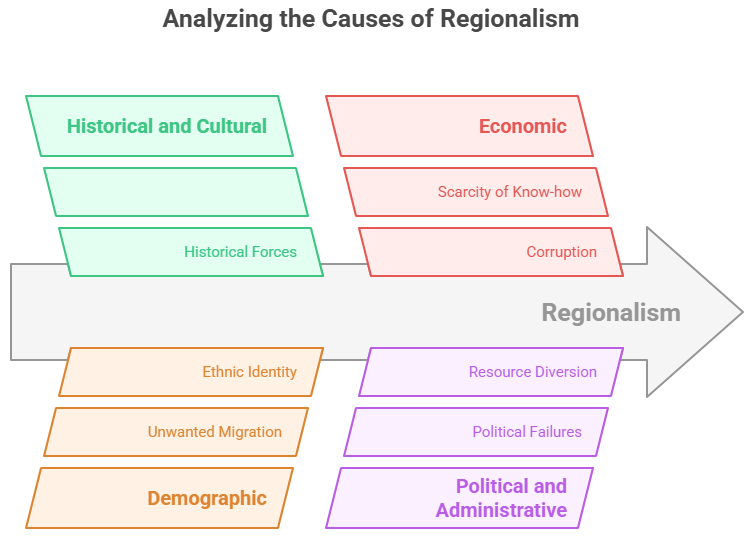
|
"Son of Soil" or nativist doctrine prioritizes locals over migrants in society, including employment and resources. It can empower locals but may also cause regionalism, discrimination, and social tension if mismanaged.
|
Major Political Movements Reflecting Regionalism
- The Self-Respect Movement Started in Tamil Nadu in 1925, focussed on empowering Dalits and non-Brahmins, later opposed Hindi imposition, and calling for a separate Dravidistan.
- Telangana dissatisfaction with agreement implementation grew after the formation of Andhra Pradesh.
- In 1969, discontent intensified against 1956 Gentleman’s agreement as guarantees were about to lapse.
- Government employees and opposition threatened direct action.
- This finally led to the formation of a separate Telangana state on June 2, 2014.
- Disparity between the regions originated from colonial rule, with Andhra under direct crown rule and Telangana under the less efficient rule of the Nizam of Hyderabad.
- Shiv Sena agitation against Kannadigas: Launched in Maharashtra under the banner of Marathi pride. In 1966, Shiv Sena launched its agitation against Kannadigas.
- Bodoland demand in Assam: Led by Assam Bodo Students Union, seeking a separate state due to educational and job disparities in backward regions.
Reasons Behind Regionalism in Andhra Pradesh and Telangana Claims
- The erstwhile united Andhra Pradesh was bifurcated more than eight years ago and the division of assets and liabilities between the two States remains elusive as the States make their own interpretation of the provisions under the Andhra Pradesh Reorganisation Act 2014.
- Several bilateral meetings between the two States as well as those convened by the Union Home Ministry failed.
|
Inter-State Disputes as Expressions of Regionalism
- Between Karnataka and Maharashtra on Belgaum where the Marathi speaking population is surrounded by Kannada speaking people
- between Kerala and Karnataka on Kasargod
- between Assam and Nagaland on Rengma reserved forests
Belagavi issue between Karnataka and Maharashtra
- This issue flared up again in 2022 when then Karnataka CM said the Karnataka government was considering laying claim to Jath taluk in Maharashtra, evoking a strong response.
- The issue soon escalated and strident protests by pro-Kannada and pro-Marathi activists broke out on both sides of the border.
|
- Use of water of three rivers mainly Narmada, Krishna and Cauvery in which states of Madhya Pradesh, Rajasthan, Gujarat and Maharashtra were involved.
- Disputes also arose regarding use of Cauvery waters among the states of Tamil Nadu, Kerala and Karnataka.
- Dispute between Punjab, Rajasthan and Himachal Pradesh over the use of waters of Ravi River.
- Issue over SYL – Satluj Yamuna link is looming between Haryana and Punjab.
SYL Issue
- The Punjab government has refused to construct the remaining portion of the Sutlej-Yamuna Link (SYL) Canal, saying it does not have additional river waters to share with Haryana, the Union government informed the Supreme Court in March 2023 in a progress report.
|
Impacts of Regionalism in India
Positive Impacts
- Nation Building: It can contribute to nation-building if regional demands are addressed.
- Regional Empowerment: Statehood or autonomy grants self-determination and empowerment.
- Democratic Engagement: Regional identities foster engagement with local governance. For example, the Tripura Tribal Autonomous District Council (TTADC) has helped protect tribal identity and reduce political extremism.
- Cultural Diversity: Regionalism respects socio-cultural diversity.
Negative Impacts
- Internal Security Challenges: Regionalism can threaten national unity and development, leading to insurgency.
- Political Impact: Regional demands influence national policies in coalition governments.
- Vote Bank Politics: Regional leaders exploit regionalism for vote bank politics, impacting democracy.
- Uneven Development: Development plans may favor regions associated with influential leaders, causing unrest.
- International Diplomacy: Regionalism affects international relations, as seen in Tamil Nadu's opposition to PM's visit to Sri Lanka and West Bengal's disagreements on border and Teesta river agreements.
Efforts to Address Regionalism in India
- Federal Structure: The federal system allows for the distribution of power between the centre and states, ensuring regional concerns are addressed at the state level.
- Autonomous Councils: The establishment of autonomous councils, like in Assam, Meghalaya, and Tripura, protects the interests and identities of minority groups.
- Coalition Governments: Coalition governments have accommodated regional parties in the center, allowing for regional issues to be given a national platform.
- Language Policies: The three-language formula promotes unity among linguistic groups.
- Panchayati Raj Institutions: Decentralization empowers local bodies.
- Developmental Schemes: Special packages promote balanced regional development.
- National Integration Council: Promotes harmony and unity among regions, communities.
- Inter-State Council: This constitutional body facilitates coordination between the states and the center, addressing regional disparities and promoting balanced growth.
- Zonal Councils: These statutory bodies aim to promote interstate cooperation and coordination, helping mitigate regional imbalances.
Reorganisation of States and Linguistic Regionalism
- The reorganization of states in India, primarily on linguistic lines, is a significant event in the country's post-independence history. This process began after independence in 1947 to meet the aspirations of diverse linguistic and cultural groups.
Before Independence
- Demand for linguistic reorganisation: Tilak advocated for linguistic reorganisation of provinces.
- Demand of All India Congress Committee (AICC): AICC demanded a Telugu-speaking state carved out of the Madras Presidency based on the recommendation of its Lucknow session.
- Acceptance of the demand for linguistic reorganisation: Following that, the Congress accepted the creation of linguistic states in principle at its Nagpur session in 1920.
- First state carved out on linguistic lines: Due to the efforts of Madhusudan Das, Odisha was the first Indian state to be formed on linguistic grounds in 1936, and it became Orissa Province.
Movement for Linguistic States after Independence
- Dhar Commission (1948): Led by Justice S.K. Dhar and was established to investigate the desirability of linguistic provinces, but it advocated against it due to concerns over national unity and administrative challenges.
- JVP Committee (set up in December 1948 and submitted its report in April 1949): Initially rejected language as the basis for state reorganization. However, Potti Sriramalu's hunger strike and death in December 1952 demanding Andhra State led to the creation of Andhra by separating Telugu-speaking areas from Madras.
- State Reorganisation Commission (Fazal Ali Commission): Set up due to the intensified demand for linguistic states. It recommended linguistic and cultural similarities, unity and integrity of India, administrative and economic considerations for state reorganization.
- Outcome: States Reorganisation Act 1956 and 7th Amendment Act 1956 were passed, abolishing Part-A and Part-B states and establishing 14 states and 6 Union Territories.
- Rajapramukh institution and special agreements with princely states were abolished.
- Article 371's control was repealed, and only Andaman and Nicobar, Delhi, and Manipur remained Union Territories.

States Reorganisation Act (1956)
- The States Reorganisation Act, 1956, was enacted by Parliament under Article 4 of the Indian Constitution.
- This act led to the formation of new states such as Andhra Pradesh, Bombay (now Maharashtra and Gujarat), Kerala, Madhya Pradesh, Madras (now Tamil Nadu), Mysore (now Karnataka), Punjab, and Rajasthan.
- Also, Five Zonal Councils were set up vide Part-III of the States Re-organisation Act, 1956.
|
Reasons behind the opposition to linguistic reorganisation of states
- Basis of reorganisation: Regionalism can occasionally sacrifice national interests in favour of local interests, and this policy boosted regionalism. Other considerations like administrative and economic weighting must be given due consideration as well.
- Threat to minority languages: Minority languages become more vulnerable. For minority languages like Naga, Bodo, and others, there have been numerous calls for independent linguistic states.
- Threat to one’s culture: Recently, there has been a worry of losing one's language and culture, as evidenced in Karnataka by laws encouraging Kannadigas in blue-collar occupations.
Strengthening of Indian Unity through Linguistic Reorganization
- End to Division: The process halted potentially divisive tendencies that could have fragmented the country on linguistic lines.
- Political Autonomy: It satisfied the desire of communities for self-governing political units.
- Vernacular Development: It promoted the growth and use of local languages, boosting literacy rates.
- Political Participation: The use of local languages in governance and public discourse encouraged widespread political engagement.
- Cultural Preservation: It enabled the safeguarding and celebration of local customs and traditions, enhancing cultural diversity. For example, Chhath celebrations in Gujarat.
- Fair Distribution: There have been no major complaints about resource distribution based on language, maintaining the federal structure of the country.
Some of the ongoing demands for new states
- Gorkhaland: The demand for a separate state of Gorkhaland has been long-standing in the Darjeeling and Kalimpong districts of West Bengal.
- Bodoland: The demand for a separate state of Bodoland is raised by the Bodo community in the Bodoland Territorial Area Districts (BTAD) of Assam.
- Vidarbha: The region of Vidarbha in Maharashtra has witnessed demands for separate statehood.
|
Conclusion
Various factors contribute to unfulfilled proposals for state creation, including ethnicity, underdevelopment, and logistical challenges. Some individuals seek separate states to preserve their ethnic traditions, while others desire better development.
20. Establishment of Parliamentary Democracy in India: Congress Era, NAM, Indira Gandhi’s Policies
Establishment of Parliamentary Democracy in India
- August 1947 to March 1952: Crucial period leading to the formation of the constitution and transitioning from the old legislative assembly to the newly elected parliament.
- First elections in 1951: Held after the constitution was established by the Constituent Assembly.
- Free and fair elections: Despite a large population facing poverty and illiteracy, India successfully conducted elections, with over half of eligible voters participating.
- The general elections of 1952 were significant in global history as a landmark for democracy.
One Party Dominated System in Parliamentary Democracy
- Indian National Congress (INC) controlled center and most states during Nehru years.
- Factors: Inclusive ideology, liberation movement, and prestige from national independence. Also, Opposition parties failed to unify against INC.
- Multiparty system formed after independence with Congress, Communists, and Bhartiya Jan Sangha. INC won 364 out of 489 seats in first Lok Sabha, surprising many.
- INC ruled in second and third general elections in 1957 and 1962.
- Era of Congress, as termed by political scientist Rajni Kothari.
Decline of Indian National Congress
- Fourth general election marked the loss of power for Congress. Nehru and Shastri's deaths before the 1967 elections affected the party's performance. Internal factionalism weakened the INC.
- Misinterpreted protests and loss of public faith.
- Opposition parties formed anti-Congress fronts through "non-Congressism" strategy.
- Congress faced defeats in states and defections prevented government formation. For instance, CPI and CPI(M) established the United Front administration with Congress dissidents.
- Regional party DMK ruled Madras State. Coalitions of non-Congress parties emerged in eight states, marking the era of coalition politics with the formation of Samyukt Vidhayak Dal (SVD).
- Decline of Indian National Congress:
- In 1967, the Congress faced losses, but still won a majority in the Lok Sabha.
- However, in states, defections prevented Congress from forming governments in seven states and two others. Regional party DMK ruled Madras State.
- Coalitions of non-congress parties took control in eight states. The era of coalition politics began when the Indian National Congress declined and non-Congress groups with differing ideas formed the Samyukt Vidhayak Dal (SVD).
Foreign Policy of Nehru
Independence coincided with the post-World War II era of emerging countries from colonialism. Cold War, imperialism, and national leaders' ideologies influenced foreign policy.

- The Agreement on Trade and Intercourse between Tibet region of China and India in April 29, 1954 highlighted the Five Principles of Peaceful Co-existence (Panchsheel).
Panchsheel became the foundation of the Non-Aligned Movement at the 1961 Belgrade Conference.
Non-Alignment Movement (NAM)
- Bandung Conference in 1955 laid the foundation for NAM, focusing on decolonization, peace, and economic cooperation.
- NAM was founded in 1961 in Belgrade, Yugoslavia, with leaders like Tito, Nehru, Sukarno, and Nasser.
- Emerged during the Cold War, aiming to maintain neutrality and independence from the US-Soviet blocs.
- Principles included opposition to colonialism, imperialism, and foreign domination, promoting peaceful coexistence and sovereignty.
- Rapid growth in membership, attracting countries from Africa, Asia, Middle East, and Latin America. By the 1970s, it had over 100 member states.
- Played a significant role in global politics, addressing disarmament, human rights, decolonization, and apartheid.
- Provided support to liberation movements and advocated for reforms within the UN.
- Challenged superpower dominance and asserted the interests of developing nations.
- Faced challenges in the post-Cold War era but remains relevant, addressing contemporary global issues.
Cold War movement of non-aligned nations seeking independence, decolonization, and a fairer world. It shaped global politics, challenged superpower dominance, supported developing nations. It remains a forum for member states to cooperate.
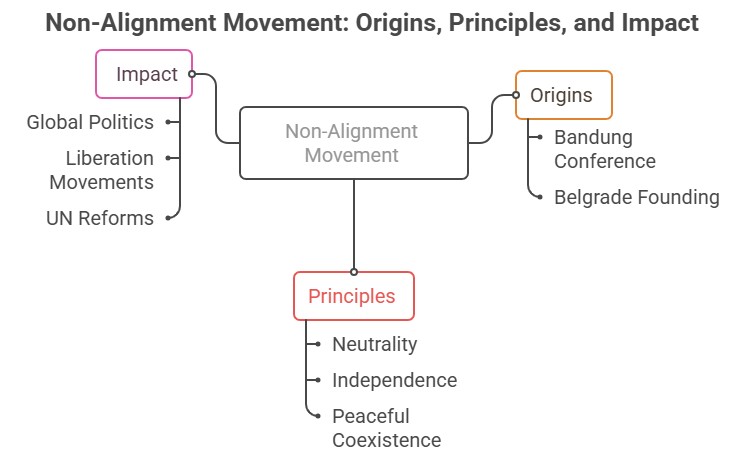
NAM's Importance for India
- The Non-Alignment Movement enabled India to make foreign policy judgements and take positions that benefited India rather than the superpowers and their supporters.
- India could balance power dynamics between superpowers, preventing one from overlooking or pressuring India.
- On several occasions, India has been chastised for its non-alignment stance. It was said that, in the name of promoting national interests, India frequently declined to take a hard stance on critical international issues, resulting in "unprincipled" policy. India was also chastised for having conflicting positions on similar matters, such as when it criticised nations for forming alliances then signed a treaty of friendship with the USSR for 20 years in 1971, claiming that it was required owing to the Bangladesh situation.
- India aimed to promote global peace through NAM, mediating tensions between the two Cold War coalitions.
- For this aim, India mediated between cold war adversaries, particularly those involved in the 1950s Korean War.
- The pinnacle of India's non-alignment policy came when it successfully ended the civil conflict in Congo.
- Following the same policy, the foreign powers recognised India's fairness during the 1956 Suez Canal issue.
India’s Engagement with the World powers after Independence
United States
- India initially had cordial relations with the US, which recognized its independence and provided economic aid and technical cooperation.
- Nehruvian era: India balanced engagement with the US and Soviet Union. Nehru criticized US policy but maintained diplomatic relations.
- U.S. assistance in development programs.
- Differences on non-alignment, border disputes, and support for Pakistan strained relations.
- US provided economic aid and technical cooperation to support India's development programs in agriculture, infrastructure, and education during the 1950s and 1960s.
- India and the US had differences on non-alignment, Indo-China border dispute, and US support for Pakistan in India-Pakistan conflicts. These strained bilateral relations at times.
Soviet Union
- Strategic partnership supporting India's economic development, industrialization, and defense needs.
- Defense cooperation as major supplier of military equipment, technology, and training.
- Nuclear Cooperation: The Soviet Union supported India's peaceful nuclear program and helped in building nuclear power plants, including the Tarapur and Kudankulam plants.
- Political support on international platforms, including conflicts with Pakistan and stance on Kashmir and Non-Aligned Movement.
- Economic and technical assistance in sectors such as heavy industry, science and technology, and space exploration.
Other World Powers
- United Kingdom: India maintained diplomatic relations with the UK, with trade and cultural ties influenced by colonial legacy.
- China: India's engagement was complex, initially recognizing and seeking friendly relations with the People's Republic of China. Border disputes and the 1962 war strained relations.
India – China Relations During Nehruvian Period
During the Nehruvian period (1947-1964), India-China relations experienced both cooperation and tensions. Here is an overview of India-China relations during that period:
Early Relations
- India recognized China early and supported its UN membership.
- The Panchsheel Agreement (1954) emphasized peaceful coexistence and mutual respect.
Border Dispute and Sino-Indian War
- Border disputes arose between them in the 1950s over Aksai Chin and the eastern sector with each side having differences over McMahon Line, the border between Tibet and India's northeastern region.
- In October 1950, China invaded eastern Tibet and occupied Chamdo, disregarding India's objections.
- India mediated, but China rejected offers and claimed Tibet as its own.
- The Panchsheel pact of 1954 recognized China's claim to Tibet, but Tibetans revolted for autonomy.
- The Dalai Lama sought sanctuary in India, causing tensions with China.
- Tensions between India and China escalated, resulting in the Sino-Indian War in 1962. The war ended in India's defeat and China's occupation of disputed territories. This conflict strained bilateral relations and had a lasting impact on India's view of China.
Impact on Non-Alignment
- The Sino-Indian War and China's aggression influenced India's policy of non-alignment. India became more cautious of China and forged closer ties with the Soviet Union to counterbalance China's influence.
- The conflict also affected India's international standing, with some non-aligned countries sympathizing with China and India's role within the Non-Aligned Movement being influenced by the conflict and alignment with the Soviet Union.
Attempts at Normalization
- After the Sino-Indian War, India made diplomatic efforts to normalize relations with China. High-level visits, such as Zhou Enlai's visit to India in 1960 and Nehru's visit to China in 1961, were conducted to improve ties.
- Both countries also engaged in negotiations and talks to resolve the border dispute, but these efforts did not lead to significant progress in resolving the underlying issues.
Result of attempts made at settling the disputes
- ‘Maintenance of Peace and Tranquillity’ (1993), military CBMs (1996), ‘Political Parameters and Guiding Principles’ for the settlement of boundary question (2005), and border defence cooperation (2012) — have failed to lead to a settlement of the border question.
Legacy
- The border dispute between India and China, originating from the Nehruvian period, remains unresolved and has resulted in periodic tensions and military standoffs, including the Doklam standoff in 2017 and the Galwan Valley clash in 2020.
- This conflict has shaped India's China policy, leading to an emphasis on border security, military preparedness, and a cautious approach to engaging with China.
In summary, India-China relations during the Nehruvian period started with goodwill and the Panchsheel Agreement but were strained by the border dispute and the Sino-Indian War. This led to a shift in India's policy and a closer alignment with the Soviet Union. The unresolved border issue remains a significant factor affecting India-China relations today.
Doklam Standoff (2017)
Doklam is a disputed area spanning less than 100 sq km at the trijunction of India, Bhutan, and China. The standoff arose in 2017 when China attempted road construction, objected by India and Bhutan. Doklam is strategically near the vulnerable Siliguri Corridor, linking mainland India with the northeast.
Galwan Valley Clash (2020)
- The eastern Ladakh border row escalated after the Galwan Valley clashes on June 15, 2020.
|
Criticism of Nehruvian Phase
- Indo-China war 1962: Ignored China's intentions and unpreparedness.
- Kashmir issue: Unilateral approach at UN, prolonged border dispute.
- Indo-China border dispute: Recognizing China's claim over Tibet.
- Ignored agriculture: Neglected food production, relied on foreign aid. • Closed economy: Self-reliance led to depleted foreign reserves, BoP crisis.
- Indo-China border dispute: Criticized for recognizing Tibet, missed opportunity for resolving NEFA issue.
- Ignorance of Agriculture: Excessive reliance on heavy industries, especially in the first years of the Mahalanobis plan, led to India's food deficit and the need for foreign aid.
Closed economy: Though the goal was self-reliance, the closed economy system eroded foreign exchange reserves, which led to the 1991 BoP crisis in India.
Shastri Era
The succession controversy arose after Jawaharlal Nehru's 1964 death. Lal Bahadur Shastri and Morarji Desai vied for the prime ministership. Shastri became Prime Minister under the Syndicate, a group of leading Congress leaders. He took office in June 1964.
Challenges
As India's Prime Minister, Lal Bahadur Shastri faced several challenges:
- A stagnating economy, worsening Balance of Payments, and serious food shortage.
- Protests in Tamil Nadu seeking English as the official language beyond the Constitution's 15-year limit.
- Demands for Goa's union with Maharashtra and Punjab's separation.
- Nagaland's independence movement.
- Kashmir and Pakistan's ambitions.
- China's power increased with October 1964 nuclear test.
Indo- Pakistan War (1965)
- Outcome: Strengthened China-Pakistan alliance, raised India's awareness of a two-front threat. Reason behind the war.
Reason behind the 1965 war
- Pakistani troops on 5th August 1965 posing as Kashmiri locals crossed the LOC intending to start an insurgency against the Indian army and government.
- This strategy of infiltration and starting an insurgency in Kashmir was done with a motive to gain control over Kashmir. This plan was named Operation Gibraltar.
Operation Gibraltar
- The operation was a failure as the presence of Pakistanis was reported to the Indian authorities. The Indian Army retaliated and captured Pakistan Occupied Kashmir (PoK) Haji Pir Pass.
Reasons why Operation Gibraltar Failed
- Differing views on the plan's effectiveness and execution.
- Clumsy and flawed attempt according to Pakistani and neutral analysts.
- Mis-judgment of Kashmiri people's response and lack of coordination among military services.
- Limited awareness among senior Pakistani officials and reluctance to escalate into a full-scale war with India.
- According to then Chief of the Pakistan Air Force, Air Marshal Nur Khan, there was little coordination amongst the military services on the impending operation.
- Many senior Pakistani military officers and political leaders were unaware of the impending crisis, thus surprising not only India, but also Pakistan itself.
- Many senior officials also were against the plan, as a failure could lead to an all-out war with India, which many wanted to avoid.
|
- Pakistan's misconception of India's weakness after its war with China influenced its strategy.
- The death of Nehru and India's food crisis, along with China's support to Pakistan, played a role.
- Operation Grand Slam targeted the Akhnoor Bridge in Jammu and Kashmir but was unsuccessful.
- Official beginning of the War: On 6th September, India crossed the international border (the Radcliffe Line), marking the official beginning of the war.
- The Indian Army captured certain areas in the Lahore district of Pakistan. The conflict ended on September 23, 1965, after the UN Security Council called for an unconditional ceasefire.
Circumstances after the end of the War
- Foreign intervention: The USA and the USSR diplomatically intervened to de-escalate the conflict. India emerged as the winner, although the conflict reached an impasse due to international pressure.
- Protests followed India's decision to agree to the ceasefire, with some believing a decisive victory was possible.
- Tashkent Agreement: Signed between President Ayub Khan and Lal Bahadur Shastri and was reached during ceasefire talks hosted by the USSR in Tashkent in 1966.
- The agreement obliged Pakistan and India to hand back the annexations to one other.
- Establishment of RAW: India formed the Research & Analysis Wing in response to the intelligence failure before the 1965 war.
- Enhanced tri-service coordination: India prioritized improving communication and coordination among its tri-services.
- Modernization of army: Post war, India took it upon itself to reorganise its armed forces as well as modernise its weaponry, the effect of which can be clearly seen in the 1971 victory.
- Changed foreign policy: United States and United Kingdom refused to supply India with sophisticated weaponry which strained the relations between the West and India. It distanced itself from Western powers and developed close relations with the Soviet Union.

Key provisions of Tashkent Agreement
- Pakistan has decided to abandon international arbitration in the Kashmir dispute.
- India will retreat from critical positions such as Haji Pir Pass and other strategic achievements in Kashmir.
- Both sides withdraw their forces to the locations they occupied prior to the war.
- The transportation of prisoners of war in a timely and organised manner.
- Diplomatic connections have been re-established.
- The refusal to use force to settle future disputes.
|
Advantages for India
- After losing to China, India's pride was restored.
- India became stronger and more unified politically.
- Litmus test of secularism: Indian Muslims supported the war, Muslims in the armed forces fought heroically, and infiltrators failed to win Kashmiri support.
|
The drawbacks for India
- The Tashkent accord did not include a no-war pledge or a renunciation of Kashmir guerilla warfare, which was unfavourable to India.
- Shastri accepted these harsh conditions since the alternative was to restart the terrible war.
- India lost critical places like the Haji Pir pass after the Tashkent agreement.
- Shastri ji's death in Tashkent caused political turmoil in India.
- After Shastri's death, succession was discussed again. The second succession in two years went smoothly, proving India's political system's resilience.
|
Initial Years of Indira Gandhi
Why Indira as Prime Minister?
- In 1966, Indira Gandhi emerged as the leader of the Congress party, overcoming competition from Morarji Desai with the help of K. Kamaraj.
- There were attempts to influence and control her within the political establishment.
Challenges for Indira Gandhi
- Indira Gandhi faced immediate elections within a year (in 1967) of becoming Prime Minister.
- India's economic status deteriorated due to conflicts and natural calamities.
- Despite her harsh leadership style, she won the 1967 general election. However, Congress' support base was diminishing due to economic and social crises.
- The party obtained a majority in the Lok Sabha, driven by public dissatisfaction with various issues.
Split in Congress
- After Shastri's death, the Congress party lacked clear political leadership, leading to a division between Indira Gandhi and Morarji Desai.
- Indira Gandhi's supporters formed the Indian National Congress (R), while those who opposed her formed the Indian National Congress (O).
- The death of President Zakir Hussain intensified the rift, with the Syndicate supporting a different candidate. Indira Gandhi promoted V.V. Giri as an independent candidate, causing further disagreements and Desai's resignation.
- S. Nijalingappa, the Congress President, issued a whip in Reddy's favor, but Indira openly backed Giri and called for a 'Conscience Vote.' Approximately one-third of the members voted for Giri, resulting in his election as President of India.
Indo-Pakistan War 1971 and Creation of Bangladesh
- Vijay Diwas is celebrated annually on December 16th to commemorate India's victory in the 1971 war against Pakistan and the liberation of Bangladesh.
Reasons that led to the War
- Language controversy: People protested Jinnah's decision to make Urdu the official language, which sparked the "Language Movement" led by Sheikh Mujibur Rehman to make Bangla the official tongue.
- Political imbalance: The Bengalis had no political say in the Pakistan administration in West Pakistan.
- Cultural differences: East Pakistanis prioritized their Bengali ethnicity, while West Pakistan favored an Islamic state with dominant Punjabi and Pashtun influences.
- Result of 1954 provincial elections: Awami League's victory was nullified, leading to riots.
- Pakistan's 1956 constitution declared it an Islamic Republic.
- Demands of the 6-point movement, 1966: East Pakistan demanded autonomy in several areas.
- Agartala conspiracy case, 1968: Mujibur Rahman accused of sedition and plotting with India.
- 1970 Cyclone Bhola: Lack of assistance increased hostility.
- Election of 1970: Awami League won, but PPP refused to accept the victory, leading to public disobedience.
- Operation Searchlight: West Pakistan kicked in operation searchlight across the whole of East Pakistan on March 26, 1971.
- Mass migration to India strained West Bengal, leading to appeal for assistance from Indira Gandhi.

Result of the 1971 War
- India launched a counterattack against both East and West Pakistan.
- East Pakistan declared independence as Bangladesh on 6 December 1971.
- Both countries agreed to a cease-fire and Z.A Bhutto emerged as a leader of Pakistan and Mujibur Rehman as the first President of Bangladesh in 1972.
- Shimla Agreement in June 1972 signed between Indira Gandhi and Z.A. Bhutto for restoration of peace and order.

Reason behind India’s decision to intervene in the War
- Refugee Crisis: The persistent influx of migrants from East Pakistan has generated various problems in the border states along with the scarcity of resources.
- Strategic Factors: Having West Pakistan and East Pakistan posed a strategic challenge for India. This was made worse by the tumultuous Sino-Indian ties that led to the war in 1962.
- Economic Pressure: India faced financial burden from hosting refugees and supporting the liberation of Bangladesh.
- Humanitarian Approach: India intervened to prevent further atrocities against East Pakistani citizens and avert a serious crisis.
Conclusion: India's role in the birth of Bangladesh has led to its current prosperity, marking a significant foreign policy achievement.
Major Economic developments during the Indira Gandhi
- Nationalization of Banks: In 1969, the Indian government, under Indira Gandhi's leadership, nationalized 14 major private banks, followed by six more in 1980.
- Aimed to promote rural banking, support agriculture and small-scale industries, and regulate credit flow for economic development.
- Green Revolution: Indira Gandhi promoted the Green Revolution in India through the introduction of high-yielding seeds, modern farming techniques, irrigation development, and increased use of fertilizers and pesticides. This led to a substantial increase in agricultural production, making India self-sufficient in food grains.
- Indira Gandhi's "Garibi Hatao" aimed to alleviate poverty. Measures included land redistribution, the Integrated Rural Development Program (IRDP) and the National Rural Employment Program (NREP) for rural development and employment.
- Indira Gandhi prioritized industrial growth and self-reliance. Investments were made in steel, coal, petroleum, and heavy machinery industries. Public-sector companies like SAIL and BHEL were established for increased industrial capacity and reduced import dependence.
- Indira Gandhi fostered close relations with the Soviet Union, receiving economic assistance for industrial projects and technology transfer. India also received economic aid from other countries and international organizations.
- During the Emergency from 1975 to 1977, Indira Gandhi's government implemented controversial policies, including stricter control over the private sector, regulations on industries, and the suspension of civil liberties. These policies had a lasting impact on India's economic and political landscape, although some were rolled back after the Emergency ended.
Emergence of Multi-Party system
Causes of Decline of Congress
- Anti-incumbency sentiments due to the party's long-standing rule
- Internal conflicts and lack of strong leadership
- Corruption allegations that damaged public trust
- Failure to connect with changing demographics and younger voters
- Emergence and success of regional parties
- Ideological shift away from traditional center-left policies.
Emergence of Multi-Party System
- Opposition parties like Ganatantra Parishad in Orissa, Samyukta Maharashtra Samiti, and Mahagujarat Parishad in Bombay emerged in different regions, challenging the Congress's dominance.
- The Congress lost power in Kerala, with the Communist Party of India (CPI) forming the government with independent support.
- In 1962, Congress's voting percentage dropped, resulting in 361 out of 496 parliamentary seats. Communists, the Swatantra Party (founded by C. Rajagopalchari in 1959), and the DMK improved.
- However, India's 1967 elections were a turning point. Congress suffered a major setback. Despite winning majority in the Lok Sabha, its seats dropped to 284 out of 520.
Politics of Defections
- Regional alliances were accepted because parties understood local issues and attempted to solve them.
- Corruption led to frequent defections among parliamentarians, with legislators in Haryana being famously referred to as "Aaya Ram and Gaya Ram" (incoming and outgoing Ram).
- Except for the Communist parties and Jan Sangh, party discipline broke broken.
- 16 states voted in 1967. The Congress only governed one state after losing majority.
- This election caused mass defections. Between 1967 and 1971, 142 MPs and 1900 MLAs switched parties.
- <span style="font-w
21. Naxalism
Maoist Movement in India: Origins and Evolution
- Maoist movement is one of the longest and deadliest insurgencies in the country's history.
- Left-Wing Extremism (LWE) traces its origins back to the Telangana peasant rebellion (1946-51) but reached its peak in 1967 with the Naxalbari uprising in West Bengal.
- After the initial rebellion was suppressed, the Naxalite movement emerged under leaders like Charu Majumdar, Kanu Sanyal, and Jangal Santhal.
- Naxalite rebels received support from local villagers and even the People's Republic of China, which referred to the movement as the "Spring Thunder."
- While initially inspired by Mao Zedong, the Naxalite movement developed its own distinct ideology, deviating from traditional Maoism.
Expansion and Consolidation of the Maoist Movement in India
- Naxalite movement spread across India, particularly in Andhra Pradesh, in the 1980s with the formation of People’s War Group (PWG) under the leadership of Kondapalli Seetharamaiah advocating for peasants’ rights through violent means.
- Despite suppression of PWG, the movement expanded to neighboring states like Madhya Pradesh, Jharkhand, Chhattisgarh, Odisha, and Maharashtra, leading to conflicts among fragmented Maoist groups.
- In 2004, various factions merged to form the Communist Party of India (Maoist), enabling the insurgents to strengthen forces, expand territorial presence, and enhance firepower.
- Maoists gained unprecedented geographic spread, surpassing other insurgent groups in India, with control over 200+ districts by 2006.
- Maoists established administrative and military infrastructures in Chhattisgarh, Odisha, Jharkhand, Maharashtra, Bihar, and West Bengal, modernizing their communication and warfare systems using information and communication technology.

Reasons behind Naxalite movement:
- Tribal Discontent: Forest conservation Act 1980 and displacement due to development projects contribute to tribal discontent and their susceptibility to joining the Naxal movement.
- Easy Targets: Maoists exploit vulnerable individuals without livelihood options, providing them with arms, ammunition, and money.
- Socio-economic Gaps: Government focuses on countering violent attacks rather than addressing socio-economic development in Naxal-affected areas.
- Weak Technical Intelligence: Limited technical intelligence hampers effective countermeasures, especially in areas with inadequate infrastructure and communication networks.
- Lack of Administrative Follow-up: After regaining control, the administration fails to provide essential services to the affected population.
- Confusion over Approach: State governments often perceive Naxalism as a central government issue, leading to a lack of proactive initiatives at the state level to combat the problem.
Government’s approach against Naxalism:
- Operation Green Hunt: Started in 2010 and massive deployment of security forces was done in the naxal-affected areas. From 223 districts that were affected due to naxalism in the year 2010, the number came down to 90 in nine years.
- Aspirational Districts Programme: Holistic approach addressing security, development, rights of local communities, governance, and public perception management.
- Operation SAMADHAN: Ministry of Home Affairs’ initiative focusing on smart leadership, aggressive strategy, motivation and training, actionable intelligence, technology utilization, and finance control.
- Operation Prahar: It is part of the government strategy to deal with the armed challenge posed by the Naxal insurgents. It was launched in 2017.
- Technological interventions: At least one UAV or Mini UAV is deployed for each of the Central Armed Police Forces (CAPF) battalions deployed in the Maoist hotbed.
- Joint Task Forces for operations along inter-State boundaries to be set up. Better inter-state coordination and intelligence sharing.
- ‘Police’ and ‘Public Order’ being State subjects, action on maintenance of law and order lies primarily in the domain of the State Governments. For this government has taken following steps:
- Filling up critical infrastructure gaps under the Scheme for Special Infrastructure in Left Wing Extremism affected States.
- Assistance in training of State Police through the Ministry of Defence.
- Assistance in community policing and civic action programmes.
Through a holistic approach focusing on development and security related interventions, the LWE problem can be successfully tackled. Civil society and the media should build pressure on the Maoists to eschew violence, join the mainstream and recognise the fact that the socio-economic and political dynamics and aspirations of 21st Century India are far removed from the Maoist world-view.
22. Indian Economy Since Independence: Evolution, Policies & Growth
Post-independence, India embarked on a journey to develop its economy and uplift its citizens from poverty. Here is an overview of the history of Indian economy development since independence
Indian Economy During Nehruvian Era (1950s–1960s)
- Five-Year Plans: These plans focused on industrialization, agrarian reforms, infrastructure development, and social welfare.
- Mixed Economy model with a combination of public sector enterprises and private sector participation. Nationalization of key industries and dominant role of the government in economic planning and regulation.
- Import Substitution Industrialization (ISI) policy aimed to reduce dependence on imports through protective tariffs and licenses.
- Growth of self-reliant industrial base but faced challenges of inefficiency and quality concerns.
- Economic challenges including low per capita income, widespread poverty, low literacy rates, and inadequate infrastructure.
- Instances of macroeconomic imbalances, such as inflation and balance of payments issues.
Industrialization and Public Sector Development in the Indian Economy
- Emphasis on the development of heavy industries such as steel, power, and machinery. Notable projects like the Bhakra-Nangal Dam and the establishment of the Steel Authority of India (SAIL).
- Establishment of public sector enterprises like Hindustan Aeronautics Limited (HAL), Bharat Heavy Electricals Limited (BHEL), and Indian Oil Corporation (IOC). Public sector enterprises played a crucial role in promoting industrial growth and self-reliance in key sectors of the economy.
Agricultural Reforms and Food Security in Indian Economy
- Agrarian reforms introduced by Nehru to address issues of landlessness, tenancy, and unequal land distribution. Measures such as the abolition of intermediaries and implementation of land ceiling laws aimed at improving agricultural productivity and reducing inequality.
- Community development programs initiated by Nehru focused on rural development, agricultural extension services, and promotion of cooperative societies.
Infrastructure Development
- Construction of dams, irrigation canals, and hydroelectric power projects to enhance agricultural productivity, generate electricity, and provide irrigation facilities.
- Emphasis on the expansion of railways and road networks to improve transportation, trade, and connectivity across the country
Issues with Indian Economy during Nehruvian Phase
- Slumped growth of agriculture: From 1951 to 1965, industry grew at 7.1% annually. Agriculture received less attention, spending reduced during second Five Year Plan. Sector developed at over 3% per year, more resources could have accelerated growth.
- Dependence on foreign aid for development projects, creating dependencies and limiting self-reliance.
- Implementation of price controls and subsidies on essential commodities to address social welfare concerns, but resulting in distortions, black markets, and inflationary pressures.
- Limited Industrial Growth: The focus on public sector enterprises and import substitution policies led to inefficiencies and lack of competition, hindering industrial development.
Indian Economy between 1965 to 1980
- Rapid industrialization reduced agriculture spending, second Plan saw 50% cut.
- The failure of the monsoon and its impact on inflation.
- Consecutive monsoon failures in 1965 and 1966 worsened the already stagnant agriculture sector, leading to a decline in agricultural output.
- The USA decided not to renew the long-term PL-480 (wheat loan) agreement with India due to India's stance on Vietnam.
- Impact of Wars: The conflicts in 1962 and 1965 led to increased defence spending, causing a fiscal deficit of 7.3% of GDP for the governments in 1966-67.
- The balance of payments situation worsened due to insufficient reserves. Foreign exchange reserves averaged around $340 million from 1964-65 to 1966-67, which was not enough to cover even two months of imports.
- Foreign aid has become increasingly relied upon during the first three Plans, but now its dependence has significantly grown due to food shortages and a negative balance of payments.
- Reform measures: After 1967, a series of radical economic policies were implemented in India, which had a lasting impact on the country's development efforts. The user mentioned that there are some things that they want to discuss.
- On July 20, 1969, the 14 major private commercial banks underwent nationalisation.
- In 1972, insurance was nationalised.
- In 1973, the coal industry underwent nationalisation in the power sector.
- Aims of reforms: The move aimed to increase bank lending to agriculture, as big businesses were dominating the credit flow.
- In 1969, the Monopoly and Restrictive Trade Practises Act (MRTP) was passed to promote a competitive environment in business by imposing restrictions on the activities of large business houses.
- After 1969, any business group with assets exceeding Rs. 20 crores were deemed a monopoly and prohibited from further business expansion.
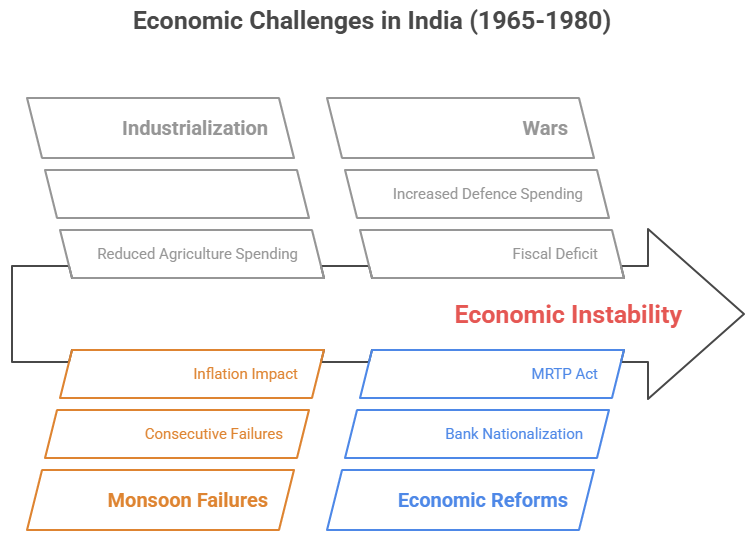
Control and Intervention Measures in Indian Economy
- Foreign Exchange and Regulation Act (FERA) enacted in 1973 imposed strict regulations on foreign investment in India.
- Nationalisation: The government has chosen to acquire and manage struggling companies, including textile mills, instead of letting them shut down.
- India briefly suspended its five-year plans and instead implemented annual plans between 1966 and 1969. The country decided not to allocate resources for an extended period.
Industrial Policy of 1977 and Its Impact on Indian Economy
- The policy focused on promoting cottage and small industries in rural areas and small towns.
- The policy classified the small sector into three groups: cottage and household sector, tiny sector, and small-scale industries.
- It aimed to prevent large business houses from gaining a dominant and monopolistic position in the market by limiting their scope.
An analysis of Phase -1
- Bank nationalisation enhanced financial inclusion and increased farm credit.
- Opening of bank branches in rural areas increased financial savings.
- Crony capitalism resulted from lending decisions influenced by politics.
Onset of Balance of Payment Crisis (1980s to 1991) in Indian Economy
- Indira Gandhi devalued the rupee by 57% to address the balance of payments crisis.
- Measures were taken to decrease the fiscal deficit by reducing government spending instead of increasing taxes. The action resulted in increased inflation and faced widespread criticism.
- The sixth five-year plan (1980-85) focused on implementing measures to enhance the economy's competitiveness.
- Delicensing: a series of measures taken to remove price controls, implement fiscal reforms, revamp the public sector, reduce import duties, and end the licencing of the domestic industry. Raj.
- The Industrial Policy of 1980 aimed to boost economic federation, improve the public sector's efficiency, and reverse the decline in industrial production.
- It also expressed support for the Monopolies and Restrictive Trade Practises (MRTP) Act and the Foreign Exchange Regulation Act (FERA).
- During Rajiv Gandhi's tenure as Prime Minister, his government implemented several reforms in the late 1980s.
- These reforms included relaxing the process of granting licences, reducing import restrictions, and introducing export incentives.
- The MRTP asset limit has been increased to Rs. 100 crores, which is five times higher than before.
- The 1985-86 budget reduced direct taxes for companies and increased income tax exemption limits.
- In 1982-83, the government made changes to the capital markets to attract more foreign investments, with a focus on non-resident Indians.
- In the 1980s, India experienced a significant increase in its growth rate, surpassing the previous three-decade record. This growth rate, which was previously referred to as the "Hindu rate of Growth" by Prof. Raj Krishna, reached over 5.5 percent of GDP.
Outcome of efforts of Rajiv Gandhi Government
- The 1980s modifications were a flexible approach within the control regime, but underlying structural weaknesses persisted.
- The issue of a structural bottleneck has not been addressed or resolved. In the 1980s, the Indian economy seemed to be thriving, but underlying structural weaknesses were emerging.
- The user mentions several factors that contributed to the economic situation, including industrial control, the licence raj, the Monopolies and Restrictive Trade Practises Act (MRTP) of 1969, nationalisation of banks and industries, self-sufficiency, and an inward-looking trade policy.
- In the late 1980s, there was a significant trade deficit as imports were almost double the number of exports. This led to export earnings being only 55% of the total imports.
- India began relying heavily on short-term borrowings in the late 1980s.
- India's weak macroeconomic indicators have resulted in negative macroeconomic fundamentals.
- In 1990-91, there were several economic challenges faced by the country including a fiscal deficit of 8.4%, a current account deficit of 3.1%, high inflation of 17%, and a significant foreign debt.
- The Balance of Payments (BoP) is heavily affected by all these factors, causing significant strain.
Liberalization and Globalization (1990s onwards):
- Economic Reforms: Starting in the early 1990s, India initiated economic liberalization and embraced globalization. Reforms included deregulation, liberalization of trade and foreign investment, privatization of state-owned enterprises, and financial sector reforms.
- Liberalization of Key Sectors: Sectors such as telecommunications, information technology, and services experienced significant growth and became key drivers of the Indian economy.
- Foreign Direct Investment (FDI): Policies were implemented to encourage FDI inflows and improve the ease of doing business in India.
- IT and Services Boom: India emerged as a global hub for information technology (IT) services and business process outsourcing (BPO).
- Infrastructure Development: Investments were made in infrastructure, including transportation networks, power generation, and urban development. Initiatives such as the Golden Quadrilateral highway project aimed to enhance connectivity and support economic growth.
- Socioeconomic Progress: There were improvements in areas such as literacy rates, life expectancy, healthcare, and poverty alleviation. Government programs targeted social welfare, rural development, and inclusive growth.
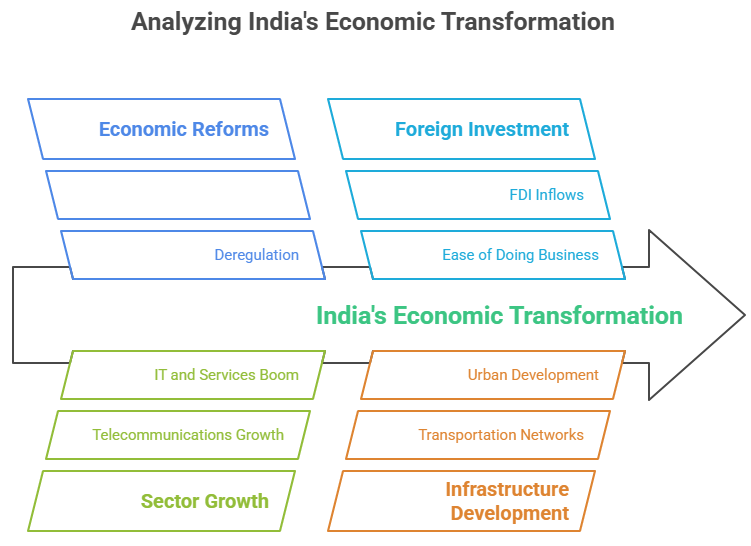
Recent Years
- Emphasis on Ease of Doing Business: India has undertaken reforms to improve the ease of doing business, streamline regulations, and attract investment.
- India jumps 79 positions from 142nd (2014) to 63rd (2019) in 'World Bank's Ease of Doing Business Ranking 2020'.
|
- Digital Transformation: The government has prioritized digitalization and e-governance initiatives, promoting digital payments, expanding internet connectivity, and leveraging technology for service delivery and financial inclusion.
- India with 89.5 million digital transactions in the year 2022 has topped the list of five countries in digital payments, according to data from MyGovIndia.
|
- Start-up Ecosystem: India has witnessed the rise of a vibrant start-up ecosystem, fostering innovation, entrepreneurship, and job creation. Various government initiatives and funding support have boosted the growth of start-ups in sectors like technology, e-commerce, and fintech.
|
The Startup India initiative was launched on 16th January 2016, by the Hon’ble Prime Minister. Since the inception of the initiative:
- There are over 99000+ startups recognized by the government of India as of May 2023
- 49% of them having a base in Tier 2 - Tier 3 cities
- These startups are spread over 669 districts from 36 States and Union Territories of India
- As of 31st March 2023, India is home to 108 unicorns with a total valuation of $ 340.80 Bn.
|
The journey of Indian economic development since independence has seen a transition from a planned economy to economic liberalization, embracing globalization and fostering entrepreneurship. Challenges such as poverty, inequality, and job creation remain, but India has emerged as one of the world's fastest-growing major economies and a key player in the global economy.
23. Radhakrishnan Commission & Evolution of Indian Education Policy: Key Reports to NEP 2020
Radhakrishnan Commission (1948–49) laid the foundation for reforms in university education in India, emphasizing quality, language policy, and administrative oversight. Subsequent commissions and policies, including the Kothari Commission and NEP 2020, have shaped the evolution of India’s education system toward inclusivity and modernization.
Radhakrishnan Commission 1948–49
The commission investigated university education throughout the nation. The main suggestions were these.
- Pre-university education should last 12 years.
- Central, liberal, and occupational education should comprise higher education.
- Administrative workers don't need degrees.
- Establish Shantiniketan and Jamia Millia-style rural universities.
- University education should be in the constitution's "Concurrent List" and examination requirements should be improved.
- A national University Grants Commission should oversee university education.
- Higher education should not abandon English.
- Where federal language and mother tongue are different, federal language should be the medium of education; where they are the same, the kid should learn a classical or modern Indian language.
Steps taken on Radhakrishnan Commission (1948–49)
- Following these recommendations, the University Grants Commission was established in 1953 and granted autonomous statutory status by an act of parliament in 1956.
Mudaliyar Commission for secondary education in 1952.
- No formal policy was created from these commissions' reports, but action was taken.
Kothari Education Commission (1964-66)
Congress was condemned in Parliament in 1964 for neglecting to promote a national education concept and vision. Thus, Dr. D.S. Kothari's commission advised on national education policy. The commission's findings highlighted:
- Work-experience, including manual labour, production, and social service, is included into general education at all levels.
- Moral education and social responsibility.
- Secondary school vocationalization.
- Strengthening advanced study centres and creating a few big universities with excellent international standards.
- Teacher training and quality are prioritised.
- Educational rebuilding should prioritise agriculture and allied science education and research.
- Quality or pace-setting institutions at all levels and sectors.
- The commission found that mother-tongue was best for school and college education.
- Additionally, school and higher education should use the same medium.
- Higher education should use regional languages.
- The panel also noted that demand for secondary and higher education had increased and would continue to rise.
- To meet public demand and existing facilities, selective admissions to higher secondary and university education were needed.
National Education Policy 1968
Indira's first National Policy on Education (NPE) followed Kothari Commission recommendations.
Policy highlights included
- Free, mandatory education till 14.
- Improved teacher status and pay.
- Three languages—mother tongue, Hindi, and English—and regional language development.
- Science and research education parity.
- 6% of GDP on education, training, and teacher quality.
- Cheap textbooks of higher quality.
- Agriculture/industry education development.
Analysis
- It was the first attempt to give Independent India's educational system direction, making it a significant milestone.
- Three-language formula was praised for national integration. The policy's recognition of central government education promotion was a promising start.
- Critics said: Political compromise characterised the three-language model. Despite the good intentions, it would burden pupils.
Education in Concurrent List
- Before 1976, state administrations delivered education at the district and taluka levels, with the central government just advising.
- Academics believed that education delivery systems were inefficient, hence the central and states should share responsibility for it.
- The 42nd Constitutional Amendment Act of 1976 included education on the Concurrent List.
National Policy on Education, 1986 (NPE)
It sought to create a national education system that provided high-quality education to all pupils, regardless of caste, creed, sex, religion, etc. Some of its goals were:
- Primary education for all.
- Help youngsters gain important skills by improving school quality.
- Secondary education: Improve education by teaching computer skills.
- Higher education should enable reflection on important social, economic, cultural, moral, and spiritual issues.
- Thus, education must empower women and enable minorities and underprivileged groups achieve social equality.
Acharya Ramamurti Committee
In 1992, the Acharya Ramamurti Committee created the 1986 policy's Action Plan.
- The NPE 1986 was updated to achieve universal enrolment and retention of children in schools and successful completion of education up to 14 years of age.
|
Key Features of Acharya Ramamurti Committee
- The "plus two stage" was recommended for all schools.
- Decentralised elementary education planning and control were also considered.
- Value education and understanding the country's cultural heritage were stressed.
- To boost individual and national production, it prioritised vocational education.
|
Achievements of NPE 1986
- NPE 1986 was a milestone in independent India's history.
- Secularism, socialism, and democracy were stressed for the country's population.
- Policy aimed to reduce urban-rural education disparity and improve women, SCs, and STs' education and vocational training.
- Policy was criticised for ignoring other factors affecting education, such as civil society activism, research, and societal changes.
|
Right to Education (86th Constitutional amendment Act)
- The Constitution's Directive Principles mandated free and compulsory education until age 14, but this was not followed.
- In 1993, the Supreme Court ruled in J.P. Unnikrishnan vs. the State of Andhra Pradesh, establishing the right to free education for children under 14 and providing a legal remedy for inadequate facilities.
- The United Front administration proposed a Constitution Amendment Bill in July 1997 to add Article 21 A to the Constitution, which was enacted in December 2002 as the 86th Constitution Amendment Act.
86th Amendment
- It introduced article 21A, which stipulates that “the state shall provide free and compulsory education to all children of the age of six to fourteen years in such manner as the state may, by law, determine”.
- It paved the way for Right to Education Bill 2005, 2008, and 2009.
- Right to Education Act (RTE), 2009 Article 21-A took effect on April 1, 2010.
New Education Policy (NEP) 2020
It transforms education in India with key changes:
- Holistic education: Integrated approach with arts, sports, and vocational skills.
- Early childhood care: Quality education for children aged 3-6.
- Foundational literacy: Focus on reading, writing, and math by Grade 3. It aims to ensure that every child attains basic reading, writing, and mathematical abilities early in their education.
- Flexible Curriculum and Choice-based Learning: Choice-based learning and multidisciplinary study options.
- Multilingualism: It encourages the medium of instruction to be the mother tongue or local language until at least Grade 5 and beyond.
- Technology integration: The policy emphasizes the integration of technology in education to enhance teaching and learning. It aims to provide digital infrastructure, e-resources, and platforms for online learning, especially in remote areas.
- Teacher Training and Professional Development: The NEP focuses on enhancing the quality of teachers through improved training, continuous professional development, and standardized teacher recruitment processes.
- Assessment Reforms: The policy advocates for a shift from rote learning to a competency-based assessment system. It promotes formative assessments, critical thinking, and analytical skills rather than relying solely on high-stakes board exams.
- Higher Education Reforms: The NEP introduces reforms in higher education, including the restructuring of the higher education regulatory system, the promotion of research and innovation, and the establishment of a National Research Foundation (NRF).
- Focus on Equity and Inclusion: The policy aims to address inequities in education access and quality by providing special provisions for disadvantaged groups, economically weaker sections, and students with disabilities.
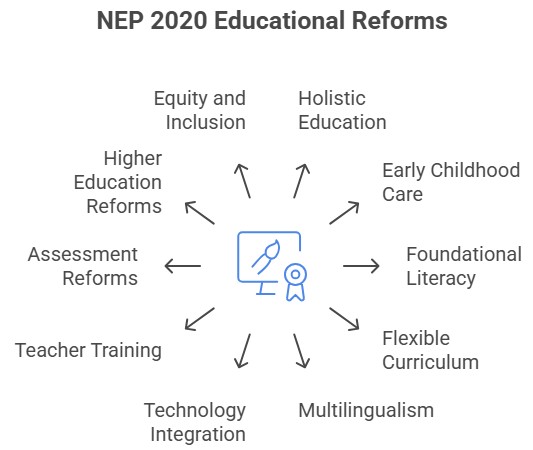
Conclusion
India has evolved to a rights-based framework that requires the central and state governments to implement this essential child right as guaranteed in Article 21A of the Constitution in line with the RTE legislation.
Scientific Developments
After India's independence in 1947, the country has made significant scientific advancements across various fields. Here are some key scientific developments in India after independence:
Technical education, Space Research and Exploration: The government worked to improve technical education infrastructure.
- The government opened the Indian Institute of Technology (IIT) in Kharagpur, West Bengal, on August 18, 1951.
- It opened the nation's first technical college.
- In Bombay, Madras, Kanpur, and Delhi, similar institutions followed.
- The government produced the Scientific Policy Resolution of 1958, which emphasised "pure, applied, and educational" cultivation of science and scientific research.
- Establishment of DRDO: The government merged the Technical Development Establishment, Directorate of Technical Development and Production, and Defence Science Organisation to create the country's top military research and development organisation, the Defence Research and Development Organisation (DRDO).
- Space research: The government established the Indian National Committee for Space Research (INCOSPAR) under the Department of Atomic Energy (DAE) in 1962. Indian Space Research Organisation (ISRO) replaced it in 1969.
- Rohini, the first Indian satellite launched using SLV-3, was launched by ISRO in 1980.
- ISRO has successfully launched numerous satellites, including the Chandrayaan lunar missions and the Mars Orbiter Mission (MOM).
- Geosynchronous Satellite Launch Vehicle (GSLV): India developed the GSLV, a launch vehicle capable of placing satellites into geostationary orbits. It has played a crucial role in India's space exploration efforts.
- Mangalyaan (Mars Orbiter Mission): In 2014, India successfully launched the Mangalyaan spacecraft, making India the first country to reach Mars' orbit in its first attempt.
- Currently India is planning to study Sun (Adity L-1 Mission) and Under Gaganyaan Mission, it will send the first-time humans to the space.
|
India's first privately-developed rocket:
- Vikram-S, India's first privately-developed rocket, lifted off from Indian Space Research Organisation's (ISRO) launchpad in Sriharikota in November 2022.
|
Nuclear Technology
- Nuclear Power: India has made advancements in nuclear power generation.
- Nuclear Weapons Program: India conducted its first nuclear test in 1974 and became a nuclear weapons state in 1998. These developments marked significant milestones in India's nuclear technology capabilities.
Information Technology (IT) and Software
- IT Services and Outsourcing: India has emerged as a global leader in IT services and software development. Indian IT companies provide a range of services, including software development, IT consulting, and business process outsourcing.
- Software Development: Indian software developers have contributed to various sectors, including finance, healthcare, e-commerce, and telecommunications.
- Overall, India's tech industry is estimated to touch $245 billion in the 2022-23 financial year, with an incremental revenue addition of $19 billion during the same period
Biotechnology and Pharmaceuticals
- Pharmaceutical Industry: Indian pharmaceutical companies have made significant advancements in drug research and development.
- Biotechnology Research: India has made strides in biotechnology, including areas such as genetic engineering, bioinformatics, and biopharmaceuticals. Research institutions and biotech companies contribute to scientific breakthroughs and drug discovery.
- The Ministry of Science and Technology created a biotechnology department in 1986, which boosted development in that area. Biotechnology helped Indian agriculture.
Pharmaceutical Industry in India
- The pharmaceutical industry in India is expected to reach $65 Bn by 2024 and to $130 Bn by 2030.
- The pharmaceutical industry in India is currently valued at $50 Bn.
- India supplies over 50% of Africa’s requirement for generics, ~40% of generic demand in the US and ~25% of all medicine in the UK.
|
Renewable Energy and Environmental Technologies
- Solar Power: India has witnessed significant growth in solar power generation. It has implemented large-scale solar energy projects and initiatives to promote renewable energy adoption.
- Environmental Technologies: Indian scientists and engineers have developed technologies to address environmental challenges, including waste management, pollution control, and water conservation.
- India stands 4th globally in Renewable Energy Installed Capacity (including Large Hydro), 4th in Wind Power capacity & 4th in Solar Power capacity (as per REN21 Renewables 2022 Global Status Report).
|
Scientific Institutions and Research
- Premier Research Institutes: India is home to esteemed research institutions such as the Indian Institutes of Technology (IITs), Indian Institutes of Science Education and Research (IISERs), and Council of Scientific and Industrial Research (CSIR) labs. These institutions contribute to innovative research and innovation.
- DST was founded in 1971. It promoted and identified frontline and priority R&D in many science and technology fields, international scientific and technological affairs, and science and technology entrepreneurship.
- Science Education and Research Funding: The government has focused on promoting science education and research funding, providing support for scientific research and infrastructure development.
- The first Indian Antarctic mission left Goa in 1981, the "Indian Antarctic Programme" began. Indian Antarctic base Dakshin Gangotri received more missions each year.
- Maitri, a permanent Antarctic base constructed in 1991, is still in operation.
Institution of Eminence (IoE)
- In 2018, the government awarded Institution of Eminence (IoE) status to three public and three private institutions — IIT-Delhi, IIT-Bombay, Indian Institute of Science (IISc), BITS-Pilani, Manipal Academy of High Education, and Reliance Foundation’s proposed Jio Institute near Navi Mumbai.
- The Union Cabinet had approved UGC’s ‘Institutions of Eminence Deemed to be Universities Regulations 2017’, in August, 2017.
|
Conclusion
The scientific developments in India have contributed to national progress, technological innovation, and global recognition.