

Get an Instant Call Back from Our Expert Mentors!
The Civil Disobedience Movement (1930–1934), led by Mahatma Gandhi, was a landmark phase in India’s freedom struggle. Beginning with the Dandi March, it united millions in defying British laws and demanding complete independence (Purna Swaraj).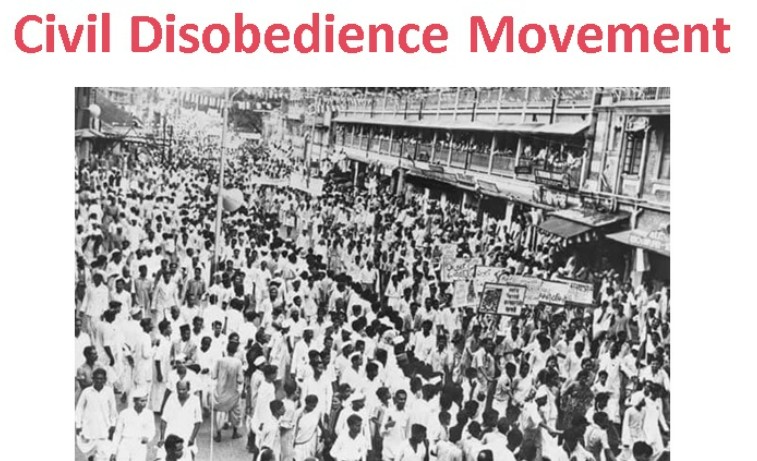
Civil Disobedience Movement (1930–1934)
- On April 6, 1930, Mahatma Gandhi initiated the Civil Disobedience Movement by collecting salt at the end of the Dandi March from Sabarmati Ashram to Dandi, breaking the government's salt law.
- His leadership galvanized widespread grassroots involvement in the freedom movement.
- The movement gained momentum nationwide as people rebelled against the salt tax. During the initial stage of the movement, salt-making emerged across the nation, symbolizing public resistance against the government.

Objective of the Civil Disobedience Movement
The movement aimed to challenge British salt laws and unfair taxation policies, while also demanding complete independence for India.
Negotiations and Truce: After several months, negotiations took place between the British and Indian leaders, leading to the Gandhi-Irwin Pact in 1931, which temporarily halted the movement.
Compared to Non-Cooperation Movement
- The stated objective this time was complete independence and not just remedying two specific wrongs and a vaguely-worded swaraj.
- The methods involved a violation of the law from the very beginning and not just non-cooperation with foreign rule.
- There was a decline in forms of protests involving the intelligentsia, such as lawyers giving up practice, and students giving up government schools to join national schools and colleges.
- Muslim participation was nowhere near the Non-Cooperation Movement level.
- No major labor upsurge coincided with the movement.
Round Table Conferences
Nevertheless, the conferences played a role in shaping the political discourse and highlighting the diverse interests and challenges in India's struggle for self-rule.

|
First Round Table Conference (1930-1931) |
Second Round Table Conference (1931) |
Third Round Table Conference (1932) |
|
|
Dates |
November 12, 1930 - January 19, 1931 |
September 7, 1931 - December 1, 1931 |
November 17, 1932 - December 24, 1932 |
|
Key Participants |
- Ramsay MacDonald (British Prime Minister) - B.R. Ambedkar - Tej Bahadur Sapru - Aga Khan III - Srinivasa Sastri - Sarojini Naidu - Various Princes and Representatives from Indian States |
- Mahatma Gandhi - B.R. Ambedkar - Madan Mohan Malaviya - Sarojini Naidu - Sir Mohammad Iqbal - Aga Khan III - Ramsay MacDonald (British Prime Minister) |
- B.R. Ambedkar - Tej Bahadur Sapru - Sir Mohammad Iqbal - Various Representatives from Indian States |
|
Main Discussions |
- The structure of government in British India - Representation of the provinces - The role of native princes in governance - Minority representation and rights |
|
- Awarding a separate electorate to the 'Depressed Classes' (Scheduled Castes) - Representation of minority communities - Drafting of a new constitution for India |
|
Key Outcomes |
- It was decided that India should have a federal structure with autonomy for provinces. - Agreement on the need for communal representation. |
|
|
Communal Award and Poona Pact (1932)
Communal Awards
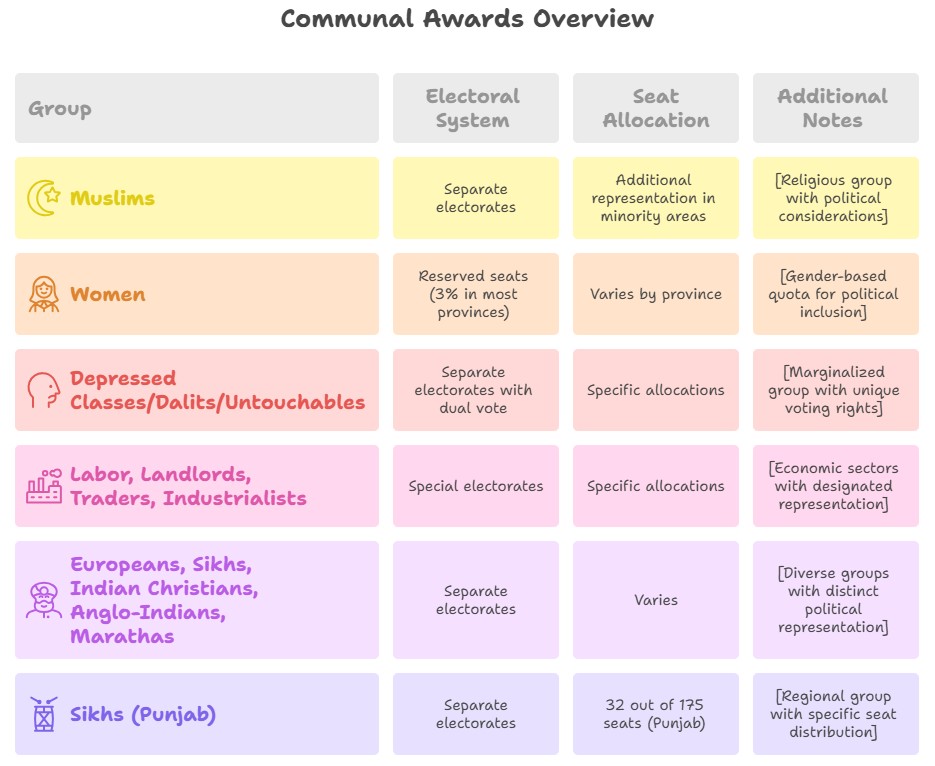
- Provincial legislature seats were set to be doubled.
- Separate electorates for minorities were maintained.
- Muslims received additional representation in areas where they were a minority.
- In all provinces except NWFP, 3% of seats were reserved for women.
- Depressed classes, Dalits, and untouchables were officially recognized as minorities.
- Specific allocations were made for labor, landlords, traders, and industrialists.
- Various groups, including Muslims, Europeans, Sikhs, Indian Christians, Anglo-Indians, Depressed Classes, and Marathas, received separate electorates.
- Depressed classes were allocated seats through elections from constituencies where only they could vote, but they could also vote in general elections.
- Special electorates were established for sectors like labor, commerce, industry, mining, plantations, and landowners.
- In Punjab, Sikhs, who comprised 13.2% of the population, were allocated 32 out of 175 seats.
|
Responses:
|
Poona Pact:
|
Government of India Act 1935
The Government of India Act 1935 was a significant piece of legislation enacted by the British Parliament to address the growing demands for greater Indian participation in the governance of the country.
Major Provisions
- Federal Structure: Establishment of a federal structure for India, with power divided between the central government and the provinces. This federation never fructified since princely states did not join it.
- Provincial Autonomy: It granted a significant degree of autonomy to the provinces, empowering them with legislative and executive authority over a range of subjects.
- Separate Electorates: It retained the provision of separate electorates for religious minorities, ensuring representation for Muslims, Sikhs, Christians, and Anglo-Indians.
- Franchise: The Act introduced limited electoral reforms, expanding the electorate by extending voting rights to a larger segment of the population.
- Central Government: It established a bicameral legislature at the centre, consisting of the Federal Assembly and the Council of States.
- Reserved Subjects: It assigned reserved subjects, exclusively to the central government's jurisdiction, including defence, foreign affairs, and the administration of tribal areas.
- Provincial Governors: It introduced the concept of provincial governors, who held significant powers and acted as representatives of the British Crown.
- All India Federation: It proposed the formation of an All-India Federation, which would include both the British Indian provinces and the princely states.
Significance
The Government of India Act 1935 served as a significant step towards constitutional reforms in India. Although it did not fully meet the aspirations of Indian nationalists for self-governance and complete independence, it laid the foundation for future constitutional developments and played a role in shaping India's political landscape.
Participation in Elections of Provincial Assemblies (1937)
- Provincial elections were held in British India in winter of 1936-37, as mandated by the Government of India Act 1935. The elections took place in eleven provinces: Madras, Central Provinces, Bihar, Orissa, United Provinces, Bombay Presidency, Assam, NWFP, Bengal, Punjab, and Sindh.
- From 1936-1939, the Indian National Congress shifted from confrontation to constitutional politics. This was a period of trial for constitutional methods, as the mass movement of the second phase of the Civil Disobedience Movement (from 1932 onwards) had not garnered as much response as the earlier phase.
- As the mass movement was on a decline, voices within Congress began advocating for a return to constitutional methods. Following a significant debate, Congress decided to participate in the 1937 elections and successfully formed governments in seven provinces.
- Prior to the 1937 elections, the Congress had been participating in Assembly and local body elections since 1934. These elections helped the Congress test its popular base, gain experience in election organization, planning, and management, and test its allies for the required electoral funds.
- The Congress session at Lucknow in April 1936, presided over by Jawaharlal Nehru, resolved to contest elections on a manifesto basis and affirmed that the people of every part of India should have the same political, civil, and democratic liberties and the right to self-determination.
- For the 1937 elections, every member of the Congress made a concerted effort to ensure the success of the party's candidates. The election results were generally favourable for the Congress, with the party faring well in all regions except Bengal, Punjab, and Sindh. The Congress emerged as the single largest party in Bengal, NWFP, Assam, and Bombay. However, the Congress did not do well in elections to the upper houses, as voting was limited to the upper strata of society.

2026-27 UPSC Mains English QEP Power Pages
View DetailsSubmit Your Details to Learn More



