World Blood Donor Day 2025 on June 14 with the theme “Give Blood, Give Hope.” Learn its history, significance, eligibility criteria for blood donation, and why donating blood is one of the most selfless acts that helps save lives.
 theIAShub | 14 Jun, 2025 | 2766 | 0 |
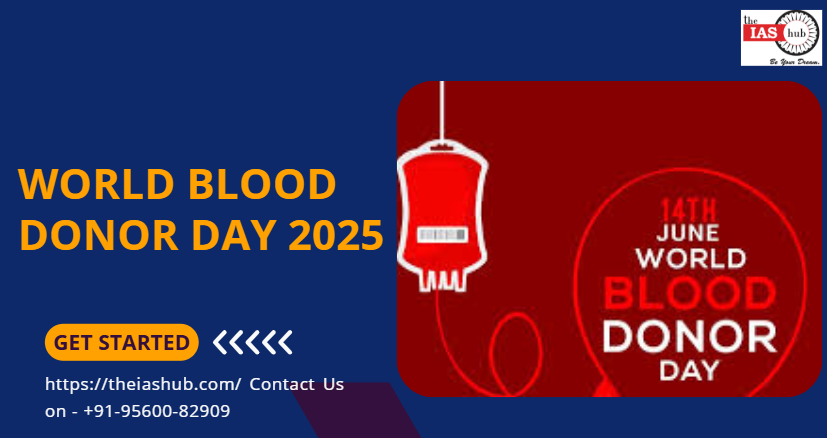

World Blood Donor Day 2025 is a celebration of life, compassion and community, not just a calendar event. This global initiative is observed on June 14th every year and headed by the World Health Organization (WHO) to raise awareness about the importance of donating blood and the critical need for safe blood and to thank volunteers and unpaid donors for their support and contributions. In this blog we have mentioned the World Blood Donor Day 2025 overview, theme, its history, eligibility criteria for blood donation, and why donating blood is one of the most selfless acts you can do.
Also Read: National and International Days 2025
World Blood Donor Day is celebrated on June 14th every year to raise awareness about the importance of safe blood donation and to thank voluntary donors for saving lives. This World Blood Donor Day highlights the need for regular blood donations and supports efforts that need to be made to ensure that blood is for everyone, everywhere. The world blood donor day 2025 is observed on Saturday, June 14, encouraging people to give blood and give hope.
| Aspect | Details |
| Name | World Blood Donor Day 2025 |
| Date | Saturday, June 14th |
| Theme | “Give blood, give hope: together we save lives” |
| Purpose | Raise awareness, thank donors, and promote voluntary donation |
| First Observed | 2004 |
| Organized By | World Health Organization (WHO) |
Also Read: List of Important Days in June 2025
World Blood Donor Day 2025 theme is “Give blood, give hope: together we save lives.” This year’s slogan focuses on the collective impact of regular blood donations—each drop not only saves lives but also brings hope and unity to patients worldwide. It celebrates the unity of voluntary unpaid donors and highlights the need to support health systems with a steady supply of safe blood.
Why this World Blood Donor Day 2025 theme is important:
Also Read: World Telecommunication Day
World Blood Donor Day (WBDD) was first observed in 2004 by the World Health Organization (WHO), in collaboration with the International Federation of Red Cross and Red Crescent Societies, the International Society of Blood Transfusion, and the International Federation of Blood Donor Organizations.
This day is celebrated on 4th June every year to mark the birth anniversary of Dr. Karl Landsteiner, the Nobel Prize-winning Austrian immunologist who discovered the ABO blood group system—a breakthrough that made safe blood transfusions possible.
Also Read: World Oceans Day 2025
World Blood Donor Day is celebrated to recognize and appreciate the selfless contribution of voluntary blood donors. This day serves as a global call to raise awareness about the need for safe blood and to inspire more people to donate regularly. It also promotes solidarity and supports efforts to ensure blood is available for everyone, everywhere. Here’s why it is important to celebrate this day:
Also Read: Bharat Forecast System
Donating blood not only saves lives, but it also offers various health and emotional benefits to the donor. Regular blood donation can support personal well-being while making a powerful difference in someone else’s life. Here are some benefits of donating blood:
Also Read: World Brain Tumour Day 2025
Human blood is classified into groups based on the presence or absence of specific antigens (A, B) and the Rh factor (positive or negative). This determines who can donate to or receive blood from whom, making blood compatibility essential for safe transfusions.
| Blood Group | Can Donate To | Can Receive From |
| O- | All blood groups (Universal Donor) | O- only |
| O+ | O+, A+, B+, AB+ | O+, O- |
| A− | A−, A+, AB−, AB+ | A−, O− |
| A+ | A+, AB+ | A+, A−, O+, O− |
| B− | B−, B+, AB−, AB+ | B−, O− |
| B+ | B+, AB+ | B+, B−, O+, O− |
| AB− | AB−, AB+ | AB−, A−, B−, O− |
| AB+ | AB+ only (Universal Recipient) | All blood groups |

O negative (O−) blood is called the “universal donor” because it can be safely given to people of any blood type in emergency situations or when the recipient’s blood type is unknown. Here are some reasons why 0 negative is the universal donor:
Also Read: Telangana Formation Day
The rules for donating blood in India are based on the National Blood Policy, ensuring safety for both donors and recipients. Individuals must meet certain medical, age, and lifestyle criteria to be eligible for donation.
Eligibility Criteria for Blood Donation
Blood donation is a powerful act to save lives and strengthen communities. By following the established eligibility criteria of donating blood, individuals contribute to a healthier society and ensure that safe blood is available when needed. On events such as World Blood Donor Day, people and communities can remind others that each donation is a gift of hope and saves many lives.
Are you preparing for UPSC 2025? Join IAShub’s UPSC coaching batches to boost your preparation. Enroll now!

World Blood Donor Day 2025 will be observed on Saturday, 14 June 2025. This date marks the birthday of Karl Landsteiner, the Nobel Prize-winning scientist who discovered the ABO blood group system.
The theme for 2025 is “Give blood, give hope: together we save lives.” This theme highlights the power of voluntary blood donation in saving lives and restoring hope to patients in need.
This day raises awareness about the need for safe and regular blood donations, thanking and recognizing voluntary unpaid donors, promoting community participation in saving lives and encouraging government investment in national blood programs.
O negative (O−) is considered the universal donor for red blood cells. It can be safely transfused to patients of all blood types, especially in emergencies.


Refine your answer writing skills and elevate your UPSC preparation with personalized support and expert feedback.
Fill out the form to get started with the program or any other enquiries !



Are you dreaming of becoming an IAS officer? Then, IAShub can be your best guide. It is one of the Best IAS Coaching in Delhi. Many students who want to clear the UPSC exam join IAShub for learning. The institute gives both online and offline classes. Their teachers are experienced and helpful. They easily explain every topic. Students also get notes, tests, and tips to do well in the exam.
IAShub is in Delhi and is trusted by many UPSC students. It offers coaching for every part of the UPSC exam – Prelims, Mains, and Interview. The classes are simple and easy to understand. The teachers are experts and guide students in the right way. IAShub is also known for its helpful notes, test series, and answer-writing practice. IAShub is the best coaching in Delhi and also gives UPSC Online Classes. This helps students from any place in India to learn. The online classes are live and also recorded. So, students can watch them anytime. These classes cover the full UPSC syllabus.
Here are some important services provided by IAShub:
The UPSC Civil Services Exam has three parts:
This exam is tough, but with the right guidance, it becomes easy to manage. Students must study smart and stay regular.
IAShub supports students from the beginning to the end. It gives the right books, tests, and notes. The classes are easy to follow, and the teachers are always ready to help. Students get personal doubt sessions too. The test series and answer checking help students learn where they need to do better. Also, free study materials save time and money.
IAShub also guides students during the final stage – the interview. Experts take mock interviews and give useful tips. This full support makes IAShub one of the best IAS coaching in Delhi.