World Asteroid Day 2025 is a UN-recognized awareness day aimed at educating the public about asteroids – the rocky, often metal-rich bodies orbiting the Sun – and how to protect Earth from potential impacts and covers key asteroid facts.
 theIAShub | 23 Jun, 2025 | 1206 | 0 |
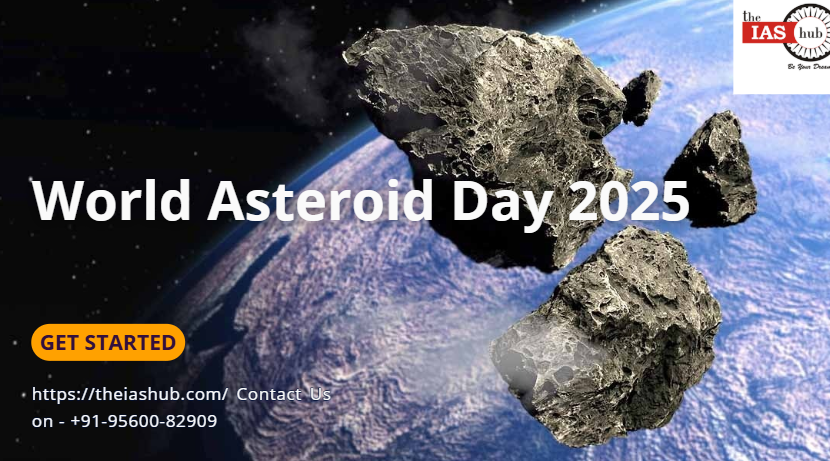


World Asteroid Day, also called International Asteroid Day, is a global awareness event held every year on June 30. It commemorates the 1908 Tunguska airburst and aims to educate the public about asteroids and planetary defense. Recognized by the United Nations, this day promotes research, public outreach, and global cooperation to prevent future asteroid impacts.
Also Read: List of Important Days in June 2025

World Asteroid Day 2025 marks the 10th anniversary of the movement. While the official World Asteroid Day 2025 theme hasn’t been released yet, previous themes have revolved around planetary defense, space education, and public engagement. 2024’s theme focused on understanding Earth’s relationship with asteroids and our responsibility to protect it.
Also Read: National and International Days 2025
These activities aim to promote public understanding of asteroids and their impact on Earth and space exploration.
Also Read: World Brain Tumor Day

Asteroids are rocky objects that orbit the Sun, mainly in the asteroid belt between Mars and Jupiter. Unlike planets, they are small, irregularly shaped, and do not have atmospheres. Most range from a few meters to hundreds of kilometers in diameter.
They are remnants of the early solar system, left over from the formation of planets. Studying them helps scientists understand how Earth and other planetary bodies formed.
Also Read: World Food Safety Day
Asteroids are composed of various materials:
These compositions help determine their origins and the potential for mining valuable resources.
Also Read: World Environment Day
The majority of asteroids are found in the main asteroid belt, which lies between Mars and Jupiter. This region contains millions of objects, including the largest asteroid, Ceres, which is also classified as a dwarf planet.
| Region | Description |
| Main Asteroid Belt | Between Mars and Jupiter, most common location |
| Near-Earth Asteroids | Cross Earth’s orbit, closer to our planet |
| Trojan Asteroids | Share orbits with planets like Jupiter |
| Kuiper Belt & Oort Cloud | Home to icy bodies and distant objects |
Not all asteroids stay in the belt—some come close to Earth and are carefully tracked for potential collision risks.
The asteroid belt is found between Mars and Jupiter, stretching between 2.1 and 3.3 AU from the Sun. It contains hundreds of thousands of known objects.
These bodies are studied for insights into early solar system conditions and the origins of water and organic material.
Understanding the difference between these objects is essential:
| Object | Description |
| Asteroid | Large rocky body orbiting the Sun |
| Meteoroid | Much smaller rock or debris, often from asteroids |
| Meteor | Flash of light when a meteoroid enters atmosphere |
| Meteorite | Meteoroid that survives and lands on Earth |
So, asteroid vs meteoroid boils down to size and activity. Asteroids are larger and remain in space, while meteoroids are fragments that can become meteors.

Another frequent question is the difference between asteroid, meteor, and comet.
| Feature | Asteroid | Meteor | Comet |
| Composition | Rock, metal | Rock or metal (burning up) | Ice, rock, and dust |
| Location | Orbit the Sun (main belt) | In Earth’s atmosphere | Orbit the Sun (elliptical path) |
| Appearance | Solid, no tail | Bright streak of light | Glowing coma and tail near Sun |
Comets are more ice-rich and develop bright tails, especially when close to the Sun. In contrast, asteroids are rocky and don’t display a tail.
Recent years have seen several major advancements in planetary defense:
These efforts show that we are no longer passive observers—we now have tools to actively defend against potential asteroid threats.
The initiative was born in response to events like the 2013 Chelyabinsk meteor and the 1908 Tunguska explosion, which highlighted the dangers of asteroid impacts. The movement gained international attention and was supported by astronomers, scientists, astronauts, and public figures. In 2016, the UN officially proclaimed June 30 as International Asteroid Day.
It emphasizes the role of asteroids in shaping our planet’s history and the importance of preparing for potential future collisions. Each year, it brings together experts and the public to learn about space safety, planetary science, and new discoveries.
Are you preparing for UPSC 2025? Join IAShub’s UPSC coaching batches to boost your preparation. Enroll now!
This year’s World Asteroid Day is more significant than ever. With ongoing missions, improved asteroid detection technology, and public interest in space science, it’s a moment to celebrate how far we’ve come—and to recognize how much more we need to do.

The official theme for World Asteroid Day 2025 is expected to focus on planetary defense, space education, and global collaboration. It will highlight the progress made in asteroid research and encourage awareness about protecting Earth from potential impacts. Events will include livestreams, lectures, and global outreach programs.
Asteroids are rocky bodies that orbit the Sun, mainly found in the asteroid belt between Mars and Jupiter. They are remnants from the early solar system and vary in size, shape, and composition. Some asteroids also pass near Earth and are closely monitored for safety.
Asteroids are larger rocky objects that orbit the Sun, while meteoroids are smaller fragments from asteroids or comets. When a meteoroid enters Earth’s atmosphere and burns up, it becomes a meteor, and if it lands, it is called a meteorite. Comets are icy bodies that develop glowing tails when close to the Sun.
World Asteroid Day 2025 will feature international events such as the Luxembourg Asteroid Day Festival, livestreamed expert talks, school programs, and observatory sessions. It aims to involve students, scientists, and the public in discussions about asteroid science and planetary protection. The events will emphasize global collaboration in space safety.





Refine your answer writing skills and elevate your UPSC preparation with personalized support and expert feedback.
Fill out the form to get started with the program or any other enquiries !




Are you dreaming of becoming an IAS officer? Then, IAShub can be your best guide. It is one of the Best IAS Coaching in Delhi. Many students who want to clear the UPSC exam join IAShub for learning. The institute gives both online and offline classes. Their teachers are experienced and helpful. They easily explain every topic. Students also get notes, tests, and tips to do well in the exam.
IAShub is in Delhi and is trusted by many UPSC students. It offers coaching for every part of the UPSC exam – Prelims, Mains, and Interview. The classes are simple and easy to understand. The teachers are experts and guide students in the right way. IAShub is also known for its helpful notes, test series, and answer-writing practice. IAShub is the best coaching in Delhi and also gives UPSC Online Classes. This helps students from any place in India to learn. The online classes are live and also recorded. So, students can watch them anytime. These classes cover the full UPSC syllabus.
Here are some important services provided by IAShub:
The UPSC Civil Services Exam has three parts:
This exam is tough, but with the right guidance, it becomes easy to manage. Students must study smart and stay regular.
IAShub supports students from the beginning to the end. It gives the right books, tests, and notes. The classes are easy to follow, and the teachers are always ready to help. Students get personal doubt sessions too. The test series and answer checking help students learn where they need to do better. Also, free study materials save time and money.
IAShub also guides students during the final stage – the interview. Experts take mock interviews and give useful tips. This full support makes IAShub one of the best IAS coaching in Delhi.