Know About Uttar Pradesh: Explore Its Map, 75 Districts, Rich History, Polity, Culture, Tribes, Major Rivers Like Ganga And Yamuna, National Parks, And Demographic Strength. Discover India’s Most Populous State And Cultural Heartland In Detail.
 theIAShub | 09 Jul, 2025 | 11698 | 0 |
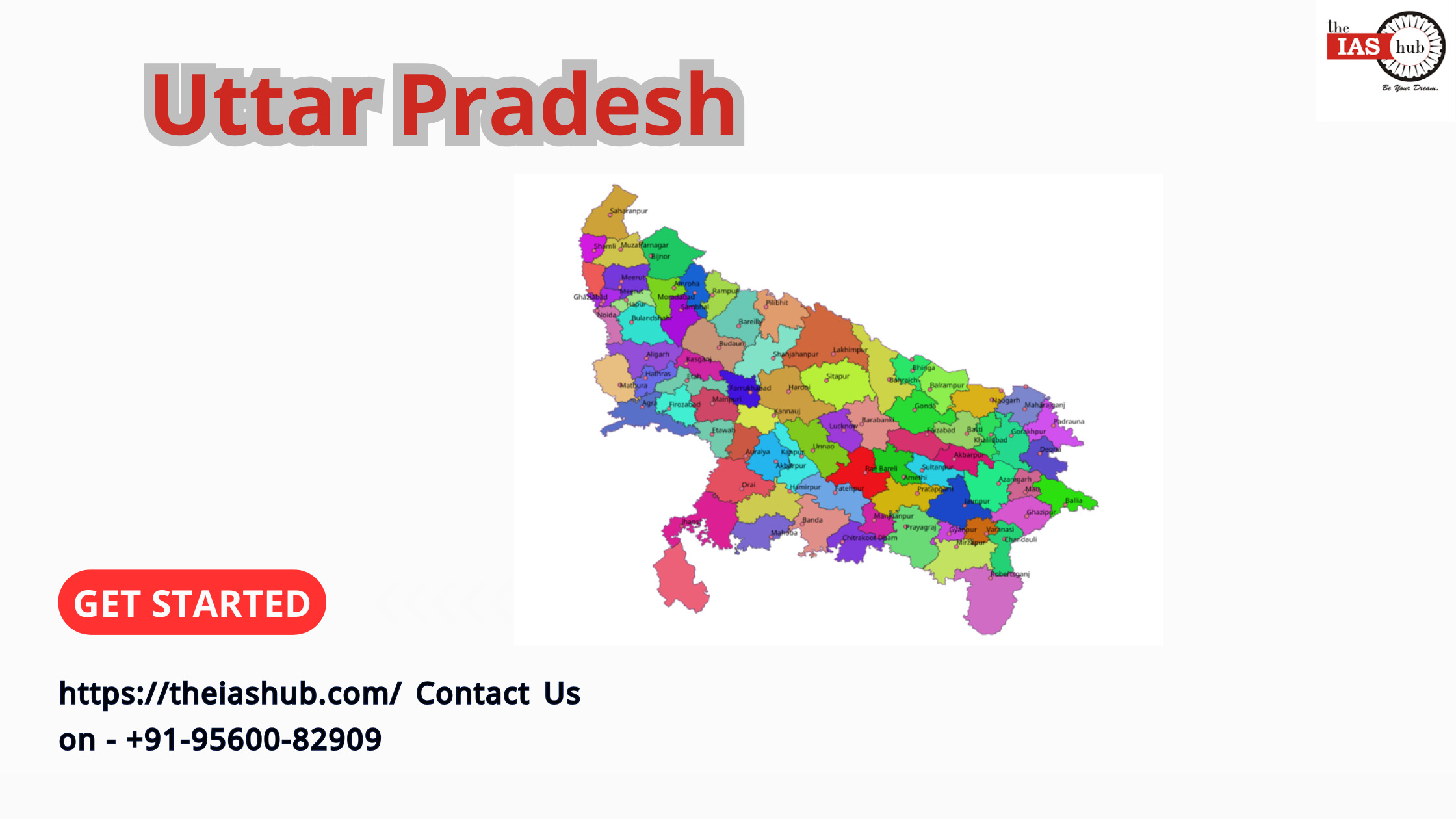


Courtesy: Maps of India
Uttar Pradesh is a northern state of India. It plays an important role in the country’s cultural and political landscape. It is known for its ancient cities, religious significance, and demographic strength, the state combines a rich historical legacy with modern administrative structures. It spans 243,286 square kilometers. It is the fourth-largest state in India by area and the most populous, with over 199 million residents as per the 2011 Census. The state capital Lucknow, serves as the administrative hub, while cities like Kanpur, Varanasi, Agra, and Noida contribute significantly to the state’s development.
Uttar Pradesh comprises the largest number of districts of all states in India. Below is a table listing all the districts of Uttar Pradesh:
| S.No | District | Population (2011 Census) | Area (sq km) |
| 1 | Agra | 4,418,797 | 4,027 |
| 2 | Aligarh | 3,673,889 | 3,650 |
| 3 | Ambedkar Nagar | 2,397,888 | 2,350 |
| 4 | Amethi | 2,540,956 | 2,321 |
| 5 | Amroha | 1,840,221 | 2,321 |
| 6 | Auraiya | 1,379,545 | 2,054 |
| 7 | Azamgarh | 4,613,913 | 4,054 |
| 8 | Badaun | 3,681,896 | 5,168 |
| 9 | Bagpat | 1,303,048 | 1,321 |
| 10 | Bahraich | 3,487,731 | 5,967 |
| 11 | Ballia | 3,239,774 | 2,981 |
| 12 | Balrampur | 2,148,665 | 3,264 |
| 13 | Banda | 1,799,410 | 4,408 |
| 14 | Barabanki | 3,260,699 | 3,825 |
| 15 | Bareilly | 4,448,359 | 4,120 |
| 16 | Basti | 2,461,056 | 2,688 |
| 17 | Sant Ravidas Nagar | 1,554,203 | 1,015 |
| 18 | Bijnor | 3,682,713 | 4,561 |
| 19 | Bulandshahr | 3,499,171 | 4,512 |
| 20 | Chandauli | 1,952,756 | 2,484 |
| 21 | Chitrakoot | 991,730 | 3,216 |
| 22 | Deoria | 3,100,946 | 2,535 |
| 23 | Etah | 1,774,480 | 2,431 |
| 24 | Etawah | 1,581,810 | 2,311 |
| 25 | Ayodhya | 2,470,996 | 2,764 |
| 26 | Farrukhabad | 1,885,204 | 2,279 |
| 27 | Fatehpur | 2,632,733 | 4,152 |
| 28 | Firozabad | 2,498,156 | 2,362 |
| 29 | Gautam Buddha Nagar | 1,648,115 | 1,269 |
| 30 | Ghaziabad | 4,681,645 | 1,956 |
| 31 | Ghazipur | 3,622,727 | 3,377 |
| 32 | Gonda | 3,433,919 | 4,003 |
| 33 | Gorakhpur | 4,440,895 | 3,321 |
| 34 | Hamirpur | 1,104,285 | 4,121 |
| 35 | Hapur | 1,338,211 | 1,774 |
| 36 | Hardoi | 4,092,845 | 5,986 |
| 37 | Hathras | 1,564,708 | 1,800 |
| 38 | Jalaun | 1,689,974 | 4,565 |
| 39 | Jaunpur | 4,476,072 | 4,038 |
| 40 | Jhansi | 2,000,755 | 5,024 |
| 41 | Kannauj | 1,656,616 | 2,275 |
| 42 | Kanpur Dehat | 1,796,184 | 3,021 |
| 43 | Kanpur Nagar | 4,581,268 | 3,155 |
| 44 | Kasganj | 1,436,719 | 1,993 |
| 45 | Kaushambi | 1,599,596 | 1,901 |
| 46 | Kheri | 4,021,243 | 7,680 |
| 47 | Kushinagar | 3,564,544 | 2,873 |
| 48 | Lalitpur | 1,221,592 | 5,039 |
| 49 | Lucknow | 4,589,838 | 2,528 |
| 50 | Maharajganj | 2,684,703 | 2,951 |
| 51 | Mahoba | 875,958 | 2,884 |
| 52 | Mainpuri | 1,868,529 | 2,760 |
| 53 | Mathura | 2,541,894 | 3,340 |
| 54 | Mau | 2,205,968 | 1,713 |
| 55 | Meerut | 3,443,689 | 2,599 |
| 56 | Mirzapur | 2,496,970 | 4,405 |
| 57 | Moradabad | 4,772,006 | 3,648 |
| 58 | Muzaffarnagar | 4,143,512 | 4,008 |
| 59 | Pilibhit | 2,037,225 | 3,686 |
| 60 | Pratapgarh | 3,209,141 | 3,717 |
| 61 | Prayagraj | 5,954,391 | 5,482 |
| 62 | Rae Bareli | 3,405,559 | 4,609 |
| 63 | Rampur | 2,335,398 | 2,367 |
| 64 | Saharanpur | 3,466,382 | 3,860 |
| 65 | Sambhal | 2,219,331 | 2,457 |
| 66 | Sant Kabir Nagar | 1,715,183 | 1,624 |
| 67 | Shahjahanpur | 3,006,538 | 4,575 |
| 68 | Shamli | 1,271,780 | 1,271 |
| 69 | Shravasti | 1,117,361 | 1,126 |
| 70 | Siddharthnagar | 2,559,297 | 2,752 |
| 71 | Sitapur | 4,483,992 | 5,743 |
| 72 | Sonbhadra | 1,862,559 | 6,905 |
| 73 | Sultanpur | 3,797,117 | 4,436 |
| 74 | Unnao | 3,108,367 | 4,558 |
| 75 | Varanasi | 3,676,841 | 1,535 |
Also Read: Districts of Uttar Pradesh Full List 2025

Uttar Pradesh has a deep-rooted history that includes the ancient city of Varanasi, mythological Ayodhya, and historical centers like Prayagraj and Mathura. The region was ruled by prominent dynasties such as the Mauryas, Guptas, Kushans, and the Delhi Sultanate.
During the medieval era, it witnessed the influence of the Mughals, particularly under Akbar, who made Agra and Fatehpur Sikri prominent capitals. After India’s independence, the United Provinces was renamed Uttar Pradesh in 1950, forming the current political entity.
Also Read: Indian States and Their Capitals

Also Read: Union Territories of India List
Uttar Pradesh is located in northern India, bordered by Uttarakhand and Himachal Pradesh to the north, Haryana, Delhi, and Rajasthan to the west, Madhya Pradesh to the south, Chhattisgarh and Jharkhand to the southeast, and Bihar to the east. The state features the fertile Indo-Gangetic Plain, the Himalayan foothills in the north, and a network of rivers including the Ganga and Yamuna.
| Category | Details |
| Geographical Features | – Northern Plains (Gangetic Plain, Terai Belt) – Plateaus & Hills (Vindhya Range, Bundelkhand Plateau) – River systems: Ganga, Yamuna, Ghaghara, Gomti, Ramganga, Betwa, Ken, Son – Longest river: Ganga (~1,140 km in UP; total length ~2,525 km) – Shortest major river: Gomti (~960 km total length) – Highest peak: Amsot Peak (957 m in Sonbhadra, Vindhya Range) – Lowest point: Gangetic Plains (~60 m elevation) – Rich in minerals (limestone – Mirzapur, coal – Sonbhadra, silica sand) and biodiversity (Dudhwa National Park, Chandra Prabha Sanctuary, Terai grasslands) |
| Climate Type | Humid Subtropical (most of UP), Semi-Arid (Bundelkhand & western UP) |
| Seasons | – Summer (Mar–Jun): Hot (30–48°C; Bundelkhand & Agra hottest) – Monsoon (Jun–Sep): Southwest monsoon (moderate-heavy rainfall; Terai & eastern UP wettest) – Post-Monsoon (Oct–Nov): Retreating monsoon (occasional showers) – Winter (Dec–Feb): Cool (5–25°C; coldest in Bareilly & Saharanpur) |
| Climate Variation | – Gangetic Plains (Central UP): Moderate rainfall (800–1,000 mm) – Bundelkhand & Western UP: Semi-arid (<700 mm) – Eastern UP (Gorakhpur, Varanasi): Humid (>1,100 mm) – Terai Belt (Lakhimpur, Pilibhit): High rainfall (1,200+ mm) – Agra-Mathura Belt: Dry & hot (low rainfall, ~600 mm) |
Also Read: Meghalaya

As per the 2011 Census, Uttar Pradesh had a population of 199.8 million, making it the most populous state in India. The population density stands at 828 persons per square kilometer, higher than the national average. The sex ratio is 912 females per 1000 males, below the national average but improving in recent years.
Literacy Rate: The state recorded a literacy rate of 67.7%, with male literacy at 77.3% and female literacy at 57.2%.
Languages Spoken:
Also Read: Manipur

Each state has its own symbols. Following are the state symbols of Uttar Pradesh:
| Symbol | Name |
| State Animal | Swamp Deer (Barasingha) |
| State Bird | Sarus Crane |
| State Tree | Ashoka Tree |
| State Flower | Palash (Flame of the Forest) |
These symbols reflect Uttar Pradesh’s ecological diversity (e.g., Sarus Crane as the world’s tallest flying bird) and cultural significance (e.g., Ashoka tree in Buddhist heritage).
Also Read: Maharrashtra

Uttar Pradesh follows a bicameral legislature, consisting of the Legislative Assembly (Vidhan Sabha) and Legislative Council (Vidhan Parishad).
| Category | Details |
| State Formation | Formed on January 26, 1950, under the Indian Constitution. Previously part of the United Provinces during British rule. |
| Chief Minister | Yogi Adityanath (Since March 2017) – Party: Bharatiya Janata Party (BJP) – Focus: Infrastructure, law & order, welfare schemes |
| Governor | Anandiben Patel – In office since July 2019 |
| Chief Justice (High Court) | Hon’ble Justice Arun Bhansali – Assumed office: 2023 – High Court located in Prayagraj (Allahabad High Court) |
| Legislature Type | Bicameral (Legislative Assembly & Legislative Council) |
| Legislative Assembly Members | 403 elected members |
| Legislative Council Members | 100 members (indirectly elected) |
| Lok Sabha Representation | 80 Members |
| Rajya Sabha Representation | 31 Members (indirectly elected) |
| Districts | 75 (as of 2024) |
| Local Governance Units | Divided into divisions, districts, tehsils, and gram panchayats |
Key Notes:
Also Read: Kerala
Following are the tribes residing in Uttar Pradesh:
| Tribe | Region (Districts) | Key Characteristics | Population (Approx.) |
| Tharu | Terai (Lakhimpur Kheri, Bahraich, Pilibhit) | – Indigenous forest dwellers – Practice agriculture & fishing – Known for unique folk dances like “Sakra” |
~2.5 lakh |
| Buxa | Terai Bijnor, Saharanpur | – Traditionally hunters – Speak Buxa language (Tibeto-Burman) – Celebrate “Basant Panchami” as major festival |
~50,000 |
| Jaunsari | Dehradun (adjacent to UP) | – Mixed Hindu-Tribal culture – Wood carving & woolen crafts – Follow both Hinduism & animism |
~35,000 |
| Rajjhi | Sonbhadra, Mirzapur | – Dependent on forest produce – Distinct bamboo crafts – Worship nature deities |
~20,000 |
| Kol | Bundelkhand (Lalitpur, Jhansi) | – Historically iron-smiths – Known for “Karma” dance – Listed as PVTG (Particularly Vulnerable Tribal Group) |
~1.2 lakh |
Key Notes:
Uttar Pradesh’s culture is a rich blend of ancient heritage, classical arts, and religious traditions, shaped by its history as the heartland of empires like the Mauryas, Guptas, Mughals, and Awadh. Known as the “Cultural Hub of India,” the state preserves a unique mix of folk, classical, and spiritual traditions.

| Category | Details |
| Classical Dance | Kathak (originated in UP under Mughal & Awadh patronage) |
| Folk Dances | Raslila (Krishna devotional dance), Charkula (women balancing lamps), Khyal (folk theatre) |
| Theatre & Puppetry | Nautanki (folk musical drama), Swang (satirical theatre), Kathputli (string puppetry) |
| Folk Music | Birha (Bhojpuri folk songs), Kajri (monsoon songs), Qawwali (Sufi devotional music) |
| Classical Music | Banaras Gharana (Hindustani classical school), Lucknow Gharana (Thumri & Ghazal traditions) |
| Major Festivals | Kumbh Mela (world’s largest religious gathering), Diwali (Ayodhya celebrations), Holi (Barsana’s Lathmar Holi) |
| Arts & Crafts | Banarasi silk sarees, Chikankari embroidery (Lucknow), Brassware (Moradabad), Zardozi work |
| Architecture | Taj Mahal (UNESCO-listed Mughal marvel), Varanasi Ghats, Lucknow’s Imambaras, Fatehpur Sikri (Mughal capital) |
Key Notes:
Also Read: Karnataka
Uttar Pradesh, known for its diverse ecosystems ranging from the Terai grasslands to the Gangetic plains, hosts several protected areas. With 1 national park and 25 wildlife sanctuaries, the state is crucial for conserving species like tigers, elephants, and the endangered Gangetic dolphin.
| Name | Key Features | Best Known For |
| Dudhwa National Park | – Part of Terai Arc Landscape – Swampy grasslands and dense forests – Home to Barasingha (Swamp Deer) |
Royal Bengal Tigers, One-horned Rhinos (reintroduced), Swamp Deer |
| Pilibhit Tiger Reserve | – Lies along India-Nepal border – Critical tiger corridor – Riverine forests and savannas |
Tigers, Leopards, Hog Deer |
| Chambal Wildlife Sanctuary | – Spread across UP, MP, and Rajasthan – Chambal River ecosystem – Ravines and sandy banks |
Gharials, Gangetic Dolphins, Indian Skimmers |
| Hastinapur Wildlife Sanctuary | – Along the Ganga River – Wetlands and dry forests – Historical significance (Mahabharata) |
Blackbucks, Migratory Birds, Indian Foxes |
| Kaimoor Wildlife Sanctuary | – Vindhya Range forests – Rocky terrain and waterfalls – Connects MP and Bihar forests |
Sloth Bears, Leopards, Chinkaras |
Uttar Pradesh has a mixed economy, driven by agriculture, industry, and services. As India’s largest state by population, it is a major contributor to the national GDP, with recent growth in manufacturing and infrastructure.
| Category | Details |
| GSDP (2023-24) | ₹24.4 lakh crore (~$290 billion) |
| GSDP Growth Rate | ~7% (aligned with national average) |
| Per Capita Income | ₹83,000 (~$1,000) |
| Sectoral Contribution | Agriculture (25%), Industry (25%), Services (50%) |
| National GDP Share | ~9% (with 16% of India’s population) |
Following are the key sectors driving the pursuit of 1 Trillion Dollar economy
| Sector | Highlights |
| Agriculture & Food Processing | – Largest producer of wheat, sugarcane, potatoes – Sugar mills (Western UP) – Food parks in Greater Noida & Lucknow |
| Textiles & Apparel | – Varanasi (Banarasi silk), Lucknow (Chikankari) – Noida & Kanpur (garment hubs) |
| Automobiles & Engineering | – Noida (Honda, Yamaha) – Lucknow (Tata Motors) – Kanpur (defence manufacturing) |
| IT & Services | – Noida (India’s 2nd largest IT hub after Bengaluru) – Lucknow (TCS, HCL) |
| Renewable Energy | – Solar parks (Jalaun, Mirzapur) – Wind energy (Bundelkhand) |
| Tourism & Hospitality | – Religious tourism (Varanasi, Ayodhya, Mathura) – Wildlife tourism (Dudhwa, Chambal) |
Following are the major industrial & Infrastructure projects:
| Project | Investment | Significance |
| Delhi-Mumbai Expressway (UP Section) | ₹40,000 crore | Connects Greater Noida to Mumbai via MP, boosting logistics |
| Purvanchal Expressway | ₹22,500 crore | Links Lucknow to Ghazipur (East UP) |
| Defence Corridor (UP) | ₹20,000 crore | Nodes in Agra, Kanpur, Jhansi, Chitrakoot (BrahMos, HAL, DRDO) |
| Noida International Airport | ₹30,000 crore | Jewar Airport (to be India’s largest upon completion) |
Following are the economic hubs of Uttar Pradesh:
| City | Key Industries | Notable Companies |
| Noida | IT, Electronics, Automobiles | HCL, Samsung, Honda |
| Kanpur | Leather, Textiles, Defence | JK Tyres, LML, HAL |
| Lucknow | IT, Handicrafts, Government Services | TCS, HCL, UP Police HQ |
| Varanasi | Silk Weaving, Tourism | Handloom clusters, Banarasi saree exporters |
Key Notes on Uttar Pradesh’s Economy
Uttar Pradesh has significant mineral resources, though not as diverse as some other states. It primarily produces limestone, coal, and silica sand, supporting industries like cement, glass, and construction.
| Mineral Resource | Major Mining Areas / Districts | Details / Notes |
| Limestone | Mirzapur, Sonbhadra, Chitrakoot | – Key raw material for cement plants (Jaypee, UltraTech). – Major deposits in Vindhyan region. |
| Coal | Sonbhadra | – Singrauli Coalfield (shared with MP) powers North India’s thermal plants. |
| Silica Sand | Mathura, Hathras, Firozabad | – Used in glass manufacturing (Firozabad is the “Glass City of India”). |
| Dolomite | Mirzapur, Sonbhadra | – Used in steel and cement industries. |
| Bauxite | Banda, Lalitpur | – Limited reserves, used in aluminium production. |
Key Notes on UP’s Mineral Wealth
Are you preparing for UPSC 2026? Join IAShub’s UPSC coaching batches to boost your preparation. Enroll now!

Uttar Pradesh earns this title as it produces over 40% of India's sugarcane and accounts for nearly half of the country's sugar production. The fertile western districts like Meerut and Muzaffarnagar have numerous sugar mills. This massive production makes UP the undisputed leader in India's sugar industry.
The sacred Ganga flows through important cities like Varanasi and Prayagraj, where it meets the Yamuna at Triveni Sangam. The Yamuna river passes through Mathura and Agra, while the Ghaghara and Gomti nourish the fertile plains. These rivers are vital for agriculture and hold deep religious significance.
UP has a diverse economy with agriculture as its backbone, being India's top producer of food grains and milk. The state has emerging IT hubs in Noida and established industries like leather in Kanpur and glass in Firozabad. Tourism centered around the Taj Mahal and religious sites also contributes significantly.
The state hosts grand events like the Kumbh Mela, the world's largest religious gathering. Traditional arts include Banarasi silk weaving, Lucknow's Chikankari embroidery, and the graceful Kathak dance. Festivals like Holi in Mathura showcase the region's vibrant living traditions.


Refine your answer writing skills and elevate your UPSC preparation with personalized support and expert feedback.
Fill out the form to get started with the program or any other enquiries !
Are you dreaming of becoming an IAS officer? Then, IAShub can be your best guide. It is one of the Best IAS Coaching in Delhi. Many students who want to clear the UPSC exam join IAShub for learning. The institute gives both online and offline classes. Their teachers are experienced and helpful. They easily explain every topic. Students also get notes, tests, and tips to do well in the exam.
IAShub is in Delhi and is trusted by many UPSC students. It offers coaching for every part of the UPSC exam – Prelims, Mains, and Interview. The classes are simple and easy to understand. The teachers are experts and guide students in the right way. IAShub is also known for its helpful notes, test series, and answer-writing practice. IAShub is the best coaching in Delhi and also gives UPSC Online Classes. This helps students from any place in India to learn. The online classes are live and also recorded. So, students can watch them anytime. These classes cover the full UPSC syllabus.
Here are some important services provided by IAShub:
The UPSC Civil Services Exam has three parts:
This exam is tough, but with the right guidance, it becomes easy to manage. Students must study smart and stay regular.
IAShub supports students from the beginning to the end. It gives the right books, tests, and notes. The classes are easy to follow, and the teachers are always ready to help. Students get personal doubt sessions too. The test series and answer checking help students learn where they need to do better. Also, free study materials save time and money.
IAShub also guides students during the final stage – the interview. Experts take mock interviews and give useful tips. This full support makes IAShub one of the best IAS coaching in Delhi.