
















UPSC Notification 2026 released on 4th February for 933 vacancies across IAS, IPS, IFS & other central services. Prelims on 24th May 2026, Mains from 21st August 2026. Check eligibility, exam dates & complete details at upsc.gov.in.
 theIAShub | 20 Apr, 2026 | 10430 | 0 |
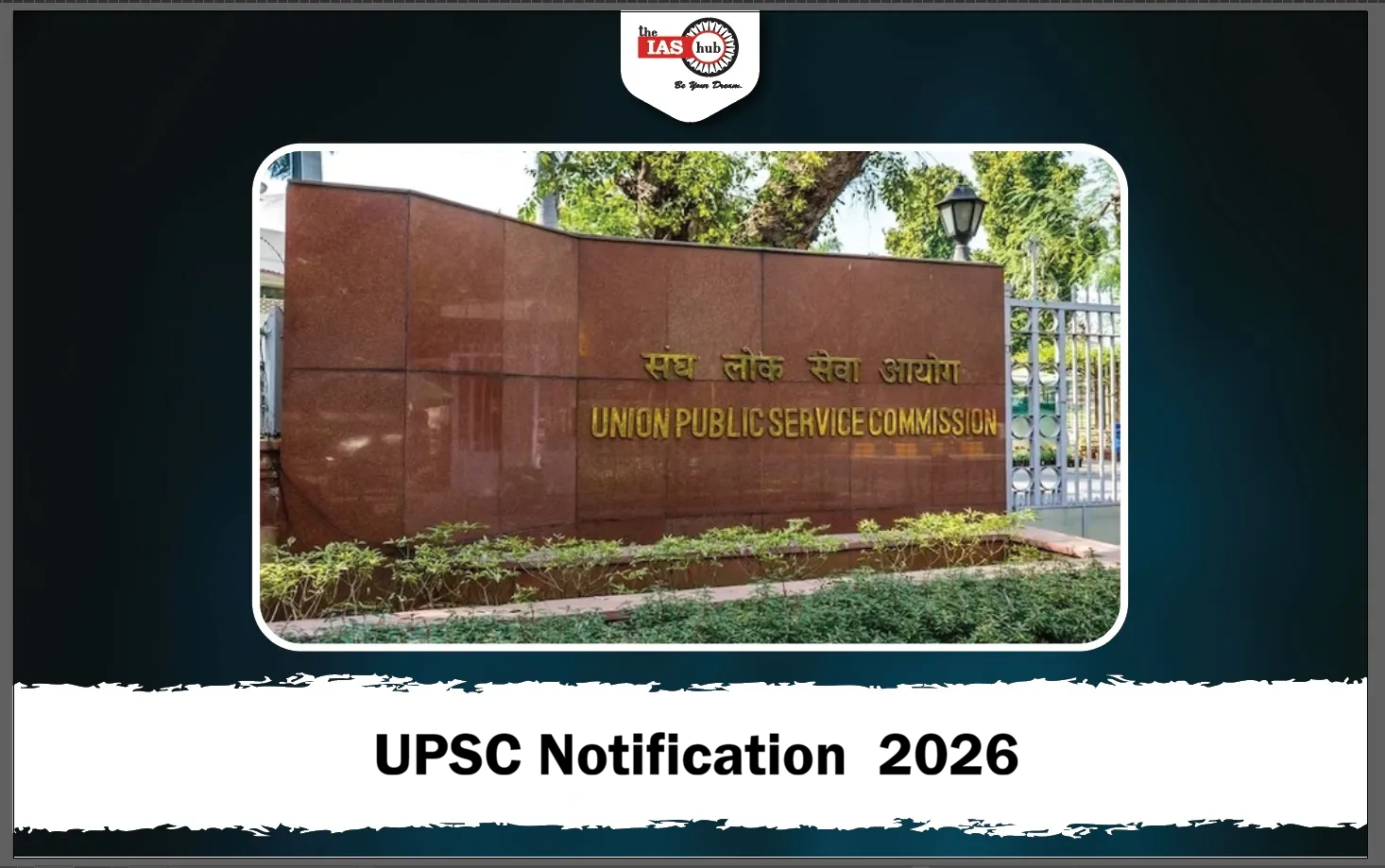

The Union Public Service Commission (UPSC) has officially released the UPSC Notification 2026 for the Civil Services Examination (CSE) on 4th February 2026. This is one of India’s most prestigious and competitive national-level examinations, recruiting officers for Group A and Group B central government services including IAS, IPS, IFS, IRS, and many other coveted posts.
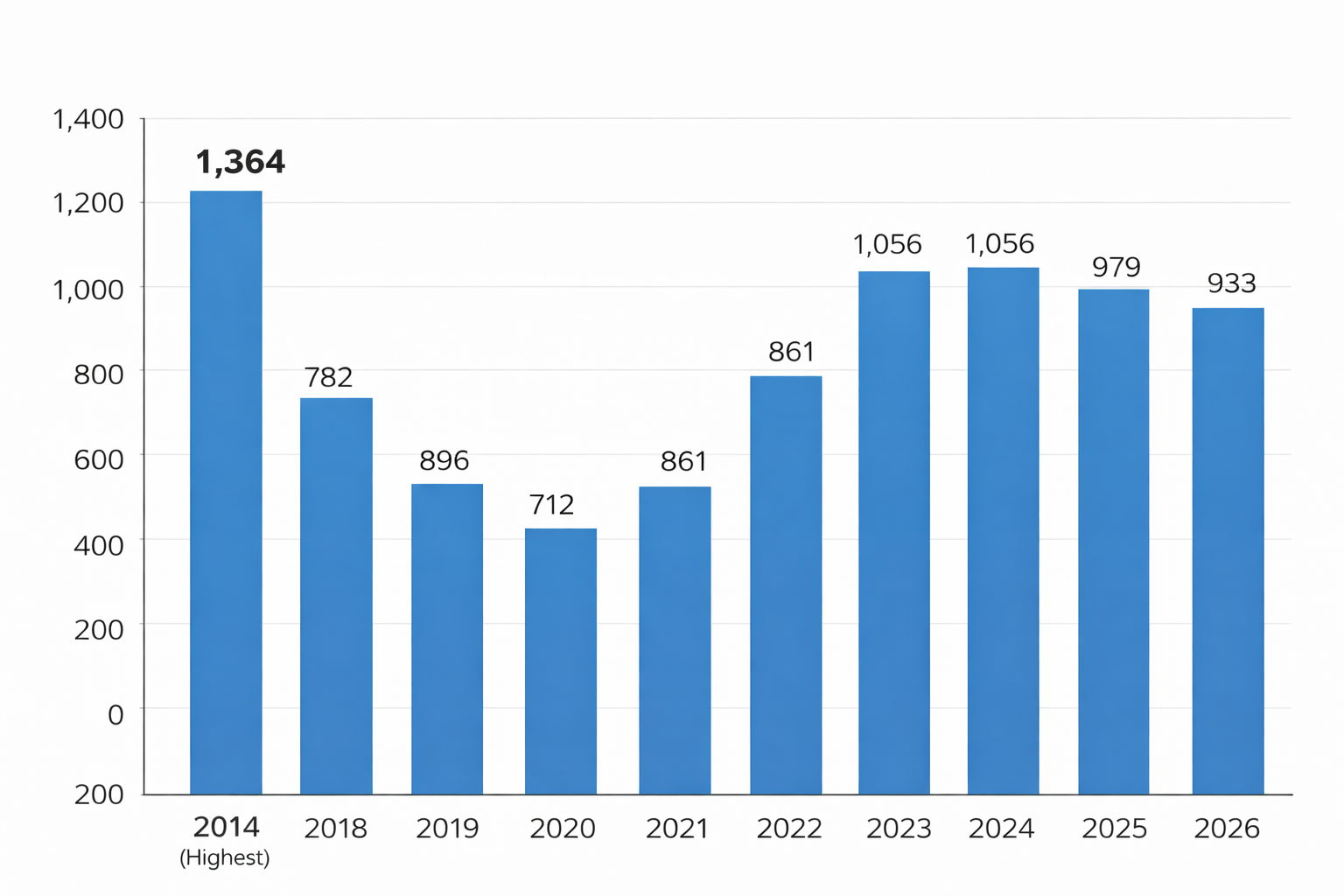
A total of 933 vacancies have been announced for UPSC CSE 2026. The Preliminary Examination is scheduled for 24th May 2026, and the Mains Examination will commence from 21st August 2026. Candidates who missed the application window should prepare now and stay updated for any official schedule changes.
| Parameter | Details |
| Conducting Body | Union Public Service Commission (UPSC) |
| Exam Name | Civil Services Examination (CSE) 2026 |
| Official Notification Date | 4th February 2026 |
| Application Start Date | 4th February 2026 |
| Application End Date | 27th February 2026 (Extended) |
| Total Vacancies | 933 (including 33 for PwBD) |
| UPSC Prelims 2026 Date | 24th May 2026 (Sunday) |
| UPSC Mains 2026 Date | 21st August 2026 (5 days) |
| Official Website | upsc.gov.in / upsconline.nic.in |
| Application Fee | Rs. 100 (Exempted for Female/SC/ST/PwBD) |
Every UPSC aspirant must bookmark the following critical dates to ensure timely action throughout the 2026 examination cycle:
| Event | Date |
| Official Notification Released | 4th February 2026 |
| Online Application Window Opens | 4th February 2026 |
| Last Date to Apply (Extended) | 27th February 2026 (6:00 PM) |
| Application Correction Window | Shortly after application closure |
| UPSC Prelims 2026 | 24th May 2026 (Sunday) |
| Prelims Admit Card | 2-3 weeks before Prelims |
| UPSC Mains 2026 | 21st August 2026 (5 days) |
| Interview / Personality Test | To be announced post-Mains result |
| UPSC Final Result 2026 | Expected early 2027 |
Important: The application deadline was extended from 24th February to 27th February 2026. Always check the official UPSC website for the latest updates.
UPSC CSE 2026 has announced a total of 933 vacancies across various prestigious central services. Out of these, 33 posts are reserved for Persons with Benchmark Disabilities (PwBD). The vacancies are distributed across 24 different services.
| Service | Category |
| Indian Administrative Service (IAS) | All India Services |
| Indian Police Service (IPS) | All India Services |
| Indian Foreign Service (IFS) | Central Services Group A |
| Indian Revenue Service (IRS – IT & Customs) | Central Services Group A |
| Indian Audit & Accounts Service (IAAS) | Central Services Group A |
| Indian Defence Accounts Service (IDAS) | Central Services Group A |
| Indian Postal Service (IPoS) | Central Services Group A |
| Indian Railway Management Service (IRMS) | Central Services Group A |
| Indian Information Service (IIS) | Central Services Group B |
| Other Central Services | Group A & B |
Note: The final service-wise vacancy breakup is published in the official UPSC notification PDF available on upsc.gov.in.
Candidates must be citizens of India. Subjects of Nepal, Bhutan, and Tibetan refugees (who came to India before January 1, 1962) are also eligible for specific services with government approval.
Candidates must be at least 21 years of age and must not have attained the age of 32 years as on 1st August 2026. This means eligible candidates must be born between 2nd August 1994 and 1st August 2005.
| Category | Minimum Age | Maximum Age | Relaxation |
| General / EWS | 21 years | 32 years | No relaxation |
| OBC | 21 years | 35 years | +3 years |
| SC / ST | 21 years | 37 years | +5 years |
| PwBD (General/EWS) | 21 years | 42 years | +10 years |
| PwBD (OBC) | 21 years | 45 years | +13 years |
| PwBD (SC/ST) | 21 years | 47 years | +15 years |
| Defence Personnel (disabled in ops) | 21 years | 35 years | +3 years |
| Ex-Servicemen | 21 years | 37 years | +5 years |
Candidates must hold a Bachelor’s degree from any recognized university established by an Act of the Central or State Legislature in India, or a university deemed to be a university under Section 3 of the UGC Act, 1956. Equivalent qualifications recognized by the Government of India are also accepted.
| Category | Maximum Attempts |
| General / EWS | 6 attempts |
| OBC | 9 attempts |
| SC / ST | Unlimited (within age limit) |
| PwBD (General/EWS/OBC) | 9 attempts |
| PwBD (SC/ST) | Unlimited (within age limit) |
Note: Appearing in even one paper of the Preliminary Examination counts as one attempt.
The UPSC Civil Services Examination is conducted in three stages. Candidates must clear each stage to advance to the next.
UPSC Syllabus 2026 — Complete Micro-Topics Study Tracker
The Prelims is a screening test. Marks scored here are NOT counted in the final merit list. It consists of two papers:
| Paper | Subject | Questions | Marks | Duration |
| Paper I | General Studies (GS) | 100 | 200 | 2 Hours |
| Paper II | CSAT (Civil Services Aptitude Test) | 80 | 200 | 2 Hours |
The Mains is the merit-deciding stage. It consists of 9 papers, out of which 7 are counted toward the final merit. Total marks counted toward merit: 1,750.
| Paper | Subject | Marks | Nature |
| Paper A | Indian Language (one of 22 scheduled languages) | 300 | Qualifying (25% minimum) |
| Paper B | English | 300 | Qualifying (25% minimum) |
| Essay | Essay (2 essays) | 250 | Merit-counting |
| GS Paper I | Indian Heritage, History, Geography | 250 | Merit-counting |
| GS Paper II | Governance, Constitution, Social Justice, IR | 250 | Merit-counting |
| GS Paper III | Technology, Economy, Environment, Security | 250 | Merit-counting |
| GS Paper IV | Ethics, Integrity and Aptitude | 250 | Merit-counting |
| Optional Paper I | Optional Subject — Paper 1 | 250 | Merit-counting |
| Optional Paper II | Optional Subject — Paper 2 | 250 | Merit-counting |
Candidates who clear the Mains are called for the Personality Test (Interview) conducted at the UPSC headquarters in New Delhi. The interview carries 275 marks and assesses the candidate’s personality, analytical ability, communication skills, and overall suitability for civil services.
| Component | Marks |
| Mains (7 merit papers) | 1,750 |
| Interview / Personality Test | 275 |
| Total (Final Merit) | 2,025 |
The application process for UPSC CSE 2026 is fully online. Note: The 2026 application window has already closed. However, candidates can prepare for the upcoming cycle. The steps below apply for future reference:
Step 1 — Visit the official UPSC portal: upsconline.nic.in
Complete your One-Time Registration (OTR) to create a permanent UPSC profile. You will also need to generate a Universal Registration Number (URN) by submitting identity and matriculation details.
Step 2 — Fill the Application Form
Log in with your OTR credentials, complete personal and academic details, select exam centres (up to 3 preferences), and upload the required documents.
Step 3 — Pay the Application Fee
| Category | Application Fee |
| General / OBC / EWS | Rs. 100/- |
| Female Candidates | Exempted |
| SC / ST Candidates | Exempted |
| Persons with Benchmark Disability (PwBD) | Exempted |
Fee can be paid via SBI branches, Visa/MasterCard/RuPay Credit/Debit Cards, or SBI Internet Banking.
Step 4 — Final Submission & Print
Review all details carefully before final submission. Download and print the completed application form and fee receipt for future reference. A correction window is typically opened after the application deadline.
UPSC conducts the Prelims at approximately 80 cities across India, while Mains is held at around 40 centres. Major centres include Delhi, Mumbai, Chennai, Kolkata, Bengaluru, Hyderabad, Pune, Lucknow, Patna, Jaipur, Bhopal, and more. Exam centre allotment is done on a first-apply-first-allot basis, so early application is strongly advised.
Civil Services officers recruited through UPSC CSE are among the best-paid government employees in India. The following pay structure is as per the 7th Pay Commission:
| Service | Pay Level | Basic Pay (Starting) |
| IAS, IPS, IFS, IRS (Group A) | Level 10 | Rs. 56,100/- |
| IAAS, IDAS, IPoS (Group A) | Level 10 | Rs. 56,100/- |
| Central Services Group B | Level 7 | Rs. 44,900/- |
In addition to basic pay, officers receive Dearness Allowance (DA), House Rent Allowance (HRA), Travel Allowance (TA), medical benefits, pension, and other government perks. IAS officers at senior levels (Cabinet Secretary) can earn Rs. 2,50,000/- per month.
Cracking the UPSC Civil Services Examination demands consistent, disciplined preparation spanning 12-18 months. Here is a structured approach used by successful candidates:
Download the official UPSC syllabus PDF from upsc.gov.in. Map every topic to standard reference books and resources. Understanding topic-wise weightage helps avoid over-preparation in low-yield areas.
NCERT textbooks (Classes 6-12) are the backbone of UPSC preparation. Cover History (Classes 6-12), Geography (Classes 6-12), Polity (Class 11), Economics (Classes 9-12), and Science (Classes 6-10). These build the conceptual clarity essential for both Prelims and Mains.
Follow at least one national newspaper daily (The Hindu / Indian Express). Additionally:
Answer writing is the most critical skill for Mains success. Start answer writing practice early — do not wait until after Prelims. Practice writing 150-250 word answers regularly, focusing on structure: Introduction – Body – Conclusion. For Essay paper, practice structuring 1,000-1,200 word essays on social, administrative, and national topics.
Choosing the right optional subject can be a game-changer. Select a subject based on your academic background, genuine interest, and availability of quality study materials. Popular optional subjects include Public Administration, History, Geography, Sociology, Political Science, Philosophy, and Anthropology.
Solve at least 7-10 years of UPSC Prelims and Mains previous year question papers. Enroll in a reliable test series for both stages. Analyze your performance after each mock test to identify weak areas.
A well-structured daily study plan is essential. As a general guideline:
UPSC has announced 933 vacancies for the Civil Services Examination 2026, of which 33 are reserved for Persons with Benchmark Disability (PwBD).
The UPSC Civil Services Preliminary Examination 2026 is scheduled for 24th May 2026 (Sunday).
Candidates must be between 21 and 32 years of age as on 1st August 2026 (i.e., born between 2nd August 1994 and 1st August 2005). Age relaxation applies to OBC, SC/ST, PwBD, and ex-servicemen candidates.
CSAT (Paper II) is qualifying in nature. Candidates must score a minimum of 33% (66 marks out of 200) to be eligible. CSAT marks are not counted in the final Prelims merit.
The final merit list is prepared based on Mains (1,750 marks) + Interview (275 marks) = 2,025 marks. Prelims marks are not included in the final merit.
No. Negative marking of 1/3rd applies only in the Prelims examination. There is no negative marking in the Mains examination.
Yes. Final-year undergraduate students can apply for the Preliminary Examination. However, they must produce their degree certificate at the time of applying for the Mains (DAF filling). If they fail to produce the degree, their candidature will be cancelled.
General / EWS category candidates are allowed a maximum of 6 attempts. OBC candidates get 9 attempts. SC/ST candidates have unlimited attempts within the age limit.
The complete UPSC CSE Notification 2026 PDF is available for download on the official UPSC website: upsc.gov.in. It contains detailed information on vacancies, eligibility, exam pattern, syllabus, and important dates.
The UPSC Civil Services Examination 2026 represents an extraordinary opportunity for aspirants to join India’s premier administrative, police, and foreign services. With 933 vacancies announced and the Prelims scheduled for 24th May 2026, candidates must now focus entirely on their preparation strategy.
Success in UPSC CSE demands consistency, the right resources, and a smart approach to both static and dynamic content. Begin with the official UPSC syllabus, build your fundamentals with NCERTs, stay current with national and international affairs, and practice answer writing daily. Remember, every successful IAS officer started exactly where you are — with the same notification in hand.
For the most accurate and updated information, always refer to the official UPSC website: upsc.gov.in and upsconline.nic.in.
All the best for your UPSC 2026 journey!

Refine your answer writing skills and elevate your UPSC preparation with personalized support and expert feedback.
Fill out the form to get started with the program or any other enquiries !



Are you dreaming of becoming an IAS officer? Then, IAShub can be your best guide. It is one of the Best IAS Coaching in Delhi. Many students who want to clear the UPSC exam join IAShub for learning. The institute gives both online and offline classes. Their teachers are experienced and helpful. They easily explain every topic. Students also get notes, tests, and tips to do well in the exam.
IAShub is in Delhi and is trusted by many UPSC students. It offers coaching for every part of the UPSC exam – Prelims, Mains, and Interview. The classes are simple and easy to understand. The teachers are experts and guide students in the right way. IAShub is also known for its helpful notes, test series, and answer-writing practice. IAShub is the best coaching in Delhi and also gives UPSC Online Classes. This helps students from any place in India to learn. The online classes are live and also recorded. So, students can watch them anytime. These classes cover the full UPSC syllabus.
Here are some important services provided by IAShub:
The UPSC Civil Services Exam has three parts:
This exam is tough, but with the right guidance, it becomes easy to manage. Students must study smart and stay regular.
IAShub supports students from the beginning to the end. It gives the right books, tests, and notes. The classes are easy to follow, and the teachers are always ready to help. Students get personal doubt sessions too. The test series and answer checking help students learn where they need to do better. Also, free study materials save time and money.
IAShub also guides students during the final stage – the interview. Experts take mock interviews and give useful tips. This full support makes IAShub one of the best IAS coaching in Delhi.
Join 50,000+ UPSC Aspirants! 🚀
Get Free UPSC/IAS Study Materials, Daily Current Affairs, Editorial Summaries & Exam Updates.
Join Telegram Channel