
















Explore the complete UPPSC PCS Syllabus 2026 for Prelims, Mains, and Interview. Get subject-wise topics, exam pattern, paper details, and preparation tips to crack the UP PCS exam.
 theIAShub | 13 May, 2026 | 7850 | 0 |
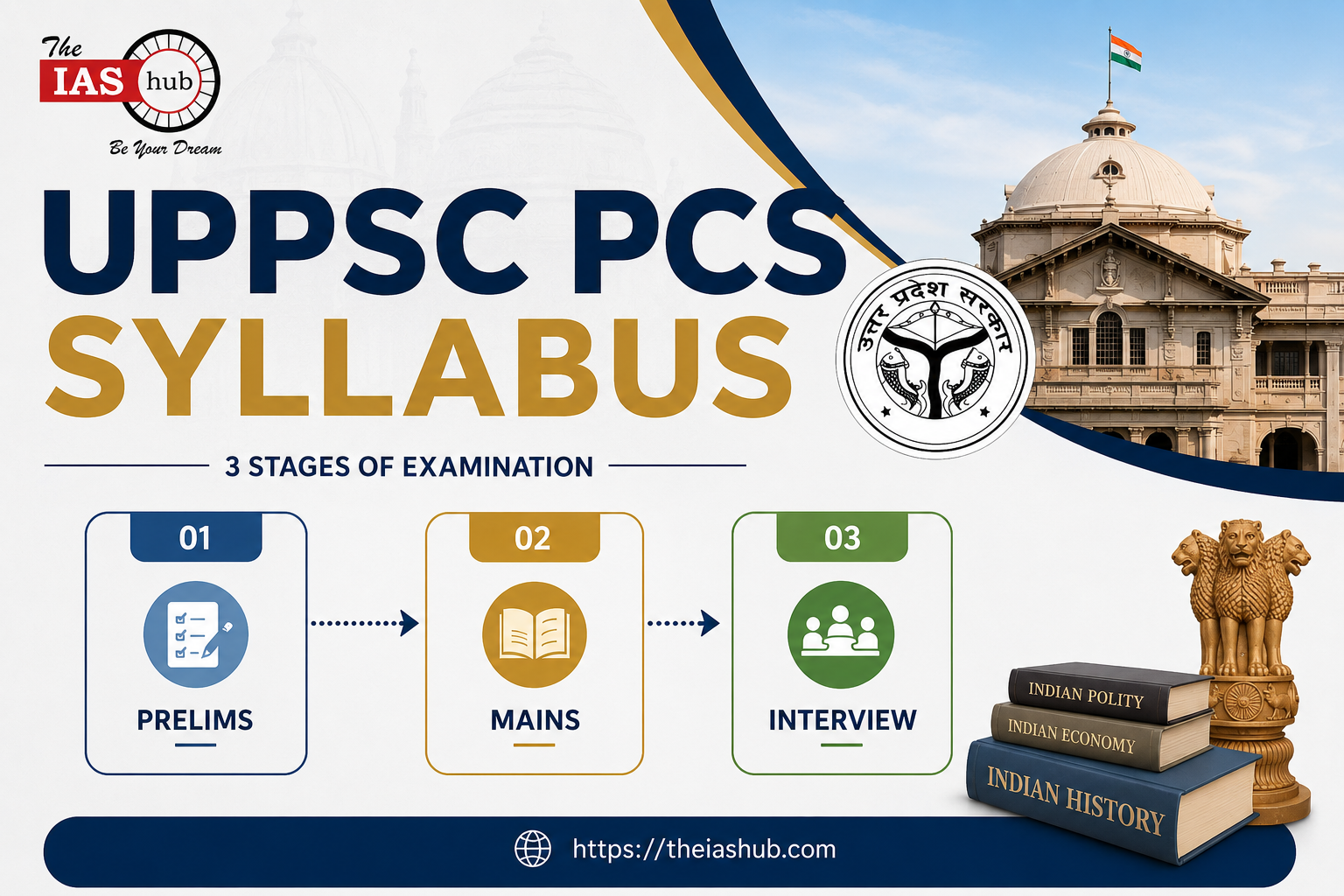

If you are preparing for the Uttar Pradesh Public Service Commission (UPPSC) exam, the first thing you need to do is understand the syllabus inside out. The UPPSC PCS Syllabus is the foundation of your entire preparation strategy. Without a clear picture of what to study, even the most hard-working candidates end up wasting time on the wrong topics.
In this article, we have broken down the complete UPPSC PCS 2026 Syllabus — covering Prelims, Mains, and Interview — in a simple and easy-to-understand way. Whether you are a first-time aspirant or someone who is attempting the exam again, this guide will help you plan better and study smarter.
The UPPSC PCS exam is conducted by the Uttar Pradesh Public Service Commission. It is one of the most prestigious state-level civil services exams in India. Through this exam, candidates are selected for various Group A and Group B posts in the Uttar Pradesh government, such as Deputy Collector, DSP, Block Development Officer (BDO), and many others.
The exam is conducted in three stages:
Before diving into the syllabus, here is a quick overview of the exam structure:
| Stage | Papers | Marks | Nature |
|---|---|---|---|
| Prelims | Paper I (GS) + Paper II (CSAT) | 200 + 200 = 400 | Qualifying + Screening |
| Mains | 8 Papers | 1500 Marks | Merit Based |
| Interview | Personality Test | 100 Marks | Merit Based |
| Total (Mains + Interview) | 1600 Marks |
Note: Prelims marks are not counted in the final merit list. They are only used for shortlisting candidates for Mains.
The Prelims exam has two papers. Paper I is for screening, while Paper II (CSAT) is only qualifying — meaning you need to score at least 33% in it, but those marks won’t be added to your merit score.
This paper has 150 questions, each carrying 2/3 of a mark. There is negative marking of 1/3 mark per wrong answer.
Topics covered in Paper I:
History of India and Indian National Movement This includes Ancient, Medieval, and Modern Indian History. The focus should be on the freedom struggle, important events, social reform movements, and key personalities.
Indian and World Geography Covers Physical, Social, and Economic Geography of India and the World. Topics like rivers, mountains, climate, soil types, population, agriculture, and natural resources are important.
Indian Polity and Governance Constitutional features, Political System, Panchayati Raj, Public Policy, Rights Issues, and governance-related topics.
Indian Economy Economic development, Planning, Five-Year Plans, current economic policies, poverty, unemployment, infrastructure, and financial institutions.
General Science Basic concepts of Physics, Chemistry, and Biology. Special focus on everyday science and current scientific developments.
Current Events of National and International Importance Major events happening in India and the world — politics, economy, sports, awards, science, and environment.
General Mental Ability Basic reasoning, comprehension, numerical ability, and analytical skills.
Special Focus on Uttar Pradesh The UPPSC exam gives special importance to UP-specific questions. Topics include:
This paper tests your aptitude and analytical ability. You need to score at least 33% (66 marks) to qualify.
Topics covered in Paper II:
Candidates who clear the Prelims are called for the Mains examination. The Mains is a descriptive exam with 8 papers in total. It tests the depth of your knowledge, writing ability, and understanding of various subjects.
| Paper | Subject | Marks |
|---|---|---|
| Paper I | General Hindi | 150 |
| Paper II | Essay | 150 |
| Paper III | General Studies I | 200 |
| Paper IV | General Studies II | 200 |
| Paper V | General Studies III | 200 |
| Paper VI | General Studies IV | 200 |
| Paper VII | Optional Subject – Paper I | 200 |
| Paper VIII | Optional Subject – Paper II | 200 |
| Total | 1500 |
This paper is aimed at testing your command over the Hindi language. Questions are set at the level of a Class XII student.
Key topics include:
Candidates are required to write three essays, one from each of the three sections. Each essay is of 50 marks.
The topics are usually from:
Good essay writing requires clear thinking, a structured argument, and knowledge of current issues. Regular reading of newspapers and editorial writing practice is highly recommended.
This paper focuses on History, Culture, and Geography.
History and Culture of India and the World
Geography of India and the World
This paper covers Indian Constitution, Governance, and Social Issues.
Indian Constitution and Political System
Social Justice and Governance
International Relations
Special focus on Uttar Pradesh
This paper deals with Economics, Agriculture, and Technology.
Economic Development
Agriculture and Rural Development
Science and Technology
Environment and Ecology
Special focus on Uttar Pradesh: Agriculture in UP, irrigation systems, Ganga expressway, industrial development zones, and state-level economic initiatives.
This paper is the Ethics, Integrity, and Aptitude paper — similar to the UPSC GS Paper IV.
Ethics and Human Interface
Ethics in Public Administration
Thinkers and Philosophers
Case Studies
This paper is scoring if you write well-reasoned answers with real-life examples and case studies.
Candidates choose one optional subject from the list below. Two papers of 200 marks each are asked from the selected subject.
List of Optional Subjects:
How to choose the right optional subject?
Your choice should depend on your academic background, interest, and the scoring potential of the subject. Many toppers choose Public Administration, Sociology, Geography, or History because the syllabus overlaps with the General Studies papers.
After qualifying the Mains exam, candidates are called for the Interview/Personality Test, which carries 100 marks.
The interview is conducted by a board of experienced officers and academicians. It is not a knowledge test alone — it evaluates your overall personality, communication skills, clarity of thought, and suitability for a civil service career.
What the interview panel looks at:
Tips for the Interview:
Many aspirants preparing for UPPSC also prepare for UPSC. While there is a lot of overlap, here are some key differences:
| Subject | Recommended Source |
|---|---|
| History | NCERT (Class 6-12), Spectrum Modern History |
| Geography | NCERT (Class 9-12), G.C. Leong |
| Polity | Laxmikanth (Indian Polity) |
| Economy | NCERT (Class 11-12), Ramesh Singh |
| Ethics | Lexicon for Ethics (Chronicle), Standard textbooks |
| UP-specific | UP government publications, newspapers like Dainik Jagran |
| Current Affairs | Monthly magazines, The Hindu, PIB |
Step 1 — Know the Syllabus Thoroughly Before you buy any book or start any topic, read the official UPPSC syllabus carefully. Understand exactly what each paper demands.
Step 2 — Focus on NCERT Foundation Start with NCERT books from Class 6 to 12 for History, Geography, Economics, and Political Science. These build a strong conceptual base.
Step 3 — Give Extra Attention to Uttar Pradesh This is the single biggest differentiator in the UPPSC exam. Aspirants who prepare UP-specific content seriously tend to do much better. Study UP’s history, geography, culture, economy, and current developments deeply.
Step 4 — Practice Answer Writing Regularly Mains is a written exam, so how you write matters as much as what you know. Practice writing structured answers daily. Focus on introduction, body, and conclusion. Use facts, examples, and diagrams wherever possible.
Step 5 — Current Affairs — Daily and Consistent Read one good national newspaper daily. Make notes of important events. Also, follow state-level news of Uttar Pradesh closely.
Step 6 — Solve Previous Year Question Papers Solving UPPSC PCS previous year papers gives you a clear idea of the type of questions asked, the difficulty level, and the areas that are frequently tested.
Step 7 — Revise, Revise, Revise More revision is always better. Make short notes for quick revision before the exam.
There are 8 papers in total — General Hindi, Essay, four General Studies papers (GS I to GS IV), and two Optional Subject papers. The total marks for Mains is 1500.
Paper II (CSAT) in UPPSC Prelims is only qualifying. You need to score at least 33% (66 marks out of 200) in it. These marks are not counted in the merit list.
The Mains exam carries The Mains exam carries 1500 marks, and the Interview carries 100 marks. So, the final merit is decided on a total of 1600 marks.1500 marks, and the Interview carries 100 marks. So, the final merit is decided on a total of 1600 marks.
Yes, General Hindi is a compulsory paper in the Mains exam and carries 150 marks.
Very important. A significant number of questions in both Prelims and Mains relate to Uttar Pradesh — its history, geography, economy, agriculture, political structure, and current developments. Candidates who prepare UP-specific content deeply have a clear advantage.
Choose a subject you are genuinely interested in and comfortable with. Also check the syllabus overlap with GS papers. Popular choices include Geography, Public Administration, Sociology, and History. If you have a background in a technical subject like Agriculture or Economics, those can also be scoring.
The UPPSC PCS Syllabus 2026 is broad but manageable with the right plan. The key is to understand what is asked, build a strong foundation using standard books, keep up with current affairs — especially those related to Uttar Pradesh — and practice answer writing regularly.
Do not rush the preparation. Give yourself enough time to cover each subject carefully, revise properly, and attempt mock tests. The candidates who succeed in UPPSC PCS are not necessarily the most talented — they are the most consistent and well-prepared ones.
Start with the syllabus, make a solid study plan, and stay committed to it. All the best for your UPPSC PCS 2026 preparation!

Refine your answer writing skills and elevate your UPSC preparation with personalized support and expert feedback.
Fill out the form to get started with the program or any other enquiries !



Are you dreaming of becoming an IAS officer? Then, IAShub can be your best guide. It is one of the Best IAS Coaching in Delhi. Many students who want to clear the UPSC exam join IAShub for learning. The institute gives both online and offline classes. Their teachers are experienced and helpful. They easily explain every topic. Students also get notes, tests, and tips to do well in the exam.
IAShub is in Delhi and is trusted by many UPSC students. It offers coaching for every part of the UPSC exam – Prelims, Mains, and Interview. The classes are simple and easy to understand. The teachers are experts and guide students in the right way. IAShub is also known for its helpful notes, test series, and answer-writing practice. IAShub is the best coaching in Delhi and also gives UPSC Online Classes. This helps students from any place in India to learn. The online classes are live and also recorded. So, students can watch them anytime. These classes cover the full UPSC syllabus.
Here are some important services provided by IAShub:
The UPSC Civil Services Exam has three parts:
This exam is tough, but with the right guidance, it becomes easy to manage. Students must study smart and stay regular.
IAShub supports students from the beginning to the end. It gives the right books, tests, and notes. The classes are easy to follow, and the teachers are always ready to help. Students get personal doubt sessions too. The test series and answer checking help students learn where they need to do better. Also, free study materials save time and money.
IAShub also guides students during the final stage – the interview. Experts take mock interviews and give useful tips. This full support makes IAShub one of the best IAS coaching in Delhi.
Join 50,000+ UPSC Aspirants! 🚀
Get Free UPSC/IAS Study Materials, Daily Current Affairs, Editorial Summaries & Exam Updates.
Join Telegram Channel