Know Swami Vivekananda Biography including his original name, philosophy, teachings, legacy, and contribution to Indian spirituality and nationalism. Explore his life, Ramakrishna Mission, and death anniversary tribute in 2025.
 theIAShub | 01 Jul, 2025 | 5399 | 0 |
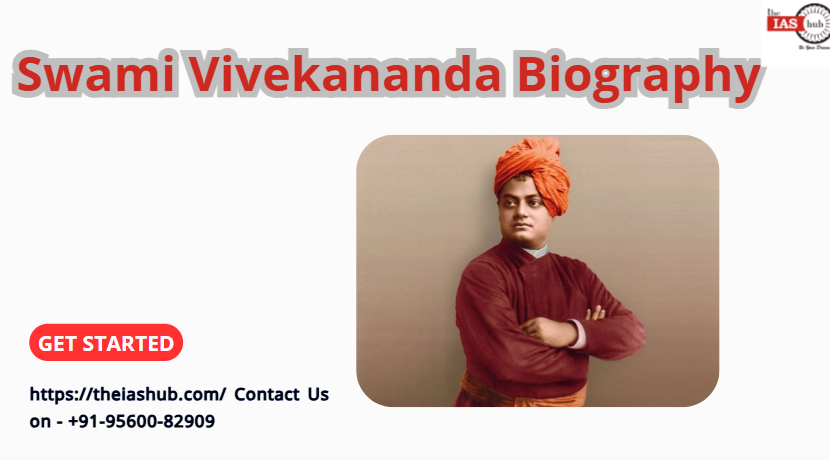

Swami Vivekananda (born January 12, 1863, Calcutta, India died July 4, 1902, Calcutta) was a Hindu monk, spiritual guide, orator, and advocate for social reform in India, as well as a key figure in spreading Vedanta philosophy in the United States and Britain. Vivekananda, who rose to prominence with his impactful address at the World’s Parliament of Religions in Chicago in 1893, championed social service and humanitarianism as the highest virtue. Regarded as the primary follower of the Hindu mystic Ramakrishna, he established two significant organizations: Ramakrishna Math (“monastic center”) and Ramakrishna Mission. He was respectfully called Swami, a title for Hindu renunciates.
Also Read: List of National and International Days 2025
Swami Vivekananda (1863–1902), born as Narendranath Datta, was a Hindu monk who introduced Vedanta and Yoga to the West. Preacher of Neo Hinduism. Overview of Swami vivekanand given below:
| Aspects | Details |
| Full Name | Narendranath Datta |
| Born | January 12, 1863, Kolkata |
| Death | July 4, 1902, Belur, India (Age 39) |
| Education | Western and Indian philosophy, graduated from Calcutta University,Spiritual Mentor
Ramakrishna Paramahamsa |
| Contribution | Introduced Vedanta and Yoga to the West; founded Ramakrishna Mission (1897) |
| Core Philosophy | Unity of religions, divinity of the soul, harmony of science and spirituality, (Vedanta) |
| Organizations Founded | Ramakrishna Mission, Ramakrishna Math |
| Teaching | Self-realization, service to humanity, fearlessness, “Arise, awake.” |
Swami Vivekananda’s life transformed profoundly after meeting his spiritual guide, Ramakrishna Paramahamsa, in 1881. Ramakrishna saw Narendra’s inner potential and mentored him toward self-discovery. His teachings stressed the oneness of all faiths, asserting that diverse paths converge on the same divine essence, shaping Vivekananda’s core beliefs. Under Ramakrishna’s tutelage, Vivekananda experienced deep spiritual growth, embracing the unity beyond religious divides. After Ramakrishna’s death in 1886, he embraced monastic life, renouncing material pursuits, and committed to disseminating his mentor’s wisdom.
Swami Vivekananda’s philosophy is rooted in Vedanta, particularly the Advaita (non-dualistic) school, blended with practical spirituality, universalism, and a call to action. His teachings, drawn from the Upanishads, the Bhagavad Gita, and his guru Sri Ramakrishna’s insights, emphasize the unity of existence, the divinity of the soul, and the importance of self-realization, service, and harmony among religions. Below core philosophical ideas Swami vivekanand
Swami Vivekananda played a pivotal role in the Indian Renaissance, a period of cultural, intellectual, and spiritual revival in the 19th and early 20th centuries. His contributions reshaped India’s spiritual and social landscape, inspiring a renewed sense of national pride and global recognition of Indian philosophy. Below is the role of Swami Vivekanand in the Indian Renaissance:

Swami Vivekananda was a greatly admired figure in Indian spirituality and global philosophy, leaving a profound legacy that continues to inspire millions. As a disciple of Sri Ramakrishna Paramahamsa, he revitalized Hinduism, introduced Vedanta and Yoga to the West, and championed India’s cultural and spiritual heritage. His legacy can be understood through his work given below:
Swami Vivekananda is a role model for youth because:
Swami Vivekananda’s enduring legacy lies in his profound contributions to Indian philosophy, spirituality, and global interfaith dialogue. His teachings, rooted in Vedanta, emphasized universalism, self-realization, and the harmony of religions, inspiring intellectual and spiritual awakening. By introducing Indian thought to the West through his historic 1893 Chicago address, the bridge cultural divides, fostering mutual respect. Vivekananda’s establishment of the Ramakrishna Mission institutionalized his vision of service and education.
Are you preparing for UPSC 2025? Join IAShub’s UPSC coaching batches to boost your preparation. Enroll now!

Vivekananda’s teachings inspire youth through his emphasis on self-confidence, resilience, and service. His motto, “Arise, awake, and stop not till the goal is reached,” motivates perseverance, while his advocacy for universalism and social reform encourages purpose-driven lives.
At the Parliament of the World’s Religions in Chicago, Vivekananda introduced Indian philosophy, particularly Vedanta, to the West. Promoted interfaith harmony and earned global recognition for Indian spirituality.
Founded in 1897, the Ramakrishna Mission is a spiritual and philanthropic organization dedicated to education, healthcare, and social service. Vivekananda established it to translate his guru Ramakrishna’s teachings into action, emphasizing service as a form of worship.
Vivekananda instilled pride in India’s cultural and spiritual heritage, countering colonial narratives. His teachings on self-reliance and unity inspired Indians to embrace their identity, laying the intellectual groundwork for the independence movement.
His teachings include self-realization, the unity of all religions, the divinity of the soul, and service to humanity. He emphasized practical spirituality, encouraging individuals to realize their potential through discipline, education, and compassion.

Refine your answer writing skills and elevate your UPSC preparation with personalized support and expert feedback.
Fill out the form to get started with the program or any other enquiries !
Are you dreaming of becoming an IAS officer? Then, IAShub can be your best guide. It is one of the Best IAS Coaching in Delhi. Many students who want to clear the UPSC exam join IAShub for learning. The institute gives both online and offline classes. Their teachers are experienced and helpful. They easily explain every topic. Students also get notes, tests, and tips to do well in the exam.
IAShub is in Delhi and is trusted by many UPSC students. It offers coaching for every part of the UPSC exam – Prelims, Mains, and Interview. The classes are simple and easy to understand. The teachers are experts and guide students in the right way. IAShub is also known for its helpful notes, test series, and answer-writing practice. IAShub is the best coaching in Delhi and also gives UPSC Online Classes. This helps students from any place in India to learn. The online classes are live and also recorded. So, students can watch them anytime. These classes cover the full UPSC syllabus.
Here are some important services provided by IAShub:
The UPSC Civil Services Exam has three parts:
This exam is tough, but with the right guidance, it becomes easy to manage. Students must study smart and stay regular.
IAShub supports students from the beginning to the end. It gives the right books, tests, and notes. The classes are easy to follow, and the teachers are always ready to help. Students get personal doubt sessions too. The test series and answer checking help students learn where they need to do better. Also, free study materials save time and money.
IAShub also guides students during the final stage – the interview. Experts take mock interviews and give useful tips. This full support makes IAShub one of the best IAS coaching in Delhi.