Explore Odisha's rich heritage, from Kalinga's ancient history and tribal cultures to rivers, national parks like Simlipal and Bhitarkanika, economic strength in mining and agriculture, and a vibrant polity rooted in India's constitutional framework.
 theIAShub | 08 Jul, 2025 | 5918 | 0 |


Courtesy: Maps of India
Odisha is located on the eastern coast of India. It is known for its ancient temples, classical dance forms, and diverse tribal communities. It is governed by the constitutional framework applicable to Indian states. The state is famed for its architectural heritage, traditional crafts, and rich biodiversity. It covers 155,707 square kilometers (statehood granted in 1936). It holds a unique position in India’s historical and cultural landscape. According to the 2011 Census, Odisha had a population of over 41 million. Bhubaneswar serves as the capital of the state.
Also Read: Indian States and Their Capitals

The history of Odisha is rooted in ancient Kalinga, known for its maritime trade and the famous Kalinga War. The region was ruled by dynasties like the Mauryas, Satavahanas, and Gajapatis.
It came under British control in the early 19th century and was part of the Bengal Presidency.
On April 1, 1936, Odisha was formed as a separate province on a linguistic basis — becoming the first Indian state to do so. The modern state was reorganized post-independence and continued to evolve under democratic governance. Odisha’s culture, language (Odia), and customs enjoy constitutional protection and recognition.
Also Read: Union Territories of India List

Odisha shares its coastline with the Bay of Bengal and borders the states of West Bengal, Jharkhand, Chhattisgarh, and Andhra Pradesh.
| Category | Details |
| Key Geographic Features | • Eastern Ghats (including Simlipal, Mahendragiri, and Malayagiri ranges) • Deccan Plateau (western Odisha) • Coastal Plains (along Bay of Bengal) • Dense tropical forests (Simlipal, Sunabeda) • River valleys (Mahanadi, Brahmani, Baitarani) |
| Highest Peak | Deomali (Devmali) • Elevation: 1,672 m (5,486 ft) • Location: Koraput district (Eastern Ghats) • Significance: Highest peak in Odisha; rich in biodiversity and tribal culture |
| Smallest Recognized Peak | No officially designated smallest peak. The coastal plains and river deltas (e.g., Mahanadi Delta) are nearly flat, with elevations as low as 10–20 m above sea level. |
| Important Mountain Passes | 1. Daringbadi Pass – Connects Kandhamal to Ganjam; known as “Kashmir of Odisha” 2. Simlipal Passes – Trek routes through Simlipal National Park 3. Mahendragiri Pass – Pilgrimage and trekking routes 4. Niyamgiri Passes – Links Rayagada to Kalahandi; ecologically sensitive |
| Major Rivers | • Mahanadi – Odisha’s lifeline; flows through Cuttack, Sambalpur • Brahmani – Formed by Koel & Sankh rivers; key for industry • Baitarani – Flows through Kendujhar and Bhadrak • Subarnarekha – Cuts through Mayurbhanj and Balasore • Rushikulya – Famous for Olive Ridley nesting |
| Climate | • Coastal: Tropical monsoon – hot, humid summers; heavy rainfall (cyclone-prone) • Eastern Ghats: Moderate – cooler summers, mild winters • Western Plateau (e.g., Titlagarh): Hotter summers, drier winters |
Also Read: Mizoram
Odisha is bordered by:
| Type of Border | Neighbour |
| Domestic Border | West Bengal |
| Domestic Border | Jharkhand |
| Domestic Border | Chhattisgarh |
| Domestic Border | Andhra Pradesh |
Also Read: Meghalaya

As per the 2011 Census, Odisha had a population of approximately 41 million. The population density is around 269 persons per square kilometer. The sex ratio is 979 females per 1000 males.
Literacy Rate: The literacy rate is 72.9%. Male literacy is at 81.6% and female literacy is at 64%.
Languages Spoken:
Also Read: Manipur
Following are the state symbols for Odisha:

| Symbol | Name |
| State Animal | Sambar Deer (Rusa unicolor) |
| State Bird | Indian Roller (Coracias benghalensis) |
| State Tree | Sacred Fig (Ficus religiosa) |
| State Flower | Ashoka Flower (Saraca asoca) |
| These symbols reflect the region’s ecological and cultural uniqueness. |
Also Read: Maharrashtra

Odisha became a separate province in 1936 and a full-fledged state after independence. It has a unicameral legislature with 147 seats. The state is administered through the Indian Constitution with representation in both houses of Parliament.
| Category | Details |
| Political Status | • Statehood since April 1, 1936 • Unicameral legislature (147 seats) |
| Current Leadership | Governor: Raghubar Das (since October 2023) Chief Minister: Naveen Patnaik |
| Judiciary | High Court: Orissa High Court, Cuttack |
| Parliamentary Representation | • Lok Sabha (Lower House): 21 elected MPs • Rajya Sabha (Upper House): 10 indirectly elected members |
| Legislative Structure | • Unicameral Assembly: 147 elected members • Districts: 30 • Subdivisions: Further divided into blocks and gram panchayats for local governance |
Also Read: Kerala
Following are the major tribes of Odisha:
| Tribe | Region/Districts Predominantly Inhabited | Key Cultural Traits |
| Kondh | Kandhamal, Rayagada, Kalahandi | Dongria sub-group, known for horticulture, animism, and eco-conservation |
| Santal | Mayurbhanj, Keonjhar, Balasore | Rich folklore, tribal dance (Chhau), and traditional hunting practices |
| Saura | Gajapati, Rayagada | Iconic Saura paintings (similar to Warli), animist rituals, and shifting cultivation |
| Bonda | Malkangiri | One of India’s most primitive tribes, known for unique dress (only wearing beads and loincloths) and Austroasiatic language |
| Gadaba | Koraput | Known for Dhemsa dance, distinctive brass jewelry, and millet farming |
| Juang | Keonjhar, Angul | Iron smelting traditions, forest-based lifestyle, traditional Juang dance |
| Bhuyan | Sundargarh, Keonjhar | Metalcraft (especially iron tools), clan-based social structure |
| Paroja | Koragput | Traditional festivals (Chaita Parab), terrace agriculture, and vibrant attire |
| Munda | Sundargarh, Mayurbhanj | Folk music (Jhumair songs), collective farming practices |
| Oraon | Sundargarh | Tribal music (Dhumkuria songs), rice cultivation, and oral storytelling traditions |
| Koya | Malkangiri | Known for communal living (Ghotul system), bamboo craft, and spiritual dances |
| Kharia | Sundargarh | Expert basket weaving, collection of minor forest produce |
| Ho | Mayurbhanj | Cultural affinity with Jharkhand tribes, unique Ho script |
| Bhottada | Nabarangpur | Festival of Chaitra Parab, intricate death rituals |
| Lodha | Balasore | Historically forest dwellers, now settled agriculturists, skilled in herbal medicine |
Odisha’s culture is deeply rooted in its classical heritage and tribal traditions. It has over 60 tribal communities contributing to a diverse cultural mosaic. These communities preserve unique traditions through dress, music, dance, art, and rituals.
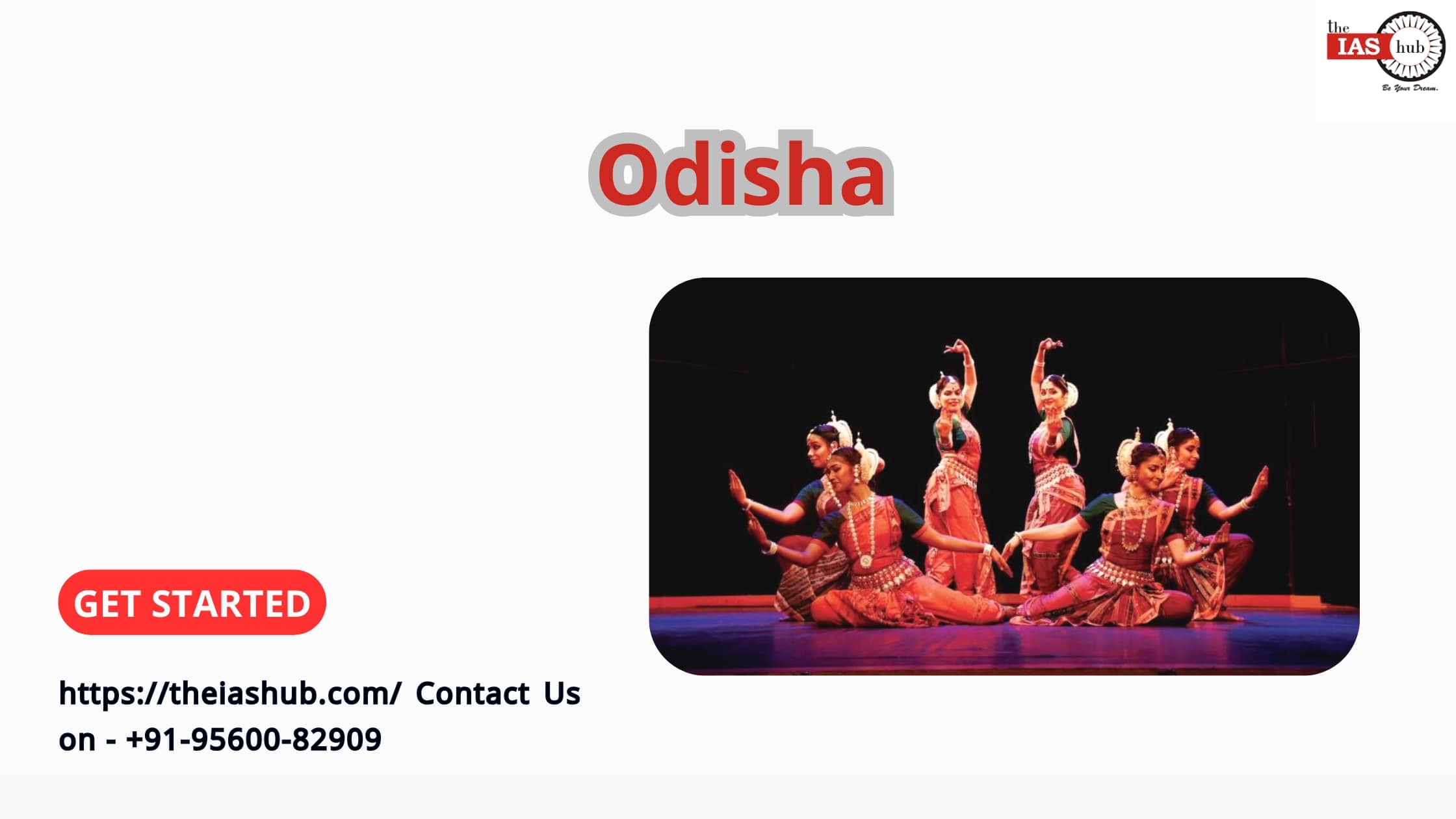
Odissi classical dance, Pattachitra painting, tribal festivals like Chaitra Parab and Nuakhai, and indigenous beliefs coexist with Hindu religious practices, shaping a distinctive socio-cultural identity.
| Category | Details |
| Classical Dance | • Odissi is one of the eight officially recognized classical dance forms of India, originating from the temples of Odisha. • Popular Folk Dances: – Ghumura (Kalahandi region) – Dalkhai (performed by women in Sambalpur) – Chhau (tribal martial dance from Mayurbhanj) • Themes: Devotion, mythology, valor, seasonal changes, and tribal lore. |
| Theatre Art | • Rich tradition of folk theatre like Prahallada Nataka and Jatra. • Influenced by religious narratives and local legends. • Village performances often blend music, drama, and dance. |
| Folk Music | • Types: Ballads, festival songs, devotional music, tribal rhythms. • Instruments: Mardala (percussion), flute, dhap, harmonium, dhol. • Notable Form: Tribal music of the Kondh, Saura, and Santhal communities. |
| Classical Music | • Odisha has a distinct style of classical music—Odissi music. • It includes elements of Hindustani and Carnatic but with unique ragas and talas. • Composers like Jayadeva and Upendra Bhanja contributed significantly. |
| Performance Traditions | • Linked to Jagannath cult, local legends, seasonal festivals, and tribal traditions. • Venues: Temple courtyards, village squares, local mandaps. |
| Major Festivals | • Cultural: Rath Yatra, Konark Festival, Dhauli Kalinga Mahotsav. • Tribal: Chaita Parab, Nuakhai, Magha Parab. • Religious: Durga Puja, Diwali, Holi, Eid, Christmas. |
| Arts & Crafts | • Woodwork: Pattachitra scroll painting mounted on palm leaf or wooden bases. • Weaving: Sambalpuri and Bomkai sarees with intricate ikat patterns. • Stone carving, appliqué work (Pipili), and silver filigree (Cuttack). |
| Architecture | • Traditional: Kalinga style temple architecture with towering shikharas and intricate carvings. • Iconic Sites: Sun Temple at Konark, Jagannath Temple at Puri, Lingaraj Temple at Bhubaneswar. • Tribal housing: Mud and thatch homes, decorated with murals. |
| Wildlife & Nature | • Sanctuaries: Simlipal National Park (tigers, elephants), Bhitarkanika (crocodiles), Chilika Lake (migratory birds, dolphins). • Ecosystems: Mangroves, coastal wetlands, sal forests, and hill ranges. |
Odisha has multiple designated national parks and sanctuaries:
| Category | Details |
| National Parks | 1. Simlipal National Park (2,750 km², Mayurbhanj) • Key Species: Bengal Tiger, Asian Elephant, Giant Squirrel, Orchid varieties 2. Bhitarkanika National Park (672 km², Kendrapara) • Key Species: Saltwater Crocodile, Olive Ridley Turtle, King Cobra, Mangrove species |
| Wildlife Sanctuaries | • Chilika (Nalabana) Wildlife Sanctuary (Puri/Ganjam) • Satkosia Wildlife Sanctuary (Angul) • Kotagarh Wildlife Sanctuary (Kandhamal) • Baisipalli, Balukhand, Karlapat, Hadagarh, and others |
| Ramsar Sites | • Chilika Lake (first Indian Ramsar site) • Bhitarkanika Mangroves |
| UNESCO Tentative Sites | • Sun Temple, Konark (proposed) • Bhitarkanika Mangroves (proposed) |
| Tiger Reserve | • Simlipal Tiger Reserve (part of Simlipal NP) • Satkosia Tiger Reserve (Angul/Nayagarh) |
The economy of Odisha is diverse, with strong contributions from mining, agriculture, manufacturing, and services.
| Category | Details |
| Key Sectors | • Agriculture/Horticulture: Rice, pulses, oilseeds, mangoes, cashew, turmeric • Mining and Minerals: Iron ore, coal, bauxite, chromite • Industries: Steel, aluminum, textiles, power • Tourism: 1+ crore annual visitors; Puri, Konark, Chilika, tribal circuits • Handicrafts: Silver filigree, Pattachitra, hornwork |
| Major Projects | • Odisha Industrial Corridor (part of East Coast Economic Corridor) • Smart Cities Mission: Bhubaneswar, Rourkela • Paradeep Port Expansion • Odisha Startup Policy • Mega Aluminium and Steel Clusters |
| Economic Overview (2023–24) | • GSDP: ₹8.2 lakh crore (approx. 8% growth) • Sectoral Contribution: – Agriculture: 21% – Industry: 39% (mining, manufacturing, power) – Services: 40% (IT, tourism, banking, education) |
| Major Economic Centers | • Bhubaneswar: Administrative and IT hub • Cuttack: Legal, trade, and textile center • Rourkela: Industrial and steel manufacturing • Paradeep: Port-based economy • Sambalpur and Angul: Power and mining |
| Top Contributing Districts | 1. Angul (power, coal) 2. Jharsuguda (aluminum, industries) 3. Sundargarh (steel, mining) 4. Khordha (services, IT) 5. Keonjhar (iron ore, forest resources) |
Odisha is one of India’s richest states in terms of mineral deposits.
| Mineral Type | Locations |
| Iron Ore | Keonjhar, Sundargarh, Mayurbhanj |
| Coal | Angul, Jharsuguda, Sundargarh |
| Bauxite | Koraput, Rayagada |
| Chromite | Jajpur, Dhenkanal |
| Limestone | Bargarh, Bolangir |
| Manganese | Keonjhar, Sundargarh |
| Nickel | Sukinda Valley (Jajpur) |
| Graphite | Rayagada, Kalahandi |
Following are the important schemes run by the government of Odisha for welfare:
| Scheme | Objective | Key Features |
| Biju Swasthya Kalyan Yojana (BSKY) | Universal health coverage | ₹5 lakh per family/year; smart health card system |
| Mission Shakti | Women empowerment | SHG-based livelihood support, financial inclusion |
| KALIA Scheme | Farmer assistance | Direct benefit transfers to small/marginal farmers |
| Mukhyamantri Karma Tatpara Abhiyan (MUKTA) | Urban wage employment | Community-led urban infrastructure projects |
| Odisha Startup Policy | Entrepreneurial support | Incubation, seed capital, mentorship, market access |
| Mo Sarkar | Governance accountability | Feedback from citizens on government services |
| Biju Yuva Vahini | Youth engagement | Skilling, volunteering, and leadership training |
| Odisha Millet Mission | Climate-resilient agriculture | Promotion of millets in tribal and rain-fed areas |
| SAMALEI Scheme | Urban infrastructure | Cultural and heritage development of western Odisha |
| Odisha Industrial Policy (2022–30) | Investment promotion | Capital subsidies, land allotment, fast-track approvals |
Extremism in Odisha is primarily associated with Left-Wing Extremism (LWE) or Maoist insurgency. It has affected parts of southern and western Odisha, particularly in tribal-dominated districts.
Key phases and features include:
While LWE still exists in pockets, Odisha’s coordinated security and development efforts have helped bring relative peace and reintegration of affected communities.
Are you preparing for UPSC 2026? Join IAShub’s UPSC coaching batches to boost your preparation. Enroll now!
With its classical roots, mineral wealth, and tribal legacy, Odisha blends heritage with growth. From temples to startups and forests to foundries, the state is shaping an inclusive and resource-driven economic model.

Major rivers include the Mahanadi, Brahmani, Baitarani, Subarnarekha, Rushikulya, and Vansadhara. These rivers are vital for irrigation, hydropower, and sustaining the state’s agrarian economy and biodiversity.
Odisha’s uniqueness stems from its synthesis of classical and tribal heritage. It is home to Odissi dance and music, ancient temple architecture, and 60+ tribal communities with distinct languages, festivals, and crafts. Art forms like Pattachitra and festivals like Rath Yatra add to its cultural vibrancy.
Odisha has two national parks—Simlipal and Bhitarkanika—and several sanctuaries including Chilika, Satkosia, and Kotagarh. These areas protect diverse species like Bengal tigers, saltwater crocodiles, elephants, and migratory birds.
Mining, manufacturing, and agriculture form the core of Odisha’s economy. It is a leading producer of iron ore, coal, and aluminum. Handicrafts, tourism, services, and startups are emerging sectors under state-led industrial and skill development policies.
The official language of Odisha is Odia. It is widely spoken across the state and is recognized as a classical language of India. Other languages include Sambalpuri, Kui, Santali, Bengali, and Urdu, reflecting its linguistic diversity.
Rath Yatra is a major religious festival celebrated annually in Puri. It involves the ceremonial procession of Lord Jagannath, Balabhadra, and Subhadra in massive chariots. It attracts millions of devotees and symbolizes Odisha’s spiritual and cultural heritage.

Refine your answer writing skills and elevate your UPSC preparation with personalized support and expert feedback.
Fill out the form to get started with the program or any other enquiries !

Are you dreaming of becoming an IAS officer? Then, IAShub can be your best guide. It is one of the Best IAS Coaching in Delhi. Many students who want to clear the UPSC exam join IAShub for learning. The institute gives both online and offline classes. Their teachers are experienced and helpful. They easily explain every topic. Students also get notes, tests, and tips to do well in the exam.
IAShub is in Delhi and is trusted by many UPSC students. It offers coaching for every part of the UPSC exam – Prelims, Mains, and Interview. The classes are simple and easy to understand. The teachers are experts and guide students in the right way. IAShub is also known for its helpful notes, test series, and answer-writing practice. IAShub is the best coaching in Delhi and also gives UPSC Online Classes. This helps students from any place in India to learn. The online classes are live and also recorded. So, students can watch them anytime. These classes cover the full UPSC syllabus.
Here are some important services provided by IAShub:
The UPSC Civil Services Exam has three parts:
This exam is tough, but with the right guidance, it becomes easy to manage. Students must study smart and stay regular.
IAShub supports students from the beginning to the end. It gives the right books, tests, and notes. The classes are easy to follow, and the teachers are always ready to help. Students get personal doubt sessions too. The test series and answer checking help students learn where they need to do better. Also, free study materials save time and money.
IAShub also guides students during the final stage – the interview. Experts take mock interviews and give useful tips. This full support makes IAShub one of the best IAS coaching in Delhi.