Mahatma Gandhi, the Father of the Nation, pioneered India’s freedom movement through nonviolence and Satyagraha. Explore his biography, major movements, teachings, and legacy for UPSC preparation. Learn about his life, philosophy, movements, teachings, and lasting legacy.
 theIAShub | 30 Jun, 2025 | 3978 | 0 |
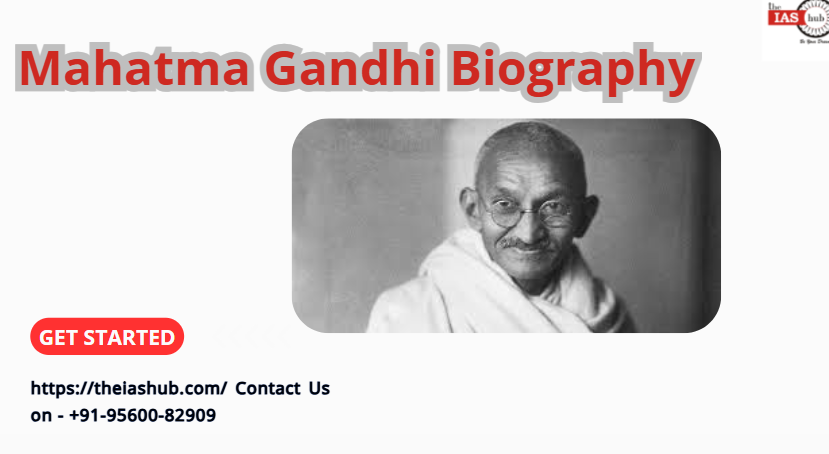


Mohandas Karamchand Gandhi, famously known as Mahatma Gandhi, was a lawyer, politician, social activist, writer, leader of the Indian Independence Movement against British rule, anti imperialist, anti colonist, father of his nation. Gandhi ji is internationally esteemed for his doctrine of nonviolent protest (satyagraha) to achieve political and social progress. In the eyes of millions of Indians, Gandhiji is Mahatma (“Great Soul”).
Mahatma Gandhi, originally named Mohandas Karamchand Gandhi, was born on October 2, 1869, in Porbandar, India. He was a pivotal figure in India’s struggle for independence from British colonial rule. Renowned for his principle of nonviolent protest (Ahimsa) and peaceful defiance, he galvanized worldwide movements for harmony and liberty. Here is overview of Mahatma Gandhi;
| Category | Details |
| Full Name | Mohandas Karamchand Gandhi |
| Born | October 2, 1869, Porbandar, Gujarat, India |
| Death | January 30, 1948, New Delhi, India , Assassinated by Nathuram Godse |
| Education | Law degree, University College London (1888–1891) |
| Occupation | Lawyer, Activist, Leader of Indian Independence Movement |
| Philosophy | Ahimsa (Nonviolence), Satyagraha (Truth and Civil Disobedience) |
| Movements | Champaran Satyagraha (1917), Kheda Satyagraha (1918), Non-Cooperation Movement (1920–1922), Dandi Salt March (1930), Quit India Movement (1942) |
| Contribution | Led India’s independence movement,Promoted self-reliance (Swadeshi)
,Advocated Hindu-Muslim unity,Inspired global civil rights movements |
| Spouse & Children | Kasturba Gandhi (married 1883, died 1944)
,Children Harilal, Manilal, Ramdas, Devdas |
| Notable writing | Autobiography: The Story of My Experiments with Truth,Hind Swaraj |
Mahatma Gandhi, spent over two decades in South Africa (1893–1914), a transformative period that shaped his philosophy of nonviolent resistance. Arriving as a young lawyer, Gandhi faced racial discrimination firsthand. In a Durban court, he was asked to remove his turban, and during a train journey to Pretoria, he was thrown out of a first-class compartment and beaten for refusing to yield to a European passenger. These humiliations sparked a resolve to challenge injustice, marking a turning point in his life.
Initially planning a brief stay, Gandhi extended his time in South Africa after discovering a bill in 1894 that aimed to disenfranchise Indians in Natal. Despite his inexperience and stage fright, he emerged as a skilled political campaigner at 25, founding the Natal Indian Congress to unite the Indian community. He drafted petitions, mobilized support, and exposed discriminatory practices to the press in Natal, India, and England, gaining international attention.Gandhian movement in Africa:
In 1894, Mahatma Gandhi founded the Natal Indian Congress to unite the Indian community in South Africa and oppose a discriminatory bill in Natal that aimed to strip Indians of voting rights. He drafted petitions signed by hundreds, sent to the Natal legislature and British government, while fostering solidarity among diverse groups like traders and laborers. By publicizing Indian grievances through the press in Natal, India, and England, Gandhi drew global attention. Although the bill passed, the campaign established him as a political leader, laying the foundation for his future activism.
Mahatma Gandhi launched the Satyagraha campaign to resist the Black Act, a discriminatory law in Transvaal requiring Indians to register, carry passes, and submit fingerprints. Deeming it dehumanizing, Gandhi introduced Satyagraha, urging nonviolent defiance. He organized mass meetings where thousands pledged to face imprisonment rather than comply and led public burnings of registration certificates as a symbol of resistance. Over 2,000 Indians, including Gandhi, were jailed, drawing international attention. A 1908 compromise permitted voluntary registration, marking Satyagraha’s first major success, though tensions persisted.
Mahatma Gandhi led a passive resistance campaign against the £3 annual tax burdening ex-indentured Indian laborers and laws invalidating non-Christian Indian marriages, which disrespected cultural practices. He mobilized a large-scale Satyagraha, involving women and laborers for the first time, and organized a march of over 2,000 Indians from Natal to Transvaal in November 1913, defying immigration restrictions. The mass arrests, including Gandhi’s, sparked global outrage, pressuring the South African government led to the Indian Relief Act (1914), which abolished the tax, recognized Indian marriages, and eased restrictions.
Mahatma Gandhi arrived back in India in January 1915, his reputation from South Africa resonating not only with the elite class but also with ordinary folk. On the counsel of Gopal Krishna Gokhale, he dedicated a year to journeying through British India, immersing himself in its true India condition and forging bonds with its diverse populace.
Mahatma Gandhi’s initial effort to rally India’s masses occurred at the request of Rajkumar Shukla, to see the plight of the indigo farmers of Champaran. This movement, was the first civil disobedience in India,

Following the Champaran Satyagraha, Mahatma Gandhi’s next effort to rally the masses focused on the textile workers in Ahmedabad’s urban center. The Ahmedabad Mill Strike of March 1918 was the result of a dispute between workers and mill owners over the discontinuation of a plague bonus.
Kheda Satyagraha of 1918 marked Mahatma Gandhi first Non-Cooperation effort within the Indian National Movement. Triggered by a monsoon failure, peasants in Kheda district endured acute hardship and sought revenue relief from the government due to crop failure and soaring prices.
Rowlatt Act Satyagraha (1919) was Mahatma Gandhi non-violent protest against the Rowlatt Act, a repressive British law allowing arrests without trial. Launched with a nationwide hartal on April 6, 1919, it united Indians in mass demonstrations. Violence erupted in Punjab, leading to the Jallianwala Bagh Massacre (April 13, 1919), where British troops killed hundreds. Gandhi suspended the movement on April 18, 1919, due to violence. The Satyagraha boosted nationalism, Hindu-Muslim unity, and Gandhi’s leadership, paving the way for future independence movements. The Act was repealed in 1922.
Non-Cooperation Movement, initiated by Mahatma Gandhi in 1920, was a reaction to the brutal Jallianwala Bagh massacre during protests against the oppressive Rowlatt Act.
In September 1920, at a special Congress session in Calcutta, Gandhi’s plan for non-cooperation with British authorities was adopted, aiming to address the Khilafat and Punjab issues and achieve self-rule.
Civil Disobedience Movement, also known as the Salt Satyagraha, was the second major mass movement following the Non-Cooperation Movement and marked a significant step forward in expanding the social base of India’s freedom struggle.
The Quit India Movement, also known as the August Kranti Movement, marked the “third major surge” in India’s fight for independence, initiated on August 8, 1942, under Mahatma Gandhi’s guidance. This Gandhian campaign was less about conventional non-violent resistance (Satyagraha) and more a bold repudiation of British authority, sparking significant and chaotic events in Indian history over the following five years.
Gandhi’s role as the mastermind behind India’s liberation and his doctrine of nonviolence continue to echo globally. His principles have ignited civil rights campaigns and influenced figures like Martin Luther King Jr. and Nelson Mandela.
Even after his death on January 30, 1948, Gandhi’s essence endures, underscoring the strength of peaceful defiance and the potential to drive transformative change through nonviolence and honesty. His pivotal role in India’s quest for freedom remains a defining chapter in the nation’s story and a lasting source of motivation for future generations.
Nonviolence and Satyagraha
Mahatma Gandhi’s assassination took place on January 30, 1948, by Nathuram Godse, a Hindu nationalist affiliated with the Hindu Mahasabha. Godse disagreed with Gandhi’s advocacy for Pakistan and disapproved of his philosophy of nonviolence.

Mohandas Gandhi was born on October 2, 1869, in Porbandar, a coastal town in Gujarat, India.
Gandhi is renowned for leading India’s struggle for independence from British rule through his philosophy of nonviolent resistance, or Ahimsa, and his practice of Satyagraha (truth and nonviolent defiance).
Satyagraha is Gandhi’s doctrine of nonviolent opposition, rooted in truth and moral courage, used to resist injustice peacefully and inspire social and political change.
Gandhi spearheaded key campaigns like the Non-Cooperation Movement (1920–22), the Salt March (1930), and the Quit India Movement (1942), mobilizing millions against British colonial rule.
The Salt March of 1930, where Gandhi led a 240-mile trek to Dandi to make salt in defiance of British laws, symbolized resistance to colonial oppression and galvanized India’s fight for freedom.
Launched on August 8, 1942, the Quit India Movement was a call for the immediate end of British rule. Gandhi’s “Do or Die” slogan inspired mass protests, despite widespread arrests.



Refine your answer writing skills and elevate your UPSC preparation with personalized support and expert feedback.
Fill out the form to get started with the program or any other enquiries !


Are you dreaming of becoming an IAS officer? Then, IAShub can be your best guide. It is one of the Best IAS Coaching in Delhi. Many students who want to clear the UPSC exam join IAShub for learning. The institute gives both online and offline classes. Their teachers are experienced and helpful. They easily explain every topic. Students also get notes, tests, and tips to do well in the exam.
IAShub is in Delhi and is trusted by many UPSC students. It offers coaching for every part of the UPSC exam – Prelims, Mains, and Interview. The classes are simple and easy to understand. The teachers are experts and guide students in the right way. IAShub is also known for its helpful notes, test series, and answer-writing practice. IAShub is the best coaching in Delhi and also gives UPSC Online Classes. This helps students from any place in India to learn. The online classes are live and also recorded. So, students can watch them anytime. These classes cover the full UPSC syllabus.
Here are some important services provided by IAShub:
The UPSC Civil Services Exam has three parts:
This exam is tough, but with the right guidance, it becomes easy to manage. Students must study smart and stay regular.
IAShub supports students from the beginning to the end. It gives the right books, tests, and notes. The classes are easy to follow, and the teachers are always ready to help. Students get personal doubt sessions too. The test series and answer checking help students learn where they need to do better. Also, free study materials save time and money.
IAShub also guides students during the final stage – the interview. Experts take mock interviews and give useful tips. This full support makes IAShub one of the best IAS coaching in Delhi.