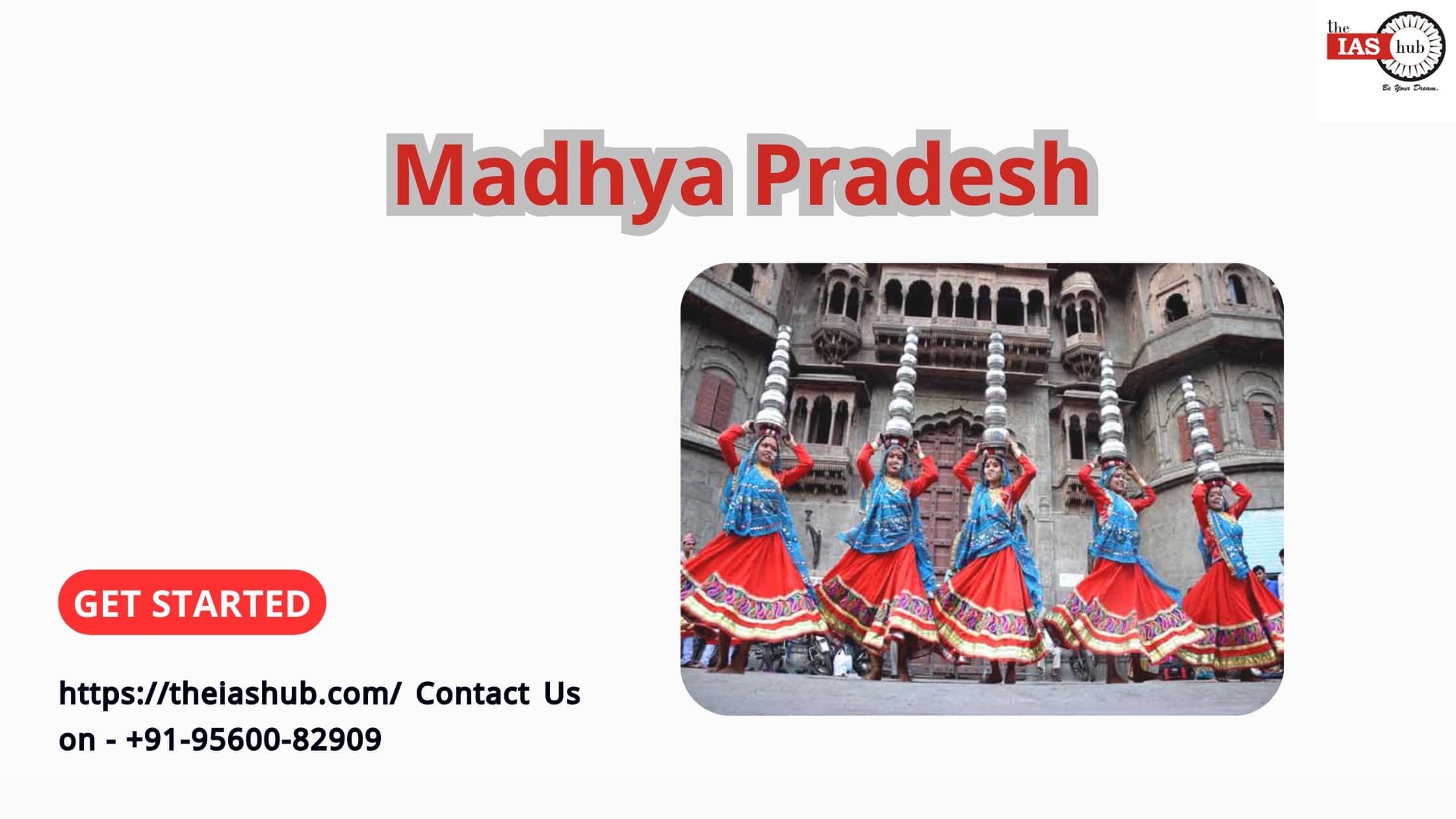
Know about Madhya Pradesh State—its historical evolution, political structure, cultural diversity, major rivers like the Narmada, national parks such as Kanha and Bandhavgarh, mineral wealth, and its role in shaping India’s central economic landscape.
 theIAShub | 08 Jul, 2025 | 6476 | 0 |


Courtesy: Maps of India
Madhya Pradesh is a centrally located state of India and plays an important role in the country’s cultural and natural heritage. It is known for its historical sites, forest cover, and mineral wealth. The state combines ancient traditions with contemporary governance. It spans over 308,350 square kilometers, hence it is the second-largest state in India by area. As per the 2011 Census, Madhya Pradesh has a population of over 72 million. Bhopal, the state capital, serves as the administrative hub, while cities like Indore, Gwalior, and Jabalpur contribute significantly to the state’s development.
Also Read: Indian States and Their Capitals

Madhya Pradesh has a deep-rooted history. It includes prehistoric cave art at Bhimbetka and ancient cities like Ujjain and Maheshwar. The region was ruled by prominent dynasties such as the Mauryas, Guptas, Paramaras, and the Mughals.
During the medieval era, it witnessed the influence of Afghan and Mughal rulers, followed by the rise of the Marathas. After India’s independence, Madhya Pradesh was created in 1956 under the States Reorganisation Act, combining several princely states and regions.
Also Read: Union Territories of India List

Madhya Pradesh is located in central India. It is bordered by Uttar Pradesh to the north, Chhattisgarh to the east, Maharashtra to the south, Gujarat to the west, and Rajasthan to the northwest. The state features a varied landscape which includes the Vindhya and Satpura ranges, fertile river valleys, and dense forests.
| Category | Details |
| Geographical Features | – Central Highlands (Malwa Plateau, Vindhya & Satpura Ranges) – Narmada-Son Rift Valley (major tectonic feature) – River systems: Narmada, Tapi (south-flowing), Chambal, Betwa, Son (north-flowing) – Longest river: Narmada (~1,077 km in MP; total length ~1,312 km) – Shortest major river: Tapi (~300 km in MP; total length ~724 km) – Highest peak: Dhupgarh (1,350 m in Satpura Range, Pachmarhi) – Lowest point: Narmada-Son Valley (~300 m elevation) – Rich in minerals (diamond – Panna, coal – Singrauli, limestone, manganese) and biodiversity (Kanha, Bandhavgarh, Satpura tiger reserves, deciduous forests) |
| Climate Type | Tropical Savanna (most of MP), Humid Subtropical (eastern MP), Semi-Arid (Bundelkhand & Malwa Plateau) |
| Seasons | – Summer (Mar–Jun): Hot (30–45°C; Bundelkhand & Gwalior hottest) – Monsoon (Jun–Sep): Southwest monsoon (moderate-heavy rainfall; eastern MP wettest) – Post-Monsoon (Oct–Nov): Retreating monsoon (occasional showers) – Winter (Dec–Feb): Cool (5–25°C; coldest in Pachmarhi & northern MP) |
| Climate Variation | – Malwa Plateau & Central MP: Moderate rainfall (800–1,200 mm) – Chambal Basin (Gwalior, Morena): Semi-arid (<800 mm) – Eastern MP (Jabalpur, Rewa): Humid (>1,200 mm) – Satpura & Maikal Ranges (Pachmarhi, Amarkantak): High rainfall (1,500+ mm) – Nimar Plains (Khandwa, Khargone): Dry & hot (low rainfall, ~700 mm) |
Also Read: Arunachal Pradesh
As per the 2011 Census, Madhya Pradesh had a population of 72.6 million. It is the fifth most populous state in India. The population density stands at 236 persons per square kilometer, lower than the national average. The sex ratio is 931 females per 1000 males, below the national average but improving in recent years.
Literacy Rate: The state recorded a literacy rate of 70.6%, with male literacy at 80.5% and female literacy at 60.0%.
Languages Spoken:
Also Read: Chattisgarh

Each state has its own symbols. Following are the state symbols of Madhya Pradesh:

| Symbol | Name |
| State Animal | Barasingha (Swamp Deer) |
| State Bird | Indian Paradise Flycatcher (Dudhraj) |
| State Tree | Banyan Tree (Vad) |
| State Flower | White Lily (Lilium candidum) |
These symbols reflect Madhya Pradesh’s ecological diversity (e.g., Kanha’s Barasingha, Satpura’s biodiversity) and cultural significance (e.g., Banyan tree as a sacred symbol).
Also Read: Assam

Madhya Pradesh follows a unicameral legislature which consists only of the Legislative Assembly (Madhya Pradesh Vidhan Sabha).
| Category | Details |
| State Formation | Formed on November 1, 1956, under the States Reorganisation Act, 1956. Originally part of Central Provinces and Berar during British rule. |
| Chief Minister | Mohammad Yadav (Since December 2023) – Party: Bharatiya Janata Party (BJP) – Focus: Agriculture, infrastructure, tribal welfare |
| Governor | Mangubhai C. Patel – In office since July 6, 2021 |
| Chief Justice (High Court) | Hon’ble Justice Ravi Malimath – Assumed office: October 2021 – High Court located in Jabalpur (Madhya Pradesh High Court) |
| Legislature Type | Unicameral (Madhya Pradesh Legislative Assembly) |
| Legislative Assembly Members | 230 elected members |
| Lok Sabha Representation | 29 Members |
| Rajya Sabha Representation | 11 Members (indirectly elected) |
| Districts | 55 (as of 2024) |
| Local Governance Units | Divided into districts, tehsils, and gram panchayats |
Key Notes:
Also Read: Bihar
Madhya Pradesh’s culture is a rich blend of tribal heritage, classical arts, and spiritual traditions. It is shaped by its history as the heartland of ancient kingdoms like the Mauryas, Guptas, and Bundelas. It is also Known as the “Sanskritik Sangeet” (Cultural Capital) of India, the state preserves a unique mix of folk and classical traditions.

| Category | Details |
| Classical Dance | Kathak (originated in MP under Mughal & Bundela patronage) |
| Folk Dances | Gaur Dance (tribal dance of cowherds), Matki Dance (women balancing pots), Karma Dance (Gond & Baiga tribes) |
| Theatre & Puppetry | Maach (satirical folk theatre), Nachya (Gond tribal dance-drama), Kathputli (string puppetry) |
| Folk Music | Pandwani (epic storytelling), Vasudev (devotional songs), Alha (ballads of bravery) |
| Classical Music | Gwalior Gharana (oldest Hindustani classical school), Tansen Music Festival (honoring Akbar’s court musician) |
| Major Festivals | Khajuraho Dance Festival, Lokrang Festival, Diwali (with unique Bagh cave rituals), Bhagoria Haat (tribal fair) |
| Arts & Crafts | Chanderi & Maheshwari sarees, Gond tribal paintings, Bamboo craft (Jhabua), Dhokra metal art (Bastar influence) |
| Architecture | Khajuraho Temples (UNESCO-listed erotic sculptures), Sanchi Stupa (oldest Buddhist monument), Orchha’s Rajput palaces, Bhimbetka rock shelters (prehistoric cave art, UNESCO) |
Key Notes:
Madhya Pradesh is often called the “Tiger State of India”. It boasts some of the country’s most biodiverse forests, ranging from dense teak woodlands to rocky ravines and grasslands. With 6 national parks and 25 wildlife sanctuaries, the state is a haven for endangered species like tigers, leopards, and rare birds.
| Name | Key Features | Best Known For |
| Kanha National Park | – Largest national park in MP – Inspiration for Rudyard Kipling’s The Jungle Book – Sal and bamboo forests |
Royal Bengal Tigers, Barasingha (Swamp Deer) |
| Bandhavgarh National Park | – Highest tiger density in India – Ancient Bandhavgarh Fort within the park – Mixed forests and grasslands |
White Tigers (historically), Leopards |
| Pench National Park | – Straddles MP and Maharashtra – River Pench flows through the park – Dry deciduous forests |
Tigers, Indian Gaurs (Bison) |
| Satpura National Park | – Part of Satpura Range – Rock shelters and deep ravines – Rich biodiversity |
Sloth Bears, Flying Squirrels |
| Panna National Park | – Famous for diamond mines nearby – Ken River flows through the park – Dry deciduous forests |
Tigers, Crocodiles, Vultures |
| Sanjay-Dubri National Park | – Merged with Guru Ghasidas NP (Chhattisgarh) – Remote and pristine forests |
Tigers, Wild Buffaloes |
Madhya Pradesh has a diversified and growing economy. It is driven by agriculture, industry, and services. While traditionally agrarian, the state has seen rapid industrialization in recent years, supported by strategic location, natural resources, and progressive policies.
| Category | Details |
| GSDP (2023-24) | ₹14.5 lakh crore (~$175 billion) |
| GSDP Growth Rate | ~8% (above national average) |
| Per Capita Income | ₹1.42 lakh (~$1,700) |
| Sectoral Contribution | Agriculture (25%), Industry (30%), Services (45%) |
| National GDP Share | ~4.5% (with 6% of India’s population) |
Key Sectors Driving MP’s Economy
Following are the key drivers of MP’s Economy:
| Sector | Highlights |
| Agriculture & Food Processing | – “Wheat Bowl of India” (top producer of soybeans, pulses, wheat) – Sugar industry (Malwa belt) – Food parks in Bhopal & Dewas |
| Automobiles & Engineering | – Pithampur Auto Cluster (Eicher, Force Motors, Bharat Forge) – Electric vehicle push (MG Motors in Ujjain) |
| Mining & Minerals | – Diamond (Panna), Coal (Singrauli), Limestone (Katni, Rewa) – Aluminium (BALCO, Korba) |
| Textiles & Apparel | – Handloom hubs (Chanderi, Maheshwar sarees) – Apparel park in Indore |
| Renewable Energy | – 750 MW Rewa Solar Park (Asia’s largest at launch) – Wind farms in Dewas & Mandsaur |
| Tourism & Hospitality | – Eco-tourism (Kanha, Bandhavgarh, Pachmarhi) – Religious circuits (Ujjain, Omkareshwar, Khajuraho) |
| Project | Investment | Significance |
| Delhi-Mumbai Industrial Corridor (DMIC) | ₹3 lakh crore | Pithampur-Dhar-Mhow Investment Region (auto, logistics) |
| Indore Metro | ₹7,500 crore | Phase-1 operational (2024) |
| Narmada Expressway | ₹50,000 crore | Connects Bhopal to Delhi via Agra |
| AIIMS Bhopal & Rewa | ₹3,000 crore | Boosting healthcare infrastructure |
| Bhopal IT Hub | ₹1,200 crore | Tata Consultancy Services (TCS) campus |
| City | Key Industries | Notable Companies |
| Indore | IT, Food Processing, Pharma | Cipla, Infosys, Haldiram’s |
| Bhopal | Defence, Tourism, IT | BHEL, Bharat Dynamics, TCS |
| Pithampur | Automobiles, Engineering | Eicher, Force Motors, Bridgestone |
| Jabalpur | Cement, Defence | ACC, Aditya Birla Group |
| Gwalior | Tourism, Textiles | Welspun, Dalmia Cement |
Key Notes on Madhya Pradesh’s Economy
Madhya Pradesh is a mineral-rich state, contributing significantly to India’s mining sector. It holds key reserves of diamonds, coal, limestone, and copper, making it a vital player in industrial and energy production.
| Mineral Resource | Major Mining Areas / Districts | Details / Notes |
| Diamond | Panna | – Only active diamond mines in India. – Famous for “Bunder Diamond Project” (Rio Tinto). |
| Coal | Singrauli, Umaria, Shahdol | – Singrauli Coalfield powers North India’s thermal plants. – MP contributes 8% of India’s coal. |
| Limestone | Katni, Rewa, Satna | – Key raw material for cement industry (Birla, ACC, UltraTech). – “Cement Capital of India” (Satna-Katni belt). |
| Copper | Malajkhand (Balaghat) | – Largest copper reserve in India (Hindustan Copper Ltd). |
| Bauxite | Amarkantak, Shahdol | – Used in aluminium production (BALCO). |
| Manganese | Balaghat, Chhindwara | – Essential for steel manufacturing. |
| Rock Phosphate | Jhabua | – Used in fertilizer production. |
| Sandstone | Bhind, Morena | – Used in monuments and construction. |
Are you preparing for UPSC 2026? Join IAShub’s UPSC coaching batches to boost your preparation. Enroll now!

Madhya Pradesh has the highest number of tiger reserves in India, including Kanha, Bandhavgarh, Pench, Panna, Satpura, and Sanjay-Dubri. It recorded 785 tigers in the 2022 census, earning its nickname as the "Tiger State." Kanha National Park also inspired Rudyard Kipling’s The Jungle Book.
The Narmada (longest river in MP) and Tapi flow southward, while the Chambal, Betwa, and Son flow northward. The Narmada is considered the lifeline of central India, supporting agriculture and hydropower through the Sardar Sarovar Dam.
Madhya Pradesh has a diversified economy driven by agriculture (top producer of soybeans and wheat), mining (diamonds in Panna, coal in Singrauli), and industries like automobiles (Pithampur Auto Cluster). The state is also a leader in renewable energy, with Asia’s largest solar park in Rewa.
The state celebrates Khajuraho Dance Festival (classical dance), Lokrang Festival (tribal culture), and Bhagoria Haat (tribal fair). Traditional arts include Gond paintings, Kathak dance (Gwalior gharana), and Maach folk theatre. Handloom specialties like Chanderi and Maheshwari sarees are globally renowned.




Refine your answer writing skills and elevate your UPSC preparation with personalized support and expert feedback.
Fill out the form to get started with the program or any other enquiries !
Are you dreaming of becoming an IAS officer? Then, IAShub can be your best guide. It is one of the Best IAS Coaching in Delhi. Many students who want to clear the UPSC exam join IAShub for learning. The institute gives both online and offline classes. Their teachers are experienced and helpful. They easily explain every topic. Students also get notes, tests, and tips to do well in the exam.
IAShub is in Delhi and is trusted by many UPSC students. It offers coaching for every part of the UPSC exam – Prelims, Mains, and Interview. The classes are simple and easy to understand. The teachers are experts and guide students in the right way. IAShub is also known for its helpful notes, test series, and answer-writing practice. IAShub is the best coaching in Delhi and also gives UPSC Online Classes. This helps students from any place in India to learn. The online classes are live and also recorded. So, students can watch them anytime. These classes cover the full UPSC syllabus.
Here are some important services provided by IAShub:
The UPSC Civil Services Exam has three parts:
This exam is tough, but with the right guidance, it becomes easy to manage. Students must study smart and stay regular.
IAShub supports students from the beginning to the end. It gives the right books, tests, and notes. The classes are easy to follow, and the teachers are always ready to help. Students get personal doubt sessions too. The test series and answer checking help students learn where they need to do better. Also, free study materials save time and money.
IAShub also guides students during the final stage – the interview. Experts take mock interviews and give useful tips. This full support makes IAShub one of the best IAS coaching in Delhi.