Read the inspiring biography of Ishwar Chandra Vidyasagar, a social reformer and educationist, a supporter of widow remarriage and women's education in India.
 theIAShub | 18 Jul, 2025 | 2045 | 0 |
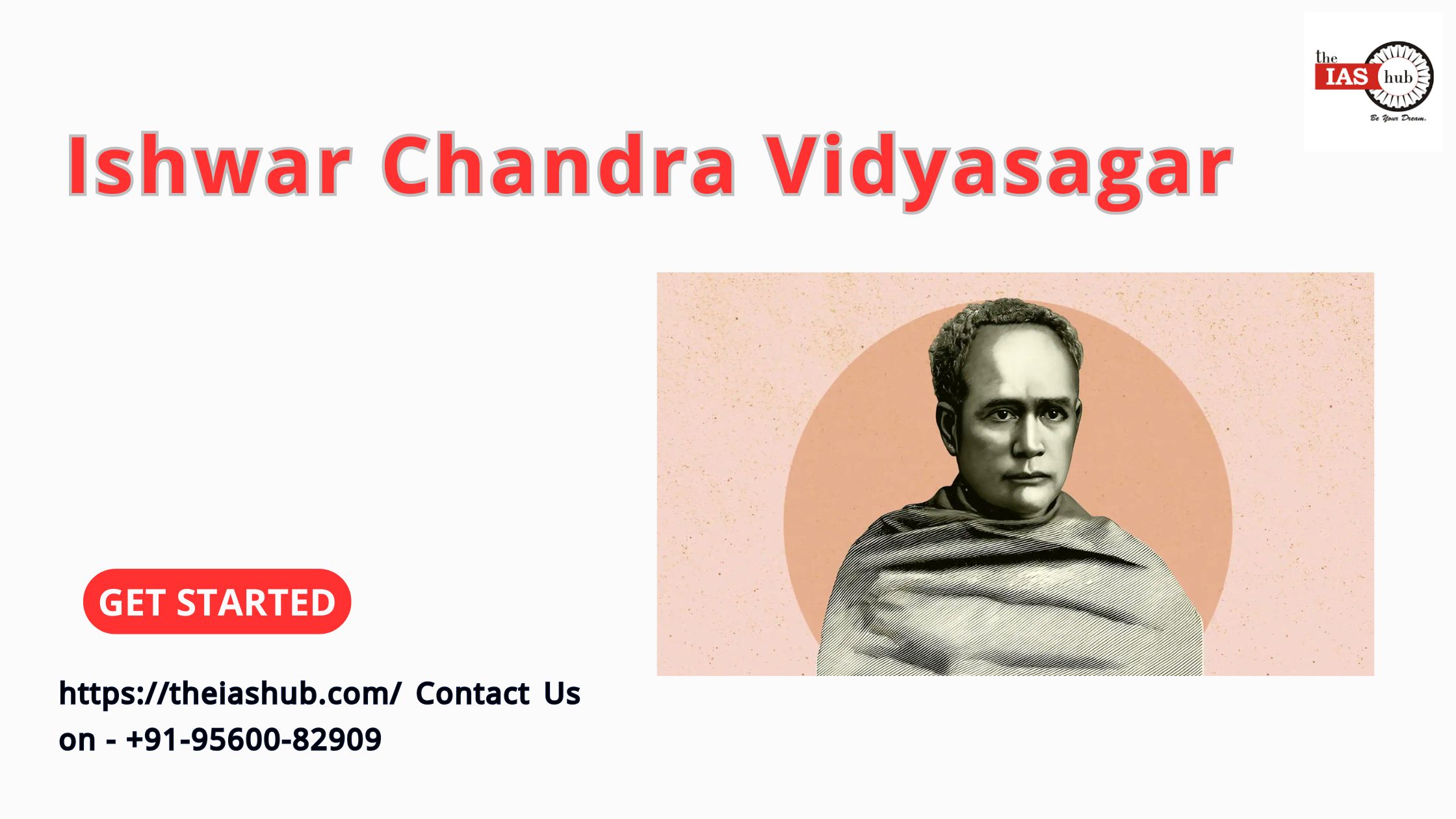


Ishwar Chandra Vidyasagar was not just a scholar—he was one of the pillars of India’s social and intellectual renaissance in the 19th century. He was a great teacher, social reformer, philanthropist, and writer who brought about revolutionary changes in the fields of education, society, and literature during the Bengal Renaissance. His contributions to women’s education, simplification of Bengali prose, and legalization of widow remarriage are unforgettable.
Also read: Mahatma Gandhi
Ishwar Chandra was born into a poor Brahmin family in Birsingh village in West Bengal’s Paschim Medinipur district in 1820. His father, Thakurdas Bandopadhyay, was a clerk who gave great importance to education despite poverty.
At the age of just 9, Ishwar Chandra moved to Kolkata (then Calcutta) and joined the Sanskrit College in 1829. There, he acquired deep proficiency in grammar, Vedanta, literature, and jurisprudence. Due to his exceptional talent, he was given the title of “Vidyasagar,” which means “ocean of knowledge.”
In an interesting incident, when Ramakrishna Paramahamsa called him the ocean of knowledge, Vidyasagar politely laughed it off by saying that the water of the ocean is salty. To this, Ramakrishna replied that “the water of the ocean of wisdom is sweet and nourishing.”
Vidyasagar started his career at Fort William College in 1841 and later became the principal of Sanskrit College. He made several revolutionary reforms in the education system:
Also Read: Bhakti movement
Vidyasagar broke social stereotypes and established more than 35 girls’ schools in Bengal between 1855 and 1858. He ensured the appointment of female teachers and wrote simple Bengali textbooks. His efforts also inspired other social reformers and missionaries.
In the social system of that time, widows were considered impure, especially child widows. Vidyasagar started a strong movement against this.
Also Read: Birsa Munda

Vidyasagar also opposed child marriage and polygamy. He:
Though laws on these issues were enacted later, the Age of Consent Act of 1891 and the foundation of other reforms were laid by Vidya Sagar.
Vidyasagar made Bengali prose simple, clear, and natural. Earlier works were heavily influenced by Sanskrit and were difficult. He made writing comprehensible to the common people.
|
Title of Work |
Type | Year |
Significance |
| Betal Panchabinsati | Translation (from Sanskrit) | 1847 | Made the classic Vetala Tales accessible to Bengali readers. |
| Barnaparichay (Parts I & II) | Educational Primer | 1855 | Introduced modern Bengali alphabet and phonetics to children. |
| Kathamala (Parts I, II, III) | Story Collection (Prose) | 1856–1860 | Moral stories for children and young readers to promote ethical education. |
| Sitar Bonobas | Adaptation (from Ramayana) | 1860 | Focused on Sita’s exile; promoted gender sensitivity through epic retelling. |
| Sanskrit Byakaran | Grammar | 1851 | Simplified Sanskrit grammar for Bengali students; used in Sanskrit College. |
| Hitopadesha | Translation (from Sanskrit) | c. 1850s | Fables with moral lessons; encouraged learning through storytelling. |
| Shakuntala (Abhijnanasakuntalam) | Translation (Kalidasa’s play) | 1854 | Introduced Kalidasa’s masterpiece in Bengali for the general public. |
| Meghaduta (Cloud Messenger) | Translation (Poetry) | 1855 | Brought Kalidasa’s lyrical poetry to Bengali readership. |
| Bodhoday (Awakening of Knowledge) | School Textbook | 1851 | Early rationalist text for young students in Bengali medium schools. |
| Upakramanika | Introductory Textbook | 1852 | Basic level Sanskrit primer used in academic institutions. |
| Iswar Chandra Bhashan Sangraha | Speech Collection | c. 1860s | A compilation of Vidyasagar’s speeches on social reform and education. |
| Vedantasara | Translation/Commentary | c. 1850s | Brought complex philosophical concepts into simplified Bengali. |
| Bhagavad Gita (Selections) | Interpretation/Translation | N/A | Helped make philosophical and moral teachings more accessible to lay readers. |
Despite Vidya Sagar’s popularity, his life was simple and restrained:
His honesty and moral courage made him respected throughout India.
Also read: Jyotibha Phule
In the late 1870s he became disillusioned with the growing conservatism in Bengal and withdrew from public life to Karmatar (now in Jharkhand). There he ran schools and served tribal communities.
He died on 29 July 1891, at the age of 70. Thousands of people attended his funeral—a testament to his popularity.
Even today, Ishwar Chandra Vidyasagar’s ideas are extremely relevant in the context of women’s rights, social justice, and education reform. He is considered the foundation of the progressive thinking of modern India.
Also Read: Rabindranath Tagore
Vidyasagar was not just an educationist; he was a beacon who emerged as a light in a dark society. His fearlessness, compassion, and intellect are a source of inspiration even today. He teaches us that, along with knowledge, courage, and human sensitivity are also necessary for change.

Major contributions are
A landmark law promoted by Vidya Sagar gave legal permission to widows to remarry.
He received this honor due to his deep scholarship and multidisciplinary knowledge.
She established over 35 girls' schools, employed female teachers, and prepared simple textbooks.
Even today, he lives on in institutions, movements, and ideologies. He is a symbol of rationalism, education, and equality in India.

Refine your answer writing skills and elevate your UPSC preparation with personalized support and expert feedback.
Fill out the form to get started with the program or any other enquiries !
Are you dreaming of becoming an IAS officer? Then, IAShub can be your best guide. It is one of the Best IAS Coaching in Delhi. Many students who want to clear the UPSC exam join IAShub for learning. The institute gives both online and offline classes. Their teachers are experienced and helpful. They easily explain every topic. Students also get notes, tests, and tips to do well in the exam.
IAShub is in Delhi and is trusted by many UPSC students. It offers coaching for every part of the UPSC exam – Prelims, Mains, and Interview. The classes are simple and easy to understand. The teachers are experts and guide students in the right way. IAShub is also known for its helpful notes, test series, and answer-writing practice. IAShub is the best coaching in Delhi and also gives UPSC Online Classes. This helps students from any place in India to learn. The online classes are live and also recorded. So, students can watch them anytime. These classes cover the full UPSC syllabus.
Here are some important services provided by IAShub:
The UPSC Civil Services Exam has three parts:
This exam is tough, but with the right guidance, it becomes easy to manage. Students must study smart and stay regular.
IAShub supports students from the beginning to the end. It gives the right books, tests, and notes. The classes are easy to follow, and the teachers are always ready to help. Students get personal doubt sessions too. The test series and answer checking help students learn where they need to do better. Also, free study materials save time and money.
IAShub also guides students during the final stage – the interview. Experts take mock interviews and give useful tips. This full support makes IAShub one of the best IAS coaching in Delhi.